



Abstract
The aim of this study was to identify which employees’ sociodemographic characteristics and personality traits affected their career development. The research was conducted on a sample of 462 employees, aged between 30 and 55. The final analysis of covariance model included only characteristics which had previously been identified as having significant effect and relations with career development: gender, age, education level, years of work experience with the current employer, total years of work experience, financial status, and all Big Five traits. It was determined that the following characteristics had a significant effect on career development: gender, years of work experience with the current employer, and financial status, from the set of sociodemographic characteristics, as well as Conscientiousness, from the personality traits. Sociodemographic characteristics and personality traits, especially Conscientiousness, represent significant determinants in career development.
Introduction
In the contemporary, dynamic work environment, changes are much quicker and more profound than in any other historical period. Career development is one of the most important aspects of the development of each individual and organization. Career represents the development of an individual in the domains of education of work over their entire life (Walton & Mallon, 2004). Arthur, Inkson, and Pringle (1999) point out that employees in the financial sector are prepared for rapid transformations and they are taking the control over their own career management. Individual interpretation of career has been attracting more attention in the sense that it emphasizes a subjective experience of an individual based on objective career conditions (Bird, 1994). Thus, there are two theoretical approaches—a subjective approach at a microlevel directed toward the internal perspective of an employee and an external approach which is more institutional, that is, the macro approach (Gunz, 1989).
A successful career development represents an interaction of individuals, behavior, organizational norms, and work practices (Collin & Watts, 1996). Career should be observed as the relationship between personality traits and employee behavior, on one hand, and organizational and social processes, on the other hand.
Career Development
The traditional definition of career narrows its meaning because, according to this definition, career is interpreted through professional lifetime achievement which includes progress. Arthur, Khapova, and Wilderom (2005) emphasize that it is the experience that employees gain over time which is the most important for career development. Hamel and Prahalad (1996) suggest that theoreticians and practitioners should focus on how people understand the meaning of work in their lives: That is why they suggested using the terms work, job, and career in discussions about work and career. Blustein and Noumair (1996) hold the opinion that career is influenced by gender, social class, family background, cultural characteristics, as well as their mutual influence on career development. Driver (1982) puts forward a concept of career which is related to the integration of career and other aspects of an individual’s life.
In contrast, Mallon (1998, p. 250) believes that career development covers one’s entire life and not just occupation. The focus is on the context of life and adjustment to life chances. Some of the factors that must be understood and applied in the analysis of career development include environment and pressures, limitations, parental responsibility toward children, and taking care of parents. Under these conditions, career development and personal development converge (Adamson, Doherty, & Viney, 1998). Seibert, Kraimer, and Liden (2001) believe that we are in the era of individual career management, where individuals have a more important role in building their individual careers. Younger employees are encouraged to act as free agents in developing their personal abilities and skills. Especially so in developing their self-marketing skill, that is, self-representation skills (Baruch, 2004). People are more focused on employment than on job certainty and they learn skills that help them take over responsibilities in relation to their career paths and development (Currie, Tempest, & Starkey, 2006).
Having this in mind, Arthur and Rousseau (1996b) suggest that researchers should shift their focus of attention to new movements and new reality in the labor market, since the focus of the career development definition has changed from objective conditions affecting the career development to a subjective experience of individuals which influences career development to a much greater extent. Walton and Mallon (2004) analyze the development of individuals from the viewpoint of lifelong learning which includes volunteer work and all other experiences which may affect that development.
In the past decade, new trends in career research emerged and they point out to careers without limitations. However, research on careers is more related to changes and shifts than on stability in career (Ng, Eby, Sorensen, & Feldman, 2005). The emphasis is put on employees in terms of creating portfolios with their personal achievements and abilities, developing their social network, and taking over the responsibility of career management with the support of organization—all of which helps them create conditions for development of necessary skills and acquiring adequate knowledge (Arnold, 2001).
A career without limitations represents a concept of development according to which employees are flexible in taking new roles in their organizations or shifting from one organization to another which belongs to the same industry (Arthur & Rousseau, 1996a; Sullivan, 1999). An individual’s career has become a complex, dynamic, and open concept in which people manage their own development by maintaining and promoting their own market values (Savickas, 2002).
As far as measurements in career development are concerned, they are accomplished through subjective and objective indicators. Subjective indicators of career development are attitudes, personality traits, and the perception of personal achievements. Nowadays, employees are changing their attitudes toward their careers, so they prefer changing employers and companies rather than staying in one organization for a lifetime (Hirschi, 2012). Objective indicators of career development are seen in the employee’s position, salary, and other benefits (Seibert et al., 2001) as well as success in one’s career which is measured according to the organizational standards, such as promotions and salary rise (Hall, 1996).
Hall (2004) makes a distinction between the traditional and the protean model of career development. Namely, a traditional career is more oriented toward organization, low mobility, and employees’ salaries, while the protean model of career is oriented toward employees, their professional development, freedom, and personal satisfaction.
Previous studies pinpointed the relevance of demographic variables in this type of research. Namely, previous studies have shown that there are gender differences in career development. Gender segregation remains a significant problem despite women’s increased activity rates. What also persists is female-dominated part-time work, associated with poor opportunities for training and promotion (Valenduc, Vendramin, Krings, & Nierling, 2007). Therefore, some comparative studies examine the issue of gender and career development and explore the continuing barriers to achieving equality of opportunity in this area. For example, Eby, Butts, and Lockwood (2003) found that women have lower career expectations than men.
Eby et al. (2003) show that age is the predictor of career success.
In some organizations, the total work experience with the organization has sufficient weight in promotion for at least rough limits to be set up: A minimal required amount of experience is defined for advancement to higher positions, but promotion is also unlikely after a specified number of years is spent at a single position. In this study, the minimum variation for a managerial category—the general foremen—showed a range of 31 years. The relation appeared to exist between one’s status in the hierarchy and one’s years of experience with the current employer. In terms of median values, a member of the current personnel would become a foreman after 11 years of employment, a general foreman after 17, and a superintendent after 20 years (Dalton, 1951).
Dalton (1951) shows the stages in one’s career development which follow the developmental life stages. On the other hand, Dalton, Thompson, and Price (1977) identify four stages of career development and describe their characteristics.
Similarly, Levinson (1986) identifies nine developmental periods between ages 17 to 22 and ages 60 to 65. The author deals with the key questions of career development, such as what the alternative ways of defining a structural stage or period are, how the best use can be made of the distinction between hierarchical levels and seasons of development, and if there are age-linked developmental periods in adulthood? The study revealed distinct patterns of how careers develop over time, particularly with regard to the impact of career contexts (societal, organizational, and relational) and of one’s career success.
Having this in mind, a three-phase, age-linked model of women’s career development has been proposed (Deborah, O'Neil, Diana, 2005): the idealistic achievement phase (aged 24 to 35), the pragmatic endurance phase (aged 36 to 45), and the reinventive contribution phase (aged 46 to 50). Similarly, Maurer, Weiss, and Barbeite (2003) created a model of involvement in work-related learning and development activities, which identifies several variables: the effects of individual, as well as situational, motivational, and age variables.
Karp and Yoels (1981) investigated and related the literature on work and profession to that on aging as a life-long process. The authors maintain that meanings attached to chronological age arise, in large measure, out of the work experience. An individual’s career frames expectations about what he or she should be doing at different ages and thus serves as a yardstick against which to measure life process. Five stages of the work career are identified: (a) preparation and exploration, (b) learning the ropes, (c) coming to grips, (d) settling in, and (e) exiting.
Prediction of Career Development Based on Big Five Personality Model
The starting point of numerous studies has been the extent to which the Big Five dimensions could be observed as a predictor of behavior, that is, to what extent the Big Five traits are valid in determination of certain complex behavior and predicting different variable criteria (Di Fabio & Kenny, 2012; Gosling, Rentfrow, & Swann, 2003; Paunonen, 2003).
Previous research on factors that influence career development was mostly based on personal characteristics and the general human capital in career development (Boudreau, Boswell, & Judge, 2001; Judge, Higgins, Thoresen, & Barrick, 1999; Seibert & Kraimer, 2001), but over the past years, factors such as job performance and job satisfaction have also been analyzed as factors of career development (Barrick & Mount, 1991). Success in career development was also considered to be the result of efforts and work which contributed to formal progress (Judge et al., 1999) but bound to subjective indicators as well (Judge et al., 1999; Eby et al., 2003; Seibert et al., 2001).
Another longitudinal study that involved 731 participants analyzed the influences and relationships between external and internal indicators of achievements in one’s career and the Big Five model of personality. The study showed that emotionally stable and conscientious respondents reported higher salaries and satisfaction with work in comparison with the respondents with lower scores on these traits (Sutin, Costa, Miech, & Eaton, 2009).
In studies which tested success at work (John, Donahue, & Kentle, 1991), the only dimension that proved to be the general predictor was Conscientiousness. Other Big Five dimensions were related only to certain aspects of success at work and career development. For instance, Agreeableness and Neuroticism predicted success at work which implied working in groups. On the other hand, the dimension of Extraversion was related to the success of managers and salespersons. A good and well-organized life, led by people who have high scores on Conscientiousness, is related to a positive health condition and a long life, which is the opposite to antagonistic hostility (low Agreeableness) and negative emotions (high Neuroticism) which appear to be risk factors. In the light of these findings, it is important to emphasize that, although personality traits represent stable dispositions, an individual can change their patterns of thinking, behavior, and feelings. The aforementioned relationship between the Big Five dimensions and certain business outcomes points out to those behavioral domains within which one can act with the aim of making a change and personal development (Barrick & Mount, 1991).
The Present Study
The main aim of this study was to determine which sociodemographic characteristics and Big Five personality traits of employees had effects on their career development. The present study is based on and builds upon the findings of several previous studies (Allen & Katz, 1992; Barrick & Mount, 1991; Dalton, 1951; Di Fabio & Kenny, 2012; Eby et al., 2003; Felsher, Allen, & Katz, 1985; Gosling et al., 2003; John et al., 1991; Karp & Yoels, 1981; Levinson, 1986; Paunonen, 2003; Valenduc et al., 2007). The previous studies give solid grounds to assume that Conscientiousness is the predictor which is most closely correlated with career development, followed by Neuroticism and Agreeableness (Barrick & Mount, 1991; Eby et al., 2003; Judge et al., 1999; Seibert et al., 2001).
Similarly, on the basis of previous studies, it can be assumed that sociodemographic characteristics—gender, work experience, and financial situation—represent the ones which are most closely correlated with career development (Allen & Katz, 1992; Dalton, 1951; Felsher et al., 1985; Karp & Yoels, 1981; Valenduc et al., 2007). Guidelines for the optimal adjustment of employees' personality traits and their sociodemographic characteristics are significant pieces of information for career development.
The aim of the research was to provide necessary guidelines for optimal adjustment of employees’ personality traits and their sociodemographic characteristics to their career development. The focus is on employees and their development, which implies creation of portfolios of their own achievements and abilities, as well as self-assessment which directs career development.
Method
Participants
The research was carried out on a sample of 462 employees (218, or 47.1%, males), aged 30 to 55. Many authors have attempted to identify the ideal stages for career development according to age limits for each individual stage. According to Levinson (1986), there are four stages in career development: the occupational choice stage (18 to 25 years of age), the early career stage (25 to 40 years of age), the midcareer stage (40 to 55 years of age), and the late career stage (from 55 years of age to retirement). Schein (1978), on the other hand, puts forward nine stages of career development.Super (1980) as well as Hall and Nougaim (1968) proposed a system consisting of five stages. The stage-based approach provides a valuable framework for understanding the experiences over the course of one’s career, but only if it is used as a means of understanding one’s career development and not as a normative model. For the purpose of identifying clearer differences in career development stages among working adults, the authors of this research propose six stages. Of the total number of employees, 15.1% belonged to the 30 to 35 age-group, 16.2% belonged to the 36 to 40 age-group, 18.6% belonged to the 41 to 45 age-group, and they were predominant in the age distribution, 15.6% belonged to the 46 to 50 age-group, followed by the 51 to 55 age-group (16.8%). Most participants were highly educated: A total of 43.4% of the employees had secondary school qualifications and 41.9% held a university degree. With respect to the position in their organizations, 17.3% employees held managerial positions. Regarding the work experience with the current employer, employees with 26 or more years of experience with the same employer, the following results were obtained: 18.8% reported 1 to 5 years of experience with the current employer, 20.3% reported having 6 to 10 years of experience, and 21% reported having 16 to 26 years of experience. When asked to assess their financial situation, majority (59.8%) were very satisfied with their financial situation, 23.5% were satisfied, and only few (0.9%) believed they were very well situated.
The sample was suitable for the research. It consisted of employees of state-owned and private companies, operating in the Republic of Serbia, from both the service sector and the production sector (a total of 12 companies). Upon receiving a written instruction to do so by the respective HR department of each company—whereby the anonymity of collected data was emphasized—the employees filled in the questionnaires during their work hours. All respondents were cooperative and enthusiastic about taking part in the research.
Instruments
Modified Career Development Questionnaire (Robbins, 1993)
This questionnaire contains 41 items which measure conditions for career development (e.g., “The employer provides support for career development of the employees and encourages it,” “The corporate culture is open and compatible with the occupational values of the employees,” “The employer encourages the employees to use their full potential,” “The needs for professional development and education are continuously being monitored and determined,” etc.). The responses are given based on a 5-point Likert scale (from 1 = completely disagree to 5 = completely agree). Higher scores refer to better and more favorable conditions for career development. Big Five Inventory (BFI: John et al., 1991). BFI contains 44 items which measure one of the five personality traits: Neuroticism (8 items), Extraversion (8 items), Agreeableness (9 items), Conscientiousness (9 items), and Openness to experience (10 items). The responses are given based on a 5-point Likert scale (from 1 = completely disagree to 5 = completely agree).
Data Analysis
Initially, t-tests and the ANOVA analyses were conducted to identify differences in career development regardless of sociodemographic characteristics. After that, Pearson correlation coefficients were calculated to identify which personality traits are related to career development. Based on these results, the final model was tested using analysis of covariance (ANCOVA), which could be used as a multivariate linear regression analysis which combines categorical and continuous predictors. In fact, ANCOVA and linear regression are mathematically the same (Sweet & Grace-Martin, 2011). In this analysis, only characteristics and traits with a previously identified significant effect on career development were included in the model. In ANCOVA, the criteria were scores on employees’ career development, categorical predictors were sociodemographic characteristics of employees (gender, age groups, level of education, the group based on the total work experience and the work experience with the current employer, and financial status), while the continuous predictors were scores on the BFI.
Results
Sociodemographic Characteristics and Career Development
There are gender differences relating to career development, t(460) = 3.24, p < .001, with men achieving higher scores than women.
Regarding the age, there is a significant difference in career development, F(2, 456) = 5.71, p < .001. Bonferroni post hoc tests showed that the age-groups of up to 35-year-old employees had the best conditions for career development. Employees older than 46 years had adverse opportunities for career development.
Significant differences in career development were found regardless of years of experience, F(3, 459) = 8.94, p < .001, and the total of years of work experience with the current employer, F(5, 457) = 9.57, p < .001. Both analyses revealed that employees with fewer years of work experience had higher scores on career development.
Significant differences were also found considering the level of education, F(2, 457) = 4.20, p < .05. Results showed that employees with a higher education level (university degree) have higher scores on career development in comparison with employees with a lower education level (elementary or secondary school), but there are no differences between employees with a higher degree and the rest of the participants.
Moreover, there are significant differences in career development between employees with different financial situations, F(2, 459) = 17.72, p < .001. The results show that employees who perceive their financial situation as either very good or good had higher scores on career development when compared with those who perceive their financial situation as bad.
No significant differences in career development were found regarding the managerial position, t(455) = 1.47, p > .05, so this characteristic will not be included in further analyses.
Correlations Between Big Five Traits and Career Development
Correlations Between Career Development and Big Five Traits.

Note. N = Neuroticism; E = Extraversion; O = Openness to experience; A = Agreeableness; C = Conscientiousness.
p < .001.
Effects of Sociodemographic Characteristics and Big Five Traits on Career Development
Effects of Sociodemographic Characteristics and Personality Traits on Career Development.
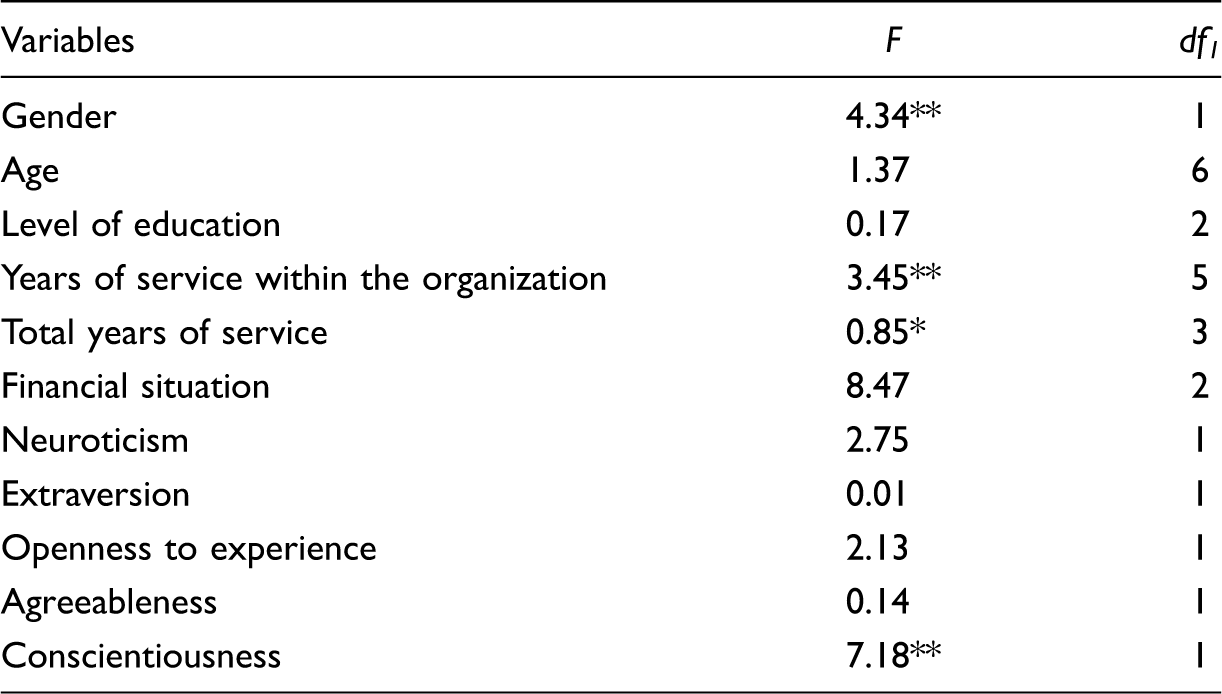
Note. ***p<0.001, **p<0.01, *p<0.5.
As already mentioned, men have higher scores on career development compared with women (B = 0.19, SE = 0.09, p < .05). Furthermore, partial contributions showed that, regardless of groups based on the number of years of work experience in the current organization, the group of up to 1 year of work experience (B = 0.67, SE = 0.24, p < .01) and the group of 1 to 5 years of work experience (B = 0.46, SE = 0.19, p < .05) had significant effects on career development. Those employees who worked for the current employer for up to 5 years reported better conditions for career development than those who worked for the current employer for more than 5 years. There is no significant difference in career development between employees who work for the current employer up to 1 year and employees who work for the current employer from 1 to 5 years. Regarding the financial status, employees who perceived their status as very good (B = 0.49, SE = 0.15, p < .001) or good (B = 0.42, SE = 0.11, p < .001) reported higher scores on career development compared with those who perceived their financial status as bad. Among the personality traits, only Conscientiousness had significant positive effects (B = 0.15, SE = 0.06, p < .01), which implies that this personality trait is the most important one for career development.
Discussion
The aim of this study was to analyze and identify which sociodemographic characteristics of employees and which of their personality traits influence their career development. With regard to the sociodemographic characteristics, the results showed that it is gender, years of work experience with the current employer, and financial status which had a significant effect on career development. Sociodemographic characteristics of employees help to identify phases in career development. The results showed that men report better conditions for career development than women. It could be assumed that this difference is due to inequality between genders in establishing a career, and due to more support and tolerance being reserved for men. Career development of women is considered as a curve of development which has a different, but legitimate, form, because women most often turn to family and children under the influence of motherhood.
Furthermore, employees with up to 5 years of work experience with the current employer have the most favorable conditions for career development. During the first 5 years of work for an employer, more learning happens and more competences get acquired as the awareness of possibilities at work increase. A period of 5 years of employment with the same employer can be understood as a period necessary to adapt to a new environment and take on new roles: It is a period of exploring new possibilities and, as such, it seems to provide better conditions for career development. The results imply that the turning point is after the sixth year of employment with the same employer. In this period, employees establish their positions in the organization they work for and the turning point refers to the employees who either make an advancement in their careers or keep their current positions, which corresponds to the transition between two phases: the phase of advancement and the phase of career preservation.
The aspect of financial situation implies considerable differences regarding favorable conditions for career development. Those who evaluate their financial situation as good or very good achieve better scores for a favorable career development. Individuals without financial problems can recognize opportunities and accomplish more—their need for security is fulfilled and they seek new challenges while developing their careers because they have a better approach to meet the set goals and they are ready to stand for themselves.
Among personality traits, results showed that Conscientiousness has been regarded as the key trait in the process of career development. Conscientiousness is related to planning and organizing—individuals who have this trait are reliable, successful, and capable of achieving their goals (Seibert et al., 2001).
It is certainly very challenging for an organization to attract, retain, and motivate high-quality professionals and provide them with conditions for their personal development through strong cooperation, information exchange, and support for their preferences and aspirations. This result points out to the significance of career development of employees who are highly motivated to achieve their goals and who represent invaluable human resources and capital for organizations. Results of this research support the results from previous research studies and further show the complexity of the career development phenomenon due to personal factors (Judge et al., 1999). Additionally, attempts have been made to identify individual factors which contribute to career development (Judge et al., 1999; O’Connor & Paunonen, 2007; Paunonen & Ashton, 2001; Seibert et al., 2001; Wayne, Linden, Kraimer, & Graf, 1999). These attempts were mostly related to the creation of a multivariate approach with the aim of creating a base for identification of career development predictors (Kirchmeyer, 1998; Seibert et al., 2001).
Conclusion
Results showed that gender, years of work experience with the current employer, and financial status had significant effects on career development from the set of sociodemographic characteristics, as well as Conscientiousness from the set of personality traits. This implies that this personality trait is the most important one for career development. Conscientiousness is considered important due to responsibility, thoroughness, and precision.
Apart from the aforementioned factors, other studies have shown that gender, total work experience, and financial status play a significant role in career development (Allen & Katz, 1992; Creed, Patton, & Prideaux, 2006; Dalton, 1951; Felsher et al., 1985; Kanfer, Wanberg, & Kantrowitz, 2001; Karp & Yoels, 1981; Valenduc et al., 2007).
For a better understanding of the results, the social framework of employees should be analyzed in the Serbian labor market because of an increased number of problems, such as job uncertainty, bad financial situation caused by a long-lasting transition period, and the global financial crisis. Furthermore, the educational system has insufficiently addressed the need for career development which mostly depends on one’s personal status, while the political instability contributes largely to the feeling of facing a glass ceiling at all levels of employees. The results of this study show that employees’ sociodemographic characteristics and personality traits represent significant determinants in career development. By getting to know their employees, many companies can improve their operation, which represents a practical implication of this study. Future studies should be conducted to compare the effects of aforementioned characteristics and traits in different types of industries.
Footnotes
Declaration of Conflicting Interests
The authors declared no potential conflicts of interest with respect to the research, authorship, and/or publication of this article.
Funding
The authors received no financial support for the research, authorship, and/or publication of this article.