




Abstract
The objective of the study is to test a refined measure of attitudes about aging as a multidimensional construct reflective of a relational process that includes personal identity (i.e., beliefs about oneself), social identity (i.e., self-conception based on group membership), and collective identity (i.e., self-conception based on comparison of groups) as well as capturing awareness of ageism and its impact. Researchers refined the Aging Anxiety Scale and recruited a convenience sample of 329 participants via a social media platform. A principal component factor analysis revealed the specification of three latent factors: personal, relational, and collective aging anxiety. Awareness of ageism as a problem in society was lower than awareness of other forms of discrimination, and awareness of the negative impacts of ageism was low. The findings support the incorporation of this new measure of relational aging anxiety as a by-product of social identity and construction in future ageism studies.
Introduction
At its core, identity is a psychosocial phenomenon that evolves through intrapersonal and interpersonal experiences and expression and reflection of self. The identity of an older person is often constrained by unwitting unacceptance of predominant cultural beliefs that aging is solely or mainly about loss and decline. Uprooting these limiting beliefs is essential to the development of a healthy aging identity and a continued sense of personhood throughout life. Both of these outcomes are more difficult to achieve in a society where ageism is normalized and ingrained in the culture so deeply that it is seen as socially acceptable at both an intrapersonal and interpersonal level. Social interactionism reminds us that personhood is the result of social interactions rather than emanations from the individual alone (Castillo, 2011). Therefore, our aging identity represents a complex construct that encompasses how we feel about ourselves as aging individuals (i.e., personal identity) as well as how we feel we are perceived by others (i.e., social identity).
Literature Review
Ageism
The construct of ageism has undergone continuous exploration and development as it was first defined as prejudice by one age group toward other age groups (Butler, 1969). Butler (1975) was the first to expand his own definition of ageism by describing it as “a process of systematic stereotyping and discrimination against people because they are old” (p. 12). While Butler likened ageism to other “isms” that represent discrimination based on visible characteristics, it is also distinguished by the truism that it is a form of discrimination all individuals potentially face, as aging is an inevitable occurrence whereas race and gender identity are, for the most part, immutable. While ageism also manifests in positive stereotypes and preferential treatment, including access to benefits and privileges not granted to other age groups (Palmore, 1999), negative stereotypes of aging are both more predominant and prevalent than positive ones (Kotter-Grühn & Hess, 2012). The labeling of age groups with specific traits that are deemed either desirable or disadvantageous creates in-groups and out-groups (Tajfel & Turner, 1979), and the positive value that American society places on the youthful in-group creates a chasm between the old and the young. Negative perceptions or behaviors toward older individuals by younger individuals not only damage the self-esteem of elders but also create a hostile environment for their own future social interactions and their own future self-development as elders. The resulting compounded effects of ageism over a lifetime can have a significant impact on aging identity.
Eagly and Chaikin (1993) further developed the concept of ageism as a tripartite phenomenon comprised of age stereotypes, attitudes toward aging, and ageist behaviors based on psychosocial attitude theory (Rosenberg & Hovland, 1960). This segmentation into cognitive, affective, and behavioral manifestations of ageism has resulted in a growing literature on ageism (for a review, see Iversen, Larsen, & Solem, 2009) that has supported a theoretically guided empirical exploration of the various impacts of ageism. This, in turn, has led to a substantial and growing body of research that indicates measurable, negative impacts of ageism, including increased risk of chronic disease (Allen, 2016), increased dependency among frail older adults in long-term care (Coudin & Alexopolous, 2010), perceived ill health (Ramirez & Palacios-Espinosa, 2016), reduced recovery from serious illness (Levy, Slade, May, & Carraciolo, 2006), and a link between the presence of Alzheimer’s disease biomarkers and internalized ageism (Levy et al., 2016).
Measurements of ageism began as unidimensional constructs focused on misconceptions and stereotypes about older people, general attitudes about older people, and level of knowledge regarding the aging process (Rupp, Vodanovich, & Credé, 2005). Researchers have continued to develop a more multidimensional understanding of ageism by drawing attention to its manifestation as implicit (i.e., unconscious behavior), explicit (i.e., conscious behavior), and as a phenomenon that exists at micro-, meso-, and macrolevels within culture. Accordingly, measurement of ageism has become more sophisticated and nuanced. Recent examples from the literature are inclusive of constructs such as age discrimination, negative age stereotypes, negative perceptions of aging (Levy, Slade, Chang, Kannoth & Wang, 2018), as well as benevolent and hostile ageism (Cary, Chasteen, & Remedios, 2017). Iversen, Larsen, and Solem (2009, p. 15) incorporate these multiple dimensions in their nearly comprehensive definition of ageism as “negative or positive stereotypes, prejudice and/or discrimination against (or to the advantage of) elderly people on the basis of their chronological age or on the basis of a perception of them as being ‘old’ or ‘elderly.’” While this broad definition of ageism captures internal and external manifestations of aging, it does not account for how ageism also presents in a relational context.
Relational Ageism
Relational ageism is a theory that describes the dynamic process by which attitudes about aging are expressed and perpetuated at the level of personal identity (i.e., beliefs about oneself) and within the context of social identity (i.e., identity based on group membership; Gendron, Inker & Welleford, 2017). The concept of relational ageism addresses the importance of interlinking life course sociology and life span psychology by examining society’s influence upon the development of identity and character (Gilleard & Higgs, 2016). Although several measures of internal, personal aging anxiety and attitudes about aging can be found in the literature, including the Attitudes to Aging Questionnaire (Laidlaw, Power, & Schmidt, 2007) and the Awareness of Age Related Change Questionnaire (Diehl & Wahl, 2010), to date no measure exists that examines ageism as a relational construct encompassing both beliefs about self-identity and identity based on group membership. However, as the Aging Anxiety Scale (AAS; Lasher & Faulkender, 1993) provides a psychometrically tested measure encompassing personal and collective identity, this study adapts and builds upon the structure of the AAS to include a measure of relational ageism and identity.
The theory of relational ageism provides a conceptual framework for understanding the internalization, expression, and social reinforcement of ageism through the lens of interpersonal dynamics. Building on the tenets of theories such as social identity theory (Tajfel & Turner, 1979), relational schemas (Baldwin, 1992), and collective identity (Brewer & Gardner, 1996), relational ageism theory posits that we continually form and reform our personal identity as an aging person through both interpersonal and intergroup contact and experiences (Gendron, Inker, & Welleford, 2017). Interpersonal experiences create relational schemas, which serve as a cognitive map that guides how we build an identity within a social framework (Baldwin, 1992). Relational schemas also represent how internalizing relationships with others influences our experiences in subsequent relationships (Baldwin, 1992). According to social identity theory, identity is developed within a social context; therefore, the cognitive basis of identity is reflected in self-categorization and social categorization. In other words, we form and reform our identities by comparing ourselves at different points in time to models of the in-group and of the out-group. Therefore, interactions and relationships with others exert a powerful influence on how we see ourselves and develop an identity. In their extended model of self, Brewer and Gardner (1996) recognized that the development of identity consists of three distinct and central self-representations, or identity orientations: personal identity, relational identity, and collective identity. A personal identity orientation refers to an individuals’ self-concept that includes differentiating individual traits and characteristics of self, compared with others. Relational identity orientation describes how representations of relationships with others are integrated into a mental representation of self. In other words, feelings about self, both positive and negative, derive from relationships with other individuals. A collective identity orientation revolves around self-conception in terms of assimilation to other social groups. A related way of looking at self-construal is through the lens of independent versus interdependent selves in which culture is said to shape an orientation either toward the individual (independent self) or the group identity (interdependent self). It is important to note that even in cultures which tend focus on the formulation of an independent self (such as Western societies), individuals are both constrained by and responsive to their interpersonal environments (Markus & Kitayama, 1991).
Given that the notion of self is dynamic and is shaped by society and culture (Cruikshank, 2013), it is important to examine how identity as an aging or older person emerges and develops throughout the life span. This is particularly salient given that our perceptions of old age are culturally constructed and interpreted and involve the interplay between personal narratives of the aging self and cultural narratives about aging (de Medeiros, 2005). There is evidence that globally current cultural narratives about aging present an overwhelmingly negative bias toward aging as a process of loss and decline (Abrams, Russel, Vauclair, & Swift, 2011). Ageist language and attitudes are, in fact, normalized and routine within the fabric of our communication and interactions (blinded for review). This begs the question therefore of whether cultural narratives about aging are more reflective of the cultural identities of “the elderly” than they are of the individual personhood of the aging self (de Medeiros, 2005).
Relational ageism theory describes the process whereby our identity orientations (personal, relational, and collective) intersect to influence our personal narrative of the aging self. According to relational ageism theory, how we see ourselves as an aging person is first influenced by these cultural narratives about aging and then internalized, expressed, and reinforced in our identity orientations. Relational ageism presents a pathway by which ageism is normed through interpersonal dynamics and group membership. Relational ageism is supported by the stereotype embodiment theory which postulates that stereotypes become internalized, can operate unconsciously, gain prominence with self-awareness, and stem from multiple pathways (Levy, 2009). In the quest to develop evidence-based interventions and mechanisms to disrupt the internalization, contagion, and perpetuation of ageism, greater understanding is needed of both the extent to which individuals are aware of ageism and its impact, and the extent to which negative attitudes about aging emanate from a personal, relational, and collective identity standpoint. The purpose of this research is therefore to develop a measure of aging anxiety representative of both an individual ideology and a socially constructed perspective. The objective of the study is to develop and test a measure of attitudes and anxiety about aging that is representative of the three domains of self-identity (personal, relational, and collective) as well as capturing awareness of ageism and its impact.
Research Design
Instrumentation
Ageism awareness and impact
Awareness of ageism was measured by four questions designed by the researchers to compare beliefs about the prevalence of various forms of discrimination in American society. Impact of ageism was measured by a series of six researcher-designed questions gauging beliefs about behaviors that can have a harmful impact on health and longevity. A 5-point Likert-type scale was used ranging from strongly agree (1) to strongly disagree (5). Awareness and impact of ageism are not examined as a scale but rather examined as individual items used as a comparison to other forms of discrimination.
Relational Aging Anxiety Scale
The Relational Aging Anxiety Scale (RAA; see Appendix) was developed based on the theory of relational ageism (blinded for review) and from the AAS (Lasher & Faulkender, 1993). The AAS is a 20-item instrument that requires participants to indicate on a 5-point Likert-type scale the extent to which they agree or disagree with statements related to overall aging anxiety as well as four specific dimensions: fear of old people, psychological concerns, physical appearance, and fear of losses. Five original items representing the Fear of Old People subscale were adapted for the RAA Scale. The five original items that comprised the Psychological Concerns subscale were also adapted for this study to represent microageism (i.e., personal aging anxiety). This adaptation of both subscales consisted of changing the word old to older in order to create a more inclusive question that can be answered regardless of age. This change also addresses the challenges of operationalizing the word old, which represents a complex, multidirectional, multifactorial process encompassing growth, maintenance, and decline, without defaulting to a loss-based valence (Gendron, Inker, & Welleford, 2017). Finally, six items were created for this study to represent relational ageism.
Procedures
After obtaining the appropriate institutional review board approval, participants were recruited by the first author and research staff using a convenience sample and a snowball approach. Survey recruitment was initially advertised via social media (Facebook) with a statement encouraging participants to share the survey link freely with others over the course of a 2-week period. No incentives were provided to the participants.
Results
Descriptive Data
A total of 329 individuals participated in this study. Demographic characteristics of the sample appear in Table 1. This study sample had a higher than average rate of respondents in the 40 to 69 range than the overall distribution of (Facebook: U.S. User Age Demographics, 2018). Single-item analysis of the awareness of ageism and impact of ageism questions demonstrated that 31% of respondents strongly agreed that ageism was a problem in American society, compared with discrimination (55%), racism (57%), and sexism (49%). Forty-four percent of respondents strongly agreed that negative attitudes about aging can have a harmful impact on health and longevity, compared with social isolation (67%), smoking (90%), obesity (84%), and inactivity (79%). Chi-square (χ2) tests of independence were performed to examine the relations between age, gender, and awareness and impact of ageism with several analyses demonstrating significance. Of particular importance to this study, χ2 results indicated that the relation between gender and awareness of ageism was significant, χ2 (12, N = 326) = 22.61, p <.001. Study results also indicated that the relations between age, gender and negative impact of ageism were all significant, age = χ2 (15, N = 320) = 31.93, p <.007, gender = χ2 (15, N = 327) = 22.61, p <.007.
Demographic Characteristics of Participants.
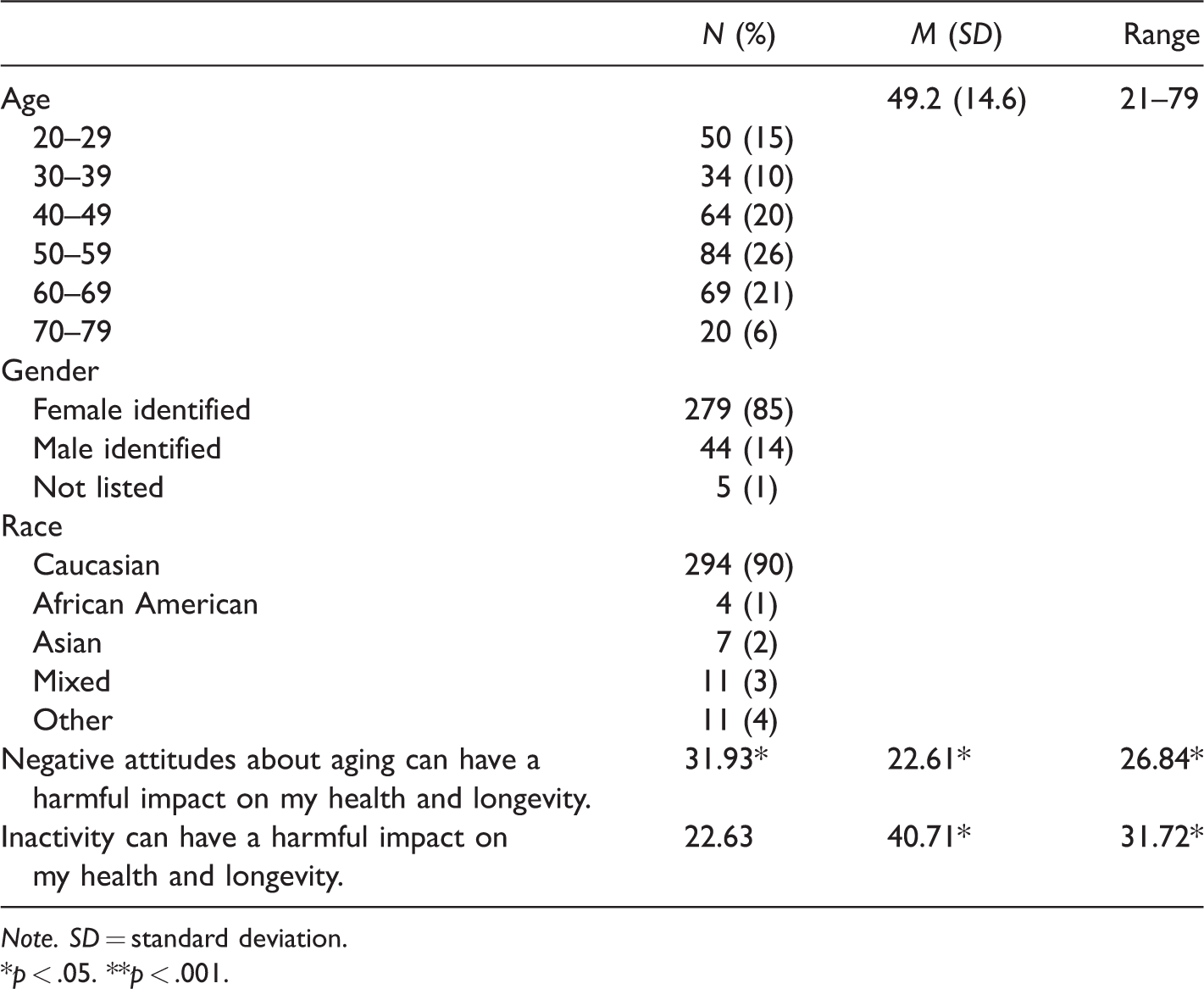
Note. SD = standard deviation.
*p < .05. **p < .001.
Factor Analysis
The frequency distributions were examined for each of the 16 items prior to conducting analyses. No evidence for extreme skewness or kurtosis was observed. In addition, the data set was checked, and no outlier cases were found using the Mahalanobis distance procedure (Mertler & Vannatta, 2002).
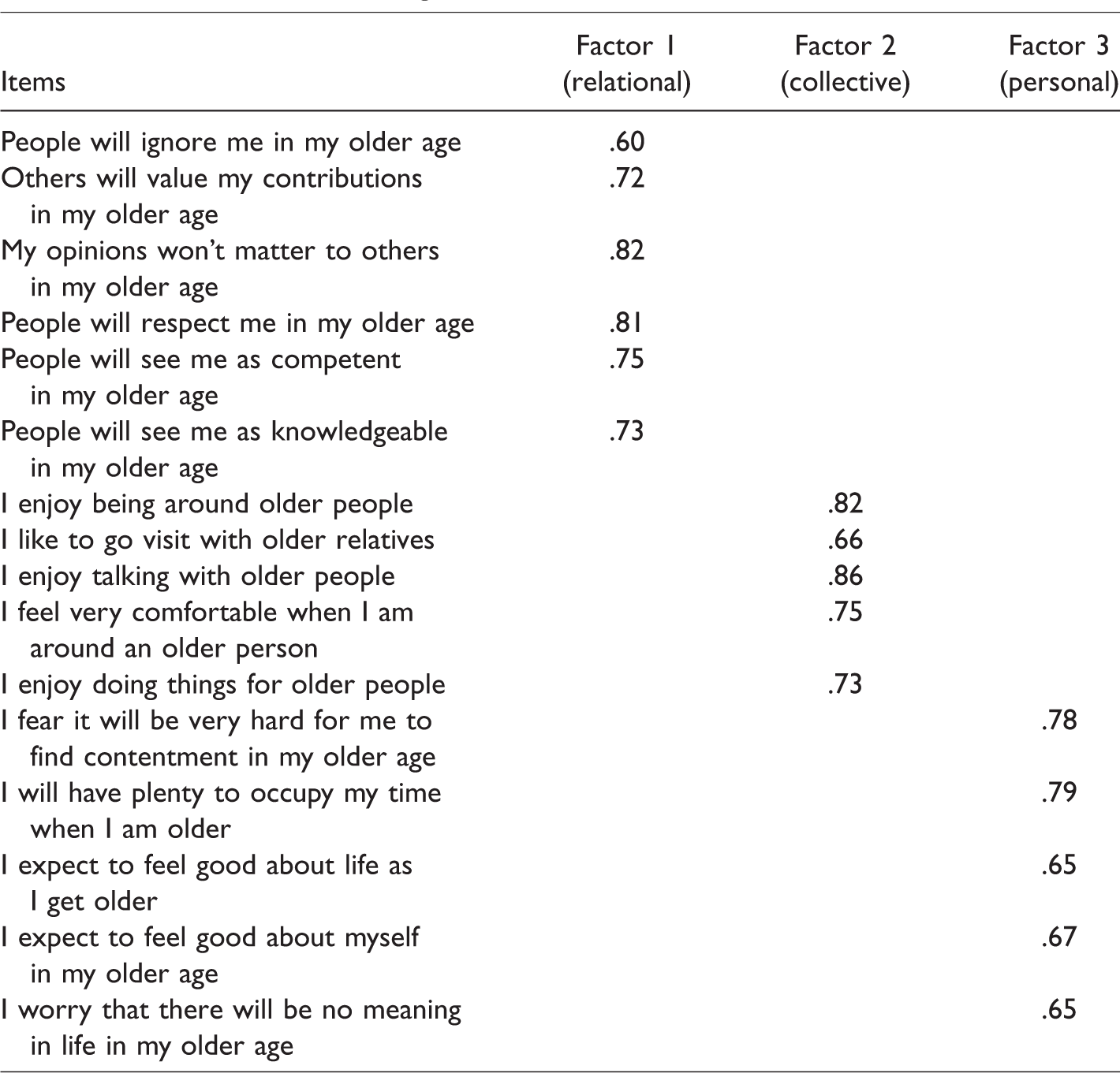
A principal component factor analysis with oblimin rotation was conducted on the set of 16 items. Several criteria were observed to retain the factors, including retaining factors with loading greater than .40, using a scree plot with Kaiser’s eigenvalue greater than one rule, and variances accounted for by factors extracted (Gorusch, 1983). The initial analysis revealed three overall factors that accounted for 59.68% of the variance, with relational aging anxiety accounting for 35.03% of the variance, collective ageism for 15.36%, and personal aging anxiety for 9.31%. Next, a scree plot was performed for factor validation. The results supported the previous finding that identified relational aging anxiety, collective ageism, and personal aging anxiety as three critical factors (see Table 2). All three factors had an eigenvalue of greater than one (Factor 1 = 5.60, Factor 2 = 2.45, and Factor 3 = 1.49).
Items and Factor Loadings.
To determine whether the factors extracted were theoretically related, a correlation matrix was performed and the results showed significant correlations among the factors (see Table 3), suggesting that the constructs identified are within a similar theoretical framework. For example, personal aging anxiety is significantly correlated with relational aging anxiety (r = .418, p <.001). As well, internal consistency for the scale as a whole (α = .88), as well as the subscales (relational aging anxiety, α = .84; collective ageism, α = .83; and personal aging anxiety, α = .81), were strong.
Component Correlation Matrix.
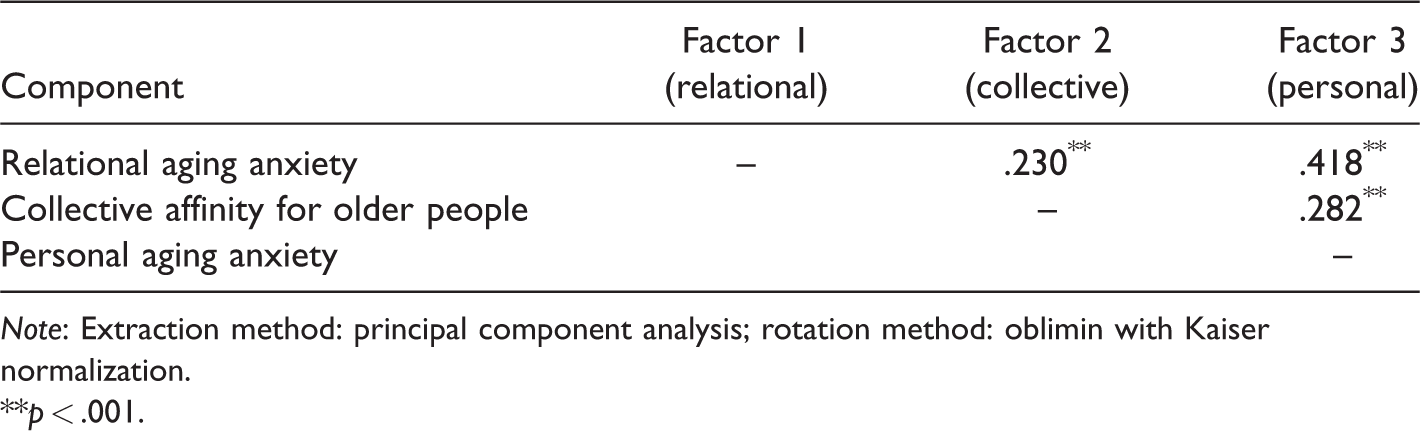
Note: Extraction method: principal component analysis; rotation method: oblimin with Kaiser normalization.
**p < .001.
Table 4 demonstrates results of analysis of variance conducted to assess potential differences between age, gender, and race among the three factors of relational aging anxiety (relational), collective affinity for older persons (collective), and personal internalized aging anxiety (personal). Statistical significance was found between age and personal aging anxiety, F(5,318) = 6.71, p <.001, gender and personal aging anxiety, F(3,325) = 2.61, p = .05, and race and relational aging anxiety, F(5,321) = 2.70, p <.021. Regression analysis was performed to examine the predictive value of each component factor (relational, collective, and personal) to awareness of ageism. The three variables together accounted for 25% of the variance. Collective affinity for older people (β = .18, p = .003) and relational aging anxiety (β = −.22, p = .001) each significantly predicted awareness of ageism. Regression analysis was also performed to examine the predictive value of each component factor (relational, collective, and personal aging anxiety) to knowledge of negative health outcome from ageism. The three variables together accounted for 28% of the variance. Collective affinity for older people (β = .22, p < .001) and relational aging anxiety (β = −.21, p = .001) each significantly predicted knowledge of negative health outcomes on ageism.
Analysis of Variance for Age, Gender, and Race by Component Scales.
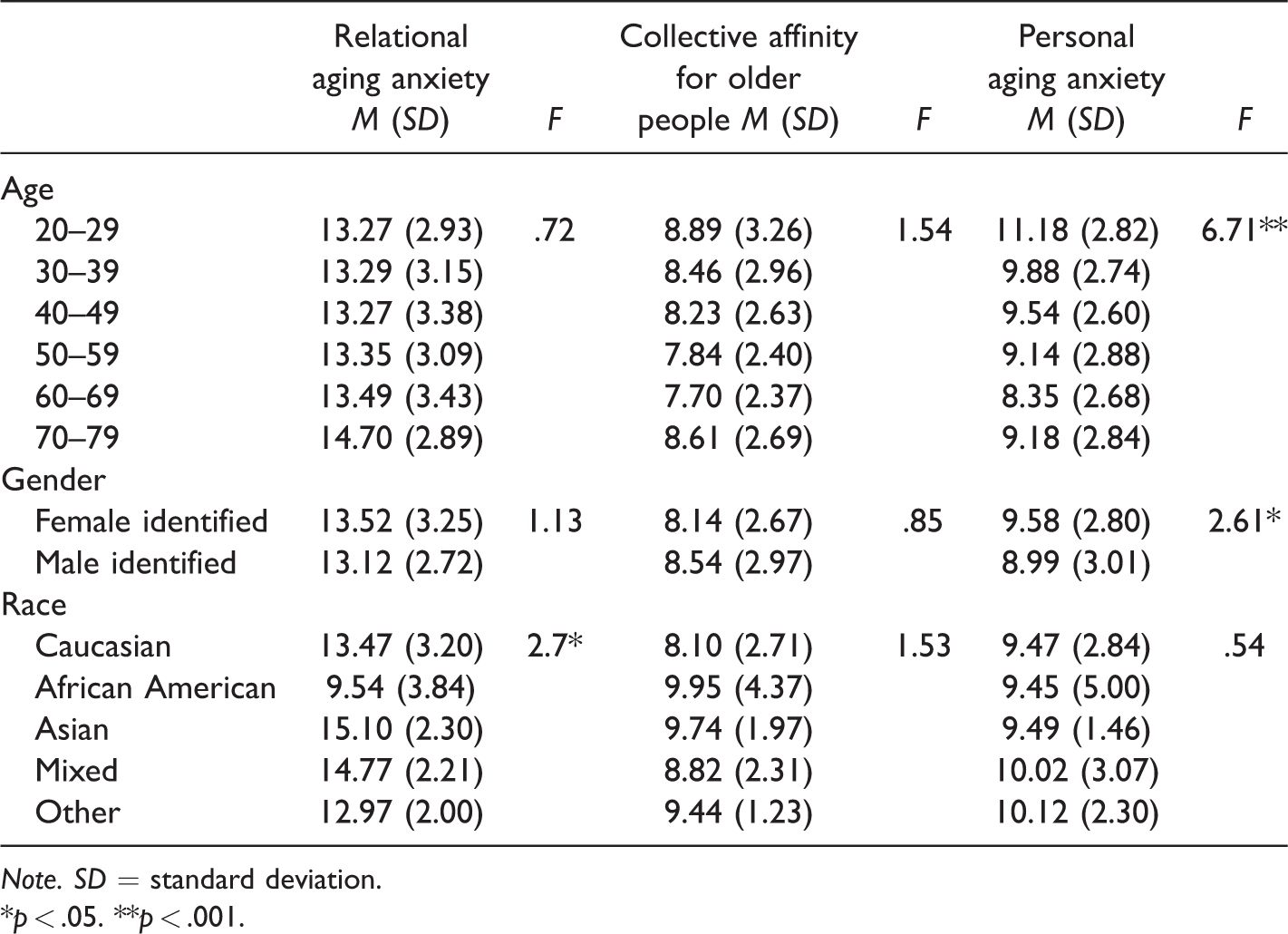
Note. SD = standard deviation.
*p < .05. **p < .001.
Discussion
The primary goal of this study was to explore the development of a relational ageism measurement instrument by examining factors related to the measurement of awareness of ageism representative of an individual ideology, a relational orientation, and from a collective identity perspective as well as measuring awareness of ageism and its impact. The theory of relational ageism posits that personal identity, relational identity, and collective identity conjointly influence our personal narrative of the aging self (blinded for review). It is only through increasing our understanding of the dynamic process by which cultural narratives of aging are internalized, expressed, and reinforced that we can develop evidence-based tools to disrupt the internalization, expression, perpetuation, and thus normalization of ageism.
There are several findings from this preliminary study that are noteworthy. First, study results demonstrate that there is a lower level of awareness of ageism as a problem in society as compared with other forms of discrimination (31% strongly agree, compared with 57% for racism and 49% for sexism). In addition, less than half of the study participants strongly agreed that negative views about aging were potentially harmful to health despite evidence that demonstrates the long-term problematic impacts of ageism, such as a 7-year decrease to longevity (Levy, & Banaji, 2002). Although analyses examining differences in gender and race must be interpreted with extreme caution due to the lack of diversity within the sample and the single-item units of measurement, it is worth consideration that male identified individuals under identified awareness and impact of ageism as compared with those that identified as female.
The factor analysis results generated three interpretable factors: personal aging anxiety, relational aging anxiety, and collective ageism. Two of the concepts, personal aging anxiety and collective ageism, are consistent with the literature (Lasher & Faulkender, 1993) and confirmatory of the importance of internal and external manifestations of ageism. The addition of a third relational concept reveals new findings. Taken together, the inclusion of all three factors is consistent with the literature on the extended model of self by Brewer and Gardner (1996). The finding of three interpretable factors is significant at both the theoretical and practical level. Theoretically, it contributes to the gerontological field by expanding evidence regarding the relational nature of identity and of ageism. Specifically, the items comprising the Relational subscale illustrate that how we are perceived by others is a separate component of anxiety we experience about aging and being older. This finding should encourage researchers to expand their view of ageism by incorporating a measure of relational aging anxiety as a by-product of social identity and construction. Practically, it is imperative that advocates and educators acknowledge that ageism represents a complex construct that is inclusive of how we feel about ourselves as aging individuals (e.g., personal identity) as well as how we feel we are perceived by others (e.g., social identity). Knowledge and understanding of ageism as a multilayered phenomenon is essential to develop targeted, evidence-based interventions that focus on all aspects of ageism. Acknowledging this complexity will enable us to fully embrace how ageism presents as a systemic and contagious form of prejudice and discrimination and attempt to prevent the negative consequential health impacts of ageism.
Study results also demonstrate that both relational aging anxiety and collective affinity for older people are predictive of awareness of ageism and the negative impacts of ageism. These findings regarding the contribution of relational aging anxiety are novel and important, specifically because lower levels of awareness of ageism and negative impact of ageism were correlated with higher levels of relational aging anxiety. In other words, those that have less awareness of ageism as a systemic problem are more likely to have greater anxiety about personal aging and are more likely to believe that older adults are not valued contributors and competent and knowledgeable members of society. These findings provide support for the invisible, contagious nature of ageism described by the theory of relational ageism and stereotype embodiment theory and support the notion that ageism is a process whereby our identity orientations intersect to influence how we see ourselves and others as aging individuals.
Analyses demonstrated that there is opportunity to develop targeted interventions that specifically focus on addressing personal aging anxiety for different age and gender groups as well as addressing relational aging anxiety among different racial groups. Specifically, analyses of variance provide preliminary evidence demonstrating the cyclical relational pathway of ageism. There was a statistically significant difference in personal anxiety about aging (i.e., internalized anxiety) for younger participants (20–29) than for older age groups. As well, there was a trend, although not statistically significant, for older participants (70–79) to report higher levels of relational aging anxiety. These results present an important snapshot of the impact of the youthful in-group on how older adults feel they are perceived by others while simultaneously demonstrating that younger adults (20–29) experience a higher level of personal fears about their own aging.
This study had several limitations that need to be acknowledged. First, this is a preliminary exploratory study of a measure of relational ageism using a convenience sample. This study should be repeated with a larger, more representative, and racially diverse sample to discover whether these results are replicable. Second, although internal consistency of the scale (and its factors) were reasonable, no test–retest assessment or data on stability over time was made. Therefore, future research in which a larger, stratified sample is used is desirable before firm conclusions are warranted. Due to the limited nature of the sample in terms of gender and race, results should be interpreted with caution.
Conclusion
In conclusion, study results demonstrate that ageism remains under recognized as a societal problem and as a pathway to negative health outcomes. Furthermore, the results illustrate that it is worthwhile to investigate ageism within the contexts of personal, relational, and collective identity. Increasing awareness of the ways in which aging anxiety impacts identity development is an essential step toward the creation of evidence-based interventions to disrupt the cycle of ageism. This instrument represents an important tool to increase our understanding of the multilayered, systemic, and complex nature of relational ageism. It can be used to further illuminate the process by which ageism is perpetuated and the link to awareness (or the lack of awareness) of its existence and impact. This will help to support the development of evidence-based interventions to disrupt ageism’s contagious cycle and to expose its cultural and social invisibility.
Footnotes
Appendix
Declaration of Conflicting Interests
The author(s) declared no potential conflicts of interest with respect to the research, authorship, and/or publication of this article.
Funding
The author(s) received no financial support for the research, authorship, and/or publication of this article.
