



Abstract

It might be hoped that publications in Teaching Sociology reflect the diversity of interests that are central to the discipline of sociology, but as directed toward teaching practice. Do the articles and notes published in Teaching Sociology correlate with the professional interests of sociologists, as exemplified in their wide-ranging professional endeavors? Our hope, informing the analysis presented here, is that such a correlation exists. However, we initiated our analysis with curiosity, as we did not know that this would be the case.
First a brief note on methods. To identify the topical content in Teaching Sociology, we coded all of the articles and notes published from 2009 to 2015 that were directly relevant to classroom application (N = 86), classifying learning objectives within the categories used by the Teaching Resources and Innovations Library for Sociology (TRAILS). Each publication could be coded as focusing on a maximum of three topic areas. To estimate the salience of professional interest in these topics, we identified American Sociological Association (ASA) section memberships that mapped well onto the TRAILS categories. For example, TRAILS has the category “Inequalities and Stratification,” and we identified the ASA sections of Disability and Society; Race, Gender, and Class; Sex and Gender; Sexualities; Inequality; Poverty and Mobility; and Education as having memberships that likely tend emphasize this topic in teaching and scholarship. Of course this does not mean that members of these sections (or their courses) are solely interested in the topics to which we link them. It is also an open question whether section membership statistics reflect the actual priorities of ASA members and nonmembers in their teaching priorities. With those caveats in mind, we observe the following.
Figure 1 shows that articles and notes in Teaching Sociology that have direct classroom applications most commonly concentrate on issues of inequality and stratification. Nearly one in two (43 percent) publications focused on this concern. This popular topic is followed by foci on theory (13 percent); culture (11 percent); family, life course, and society (11 percent); politics and social change (8 percent); research methods (6 percent); race and ethnicity (4 percent); social psychology and interaction (4 percent); medicine and health (3 percent); work, economy, and organizations (3 percent); and place and environment (3 percent).
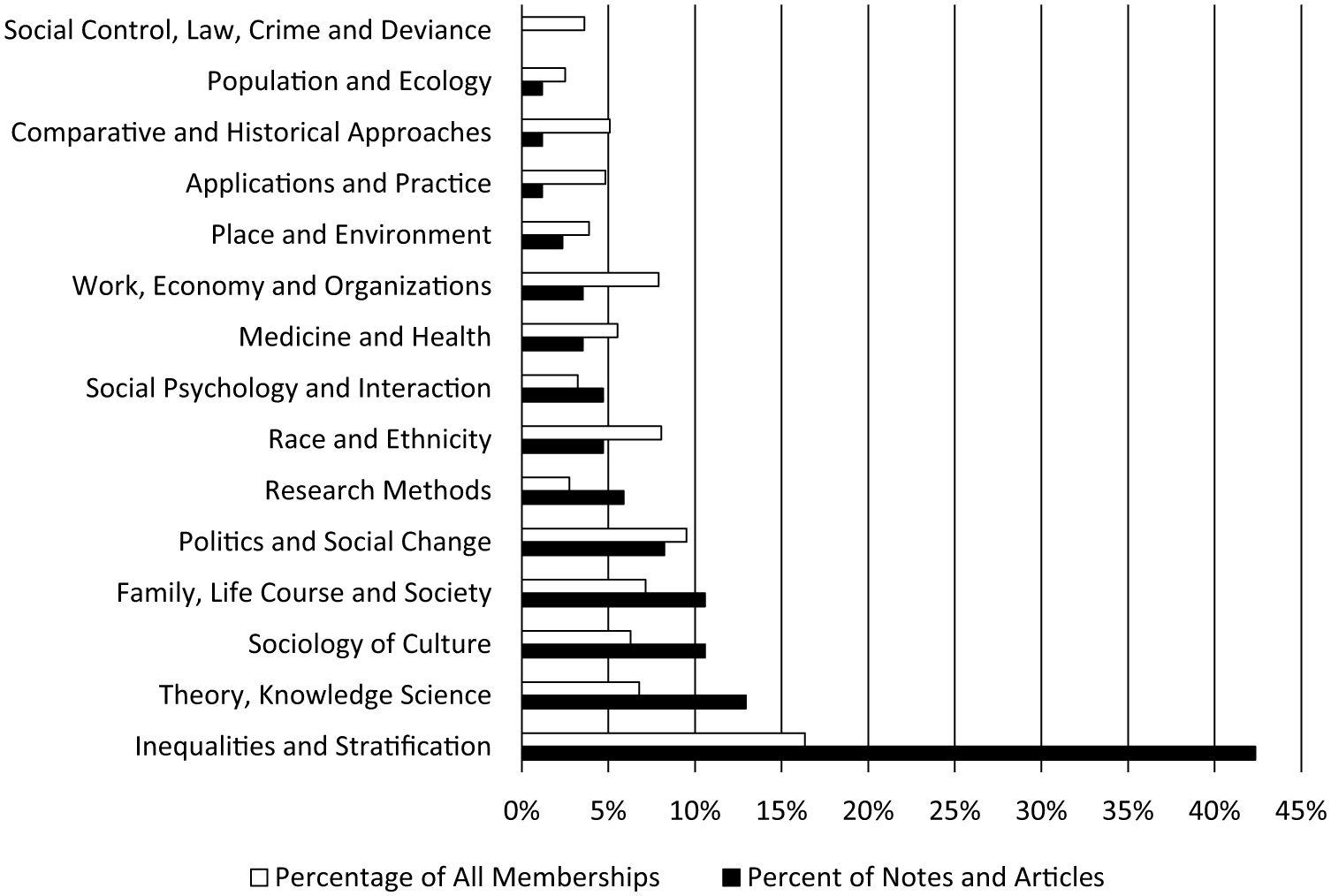
Percentages of articles and notes published in Teaching Sociology from 2009 to 2015 by topic areas and percentages of total American Sociological Association section memberships related to these topics 2015.
While publication representations are not always proportionate to section memberships, the presence of articles and notes in the journal generally corresponds to the rank ordering of section memberships. In other words, the frequency of topics published in Teaching Sociology tend to reflect professional interests as identified by the frequency of section memberships. We were gratified to see this finding. The journal publishes over twice as many articles in the area of inequalities and stratification than would be expected on the basis of memberships in the sections mentioned above. However, this emphasis on inequality is in keeping with one of the core recommendations of the ASA Task Force on the Undergraduate Major (McKinney et al. 2004)—the need to emphasize issues relating to race, class, and gender inequalities. A similar a recommendation is offered in a forthcoming publication on learning competencies expected for the major (Ferguson and Carbonaro forthcoming). We were surprised to observe that no article or note published in the past six years focused specifically on classroom applications of social control, law, crime, and deviance.
On the whole, findings reflect favorably on the journal, indicating that it is meeting an objective of providing a wide array of approaches that might be implemented within diverse program curricula. It also suggests offering a gentle prod to potential contributors. While it would be valuable to continue to receive articles that focus on social inequalities, clearly there are content areas that have more limited exploration within Teaching Sociology. We welcome submissions that might focus on ongoing debates in these areas, considerations of what should be taught, as well as innovative applications that offer demonstrated success.