



Abstract
Utilizing a focus theory of normative conduct and primary socialization theory, this study hypothesized that parents’ references to the negative consequences of alcohol use, to their own past use, to conditional permissive messages about use, and to drinking responsibly (all from the adolescents’ perspectives) are indirectly related to adolescents’ intention to drink alcohol through their pro-alcohol norms. Furthermore, it was hypothesized that parents’ alcohol consumption, as perceived by the adolescents, would moderate these indirect associations. Using cross-sectional survey data from 259 high school students, parents’ references to the negative consequences of alcohol use were related to weaker pro-alcohol norms, and in turn, weaker alcohol-use intention. By contrast, parents’ conditional permissive messages and references to drinking responsibly were related to stronger pro-alcohol norms, and in turn, stronger alcohol-use intention. Adolescents’ perceptions of their mother’s and father’s alcohol consumption were significant moderators of what they said to their children about alcohol.
In 2013, U.S. national survey data revealed that 52% of 10th-grade students and 68% of 12th-grade students had tried alcohol, with 14% of 10th-grade students and 22% of 12th-grade students having drunk heavily (i.e., consuming five or more alcoholic beverages during one occasion) at least once within the last two weeks prior to completing the survey (Johnston, O’Malley, Bachman, & Schulenberg, 2013). Underage drinking remains a serious public health concern in the United States because alcohol consumption is the most commonly used substance among individuals under 21 years of age, and it has been associated with a number of negative outcomes (U.S. Department of Health and Human Services, 2007). For example, one study found that high school students who reported drinking heavily were more likely to perform poorly in school, use other substances, or attempt suicide (Miller, Naimi, Brewer, & Jones, 2007). Moreover, the National Institute on Alcohol Abuse and Alcoholism (2006) suggests that because early, middle, and late adolescents’ brains are still developing, the effects of alcohol may be particularly harmful. Adolescents may be susceptible to drinking alcohol because they are at a period in their lives when appearances, peer acceptance, boundary exploration, and autonomy become increasingly important (Compas, Hinden, & Gerhardt, 1995). In addition, adolescents experience social, physical, and psychological changes that may lead to greater sensation seeking through alcohol consumption. Such developmental changes may also be particularly stressful, and adolescents may turn to alcohol as a way to cope with their stress (U.S. Department of Health and Human Services, 2007). In short, adolescents may be at risk of underage drinking and even heavy drinking; however, it is important to note that not all adolescents engage in these behaviors. Certain protective factors may discourage adolescents from drinking alcohol.
Primary socialization theory (PST; Oetting & Donnermeyer, 1998) identifies parents, peers, and schools as sources that may exhibit positive and negative influences on adolescents by instilling in them certain beliefs about alcohol and other substances. Focus theory of normative conduct (FTNC; Cialdini, Reno, & Kallgren, 1990) identifies the specific norms that lead to behavioral intentions and actual behaviors. Prior research has mainly focused on the protective nature of parents and schools in discouraging substance use but the negative influence of peers in promoting substance use (D’Amico & McCarthy, 2006; Trucco, Colder, Bowker, & Wieczorek, 2011; Van der Vorst, Engels, Meeus, & Deković, 2006). The current study extends past research by concentrating on parents’ potential to serve as positive and negative socialization agents through communication. A variety of other socialization agents (e.g., peers, schools, and media) contribute to developing alcohol-use norms and intentions; however, parent-child communication remains an important factor throughout development (Kam, 2011) and has been shown to be a key factor when considering alcohol-specific attitudes (Mares, van der Vorst, Engels, & Lichtwarck-Aschoff, 2011). Thus, the present study adopts a micro-level approach to examining PST and FTNC by determining how different types of parent-child communication indirectly relate to adolescents’ alcohol-use intention through their pro-alcohol norms.
Initially, parent-child communication was operationalized through openness (e.g., how openly adolescents communicate with their parents) and frequency (e.g., how often adolescents communicate with their parents), but a number of researchers have more recently argued for measuring specific messages about alcohol (Ennett, Bauman, Foshee, Pemberton, & Hicks, 2001; Miller-Day & Kam, 2010). For example, Ennett and her colleagues (Ennett et al., 2001; Reimuller, Hussong, & Ennett, 2011) introduced the concept alcohol-specific parent-child communication and Miller-Day and her colleagues (Miller-Day & Dodd, 2004; Miller-Day & Kam, 2010) introduced the concept targeted parent-child communication about alcohol use. Common to both alcohol-specific communication and targeted parent-child communication about alcohol is an interest in communication about alcohol use specifically. That is, they refer to one time or ongoing direct or indirect messages about alcohol (Kam, 2011). By studying alcohol-specific communication or targeted parent-child communication about alcohol (hereafter referred to as targeted parent-child communication), researchers can identify different messages about alcohol use, as well as specific parenting approaches that encompass frequency and quality of communication (Koning, van den Eijnden, Verdurmen, Engels, & Vollebergh, 2012). This information can then be used to examine the unique associations with alcohol-use beliefs and behaviors of both adolescents and their parents. Such findings can better inform alcohol-prevention interventions by providing parents with specific messages to discuss (or perhaps to avoid) with children (Boone & Lefkowitz, 2007).
Despite the call for more work that captures the specific messages about alcohol use, few studies have treated communication as multidimensional or determined how different types of messages uniquely relate to alcohol-use beliefs and behaviors. The few studies (e.g., Kam & Middleton, 2013; Reimuller et al., 2011) that have considered different dimensions of parent-child communication have focused primarily on verbal messages (e.g., discussing the negative consequences to drinking alcohol), while excluding nonverbal messages (e.g., observing a parent drink alcohol). Verbal messages, however, occur alongside nonverbal messages, and they may complement or contradict each other (Dailey, 2008). Accordingly, adolescents’ perceptions that their parents drink alcohol may enhance or undermine what parents say to their adolescent children about drinking alcohol (Kam & Middleton, 2013). Thus, this study uses self-reported survey data from middle and late adolescents (ages 14-18 years; 9th-12th grades) to examine how targeted parent-child communication indirectly relates to adolescents’ alcohol-use intentions through their pro-alcohol-use norms, focusing on four particular types of verbal messages. Furthermore, this study determines whether adolescents’ perceptions of their parents’ alcohol consumption might undermine or enhance what parents say about alcohol. This study’s findings can add greater theoretical specificity to PST and FTNC, while informing the development of family-based alcohol-prevention interventions for adolescents.
Merging FTNC With PST
To understand why individuals refrain from or engage in certain behaviors, Cialdini and his colleagues developed FTNC (Cialdini et al., 1990; Reno, Cialdini, & Kallgren, 1993), which explains the psychological mechanisms that motivate behaviors. FTNC posits that when individuals hold favorable injunctive norms (i.e., believe that important others think they should participate in a behavior) and descriptive norms (i.e., believe that others engage in the behavior), they are more likely to develop intentions to carry out that behavior, and in turn, actually engage in the behavior. In the context of adolescents’ alcohol consumption, as adolescents hold pro-alcohol injunctive norms (e.g., perceive that their parents would approve of alcohol use) and pro-alcohol descriptive norms (e.g., perceive that other students at school drink alcohol), they are more likely to develop intentions to drink alcohol, and in turn, are more likely to consume alcohol.
Recent research (e.g., Elek, Miller-Day, & Hecht, 2006; Kam, Matsunaga, Hecht, & Ndiaye, 2009), however, has extended FTNC to identify injunctive and descriptive norms as external norms because they are rooted in perceptions of what others think or do. They added the concept personal norms (i.e., internal norms), which are the individual’s own expectations of what behaviors are morally right or wrong. Personal norms are internalized perceptions of whether a behavior is acceptable (Elek et al., 2006). Thus, FTNC and more recent work would suggest that parent-child communication about alcohol is indirectly related to alcohol-use intention and behavior through alcohol-related external and internal norms. Based on longitudinal survey data from Latino early adolescents in Arizona and longitudinal survey data from Latino early adolescents in Illinois, Kam and her colleagues (Kam et al., 2009; Kam & Wang, 2014) found support for the indirect effects of external norms on substance-use intention or behavior through internal norms.
As FTNC examines the psychological mechanisms that motivate behaviors, PST (Oetting, Donnermeyer, & Deffenbacher, 1998) identifies how individuals develop such psychological mechanisms—through communication with parents, peers, and school. Considering PST and FTNC together provides a useful framework for understanding how parents, as socialization agents, may influence adolescents’ norms and alcohol-use intention. Nevertheless, one of the limitations of PST and FTNC is that they do not specify the particular messages that lead to favorable or unfavorable norms regarding a behavior, such as alcohol consumption. Thus, the following section argues for extending PST and FTNC by considering the multifaceted nature of targeted parent-child communication and determining which messages uniquely relate to pro-alcohol norms and intention.
The Multidimensional Nature of Targeted Parent-Child Communication About Alcohol
A number of studies have found support for targeted parent-child communication’s negative associations with adolescents’ pro-alcohol beliefs and alcohol consumption. For example, Miller-Day and Kam (2010) reported that targeted parent-child communication was related to weaker positive alcohol expectancies, as well as lower alcohol use among a sample of early adolescents (seventh-eighth grades). Similarly, Kam, Potocki, and Hecht (2014) found that the more often Mexican-heritage early adolescents engaged in targeted parent-child communication, the more likely they were to consider the negative consequences of drinking alcohol, and in turn, the more likely they would intervene in a friend’s alcohol consumption. Hence, prior research suggests that targeted parent-child communication may discourage alcohol use.
Nevertheless, a notable limitation to the body of work on targeted parent-child communication is that researchers often treat this concept as unidimensional. Past research has examined communication frequency and quality (e.g., Van den Eijnden, Van De Mheen, Vet, & Vermulst, 2011), and other studies (e.g., Kam & Yang, 2014; Miller-Day & Kam, 2010) on targeted parent-child communication have made advances by measuring different message content (e.g., discussing family rules, stating disapproval of use, warning against the negative consequences of use). They often, however, represent communication as one composite score or latent factor. Treating communication as multidimensional is more informative because not all messages operate the same way. Instead, targeted parent-child communication may comprise different messages that are uniquely related to alcohol-use beliefs and behaviors (Kam & Middleton, 2013). Knowing which messages are positively or negatively related to pro-alcohol-use beliefs and behaviors is essential to advancing theory and alcohol-prevention interventions.
To date, a small number of scholars have captured the multidimensional nature of targeted parent-child communication, although this area of research would benefit from additional studies. For example, Ennett and her colleagues (2001) found that a moderate to large percent of parents talked to their adolescent children about the negative consequences of using alcohol and tobacco, resistance strategies, and rules against use, but a small percent discussed discipline or media portrayals of alcohol or tobacco use. In addition, Reimuller et al. (2011) revealed that permissive messages about alcohol use were related to higher levels of adolescents’ alcohol use, but discussing the negative consequences of use was not significantly related to adolescents’ alcohol use. Lastly, Kam and Middleton (2013) found that although targeted parent-child communication was related to stronger anti-substance-use beliefs among early adolescents, parents’ references to their own past alcohol, cigarette, and marijuana use were related to weaker anti-substance-use beliefs. The current study continues the aforementioned body of work by treating targeted parent-child communication as a multidimensional construct, suggesting that the messages may operate differently in relation to pro-alcohol norms and intention.
Although a number of messages exist that may influence adolescents’ alcohol-use intention, this study focuses on four types of messages based on prior research: (1) parents’ references to the negative consequences of alcohol use, (2) parents’ references to their own past experiences with alcohol use, (3) parents’ conditional permissive messages, and (4) parents’ references to drinking alcohol responsibly. The following sections define each message and describe how they may indirectly relate to alcohol use through pro-alcohol norms and attitudes.
Parents’ References to the Negative Consequences of Alcohol Use
Parents’ references to the negative consequences of alcohol use refer to messages that focus on the dangers of drinking alcohol and the undesirable experiences that may emerge from drinking alcohol (Warren, Allen, Hopfer, & Okuyemi, 2010). For example, parents may tell their adolescent children about alcohol poisoning, how alcohol negatively affects the body, being in a vulnerable situation because of drinking alcohol, or getting arrested for underage alcohol use. The research on targeted parent-child communication reveals that parents’ references to the negative consequences of alcohol use are one of the most commonly reported conversation topics when discussing alcohol consumption. For example, Miller-Day and Dodd (2004) asked college students to describe a conversation that they had with a parent about alcohol, and Warren et al. (2010) asked mothers of preadolescents (8-12 years of age) to describe the conversations that they had regarding substance use. Both studies reported that parents often warned their children about the negative consequences of substance use. Given that these types of verbal messages highlight the undesirable and harmful aspects of drinking alcohol, adolescents who receive these types of messages are less likely to develop favorable norms regarding drinking alcohol, and in turn, are less likely to form intentions to drink alcohol (Kam & Middleton, 2013).
Parents’ References to Their Own Past Experiences With Alcohol Use
In addition to focusing on the negative consequences of using alcohol, prior research indicates that parents may discuss their own past alcohol consumption with their child to use it as a teachable moment. Hazelden Foundation (2012), which focuses on addiction treatment and recovery, found that 63% of the adolescents surveyed in their study reported that they would like to hear about their parents’ own experiences with substance use. The adolescents reported that they would perceive such conversations as a sign of honesty and trust, thereby promoting greater parent-child openness. Similarly, Partnership for a Drug-Free America (2012) suggests that when adolescents ask their parents about their own past substance use, parents can make their experiences teachable moments. Nevertheless, the relation between this particular type of verbal message and adolescents’ substance use remains unknown because few studies have examined whether parents’ references to their own past substance use are positively or negatively related to adolescents’ substance-use beliefs and behaviors. Kam and Middleton (2013) are one of the first to empirically test this association, and they found that conveying such messages was actually related to weaker anti-substance-use beliefs among Latino and European American early adolescents. Given the limited research on this type of message, Kam and Middleton called for further research to determine how discussing past experiences with substance use (including alcohol use) may relate to adolescents’ beliefs about substance use, and in turn, their behaviors.
Although referencing the negative consequences of alcohol use serves as a clear and explicit anti-alcohol message, parents’ references to their own past alcohol use are more ambiguous with respect to being anti- or pro-alcohol. Parents may share their past experiences with their children with good intentions; however, it is possible that such discussions may actually downplay the negative consequences of alcohol use or normalize the behavior (Kam & Middleton, 2013). Thus, parents’ references to their own past alcohol use, even when expressing regret over such use, may be interpreted in different ways. Given the ambiguous nature of this type of verbal message, parents’ references to their own past alcohol use may be associated with greater pro-alcohol norms and intentions.
Parents’ Conditional Permissive Messages About Alcohol Use
In keeping with ambiguous messages, the present study also examines parents’ conditional permissive messages about drinking alcohol. When parents express conditional permissive messages, they may not explicitly condone alcohol use, but they also do not expressly forbid it. For example, in Reimuller et al.’s (2011) study, they operationalized permissive messages with survey items such as “Under some circumstances, it’s okay to have sips of a drink, like with parents or for special family occasions” or “Drinking in moderation is okay” (p. 394). Conditional permissive messages include telling children that they may drink on special occasions or under the supervision of an adult. Thus, when parents use conditional permissive messages, they imply that under certain situations, underage drinking is acceptable. Consistent with this notion, Reimuller et al. (2011) found that adolescents who received this type of permissive message were more likely to drink alcohol.
Parents’ References to Drinking Alcohol Responsibly
In addition, Reimuller et al. (2011) found that parents may believe their children will inevitably drink alcohol, and to ensure their children’s safety, parents may talk to their children about drinking alcohol responsibly. References to drinking responsibly include telling adolescents that they should call their parents if they need a ride after drinking alcohol. Rather than clearly stating that drinking is acceptable or unacceptable, parents put sanctions in place to try to ensure the safety of their children when drinking alcohol. Similar to conditional permissive messages, parents’ references to drinking responsibly can be ambiguous and may unintentionally convey approval of underage alcohol consumption.
This study concentrates specifically on these four types of verbal messages about alcohol use because the first message (negative consequences) clearly conveys anti-alcohol norms; however, the last three messages are more ambiguous and can be interpreted in different ways. Moreover, limited research has been conducted to determine how these different messages uniquely relate to alcohol use, specifically through pro-alcohol external and internal norms. Drawing from PST, FTNC, and past research, the following mediation hypothesis was set forth:
Whereas the first type of message—parents’ references to the negative consequences of alcohol—is clearly anti-alcohol in its content, the other three types of messages are far more ambiguous. For example, when parents express regret over their own past use, they frame alcohol use as a negative experience; yet, they admit that they have engaged in the behavior (Kam & Middleton, 2013). Moreover, Reimuller et al. (2011) suggest that permissive messages demonstrate acceptance of alcohol use, and messages about responsible drinking may do the same, as parents assume that adolescents will likely engage in this behavior. When parents provide such messages, their intentions may be to prevent adolescents from excessive consumption and to provide a safe environment for their drinking; however, these messages may also unintentionally promote alcohol use. When parents convey verbal messages that can be interpreted as condoning alcohol use, adolescents may believe that their parents have stronger pro-alcohol norms. Again, based on PST and FTNC, we hypothesize mediation such that,
The Interactions Between Parents’ Verbal and Nonverbal Messages About Alcohol Use
What parents say when they talk about alcohol use is critical to the prevention of underage alcohol consumption (Ennett et al., 2001). Of equal importance, however, is how parents act in relation to their targeted communication. Both parents’ verbal and nonverbal messages about alcohol may impact adolescents’ own drinking behaviors (Miller-Day & Dodd, 2004). Adolescents’ perceptions of their parents’ alcohol use may be a crucial element to understanding how they interpret what their parents say about alcohol use (Kam, 2011). Thus, it is important to consider the multidimensional nature of targeted parent-child communication from both verbal and nonverbal perspectives.
Although researchers have investigated how verbal messages discourage adolescents from consuming alcohol (e.g., Kam et al., 2013), the nonverbal component of parent-child communication about alcohol use has been given little attention. Nevertheless, nonverbal messages are essential to the overall effectiveness of an interaction. For example, Dailey (2008) suggests that in general, parents’ messages containing both explicit (verbal) and implicit (nonverbal) communication are more effective if those messages are consistent rather than inconsistent with one another. Specific to messages about alcohol consumption, this may mean that when parents’ verbal and nonverbal communication about alcohol use is consistent, their interactions may be more effective in discouraging adolescents’ drinking behavior. That is, adolescents may be more likely to pay attention to both types of messages when parents’ verbal and nonverbal behaviors work together. This may be particularly important in adolescence, as this is a period when children begin to measure their parents’ verbal and nonverbal messages against each other to look for contrasting information (Grebelsky-Lichtman, 2014). Contradicting verbal and nonverbal messages may translate into muddled communication acts that require the adolescent to filter and make sense of conflicting messages. Because parents are important socialization agents (Oetting & Donnermeyer, 1998), these conflicting messages may have dramatic consequences.
The current study considers adolescents’ perceptions of parents’ alcohol consumption, which may be based on nonverbal behaviors such as observing their parents purchase alcohol, drink alcohol, or keep alcohol in a cabinet at home. Prior literature (e.g., Ennett et al., 2001; Kam, 2011; Miller-Day & Dodd, 2004) suggests that perceptions of parents engaging in or refraining from drinking alcohol or using other substances may implicitly convey parents’ beliefs about alcohol consumption. For example, Miller-Day and Dodd (2004) found that some of the undergraduate students in their study learned to refrain from drinking or smoking because they saw their parents did not drink alcohol or smoke cigarettes. Furthermore, Andrews, Hops, and Duncan (1997) revealed that the adolescents in their study were more likely to smoke cigarettes if their mother smoked cigarettes, and they were more likely to use marijuana if their father used marijuana. Social learning theory (Bandura, 1971) suggests that children are likely to mimic behaviors that they observe enacted by valued or important individuals (e.g., parents), although a question emerges as to whether the perceptions of parents’ alcohol consumption undermine or enhance what they say about alcohol use.
If parents verbally convey anti-alcohol-use messages, but frequently consume alcohol, adolescents may perceive a contradiction between parents’ verbal (what they say) and nonverbal (what they do) messages. When adolescents perceive that their parents frequently drink alcohol, they may disregard their parents’ verbal anti-alcohol messages (e.g., parents’ references to the negative consequences of alcohol), noting that their parents do not adhere to their own advice. By contrast, parents’ frequent alcohol use may coincide with more ambiguous messages that may be interpreted as pro-alcohol messages (e.g., parents’ references to their own past use, parents’ permissive messages, and parents’ references to drinking responsibly). When parents’ verbal instructions conflict with their communication about their own past alcohol consumption, adolescents may experience some dissonance in perceiving what their parents’ attitudes and norms are about alcohol use. Hence, the following moderation hypotheses predict how perceptions of parents’ alcohol use interact with what they say about alcohol (see Figure 1).
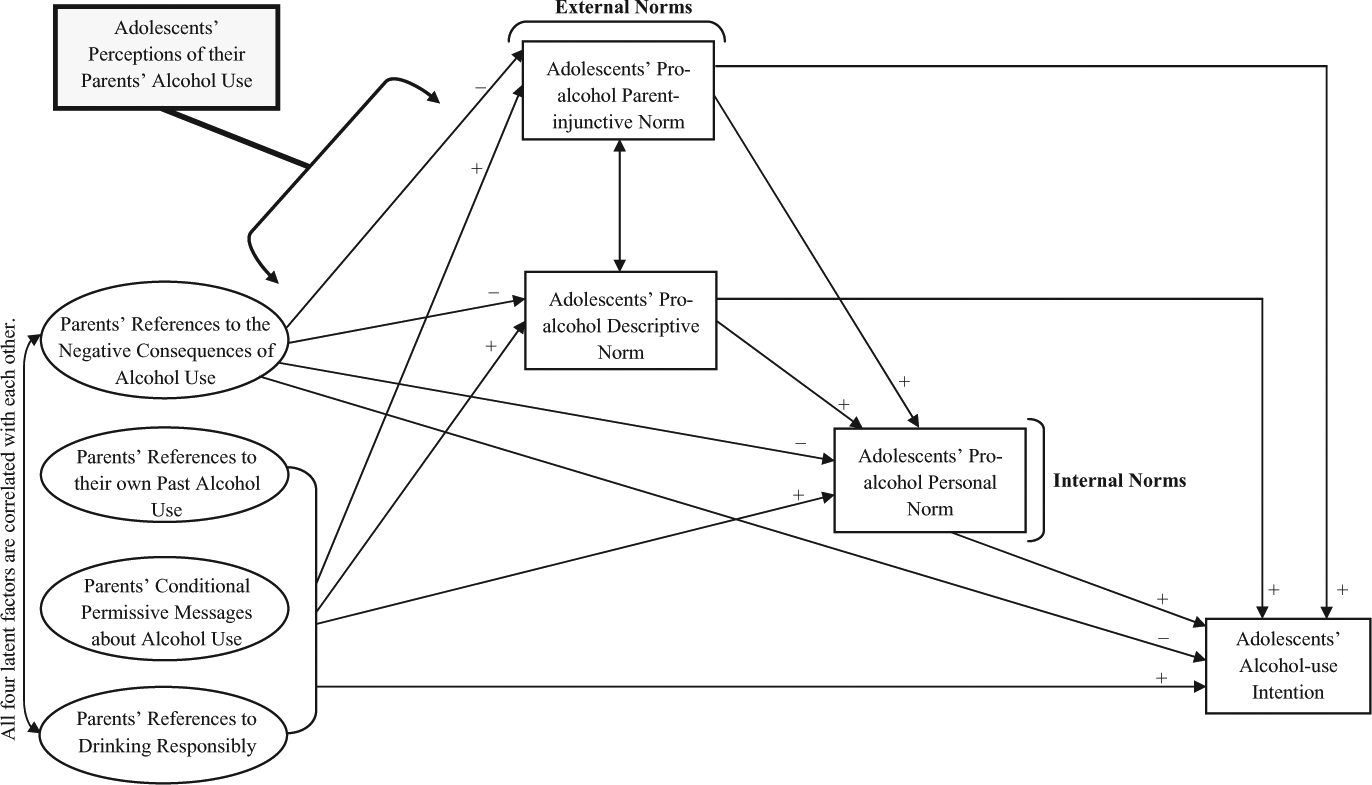
A hypothesized model of alcohol-related parental socialization from the adolescents’ perspective.
Method
This study was based on self-reported, cross-sectional survey data from students (9th-12th grades) at a public high school in Illinois. More specifically, 259 students (M = 16.3 years, SD = 1.1; ages 14-18) completed the survey, with 47% identifying as female and 53% as male. Among the high school students, 17% were in 9th grade, 33% in 10th grade, 28% in 11th grade, and 22% in 12th grade. Eighty-nine percent identified as non-Latino White or European American, 3.2% as Latino, 0.8% as American Indian/Alaskan Native, 0.8% as Asian or Pacific Islander, 0.4% as African American or Black, and 5.8% as multiracial/multiethnic. Among the 259 students, 1% identified as upper-class/rich, 18% as upper-middle class, 62% as middle class, 16% as lower middle class, and 3% as poor.
Procedures
The present study is part of a larger research project funded by a university grant. The primary goal of the larger project was to develop and validate survey measures of adolescents’ communication about alcohol and marijuana use with their friends. On receiving approval from the university’s Institutional Review Board, local public high schools were invited to participate in this study. One school volunteered to participate; therefore, information letters were sent to the students’ parents. The letters included a withdrawal form with a university-addressed envelope and postage paid for by the small grant awarded to the first author. A total of 12 students were withdrawn from the study by their parents. On the day of the survey distribution, research personnel described the confidential and voluntary nature of the study, and because no personally identifying information was requested, the surveys were anonymous. Students were asked to sign an assent form, but this form was not connected to the survey responses. The entire assent and survey completion process took approximately 45 minutes, and the survey distribution occurred during study hall, physical education, or band. The school received US$500, and 50 students were randomly selected to receive US$10.
Measures
Shortened scales were used to meet the school’s time restrictions and the developmental needs of the students. Means, standard deviations, and bivariate correlations are provided in Table 1. Higher scores indicate greater communication, stronger pro-alcohol norms, and greater alcohol-use intention.
Adolescents’ Means, Standard Deviations, and Bivariate Correlations.
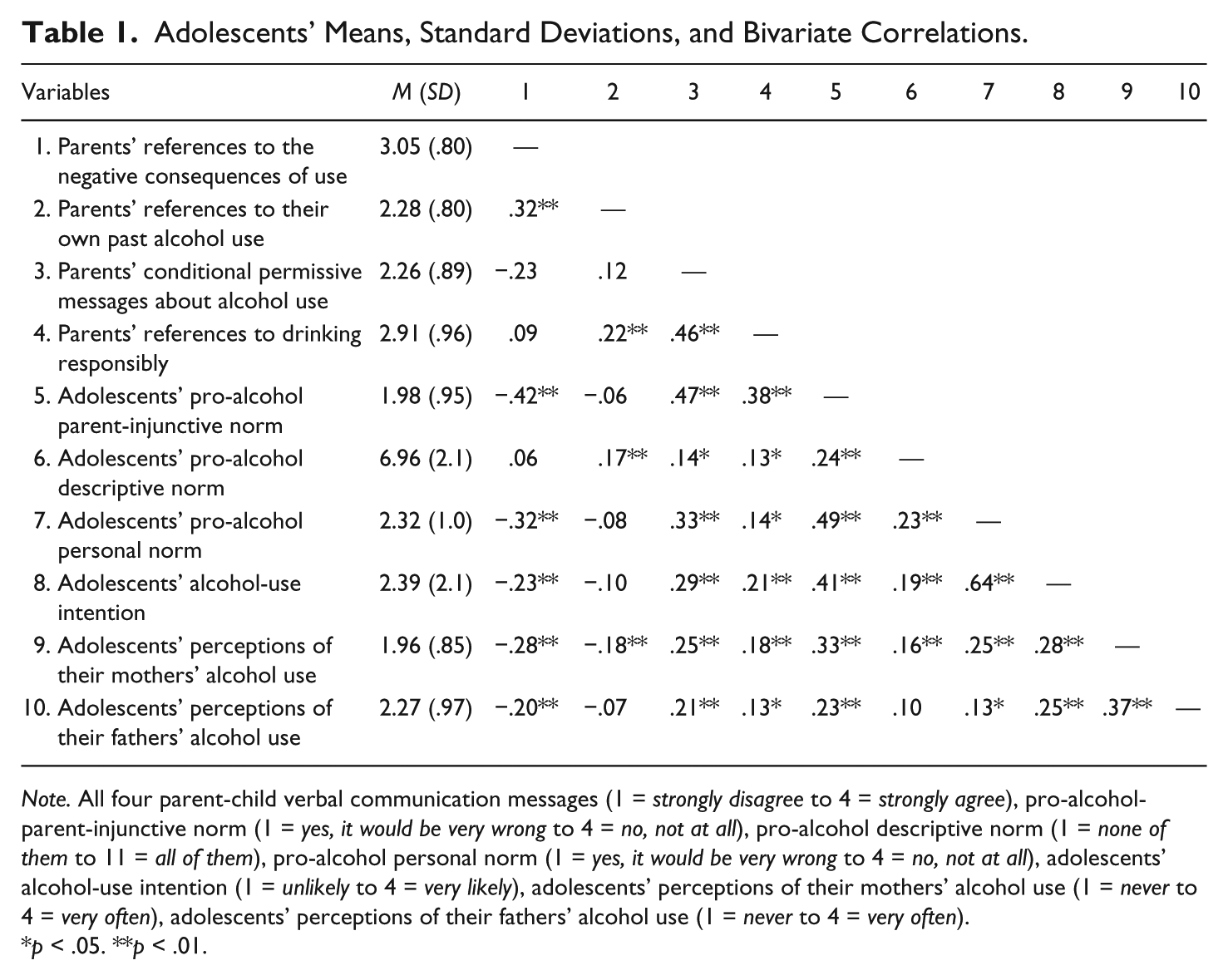
Note. All four parent-child verbal communication messages (1 = strongly disagree to 4 = strongly agree), pro-alcohol-parent-injunctive norm (1 = yes, it would be very wrong to 4 = no, not at all), pro-alcohol descriptive norm (1 = none of them to 11 = all of them), pro-alcohol personal norm (1 = yes, it would be very wrong to 4 = no, not at all), adolescents’ alcohol-use intention (1 = unlikely to 4 = very likely), adolescents’ perceptions of their mothers’ alcohol use (1 = never to 4 = very often), adolescents’ perceptions of their fathers’ alcohol use (1 = never to 4 = very often).
p < .05. **p < .01.
Parents’ references to the negative consequences of alcohol use
Two items were taken from the Targeted Parent-child Communication about Alcohol Scale (Miller-Day & Kam, 2010), which focused on the negative consequences of drinking alcohol. Students were asked, “How strongly do you agree with the following statements?” and they responded to two items (“At least one of my parents . . . ” “ . . . said they would be upset with me if I drank alcohol” and “ . . . warned me about the dangers of drinking alcohol”; 1 = strongly disagree to 4 = strongly agree; r = .67; α = .80).
Parents’ references to their own past use
This study used Kam and Middleton’s (2013) three-item scale of parents’ references to the negative consequences of their own past use. Students were asked, “How strongly do you agree with the following statements?” and they responded to three items (e.g., “At least one of my parents has told me . . . ,” “ . . . how he or she regretted past choices to drink alcohol,” and “ . . . about times when bad things happened to them because they drank alcohol”; 1 = strongly disagree to 4 = strongly agree; α = .81).
Parents’ conditional permissive messages
Two items were taken from Reimuller et al.’s (2011) Permissive Messages Scale. Students were asked, “How strongly do you agree with the following statements?” and they responded to two items: “At least one of my parents said that . . . ” “ . . . if I ever want to try a drink, I can have sips of a drink in front of him/her” and “ . . . under some circumstances, it’s okay to have sips of alcohol (e.g., with parents, for special occasions)”; 1 = strongly disagree to 4 = strongly agree; r = .75; α = .86).
Parents’ references to drinking responsibly
Again, two items were taken from Reimuller et al.’s (2011) Permissive Messages Scale. Students were asked, “How strongly do you agree with the following statements?” and they responded to two items: “At least one of my parents said that . . . ” “ . . . I should call home to be picked up if I drink” and “ . . . if I drink, I should drink responsibly” (1 = strongly disagree to 4 = strongly agree; r = .61; α = .76).
Adolescents’ pro-alcohol parent-injunctive norm
The pro-alcohol parent-injunctive norm measure was taken from Pettigrew et al. (2013), which was based on Arthur, Hawkins, Pollard, Catalano, and Baglioni (2002). Students were asked one question, “Would your parent(s) feel it would be wrong for you to drink alcohol (beer, wine, or hard liquor) occasionally?” (1 = no, not at all to 4 = yes, it would be very wrong). The item was reverse coded; higher scores indicated more favorable alcohol norm.
Adolescents’ pro-alcohol descriptive norm
One item was taken from Pettigrew et al. (2013), which was based on Hansen and Graham (1991). Students were asked, “Out of every 100 students at your school, how many do you think drink alcohol at least once a month?” (1 = none of them to 11 = all of them).
Adolescents’ pro-alcohol personal norm
Based on Hansen and Graham (1991) and Elek et al. (2006), students were asked, “Do you think it would be wrong for someone your age to drink alcohol (beer, wine, or hard liquor) occasionally?” (1 = no, not at all to 4 = yes, it would be very wrong). The item was reverse coded; higher scores indicated greater pro-alcohol norms.
Adolescents’ alcohol-use intention
Based on Graham et al. (1984) and Godbold and Pfau (2000), students reported their alcohol-use intention (one item; “If you had a chance this month (the next 30 days), how likely would you use alcohol (beer, wine, hard liquor), but NOT for religious services?” 1 = unlikely to 4 = very likely).
Adolescents’ perceptions of their mother’s and father’s alcohol use
Mothers’ and fathers’ alcohol use were measured with items from LaRusso, Romer, and Selman (2008). Students were asked, “Thinking of your mother or female guardian, how often would you say that she drinks alcohol (e.g., beer, wine, or hard liquor)?” and “Thinking of your father or male guardian, how often would you say that he drinks alcohol (e.g., beer, wine, or hard liquor)?” (1 = never to 4 = very often). These two variables were treated as separate moderators in this study’s analyses.
Control variables
In the analyses, the control variables were sex (0 = male, 1 = female), family wealth (1 = very poor to 6 = upper-class/rich), school grades (1 = mostly As to 9 = mostly Fs), ethnicity (0 = European American to 1 = non-European American), grade level (9th, 10th, 11th, or 12th grade), how often high school students have had conversations with their parents about alcohol (1 = never to 4 = very often), and past-30-day alcohol use (1 = none or only sips for religious services to 8 = more than 30). These variables were taken into account because past research suggests that parent-child communication about alcohol, alcohol-related perceptions, and alcohol-use intention may vary by all of the aforementioned variables. Furthermore, frequency of alcohol-related parent-child communication was included as a control variable because Miller-Day and Dodd (2004) developed a typology of messages, suggesting that some parents only have one “sit-down” conversation with their child about alcohol, whereas others may discuss the topic regularly. The literature on parent-child communication about substance use also traditionally only examined how frequently parents talk about substances, whereas more recent work has emphasized the importance of content. In the analyses, paths were included from the control variables to the dependent variables.
Analysis Summary
This study examined the mediation hypotheses (H1 and H2) using structural equation modeling (SEM) in Mplus. The missingness ranged from 0.4% to 3.1%. To handle the missing data, the full information maximum likelihood was utilized, which Graham (2009) and Enders (2010) recommend. With respect to nonnormality, Mardia’s coefficient was 126.09, p < .01. The present study used the best option for handling nonnormally distributed data when examining mediation. Testing for mediation included simultaneously examining direct and indirect associations in one model, while using the bootstrapping option (set at 5,000) to obtain the bias-corrected 95% confidence intervals (CIs; Preacher, Rucker, & Hayes, 2007). When using bootstrapping, the bootstrap standard errors (SEs) are provided, which are robust against nonnormally distributed data (L. Muthen, personal communication, May 28, 2014).
The models were evaluated based on the following criteria. A well-fitting model should have a root mean square error of approximation (RMSEA) ≤ .06 (Hu & Bentler, 1999) and a comparative fit index (CFI) ≥ .95. An acceptably fitting model should have a RMSEA < .08 (Browne & Cudeck, 1993) and a CFI value ≥ .90 (Beaudoin & Thorson, 2006; Hu & Bentler, 1999). Lastly, the standardized root mean square residual (SRMR) should be < .08 (Hu & Bentler). Prior to testing the hypotheses, confirmatory factor analysis (CFA) was conducted to examine all of the latent factors (four parent-child communication factors) and their corresponding items in one model, which resulted in an adequate fit: (χ2(44) = 123.30, p < .01; RMSEA = .08, 90% CI = [.07, .10]; CFI = .93; SRMR = .06). All of the standardized factor loadings were > .60.
When examining moderation (H3 and H4), four mediation models were examined with adolescents’ perceptions of their mother’s alcohol use as a moderator, and four additional mediation models were examined with adolescents’ perceptions of their father’s alcohol use as a moderator. Interaction terms were created by centering each parent-child communication variable and multiplying each one by mother’s alcohol use and father’s alcohol use, both of which were also centered (Aiken & West, 1991). The interaction terms and adolescents’ perceptions of their mother’s or father’s alcohol use were represented by observed variables, but all four types of parent-child communication about alcohol were represented as latent factors in the moderation models. Currently, there is still some debate over the way in which interactions should be represented in a SEM framework, although when possible, modeling latent interactions is preferred over the present study’s observed interactions (Marsh, Wen, Hau, & Nagengast, 2013). Nevertheless, when modeling latent interactions in Mplus, one cannot use the bootstrapping feature. Given that the present study hypothesizes a four-step mediation model (i.e., communication → external norms → internal norms → intentions), bootstrapping was the only option to obtain the 95% bias-corrected CIs. PRODCLIN (Tofighi & MacKinnon, 2011), which provides 95% bias-corrected CIs, only calculates the CIs for three-step mediation models.
Results
H1 and H2: Mediation Analyses
H1 posited that parents’ references to the negative consequences of alcohol use would be related to weaker pro-alcohol external norms, which in turn, would be related to weaker pro-alcohol internal norms, and hence, weaker alcohol-use intention. By contrast, H2 posited that parents’ references to their own past alcohol use, parents’ conditional permissive messages about alcohol use, and parents’ references to drinking responsibly would be related to stronger pro-alcohol external norms, which, in turn, would be related to stronger pro-alcohol internal norms, and thus, greater alcohol-use intention. To test H1 and H2, a mediation model was examined that fit the data well: (χ2(77) = 142.59, p < .001; RMSEA = .06, 90% CI = [.04, .07]; CFI = .96; SRMR = .05). When taking into account the control variables, this model explained 54% of the variance in injunctive norm, 21% of descriptive norm, 47% of personal norm, and 65% of adolescents’ alcohol-use intention (see Figure 2). Only unstandardized results are reported in Figure 2 and in Table 2, as recommended by Slater, Hayes, and Ford (2007) when assessing mediation.
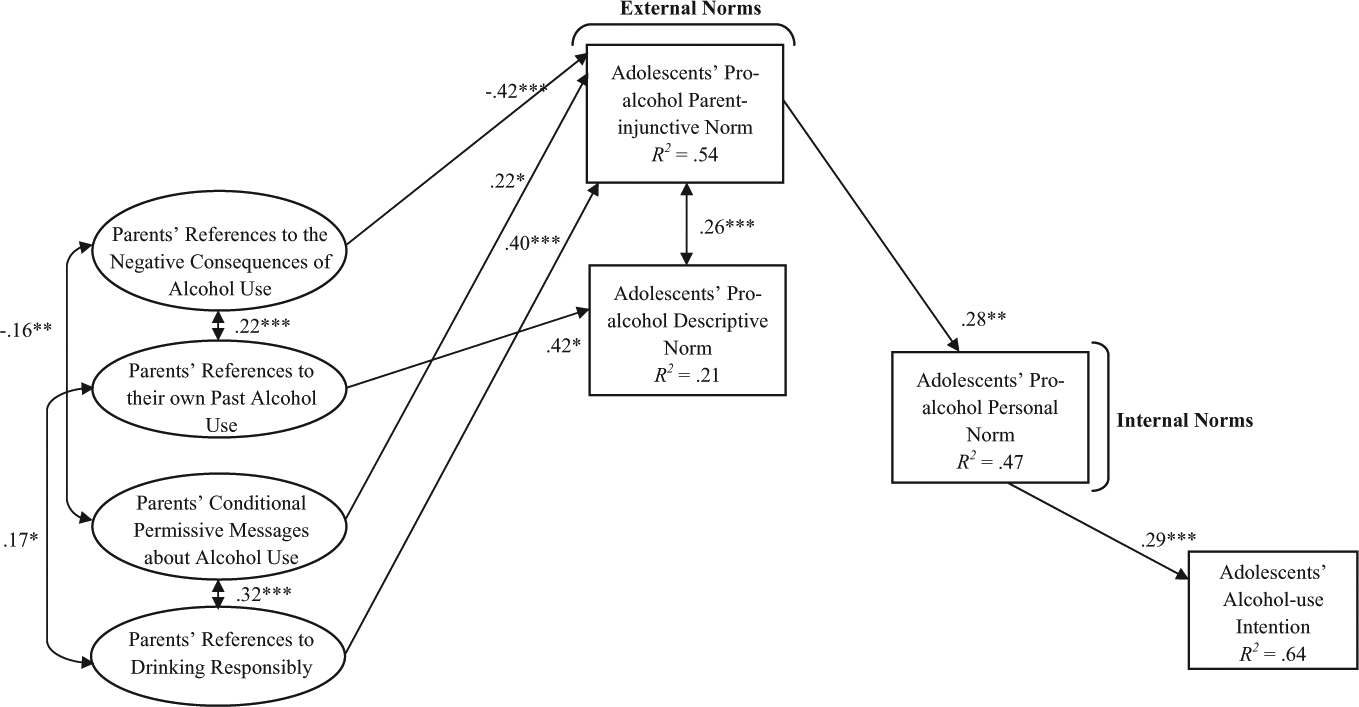
A mediation model of alcohol-related parental socialization from the adolescents’ perspective.
Hypotheses 1 (H1) and 2 (H2): The Indirect Associations Between Parent-Child Communication About Alcohol and Adolescents’ Alcohol-Use Intentions.
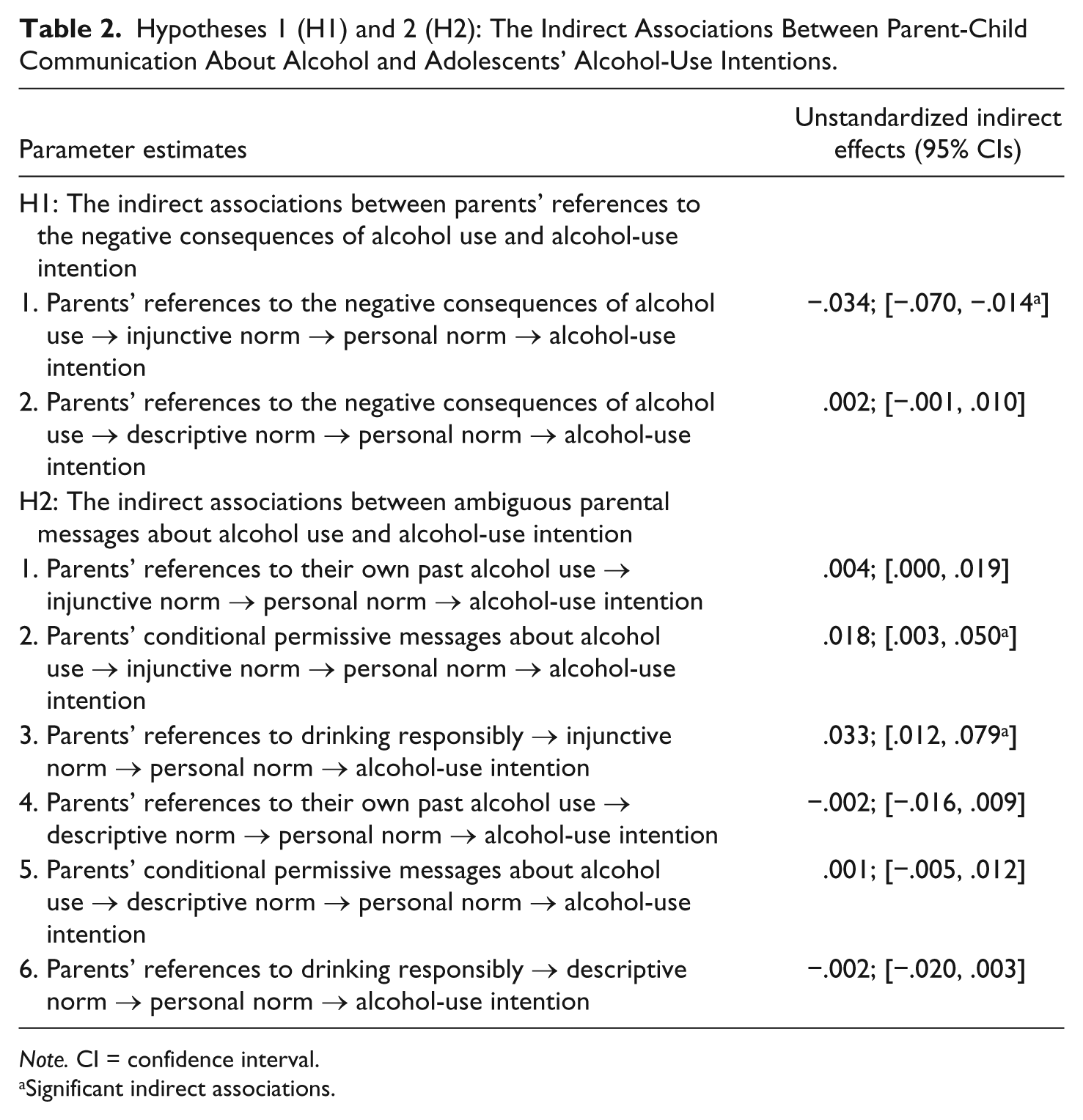
Note. CI = confidence interval.
Significant indirect associations.
With respect to H1, the unstandardized 95% bias-corrected CIs in Table 2 indicate that parents’ references to the negative consequences of alcohol use were indirectly related to adolescents’ alcohol-use intention through pro-alcohol parent-injunctive norm and pro-alcohol personal norm. More specifically, Figure 2 reveals that as parents discussed the negative consequences of alcohol use, adolescents were less likely to report pro-alcohol parent-injunctive norm, and in turn, they were less likely to report pro-alcohol personal norm, which means they were also less likely to report alcohol-use intention. Furthermore, parents’ references to the negative consequences of alcohol use were not directly significantly related to adolescents’ alcohol-use intention. For pro-alcohol descriptive norm, the 95% CIs in Table 2 indicate that pro-alcohol descriptive norm did not significantly mediate the indirect association between parents’ references to the negative consequences of alcohol use and adolescents’ alcohol-use intention. In short, H1 was supported for pro-alcohol parent-injunctive norm, but not descriptive norm.
For H2, the 95% CIs in Table 2 reveal that two significant indirect associations were found. In particular, parents’ conditional permissive messages about alcohol use were related to stronger pro-alcohol parent-injunctive norm, which were related to stronger pro-alcohol personal norm, and in turn, greater intentions to consume alcohol in the future. A similar indirect association was found with respect to parents’ references to drinking responsibly. Parents’ references to drinking responsibly were related to stronger pro-alcohol parent-injunctive norm, which were related to stronger pro-alcohol personal norm, and in turn, greater intention to consume alcohol in the future. Parents’ references to their own past alcohol use did not exhibit a significant indirect association with alcohol-use intention, and descriptive norm was not a significant mediator for any of the three ambiguous parent-child messages about alcohol. Thus, H2 received partial support for pro-alcohol parent-injunctive norm but not for descriptive norm.
H3: Moderation With Parents’ References to the Negative Consequences of Alcohol Use
H3 posited that adolescents’ perceptions of their mother’s or father’s alcohol use would moderate the association between parents’ references to the negative consequences of alcohol use and pro-alcohol external norms, which in turn, would be indirectly related to alcohol-use intention. To test H3, two mediation models were examined: one with adolescents’ perceptions of their mother’s alcohol use as a moderator and one with perceptions of their father’s alcohol use as a moderator. Both models fit the data acceptably (e.g., RMSEAs = .05-.07, CFIs = .93-.96, SRMR = .05-.06). H3 received partial support for the moderating role of adolescents’ perceptions of their mother’s alcohol use but no support with respect to father’s. More specifically, adolescents’ perceptions of their mother’s alcohol use significantly interacted with parents’ references to the negative consequences of alcohol use to predict pro-alcohol parent-injunctive norm (β = .10, b = .12, SE = .05, p < .05), and in turn, pro-alcohol personal norm, which then predicted adolescents’ alcohol-use intention (see Table 3 for indirect associations).
Hypotheses 3 (H3) and 4 (H4): The Significant Indirect Associations of the Interactions.

Note. CI = confidence interval.
Significant indirect associations.
For adolescents who reported that their mother frequently drinks alcohol, parents’ references to the negative consequences of alcohol use were related to weaker pro-alcohol parent-injunctive norm (β = −.31, b = −.36, SE = .09, p < .001). For adolescents who reported that their mother infrequently drinks alcohol, parents’ references to the negative consequences of alcohol use were also related to weaker pro-alcohol parent-injunctive norm (β = −.43, b = −.49, SE = .09, p < .001). Nevertheless, by looking at the betas for both adolescent groups, it appears that the negative association between parents’ references to the negative consequences of alcohol use and pro-alcohol parent-injunctive norm was weaker for adolescents who reported that their mother frequently drinks alcohol compared with adolescents who reported that their mother infrequently drinks alcohol. As seen in Table 3, the 95% CI also provides support for this interaction’s indirect association with adolescents’ alcohol-use intention. No other significant interactions were found for parents’ references to the negative consequences of alcohol use and adolescents’ perceptions of their parents’ alcohol consumption. Thus, descriptive norm was not a significant mediator between any of the interactions and alcohol-use intention.
H4: Moderation With Parents’ References to Their Own Past Use, Parents’ Conditional Permissive Messages, and Parents’ References to Drinking Responsibly
H4 posited that adolescents’ perceptions of their mother’s or father’s alcohol use would moderate the associations of parents’ references to their own past use, parents’ conditional permissive messages, and parents’ references to drinking responsibly with pro-alcohol external norms, which would be indirectly related to adolescents’ alcohol-use intention. To test H4, three mediation models were examined with adolescents’ perceptions of their mother’s alcohol use as a moderator. An additional three mediation models were examined with adolescents’ perceptions of their father’s alcohol use as a moderator. All of the models fit the data acceptably (e.g., RMSEAs = .05-.07, CFIs = .94-.95, SRMR = .05-.06). H4 received partial support with respect to adolescents’ perceptions of their mother’s alcohol use but no support for father’s alcohol use.
Adolescents’ perceptions of their mother’s alcohol use
Adolescents’ perceptions of their mother’s alcohol use significantly interacted with parents’ conditional permissive messages (β = −.11, b = .13, SE = .06, p < .05) and parents’ references to drinking responsibly (β = .13, b = .15, SE = .05, p < .01) to predict pro-alcohol parent-injunctive norm, which predicted pro-alcohol personal norm, and in turn, adolescents’ alcohol-use intention. For adolescents who reported that their mother frequently drinks alcohol, receiving conditional permissive messages was positively related to pro-alcohol parent-injunctive norm (β = .49, b = .51, SE = .08, p < .001), but the association was weaker for adolescents whose mother infrequently drinks alcohol (β = .33, b = .35, SE = .08, p < .001). In addition, for adolescents who reported that their mother frequently drinks alcohol, references to drinking responsibly were positively related to pro-alcohol parent-injunctive norm (β = .48, b = .47, SE = .08, p < .001), but this association was weaker for adolescents who reported that their mother infrequently drinks alcohol (β = .21, b = .20, SE = .07, p < .01). As seen in Table 3, the 95% CIs also provide support for these two significant interactions’ indirect association with adolescents’ alcohol-use intention. No significant interactions were found for parents’ references to their own past alcohol use and adolescents’ perceptions of their parents’ alcohol consumption. Lastly, descriptive norms were not a significant mediator between any of the interactions and alcohol-use intention.
Adolescents’ perceptions of their father’s alcohol use
Contrary to H4, adolescents’ perceptions of their father’s alcohol use did not significantly interact with any of the three ambiguous parent-child messages to predict pro-alcohol parent-injunctive norm or descriptive norm. Thus, H4 was not supported for perceptions of fathers’ alcohol use.
Significant Interactions and Direct Associations With Alcohol-Use Intention
Although the present study hypothesized that adolescents’ perceptions of their parents’ alcohol consumption would interact with the four types of parent-child communication to indirectly predict adolescents’ alcohol-use intention, we thought it was also important to make note of two significant direct associations between two interaction terms and alcohol-use intention (see Table 3). In particular, adolescents’ perceptions of their mother’s alcohol use significantly interacted with parents’ references to drinking responsibly to directly predict alcohol-use intention (β = .09, b = .10, SE = .05, p < .05). For adolescents who reported that their mother drinks alcohol frequently, parents’ references to drinking responsibly were positively related to adolescents’ alcohol-use intention (β = .34, b = .35, SE = .09, p < .001); however, this association was not significant for adolescents who reported that their mother drinks alcohol infrequently (β = .03, b = .04, SE = .08, p = .68).
Furthermore, adolescents’ perceptions of their father’s alcohol use significantly interacted with parents’ conditional permissive messages to directly predict alcohol-use intention (β = .11, b = .13, SE = .05, p < .01). For adolescents who reported that their father drinks alcohol frequently, parents’ conditional permissive messages were positively related to alcohol-use intention (β = .43, b = .48, SE = .10 7, p < .001), but that association was not significant for adolescents who reported that their father drinks alcohol infrequently (β = .04, b = .04, SE = .10, p = .66).
Discussion
Utilizing FTNC and PST, this study examined how four types of parent-child, alcohol-specific verbal messages were indirectly related to adolescents’ alcohol-use intention through pro-alcohol parent-injunctive norm, descriptive norm, and personal norm. Overall, this study found partial support for the hypotheses. Parents’ references to the negative consequences of drinking alcohol, parents’ conditional permissive messages, and parents’ references to drinking responsibly were indirectly related to alcohol-use intention through pro-alcohol parent-injunctive norm and personal norm. The mediation model explained small to medium amounts of the variances in norms and alcohol-use intention. Furthermore, this study examined whether adolescents’ perceptions of their parents’ alcohol use, as a form of nonverbal communication, strengthened or weakened the indirect associations between the four types of verbal messages and adolescents’ alcohol-use intention. Adolescents’ perceptions of their mother’s alcohol use moderated the associations of several parent-child verbal messages with adolescents’ pro-alcohol parent-injunctive norm, which in turn, had implications for adolescents’ alcohol-use intention. This section explicates these findings in greater detail and summarizes their implications.
H1 and H2: Elucidating the Mediation Results
This study hypothesized that external and internal norms would mediate the associations between the four types of parent-child, alcohol-specific verbal messages and adolescents’ alcohol-use intention. Consistent with the hypothesis, parents’ references to the negative consequences of alcohol use were related to weaker pro-alcohol parent-injunctive norm, and in turn, weaker pro-alcohol personal norms, which means adolescents were also less likely to report alcohol-use intention. By contrast, parents’ conditional permissive messages and parents’ references to drinking alcohol responsibly were related to stronger pro-alcohol parent-injunctive norm, and in turn, stronger pro-alcohol personal norm, which means they had a stronger intention to drink alcohol. This study’s findings are partially consistent with past research. For example, Reimuller et al.’s (2011) longitudinal study found that parents’ permissive messages were associated with increased alcohol consumption among adolescents; however, parents’ references to the negative consequences of alcohol use were not significantly related to alcohol use. They concluded that parents’ references to the negative consequences of alcohol use may not reduce alcohol use among adolescents, although the current study showed otherwise.
One possible explanation for the difference in results between Reimuller et al. (2011) and the present study is in the latter’s use of FTNC to identify the underlying psychological mechanisms that may explicate the link between parents’ references to the negative consequences of alcohol use and adolescents’ alcohol-use intention, whereas Reimuller et al. only examined direct associations with alcohol use. Another possible explanation may be the different negative consequences (e.g., upsetting one’s parents and experiencing the dangers of alcohol use) that the current investigation focused on compared with Reimuller et al. (e.g., drinking alcohol can result in a loss of control or alcoholism). Despite the slight difference in findings, the present study provides additional evidence for the potentially problematic nature of conditional permissive messages and references to drinking responsibly, which falls in line with Reimuller et al. Consistent with past research on targeted parent-child communication about alcohol (e.g., Kam & Middleton, 2013), referring to the negative consequences of alcohol consumption was related to weaker pro-alcohol norms and alcohol-use intention, thereby providing support for its protective nature and the importance of using FTNC.
Another finding worth noting is that pro-alcohol parent-injunctive norm did not directly predict alcohol-use intention in the present study; however, it indirectly predicted alcohol-use intention through pro-alcohol personal norm. This finding is consistent with Kam et al. (2009) who also found that pro-alcohol parent-injunctive norm indirectly predicted early adolescents’ alcohol-use intention through pro-alcohol personal norm. In addition, Kam and Yang (2014) found that pro-alcohol parent-injunctive norm indirectly predicted early adolescents’ intentions to intervene in a friend’s alcohol use through pro-alcohol personal norm. Thus, even though pro-alcohol parent-injunctive norm was not directly associated with alcohol-use intention in the present study, it may exhibit an indirect association. Such findings emphasize the importance of incorporating this extended version of FTNC in which external norms predict internal norms.
Although pro-alcohol parent-injunctive norm and personal norm exhibited significant mediation, pro-alcohol descriptive norm was not a significant mediator. This result is similar to Kam and Yang (2014) who found that targeted parent-child communication about substance use significantly predicted parent-injunctive norms about substance use but not descriptive norms among Latino and European American early adolescents. The present study hypothesized that parents’ discussions of alcohol use might make adolescents think that alcohol use is common, particularly among their age group. One possible explanation, however, for the nonsignificant associations between parent-child communication about alcohol and descriptive norms is that none of the messages specifically refers to others who engage in alcohol use.
Interestingly, parents’ references to their own past alcohol use were not significantly indirectly related to alcohol-use intention through external or internal norms. To the authors’ knowledge, the current study is one of few to empirically test the associations of these two types of parent-child, alcohol-specific verbal messages with alcohol-use beliefs and intention; therefore, little is known regarding how these associations operate. Kam and Middleton (2013) tested the associations between parents’ references to their own past substance use and early adolescents’ substance-use beliefs and behaviors. They found that parents’ references to their own past alcohol use were related to stronger pro-substance-use-injunctive norms for Latino early adolescents, and they were related to stronger pro-substance-use attitudes for European American early adolescents. Nevertheless, it is important to note that Kam and Middleton’s study focused on a sample of early adolescents (sixth-eighth grades), whereas the current investigation concentrated on high school students primarily of European American origin.
H3 and H4: Elucidating the Moderation Results
When considering the moderation results, H3 received support with respect to adolescents’ perception of their mother’s alcohol use but not father’s alcohol use. For adolescents who reported that their mother drinks alcohol frequently, parents’ references to the negative consequences of alcohol use were related to weaker pro-alcohol parent-injunctive norm, and in turn, weaker pro-alcohol personal norm, which means lower alcohol-use intention. Those associations, however, were stronger for adolescents who reported that their mother drinks alcohol infrequently. Based on Dailey (2008), it was hypothesized that such nonverbal and verbal messages would contradict each other, thereby weakening the association between parents’ references to the negative consequences of alcohol use and pro-alcohol parent-injunctive norm. Consistent with this notion, the present study found that perceiving one’s mother or father drinking alcohol frequently may undermine parents’ references to the negative consequences of drinking alcohol. In particular, social learning theory (SLT) suggests that it is not only what people hear (i.e., verbal messages) that influences their behavior but also what they observe in others’ behavior. Bandura (1971) stated, “observing models engage in threatening or prohibited activities without experiencing any adverse consequences can reduce inhibitions in observers” (p. 11). If adolescents do not observe negative consequences of drinking behavior, they may not be deterred from engaging in alcohol consumption.
Another important result worth noting is that conditional permissive messages and references to drinking responsibly were related to greater pro-alcohol parent-injunctive norm for adolescents who perceived their mother frequently drinks alcohol, but the associations were weaker for adolescents who perceived their mother infrequently drinks alcohol. This finding is consistent with the fourth hypothesis. Perceiving that one’s mother drinks alcohol frequently seemed to strengthen the associations that conditional permissive messages and references to drinking responsibly shared with pro-alcohol parent-injunctive norm. This interaction was also significantly indirectly related to adolescents’ alcohol-use intention through pro-alcohol personal norm. The moderating role of adolescents’ perception of their mother’s alcohol use may provide further evidence for Dailey (2008) who suggested that messages are more influential when nonverbal messages fall in line with the verbal messages.
Although adolescents’ perception of their mother’s alcohol use moderated the associations between several parent-child communication messages and pro-alcohol parent-injunctive norm, adolescents’ perception of their father’s alcohol use did not significantly moderate these associations. The third and fourth hypotheses were not supported with respect to adolescents’ perception of their father’s alcohol use; however, father’s alcohol use did moderate the direct association between parents’ conditional permissive messages about alcohol use and adolescents’ alcohol-use intention. Perceiving that one’s father drinks alcohol frequently strengthened the associations that conditional permissive messages shared with adolescents’ alcohol-use intention.
Thus, two questions emerge. First, why did adolescents’ perceptions of their mother’s alcohol use act as a significant moderator in the hypothesized ways, but adolescents’ perceptions of their father’s alcohol use did not function in the hypothesized manner? Miller-Day’s (2002) work on parent-child communication and substance use suggests that adolescents preferred and expected to have discussions about substance use with their mothers rather than their fathers because they felt closer to their mothers. Perhaps, then, relationship characteristics such as closeness or communication characteristics such as openness would shed light on the differences between mothers’ and fathers’ communication with their children. Overall, previous research on parent-child communication about alcohol and other substances seems to suggest that mothers and fathers differ in significant ways. Future research should continue to explore the characteristics that contribute to these differences.
A second question that emerged is as follows: When adolescents’ perception of their father’s alcohol use acted as a significant moderator, why did it only interact with parents’ conditional permissive messages about alcohol use? One explanation may be that fathers engage in conditional permissive messages more often than mothers, although future research would have to verify this possibility. This study did not separate each verbal message by father and mother; therefore, it cannot state whether fathers or mothers were more likely to use certain verbal messages over others. In the future, it may be important to parse out whether gender differences exist with respect to each type of verbal message. If the influences of mothers and fathers are significantly different (as they are here), this has significant implications for intervention. For instance, it seems that adolescents expect and desire to engage in conversations about substance use with mothers (Miller-Day, 2002), and mothers’ (but not fathers’) alcohol behaviors are significantly related to the impact of verbal messages. If mothers play a different role in substance use behavior than fathers, then their roles as parents in intervening in this behavior will look quite different. Moreover, efforts may be made to help adolescents feel more comfortable with fathers playing a larger role in the anti-alcohol socialization process.
Theoretical and Practical Implications
Overall, this study makes several theoretical and practical contributions. First, Bandura’s (1971) discussion of SLT suggests that adolescents learn behavior from models, and although parents represent one important model, others (e.g., media) certainly exist. In this article, we continue in the line of previous research on SLT in the context of adolescents’ substance use by focusing specifically on parents as models. Second, the findings provide greater specificity for PST by presenting parent-child communication as multidimensional. PST suggests that parents (and other socialization agents) shape adolescents’ substance-use beliefs and behaviors through communication (Oetting & Donnermeyer, 1998), and FTNC identifies certain norms that predict intentions and behaviors (Reno et al., 1993). Given that these two theories did not emerge from the communication field, their lack of attention to communication is understandable. Nevertheless, the present study extends PST and FTNC by identifying how different types of verbal and nonverbal messages work together in relation to adolescents’ alcohol-use norms and intention. Treating targeted parent-child communication as multidimensional illustrates the positive and negative influences that parents may have on their adolescents’ alcohol-related norms and intention.
When considering the various types of parent-child, alcohol-specific verbal messages, this study also contributes to the literature on parents’ references to their own past alcohol use. Although the Hazelden Foundation (Hazelden, 2012) and Partnership for a Drug-Free America (2012) advise parents to use their own past experiences with substance use as teachable moments for their children, limited empirical research has tested the effects of engaging in such conversations. In their study, Kam and Middleton (2013) found that engaging in such conversations may not be protective against substance use. Given that they were one of the first studies to examine this association, they also called for additional empirical research to test the associations. By contrast, the present study found that parents’ references to their own past alcohol consumption were not significantly related to any of the variables in the model. Further research is necessary to fully understand how, if at all, parents’ references to their own past alcohol use shape adolescents’ alcohol-related norms, intentions, and behaviors. Nevertheless, the current study indicates that among this particular group of high school students, learning of their parents’ past alcohol consumption was not indirectly related to their alcohol-use intention.
In addition to making several theoretical contributions, this study’s findings inform the design of family-based alcohol-use prevention interventions for adolescents in high school. By treating targeted parent-child communication about alcohol as multidimensional, the present study identified several types of verbal messages that prevention scientists may want to promote or discourage. For example, although parents may be well-intentioned when they offer conditional permissive messages to their children or discuss responsible drinking, Reimuller et al. (2011) and the current study have shown that such messages are associated with higher rates of alcohol-use intention or use among adolescents. Moreover, the ambiguity of such messages may have an impact on adolescents’ interpretations, particularly because adolescents may be searching for conflicting messages from their parents (Grebelsky-Lichtman, 2014). As such, although parents’ primary goal may be to protect their adolescent children, it may benefit them to use clear, unambiguous messages discouraging substance use. This may be particularly important for parents who drink alcohol in front of their children. Specifically, the results of this study indicate that it may be important for these parents to engage in verbal communication that emphasizes the negative consequences of alcohol use to avoid any ambiguity between their verbal interactions and the nonverbal behavior that their children observe.
Limitations and Future Research
Although this study offers important theoretical and practical contributions, it is constrained by several notable limitations. First, in considering the role of parent-child communication in adolescents’ alcohol-use behaviors, we elicited responses from adolescents regarding their own and their parents’ communication. Nevertheless, parent-child communication is a transactional process that occurs between the parent and the child; therefore, this area of research would benefit from acquiring data from both parties. Previous research has established that a hallmark of close relationships is their interdependence (Berscheid, 1983). As such, the parents’ perspective is critical for offering a more robust understanding of verbal and nonverbal communication about alcohol-related beliefs and behaviors. Future research should focus on obtaining the parents’ perspective as a complement to the current study.
Second, the data collected for this study are cross-sectional in nature. Although we used previous research and theory to guide our predictions, the cross-sectional nature of the data precludes us from making causal claims about the directionality of our predictions. For example, we contend that parents’ references to the negative consequences of alcohol use predict norms, which in turn, predict adolescents’ alcohol-use intention. It is possible, however, that adolescents’ alcohol-use intention results in their parents engaging in targeted parent-child communication in an attempt to intervene. Longitudinal research would be useful in clarifying the causal order of relationships among the variables in our study.
Third, due to the time constraints of collecting data in a school setting, the measures that we used to operationalize many of the concepts were abbreviated or omitted. For example, parents’ references to the negative consequences of alcohol use and parents’ conditional permissive messages were each measured with only two items. Although we are encouraged by the psychometric properties of our measures and their relationships with other measures in the study, more comprehensive measures may provide additional insights into the concepts of interest. Another measurement concern is that this study did not include observational data on parents’ alcohol use and how that might have impacted the adolescents’ drinking intention. Clear articulation of observing parents’ alcohol use in the future may bolster the current data gathered on this important issue and contribute to prior literature (Vermeulen-Smit et al., 2012).
Finally, some marked differences existed between adolescents’ perceptions of their mother’s and father’s verbal and nonverbal communication. We proposed possible explanations for the differences. Nevertheless, our study and the results of Miller-Day (2002) reveal that further research is necessary to clarify the mechanisms behind these gender differences.
Despite this study’s limitations, it is one of the first to examine whether perceptions of parents’ alcohol use may undermine or enhance what parents say about drinking alcohol. The findings demonstrate the importance of conceptualizing and operationalizing targeted parent-child communication as a multidimensional construct with respect to verbal and nonverbal messages. Studying the unique associations that parent-child, alcohol-specific verbal and nonverbal messages have with adolescents’ alcohol use is essential to extending theory and enhancing alcohol-prevention interventions for adolescents.
Footnotes
Acknowledgements
The authors would like to thank the undergraduate and graduate students who assisted in this study’s data collection and data entry, as well as the principal, teachers, staff, and students who contributed to this study.
Declaration of Conflicting Interests
The authors declared no potential conflicts of interest with respect to the research, authorship, and/or publication of this article.
Funding
The authors disclosed receipt of the following financial support for the research, authorship, and/or publication of this article: This study was funded by the Campus Research Board Award, which the first author received when she was an assistant professor in the Department of Communication at the University of Illinois at Urbana–Champaign.