



Abstract
Trust is a valued resource of any organization and is a necessary component of a positive, healthy work environment. In corrections, the work environment is critical to ensure the safety and security of staff, inmates, and the community. The demands of correctional work can lead to job burnout, which has been linked to psychological and physical health problems, decreased work productivity, increased absenteeism, and heightened turnover intent and turnover. Thus, it is paramount for corrections to find methods that can alleviate job burnout effectively. Three types of burnout have been identified in the literature: emotional exhaustion, depersonalization, and a feeling of ineffectiveness. This study explored whether correctional staff trust in supervisors and management reduced burnout. Six hypotheses were proposed examining the three types of burnout and the two levels of trust. Results indicate that levels of burnout were lower when workers trusted their supervisors and management in five of the six hypotheses proposed.
Although job burnout is found in almost all occupational fields, it is more likely to occur in human service professions (Cherniss, 1980a, 1980b; Cordes & Dougherty, 1993; Garner, Knight, & Simpson, 2007). Maslach and Jackson (1981) contended that burnout “occurs frequently among those who do ‘people work’ of some kind” (p. 99). Although working in the human service field has its unique rewards, it also has its unique problems. Working with people can be challenging and demanding. It has been argued that employees working in human service organizations are sometimes under great pressure and strain, which in the end can lead to burnout (Cordes & Dougherty, 1993; Maslach & Jackson, 1981). For example, working with individuals who are being confined against their will can be a demanding experience. Armstrong and Griffin (2004) contended that “few other organizations are charged with the central task of supervising and securing an unwilling and potentially violent population” (p. 577). Over time, this can lead to strain and ultimately to job burnout. Burnout is, therefore, a real possibility in the field of corrections (Carlson, Anson, & Thomas, 2003; Morgan, Van Haveren, & Pearson, 2002; Whitehead, 1989; Whitehead & Lindquist, 1986). Furthermore, research indicates that correctional staff report one of the highest rates of psychological claims among human service workers (Dollard, Winefield, & Winefield, 2001) and higher levels of burnout than the general population, including police officers (Keinan & Malach-Pines, 2007).
Job burnout is costly to all involved. It detracts from the quality of life for the person suffering from it. It is associated with increased substance abuse problems, psychological and physical health problems, conflicts at home, and withdrawal from others (Belcastro, Gold, & Grant, 1982; Carlson & Thomas, 2006; Lambert, Hogan, & Altheimer, 2010; Neveu, 2007). Coworkers, inmates, and the correctional facility are harmed from burnout (Garner et al., 2007; Whitehead, 1989). Garland (2002) contended that “unless the burnout victim receives help and recovers, mustering the energy to function at an ordinary level will become a continual struggle” (p. 116). Burnout has been linked with decreased work performance, increased absenteeism, heightened turnover intent and turnover, and disengagement from coworkers and from the job (Belcastro et al., 1982; Carlson & Thomas, 2006; Demerouti, Bakker, Vardakou, & Kantas, 2002; Garland, 2002; Lambert, Hogan, & Altheimer, 2010; Maslach & Jackson, 1981; Neveu, 2007; Schaufeli & Peeters, 2000). Because of reduced quality of work and increased work demands, burnout can spread to other employees, creating a looping cycle (Maslach, Schaufeli, & Leiter, 2001).
As the costs of burnout are high, investigating forces that may lead to burnout is important. Although there is a growing body of literature that focuses on correctional staff, very little research has been conducted on burnout either in the United States or globally (Cieslak, Korczynska, Strelau, & Kaczmarek, 2008; Garland, 2002). Neveu (2007) reported that he found only 16 published studies on correctional staff burnout. To respond to the problem, a better understanding of the forces linked with burnout is necessary. This study, therefore, was undertaken to examine the effects of perceptions of supervisor trust and management trust on burnout among staff members at a midwestern correctional facility.
Literature Review
Burnout
Freudenberger (1974) is given credit for proposing the term burnout. He postulated that job burnout occurs when a person becomes psychologically worn out from the job because of excessive demands at work. Maslach (1978), who is seen as a pioneer in the study of burnout, proposed that burnout occurs when a person experienced “the gradual loss of caring about the people they work with. Over time, they find that they simply cannot sustain the kind of personal care and commitment required in the personal encounters that are the essence of their job” (p. 56). Pines and Kafry (1978) defined burnout as psychological discontent, discomfort, and distress resulting from tedium at work and contended that these psychological strains led a person to experience emotional and physical depletion from the job. Similarly, Kahn (1978) saw burnout as negative views of coworkers, clients, and one’s self that resulted from excessive demands from the job, which drained the person over time. Freudenberger (1980) refined his definition of burnout to refer to when a person was “in a state of fatigue or frustration” from the job (p. 13). Cherniss (1980a, 1980b) saw burnout as a three-stage event: First was an imbalance of work demands and resources, which resulted in psychological strain for the person. The second stage involved treating coworkers and clients in a depersonalized manner, and this stage was the result of the strain from the first stage. The third stage was the development of self-perceptions of being ineffective at work, which resulted in withdrawal from others and the job. Cherniss (1980a, 1980b) contended that workplace factors, and not personal characteristics, were responsible for job burnout.
Maslach and Jackson (1981) built on the early work of Maslach (1978) and identified burnout as “a syndrome of emotional exhaustion and cynicism that occurs frequently among individuals who do ‘people work’ of some kind” (p. 99). They contended that workplace factors placed excessive demands on a person, resulting in strain, which then resulted in burnout in three different areas. Maslach and Jackson (1981, 1984) further theorized that job burnout comprised three separate dimensions: emotional exhaustion, depersonalization, and a reduced sense of accomplishment at work. They defined emotional exhaustion as a feeling of being emotionally drained and fatigued from the job. They defined depersonalization as treating coworkers and clients in an impersonal and callous manner. Finally, they indicated that a reduced sense of work accomplishment was the perception of being ineffective in dealing with others at work and not making a positive impact. To Maslach and Jackson (1981, 1984) and Maslach (2003), burnout was ultimately caused by workplace factors that placed strain on a person. Maslach (2003) contended that burnout was the “chronic strain that resulted from an incongruence, or misfit, between the worker and the job” (p. 198).
The above definitions have two major commonalities. First, factors lead to a psychological strain for a person, leading to feeling drained from work, treating others at work as objects, and feeling that one is not effective at work. Second, workplace factors and not personal characteristics trigger burnout (Maslach et al., 2001). Maslach (2003) pointed out that
among the general public, the conventional wisdom about burnout is that the problem lies within the person. Some argue that the person who burns out is trying too hard and doing too much, whereas others believe that the weak and incompetent burn out; however, research results have not supported the argument that burnout is related to a person’s disposition. (p. 191)
Where the above theories differ from one another is whether burnout is a uni- or multidimensional concept. Today, the general view of job burnout is that proposed by Maslach and Jackson (1981) of burnout having the three related but distinct dimensions of emotional exhaustion, depersonalization, and feelings of being ineffective at work (Maslach & Leiter, 1997; Poghosyan, Aiken, & Sloane, 2009; Schaufeli & Peeters, 2000).
Although some people consider job stress and burnout the same concept, they are not interchangeable terms but, rather, are distinct concepts (Maslach & Jackson, 1981; Whitehead, 1989). Job stress is a feeling of anxiety and frustration, whereas burnout is the long-term outcome that results from the prolonged effects of job strains, including job stress (Maslach & Jackson, 1981). Researchers have also found that job stress has been linked with increased levels of correctional staff burnout, but again, the two remained separate concepts (Garner et al., 2007; Keinan & Malach-Pines, 2007; Maslach & Leiter, 1997; Pines & Keinan, 2005; Whitehead, 1989).
There is a small, but growing, body of published research on correctional staff job burnout. The research suggests that workplace factors are more important than are personal characteristics in explaining burnout of correctional staff (Garner et al., 2007; Gerstein, Topp, & Correll, 1987; Griffin, Hogan, Lambert, Tucker, & Baker, 2010; Lambert, Hogan, & Altheimer, 2010). The workplace stressors of role conflict, role ambiguity, perceived dangerousness of the job, work–family conflict, and harassment have been reported to be positively linked with burnout from the job (Cieslak et al., 2008; Dignam, Barerra, & West, 1986; Drory & Shamir, 1988; Garland, 2004; Lambert & Hogan, 2010; Lambert, Hogan, & Altheimer, 2010; Lambert, Hogan, Jiang, & Jenkins, 2009; Lindquist & Whitehead, 1986; Savicki, Cooley, & Gjesvold, 2003; Shamir & Drory, 1982; Whitehead, 1989). Support in the workplace, in the forms of supervisory support, administrative support, and coworker support, has been observed to be negatively associated with correctional staff burnout (Cieslak et al., 2008; Drory & Shamir, 1988; Garland, 2004; Neveu, 2007; Savicki et al., 2003). Input into decision making, instrumental communication, distributive justice, procedural justice, and perceptions of promotional opportunities have been associated with lower levels of job burnout (Dollard & Winefield, 1998; Lambert, Hogan, & Jiang, 2010; Lambert, Hogan, Jiang, et al., 2010; Lindquist & Whitehead, 1986; Neveu, 2007; Whitehead, 1989; Whitehead & Lindquist, 1986). Job stress has been found to lead to increased reports of being burned out (Garner et al., 2007; Keinan & Malach-Pines, 2007; Whitehead, 1989). Conversely, job satisfaction appears to lessen the chances of job burnout for correctional staff (Griffin et al., 2010; Whitehead, 1989; Whitehead & Lindquist, 1986). Although it has been postulated that working directly with inmates raises the chances of job burnout, the literature on this is mixed. Gerstein et al. (1987) reported that custody officers had a higher level of reported burnout than staff who did not have regular contact with inmates. In a study of state prison staff, greater daily contact with inmates was positively associated with burnout (Lambert, Hogan, & Jiang, 2010). In three other studies, the amount of contact with inmates was not associated with burnout (Morgan et al., 2002; Lambert et al., 2009; Whitehead & Lindquist, 1986).
This literature points to two important conclusions. First, workplace factors appear to be important in influencing burnout among correctional staff. Second, there is a need for much more research in this area, particularly to examine whether previous findings can be replicated. Moreover, only a fraction of workplace factors and their relationships with correctional staff burnout have been explored, such as supervisor trust and management trust.
Trust
Trust is a common concept in everyday life but is not readily defined by most people (Kramer, 1999). Rotter (1967) defined trust as “an expectancy held by an individual or a group that the word, promise, verbal or written statement of another individual or group can be relied upon” (p. 651). It is the expectation that a promise will be carried out (Lewicki, McAllister, & Bies, 1998). Rousseau, Sikin, Burt, and Camerer (1998) saw trust as “a psychological state comprising the intention to accept vulnerability based upon positive expectations of the intentions or behaviors of another” (p. 395). Boiled down to its simplest definition, trust refers to belief that someone will carry out what he or she said that he or she would do (Chughtai & Buckley, 2008). Some definitions of trust take it a step farther and add the requirement that the actions will benefit the person who trusts that another person will carry out some expected action. Robinson (1996) saw trust as the “expectations, assumptions, or beliefs about the likelihood that another’s future actions will be beneficial, favorable, or at least not detrimental to one’s interests” (p. 576). Similarly, Zhang, Tsui, Song, Li, and Jia (2008) viewed trust as the belief by one person or party that another person or party would act benevolently toward them. In addition to expected actions that are beneficial (or at least not harmful), other definitions add honesty to the definition. Whitener, Brodt, Korsgaard, and Werner (1998) defined trust as the belief by one person that the other person or persons would act honestly and benevolently in carrying out promised actions. In simple terms, trust is the belief that there will be congruency of what is said and what is actually done.
For trust to occur, there must be at least two parties, the trustor (the person who is trusting that an expected outcome will occur) and the trustee (the person or persons who are being trusted to carry out an expected outcome) (Whitener et al., 1998). The trustor must have a belief that the other party will carry through on the promised action. If the trustor has no faith that the other party will engage in the promised action, there can be no trust relationship. Trust is, therefore, a psychological state for the trustor (Rousseau et al., 1998). Trust means that a trustor becomes vulnerable to the actions of the trustee (Mayer, Davis, & Schoorman, 1995). The trust between the two parties can end if the trustee fails to carry through on the expected actions. The definitions of trust generally include that the trustee will honor his or her word and will act fairly or benevolently. This is the definition of trust used in this study. Trust often forms or is broken on the basis of an evaluation of what has occurred in the past (Zhang et al., 2008). Broken trust relationships can take a long time to rebuild. To rebuild these relationships, the trustee must explain to the trustor what went wrong in the past and ensure that future promises are kept. Trust is a mental state based on perceptions of a trustor. The trustor must feel that the trustee is trustworthy. If a trustor perceives a trustee to be honest and reliable, there is a good likelihood that trust will be formed (Kramer, 1999; McAllister, 1995). Trust, therefore, is built over time and develops because of the perceived fairness and consistency of actions (Mayer et al., 1995). These perceptions do not need to be accurate for the results to be real for the trustor.
Trust is very important in organizations. It is the social lubricant for organizations. Zhang et al. (2008) contended that trust “is a fundamental ingredient in any positive and productive social process” (p. 111). Wong and Cummings (2009) contended that trust is necessary for a healthy work environment. Trust has been postulated to be linked with greater productivity of employees (Mayer & Davis, 1999). Organizations with staff who trust those in charge tend to be more successful in the long run than those organizations with staff who do not trust those in charge (Robinson, 1996). Lack of trust hinders work relationships, duties, and efforts (Harvey, Kelloway, & Duncan-Leiper, 2003). Organizations and employees enter into psychological contracts of what is expected and owed to each party, and trust is a critical component of these contracts (Robinson, 1996; Rousseau, 1989). Trust is predicated on the social exchange principle. Employees will put forth effort at work in return for promises they expect to be kept. If employees lack trust, negative employee outcomes are possible.
Employee trust has two dimensions, supervisor trust and management trust (Chughtai & Buckley, 2008; Masterson, Lewis, Goldman, & Taylor, 2000). Supervisor trust refers to the degree of trust a staff member has with his or her supervisor. Management trust deals with the degree of trust a staff member has with trust in the overall organization. Management represents the correctional organization and is responsible for setting and carrying out the goals and objectives of the correctional organization. Management trust is the general overall trust of the correctional organization (Lambert, Jiang, & Hogan, 2008). Although it is sometimes referred to in the literature as organizational or administrative trust, the more common term of management trust was used in the current study.
Although employee trust is theoretically important for correctional organizations, there has been very little research in the area. Only four published studies were located. Among correctional staff at a federal facility in New York City, trust in management was positively associated with commitment to the Federal Bureau of Prisons (i.e., agency commitment; Kane, Saylor, & Nacci, n.d.). Liou (1995) found that supervisor trust was negatively related with job stress among staff at two juvenile detention centers. Furthermore, Liou indicated that there is a need to examine the effects of trust on correctional staff. Among midwestern correctional staff, supervisor trust and management trust had significant negative associations with job stress and positive associations with both job satisfaction and organizational commitment (Lambert et al., 2008; Lambert & Hogan, 2009). This limited research points to two conclusions. First, supervisor trust and management trust are significant predictors of salient correctional staff outcomes. Second, much more research on the effects of supervisor trust and management trust are needed.
Research Focus
Building on the previous correctional research, we explored the effects of supervisor trust and management trust on job burnout. The job demands–resources model provides the theoretical framework for the study (Karasek, 1979). In the job demands–resources model, the work environment can be divided into two fundamental categories, job demands and job resources (Bakker & Demerouti, 2007; Demerouti, Bakker, Nachreiner, & Schaufeli, 2001; Lee & Ashford, 1996). Job demands are those things at work that place pressure or strain on a worker. Job resources are those work forces that are important for employees to complete their jobs and help lessen the effects of job demands (Cieslak et al., 2008; Neveu, 2007; Schaufeli & Salanova, 2007). Job resources can also meet the needs of employees, such as being valued and respected (Demerouti et al., 2001). A lack of critical job resources can reduce the ability of employees to be successful in their jobs, which ultimately places greater pressures, demands, and strains on them (Bakker & Demerouti, 2007; Halbesleben, 2006). The literature indicates that job burnout is influenced by both job demands and job resources. There are many different aspects of the work environment that can be classified as either demands or resources for correctional staff.
Supervisor trust and management trust should be linked with burnout for two reasons: (a) direct (a lack of trust can be a stressor) and (b) trust can act as a buffer to other stressors linked with burnout. First, trust can be a benefit for staff, whereas a lack of trust can be a strain. For example, trust in supervisors and management can provide a positive feeling for staff, ultimately resulting in a salient resource for them to accomplish their jobs. Likewise, a lack of or lowered trust in management may function as a missing critical element necessary for being successful at work. This lack of or lowered trust potentially may lead to direct strain for staff, which can wear over time and lead to burnout from the job. Second, with the buffering or insulating perspective, supervisor trust and management trust can help correctional staff deal with other work demands, which ultimately reduces the chances of suffering from burnout (Neveu, 2007). Trust in supervisors and management may allow staff to be more accepting of work demands and the perception of long-range positive outcomes. On the other hand, lack of trust can act in concert with other work demands, heightening the chances of job burnout. In addition, trust can allow staff experiencing strain to turn to others for help and guidance. This can provide staff with both possible solutions to the problems they face and faith that they can overcome them (Cordes & Dougherty, 1993). In a sense, trust can be seen as a method for providing employees with the confidence that they will be successful in the long run. A lack of trust means that the potential resources for dealing with work strain will not be sought or accepted as valid. In addition, trust can help reduce or eliminate other work demands from occurring. Part of trust is bidirectional communication between staff and supervisors and management. This communication can help address problem areas before they grow over time and place greater strain on staff. From this perspective, supervisor trust and management trust act as buffering and insulating agents as well as coping mechanisms (Harvey et al., 2003).
Both forms of trust, therefore, should have both direct and indirect effects on job burnout. Supervisors play a vital role for staff (Cherniss, 1980b). Supervisors provide guidance, direction, control, and feedback for employees (Brough & Williams, 2007). Supervisor trust is critical (Deluga, 1994); therefore, supervisor trust was hypothesized to have a negative association with emotional exhaustion, depersonalization, and feelings of being ineffective at work. Similarly, management trust is a critical element for many staff. Management represents the organization (Robinson, 1996). It is difficult not to have a trust bond with the employing organization. Management trust should provide a sense of security in working at the correctional facility because in the long run, management should be looking out for the best interests of the employee and facility as a whole. A lack of trust in management can lead to a sense of uncertainty about what management will do and what the future holds. In addition, it can cause staff to question organizational decisions, which can be stressful in itself and hamper the ability to complete work duties (Lambert et al., 2008). Suspicion can arise when staff does not trust management, and this can lead staff to question the motivations of decisions made by management. Thus, the following hypotheses were proposed:
Hypothesis 1: Supervisor trust would be negatively related to emotional exhaustion.
Hypothesis 2: Supervisor trust would be negatively related to depersonalization.
Hypothesis 3: Supervisor trust would be negatively related to feelings of being ineffective at work.
Hypothesis 4: Management trust would be negative related to emotional exhaustion.
Hypothesis 5: Management trust would be negatively related to depersonalization.
Hypothesis 6: Management trust would be negatively related to feelings of being ineffective at work.
Method
Participants
A human participants review board–approved survey packet was provided to all the available staff members at a midwestern private correctional facility. Although there were about 220 staff members, only 200 staff members were provided a survey packet. Some staff members were off duty (e.g., vacation leave, sick leave, administrative leave) during the 2-week period of the survey. The correctional facility was a maximum-security-level closed facility administered by a private company contracted by the state government to house 480 young male inmates adjudicated as adults who were serving long prison sentences. At the time of their crime, the inmates were juvenile offenders who were transferred to and sentenced by adult court. All the inmates were serving long sentences for serious crimes, particularly for violence. After an offender reached 20 years of age, he was transferred to an adult state-run correctional facility.
The survey packet contained a cover letter, a survey, a return envelope, and a bifurcated raffle ticket. The cover letter explained the nature of the survey, that participation was voluntary, and that responses would be anonymous and would remain confidential. Prior to the administration of the survey, it was pilot tested among a group of correctional employees. The survey was 16 pages long and included more than 220 questions about a wide array of concepts about working at the facility. 1 The return envelope had a mailing address of one of the researchers. The bifurcated raffle ticket allowed staff members to be included in a cash raffle. Several cash prizes ranging from $50 to $150 were offered in a raffle to increase the response rate, and a total of $500 was provided as prizes. All that a staff member needed to do to participate in the raffle was to return half of the ticket, regardless of whether the survey was completed. To ensure that a particular staff member could not be linked to a particular survey, the raffle tickets were separated from the return envelopes before any of the surveys were examined. Several weeks after the surveys were collected, a drawing was held at a staff function. Staff members with winning raffle tickets were awarded cash prizes. All unclaimed cash prizes were donated to the facility’s employee organization. With 160 completed surveys returned, the response rate was 80%.
The median age of the participants was 33 and ranged from 19 to 68 years old. The median tenure at the facility was 17 months and ranged from 1 to 53 months. Tenure did not exceed 54 months because the facility had been open for less than 5 years at the time of the survey. In terms of highest educational level, 6% had a high school degree or GED, 47% had some college but no degree, 24% had an associate’s degree, 16% had a bachelor’s degree, and 7% had a graduate or professional degree. With regard to race-ethnicity, 79% of the respondents were White, 11% Black, 2% Hispanic, 3% Native American, and 4% Other. In terms of position, approximately 62% were correctional officers, 6% worked in the business office, 4% worked in education, 4% were unit management staff (i.e., counselors, case managers, and unit managers), 3% worked in the medical department, 9% were custody supervisors, and 13% worked in other areas. The typical employee had worked in the field of criminal justice for approximately 3.70 years. Approximately 59% of the participants were men, and 41% were women. Overall, the respondents appeared to be demographically representative of the total employee population at the private correctional facility; at the time of the survey, 61% of the staff members were men, 81% were White, and 66% were custody (correctional) officers. According the personnel office at the facility, the median age range of staff was 34 years old, and the median tenure was approximately 20 months. No educational information could be provided by the personnel office at the private correctional facility.
Dependent Variables
Three dimensions of burnout—emotional exhaustion, depersonalization, and feeling ineffective in dealing with others at work—were the dependent variables in this study. Emotional exhaustion was measured using three items (see appendix for the items). The items tapped into the emotional strain participants felt from their jobs. The responses for the three items were summed together to form an index, and the index had a Cronbach’s alpha value of .85. A perception of treating others in a depersonalized manner was measured using four items (see appendix). The items asked participants whether they had treated inmates as impersonal objects, had become more callous toward coworkers, and/or had become less sympathetic with others at work. The items had a Cronbach’s alpha value of .74. An additive index was created from these items. An index of perceptions of being ineffective in working with others, including fellow staff and inmates, was created by summing together the responses to six items (see appendix). The Cronbach’s alpha for the items was .72.
Independent Variables
Supervisor trust and management trust were the two independent variables of interest in this study. Supervisor trust was measured using three items (see appendix). The items dealt with the trust participants had in their supervisors. An additive index was created, and the Cronbach’s alpha value for the index was .78. Management trust was measured using two items that asked about the participant’s trust in management at the correctional facility (see appendix). The summed management trust index had a Cronbach’s alpha of .78.
Because interpersonal contact with clients can lead to burnout, a measure of the average daily contact with inmates was included. Participants were asked, “On a typical day, about how much time do you spend in direct contact with inmates (e.g., supervising, talking with, counting, training, counseling, etc.)?” The response options were less than 1 hr, 1 to 2 hr, 3 to 4 hr, 5 to 6 hr, and 7 hr or more. Seventeen percent of the participants indicated that they spent on average less than an hour a day in direct contact with inmates, 6% indicated 1 to 2 hr, 9% indicated 3 to 4 hr, 19% indicated 5 to 6 hr, and 49% indicated 7 hr or more.
The personal characteristics of age, tenure, educational level, race, position, years working in the field of criminal justice, and gender were included more as control variables than as explanatory variables. Age was measured in continuous years. Tenure at the private correctional facility was measured in continuous months. A variable representing educational level was created by collapsing the participants into two groups: those who had earned a college degree (coded as 1) or not (coded as 0). Position measured whether the respondent worked in a custody position (i.e., correctional officer) (coded as 1) or a noncustody position (coded as 0). Race was measured as a variable indicating whether the participant was White (coded as 1) or non-White (coded as 0). Staff members were asked the number of total years that they had worked in the field of criminal justice. Gender was coded as women = 0 and men = 1.
Results
The descriptive statistics for the variables are presented in Table 1. There appeared to be significant variation in both the dependent and independent variables (i.e., none was a constant or close to being a constant). On the basis of the skewness and kurtosis statistics, there appeared to be no problem with skewness or kurtosis. The indexes’ Cronbach’s alphas were greater than .70, which is viewed as having good internal reliability. Factor analysis was conducted with the items used in creating the index variables. The items loaded on the predicted factors.
Descriptive Statistics
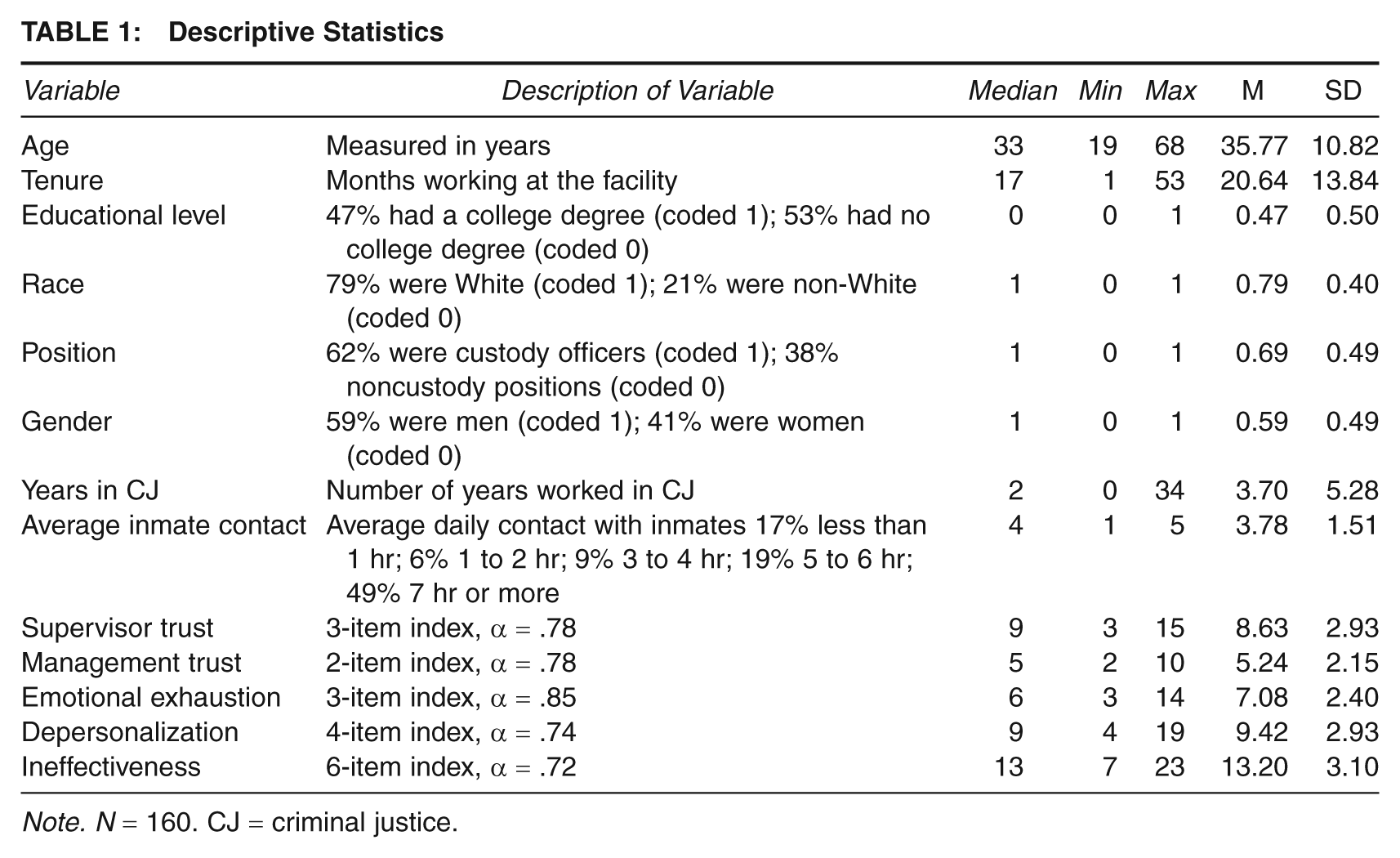
Note. N = 160. CJ = criminal justice.
Pearson’s correlation coefficients were calculated and are presented in Table 2. None of the personal characteristics had a statistically significant correlation with the emotional exhaustion index. Likewise, the inmate contact variable had a nonsignificant correlation with emotional exhaustion. Both supervisor trust and management trust had significant negative correlations with the index for emotional exhaustion. This means that increases in either supervisor trust or management trust were associated with decreases in reported emotional exhaustion from the job.
Correlation Matrix
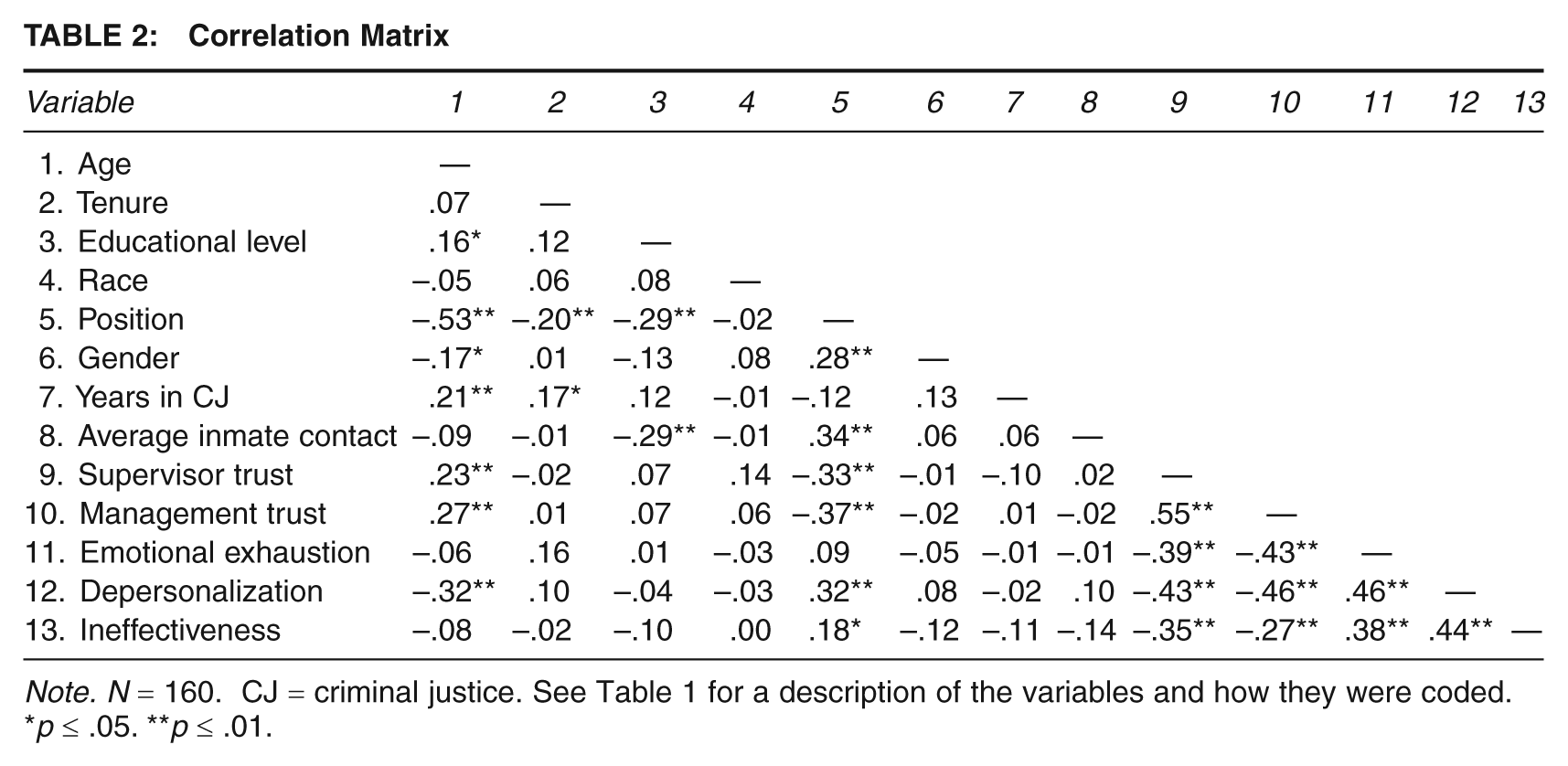
Note. N = 160. CJ = criminal justice. See Table 1 for a description of the variables and how they were coded.
p ≤ .05. **p ≤ .01.
For the depersonalization index, age, position, supervisor trust, and management trust had significant correlations. As age increased, the depersonalization variable decreased. In other words, older respondents were less likely to report treating people in a depersonalized way. Custody officers in general reported higher levels of depersonalization as compared to their noncustody counterparts. Increases in supervisor trust and management trust were associated with decreases in depersonalization. Tenure, educational level, race, years working in the field of criminal justice, and gender all had nonsignificant correlations with the depersonalization variable.
The only personal characteristic variable to have a significant correlation with feelings of being ineffective at work was position. Custody officers were, on average, more likely to report feeling ineffective than were noncustody staff. Average daily contact with inmates had a nonsignificant correlation. Both supervisor trust and management trust had significant negative correlations with the ineffectiveness index. Finally, the three dimensions of burnout had significant moderate-sized correlations with one another, further indicating that they are related but distinct dimensions of job burnout.
Three ordinary least squares (OLS) regression equations were estimated with emotional exhaustion, depersonalization, and ineffectiveness as the dependent variables. The independent variables in the three OLS regression equations were age, tenure, educational level, race, position, gender, years working in criminal justice, average daily contact with inmates, supervisor trust, and management trust. The results for the three OLS regression equations are reported in Table 3. On the basis of the correlation matrix presented in Table 2, collinearity was not a problem among the independent variables. The variance inflation factor and tolerance statistics indicated no problem of multicollinearity among the independent variables. High multicollinearity occurs when an independent variable shares a very large part of its variance with the other independent variables in the regression equation, and this hinders the estimation of the effects on the dependent variable by the independent variables in question (Berry, 1993). For the OLS regression equation for emotional exhaustion, the variance inflation factor scores ranged from 1.06 to 1.99, and tolerance values ranged from 0.50 to 0.94. For the depersonalization OLS regression equation, the variance inflation factor scores ranged from 1.17 to 1.99, and tolerance values ranged from 0.50 to 0.94. For the ineffectiveness OLS regression equation, the variance inflation factor scores ranged from 1.07 to 1.99, and tolerance values ranged from 0.50 to 0.94. Variance factor scores above 5 or tolerance values below 0.20 indicate a problem with multicollinearity among the independent variables (Chatterjee & Price, 1991; Maruyama, 1998; Tabachnick & Fidell, 1996). In this study, the variance of factor scores and tolerance scores were much lower than the cutoff points of 5 and 0.20, respectively.
Effects of Trust on Burnout Among Private Prison Staff
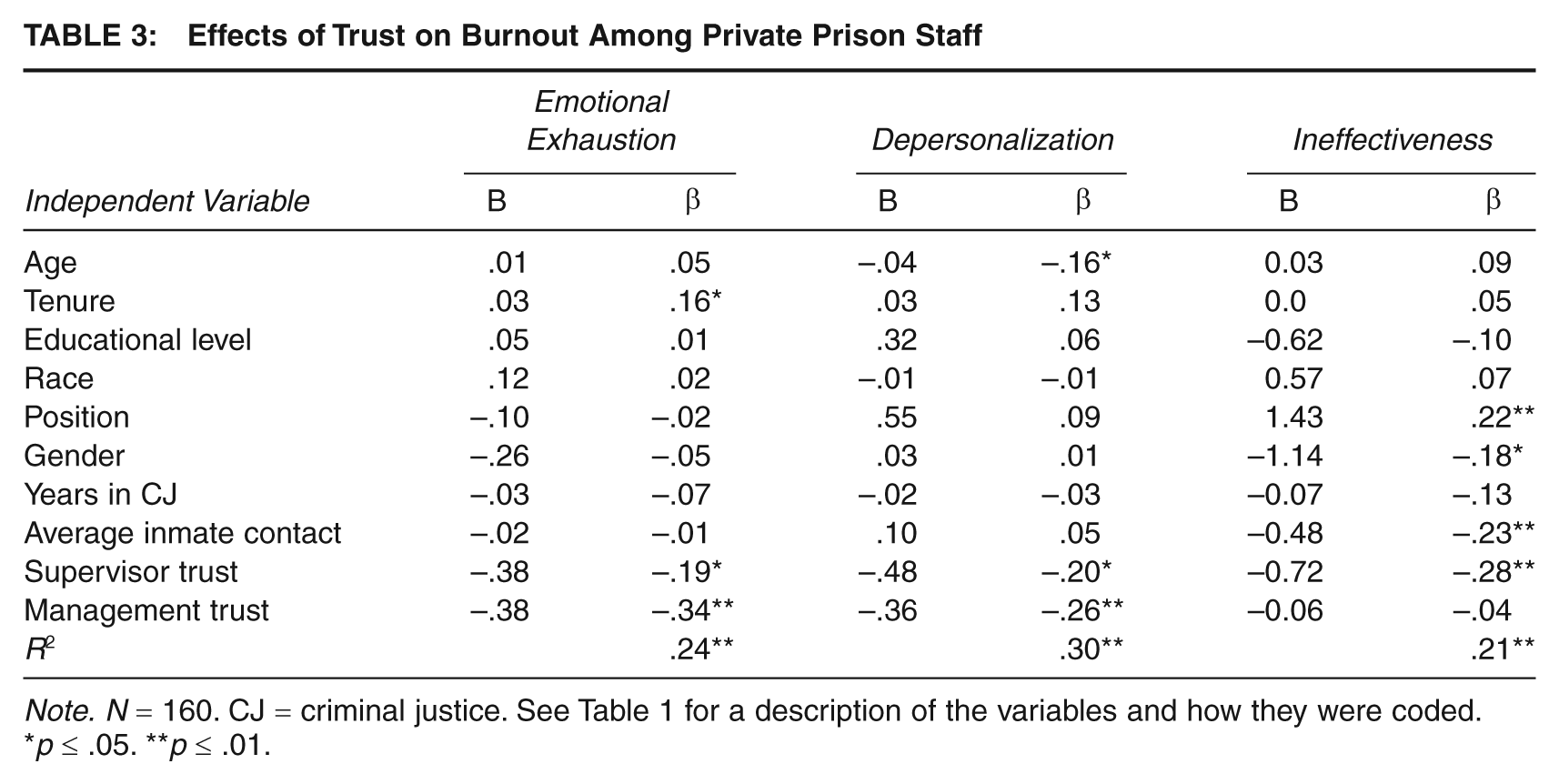
Note. N = 160. CJ = criminal justice. See Table 1 for a description of the variables and how they were coded.
p ≤ .05. **p ≤ .01.
For the emotional exhaustion equation, the R2 statistic was .24, which means that the independent variables explained about 24% of the variance observed in the emotional exhaustion index. Among the personal characteristics, only tenure had a significant association. As tenure increased, so did the level of reported emotional exhaustion from the job. Average daily contact with inmates had a nonsignificant association. Both supervisor trust and management trust had significant negative relationships with emotional exhaustion. Increased supervisor trust or management trust was associated with decreased emotional exhaustion. By examining the standardized regression coefficients (i.e., values in the β columns in Table 3), one can estimate the magnitude of the effect of an independent variable on the dependent variable. Among the three significant variables, management trust had the largest effect, followed by supervisor trust and then tenure.
The independent variables accounted for 30% of the observed variance in the depersonalization index (i.e., R2 = .30). Among the personal characteristics, only age had a significant association with depersonalization. As age increased, the self-reported level of treating others at work in an impersonal and callous manner dropped. Tenure, educational level, race, position, gender, number of years in the field of criminal justice, and daily inmate contact all had nonsignificant effects. Both supervisor trust and management trust had a significant negative relationship with the depersonalization measure. An increase in either form of trust was associated with a decrease in the depersonalized treatment of coworkers and inmates. On the basis of the standardized coefficients, management trust had the largest-sized effect, followed closely by supervisor trust and then age.
The independent variables explained approximately 21% of the observed variance of ineffectiveness. Age, tenure, educational level, race, position, and years in criminal justice all had nonsignificant relationships with the perception of being ineffective at work. Position had a positive association. In general, custody officers were more likely to report feeling being ineffective than were noncustody staff members. Gender had a significant negative association. Women were more likely than men to report perceiving themselves to be ineffective at work. Average daily inmate contact had a negative association with the ineffectiveness index. The more time participants spent in contact with inmates, the less likely they were to report seeing themselves as being ineffective. Supervisor trust had a significant negative association with ineffectiveness. Contrary to our hypothesis, management trust had a nonsignificant association with the ineffectiveness dependent variable.
Discussion and Conclusion
Trust is at the heart of most social interactions (Zand, 1972). Trust can be a barrier against burnout, and a lack of trust can be linked with burnout from the job. The relationships between supervisor trust and management trust and the burnout dimensions of emotional exhaustion, depersonalization, and ineffectiveness were examined among staff at a private correctional facility. Five of the six hypotheses were supported. Both forms of trust were negatively linked with emotional exhaustion. It appears that trust in supervisors and management can lead to decreased burnout, and a lack of trust can heighten the level of burnout. Likewise, both measures of trust were negatively associated with feelings of treating others at work in a depersonalized manner. In other words, respondents who trusted felt they treated others at work in a more personal manner.
Perceptions of trust probably provide staff with positive feelings, such as being respected, which places less strain on them and may even buffer them from other demands at work. Part of trust is the belief that the trustee will act benevolently toward the trustor. A lack of trust can be a strain on staff members who feel that others may be not acting in their best interests. In addition, a lack of trust can hamper the ability of staff to do their jobs, which can be frustrating in itself. Staff may take out their frustrations on others at work, particularly those who have little power, such as inmates, and treat them in a callous and impersonal manner. Supervisor trust was also negatively related to perceptions of being ineffective with others at work. In other words, those who trusted supervisors saw themselves as being effective at work. Supervisors are important in providing feedback and directions for staff to be effective at work. Trust in supervisors probably allows for greater acceptance of information and suggestions that improve the job abilities of staff. Likewise, supervisory trust may prompt staff to try harder on their jobs. Contrary to our hypothesis, management trust had a nonsignificant association with perceptions of being ineffective at work. It could be that there is a relationship between the two variables but it was not observed in the current study. It is also possible that management trust is not a salient variable in accounting for perceptions of being ineffective at work. As noted above, supervisors are directly linked with the daily activities and duties of staff. Management may be more removed, and as such, trust in management does not play an important role in this dimension of burnout.
The findings provide support for the job demands–resource model. It appears that trust is an important aspect of the work environment in terms of correctional staff burnout. What is not known is whether the two forms of trust are directly or indirectly linked with burnout. This needs to be further researched. Furthermore, the results support the postulation that both forms of trust are linked with burnout among correctional staff; except for ineffectiveness, supervisor trust and management trust were both associated with each of the dimensions of burnout. This suggests the need to increase both forms of trust in the correctional workplace and not to ignore one or both.
Increasing trust in an organization takes time and effort. Too often, organizations concentrate on basics of control and direction of staff without giving thought to the more complex dynamics of the workplace (Eisenhardt, 1989). Although control and direction are important, staff members also have social needs (Fry, 1989; Likert, 1967). According to the social exchange theory, trust is one of the social needs of most employees (Whitener et al., 1998). Trust cannot be demanded from staff. It is earned through reciprocal relationships over time. It is based on a cognitive assessment of what is expected in the future on the basis of what has occurred in the past (Robinson, 1996). Trust is from the belief that a promised action will occur (Clark & Payne, 1997). There must be a positive association between what is said and what is done (Mayer et al., 1995). There must be real and concerted effort to ensure that promises are consistently kept. If unexpected events arise that prevent promised outcomes, this must be explained to staff, and staff need to be allowed to voice their concerns and frustrations as well as to provide suggestions on possible changes to avoid future occurrences of unmet promises (Butler, 1991; Whitener et al., 1998). In fact, trust can even facilitate salient feedback from staff members on a wide array of matters (Wong & Cummings, 2009). This feedback not only helps improve the trust at a correctional facility but also helps with the operations of a facility. Open dialogue can help deal with small problems before they become big ones. Providing staff a voice shows that they are respected and valued. It also allows them to become more involved, which can increase the level of commitment and trust in correctional organization (Korsgaard, Schweiger, & Sapienza, 1995; Stohr, Lovrich, Monke, & Zupan, 1994). Ignoring breaches of trust will only decrease the level of trust of staff. Even if the breach of trust was not done intentionally, not all staff will be aware of this unless it is explained to them (Lambert et al., 2008).
The responsibility for building staff’s trust lies with supervisors and the administration and not the staff (Whitener et al., 1998). To build trust, authentic behavior is essential, which requires acting with honesty, integrity, dependability, and respect (Avolio, Gardner, Walumbwa, Luthans, & May, 2004; Mishra, 1996; Wong & Cummings, 2009). Honesty and integrity are critical. Supervisors and administrators must hold themselves to high ethical standards to build trust among the staff (Mulki, Jaramillo, & Locander, 2008). Rewarding ethical behavior for all members of the correctional facility should help facilitate trust among the staff (Zhang et al., 2008). Dasgupta (1988) argued that the most important factor in developing staff trust is honesty. Supervisors and managers should not state one thing and do another thing. Whitener et al. (1998) labeled this as behavioral integrity. Proverbially, actions speak louder than words. Lying can erode staff trust, as can exploitation of others for personal gain. As already emphasized, dependability means that promises should be kept or should not have been made in the first place. Treating staff with respect can go a long way in helping build trust (Konovsky & Pugh, 1994; Whitener et al., 1998). Despite the importance of honesty in working relationships, trust building means more than keeping promises. Staff members must also feel that supervisors and administrators are truly concerned with their welfare. This is the issue of benevolence (Mayer & Davis, 1999). Concern must be genuine and not faked (Lambert et al., 2008; Whitener et al., 1998). This means being considerate of staff, looking out for their long-term interests, and not exploiting them for personal gain (Whitener et al., 1998). Staff members are likely to see through feigned concern, which can lead to decreased trust. Trust is built on positive relationships (Schoorman, Mayer, & Davis, 2007). In addition to listening, allowing staff input into their jobs and the organization is another way to build positive relationships. Allowing input into decision making is a way of putting the social exchange theory into action and increasing trust at both levels (Whitener et al., 1998). Input into decision making allows staff to feel valued and trusted. Not allowing real and meaningful input into decision making sends a message to staff that they cannot be trusted (Tyler & Lind, 1992).
In addition, trust is built over time and is derived from the perceived fairness and consistency of actions. Supervisors and administrators need to be fair and consistent in how they deal with all staff. There can be no favoritism (Deluga, 1994; Lambert et al., 2008). Favoritism sends a powerful message that all staff members are not equal and valued and can erode the level of both types of trust. This leads to the issue of organizational justice. Organizational justice is a theory that employees desire to be treated fairly and justly at work (Folger & Cropanzano, 1998; Greenberg (1990a). There are two major aspects of organizational justice, distributive justice and procedural justice (Greenberg, 1987a, 1987b). Distributive justice refers to the perceptions that fair and just organizational outcomes are reached, such as pay, promotions, evaluations, assignments, amount of work assigned, rewards, punishments, and so forth (Greenberg, 1987b, 1990b). Procedural justice refers to the perception that the processes and procedures used to reach the outcomes are fair, just, and transparent (Folger & Cropanzano, 1998; Greenberg, 1987a, 1990b). The literature suggests that perceptions of distributive justice and procedural justice are used by employees in developing their level of supervisor and management trust (Korsgaard et al., 1995; Sapienza & Korsgaard, 1996). If the processes and outcomes are fair and open, trust by staff is probably much more likely; however, research is needed to explore whether organizational justice is positively associated with supervisor and management trust among correctional staff as well as to explore other factors that help develop trust in the workplace. Correctional staff members expect that outcomes and procedures that affect them will be fair (Lambert, 2003).
The study had limitations. Staff members at a single correctional facility were surveyed. Staff members at other correctional facilities need to be studied to determine whether the results can be replicated. In addition, research is needed to determine whether the relationship between the two forms of trust and the three dimensions of burnout are contextual and vary by the type of correctional facility. Here, the staff worked at a high-security, private facility that housed juveniles convicted in adult court. The effects of supervisor trust and management trust could vary between public and private prisons, between adult and juvenile facilities, by security, by region of the United States, and between nations. More detailed measures of trust should be used. In this study, supervisor trust was measured by three items, and management trust was measured by two items. Additionally, there are different ways to measure burnout. Three dimensions of burnout, using items based on the Maslach Burnout Inventory, were used rather than the actual inventory itself (Maslach & Jackson, 1981). It is unknown whether similar results would occur using the Maslach Burnout Inventory by Maslach and Jackson (1981) or the Total Exhaustion Index by Gerstein et al. (1987). Furthermore, other dimensions of workplace trust should be explored, such as trust in coworkers (Chughtai & Buckley, 2008).
There is a need to explore the forces that shape supervisor trust and management trust among correctional staff. In addition, the effects of perceptions of not being trusted and burnout need to be explored (Salamon & Robinson, 2008). In the current study, the degree of trust staff had in supervisors and management was examined. Staff may feel that they are not trusted by their supervisor or by the organization, and it is unclear whether these perceptions of not being trusted would be linked with any of the dimensions of burnout. The current study did not examine the effect of trait trust. Trait trust is the willingness to trust others (Chughtai & Buckley, 2008; Mooradian, Renzl, & Metzler, 2006). Some people are more willing to trust in general, and other people are less willing to trust, particularly if they have been harmed in the past in a trusting relationship. It is unknown whether the type of relationship with supervisors influences the willingness to trust. For example, female staff could be more willing to trust female supervisors, or Black staff may be more willing to trust Black supervisors. This needs to be explored. Future research may wish to include a measure asking staff the average amount of time spent daily interacting with supervisors and managers. It could be that the more time spent with supervisors and managers influences the level of trust in each. Furthermore, other possible outcomes of supervisor and management trust need to be explored among correctional staff, such as job performance, relations with coworkers and inmates, work engagement, organizational citizenship behaviors (i.e., going above and beyond what is expected at work), life satisfaction, absenteeism, turnover intent, and so forth.
Another shortcoming was the use of cross-sectional data, which does not allow for the demonstration of causality. Longitudinal studies are needed to examine in more detail the relationship with supervisor trust and management trust over time with burnout. The other factors linked with burnout need to be explored and identified as well. About 24%, 30%, and 21% of the variance in emotional exhaustion, depersonalization, and feelings of ineffectiveness were accounted for in this study. This means that other variables accounted for the remaining variance of each of the burnout measures. Future research is, therefore, needed to determine other possible correlates of correctional staff burnout. Clearly much more research is needed on correctional staff burnout. Finally, recommendations for how to build staff trust in correctional organizations were made. Studies are needed to determine whether these suggestions actually help facilitate supervisor trust and management trust in correctional organizations.
Research in other organizations identifies trust as a key element in creating a positive work environment. Although the research relating trust to burnout is limited, this study provides preliminary support for the contention that correctional staff members who trust supervisors and management have reduced levels of job burnout. An effective, yet inexpensive, way to enhance the work environment would be for correctional administrators to encourage honest and open communication at all managerial levels. The end result may produce positive outcomes, such as increased worker performance, less absenteeism, and reduced turnover. It is hoped that this study will spark continued interest and research on burnout and trust among correctional staff. Additional research is essential, and the new knowledge generated will be critical for all involved, including staff, inmates, administrators, scholars, and society. Ignoring the issues of trust and burnout among correctional staff is unlikely to lead to improvements or solutions.
Footnotes
Appendix
The below items were measured using a 5-point Likert-type response scale ranging from strongly disagree (coded as 1) to strongly agree (coded as 5).
The authors thank Janet Lambert for editing and proofreading the paper.
Notes
References
Supplementary Material
Please find the following supplemental material available below.
For Open Access articles published under a Creative Commons License, all supplemental material carries the same license as the article it is associated with.
For non-Open Access articles published, all supplemental material carries a non-exclusive license, and permission requests for re-use of supplemental material or any part of supplemental material shall be sent directly to the copyright owner as specified in the copyright notice associated with the article.
