



Abstract
Although correctional staff job burnout is costly to all involved, it has not received the empirical attention it deserves. The job characteristics model holds that job characteristics are important in shaping employee outcomes. This study focused on the effects of the job characteristics of supervision consideration, supervision structure, job autonomy, and job variety on the three dimensions of job burnout (i.e., emotional exhaustion, depersonalization, and perceived ineffectiveness at work) among correctional staff. Ordinary least squares (OLS) regression analysis of data from 160 staff members at a private prison indicated that job autonomy and job variety had significant negative relationships with emotional exhaustion. Supervision consideration, job autonomy, and job variety all had negative effects on the depersonalization dimension of burnout. Job autonomy and job variety had significant negative effects on perceived ineffectiveness.
Keywords
Working in corrections is a unique experience, a type of “people work” that is unlike that found in other organizations. Working in a prison requires dealing with a group of criminally involved individuals who are held against their will and, although generally compliant, may act out without warning. As Armstrong and Griffin (2004) noted, “few other organizations are charged with the central task of supervising and securing an unwilling and potentially violent population” (p. 577). Clients who are uncooperative and hostile place an even greater burden on correctional staff, making job burnout a real possibility for correctional staff (Carlson, Anson, & Thomas, 2003; Lindquist & Whitehead, 1986; Whitehead, 1989). Prior studies have indicated that correctional employees experience higher rates of burnout compared to those found in the general population, and even higher than rates found among police officers (Hurst & Hurst, 1997; Keinan & Maslach-Pines, 2007).
Burnout is the feeling of being overwhelmed and can lead to emotional, social, psychological, and physical health problems (Dollard, Winefield, & Winefield, 2001; Neveu, 2007). Burnout can lead to decreased work performance, withdrawal from or reduced quality of interactions with other employees and inmates, and increased absenteeism, substance abuse, and turnover intent or turnover (Belcastro, Gold, & Grant, 1982; Carlson & Thomas, 2006; Garland, 2002; Maslach & Jackson, 1981; Neveu, 2007; Schaufeli & Peeters, 2000). Employees suffering from burnout also may affect coworkers, inmates, family members, and the correctional facility. Some argue that burnout should be viewed as having a possible “contagious” effect on other workers in the organization (Maslach, Schaufeli, & Leiter, 2001). Given that correctional staff is the largest budget expenditure of most correctional agencies, employee burnout has the potential to be quite costly for most correctional institutions that rely so heavily on staff members to carry out a myriad of duties necessary to run a safe, humane, and secure facility.
In an era where rising costs, shrinking budgets, and personnel shortages are common, ensuring that correctional staff do not suffer burnout is increasingly important. Nevertheless, there has been limited research in this area (Garland, 2002). Only with a better understanding of the causal factors associated with burnout can correctional administrators develop interventions to reduce occurrences of job burnout and avoid the possible implementation of efforts that unintentionally increase burnout. Although studies have examined the effects of some aspects of the work environment on correctional staff burnout, there are many other dimensions of the work environment that require further clarification. As such, this study tests the efficacy of the job characteristics model to explain job burnout among correctional staff. More specifically, the effects of supervision consideration, supervision structure, job autonomy, and job variety on three dimensions of burnout (emotional exhaustion, depersonalization, and perceived ineffectiveness at work) were examined among staff members at a private prison.
Literature Review
Job Burnout
The term job burnout was proposed by Freudenberger (1974) to explain the condition of an individual who has become psychologically exhausted because of excessive work demands. More recently, Maslach and Jackson (1981) described job burnout as “a syndrome of emotional exhaustion and cynicism that occurs frequently among individuals who do ‘people work’ of some kind” (p. 99). More important, they theorized that burnout was composed of three dimensions: emotional exhaustion, depersonalization, and a reduced sense of personal accomplishment (Maslach & Jackson, 1981, 1984). Emotional exhaustion occurs when a person feels emotionally fatigued and drained from the job. The person psychologically feels used up from the job and has little desire to go to work each day. With depersonalization, a person develops a cynical attitude toward others and their motivations. As a result, those who experience depersonalization push others away and distance themselves from coworkers and clients. In the end, they become detached at work, treating others impersonally, callously, and as objects. An employee may experience a reduced sense of personal accomplishment. This is a perception of not being productive when working with other individuals, as well as having little, if any, meaningful impact on others at work (Maslach, 1982, 2003; Maslach et al., 2001; Maslach & Jackson, 1981, 1984). Furthermore, Maslach and Jackson (1981) theorized that the work environment factors, including job characteristics, were the primary causes for job burnout. They speculated that different work environment factors may have unique effects on each burnout dimension. Others have suggested that although individuals may experience all dimensions of burnout, such dimensions may exist separately (Cordes & Dougherty, 1993; Maslach, 2003).
A small but growing body of published research has examined correctional staff job burnout exploring the relationship between burnout and both personal characteristics (i.e., position, gender, age, tenure, educational level, and race) and work environment factors. As discussed elsewhere, findings regarding the impact of personal characteristics on correctional job burnout generally have been inconsistent and often negligible (Griffin, Hogan, Lambert, Tucker, & Baker, 2010; Lambert & Hogan, 2010). Work environment factors, however, have been found to be better predictors of job burnout among correctional staff. For example, organizational structure factors of instrumental communication, input into decision making, distributive justice, procedural justice, and perceptions of promotional opportunities all have been found to be negatively associated with job burnout (Dollard & Winefield, 1998; Lambert, Hogan, & Jiang, 2010; Lambert, Hogan, Jiang, et al., 2010; Lindquist & Whitehead, 1986; Neveu, 2007; Whitehead, 1989; Whitehead & Lindquist, 1986). Social support (e.g., supervisory support, administrative, and coworker support) has been observed to be negatively associated with correctional staff burnout (Cieslak, Korczynska, Strelau, & Kaczmarek, 2008; Drory & Shamir, 1988; Garland, 2004; Neveu, 2007; Savicki, Cooley, & Gjesvold, 2003). These and other studies examining the relationship between work environment factors and job burnout support the contention that work environment factors are stronger predictors of correctional staff job burnout than are personal characteristics (Garner, Knight, & Simpson, 2007; Gerstein, Topp, & Correll, 1987; Griffin et al., 2010; Lambert & Hogan, 2010; Lambert, Hogan, & Altheimer, 2010). Although research has begun to identify significant factors related to job burnout among correctional staff, there remains much to be explored.
Job Characteristics Model
The correctional work environment is not limited to the physical building or structure but also includes intangible psychological and social components. Two critical areas of the correctional work environment are organizational structure and job characteristics (Lambert, 2004). Organizational structure refers to how an organization arranges, manages, and operates itself, including centralization, formalization, integration, legitimacy, and instrumental communication (Lincoln & Kalleberg, 1990; Oldham & Hackman, 1981). Organizational structure permeates the organization. Job characteristics, on the other hand, generally are more limited in scope within an organization and tend to apply to a certain job or group of jobs within an organization (Glisson & Durick, 1988; Lambert, 2004; Lambert, Hogan, & Cluse-Tolar, 2007). The typical job characteristics are different aspects of supervision, job autonomy, job variety, and job feedback (Hackman & Lawler, 1971; Lambert et al., 2009).
The job characteristics model was developed to provide a theoretical understanding of how job characteristics influence salient worker outcomes and has been used to explain job satisfaction, job involvement, organizational commitment, absenteeism, and turnover intent or turnover (Fried & Ferris, 1987; Hackman & Oldham, 1975, 1976, 1980; Tiegs, Tetrick, & Fried, 1992). In this study, the job characteristics model is utilized to assess job burnout among correctional staff. The basic premise of the model suggests that providing employees with positive job characteristics will result in positive psychological states, which, in turn, result in positive outcomes for both the employees and the employing organization. Negative job characteristics, on the other hand, can lead to strain and other negative psychological states and, in the end, increase the chances of negative outcomes (Hackman & Oldham, 1975, 1980; Saavedra & Kwun, 2000). For example, Hackman and Oldham (1980) reported that positive job characteristics allow workers to “experience a positive, self-generated affective kick when they perform well” (p. 60). Spector and Jex (1991), on the other hand, reported that negative job characteristics lead to increased frustration and strain and cause the person to withdraw from the job.
Past correctional staff research supports the contention that job characteristics have significant effects on outcomes. For example, perceptions of quality supervision and positive perceptions of supervisors were positively linked to increased job satisfaction (Cullen, Link, Wolfe, & Frank, 1985; Griffin, 2001; Jurik & Winn, 1987; Van Voorhis, Cullen, Link, & Wolfe, 1991). In addition, the job characteristics of supervision, job autonomy, and job variety have been found to be positively associated with job satisfaction among correctional staff across different correctional settings (Brief, Munro, & Aldag, 1976; Jurik & Winn, 1987; Lambert, 2004; Lambert et al., 2009; Wright, Saylor, Gilman, & Camp, 1997). Furthermore, job variety, supervision, and organizational support have been reported to be positively linked with correctional staff organizational commitment (Griffin & Hepburn, 2005; Lambert, 2004; Lambert et al., 2009). These findings support the job characteristics model, which states job characteristics help shape various correctional staff outcomes.
Focus of Current Study
Given this extant literature, it appears reasonable to hypothesize a relationship between job characteristics and burnout among prison staff. Only one study was found, however, that tested the job characteristics model for correctional staff burnout. Lambert, Hogan, Cheeseman Dial, Jiang, and Khondaker (2010) tested the job characteristics model among burnout among staff at a state prison. Specifically, they explored the effects of supervision consideration, job variety, job feedback, and job autonomy on emotional exhaustion and found that job feedback and job autonomy had significant negative effects on emotional exhaustion, whereas job variety had nonsignificant effects. Given that prior studies suggest that the three dimensions of burnout may not be similarly affected by job characteristics, this study builds on prior work by examining the effects of supervision consideration, supervision structure, job autonomy, and job variety on burnout’s three dimensions—emotional exhaustion, depersonalization, and feelings of ineffectiveness among staff at a private prison working with youth adjudicated adults.
This focus on supervision is critical because supervision is an ever-present factor in the often quasi-military environment of a prison. Supervisors are the first line of management for most employees, and they help employees by providing guidance, support, control, and direction for staff (Brough & Williams, 2007). Supervision is a multidimensional concept and includes supervision consideration and supervision structure (House & Dessler, 1974; Lambert et al., 2009). Conceptually, supervision consideration suggests that supervisors can be open, supportive, friendly, and approachable, or they can be closed, distant, uncaring, and unavailable to those in their charge. Studies have shown that supportive and caring supervisors help staff members to be successful in their jobs and to deal effectively with problems that may arise (Cherniss, 1980; Lambert, 2004; Lombardo, 1981). Good supervision may function as a protective factor for employees by shielding them from the potential strains and stress of working in corrections. This is likely to lead to a positive psychological state among staff. On the other hand, supervisors can also create an unpleasant, taxing, and even harsh work experience, resulting in frustration and strain for correctional staff. In the end, this can wear on staff members, increasing the chances of burnout from the job.
Supervisory structure reflects the perceived degree of structure a supervisor creates for subordinates (House & Dessler, 1974; Teas, 1981). More specifically, it reflects the degree to which a supervisor organizes and directs subordinates in meeting the objectives and goals of the organization (Lambert et al., 2009). It includes holding staff members accountable for their jobs and making sure that the organizational rules and regulations are obeyed. By providing structure in a correctional institution, staff may be more likely to overcome difficult situations, adapt to unpredictable events, and complete their jobs successfully. This can allow staff members to experience positive affective states from being successful at their jobs. A lack of structure, on the other hand, can lead to confusion and frustration among staff. In addition, staff members who follow the rules and put forth effort to complete their job duties can become resentful when other employees do not if there are no consequences for them failing to follow rules or to put forth effort. This can lead to psychological strain, increasing the chances of job burnout.
Job autonomy is the degree of freedom that workers have in making job-related decisions (Agho, Mueller, & Price, 1993). Some jobs provide employees significant decision-making opportunities regarding job tasks and job processes, whereas other jobs allow little employee input. Job autonomy sends a message to staff members that they are trusted and their input is valued. This kind of autonomy allows for staff members to feel pride about their work since job outcomes reflect their decision-making abilities (Kouzes & Posner, 1995; Lambert, 2004). Employees’ perceptions of a lack of autonomy at the job can result in staff members feeling that they have little control over their workplace and that they are little more than pawns of the organization. This can lead to a sense of frustration and even a sense of fatalism and, in the end, increase the likelihood of burnout (Whitehead, 1989).
Job variety refers to the level of variation in the job (Price & Mueller, 1986). Some jobs allow for a great deal of different experiences and tasks, whereas other jobs are highly repetitive. New and different work experiences provide employees with the opportunity to develop new skills and to employ creativity in dealing with job tasks. As a result, employees may experience increased job-related growth and pride in their work (Lambert, 2004). In the end, these positive feelings may help buffer individuals from the adverse effects of job burnout. Conversely, repetitive jobs provide little opportunity for mental stimulation and growth, and often are tedious (Price & Mueller, 1986). This can wear on a person over time, increasing the chances of burnout.
Given this literature, and within the context of the job characteristics model, this study examined the impact of supervision consideration, supervision structure, job autonomy, and job variety and on the three dimensions of burnout—emotional exhaustion, depersonalization, and feeling ineffective at work. In addition, several personal characteristics (position, gender, age, tenure, educational level, and race) were included as control variables.
Method
Respondents
Staff members at a midwestern private correctional facility were surveyed. At the time of the survey, the facility housed approximately 450 youthful offenders who were younger than 20 years of age and who had been sentenced in court to adult sentences for violent offenses. The facility was a high-security facility that employed 220 staff members. At the time of the survey, only 200 staff members were available because of vacation leave, sick leave, administrative leave, and other similar reasons. These 200 staff members were provided a survey packet by their supervisors that contained a cover letter, the survey, a return envelope, and a raffle ticket. Staff members were provided the survey when they picked up their paycheck and paystub. The staff were informed that they could either complete the survey at home or at work if they were able to do so. The prison administration and supervisors encouraged staff to complete the survey. The survey and raffle tickets were returned in a stamped envelope provided to staff. Staff either could mail the survey back to the researchers or could place it in a locked box in the main entrance area of the prison. In the cover letter it was indicated that only the researchers had the key to the locked box. The cover letter also contained an explanation of the nature of the study and notifications that human subjects approval had been obtained, that completing the survey was voluntary, and that responses would be anonymous, as well as instructions on how to return the survey and be part of the raffle. To help increase the response rate, a raffle of cash prizes ranging from $50 to $150 was offered to those staff members who returned their raffle ticket regardless of whether the survey was completed. Staff members were instructed to keep one half of the raffle ticket and to return the other half. The returned tickets were removed and separated from the surveys so that it would be impossible to link surveys with specific staff members. About a month after the survey packets were distributed, a drawing of raffle tickets was held at a staff event, and individuals with a winning raffle ticket were awarded a cash prize. A total of $500 was given out from the raffle. Any unclaimed raffle prizes were donated to the staff association at the private correctional facility. Based on the 200 staff members who were provided the survey packet, a total of 160 usable surveys were returned, representing a response rate of 80%. 1
Except upper administration, the respondents represented all the work areas at the prison. Specifically, 62% (n = 99) were correctional officers, 3% (n = 5) were unit management staff (i.e., counselors, case managers, and unit managers), 4% (n = 6) worked in education, 3% (n = 5) worked in the medical department (including mental health professionals), 6% (n = 10) worked in the business office, 9% (n = 14) were custody supervisors, and 13% (n = 21) worked in other areas. Of the respondents, 59% (n = 94) were men and 41% (n = 66) were women. The mean age was 35.77, with a standard deviation of 10.82. The median age was 33 years old and ranged from 19 to 68 years. The mean number of months working at the private prison was 20.64, with a standard deviation of 13.84. The median tenure at the correctional institution was 17 months and ranged from 1 to 53 months. The reason for the low tenure was because the prison has been in operation for only 5 years prior at the time of the survey. In terms of highest educational level, 6% (n = 10) of the respondents indicated that they had a high school degree or GED, 47% (n = 75) had some college but no degree, 24% (n = 38) had an associate’s degree, 16% (n = 26) had a bachelor’s degree, and 7% (n = 11) had a graduate or professional degree. With regard to race/ethnicity, 79% (n = 126) of respondents marked that they were White, 11% (n = 18) were Black, 2% (n = 3) were Hispanic, 3% (n = 5) were Native American, and 5% (n = 7) marked other. Institutional records indicated that, at the time of the survey, approximately 81% (n = 178) of the all employees at the prison were White and 61% (n = 134) were male; therefore, the respondents appeared to be demographically representative of the staff at the private correctional facility. In addition, the median age range of all employees at the facility was about 32 to 34, the average tenure was about 19 months, and about two-thirds of the staff members held a custody position.
Variables
Dependent Variables
The three burnout dimensions of emotional exhaustion, depersonalization, and ineffectiveness in dealing with others at work were the dependent variables. 2 Three items were used to measure emotional exhaustion in working with others (see the appendix for specific items for all measures). The responses to these items were summed together to form an index measuring emotional exhaustion. This index had a Cronbach’s alpha value of .85. The burnout dimension of depersonalization was measured using four items and had a Cronbach’s alpha of .74. The last dimension of job burnout, perceived ineffectiveness at work, was measured using an index of six items. This additive index had a Cronbach’s alpha of .72. All of the burnout indicators were measured using a 5-point Likert-type response scale ranging from strongly disagree (coded 0) to strongly agree (coded 5). Exploratory factor analysis using principal axis factor with a varimax rotation was used. As predicted, the items loaded on the correct factor. The factor loadings ranged from .30 to .95. In addition, confirmatory factor analysis was conducted using AMOS. This resulted in three distinct factors, and the fit measures were acceptable (goodness of fit index = .95, adjusted goodness of fit index = .93, normed fit index = .91, and the root mean square error of approximation = .08).
Independent Variables
The four job characteristic areas of supervision consideration, supervision structure, job autonomy, and job variety were the independent variables of interest in this study. All items for the above job characteristics variables are presented in the appendix and were measured using a 5-point Likert-type response scale ranging from strongly disagree (coded 0) to strongly agree (coded 5). Four items based on a study by Teas (1981) were used to measure quality, open, supportive supervision. These items, which were summed together to form an index, had a Cronbach’s alpha value of .85. Supervisory structure also was measured using two items from Teas’s (1981) study. The two items were summed together to form the supervisory structure index with a resulting Cronbach’s alpha of .63. Adapted from Curry, Wakefield, Price, and Mueller (1986), an index was created to measure job autonomy using three items. These items had a Cronbach’s alpha of .69. Finally, job variety was measured using five items adapted from other studies (Curry et al., 1986; Mueller, Boyer, Price, & Iverson, 1994). The five items were summed together to form an index, and this index had a Cronbach’s alpha of .70. Factor analyses were conducted on the scales listed above, and the items loaded on the predicted factors.
Employee characteristics of position, gender, age, tenure, educational level, and race were included as control variables. Position reflected whether the respondent worked in a correctional officer position (coded 1) or a non–correctional officer position (coded 0). The variable of gender was coded as male (coded 1) or female (coded 0). Age was measured in continuous years. Tenure of working at the facility was measured in continuous months. Educational level was measured as a variable representing whether the respondent had earned a college degree (coded as 1) or not (coded as 0). Finally, race/ethnicity was collapsed into a dichotomous variable representing whether the respondent was White/non-Hispanic (coded 1) or non-White (coded 0).
Results
The descriptive statistics for the variables in this study are presented in Table 1. There appeared to be significant variation in both the dependent and independent variables (i.e., none of the variables were constants), and statistical tests indicate that the variables were normally distributed.
Descriptive Statistics
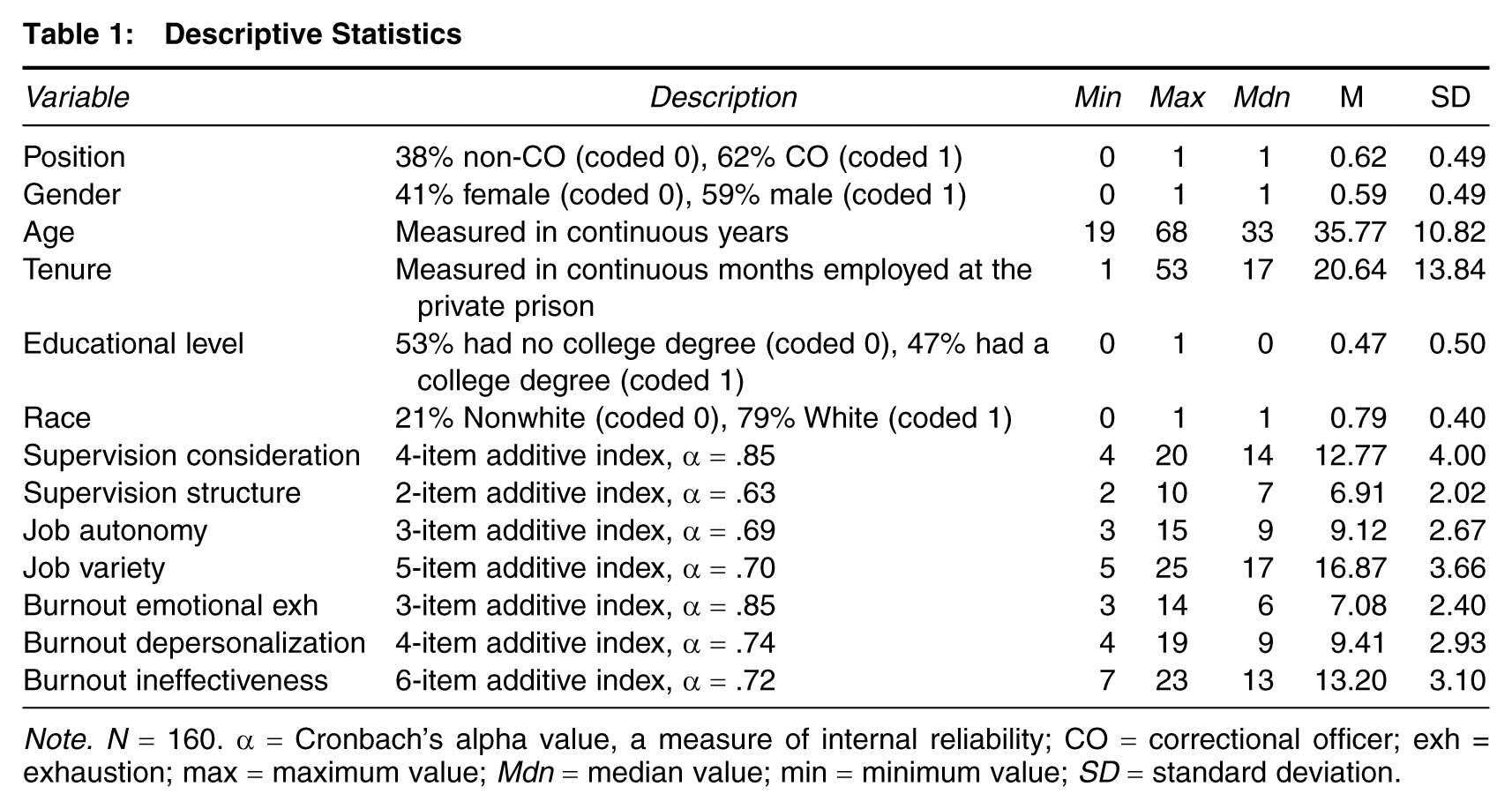
Note. N = 160. α = Cronbach’s alpha value, a measure of internal reliability; CO = correctional officer; exh = exhaustion; max = maximum value; Mdn = median value; min = minimum value; SD = standard deviation.
The Pearson product–moment correlations are presented in Table 2. Supervision consideration, supervision structure, job autonomy, and job variety were each negatively correlated with emotional exhaustion. None of the personal characteristic variables were significantly correlated with emotional exhaustion. For the depersonalization index, position had a significant positive correlation. Correctional officers were, on average, higher on the depersonalization index than noncustody staff. Age, supervision consideration, supervision structure, job autonomy, and job variety were negatively correlated with the measure of depersonalization. Employee position also had a positive correlation with perceived ineffectiveness at work, indicating that correctional officers were more likely than their noncustody colleagues to feel ineffective. Position, supervision consideration, supervision structure, job autonomy, and job variety were significantly and negatively correlated with perceptions of effectiveness. Increases in supervision consideration, supervision structure, job autonomy, and job variety were associated with decreased self-reports of feeling ineffective with others at work. Finally, the three burnout variables had significant moderate correlations with one another, indicating that they are related but distinct dimensions.
Correlation Matrix

Note. N = 160. See Table 1 for a description of the variables and how they were coded. Depersonal = burnout depersonalization dimension; education = educational level; emotional = burnout emotional exhaustion dimension; ineffective = burnout ineffectiveness dimension; job auto = job autonomy; sup con = supervision consideration; sup struct = supervision structure. Pearson product–moment correlations are reported. Two-tailed significance reported.
p ≤ .05. **p ≤ .01.
Three ordinary least squares (OLS) regression equations were estimated with emotional exhaustion, depersonalization, and ineffectiveness as the dependent variables. 3 The independent variables in each of the OLS regression equations included personal characteristics, supervision consideration, supervision structure, job autonomy, and job variety. For all three equations, the highest variance inflation factor (VIF) value was 2.93 and the lowest tolerance statistic value was .34. VIF values greater than 5 and tolerance values less .20 indicate multicollinearity may be a problem (Maruyama, 1998; Tabachnick & Fidell, 1996). The results are reported in Table 3. The emotional exhaustion model was significant and had an R2 value of .29, indicating that approximately one third of the variance observed in the emotional exhaustion model was explained by personal characteristics and the four job characteristic variables. Of the personal characteristics, only tenure had a statistically significant effect. As tenure at the private correctional facility increased, the level of emotional exhaustion also increased. Among the job characteristics, both job autonomy and job variety exerted significant negative effects on emotional exhaustion, indicating that staff with low levels of autonomy and variety on the job reported increased levels of emotional exhaustion. Neither supervision consideration nor supervision structure significantly influenced emotional exhaustion. An examination of the standardized coefficients (i.e., reported in the β column in Table 3) shows that autonomy had the strongest effect on emotional exhaustion (–.30), compared with those of job variety (–.27) and tenure (.14).
The Effects of Job Characteristics on Burnout among Private Correctional Staff
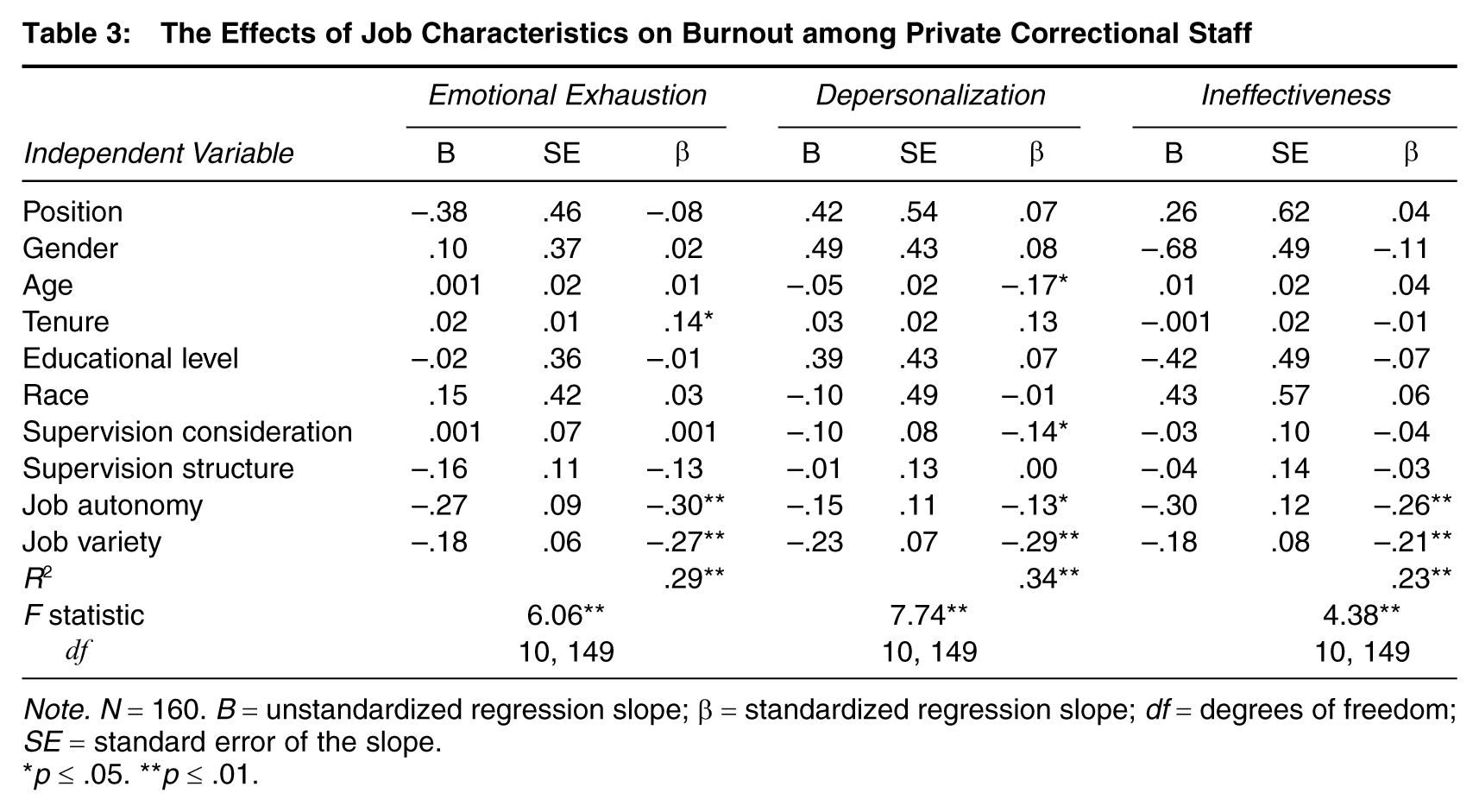
Note. N = 160. B = unstandardized regression slope; β = standardized regression slope; df = degrees of freedom; SE = standard error of the slope.
p ≤ .05. **p ≤ .01.
The model estimating the effects of personal characteristics and job characteristics on de-personalization was significant, with the independent variables accounting for approximately 34% of the observed variation in the dependent variable. Among the personal characteristics, only age had a significant effect (−.17). As age increased, self-reported treatment of others in a depersonalized manner dropped. Supervision consideration, job autonomy, and job variety each had a significant negative effect. Those employees who believed that their supervisors were considerate and who reported higher job autonomy and variety expressed lower levels of depersonalization. Job variety exerted the largest impact (−.29) on feelings of depersonalization, followed by age (−.17), supervision consideration (−.14), and job autonomy (−.13).
The third OLS regression equation, which estimated the effects of personal characteristics and job characteristics on ineffectiveness, was significant, with the independent variables accounting for approximately 23% of the observed variation in the dependent variable. None of the personal characteristic variables had a significant impact on an employee’s perceptions of ineffectiveness at work. Job autonomy and job variety had significant and negative effects, with job autonomy having a slightly stronger impact than job variety (–.26 and –.21, respectively).
Discussion and Conclusion
Few studies have fully examined the role of burnout among correctional staff, specifically identifying salient job characteristics associated with increased levels of burnout among those who are employed in a difficult and, at times, dangerous occupation. The current study assessed the value of the job characteristics model to explain three dimensions of job burnout among private correctional staff. Findings suggest that in many instances, job characteristics, although generally more limited in scope than broader organizational structure, do influence organizational outcomes, including burnout. Job autonomy and job variety, in particular, proved to have strong and consistent effects across all dimensions of burnout, supporting the notion that positive job characteristics will result in positive employee psychological states (Hackman & Oldham, 1975). It is interesting that those job characteristic measures associated with supervision had only a limited impact on burnout. Last, and not surprising, individual characteristics of the correctional staff had little impact on these work outcomes, supporting the vast majority of previous studies that have shown that it is the work context and not the individual that accounts for work-related outcomes.
Again, it is interesting to note the consistent impact of job autonomy and job variety across the three dimensions of burnout. Whether faced with concerns of an emotionally straining work environment, a less sympathetic or callous response to others, or feelings of ineffectiveness, an increased belief in one’s autonomy in the workplace appears to act as a protective factor against such negative responses. At a minimum, autonomy over one’s job represents a level of control over one’s environment. Having such control over the job may not only reduce levels of strain but also induce a sense of pride. Job autonomy may provide staff members with an ability to deal more quickly and effectively with problems that arise, thus reducing the effects of stress at work. In addition, job autonomy often sends a message to staff members that they are valued and trusted, leading to positive psychological states. Understandably, a lack of control over one’s roles and responsibilities can lead to frustration because constraints on the opportunity to provide input into the job may lead to individuals’ belief that they are ineffective. This supports Maslach’s (1982) assertion that perceptions of helplessness and powerlessness are linked to increased chances of job burnout. That job autonomy is negatively related to emotional exhaustion, depersonalization, and ineffectiveness is supported by previous research that has linked increased levels of input into organizational decision making with lower levels of correctional staff burnout (Dollard & Winefield, 1998; Lindquist & Whitehead, 1986; Neveu, 2007; Whitehead, 1989; Whitehead & Lindquist, 1986).
Not only may variety be the “spice of life,” but job variety appears to be linked to decreased levels of emotional exhaustion, depersonalization, and ineffectiveness. Perhaps acting as a protective factor, the ability to be creative and learn new things on the job allows employees to experience such positive psychological states as fulfillment, pride, and enjoyment. In turn, this reduces the likelihood of experiencing the frustration, disappointment, and strain associated with the different dimensions of burnout. Having a sense of variety in one’s job allows an individual to address job-related problems and pressures with a more creative approach, thus potentially avoiding stressors that can lead to burnout.
Finally, it is interesting to note that supervision consideration significantly affected only one dimension of burnout, depersonalization, supporting previous research that has found a significant relationship between supervisory support and job outcomes (e.g., job satisfaction, organizational commitment, and burnout) and supervisory support and job-related attitudes (e.g., use of force and custody orientation; Cullen, Lutze, Link, & Wolfe, 1989; Drory & Shamir, 1988; Griffin, 1999). After reviewing the items that compose the supervision consideration scale, it appears that how an individual is treated by his or her supervisor affects how that person, in turn, treats others on the job. Belief that a supervisor “has your back,” is approachable, and tries to improve the work environment significantly influences an employee’s response to others. Employees show a greater respect toward colleagues and inmates, as well as feeling greater sympathy toward others. This is a critical finding in that it presents insight into the possible dynamics that create a healthy, safe, and secure correctional work environment. Why supervision consideration and supervisory support did not have a greater impact on the different dimensions of burnout is less clear. Although this interpretation is speculative, the two-item supervision structure measure may not adequately reflect the positive or protective factors associated with structure and accountability. Although structure to one’s job provides a level of certainty and the ability to adapt to difficult situations, an overly structured work environment may negatively affect employees, particularly in a job requiring correctional employees to use a certain amount of discretion in carrying out their daily activities.
As with all studies, there are limitations that must be recognized. As mentioned previously, the current study relied on three components of burnout using items informed by the Maslach Burnout Inventory (MBI) rather than the actual inventory itself (Maslach & Jackson, 1981). This raises several issues. First, it would be useful to know if similar results would be obtained using the MBI or if more detailed and extensive measures of the latent concepts would yield the same results. Because the MBI has been widely used and has been found to be both valid and reliable (Langballe, Falkum, Innstrand, & Aasland, 2006; Maslach, Jackson, & Leiter, 1982), results from future analyses that make use of this measure could more easily be compared across studies. In addition, data for this study came from surveys of staff at one private correctional facility. In light of the fact that the effects of job characteristics may be contextual, one should be careful when generalizing to other types of facilities such as those that are government operated, facilities that house jail inmates, or those with differing security levels. In addition, the effects of job characteristics may vary by type of correctional staff, wherein greater variation in position, gender, tenure, age may influence the dimensions of burnout differently. For example, because of the sample size (N = 160), it was not possible to explore how the effects of the job characteristics of supervision consideration, supervision structure, job autonomy, and job variety may vary across different correctional staff (e.g., White male correctional officers vs. African American female case managers). Future research should examine whether and how the effects of job characteristics vary across different groups of correctional staff. The relatively small sample size also may have limited the ability to detect small effect sizes in the regression analyses and may have affected the factor analysis used in this study (Tabachnick & Fidell, 1996; Wilson Van Voorhis & Morgan, 2007). In addition, the use of cross-sectional data did not allow for causality to be demonstrated. Although the models used in this study are theoretically sound, to demonstrate empirically that job characteristics cause burnout, longitudinal studies are needed.
As previously indicated, this study examined the job strain model in terms of burnout among staff at a private prison. It could be that the effects of job characteristics on burnout are contextual and vary between public and private prisons; however, we are unable to examine this issue with the current data. This is a salient question that needs to be studied, particularly in light of the growth of private correctional facilities over the past several decades. Arguably, there are significant differences between private and public prisons, such as pay, benefits, and promotional opportunities, and such differences may have an impact on a variety of work outcomes. There is clearly a need to study such differences in private and public prison work environments not only to understand whether there are differences in the strength of relationships between workplace measures but also to recognize the extent to which predictors of work outcomes vary by prison context.
Regardless of such limitations, it is clear that staff members are the most valuable resource for any correctional facility, and it is critical that we continue to examine workplace burnout. With society’s continued reliance on incarceration as a primary means of punishment and control, protecting that resource in a time of economic scarcity is imperative. Given the difficult and dangerous nature of this job, it is critical that scholars provide practitioners with research to help inform “best practices” within the workplace. This study provides insight into those factors that may act to protect staff from facing the strain of burnout. By focusing on the quality of the job at hand and the type of supervisory conditions within the workplace, corrections administrators can address the consequences of job burnout before they occur. This is a critical factor in an era of rising costs and shrinking budgets where administrators are often expected to do more with less. Future studies should continue to explore these relationships within other correctional contexts as well as assess relationships between other types of job characteristics (e.g., job feedback, job identity, and job significance) and the three dimensions of job burnout.