



Abstract
Some prison systems across the United States actively recruit veterans of the Armed Forces based on the idea that prior military experience is an asset for prison work—a presupposition that has yet to be empirically validated. We examined whether military experience is relevant in explaining variation in occupational outcomes in a statewide random sample of prison staff in Kentucky. Results from a structural equation model (confirmatory factor analysis and multivariate regression with latent constructs of job outcomes) suggest more similarities than differences between veteran and nonveteran prison staff—a finding that also applies across veterans with different military backgrounds (based on branch of service, years served, injuries sustained during service, etc.). Implications for theory and policy are discussed and suggestions for future research are provided.
Prisons are uniquely stressful working environments due in part to the task of supervising offenders serving time for serious crimes and who may be uncooperative with staff (Armstrong & Griffin, 2004; DeLisi, 2003; Griffin et al., 2012; Morgan, 2009). Staff must also contend with limited resources, insufficient training, and administrative constraints. Collectively, these factors result in high rates of turnover and are detrimental to correctional organizations’ long-term goals (Denhof et al., 2014). Administrators have responded by recruiting individuals with certain background characteristics that they believe will better prison work.
One strategy has been to hire military veterans (Trigg, 2021). Both the military and prison systems have been characterized as “total institutions” based on structure and order, involve working long hours, and encourage a sense of composure and hypervigilance in anticipation of danger. Veterans tend to have more experience with handling firearms, physical conditioning, and critical incident response than nonveterans (Reingle-Gonzalez et al., 2019). Thus, prior military service could insulate staff from the difficulties associated with prison work. The appeal in hiring military veterans may also be related to efficiency due to having their background checks expedited and agencies may capitalize on word-of-mouth recruiting from veterans who are already employed. Prior military service may also count toward time served in an institution and employee pensions.
Despite structural similarities between military and prison systems, and preferences of correctional agencies to hire veterans, there is scant research on the perceptions of veterans employed in corrections. Contrary to the above, anecdotal evidence suggests that prior service could be a potential liability, especially for those who have experienced combat and trauma exposure leading to things such as posttraumatic stress disorder (PTSD; Fleming et al., 2013). Studies show that the working conditions of prison correspond with high rates of PTSD among correctional staff, mirroring rates of PTSD among military veterans (~33%; L. James & Todak, 2018). Thus, prior military service (especially for those who have experienced trauma during service) could enhance challenges posed by prison environments, resulting in veterans faring worse than nonveterans.
Our focus is on differences in occupational adaptation between veteran and nonveteran correctional staff in Kentucky. Whether veteran status serves as an asset or liability within prison represent variations of the same assumption: Veterans are a distinct group. Both perspectives are based on the notion that the backgrounds of veterans should affect their ability to work in prison, but they differ on how these effects should manifest.
Sources of Stress Among Correctional Staff
The idea that prisons are demanding work environments is theoretically congruent with the stress process paradigm (Pearlin et al., 1981). Advocates of this perspective link workplace characteristics, such as lack of job autonomy and variety, to job burnout and dissatisfaction (Dewe et al., 1993; Karasek & Theorell, 1990). The model assumes that organizational dynamics determine job conditions, which in turn affect the psychosocial well-being of employees. For instance, some jobs are complex and psychologically demanding, with high levels of decision latitude that require workers to use individual skill sets. These job characteristics can buffer the onset of stress (Griffin et al., 2012; Link et al., 1993). Conversely, some jobs are characterized by dangerous work conditions and simple, routine skills where employees have little to no control over any occupational aspect, which contributes to stress (Van Der Doef & Maes, 1999). Prison work has been characterized as the latter: physically and psychologically demanding where employee input is minimal or devalued and daily tasks are monotonous, repetitive, and exacerbated by the omnipresent threat of danger at the hands of incarcerated persons (IPs; Brower, 2013; Siennick et al., 2021).
IPs can be a source of stress among staff for many reasons. Data from the National Institute of Justice show that IPs injure approximately 2,000 correctional staff annually across the United States, whereas the Bureau of Labor Statistics reports a fatality rate of 2.7 per 100,000 full-time correctional staff—40% of which are IP-related (Brower, 2013). Staff must also contend with IPs’ gang activity, drug markets, substance abuse, and mental illness (D. James & Glaze, 2006; Martin et al., 2012).
Manifestations of Stress Among Correctional Staff
Exposure to stress on the job can manifest as job burnout and job dissatisfaction. Job burnout consists of several psychological and physiological symptoms frequently observed among persons in service professions (Griffin et al., 2012). These symptoms include extreme emotional or psychological exhaustion and cynicism about the organization in which individuals work (Richardsen et al., 2006; Simha et al., 2014).
Job burnout has been operationalized in prior studies to include elements of (a) emotional exhaustion, (b) depersonalization, and (c) a reduced sense of accomplishment or effectiveness (Griffin et al., 2012, 2010). Emotional exhaustion refers to being emotionally drained after work, such as feeling overextended and fatigued, with nothing left to give. Depersonalization refers to devaluing or disrespecting others at work (peers as well as IPs). Depersonalized staff see coworkers and clients as objects and show little to no concern for their well-being. Employees with high levels of depersonalization are at an increased risk of detaching themselves from their mandate and are more likely to view their work cynically. A reduced sense of accomplishment is characterized by an inability to find meaning in one’s job, oftentimes accompanied by a lack of productivity.
Job dissatisfaction refers to an individual’s perception of whether his or her needs are being met by their job (i.e., whether they “like” their job) and results from a comparison of actual outcomes to those expected, wanted, or needed (Griffin et al., 2010; Spector, 1996). Past research shows that high levels of job satisfaction correspond with positive outcomes for both employees and organizations, including affective commitment and employment stability (Dormann & Zapf, 2001; Moorman et al., 1993). By contrast, low job satisfaction is a robust predictor of job turnover among correctional staff (Lambert, 2006, 2010; Stohr et al., 1992). Research further suggests that job burnout and job dissatisfaction are directly related and can have negative effects on staff as well as their families and friends (Brower, 2013; Griffin et al., 2010). Job burnout and job dissatisfaction have also been linked to negative performance outcomes and are associated with increased urge to quit, tardiness and absenteeism, and strain on the quality of relationships between staff and IPs (Federici & Skaalvik, 2012; Lambert et al., 2010, 2016; Tewksbury & Higgins, 2006).
Correctional Staff and the Military Influence
Despite publicized encouragement by state and federal agencies to hire veterans, whether veteran status serves as a protective or risk factor for adverse occupational outcomes among correctional staff has not been empirically addressed but is a worthy line of inquiry. Military service has been associated with positive attributes, including discipline, leadership, patience, and stoicism (Willbach, 1948). Correctional staff with military experience may be less vulnerable to job burnout and dissatisfaction, assuming their training and field experience promoted maturity and provided them with mental and physical skills (proficiency with weapons, self-defense, de-escalation training, etc.) to cope with the strains of prison work (Hartley et al., 2013; Ivie & Garland, 2011). Furthermore, the security component of a U.S. prison is paramilitary in organization, rank, and dress. Inherent in the paramilitary model are established hierarchies based on the chain of command, occupational ranks based on military terminology, roll calls, routine inspections, standard uniforms, and the use of military-style basic training. Given this overlap, characteristics thought to make good soldiers may also make more resilient correctional staff. This argument has been applied to occupational outcomes for police officers (Hartley et al., 2013; Ivie & Garland, 2011) and is in line with research on occupational success and determinants of employment satisfaction. Scholars in this area argue that whether one is (dis)satisfied with their job largely depends on whether their backgrounds “match” with their chosen profession—what is referred to as person–environment fit theory (Edwards et al., 1998).
Alternatively, veterans who experienced combat and sustained trauma might be more likely to experience job burnout and dissatisfaction. As Fleming et al. (2013) caution, PTSD among veteran staff members that is “. . . developed abroad can be retriggered on the job by varying scenarios including assaults, hostage situations and inmate suicides” and note that “some correctional staff liken working in a prison to that of being in a combat zone” (p. 40). If veterans sustained trauma during their military service, they may have greater difficulty working in prison and interacting with peers and IPs.
Aside from possible differences in job outcomes between veterans and nonveterans, the discussion immediately above suggests that heterogeneity in military backgrounds may generate differences in job outcomes among veterans only (e.g., veterans with vs. without combat experience). In other words, military-specific service factors could influence job burnout and satisfaction among veterans working in prison. In addition to combat experience and trauma score, we might anticipate differences in perceptions of prison work based on military branch, years in service, years since discharge, whether physical injuries were sustained during service, and whether a correctional staff member was still serving in some capacity. This type of inquiry is purely exploratory at this stage because of the absence of any studies on the subject, but related findings might be useful to suggest whether certain military factors matter and should be considered in future studies (e.g., Brooke, 2018).
The current study explores four research hypotheses regarding differences in the occupational outcomes of veterans and nonveterans working in prison:
Method
Sample and Data
The study involved gathering survey data from correctional staff on their demographics, social histories, work environments, interactions with and perceptions of other staff and IPs, and job satisfaction. The target population included all correctional staff at the 12 state prisons for adults in Kentucky. Surveys were completed by 800 staff members between February 2016 and December 2016. Employees from all three shifts were sampled, producing a 33% sample of all 2,460 staff who met the inclusion criteria. The sample was representative of the target population based on information provided by the Kentucky Department of Corrections (KYDOC) and was virtually identical to the target population on sex (36.1% vs. 36.0% female, respectively), race/ethnicity (7.6% non-White for both), and age (39.5 vs. 40.0 years old, respectively).
Surveys were voluntary, completed during work hours, and administered in controlled settings (conference rooms where doors could be shut, radios were silenced, and staff were away from their posts and computers). The principal investigator was always present and available to answer questions from the participants. The survey took staff between 45 and 90 min to complete. Correctional officers either had to wait to be relieved from their post or were permitted to stay and earn overtime while completing the survey. Other correctional staff completed the survey during normal work hours (between 8:00 a.m. and 4:00 p.m.).
Samples were selected at each facility from a roster of all eligible staff provided by the warden as the point of contact with the principal investigator. Every third person on the roster was selected and asked to participate in the survey. If they agreed and provided informed consent, they were included; if they were unavailable due to work tasks, the sampling interval was repeated until a 33% sample was obtained (which meant continuing from the top of the list after reaching the end, but without replacement of names already removed due to agreeing or refusing to participate). Of the 800 surveys completed, 775 were valid. Surveys were considered “invalid” if fewer than 50% of the survey items were completed. This resulted in the removal of 25 surveys from our analysis because their responses raised questions about content validity. A total of 694 correctional staff responded to all survey items examined for the analysis presented here, representing a 29% sample of eligible correctional staff across the state.
Measures
All variables are defined and described in Table 1. The dependent variables included three latent constructs of a staff member’s job burnout and two latent constructs of job satisfaction. Job burnout was measured using the three dimensions from Maslach Burnout Inventory that includes emotional exhaustion, depersonalization, and feelings of ineffectiveness at work (Maslach et al., 1986; Maslach & Jackson, 1981). Like Griffin et al. (2012), a pared-down version of the Maslach Burnout Inventory was used due to limitations of survey space. All items across all three dimensions were measured using 5-point Likert-type scales (strongly disagree to strongly agree), with high scores indicating high rates of the specific dimension. Job satisfaction reflects personal job satisfaction and satisfaction with supervisors. All items tapping these two components come from Spector’s (1985) job satisfaction questionnaire.
Description of Measures for the Models of Job Burnout and Satisfaction

Response categories for survey items: strongly disagree = 1; disagree = 2; neither agree nor disagree = 3; agree = 4; strongly agree = 5. bResponse categories for survey items: strongly disagree = 1; disagree = 2; agree = 3; strongly agree = 4.
Latent constructs were also created for job autonomy and job variety. Job autonomy is based on five survey items, all of which are ordinal measures tapping feelings experienced by correctional staff during their daily routines. Job variety also includes five survey items tapping the extent to which staff felt that their occupation fostered creativity. These items were used by Griffin et al. (2012) to measure correctional officer job variety and were adapted from previous studies on job variety (Curry et al., 1986; Mueller et al., 1994).
Survey items relevant to each of the seven latent variables are displayed in Table 1 with alpha reliabilities reported for each group. Confirmatory factor analysis (CFA) was used to generate, assess, and modify the latent variables. Originally, 13 items were designed to capture job burnout and 10 items for job satisfaction. The CFA results described below led to removal of a couple of these items. Aside from our interest in how veteran status might have affected the effects of job autonomy and job variety on the outcomes, we were also interested in examining conditioning effects of veteran status on relationships between PTSD and job outcomes.
Due to our focus on whether serving in the military functions as a protective or risk factor regarding job burnout and job dissatisfaction, we included a measure of whether the correctional staff member was a military veteran and whether they had combat experience.
The measure of PTSD symptoms comes from the Trauma Symptom Inventory–2 (TSI-2): a 136-item questionnaire measuring the display of short- and long-term symptoms following a traumatic event, including indicators of anxiety, depression, PTSD, and suicidality (Briere, 2011; McDevitt-Murphy et al., 2005). Each item asks how often the respondent experienced a series of trauma-related symptoms or behaviors over the past 6 months. Items comprising the Trauma factor were used to measure PTSD symptomology. The Trauma factor comprised five subfactors measuring symptoms of the five criteria for a PTSD diagnosis: anxious arousal-avoidance, anxious arousal-hyperactivity, intrusive experiences, defensive avoidance, and dissociation (Briere, 2011). To create the Trauma score (T-score), we summed the raw scores from the responses for each subscale. We then converted the raw scores into T-scores by using the TSI-2 Professional Manual (Briere, 2011). Scores 65 or higher indicate elevated PTSD symptoms and are of significant clinical concern.
Additional covariates included whether employees were correctional officers or other noncustodial staff members, sex (male), age, race/ethnicity (non-Latinx White), level of education (bachelor’s degree), the number of years employed in the KYDOC, and the specific facility in which the person was working. We included the facility because there are many potentially relevant facility factors that might have influenced job outcomes but were not measured in the study (violence rates, physical environments, prison population composition, etc.).
Statistical Analysis
Structural equation modeling (SEM) with Mplus 8 was used for the analysis. SEM is a two-step procedure, where a measurement model is estimated (and possibly modified) in the first step to create the latent variables for the analysis, and then multivariate models with these latent variables included are estimated at the second step. This procedure was followed for the entire sample to determine the main effect of veteran status on each of the job outcomes (H1), then for veterans and nonveterans separately to assess group differences on the predictors of interest (H2 and H3), and finally for the within-group analysis of veterans only to assess the impact of military-specific service factors on veterans’ job perceptions (H4). Regarding estimation of the SEMs for veterans versus nonveterans, the statistical procedure tests for the equivalence between two groups in the factorial structure of the measurement instrument (both mean and covariance structures), and in the causal structure of main effects (for details on these procedures in Mplus, see Byrne, 2012, Chapters 7–9). In other words, both the measurement model and path model are estimated and compared for similarities (equivalence) and differences (nonequivalence) between groups. The same model is first estimated for each group and then the model can be modified differently for each group in subsequent steps until good fit is achieved overall. Equivalence in the measurement model is tested first and then modified, if necessary, followed by equivalence in the causal model. This allows us to assess any differences in effects on job outcomes between veterans and nonveterans. Both the CFA and the multivariate models were estimated using the WLSMV (weighted least square mean and variance adjusted) estimator in Mplus.
Results for group equivalence on the measurement model are displayed in Table 2. The assumption of equivalence was met without having to modify the model differently for each group, but the overall model had to be modified to achieve good fit, with the same modifications applied to both veterans and nonveterans (see below). Table 2 includes the modified model reflecting both veterans and nonveterans. All factor loadings were significant at p < .0001 and each item loaded only on a single factor. For the purpose of model identification, a default in Mplus fixes the loading of the first item in a latent construct to 1.00. Factor loadings for the remaining items are determined relative to the first item.
Confirmatory Factor Analysis of Latent Constructs (Veterans and Nonveterans Treated as Equivalent Groups)
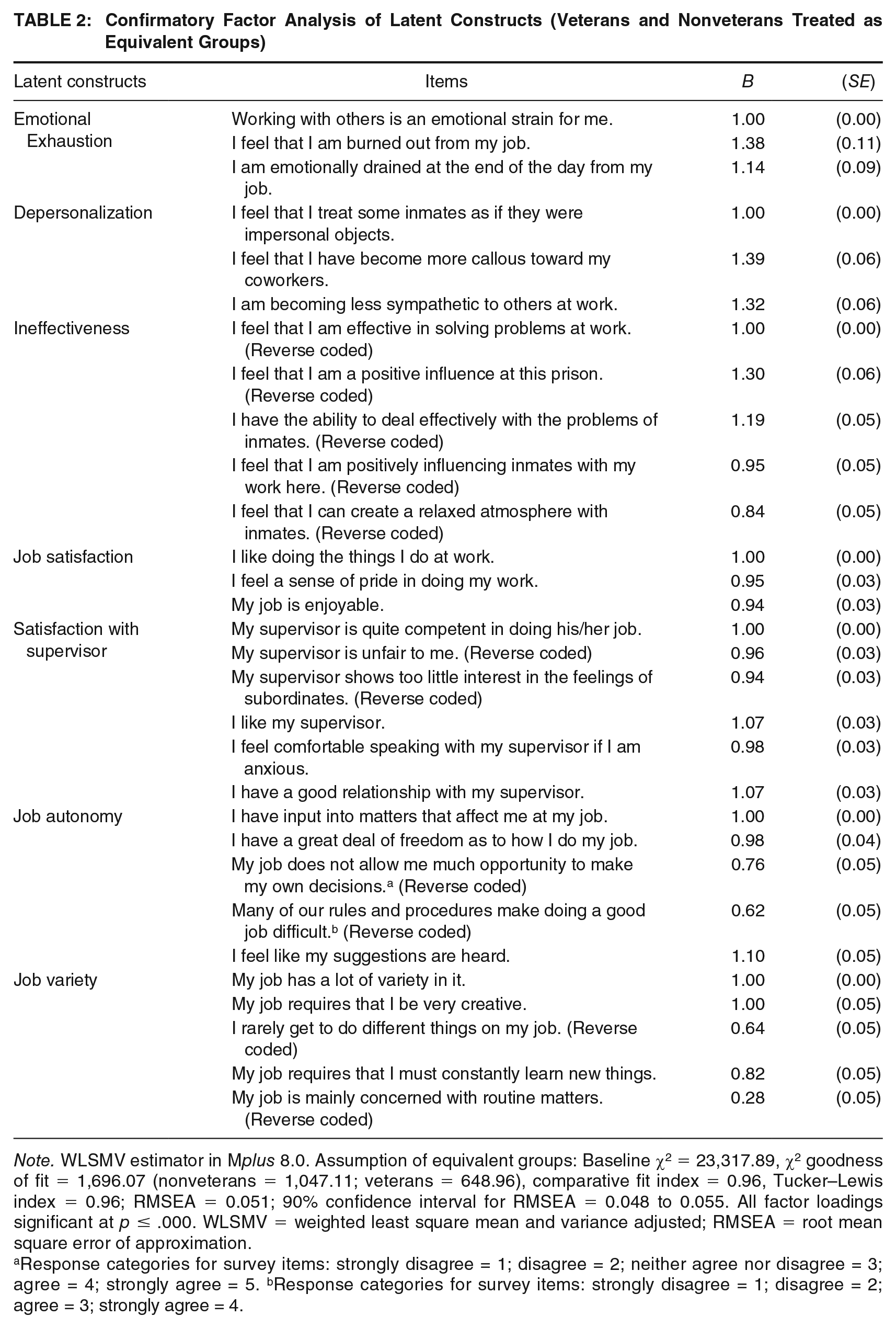
Note. WLSMV estimator in Mplus 8.0. Assumption of equivalent groups: Baseline χ2 = 23,317.89, χ2 goodness of fit = 1,696.07 (nonveterans = 1,047.11; veterans = 648.96), comparative fit index = 0.96, Tucker–Lewis index = 0.96; RMSEA = 0.051; 90% confidence interval for RMSEA = 0.048 to 0.055. All factor loadings significant at p ≤ .000. WLSMV = weighted least square mean and variance adjusted; RMSEA = root mean square error of approximation.
Response categories for survey items: strongly disagree = 1; disagree = 2; neither agree nor disagree = 3; agree = 4; strongly agree = 5. bResponse categories for survey items: strongly disagree = 1; disagree = 2; agree = 3; strongly agree = 4.
Model fit for the CFA was assessed with the comparative fit index (CFI), the Tucker–Lewis index (TLI), and the root mean square error of approximation (RMSEA). Ideally, values of the CFI and TLI should be greater than 0.95 (closer to 1.0 is better) and values of the RMSEA should be equal to or less than 0.05 (closer to 0.00 is better; Byrne, 2012). We followed the modification indices suggested in Mplus when these statistics were initially poor, including dropping a couple of the items altogether from the analysis and allowing 13 non-zero error covariances between some of the items within the factors (but not between the factors). These modifications produced the statistics at the base of Table 2. The value of 0.051 for the RMSEA was slightly above the preferred value of 0.050 but we were satisfied because the lower boundary of the 95% confidence interval for the RMSEA was 0.048 (Kline, 2017). Next, we proceeded with testing group equivalence on the causal (path) model. These results are relevant to our research hypotheses and are described in the next section.
Results
Differences in Occupational Outcomes by Veteran Status (H1)
The above test for group equivalence involved testing the equivalence of both mean and covariance structures between veterans and nonveterans. The assumption of group equivalence in the latent factors was met after slight modifications to the covariance structure only. Thus, equivalence on the mean structure suggests no substantive group differences on latent variable means, also reinforced with group comparisons of the univariate descriptives for the survey items in Table 1. Contrary to H1, levels of job burnout and job satisfaction appear to be comparable between veterans and nonveterans, with similar distributions on both sets of outcomes.
In terms of group differences in factors affecting job outcomes, Table 3 displays the multivariate models estimated with the pooled sample (veterans and nonveterans included), nonveterans only, and veterans only. The assumption of group equivalence on the path model was met for the pooled sample without having to modify the model differently for veterans and nonveterans, based on the global statistics displayed at the base of Table 3 (CFI = 0.96; TLI = 0.96; RMSEA = 0.034). These values satisfy the requirements for good model fit, indicating that the same model produces a comparable fit for veterans and nonveterans.
Linear Multivariate Model of Job Burnout and Work Satisfaction
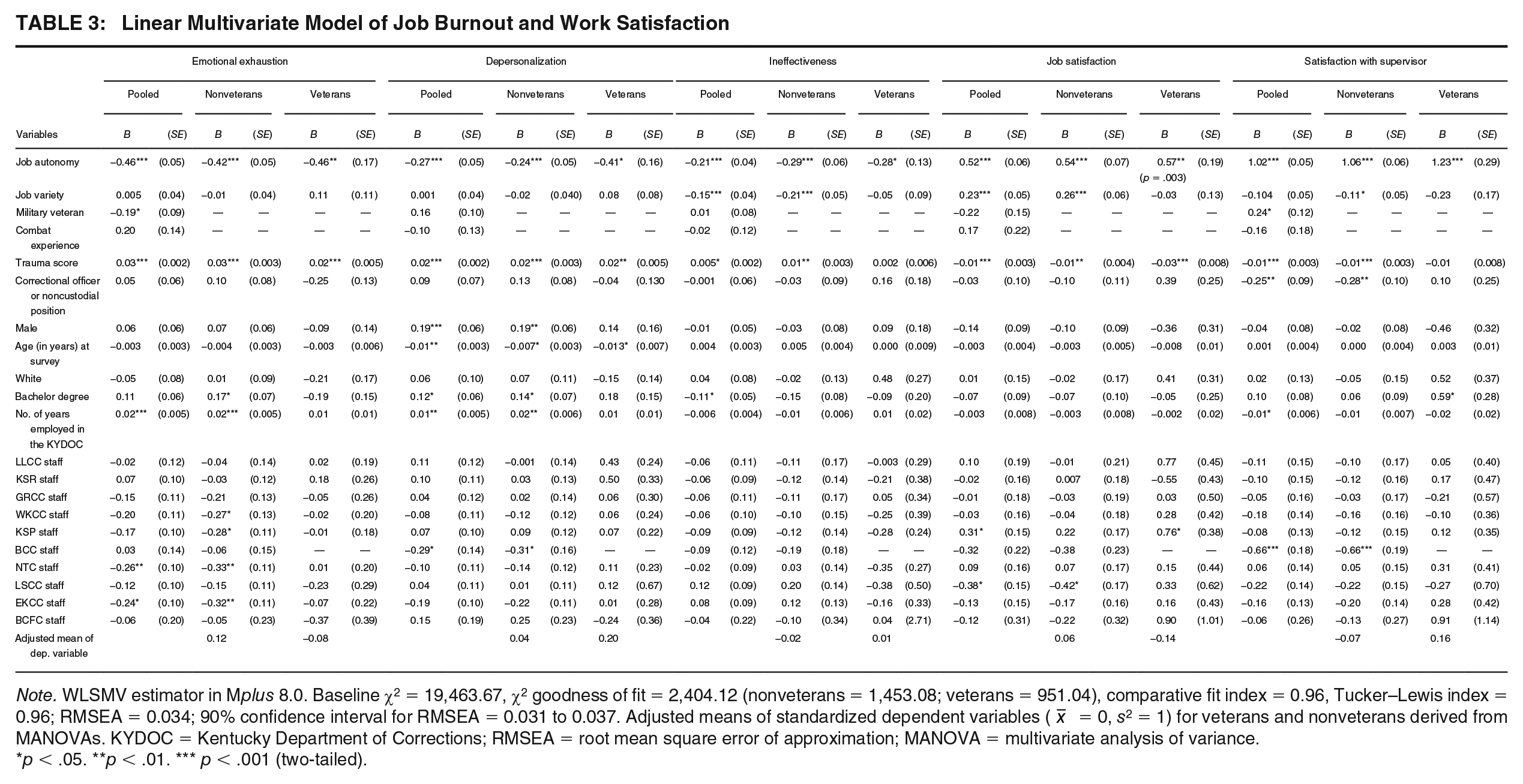
Note. WLSMV estimator in Mplus 8.0. Baseline χ2 = 19,463.67, χ2 goodness of fit = 2,404.12 (nonveterans = 1,453.08; veterans = 951.04), comparative fit index = 0.96, Tucker–Lewis index = 0.96; RMSEA = 0.034; 90% confidence interval for RMSEA = 0.031 to 0.037. Adjusted means of standardized dependent variables (
p < .05. **p < .01. *** p < .001 (two-tailed).
The main effects of military veteran status and combat experience were assessed in the pooled model but were excluded from the evaluation of group equivalence simply because veteran status is constant for both groups and combat experience is constant for nonveterans. Combat experience had no impact on job outcomes, whereas military veterans were significantly less likely to experience emotional exhaustion (p = .037) and were more likely to be satisfied with their supervisors, controlling for other covariates (p = .042). These two sets of findings suggest that veterans might confer a greater advantage over nonveterans in adjusting to the work of correctional staff.
Differences in the Effects of Job Autonomy and Job Variety by Veteran Status (H2)
Despite group equivalence on the job outcome models overall, it is possible for the magnitude of some covariates to differ between groups. Our second research hypothesis focused on group differences in the effects of job autonomy and job variety on job burnout and job satisfaction. Regarding burnout, and without exception, perceptions of greater job autonomy corresponded with less burnout for both groups, and none of these estimates differed significantly in magnitude between the two groups (p > .05), based on the equality of coefficients test introduced by Clogg et al. (1995). The largest group difference emerged for depersonalization, being larger in magnitude for veterans, but was nonsignificant.
Job variety, by contrast, was a significant predictor of only one of the three outcomes tapping job burnout, and for nonveterans only. Specifically, nonveterans’ perceptions of greater variety in their jobs coincided with lower levels of perceived ineffectiveness. However, the significant inverse effect was not stronger in magnitude relative to the effect for veterans (p > .05). These two sets of findings provide no evidence of significant between-group differences in the effects of job autonomy and variety on job burnout. It also appears that job autonomy is more relevant than variety for impacting an individual’s feelings of burnout.
Turning to the models of job satisfaction and satisfaction with one’s supervisor, the same theme for job autonomy that emerged from the analysis of burnout also emerged in these models. Greater autonomy corresponded with significantly better outcomes regardless of veteran status and the strength of these effects was similar for veterans and nonveterans with no significant differences in magnitude (p > .05). Levels of satisfaction with one’s job and supervisor appear to be impacted by the level of autonomy granted to correctional staff.
Findings for the effects of job variety on satisfaction differed from the analysis of burnout, where these effects were significant for nonveterans only. Also, the findings for job satisfaction are intuitive, whereas those for satisfaction with one’s supervisor are not. Greater job variety corresponded with significantly higher levels of job satisfaction for nonveterans, yet significantly lower levels of satisfaction with their supervisors (p = .031). The estimate was also negative for veterans and larger in magnitude, although nonsignificant, due to the smaller sample size. Moreover, both sets of coefficients did not differ significantly in magnitude between the two groups based on the Clogg test (p > .05).
These findings provide no evidence of significant group differences in the effects of job autonomy and variety on satisfaction with one’s job or supervisor. Job autonomy appears to be more relevant than job variety for shaping satisfaction among both groups and the latter might have a negative impact on individuals’ perceptions of their supervisors.
Differences in the Effects of PTSD by Veteran Status (H3)
The null effects of combat experience in all five models with the pooled samples beg the question of whether controlling for T-scores (PTSD symptoms) rendered these null effects. This would be a logical expectation given our earlier discussion of the negative ways in which combat experience might impact perceptions of correctional staff. Interestingly, although combat experience and T-scores score were positively correlated, the group-specific models revealed that T-scores had significant effects on all job outcomes for nonveterans and these estimates were either comparable or stronger in raw magnitude relative to those for veterans except for job satisfaction. That is, it does not appear that the impact of T-scores proxied the effects of combat experience.
To the question of whether an individual’s T-score had differential impacts for veterans and nonveterans, and consistent with the above, the equality of coefficients tests did not produce any significant differences in the magnitude of trauma effects on these five outcomes. T-scores were a significant predictor of all five outcomes for nonveterans and were significant for veterans in four of the five models. Despite its nonsignificance for veterans in the model of satisfaction with supervisor, the rounded estimates for both groups are identical. The nonsignificance for veterans appears to be due to the smaller sample.
Occupational Outcome Differences Among Veterans Based on Military Service Factors (H4)
Recognizing heterogeneity in military backgrounds and its potential impact on variance in job outcomes, we also examined the relevance of military service factors for shaping the job outcomes of veterans. These models included military-specific measures in addition to all the covariates from the previous models, but only the estimates for the military factors are displayed in Table 4. Also displayed are the estimates for combat experience and T-score because of their relevance to military service.
Veteran-Specific Multivariate Model With Military Service Factors
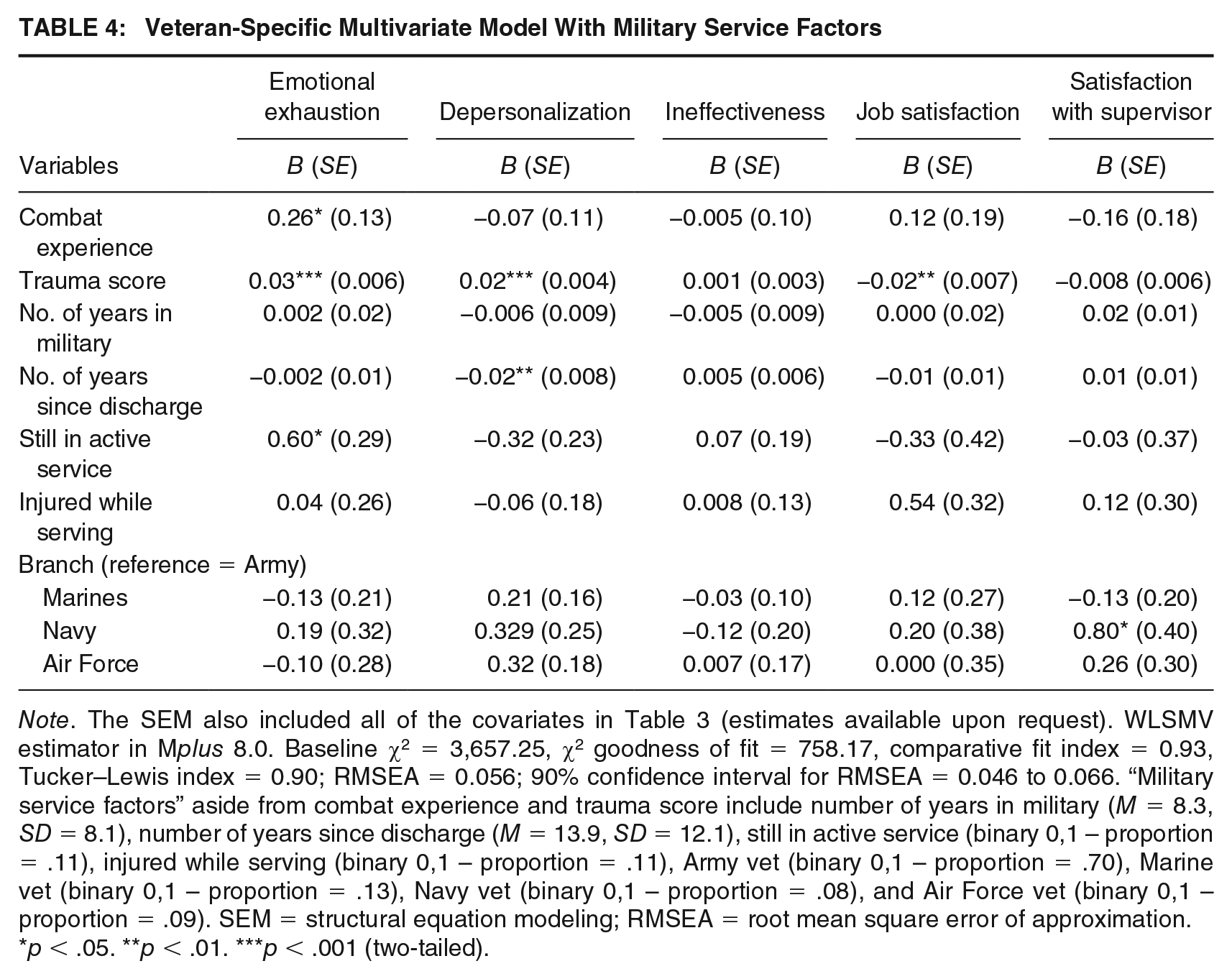
Note. The SEM also included all of the covariates in Table 3 (estimates available upon request). WLSMV estimator in Mplus 8.0. Baseline χ2 = 3,657.25, χ2 goodness of fit = 758.17, comparative fit index = 0.93, Tucker–Lewis index = 0.90; RMSEA = 0.056; 90% confidence interval for RMSEA = 0.046 to 0.066. “Military service factors” aside from combat experience and trauma score include number of years in military (M = 8.3, SD = 8.1), number of years since discharge (M = 13.9, SD = 12.1), still in active service (binary 0,1 – proportion = .11), injured while serving (binary 0,1 – proportion = .11), Army vet (binary 0,1 – proportion = .70), Marine vet (binary 0,1 – proportion = .13), Navy vet (binary 0,1 – proportion = .08), and Air Force vet (binary 0,1 – proportion = .09). SEM = structural equation modeling; RMSEA = root mean square error of approximation.
p < .05. **p < .01. ***p < .001 (two-tailed).
With few exceptions, these within-group analyses suggest more similarities than differences among veterans. Although T-scores were significantly related to three of the five outcomes—where higher scores corresponded with higher levels of emotional exhaustion and depersonalization, and lower levels of job satisfaction (p = .002)—recall that they were also significant for nonveterans and estimates for both groups did not differ significantly.
Combat experience (p = .048) and active service (p = .038) also increased the likelihood of emotional exhaustion. Finally, Navy veterans reported higher levels of satisfaction with their supervisors compared with Army veterans (p = .047). Although the military service factors examined reflect only a cross-section of potentially relevant indicators, the bulk of null findings in Table 4 suggest that heterogeneity in military backgrounds may only account for a small portion of the variance in job outcomes for veterans.
Other Correlates of Job Outcomes
Some of the findings for the covariates included in the models for the pooled samples are noteworthy for informing model specifications in future studies. First, differentiating between correctional officers and other correctional staff improved prediction of satisfaction with one’s supervisor (officers were less likely to be satisfied; p = .004), but nothing else, suggesting that perceptions of correctional staff in general are shaped by many of the same factors. Second, education effects are nuanced depending on the specific dimension of job burnout being examined. More education was associated with stronger perceptions of depersonalization (p = .046), weaker perceptions of ineffectiveness (p = .050), and no differences in feeling of emotional exhaustion. Third, more years employed in the KYDOC coincided with worse job outcomes in terms of emotional exhaustion, depersonalization (p = .005), and satisfaction with one’s supervisor (p = .030). Job tenure might be the most relevant control variable in this regard because it was related to aspects of both job burnout and satisfaction. Fourth, age and sex mattered only for predicting depersonalization, with males and younger staff (p = .005) more likely to experience depersonalization. Finally, most job outcomes were better or worse for staff at particular facilities (excluding job ineffectiveness). The varied perceptions of staff regarding job outcomes across these facilities underscore the importance of controlling for location in related studies, at a minimum, and perhaps modeling facility-level effects on job burnout and satisfaction.
Table 1 reveals that veterans in our sample were 3.5 years older than nonveterans, on average, and typically had worked longer in the KYDOC by 2 years. These are substantive differences that raise the question of whether age (maturity) and job tenure might be confounders in our analysis, especially given that these variables were significant predictors of some of these outcomes. Therefore, we assessed whether the estimates for veteran status changed when age and job tenure were excluded from the models. For every outcome, estimates for veteran status weakened slightly in magnitude but did not change in statistical significance when these covariates were excluded. Specifically, maximum likelihood (ML) estimates dropped from −0.19 to −0.18 for emotional exhaustion, from 0.16 to 0.14 for depersonalization, from 0.01 to 0.005 for ineffectiveness, from −0.22 to −0.19 for job satisfaction, and from 0.24 to 0.23 for satisfaction with supervisor.
Discussion and Conclusion
Workplace stress is common in many professions, including institutional corrections (Fenwick & Tausig, 2007; Griffin et al., 2012; Lambert et al., 2016). Yet, several factors may influence whether symptoms (e.g., burnout and dissatisfaction) manifest among personnel. Given the emphasis placed by some states on hiring veterans, we assessed whether prior military service explains variation across job-related outcomes among correctional staff. Overall, results suggest veterans and nonveterans had far more similarities than differences in job outcomes, and factors affecting these outcomes. These findings have theoretical and policy implications.
Theoretically, our findings question the acceptance of a “veteran effect” across occupational outcomes among those working in institutional corrections. The guiding edict of previous research is veterans—due to backgrounds and prior training in a regimented institution—have significantly different work-related experiences than nonveterans. Although emotional exhaustion and dissatisfaction with supervisors were somewhat less common among veterans relative to nonveterans in our sample, the findings do not provide compelling evidence that veterans hold an advantage in terms of more favorable job perceptions overall and the factors that influence those perceptions. Simultaneously, none of our findings indicated veterans held more negative views relative to nonveterans, as some have suggested (Fleming et al., 2013). The magnitude of the effects on job outcomes was also comparable between the two groups. For example, T-scores had comparable effects, which casts doubt that PTSD is primarily a problem for military types.
The nonsignificant differences between veterans and nonveterans in depersonalization, ineffectiveness, and job satisfaction could be artifacts of socializing/cultural practices within the daily routines of both servicemembers and correctional staff. Veterans might be more likely to depersonalize others if the military teaches recruits to emotionally detach oneself from the enemy to gain advantage (Grossman, 1996). Military roles are varied and often contradictory. Sometimes servicemembers are asked to embrace a calloused “warrior” identity; other times identities like “protector” or “diplomat” are needed (Hajjar, 2014; Lunasco et al., 2010). Thus, these effects might work against other potential benefits of military training such as discipline, leadership, and patience.
Regarding nonsignificant differences in perceived ineffectiveness, new recruits in both the military and prison systems are quickly indoctrinated into cultures hierarchically stratified by experience and rank (Burdett et al., 2018; Crewe et al., 2011; Hall, 2011; Viglione et al., 2015; Wilson, 2008). Both correctional staff and military recruits report to, and take orders from, those next in the chain of command. Similarities in socialization processes among recruits, coupled with relative positions of authority, could explain the similarities between veterans and nonveterans on perceptions of ineffectiveness.
With respect to job satisfaction, working in prison may not be the first choice of employment for many people, irrespective of veteran status. People oftentimes seek out careers in corrections because they lack alternatives and many veterans struggle to find employment after active duty (Hammer et al., 2017; Roy et al., 2020; Schlosser et al., 2010). As critics have noted, the U.S. military effectively trains recruits to operate within the military context, yet also does an “. . . extremely poor job of reversing that training or preparing them before sending them back into civilian life” (Zogas, 2017, pp. 4–5). Thus, regardless of backgrounds, correctional staff may be less apt to find their jobs “satisfying” if these jobs are often viewed as fallback options.
Extant literature on the “veteran effect” focuses almost exclusively on occupational stress and burnout in police work (Hartley et al., 2013; Ivie & Garland, 2011; Shernock, 2017). Police officers and correctional staff share some occupational stressors, but the underlying casual mechanisms for each group are nuanced and should not be conflated. Prison work is distinct from other criminal justice professions in that staff and IPs may interact daily. Conversely, interactions between police officers and civilians are less frequent, more impersonal, and subject to more formal procedures.
Still, the observed differences in emotional exhaustion and dissatisfaction with supervisors between veterans and nonveterans are noteworthy. Veterans may be less likely than nonveterans to report emotional exhaustion because of the mental and physical conditioning that accompanies the rigors of military training. The military training model is predicated on enhancing cognitive ability, locus of control, self-efficacy, organizational commitment, expectations, and motivation. These attributes are tested under adverse conditions and likely serve as assets within prisons (Cannon-Bowers et al., 1995; Miller et al., 2011).
The extent to which veteran staff members feel more prepared for, and less exhausted by, their occupational mandate may influence how they view their superiors. The overlap between military and prison environments in physical and psychological demands, autonomy (or lack thereof), and deference to authority in the chain of command could influence how subordinates and superiors interact (Craig, 2004; Penrod et al., 2014). Veterans who are more accepting of basic training’s highly routinized environment often fare better across metrics of adjustment at later stages of their career (Britt et al., 2016). Therefore, veterans may be more apt to proactively accept the demands of working in prison and be more understanding of expectations placed on them by their supervisors. One caveat may be veterans who have seen combat and active servicemembers (see Table 4), where the psychological effects of warfare and additional work mandates may compound the stress of prison work.
From a policy perspective, our results should caution prison administrators and recruiters from extrapolating theoretical assumptions and findings from policing to inform their hiring practices. Our findings do not suggest agencies should avoid hiring veterans—veterans did not maintain worse job perceptions relative to nonveterans and their perceptions were not unduly influenced by factors like PTSD. Yet, administrators may consider the potential impacts on recruits who have seen combat or are still active service members. There are also compelling arguments for hiring veterans. Their military training and experience may provide useful skills that correctional staff training either does not provide or provides with less rigor. Still, our results indicate veterans are no better or worse off than nonveterans with respect to most of the occupational outcomes examined, which could be noted when developing recruitment strategies.
The results and limitations of this study offer avenues for future research. First, our study was limited to Kentucky prisons. Researchers should replicate our analyses in other states to investigate geographic differences in findings. Second, our staff sample consisted primarily of White men. Future research should include more diverse samples of correctional staff to establish whether the effects of military experience on job burnout and (dis)satisfaction among correctional personnel are uniform across demographic groups. Third, our data are cross-sectional. Longitudinal analyses would allow for assessment of job burnout and dissatisfaction across an individual’s career. Finally, our analyses are of self-report data, which may be susceptible to social desirability bias (Lynch & Addington, 2010). Staff members may overreport or underreport behaviors. For example, staff with military experience may exaggerate their combat experience to appear more legitimate (Lynn & Belza, 1984). Future studies may supplement survey data with administrative data to corroborate different pieces of information. Finally, for the purpose of data collection, future studies should consider the prospect that, with few exceptions, military veterans are a homogeneous group regarding service-specific factors, as research on incarcerated veterans suggests (Brooke, 2018).
In sum, our study demonstrates the (ir)relevance of military experience for shaping job outcomes among persons working in prison. Given recent increases in veterans seeking careers in corrections and other security-based occupations, and efforts by agencies such as the Federal Bureau Prisons and the Texas Department of Criminal Justice, this will be an important research area for the foreseeable future (Bureau of Labor Statistics, 2020; Givens, 2017; U.S. Office of Personnel Management, 2019).
Footnotes
Authors’ Note:
The authors thank all staff who participated. The findings, conclusions, and recommendations expressed in this manuscript are those of the authors and do not necessarily reflect those of the Kentucky Department of Corrections. The authors have no funding or conflicts of interest to disclose. Data for the current study come from a previous project supported by the Kentucky Department of Corrections.
