




Abstract
Although research recognizes gender differences in offending and interactions with the criminal justice system, few studies have explored the role of gender in the relationship between postrelease supervision and recidivism. Building on feminist criminological research, this study uses a feminist pathways theoretical framework to investigate the overall and gendered effects of postrelease supervision on multiple measures of recidivism. Using a large sample of offenders released from prisons in Florida (N = 141,338) and propensity score matching techniques, this study uncovers that postrelease supervision is associated with a very small (4% to 4.5%) reduction in recidivism. Moreover, the effect sizes from the analyses also indicate that postrelease supervision plays a greater role in reducing recidivism among men, but the effects for women are much smaller. Based on this study’s findings, policymakers should consider the importance of gender in designing appropriate programming in prison and developing postrelease techniques in reducing recidivism.
Introduction
The United States incarcerates a larger share of its population than any other country (Walmsley, 2016). Current estimates suggest about 1 in 38 adults are currently in the correctional population (Kaeble & Cowhig, 2018). Although more men than women are in prison, the total number of female prisoners has increased from a total of 13,206 to 111,422 between 1980 and 2016 (Carson, 2018; Kalish, 1981). Along with this growth in prison population (Carson, 2018; Carson & Golinelli, 2013), there has been an accompanying growth in the number of men and women under correctional authority and supervision on release. In 2016, around 70% of those under correctional authority were under community supervision, meaning they are supervised and monitored by the criminal justice system outside of prisons (Kaeble & Cowhig, 2018).
In response to these trends, measuring the effectiveness of postrelease supervision on recidivism has become increasingly important. Past research shows that postrelease supervision reduces recidivism (Gifford et al., 2014; Peters, Hochstetler, DeLisi, & Kuo, 2015; Schlager & Robbins, 2008; Vito, Higgins, & Tewksbury, 2017). These studies, however, have focused on specific types of supervision programs (e.g., parole, drug-treatment programs, and intensive supervision) and have not accounted for how gender may shape these processes. This prevents criminologists’ from understanding how postrelease supervision programs may be gendered (biased toward one gender over another) and whether this affects recidivism. Because the incarcerated population in the United States is predominately male—around 93% in total (Carson, 2018)—most studies on reentry have used all-male or solo-gender correctional samples and few studies have investigated any possible gendered differences in the relationship between postrelease supervision and recidivism, and this oversight may mask structural gender differences across these processes.
This study adds to the literature on postrelease supervision by examining the overall and gendered relationships between postrelease supervision and recidivism in a large cohort of offenders released from prison in Florida (N = 141,338) using propensity score matching (PSM) techniques. The knowledge offered from this study on the overall effectiveness of postrelease supervision can help policymakers ascertain its usefulness in reducing recidivism while also acknowledging the ways that gender shapes the likelihood of being supervised as well as the effectiveness of this supervision.
Literature Review
Supervision, Recidivism, and Gender
Research has found that imprisonment leads to higher rates of recidivism when compared with non-incarcerated alternatives (Bales & Piquero, 2012; Gaes, Bales, & Scaggs, 2015; Mears, Cochran, & Bales, 2012) and that postrelease supervision can also help recidivism (Gifford et al., 2014; Peters et al., 2015; Schlager & Robbins, 2008; Vito et al., 2017). Although this research suggests that postrelease supervision reduces re-incarceration, these studies have typically focused on specific types of supervision programs (Andersen & Wildeman, 2015; Gifford et al., 2014; Peters et al., 2015; Vito et al., 2017). For example, drug-treatment courts in North Carolina reduced rearrest rates (Gifford et al., 2014) and in Iowa the completion of treatment regimens—a series of programs that take place both while the offender is incarcerated and on parole—also decreased rearrests (Peters et al., 2015). In contrast, a 90-day postrelease service program in New York City found no differences in recidivism among participants (White, Saunders, Fisher, & Mellow, 2012). Other research done in Kentucky suggests that drug offenders on parole are substantially more likely than those without supervision to be reincarcerated (Vito et al., 2017).
Unsurprisingly, research investigating gendered differences in the relationship between supervision and recidivism are even more limited. Past studies have examined the gendered effects of incarceration (Mears et al., 2012; Staton-Tindal et al., 2011) or gender-specific treatment programs in prison (Pelissier, Camp, Gaes, Saylor, & Rhodes, 2003) or after release (Evan et al., 2013). These women-only programs have a positive, short-term effect on rearrest rates, but long-term outcomes, such as re-incarceration after 3 years of treatment, show no meaningful effects (Hser, Evans, Huang, & Messina, 2011). These mixed or incomplete findings for women specific programs as well as the mixed and limited findings for male-focused supervision programs has led to an incomplete assessment of the effects of postrelease supervision.
Although studies examining the gender differences in the relationship between postrelease supervision and recidivism have been limited, one has reasons to expect that there are meaningful gender differences across recidivism outcomes. A large body of research documents that gender shapes both offending behaviors and interactions within the criminal justice system. For example, multiple studies indicate that men and women experience difference types of strain or stressors, differ in how they emotionally respond to these strains (e.g., anger and depression), and cope with strain in different ways (Broidy, 2001; Broidy & Agnew, 1997). These men tend to externalize their emotional responses to anger with crimes against others, whereas women are more likely to internalize their anger with self-destructive forms of deviance, such as illicit drug use (Broidy & Agnew, 1997; M. S. Jones, Worthen, Sharp, & McLeod, 2018).
In terms of criminal sentencing, studies have also found that women are sentenced more leniently than men (Doerner & Demuth, 2014; Koons-Witt, Sevigny, Burrow, & Hester, 2014; Spohn, 1999), though the type of crime committed (Rodriguez, Curry, & Lee, 2006), age of the offender (Steffensmeier, Ulmer, & Kramer, 1998), and incarceration decisions (jail vs. prison) can affect these relationships (Freiburger & Hilinski, 2013). Rodriguez and colleagues (2006) found that for both property- and drug-offending women were less likely to be sentenced to prison and also received shorter sentences. For violent offending, however, female offenders were as likely as male offenders to receive prison time, but received substantially shorter sentences than male offenders (Rodriguez et al., 2006).
Gender also plays a critical role in experiences after being released from prison. Indeed, employment, housing, transportation, economic problems, and family issues affect both male and female offenders (Makarios, Steiner, & Travis, 2010), but may be especially difficult for women (Garcia, 2016; Matheson, Doherty, & Grant, 2011). Many women who are released from prison report extensive histories of abuse, mental health issues, and drug use prior to their incarceration (M. S. Jones et al., 2018; Owen, 1998; Sharp, 2014), which may increase reoffending. Women may not have access to physically demanding jobs such as construction, leading to fewer opportunities in the secondary labor market jobs for these offenders (Visher, Debus, & Yahner, 2008). Female offenders can struggle to find suitable housing on release, and this is especially true for offending mothers, for whom finding safe housing is important for their children as well as their own well-being. Many are reunited with their children even though “getting full responsibility too soon could sabotage the chance of successful reintegration” (Sharp, 2014, p. 116).
Although researchers have made great strides in understanding gender differences in experiences with the criminal justice system, the role of gender in the relationship between postrelease supervision and recidivism remains understudied. This study explores some of these potentially gendered pathways in postrelease supervision and their effect on recidivism.
Feminist Pathways Theoretical Framework
The motivation for this study comes from the extensive research on women’s pathways into crime that indicate that gender matters. Gendered pathways research has focused on girls’ and women’s life histories to understand how both childhood and adult experiences are linked to offending behaviors (Belknap, 2015). Although data limitations prevent this study from fully exploring specific gendered pathways out of the criminal justice system, this research provides both a framework and motivation for exploring how gender shapes who gets supervised and the effectiveness of this supervision. The pathways perspective focuses on how experiences of abuse and oppression of women and girls narrow their options and can place them on a trajectory where deviance or crime may be a response to managing these difficulties. Considerable research on women’s pathways to crime has documented experiences with childhood abuse (Belknap & Holsinger, 2006; M. S. Jones et al., 2018; Owen, 1998; Sharp, 2014), substance abuse (Daly, 1992; Owen, 1998; Salisbury & Van Voorhis, 2009), unhealthy intimate relationships (M. S. Jones et al., 2018), and a lack of self-efficacy (Sharp, 2014) as pathways into offending for women. Other factors such as mental illness are often interconnected with extensive histories of childhood and adult abuse as well as substance abuse problems (Brennan, Breitenbach, Dieterich, Salisbury, & Voorhis, 2012; Owen, 1998; Salisbury & Van Voorhis, 2009; Sharp, 2014)
Although male offenders also have histories laden with trauma and abuse (Belknap & Holsinger, 2006; N. J. Jones, Brown, Wanamaker, & Greiner, 2014; Messina, Grella, Burdon, & Prendergast, 2007), research has shown that women under correctional supervision are more likely to experience physical and sexual abuse as children and adults than male offenders (Bloom, Owen, & Covington, 2003; Messina et al., 2007) and that these experiences are often directly linked to their offending behaviors (Brennan et al., 2012; N. J. Jones et al., 2014; Salisbury & Van Voorhis, 2009). Indeed, research has documented that 70% to 90% of women in prison have experienced abuse in both childhood and adulthood as recently as 12 months before their incarceration (Messina et al., 2007; Owen, 1998; Sharp, 2014).
Other theories that focus on female development, such as Relational Cultural Theory (RTC), recognize that women’s identity, self-worth, and sense of empowerment are defined by the quality of relationships and connections they have with others (Gilligan, 1982; Kaplan, 1984; Miller, 1976). Correctional scholars have also noted that many women offenders engage in relationships that facilitate their criminal behavior (Richie, 1996; Sharp, 2014). For example, in Sharp’s (2014) study of female offenders from Oklahoma, she found that being in relationships with criminal men is one common pathway into crime for women. These relationships not only introduced and encouraged the women to participate in illegal activities but also resulted in women taking responsibility for crimes committed by their boyfriends to keep them out of prison. Feminist scholars have found that women who are involved in abusive intimate relationships often turn to substance abuse to cope with their mental distress associated with their abuse (Bloom et al., 2003; Salisbury & Van Voorhis, 2009).
Women also face several gender-specific barriers when attempting to reintegrate into society. These include the lack of social and human capital unique to incarcerated women, which some argue represent a distinctive pathway for women’s reoffending (Salisbury & Van Voorhis, 2009; Sharp, 2014). Women’s experiences with drug-related offenses, having family in prison, exposure to abuse, and struggles with mental health all place them at a disadvantage in the reentry process (Cloyes, Wong, Latimer, & Abarca, 2010). Freudenberg et al. (2007) report that 83% of mothers live with their children in the year before their arrest. This, coupled with women’s economic marginalization and substance abuse problems, often leads to stress about being able to provide for their children on release (Greene, Haney, & Hurtado, 2000). Maternal demands may directly contribute to recidivism, and many women offenders face financial difficulties in providing for themselves and their children (Sharp, 2014). Overall, the feminist pathways framework suggests that women encounter distinctive pathways into and out of prison. This may be particularly true among women who receive postrelease supervision.
The Current Study
Guided by a feminist pathways theoretical framework, this study uses data from the Criminal Recidivism in a Large Cohort of Offenders Released from Prison in Florida (2004-2008, described fully below) and PSM techniques to explore the gender differences in the effects of postrelease supervision on recidivism. Although in general the research on postrelease supervision (Peters et al., 2015; Vito et al., 2017) and reentry (Garcia, 2016; Matheson et al., 2011) provides mixed findings, the goal of supervision is to help offenders reintegrate into their communities while maintaining any necessary oversite and treatment they may require. Based on prior research and the goal of supervision, one can anticipate that these programs will reduce recidivism, though the effects may be modest. This leads to the first hypothesis:
The research on the feminist pathways (Daly, 1992; Salisbury & Van Voorhis, 2009) into and out of the prison system suggests that women and men differ in their experiences entering into the criminal justice system as well as their experiences within prison. In spite of the lack of research on women’s reentry, one may fully expect to find the relationship between postrelease supervision and recidivism to be shaped, in part, by gendered processes. This leads to the second hypothesis of this study:
Assessing whether and to what degree these expectations are met should contribute to several literatures by establishing how gender shapes the association between postrelease supervision and recidivism.
Method
Sample
This study utilizes data from the Criminal Recidivism in a Large Cohort of Offenders Released from Prison in Florida, 2004 to 2008 (CRPF). Collected by the Urban Institute, researchers complied and coded these data using criminal history records and Florida’s DNA database (kept by the Florida Department of Law Enforcement [FDLE]) as well as court docket information acquired from the Florida Department of Corrections (FDOC). These data were compiled to understand how advances in DNA technology as well as the increased collection of DNA by law enforcement agencies might shape offender behavior after release from prison (Bhati, 2010; Bhati & Roman, 2014). For our purposes, these data contain a large sample of offenders released from the Florida Department of Corrections (FDOC) from 1996 to 2004 along with a 3-year follow-up to determine whether these offenders recidivated. These data contain a wide variety of variables on the crime(s) committed by offenders, their demographic profile, and time-specific measures of recidivism. After adjusting for missing cases, the CRPF contains information on 141,338 individuals released from Florida prisons: 128,183 men (91%) and 13,155 women (9%). Table 1 presents the sample descriptive statistics for the full and gender-specific sample for the variables used in the analyses (variable coding described below), as well as tests for mean gender differences for each measure. Given the sample size, it is unsurprising that many significant differences were detected. Important for the purposes of this study is the large percentage difference between men and women in receiving supervision (36.4% men and 25.7% women), rearrest (58.2% and 47.1% for men and women, respectively), and reconviction (42.4% and 31.7% for men and women, respectively).
Descriptive Statistics, by Gender
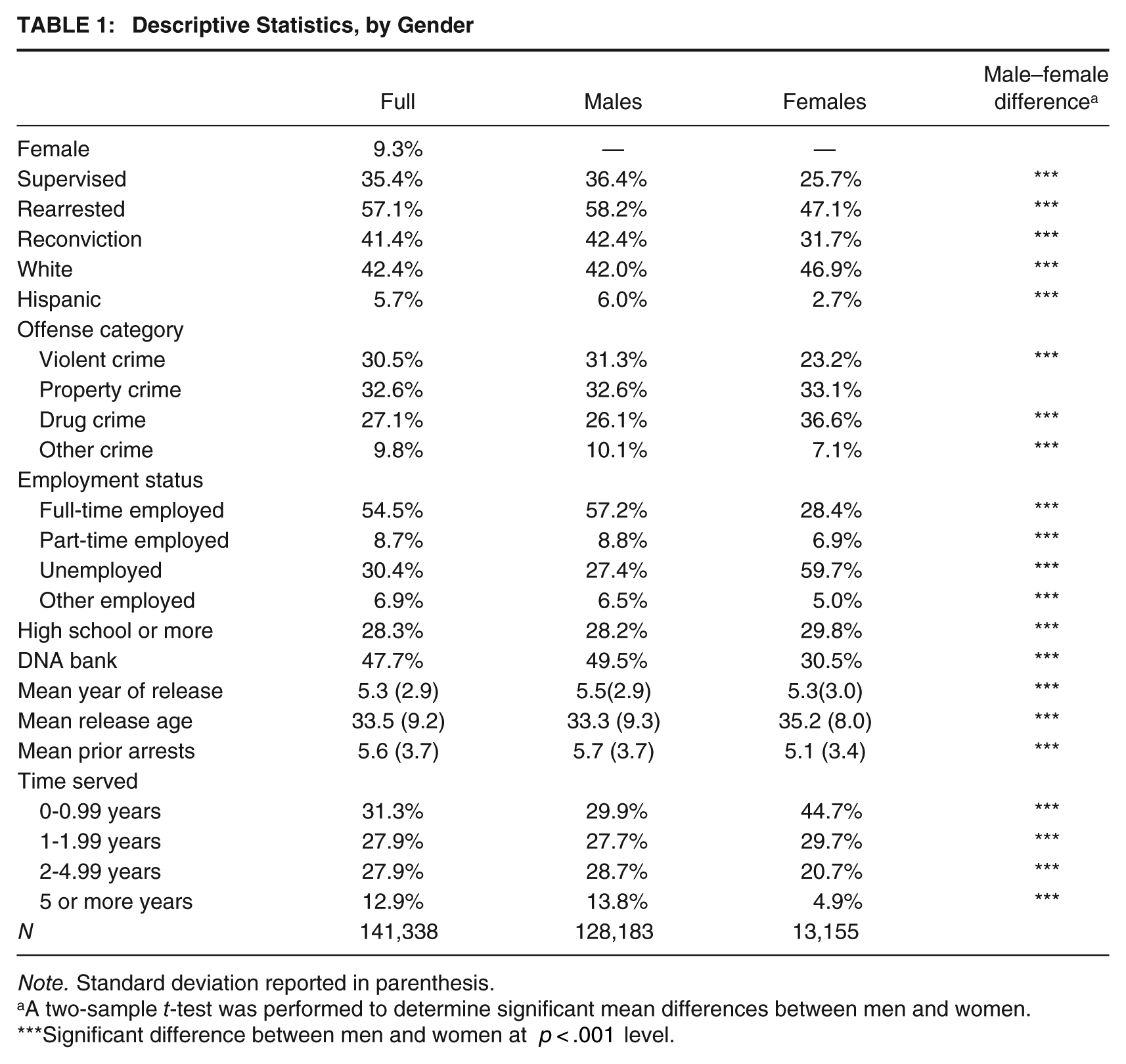
Note. Standard deviation reported in parenthesis.
A two-sample t-test was performed to determine significant mean differences between men and women.
Significant difference between men and women at
Outcome Variable: Recidivism
The CRPF collects information about recidivism over a 3-year follow-up period for all the individuals in the survey. In Florida, there are several different types of postrelease supervision. Perhaps, the most known form of supervision is parole. This is when an offender is released before their court-imposed sentence expires, with specific conditions regarding how they will be supervised by the Florida Department of Corrections (FDOC). For inmates with sentences for specific crimes such as violent or sexual crimes, conditional release is a type of mandatory post-prison supervision. Inmates who are terminally ill or permanently incapacitated may be released on conditional medical release if they do not represent a danger to others. Other times, offenders may be released with supervision to maintain a prison population between 99% and 100% capacity. Finally, addiction recovery supervision is a mandatory post-prison supervision for inmates with substance abuse histories or addiction, given they have not been convicted of certain crimes such as violent offenses or drug trafficking (Florida Commission on Offender Review [FCOR], 2014).
Because the purpose of all these types of supervision is similar—to rehabilitate offenders and minimize the likelihood that they will recidivate—this study takes a broad view on supervision to determine whether and to what degree postrelease supervision shapes rates of recidivism in a gendered way. This includes information on whether the respondents are rearrested or reconvicted within a 3-year follow-up period. There is some debate over how long follow-up periods ought to be in recidivism studies (Hedderman & Jolliffe, 2015; Kennealy, Skeem, Manchak, & Louden, 2012; Matheson et al., 2011), because shorter follow-up periods risk underreporting recidivism because they do not track these offenders for a long enough period of time (see also Durose et al., 2014). Although these data are limited to only a 3-year follow-up period, this is aligned with some previous research on recidivism (Bales & Piquero, 2012; Mears et al., 2012; Pelissier et al., 2003; Scott, Grella, Dennis, & Funk, 2016).
Not all individuals who are rearrested will be reconvicted, and this means that reconviction is a more conservative and less bias measure of recidivism and will be the main focus of the analyses. This study includes both conditions as outcomes for models to determine whether gender plays a role at either stage of the recidivism process. Two dichotomous outcome variables for rearrest or reconviction were coded as “1” if the offender was rearrested or reconvicted, respectively, and 0 if they were not. Around 57% of all respondents are rearrested within a 3-year period, 58% men and 47% women. For reconviction, overall around 41% of these individuals are reconvicted, 42% men and 32% women.
Treatment Variable
This study is primarily interested in the gender differences in the effectiveness of postrelease supervision. We know, however, that supervision is not randomly assigned across all individuals in the population. Some are more likely to receive supervision because of the crimes they committed, their demographic profile, and their gender. Traditional regression analyses do not fully account for these differences, making it difficult to make causal claims. This study uses the information from the CRPF on whether respondents received postrelease supervision as a treatment variable in the PSM analyses. This variable is a binary indicator where those who receive supervision (treatment) were coded “1” and those who did not were coded “0.” In PSM, the treatment variable is used to predict the outcome(s) of interest after adjusting for the respondent’s probability of receiving treatment. This means that the postrelease supervision will be the outcome of the matching models and a primary predictor of the matched sample (described thoroughly below).
Matching Variables
In PSM models, the first step is to determine the likelihood or propensity of individuals to receive the treatment (in this case, supervision). To achieve this, a logistic regression model was performed on the treatment variable while controlling for additional covariates to determine their probability of receiving the treatment. Several demographic and crime-related variables were included in the matching models (called Matching Variables). To account for gendered differences, a binary indicator for females was included and this variable was used to split the sample in additional sensitivity analyses. To capture racial differences, a dummy variable for White (coded “1”) and non-White (coded “0”) offenders was included. 1 A binary indicator for Hispanic offenders was used to control for ethnic difference and a control for high school education with having a binary indicator for those with 12 or more years of schooling (coded “1”) compared with individuals who have not (coded “0”) was also included. Employment status is a categorical variable capturing unemployed, part-time employment, and other employment 2 with full-time employment as the reference category.
The CRPF includes information on the type of crimes committed and a series of binary variables were created for property crime, drug crime, or other crime with violent crime as the reference category. The presence of DNA in the law enforcement computer system affects recidivism (Bhati, 2010) and this was controlled for with a binary variable DNA bank (DNA on file coded “1,” otherwise coded “0”). Continuous measures of age at release and year of release were also included as these may affect chances of being supervised (Bonham, Janeksela, & Bardo, 1986). Time served (years) was controlled for with the indicator variables: less than 1 year (comparison), 1 to 1.99 year, 2 to 4.99 years, and 5 or more years. Finally, the number of prior arrests was controlled for with a continuous variable that ranges from 0 to 13 or more arrests.
Interactions in the Matching Models
Previous research suggests that there are several distinct criminological processes that effect men and women in different ways. Extending this, one would expect that the propensity to receive supervision will also be a gendered process. To account for these differences in the matching models, a series of additional interactions were included in these regressions that allows the effect of the covariate to vary for men and women. Past research has shown gender differences in the types of crimes committed (Steffensmeier & Allan, 1996), and here, the female indicator is interacted with each of the offense category dummy variables in the matching model. Formal model comparison tests—along with previous research that highlights the educational differences between men and women offenders (Harlow, 2003)—provide justification for including an interaction between the female and high school education indicators. The type of crime committed affects having one’s DNA in the system (Biancamano, 2009), and each offense category with the indicator for DNA bank was interacted.
When examining the propensity of supervision, the number of prior arrests, along with the type of crime, may lead to differential chances of being supervised. For example, an offender with 13 or more prior arrests, who also committed a violent crime, may be more likely to be supervised than an offender with 0 prior arrests who committed a property crime. Therefore, the measure of prior arrests was interacted with each offense category. As the amount of time served is often affected by the offense committed, the offense category variables were interacted with each of the categories for time served. Finally, the amount of time served in addition to an offender’s age at release may affect supervision and was included in this interaction as well. These interactions are aligned with previous research, and the inclusion of each improves the model fit (using Akaike information criterion [AIC] and Bayesian information criterion [BIC] measures 3 ) and is preferred for log likelihood model comparisons.
Analytical Strategy
PSM was used to mimic randomized assignment by identifying “for each individual in a treatment condition, at least one other individual in a comparison condition that ‘looks like’ the treated individual on the basis of a vector of measured characteristics that may be relevant to the treatment and response in question” (Apel & Sweeten, 2010, p. 543). Observational data often are not randomized, and this means that these data cannot ensure that the groups are balanced on unobservable differences (omitted variable bias). Due to practical or ethical reasons, randomization of a treatment may be impossible for some research questions (Apel & Sweeten, 2010). Because randomization is the current standard for determining statistical causation, traditional approaches to analyzing quantitative observational data make it difficult to make plausible causal claims (Morgan & Winship, 2015). A PSM approach begins to address this issue by mimicking experimental techniques by creating a matched sample across observable characteristics between the control and treatment groups within quantitative observational data (Rosenbaum & Rubin, 1983). PSM approaches, thereby, allow for statements that are closer to causality than many other analytic techniques (Guo & Fraser, 2015; Rosenbaum & Rubin, 1983).
PSM models involve three analytical steps. First, a regression model is estimated (here, a binary logistic regression) to predict the log odds of each individual in the sample to receive treatment (in this case, postrelease supervision). With this model’s predictive equation, one can calculate a single propensity score for each individual in terms of their probability to be supervised. These scores range from 0 (certainty of not being supervised) to 1 (certainty of supervision), with almost all respondents being assigned a score between these two extremes. In this sample, the propensity scores range from 0.08 to 0.91. The following logistic regression is estimated to obtain propensity for receiving postrelease supervision

where
Logistic Regression Matching Model on Postrelease Supervision
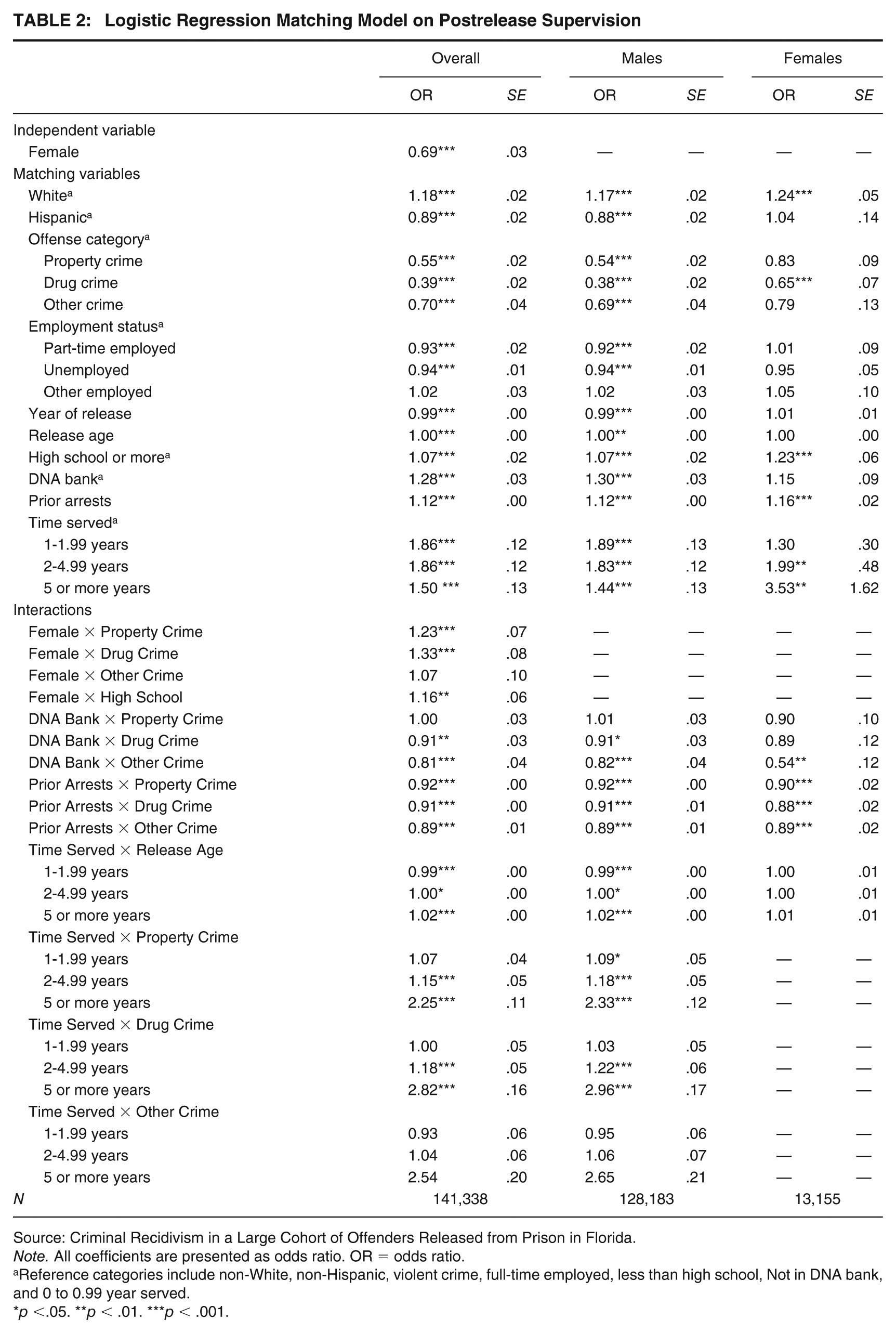
Source: Criminal Recidivism in a Large Cohort of Offenders Released from Prison in Florida.
Note. All coefficients are presented as odds ratio. OR = odds ratio.
Reference categories include non-White, non-Hispanic, violent crime, full-time employed, less than high school, Not in DNA bank, and 0 to 0.99 year served.
p <.05. **p < .01. ***p < .001.
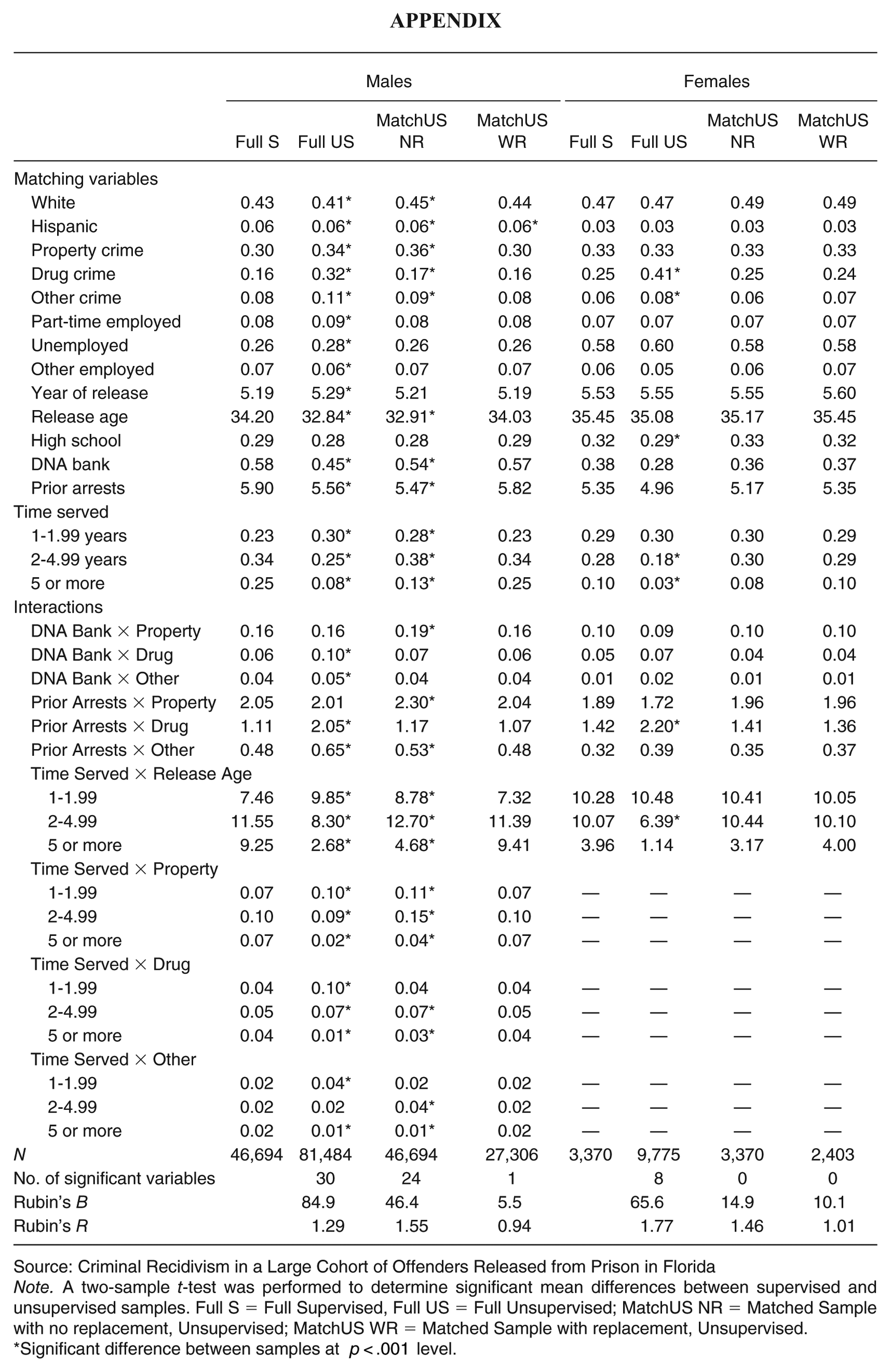
The second step in the PSM analysis is to match the individual who receives treatment to individuals who have similar propensities to be supervised but were not. By creating a matched sample, one can mimic the randomization process allowing for formal comparisons across these groups as well as a formal assessment of the covariate balance. Here, supervised individuals are matched to unsupervised offenders who have the closest propensity score. 4 To ensure a successful matching, a formal comparison is completed with the covariates across the treatment groups for the matched sample. After matching, there should be little to no significant differences between the supervised and unsupervised groups across all the variables and interactions in the matching model. Table 3 shows the summary statistics before matching, after PSM without replacement, and after PSM with replacement. Each of the unsupervised columns is compared with the supervised column with a summary two-sample t-test of mean difference to indicate any significant differences between the groups. Because the sample size is large, this table reports only significant differences at the p < .001 level.
Summary Statistics Comparison Across Different Matching Conditions

Source: Criminal Recidivism in a Large Cohort of Offenders Released from Prison in Florida.
Note. A two-sample t-test was performed to determine significant mean differences between supervised and unsupervised samples.
Significant difference between samples at
The first two columns from Table 3 show that female offenders comprise about 7% of the supervised offenders compared with 11% unsupervised offenders, a statistically significant difference. Overall, there are 34 meaningful differences between the supervised group and unsupervised groups across the covariates. The “matched without replacement” column shows the covariates for a matched without replacement. Here, every supervised offender is matched with exactly one unsupervised offender, making each pairing unique across treatment in each group. Although this matching strategy improves the sample balance, this analysis still detects 28 statistically significant differences across the groups of interest. In addition, Rubin’s B and R statistics are both above the threshold, which indicates good group balance. 5 In the final approach, a matched subsample was created with replacement. This means that the matches between supervised and unsupervised offenders do not have to be a unique pairing and an unsupervised offender may be matched with more than one supervised offender. By not requiring a unique match, this approach can greatly improve covariate balance. For the matched sample with replacement, only one variable remains significantly different across samples and both of Rubin’s statistics show an excellent balance across treatment. After establishing a well-balanced sample, one can now see that females represent 7% of both the supervised and the matched with replacement unsupervised group. After this matching method, only one variable remains significantly different—Hispanic. 6 This shows that the supervised and unsupervised groups are well-balanced after using the matching with replacement technique and that it is appropriate to now calculate the treatment effects.
Having computed a matched sample, the final step in PSM analyses is to calculate and interpret the effect of the treatment condition. Here, the two most common types of treatment effects were computed. First, the average treatment effect (ATE) is the “expected effect of treatment on a randomly selected person from the target population” (Apel & Sweeten, 2010, p. 545). This means that across the target population of offenders, the ATE tells the anticipated effect of supervision. Second, the treatment effect is the Average Treatment Effect on the Treated (ATT), which is the expected effect of treatment among those individuals who are actually assigned to be in the treated group (Apel & Sweeten, 2010). Essentially, the difference in the ATE and ATT involves the focus of the research question and to broadly examine the relationship between postrelease supervision and recidivism; both the ATE and ATT were reported in this article and are interpreted accordingly. 7
Gendered Samples
To examine differences by gender, the three-step process outlined above was repeated on subsamples of men and women. Because the overall models include several gender interactions, the gender-specific models are slightly different in form. The female subsample models do not include the interaction between time served and offense category due to small cell size. With these gender-specific samples, PSM with replacement was performed and excellent sample balance of supervision was achieved (see Table 2 for models results and Appendix Table A1 for comparison matched subsamples).
Results
Full Sample
Figure 1 shows the results for our PSM models of the full sample. The unmatched sample treatment effect (MU), the average treatment effect (ATE), and the average treatment effect on the treated (ATT) from these models were presented. Recall that the ATE is the expected effect of supervision for any individual offender and the ATT anticipated effect of supervision is among those who are actually supervised (Guo & Fraser, 2015). The MU is the expected effect of supervision when one does not use a matching strategy and is presented for comparison purposes. A significant negative value represents the treatment meaningfully decreasing the probability of recidivism, measured here by both rearrest and reconviction.

Percentage Reduction in Recidivism Between Supervised and Unsupervised Groups
In Figure 1, the MU shows that those who are supervised have a 5.5% lower chance of reconviction. In other words, before matching 43.3% of those who were not supervised and 37.8% of those supervised are expected to be reconvicted within a 3-year period. This aligned with expectations of the criminal justice system, and this decrease in reconviction rates shows that supervised offenders recidivate at lower levels than unsupervised offenders. Before matching, however, the supervised and unsupervised groups may look very different and are poorly balanced. This makes it impossible to determine whether the difference we observe is due to being supervised after release or due to one or more of the unbalanced characteristics across this unmatched sample.
After using the PSM approach, it was found that the magnitude of the effect of supervision is reduced. From the M-ATE and M-ATT of Figure 1, supervision is associated with a significant 4.07% decrease (37.8% supervised and 42.3% unsupervised) in reconviction rate across all individuals within the sample (ATT). This is an 18.6% reduction in the estimated association from MU analyses. Among those who actually are supervised (ATE), the expected effect of supervision is a 4.05% decrease in reconviction rates, a 26.9% reduction from the MU analyses.
These trends are echoed in the rearrest results (although this study includes rearrest information for comparison, the focus is on the more conservative measure of reconviction). When looking at the unmatched sample, supervision is associated with a 5.8% decrease in reconviction rates (59.2% of unsupervised and 53.4% of supervised are reconvicted within a 3-year period). After matching, this treatment effect is reduced by 30.1% to 4.1% (ATE). Among those who are supervised, the ATT has −4.50% decrease in reconviction rates. Here, again the unmatched sample slightly overestimates the association between supervision and reconviction. These anticipated effects, although small, are statistically significant.
Although the analyses do uncover some significant effects here, it is also important to note that overall, the effects of supervision are relatively small. Under all of the conditions, an effect of supervision that is greater than 6% was not detected. To further highlight the general weakness of the magnitude of the effect here, the bottom half of Figure 1 plots the proportion of individuals who recidivated across supervision categories for both recidivism outcomes. These proportions come from the matched ATT predictions. In terms of reconviction, one can see here that 58% of those not supervised were not reconvicted within a 3-year period. This can be compared with the 62% among those who were supervised. One can see the 4.5% difference here, but one can also see that around 40% of individuals (42% of unsupervised and 38% of those supervised) were reconvicted, independent of whether they received supervision. In terms of rearrest, one also observes a significant difference in the effect of supervision, but the general magnitude of the difference in proportions who were rearrested was modest at best. Because the sample size for these analyses is large, there is a concern that the detected findings may be trivial and are only detected due to statistical power of these data. To test for this, additional models that randomly sampled, 50% and 25% of the total sample, were run to determine the robustness of these results. The findings were qualitatively unchanged under these conditions, giving confidence that the results, however small, capture real difference in the population.
This study does capture some meaningful—if small—effects of supervision on recidivism. For the PSM models, these samples are matched on gender. Theory, however, suggests that the difference between male’ and females’ interactions with the criminal justice system warrant further exploration. The following analyses focus on the gender-specific samples to highlight the differences in the effects of supervision on male and female recidivism.
Gender-Specific Samples
The analyses are further focused on gender differences by examining any effects for postrelease supervision on gender-specific samples. Figures 2 shows the treatment effects for the male and female subsamples, respectively, focusing on the more conservative reconvictions. For men, one can see that the ATE and ATT for both reconvictions are similar to the treatment effects from the overall sample. The MU effects of supervision were associated with a 6.2% decrease in reconviction rates for men. However, after matching the ATE, there was a 4.4% decrease, and the ATT captures a 4.8% decrease. This translates to a 29% reduction in the estimate for the ATE and a 23% reduction for the ATT. In terms of the proportion of respondents who are expected to be reconvicted, around 43% of those not supervised and 38% of those who are supervised are expected to be reconvicted within a 3-year period.
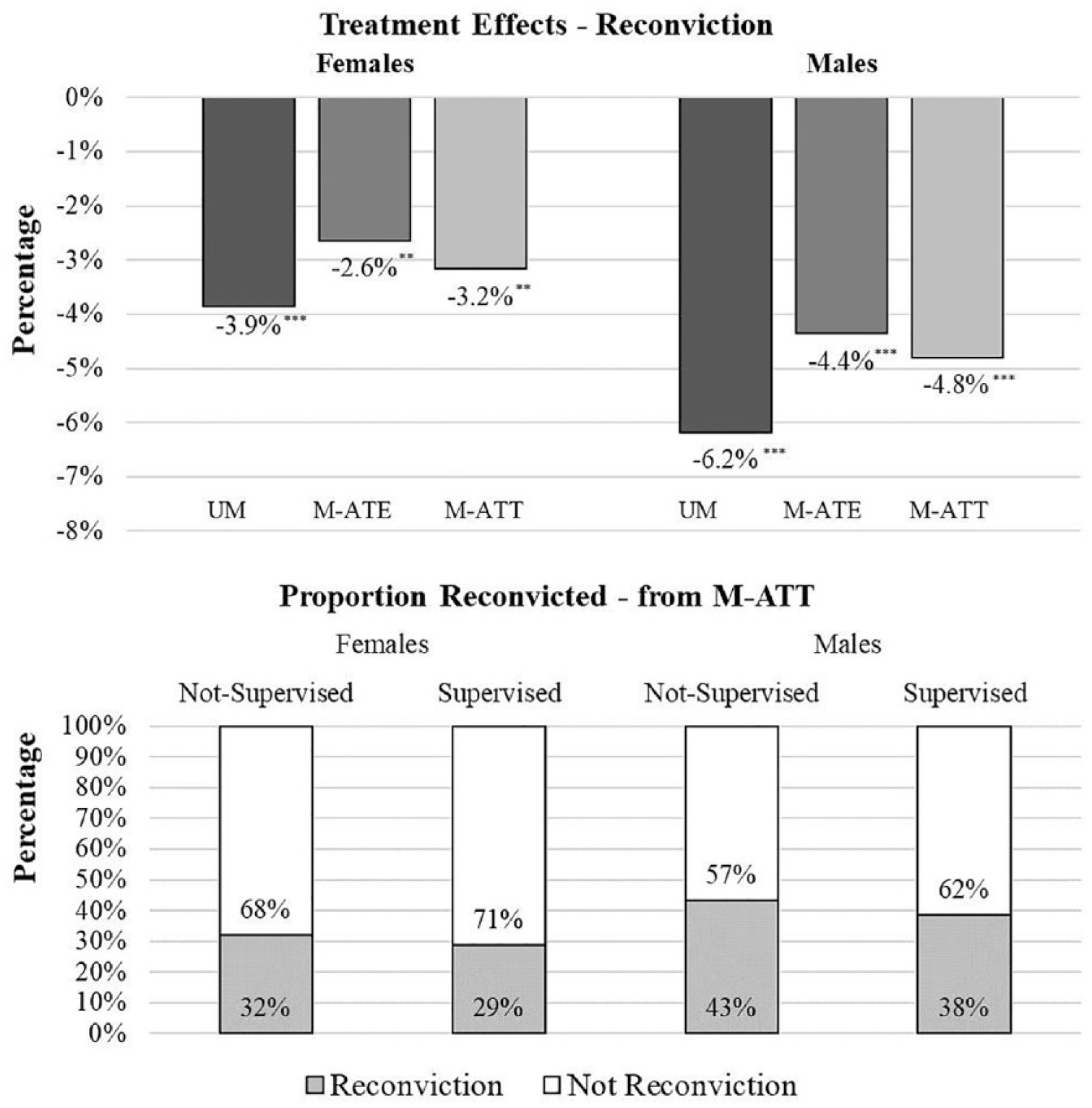
Percentage Reduction in Reconviction for Males and Females by Supervision Status
In terms of the women in the sample, within the MU estimates, supervision was associated with a 3.9% decrease in reconviction and, as expected, the magnitude of the effect of supervision was reduced after matching. The ATE shows a 2.6% decrease in reconviction and the ATT shows a 3.2% decrease. Around 32% of unsupervised and 29% of supervised women are expected to be reconviction within 3 years from the ATT estimates. The ATT effects capture an 18% reduction in the treatment estimates of the effectiveness of supervision between the unmatched and the ATT results. This is evidence that there are gendered differences in the effects of postrelease supervision on recidivism. Although women are far less likely to be reconvicted overall, additional supervision is less effective for women at reducing recidivism.
Discussion and Conclusion
The goal of this study was to examine the gendered effects of postrelease supervision on recidivism. Although this study is not the first to address these relationships, this study’s examination of the effects of postrelease supervision on recidivism more broadly focuses on all forms of supervision instead of specific programs and can therefore help map out the large-scale structural gender inequalities within the postrelease supervision system. Moreover, knowledge from this study can help highlight how deeply embedded gender is in the design and implementation of postrelease supervision and its effect on recidivism. Specifically, this study explored: (a) whether offenders who were supervised after release had lower rates of recidivism than those without supervision, and (b) whether the effects of supervision on recidivism were different for women and men utilizing PSM techniques and a feminist pathways theoretical framework. PSM matches each supervised offender with a similar unsupervised offender to better control for observable characteristics between these groups. This mimics experimental techniques and can better assess causal claims of these data. Furthermore, PSM techniques provide an alternative to multivariate regressions that are more closely aligned with testing the effectiveness of different forms of treatment processes (here, postrelease supervision) across groups of interest with observational data.
The results of this study indicate that postrelease supervision is associated with lower recidivism and may cause the decreases in both rearrest and reconviction rates. However, reliance on traditional statistical analyses overestimates the influence of postrelease supervision on recidivism. After matching, the anticipated reduction in recidivism was far smaller, if still significant. This finding is aligned with previous research suggesting that postrelease supervision has a modest effect on recidivism (Peters et al., 2015; Schlager & Robbins, 2008; Vito et al., 2017). It could be that Florida does not utilize risk-need-responsivity (RNR) principles that match level of program intensity to offender risk level, target criminogenic needs of offenders, and/or match style of and mode of intervention to the offender in their supervision practices (Andrews & Bonta, 2010). Prior studies suggest that interventions that adhere to the RNR principles are associated with significant reductions in recidivism, whereas treatments that fail to follow the principles yield minimal reductions in recidivism, and, in some cases, may increase recidivism (Andrews & Bonta, 2010; Andrews, Bonta, & Wormith, 2011). Although beyond the scope of this article, it could be that these principles are not being implemented or being misapplied in Florida and this might explain the relatively poor supervision outcomes. Future research should further explore these possibilities in Florida.
This study also found that the treatment effects of supervision for women were much smaller than those found for men in this sample. Among women who were supervised after release, no sample analyzed here achieved a supervision treatment effect on reconviction greater than 4%. In other words, these women who received supervision were only marginally less likely to be reconvicted within 3 years compared with those who were not supervised. This finding is somewhat surprising and suggests that the implementation of postrelease supervision in Florida—which is not particularly effective at all—may be tailored to reduce male recidivism in particular and may be less well suited to aide female reintegration into the community.
In the past decade, there have been many advances regarding effective intervention practices for justice involved women. Many of these advances recognize the extensive histories of trauma and abuse among girls and women (Messina et al., 2007; Owen, 1998), the role of relationships/support for women (Gilligan, 1982; Kaplan, 1984; Miller, 1976), and consider the gendered context of female offending (Daly, 1992; Salisbury & Van Voorhis, 2009). For example, the National Institute of Corrections funded a large research project demonstrating that women who are placed on supervision case-loads that are gender-response (e.g., trauma-informed and strength-based) are less likely to recidivate than women who receive gender-neutral supervision (Millson, Robinson, & Van Dieten, 2010). Even tools used to gauge recidivism risk, such as the Level of Supervision Inventory-Revised (LSI-R), have traditionally failed to consider the specific challenges women face on reentry into society (Holtfreter & Morash, 2003; Reisig, Holtfreter, & Morash, 2006). However, almost every mainstream instrument on the market, including the LSI-R, has responded to this discrepancy by developing appropriate cutoff points. Researchers have also developed and validated specific tools for women, such as Women’s Risk Need Assessment (Salisbury, Van Voorhis, & Spiropoulos, 2009). Studies have shown that gender-informed treatment programs developed especially for women are effective in reducing recidivism (Gobeil, Blanchette, & Stewart, 2016; Matheson et al., 2011; Stanley, Sata, Oparah, & McLemore, 2015). However, these gender-specific programs have not been widely implemented across the criminal justice system. Most women—like most men—are supervised through a state or federal department of corrections that pays little to no attention to unique needs these women face on release from prison. Thus, more prison and postrelease programs are needed to incorporate the gender-specific needs of women to help prevent recidivism. Future research should continue to explore and evaluate postrelease supervision programs, including programs designed and implemented in the state of Florida.
This study’s findings coincide with a feminist pathways framework (Daly, 1992; Salisbury & Van Voorhis, 2009; Sharp, 2014) and the literature on gender in both offending (Broidy & Agnew, 1997; M. S. Jones et al., 2018; Steffensmeier & Allan, 1996) and reentry processes (Garcia, 2016; Matheson et al., 2011). The smaller treatment effects for women suggest a gendered pathway out of prison and that the conditions of supervision are not as helpful in addressing the specific challenges faced by women as they reenter into society. Future research should be attentive to this possibility, and research gathered on the life histories of female offenders should also include follow-ups with women after they leave the criminal justice system. It could be that postrelease supervision itself is not effective in reducing recidivism for women, but that perhaps is more about the quality of the relationship with one’s supervisor that may play a bigger role in recidivism for women than for men. Morash, Kashy, Smith, and Cobbina (2016) found that women who reported having parole officers who were less supportive and used a more punitive style of supervision tended to respond negatively to constraints on their freedom and in turn were more likely to recidivate as suggested by relational theories (Miller, 1976).
Other relational factors may play a more significant role in reducing recidivism for women than for men (Gilligan, 1982; Kaplan, 1984; Miller, 1976). Although family visitation in prison may not reduce recidivism for women compared with men (Bales & Mears, 2008), other research indicates that getting custody of children, engaging in a self-help activity, environmental support, maintaining contact with family, and having a good-quality relationship with an intimate partner while in prison, all significantly decrease the risk of recidivism for women (Barrick, Lattimore, & Visher, 2014; Cobbina, Huebner, & Berg, 2012; Greiner, Law, & Brown, 2015; Scott et al., 2016; Taylor, 2015). Moreover, prior studies also suggest that services such as child care, transportation, and housing (Peugh & Belenko, 1999) can play a stronger role in women’s reoffending behaviors than for men. Mental illnesses (Bakken & Visher, 2018; Pelissier et al., 2003) often associated with experiences of abuse and trauma (M. S. Jones et al., 2018; Owen, 1998; Salisbury & Van Voorhis, 2009; Sharp, 2014) may also be more crucial in understanding recidivism among women than for men. Policymakers should consider the importance of gender in designing appropriate programming in prison and developing postrelease techniques that account for the unique experiences of women.
There are several limitations with this study that warrant mention. Although the data set allows for a varied set of matching variables, it does not include demographic information during the supervision period. Information about whether an offender was employed while being supervised, as well as what counties and cities they attempted reintegration, would play an important role in whether they recidivate. Offenders may also be reincarcerated due to technical violations of their supervision and these data do not provide information to whether individuals who return to jail or prison violated these conditions or committed additional criminal acts. Another data issue with this study is the lack of longitudinal information about these offenders. Although this study was informed by the literature on gendered pathways to explore gender differences in these processes, it cannot tract out formally a “pathway” with these cross-sectional and retrospective data. Although this study’s findings remain of interest to scholars working with this theory, it does not claim to have uncovered any particular gendered pathway.
Finally, although modeling the effects of all types of postrelease supervision on recidivism provides a better sense of the gender dynamics involved in these relationships, this study cannot ascertain the effectiveness of all the various types of postrelease programs. Future research should continue to examine the effects of postrelease supervision on recidivism by focusing on both specific types of supervision and overall supervision to determine general effectiveness of supervision programming. This is especially important when it comes to developing and incorporating gender-specific needs into postrelease supervision programming.
In conclusion, these analyses show that gender shapes the relationship between postrelease supervision and recidivism. Although the overall effects of postrelease supervision show a modest reduction in recidivism, we uncover that these programs are far less effective in aiding female offenders in their reentry into society. Whether these differences reflect the sorting of high-risk female offenders into supervision or the paternal nature of this program leading to a disadvantage for female offenders, policymakers interested in reducing rates of recidivism need to be attentive to the growing population of incarcerated females and the unique set of experiences and needs these women face in reentering society.
Footnotes
Appendix
| Males | Females | |||||||
|---|---|---|---|---|---|---|---|---|
| Full S | Full US | MatchUS NR | MatchUS WR | Full S | Full US | MatchUS NR | MatchUS WR | |
| Matching variables | ||||||||
| White | 0.43 | 0.41* | 0.45* | 0.44 | 0.47 | 0.47 | 0.49 | 0.49 |
| Hispanic | 0.06 | 0.06* | 0.06* | 0.06* | 0.03 | 0.03 | 0.03 | 0.03 |
| Property crime | 0.30 | 0.34* | 0.36* | 0.30 | 0.33 | 0.33 | 0.33 | 0.33 |
| Drug crime | 0.16 | 0.32* | 0.17* | 0.16 | 0.25 | 0.41* | 0.25 | 0.24 |
| Other crime | 0.08 | 0.11* | 0.09* | 0.08 | 0.06 | 0.08* | 0.06 | 0.07 |
| Part-time employed | 0.08 | 0.09* | 0.08 | 0.08 | 0.07 | 0.07 | 0.07 | 0.07 |
| Unemployed | 0.26 | 0.28* | 0.26 | 0.26 | 0.58 | 0.60 | 0.58 | 0.58 |
| Other employed | 0.07 | 0.06* | 0.07 | 0.07 | 0.06 | 0.05 | 0.06 | 0.07 |
| Year of release | 5.19 | 5.29* | 5.21 | 5.19 | 5.53 | 5.55 | 5.55 | 5.60 |
| Release age | 34.20 | 32.84* | 32.91* | 34.03 | 35.45 | 35.08 | 35.17 | 35.45 |
| High school | 0.29 | 0.28 | 0.28 | 0.29 | 0.32 | 0.29* | 0.33 | 0.32 |
| DNA bank | 0.58 | 0.45* | 0.54* | 0.57 | 0.38 | 0.28 | 0.36 | 0.37 |
| Prior arrests | 5.90 | 5.56* | 5.47* | 5.82 | 5.35 | 4.96 | 5.17 | 5.35 |
| Time served | ||||||||
| 1-1.99 years | 0.23 | 0.30* | 0.28* | 0.23 | 0.29 | 0.30 | 0.30 | 0.29 |
| 2-4.99 years | 0.34 | 0.25* | 0.38* | 0.34 | 0.28 | 0.18* | 0.30 | 0.29 |
| 5 or more | 0.25 | 0.08* | 0.13* | 0.25 | 0.10 | 0.03* | 0.08 | 0.10 |
| Interactions | ||||||||
| DNA Bank × Property | 0.16 | 0.16 | 0.19* | 0.16 | 0.10 | 0.09 | 0.10 | 0.10 |
| DNA Bank × Drug | 0.06 | 0.10* | 0.07 | 0.06 | 0.05 | 0.07 | 0.04 | 0.04 |
| DNA Bank × Other | 0.04 | 0.05* | 0.04 | 0.04 | 0.01 | 0.02 | 0.01 | 0.01 |
| Prior Arrests × Property | 2.05 | 2.01 | 2.30* | 2.04 | 1.89 | 1.72 | 1.96 | 1.96 |
| Prior Arrests × Drug | 1.11 | 2.05* | 1.17 | 1.07 | 1.42 | 2.20* | 1.41 | 1.36 |
| Prior Arrests × Other | 0.48 | 0.65* | 0.53* | 0.48 | 0.32 | 0.39 | 0.35 | 0.37 |
| Time Served × Release Age | ||||||||
| 1-1.99 | 7.46 | 9.85* | 8.78* | 7.32 | 10.28 | 10.48 | 10.41 | 10.05 |
| 2-4.99 | 11.55 | 8.30* | 12.70* | 11.39 | 10.07 | 6.39* | 10.44 | 10.10 |
| 5 or more | 9.25 | 2.68* | 4.68* | 9.41 | 3.96 | 1.14 | 3.17 | 4.00 |
| Time Served × Property | ||||||||
| 1-1.99 | 0.07 | 0.10* | 0.11* | 0.07 | — | — | — | — |
| 2-4.99 | 0.10 | 0.09* | 0.15* | 0.10 | — | — | — | — |
| 5 or more | 0.07 | 0.02* | 0.04* | 0.07 | — | — | — | — |
| Time Served × Drug | ||||||||
| 1-1.99 | 0.04 | 0.10* | 0.04 | 0.04 | — | — | — | — |
| 2-4.99 | 0.05 | 0.07* | 0.07* | 0.05 | — | — | — | — |
| 5 or more | 0.04 | 0.01* | 0.03* | 0.04 | — | — | — | — |
| Time Served × Other | ||||||||
| 1-1.99 | 0.02 | 0.04* | 0.02 | 0.02 | — | — | — | — |
| 2-4.99 | 0.02 | 0.02 | 0.04* | 0.02 | — | — | — | — |
| 5 or more | 0.02 | 0.01* | 0.01* | 0.02 | — | — | — | — |
| N | 46,694 | 81,484 | 46,694 | 27,306 | 3,370 | 9,775 | 3,370 | 2,403 |
| No. of significant variables | 30 | 24 | 1 | 8 | 0 | 0 | ||
| Rubin’s B | 84.9 | 46.4 | 5.5 | 65.6 | 14.9 | 10.1 | ||
| Rubin’s R | 1.29 | 1.55 | 0.94 | 1.77 | 1.46 | 1.01 | ||
Source: Criminal Recidivism in a Large Cohort of Offenders Released from Prison in Florida
Note. A two-sample t-test was performed to determine significant mean differences between supervised and unsupervised samples. Full S = Full Supervised, Full US = Full Unsupervised; MatchUS NR = Matched Sample with no replacement, Unsupervised; MatchUS WR = Matched Sample with replacement, Unsupervised.
Significant difference between samples at
Authors’ Note:
The authors would like to thank Trina L. Hope, Martin Piotrowski, and Susan F. Sharp for helpful comments on earlier versions of the paper.
