



Abstract
All incarcerated juveniles have to receive correctional education, but little is known about how these school experiences influence reentry. With longitudinal data of 569 incarcerated juveniles (91% male) from the Pathways to Desistance Project, this study tested how motivational (teacher bonding, school orientation, time spent on homework) and performance (grades) aspects of schooling were related to desistance for youth returning from juvenile versus adult facilities. Results revealed that across facility type, increased attachment to facility schools, but not grades, predicted increased gainful activity (attending school and/or working), less self-reported delinquency, and lower recidivism in the community. Path models showed that gainful activity during Months 1 through 6 was related to stay in community, but not to self-reported behavior in Months 7 through 12. Results indicate that incarceration is an environment that shapes future behavior, but also highlight differences between behavioral and system responses. Facility school experiences might be an important locus of intervention.
Ample research shows that involvement with the justice system as a juvenile has more severe derailing consequences than involvement as an adult, especially for juveniles that have spent time in adult facilities (Lambie & Randell, 2013; Redding, 2016). For example, several studies have shown higher rates of recidivism in transferred youth compared with youth remaining in the juvenile system (Zane et al., 2016). Although rates have declined, incarceration of juveniles in adult prisons and jails continues; in 2015, 3,500 juveniles were held in adult jails across the United States (Minton & Zheng, 2016).
Educational programs for incarcerated adults are one of the most powerful interventions to prevent recidivism, particularly if the recipients develop a high commitment to education (RAND Corporation, 2014). In contrast to incarcerated adults for whom it is a privilege, school-aged incarcerated juveniles must receive schooling meeting the minimal standards of mandatory public education (Leone & Cutting, 2004). This means that receiving some type of correctional education is one shared experience for most incarcerated juveniles, and investigating how this experience influences community adjustment might provide insights into an important locus of intervention that is applicable across State judicial systems. Furthermore, the extent to which differences in outcomes between transferred and nontransferred youth have to do with experiences during incarceration versus labeling processes happening after incarceration is unclear (Augustyn & Loughran, 2017; Redding, 2016). This study describes and measures how differences in the delivery of correctional education in a sample of incarcerated adolescents who spent time in juvenile versus adult facilities affects their reentry, shedding some light on these important questions.
Cumulative Disadvantage and the Life Course Development of Crime
Labeling an individual as deviant (e.g., through a criminal record) can trigger exclusionary processes that have negative consequences for conventional opportunities in education, employment, and social relationships, thereby increasing the likelihood for further deviance (Sampson & Laub, 2005). According to this view, current antisocial behavior is explained by the strength of social bonds, regardless of prior differences in propensity to offend. Especially serious sanctions are seen to cut justice-involved individuals off from future options for social interdependence, such as a stable employment, and compromise their relationships with family, friends, and romantic partners. Furthermore, these processes get magnified in contexts of already disadvantaged urban poor minorities (Blomberg et al., 2012; Sampson & Laub, 2005). There is ample evidence supporting this theory. For example, a large longitudinal study showed that among adolescents with equivalent neighborhood, school, family, peer, and individual characteristics, as well as similar frequency of criminal offending, having an arrest record was associated with a substantively large and robust impact on dropping out of high school and a gap in 4-year college enrollment (Kirk & Sampson, 2013). These effects were due to institutional responses that led to disrupted academic trajectories, and not due to individual characteristics of the adolescents.
Conversely, bonding with prosocial individuals and traditional institutions can be a positive turning point that promotes desistance. Research repeatedly has shown an impressive amount of plasticity in trajectories of offending (e.g., Natsuaki et al., 2008). Consequently, investigating so-called turning points—events that redirect criminal trajectories in either a more positive (strengthening social bonds) or a more negative manner (further alienating individuals from mainstream society)—seems a promising avenue to both explain and predict offending (Mulvey et al., 2004).
The Incarceration Experience and Recidivism
It can be argued that incarceration constitutes a treatment intervention intended to change future behavior. Treatment evaluations consistently find that client perceptions are among the strongest predictors of treatment outcomes (Lambert & Barley, 2001), while educational research documents the importance of school climate for positive academic outcomes (P. J. Cook et al., 2010). Furthermore, quality of teacher–student relationships is an important factor in initiating behavioral change for aggressive youth (Meehan et al., 2003). However, research on the effects of juvenile incarceration rarely includes the perspective of the incarcerated juveniles (Schubert et al., 2012). Yet, resident perceptions could be important moderators of treatment outcomes, that is, community integration after release (Kupchik & Snyder, 2009).
Supporting the hypothesis that resident perceptions could moderate treatment outcomes, one study investigating differences between boot camps and traditional correctional facilities showed that more positive perceptions of their environment led youth in a particular boot camp to become less antisocial and less depressed during their stay (MacKenzie et al., 2001). A series of Dutch studies with institutionalized juveniles has shown how negative perceptions of their environment were connected to worse adjustment, and how group workers’ responsiveness was positively associated with higher behavioral competence and greater treatment motivation while institutionalized (e.g., van der Helm et al., 2014). There is tentative evidence that different experiences within facilities also influence outcomes in the community. Schubert et al. (2012) found that more positive resident perceptions across different dimensions of facility climate (e.g., safety, service availability, presence of caring adults) were positively associated with less re-involvement with the criminal justice system and less self-reported antisocial behavior above and beyond facility type and individual qualities after release.
The Protective Effect of Correctional Education
Prior to entering the judicial system, many incarcerated juveniles accumulate negative school experiences that include truancy, suspension, expulsion, dropping out, and other forms of academic failure (Mathur & Schoenfeld, 2010). High illiteracy rates and low reading competency are an important problem, and there are elevated numbers of students with special needs (Leone & Cutting, 2004; Rogers-Adkinson et al., 2008). This means correctional schools have to serve a highly transient population of students with unique emotional and educational needs (Mathur & Schoenfeld, 2010).
There is ample evidence showing that the interruption of school attendance resulting from incarceration often enables more deviance by severing ties to an important positive context for adolescent development in a population that is already struggling academically (e.g., T. D. Cook & Hirschfield, 2008; Kirk & Sampson, 2013). Conversely, life course theory suggests that juveniles who bond with traditional institutions subscribe to prosocial norms that prohibit deviant behavior (Sampson & Laub, 2005). One such institution is school, and a large body of research shows that attending and engaging with school has protective effects against delinquency, even for formerly delinquent youth (Natsuaki et al., 2008). In line with these findings, several studies have found that school performance while incarcerated was associated with less recidivism, higher likelihood of community school enrollment, and increased access to college or employment opportunities across sex and race/ethnicity (Blomberg et al., 2012; Cavendish, 2014; Steele et al., 2016). Furthermore, several studies have found that facilitating transitions to community schools or other gainful activity can reduce recidivism, highlighting the importance of identifying factors associated with gainful activity (Griller Clark et al., 2011; Unruh et al., 2009).
Factors Influencing the Protective Effect of Correctional Education
The student–teacher relationship is a strong predictor of academic motivation and achievement from elementary through high school (e.g., Roorda et al., 2011). A large body of research shows that school connectedness, bonding to teachers, and academic motivation reduce the risk of drop out, substance abuse, and aggressive behavior (Bryant et al., 2003; McNeely & Falci, 2004; Meehan et al., 2003). Similarly, the motivation to pursue education and the successful connection back to school helps account for the resilience of incarcerated juveniles after reentry (Bullis & Yovanoff, 2002). Thus, it seems likely that teachers are important agents in encouraging school engagement and shaping performance expectancies in the correctional context, where they are one of the few attachment figures available for a population with accumulated negative school experiences.
In line with the hypothesis that teachers are vital for incarcerated youth, European studies of adolescents in secure residential care document that teachers often are used as important providers of emotional support and as a source of secure attachment (Harder et al., 2013). Reed and Wexler’s (2014) qualitative study of incarcerated juveniles from the United States showed that when youth perceived teachers to be supportive and caring, they demonstrated academic resilience and a continued desire to pursue education, but reported further disconnection with school when they perceived teachers did not care. The facility schooling experience could thus be a positive turning point for those youth who experience themselves as successful students. This success might increase motivation to attend school back in the community, reconnecting them to a normative context of development that promotes desistance (Blomberg et al., 2012; Bullis & Yovanoff, 2002).
In contrast, if the school experience while incarcerated further demoralizes youth and puts them farther behind in school, correctional education could permanently sever those ties and further delineate trajectories toward more deviance (Clinkinbeard & Zohra, 2012; Gagnon et al., 2009; Reed & Wexler, 2014). Both scenarios highlight the importance of the quality of correctional education for future life trajectories, yet little is known about what promotes better school outcomes while incarcerated and how these factors are connected to reentry. In addition, it is likely that incarceration and correctional education have different effects on juveniles based on their age, institutionalization history, and previous school experience (Mulvey et al., 2004; Natsuaki et al., 2008). However, little research considers these factors and virtually nothing is known about how perceptions of the correctional school interact with individual differences to influence reentry.
Influence of Type of Facility on Reentry Outcomes
A number of rigorous studies, including a recent meta-analysis, have found higher recidivism rates for juveniles that have been processed in the adult criminal system, especially if this results in incarceration in an adult prison (Lambie & Randell, 2013; Redding, 2016; Zane et al., 2016). Incarceration during adolescence means that juveniles have to reach developmental milestones in an extreme and adverse environment (Dmitrieva et al., 2012). There are even more challenges faced by those incarcerated in adult facilities: There, (a) juveniles are the population at greatest risk for victimization, (b) juveniles are thus more likely held in solitary confinement for their protection, and (c) generally, lower levels of services are offered compared with juvenile facilities where more emphasis is put on education and rehabilitation (Beck & Harrison, 2008; Lambie & Randell, 2013; Redding, 2016).
These systematic differences between juvenile and adult facilities extend to the classroom: Schools in juvenile facilities are often run like community middle and high schools, including a mandatory schedule, standardized testing, and extracurricular activities (Gagnon et al., 2009). In adult facilities, educational programs are designed to cater mainly to adults, thus offering more general educational development (GED) and vocational classes (Augustyn & Loughran, 2017; RAND Corporation, 2014).
Another explanation for the comparatively worse outcomes of juveniles in adult prisons is differing collateral consequences between systems (Augustyn & Loughran, 2017). Although juveniles usually still get the privilege of confidential records, processing and incarceration as adults means the same labeling and practical consequences of being a marked felon as their adult counterparts. In addition to losing political rights, in many states convicted felons are excluded from public assistance such as social welfare, public housing, scholarships, or student loans for higher education (Manza & Uggen, 2004). In addition, felons face severe restrictions on the labor market and often are barred from working in state-licensed occupations as well as excluded by an increasing number of private and public employers (Chiricos et al., 2007).
Investigating the collateral consequences for educational attainment and earnings in a matched sample of juveniles processed in the adult versus juvenile system, Augustyn and Loughran (2017) found that even though overall more transferred youth had a degree (mainly GED, 65%) compared with nontransferred youth (mainly high school diplomas, 47%), they had much diminished average earnings, supporting the labeling idea that having an adult record substantially impacted their success on the labor market. The study was the first to confirm collateral consequences of transfer laws in educational attainment and earnings. However, it did not assess the influence of incarceration or correctional education as a source of these consequences for youth who received part of their schooling while incarcerated. More knowledge on how institutional school characteristics interact with labeling to influence community outcomes is still needed.
Markers of Community Adjustment
Given the many developmental transitions during adolescence and young adulthood, neither school nor work information alone would sufficiently reflect successful reentry back into the community (Mulvey et al., 2004). This and other studies with a developmental perspective have thus consolidated school attendance and employment into one construct of gainful activity (Mulvey, 2012). Most studies investigating recidivism rely on administrative records, which encompasses a range of measurement problems. First, recidivism can encompass anything from being rearrested (only suspected involvement in crime/delinquent behavior), to being reconvicted (i.e., charged and found guilty/adjudicated for an offense). Because it is difficult to compare those different measurements, it is difficult to obtain reliable estimates of recidivism (Ostermann et al., 2015). Second, those measures are administrative responses to a behavior that has been detected and qualified as breaking the law by someone else. Disproportionate minority contact illustrates how such records are neither an objective nor an accurate reflection of actual behavior, especially not of general tendencies of behavior (Moore & Elkavich, 2008). Finally, per definition, there are no objective measures of severe delinquent behaviors that would not have labeling consequences. In this study, successful transition back into the community was therefore assessed through a combination of engagement in gainful activity, self-reported antisocial behavior, and time spent back in a secure facility. Taken together, these three indicators are more indicative of actual behavioral change that judicial system contact, and allow for a comparison between behavioral and system responses.
The Present Study
The present study investigated to what extent incarcerated male and female juveniles’ experiences in a facility school predicted reentry adjustment during 12 months after their release, and whether this was moderated by receiving the schooling in a juvenile versus an adult facility. Building on a developmental turning-point framework (Sampson & Laub, 2005), this study advanced the literature in several important ways: (a) It integrated indicators of relationship quality and motivation (school orientation, bonding to teachers, and time spent on homework) with school performance (grades) and adjusted for dosage of the intervention (rate of schooling and length of school attendance) to capture multiple dimensions of the facility school experience across institutions; (b) The study provided an in-depth description of the schooling received by juveniles in adult versus juvenile facilities and investigated if systematic differences in the delivery of correctional education impacted community outcomes; (c) The study assessed reentry adjustment along three dimensions: academic- and employment-related adjustment (gainful activity), engagement in delinquency, and readmittance into a secure facility; and finally (d) Applying path models, the study investigated whether increased participation in school and/or work during the first 6 months in the community was connected to subsequent desistance in the form of less self-reported delinquency and decreased likelihood of returning to a secure facility during Months 7 through 12. The findings further our understanding of how individual experiences in facility schools are related to reentry processes across different types of facilities and tested the life course paradigm that correctional education promotes desistance by connecting incarcerated juveniles back to normative contexts of development.
Method
Participants and Study Context
Pathways to Desistance Study
The present study is a secondary data analysis from the Pathways to Desistance project, a multisite, longitudinal study of justice-involved youth (Mulvey et al., 2004). Following juveniles for a period of 7 years, it is the most comprehensive data set currently available with this population in the United States. Beginning in 2000, project staff recruited 1,354 adolescents (184 females) aged 14 through 17 (at the time of their committing offense), at their current court appearance in Philadelphia, PA (N = 654) and Phoenix, AZ (N = 700), who were adjudicated delinquent, or found guilty, of a serious (overwhelmingly felony-level) offense. The number of males adjudicated for a drug offense was capped at 15% of the sample, but all eligible females and youth transferred to the adult system were included. The study achieved a very high participation rate of 67%. After the baseline interview researchers interviewed participants every 6 months for 3 years and annually thereafter for 4 years, resulting in 10 waves of data. Additional details regarding the study design and methodology can be found at https://www.pathwaysstudy.pitt.edu/ (Center for Research on Health Care [CRHC] Data Center, n.d.).
Present Sample
This study used data from the public use baseline and follow-up interviews, as well as restricted calendar data (Mulvey, 2012, 2017). These data were reduced to information from a subset of 569 participants (519 male and 50 female) who had received at least 3 months of institutional schooling in one unique stay at a facility, followed by at least a 2-month release back into the community. In addition, we required that participants had complete data on their school experience at the institutional school and at least 50% of data present for a 12-month follow-up period after release. To eliminate possible bias, no participant contributed data on more than one stay; if a participant had multiple qualifying episodes, the first was used. Participants were predominantly from PA and there was a larger proportion of youth who were Black, compared with participants in the original study. Participants included in the present study also were younger at baseline (t = −6.60, p < .001), and there was a smaller proportion of females, χ2(1) = 19.27, p < .001. However, there were no differences in history of offending or on any of the school measures between this study sample and the excluded participants. An overview of the sample is included in Table 1.
Demographics, School and Facility Experience by Facility Type

Note. __ Numbers masked for confidentiality. Statistical tests were either chi-square or t-tests of mean sample differences between participants in juvenile versus adult facilities, respectively. GED = general educational development; HSD = high school diploma.
p < .05. **p < .01. ***p < .001.
Measures
Facility School Experience
Educational experience during commitment was based on the work of Cernkovich and Giordano (1992) using the self-report detention education measures from follow-up interviews. Academic commitment was divided into Bonding to Teacher (mean of three items, for example, “Most of my teachers treat me fairly”) and School Orientation (mean of seven items, for example, “Schoolwork is very important to me”). Participants rated statements on 5-point Likert-type scales regarding their facility schools, with higher scores indicating a greater degree of academic commitment. Participant’s average Time on Homework (if any) in the institutional school was assessed on a scale ranging from 1 (no time spent on homework) to 5 (more than 10 hours a week spent on homework). Average Grades during the recall period were reported on a scale from 1 (mostly Ds and below) to 8 (mostly As); respondents reporting that they did not receive any grades were treated as missing but included in the sample. Finally, two variables assessed the amount of schooling received while in the facility: (a) Time in School was assessed in continuous months and (b) Rate of Schooling was a proportion score dividing the number of school sessions received by the number of days spent in the facility.
Community School History
Educational experience in the community prior to commitment mirrored the assessment of the facility school experience described above, with respondents referencing the most recent school attended.
Gainful Activity in the Community
Successful transitioning back to community schools or work was assessed through Gainful Activity, a construct developed to simultaneously provide descriptive data about school attendance and employment (Mulvey et al., 2004). A gainfully active month indicated that the participant had either attended school and missed fewer than 5 days or had been employed (legally or “under the table”) for at least 2 weeks at 20 hr/week. This information was summarized into 6- and 12-month proportion scores, dividing the number of gainfully active months by the number of valid months (i.e., not incarcerated and not missing).
Delinquency
A modified version of the Self-Report of Offending (Huizinga et al., 1991) scale was used to measure the adolescent’s account of his or her involvement in three drug-related, nine nonaggressive, and 12 aggressive delinquent acts. As recommended by Monahan and Piquero (2009), the sum of endorsed items was divided by the number of questions answered to produce a variety proportion score (range 0 to 1). This metric distinguishes between individuals where the frequency of delinquent acts may be higher but comparatively minor (e.g., sold drugs hundreds of times), and those who engage in different forms of delinquency (e.g., shooting, robbery). Higher scores thus indicate more varied, and hence severe, delinquency patterns. Monthly reported offending counts were summarized into a history proportion score from community reentry to 12 months, and for 7 to 12 months.
Community Stay
Community Stay was assessed monthly as whether the participant spent more than 8 days in a secure facility, jail, or detention center (yes/no). This was reverse scored into one variable indicating if the participant spent all months in the community (1), or had any months in a secure facility (0) within the past 12, or 7 to 12 months.
Covariates and Demographic Characteristics
Single items represented Sex (male = 0, female = 1) and Type of Facility (juvenile = 0, adult = 1); Age at release was assessed in years. History of system contact and prior delinquency was assessed with three variables: Self-reported Delinquency at Baseline as described above, Age at first Conviction from official records, and count of self-reported Lifetime Facility Stays in a detention center/jail including the current incarceration. Table 1 provides additional details on participant background and service delivery by Type of Facility; additional details regarding all measures and constructs can be found at https://www.pathwaysstudy.pitt.edu/ (CRHC Data Center, n.d.).
Data Analysis
Analyses were performed using Mplus version 8.2 (Muthén & Muthén, 1998–2018) and SPSS version 25 (IBM Corporation, 2013). To account for clustering of the data within facilities, all analyses in Mplus used a complex sampling procedure with cluster robust standard errors (McNeish et al., 2017). First, we examined differences in demographic characteristics, facility school experience, and outcomes by Type of Facility using χ2 and independent sample t-tests. We used a combination of theoretical considerations and statistical model comparisons to identify a well-fitting measurement model for the facility school experience and conducted a confirmatory factor analysis (CFA) of community school history variables paralleling the facility school measurement. Participants with missing data were included in all model estimations using full information maximum likelihood (FIML) techniques. Model fit was assessed using the root mean square error of approximation (RMSEA) and its 90% confidence interval, the standardized root mean square residual (SRMR) and the comparative fit index (CFI). Values of 0.95 or above for the CFI, 0.06 and 0.08 or below for the RMSEA and SRMR, respectively, indicate adequate model fit (Hu & Bentler, 1999). Then, we estimated multiple group comparison models to explore moderation of outcomes by Type of Facility using the Satorra–Bentler scaled χ2 difference test (Muthén & Muthén, 1998–2018).
Main structural equation models (SEMs) predicting Gainful Activity, Delinquency, and Community Stay up to 12 months after release were adjusted for baseline levels of School Attachment, Grades, and Delinquency, as well as Age at First Conviction, Lifetime Facility Stays, Age at Release, and Sex. In models predicting Community Stay, MLR estimation with Monte Carlo integration was used and model fit was assessed with the sample-size adjusted Bayesian information criterion (SSA-BIC) and the Akaike information criterion (AIC, Muthén & Muthén, 1998–2018). After inspection of modification indices for the covariates, we also adjusted baseline school variables for Delinquency at Baseline. No main paths were modified. Based on the results of the multiple group comparisons, Type of Facility was included as an additional covariate in models predicting Community Stay. A schematic overview of the main SEMs is included in Figure 1. Finally, we estimated two path models investigating whether more involvement in Gainful Activity in Months 1 through 6 was connected to less Delinquency or increased likelihood of Community Stay in Months 7 through 12 (see Figure 2).
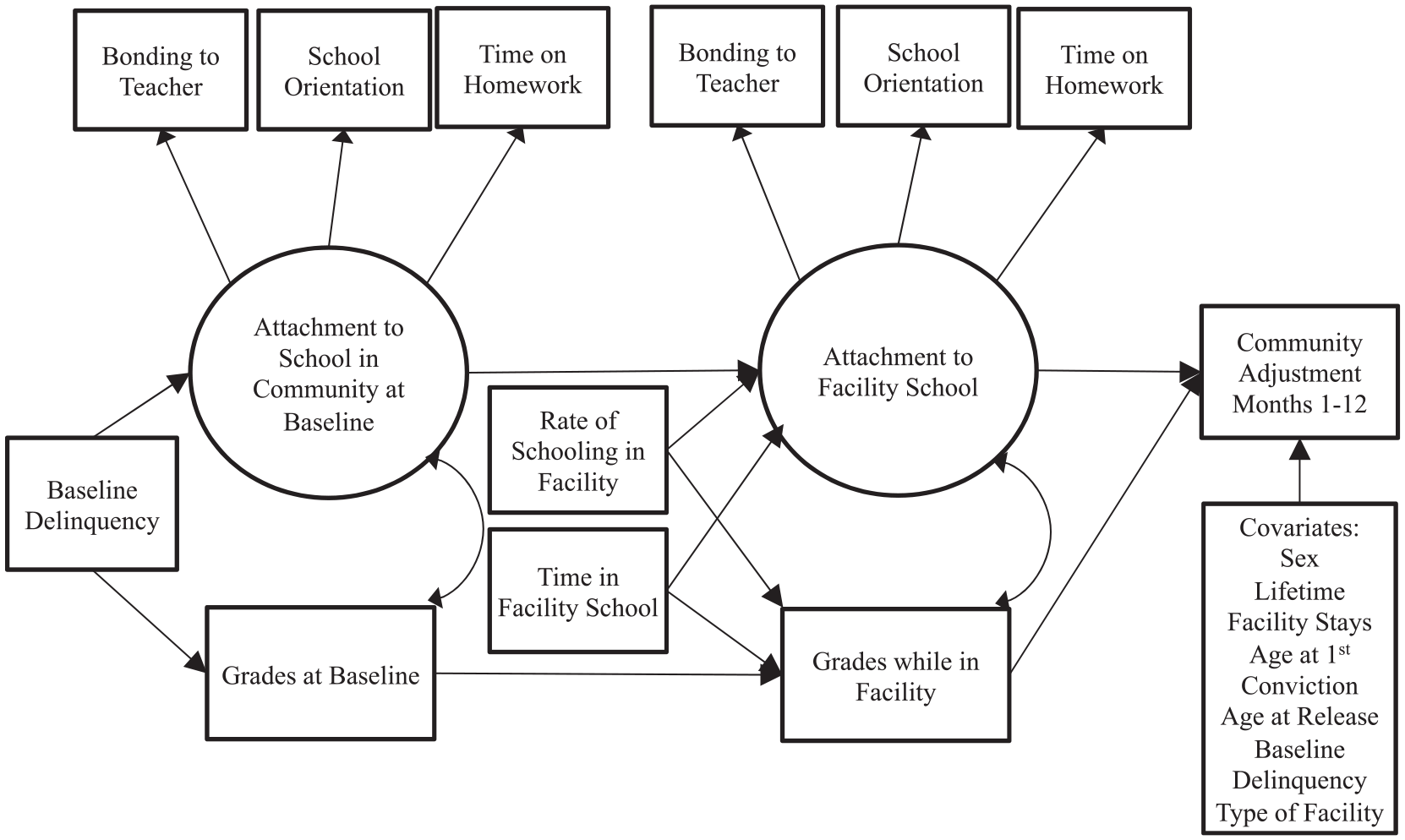
Schematic Overview of Models Predicting Community Adjustment Based on Facility School Experience, Controlling for Baseline School History and Covariates

SEM Predicting Community Stay After Gainful Activity
Results
Demographic Characteristics of the Study Sample by Type of Facility
Comparing juveniles who stayed in adult versus juvenile facilities revealed differences in treatment across juvenile versus adult justice systems (see Table 1). Due to site differences in waiver laws, most residents in adult facilities were from AZ, while the population in juvenile facilities was predominantly from PA, χ2(1) = 124.15, p < .001. This unequal distribution also resulted in differences in ethnicity, with more Black and Hispanic participants in juvenile versus adult facilities, respectively, χ2(3) = 64.41, p < .001. As expected, participants in adult facilities were older (t = −8.60, p < .001), had more Lifetime Facility Stays (t = −5.93, p < .001), and were less likely to have been enrolled in school prior to their stay, χ2(1) = 17.12, p < .001. The incarceration experience between adult and juvenile facilities differed significantly: residents in a juvenile facility reported less peer delinquency (t = −4.07, p < .001), were in a more future-oriented program (t = 9.69, p < .001), felt safer (t = 4.39, p < .001), and received more than twice as many services on average (t = 13.55, p < .001), including case management services, χ2(1) = 66.50, p < .001, and job training, χ2(1) = 57.96, p < .001.
Although there were large average differences between length of stay in the facility and how much time residents spent in the facility school for the entire sample, residents in adult facilities received even less schooling (t = 5.42, p < .001). Most residents in adult facilities attended a GED, High School Continuation or HSD program, while most residents in juvenile facilities attended an unspecified school, χ2(2) = 34.40, p < .001. Little more than half of residents in adult facilities received grades in school, χ2(1) = 54.29, p < .001, 45% among students attending GED, High School Continuation, or high school diploma (HSD) programs, and 64% in the unspecified school. This distribution of missing values was equal across school types in juvenile facilities (14%). Almost no one was involved in extracurricular activities, χ2(1) = 54.70, p < .001. Despite stark differences in service delivery, there were no group differences on other facility school variables or in community school history, besides higher Bonding to Teachers in the community among the sample in an adult facility (t = −2.94, p = .003). Participants returning from adult facilities were less likely to remain in the community, χ2(1) = 3.98, p = .046, but there were no differences in other community outcomes. Finally, all juveniles had received low levels of previous school services in the community, despite high levels of previous school failure and low average grades. Correlations, estimated mean values, and proportion of missing values of study variables are included in Supplemental Table S1 (available in the online version of this article).
Facility School Experience
The 569 participants in the present sample experienced their facility schooling in 98 facilities. Analyses showed intraclass correlations of study variables ranging from .02 to .16, and we adjusted all models for clustering of the data in all our analyses as outlined above. Using a combination of theory and exploratory analyses, we assessed facility school experience as a one-factor latent construct “Attachment to Facility School” that included three variables: (a) Time on Homework, (b) School Orientation, and (c) Bonding to Teacher, and a correlated manifest variable (Grades). In addition to being a good fit to the data both in the facility (RMSEA: 0.04, 90% CI [0.00, 0.10]; CFI: 0.99; SRMR: 0.02) and community school context (RMSEA: 0.04, 90% CI [0.00, 0.10]; CFI: 0.99; SRMR: 0.02; see also Supplemental Table S2 [available in the online version of this article]), separating Grades in such a fashion within the model allowed for a better comparison with the literature that has concentrated on the sole contribution of (facility) school performance to community adjustment. This study conceptualized incarceration as an intervention and thus also included Rate of Schooling and Length of Facility School Attendance as predictors, despite low correlations with facility school variables (see Figure 1 for a schematic overview of the complete models).
Stay in a Juvenile versus an Adult Facility
To investigate differences in facility school experience and community adjustment by Type of Facility, we estimated a series of multiple group comparison models. While staying in an adult (n = 119) versus juvenile (n = 429) facility was associated with numerous differences in service delivery (see Table 1), the multiple group comparisons showed few differences with community adjustment by Type of Facility. Specifically, there was no difference in fit of the latent variables Attachment to Facility School, χ2Diff(3) = 3.11, p = .412, or Attachment to Community School, χ2Diff(3) = 2.90, p = .408. Thus, in all following model comparisons, loadings of the latent variables were held constant; comparisons were calculated between a fully constrained model and one where associations with outcomes were allowed to vary.
Comparisons showed no improved fit for a model accounting for differences in relations with Gainful Activity, χ2Diff(2) = −.34, p = .935, or Delinquency, χ2Diff(2) = 3.48, p = .186, at 12 months. However, letting parameters for Community Stay vary was associated with overall better fit, χ2Diff(2) = −8.26, p = .015. Specifically, participants returning from adult facilities had a lower likelihood of remaining in the community and no significant relation between Attachment to Facility School and that outcome. Thus, Type of Facility was included as a covariate in all analyses predicting Community Stay. Similarly, we investigated differences in facility school experience and community adjustment by race/ethnicity. Results showed no differences for African Americans (n = 290) compared with participants from all other races (n = 279); race/ethnicity was thus not included as a covariate in any of the models.
Facility School Experience and Community Adjustment
To test the influence of facility school experience on community adjustment, we estimated SEMs predicting Gainful Activity, Delinquency, and likelihood of Community Stay at 12-month follow-ups (see Figure 1). Community school experience was included as a predictor of facility school experience. Lifetime Facility Stays, Age at Release, Age at First Conviction, Delinquency at Baseline, and Sex were included as covariates for all outcomes. Type of Facility was included in models predicting Community Stay.
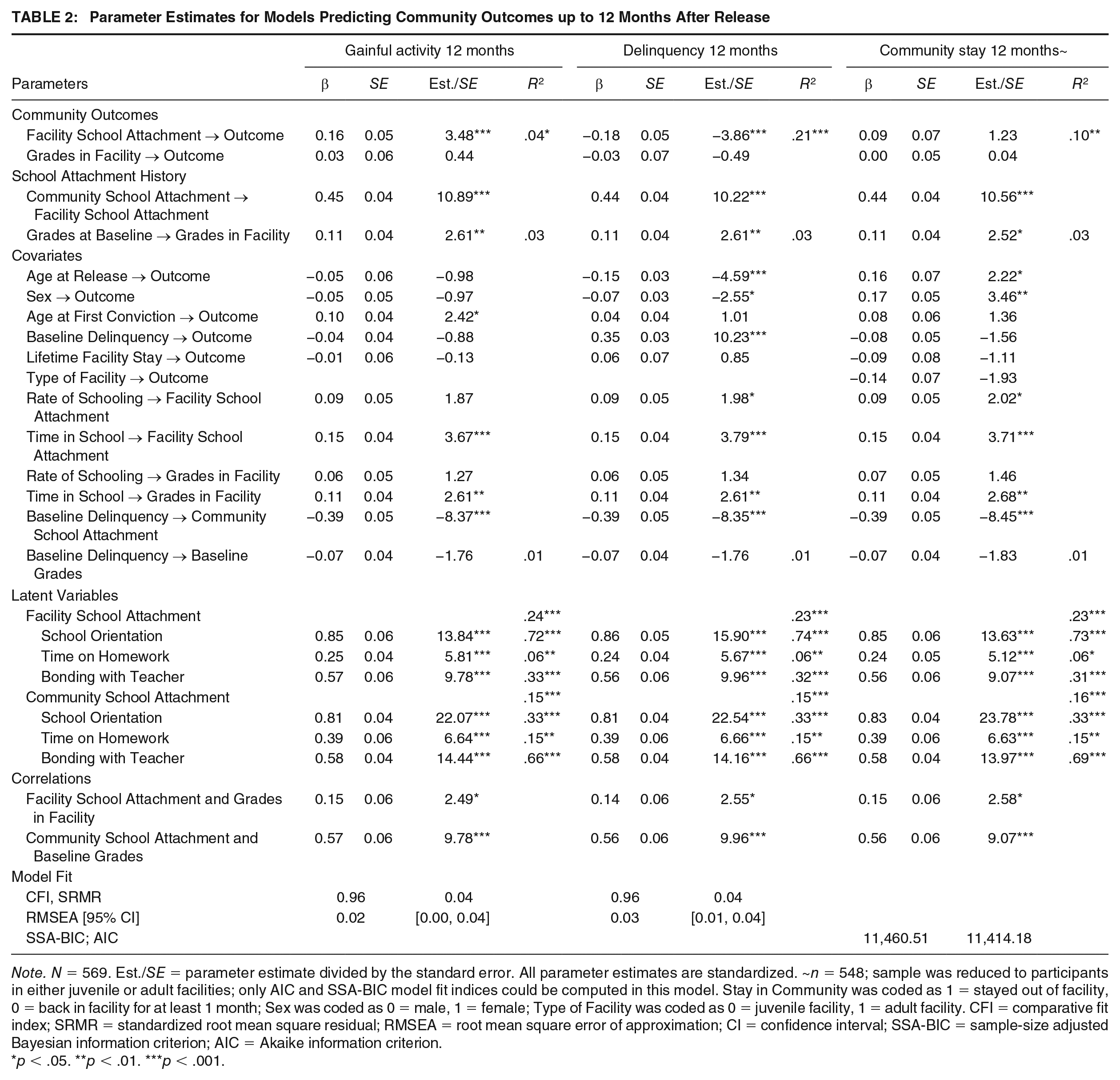
Results showed that higher Attachment to Facility School predicted better community adjustment in the form of more Gainful Activity and less Delinquency at 12 months, even when accounting for community school history and other covariates (see Table 2). Higher Attachment to Facility School was not related to a higher likelihood of staying in the community. School performance in the form of grades, though positively correlated with Attachment to Facility School, was not related to any of the community outcomes. Higher Attachment to Community School was strongly associated with higher Attachment to Facility School in all models, and higher grades at baseline predicted better performance in the facility school, though the association was much weaker. Although school attachment and school performance were strongly correlated in the community school variables, this association was much weaker in the facility school variables. In all models, Attachment to Facility School increased with more time spent in the facility school and with higher rates of schooling. Conversely, while more time in school was associated with an increase in grades, rate of schooling had no influence on school performance. Lifetime Facility Stays was not related to any of the outcomes, but being female was associated with a strong reduction in delinquency and increased likelihood of staying in the community.
Parameter Estimates for Models Predicting Community Outcomes up to 12 Months After Release
Note. N = 569. Est./SE = parameter estimate divided by the standard error. All parameter estimates are standardized. ~n = 548; sample was reduced to participants in either juvenile or adult facilities; only AIC and SSA-BIC model fit indices could be computed in this model. Stay in Community was coded as 1 = stayed out of facility, 0 = back in facility for at least 1 month; Sex was coded as 0 = male, 1 = female; Type of Facility was coded as 0 = juvenile facility, 1 = adult facility. CFI = comparative fit index; SRMR = standardized root mean square residual; RMSEA = root mean square error of approximation; CI = confidence interval; SSA-BIC = sample-size adjusted Bayesian information criterion; AIC = Akaike information criterion.
p < .05. **p < .01. ***p < .001.
Baseline Delinquency predicted Attachment to Community School and Delinquency after release, but was unrelated to Gainful Activity or Stay in Community. Finally, adjusted path models investigating the protective effect of engagement in Gainful Activity during the first 6 months after release on Delinquency for Months 7 through 12 showed no significant relation between the two constructs (see Supplemental Table S3 [available in the online version of this article]). Conversely, Gainful Activity during the first 6 months after release more than doubled the odds of staying in the community during Months 7 through 12 (odds ratio [OR] = 2.37, 95% CI [1.60, 3.50]) even when accounting for covariates (see Figure 2).
Discussion
One common part of the incarceration experience for school-aged incarcerated juveniles in adult or juvenile facilities across the United States is the obligation to attend school and receive correctional education (RAND Corporation, 2014). However, until recently most research has not investigated incarceration as a treatment environment which influences behavior upon return to the community, and the role of juveniles’ perspectives on their experiences in institutional settings largely has been ignored (see Schubert et al., 2012, for an exception). Consequently, little is known about how positive community outcomes are influenced by experiences while incarcerated, such as institutional schooling. This is despite a large body of research showing that higher academic achievement, attending community school, and/or being employed are connected to better community outcomes for juvenile delinquents (e.g., Hirschfield & Gasper, 2011).
In contrast, the present study investigated how facility school experiences predicted community adjustment for male and female incarcerated juveniles. Furthermore, it described systematic differences in service delivery and investigated how receiving the institutional schooling in a juvenile versus adult facility influenced reentry outcomes. Specifically, the present study tested three dimensions of reentry adjustment: academic- and employment-related adjustment (Gainful Activity), self-reported delinquency, and readmittance into a secure facility. Facility school experience considered relational and motivational dimensions (Attachment to Facility School comprised of Bonding with Teacher, School Orientation, and Time on Homework), as well as performance (Grades) and dosage (Time in School and Rate of Schooling) of correctional education received. Results showed that across adult and juvenile facilities, higher attachment to the facility school predicted better community adjustment on two indicators: increased involvement in gainful activity and decreases in self-reported delinquency over 12 months after release. These associations were influenced by individual community school history, with higher school attachment prior to incarceration positively impacting attachment in the facility school. Similarly, higher grades in the community prior to incarceration predicted better performance in the facility school, although this association was much weaker. In line with this finding, though grades were still positively correlated with attachment in the facility school, the relation between attachment and performance was much stronger in the community environment.
In contrast to other studies, grades received while incarcerated did not predict community adjustment in the present study. This study included girls in its sample despite their comparatively small numbers to increase the knowledge base on this gravely underresearched population. In line with other research on sex differences in reoffending (e.g., Barrett et al., 2006), our results showed that sex was associated with self-reported delinquency and likelihood of returning to a facility, with females showing lower risk on both of these measures. In accordance with life course theory (Sampson & Laub, 2005), the present results showed behavioral differences based on individual experiences during incarceration and add to the mounting evidence that it is necessary to investigate incarceration as an environment that shapes future behavior. Finally, these data suggest that relationships with teachers and school orientation while incarcerated matter greatly across facility type, indicating resources should be directed to this aspect of all institutions housing juveniles.
Differences by Type of Facility
As expected, the incarceration experience differed significantly by facility type, and residents in a juvenile facility reported more services available to them. Residents in adult facilities received fewer school sessions, were seldom graded, and reported little involvement in extracurricular activities. This confirms other research reporting on conditions in adult jails and the comparatively more detrimental effect of spending time in adult facilities for juveniles (Lambie & Randell, 2013; Redding, 2016). Although the distribution revealed some significant site differences, age was confounded with staying in adult versus juvenile facilities and the study population in adult facilities was older compared with those in juvenile facilities. Finally, it is notable that, while worse for residents in adult facilities, there were big differences between the average length of stay in the facility and the time participants spent in the facility school for all participants. This suggests major gaps in the delivery of correctional education for all incarcerated juveniles.
Despite these differences in service delivery, multiple group comparisons showed no differences in the construct of attachment to the facility school. There were few differences in community outcomes by Type of Facility, and the majority of those could be attributable to age differences of the returning residents from different facility types. Still, we included Type of Facility as a covariate in all analyses predicting Community Stay. In contrast to the distributions showing that individuals returning from adult facilities engaged in less delinquency, they were still less likely to remain in the community, suggesting that there might be labeling effects (Augustyn & Loughran, 2017). Results in the overall models, however, showed that there was no association between Type of Facility and the likelihood of remaining in the community after accounting for facility school experience and history of previous facility stays.
Attachment to Facility School and Community Outcomes
Findings showed a relation between higher attachment to the facility school and more gainful activity and less delinquency up to 1 year after release. This finding is supported by qualitative studies showing that residents who report positive interactions with staff or those with a high buy-in to treatment programs also tend to report more concrete plans for their reentry (Reed & Wexler, 2014). In the present study as well, attachment to the school constituted of a positive relationship with teachers and two motivational indicators: amount of time spent on homework, which measured a behavioral investment in school, and school orientation, which measured attitudes toward school. Taken together, this school attachment stood apart in predicting adjustment back in the community and trumped grades.
Consistently, higher attachment to the facility school lead to reductions in self-reported delinquency upon return to the community. It is important to note that while self-reported delinquency and stay in community were correlated, the correlations were comparatively low in magnitude (see Table 2). The reduction in self-reported delinquency associated with higher facility school attachment did thus not translate into an increased probability of staying in the community after 12 months when adjusting for other factors. Contrary to our expectations, results of the path models showed that more gainful activity during the first 6 months did not lead to reductions in self-reported delinquency in months 7 through 12. This is in contrast to the social-bonds-hypothesis of life course theory, according to which more involvement with prosocial institutions would lead to a reduction in antisocial behavior (Sampson & Laub, 2005). However, those who managed to find work and/or attended school had much improved odds of remaining in the community.
One interpretation of this pattern of findings is that regardless of personal behavior, individuals whose daytime hours are accounted for might be less likely to be stopped by police or scrutinized by parole officers, for example, for loitering, regardless of their actual levels of involvement in delinquent activities (Parker et al., 2010). Furthermore, for some participants, failure to work or attend school might have constituted a violation of their parole, which might even be the sole cause for reinstitutionalization (Archwamety & Katsiyannis, 2000). Whatever the explanation, the present findings expose the complicated relations and important difference between measures of self-reported behavior and measures of system response when investigating recidivism (Ostermann et al., 2015).
Grades and Community Adjustment
In contrast to other studies that showed positive associations between school performance while incarcerated and community school attendance and recidivism (Blomberg et al., 2012; Cavendish, 2014) grades were not related to any of the outcomes in the present study. However, in those studies, subjective aspects of schooling such as teacher bonding or school orientation were not assessed and academic performance was investigated in isolation. In this light, the present results might indicate that while grades are an important factor, subjective aspects of the facility school experience might be relatively more important in predicting community adjustment. Furthermore, it might be that the average of 5 months spent in the facility school does not provide juveniles with enough time to catch up in a way that is reflected in a gain in grades.
In contrast, building positive relationships and increasing motivation would be more important as it would have a comparatively more immediate and thus more important effect. This interpretation is supported by a recent meta-analysis of teacher–student relationships, school performance, and school engagement in adolescents (Roorda et al., 2011). Another possible explanation for the present findings is that grades might not be measuring true performance in the context of facility schools. A qualitative study in a secure facility revealed that students often were left clueless as to what was expected of them, but still received high marks if they handed in their work packages, even when filled in at random (Reed & Wexler, 2014). In the present study, mean grades were higher in the facility and 45% of residents in adult facilities reported they did not receive any grades. Taken together, this might provide another explanation for why grades were neither a good predictor of school adjustment postrelease nor highly correlated with attachment to the facility school in the present study. It also raises concerns about the validity of grades received while in a facility in general. Ideally, higher grades in the facility schools would reflect individual gains in the more personalized environment of a detention school. However, it could also be an indicator that grading was not taken very seriously in this environment and more studies with standardized performance measures are needed.
Study Limitations
There were several limitations to the present study. First, as in all studies assessing recidivism through system contact, readmittance into a secure facility was dependent on the specific legal systems in which the study took place. We did not measure rearrest, nor could we account for processing time between the occurrence of a delinquent act and the beginning of a stay in a secure facility. Furthermore, it is possible that youth were admitted for actions that occurred before their last incarceration. These reasons make it difficult to compare our results across localities and samples (Ostermann et al., 2015). To offset these disadvantages, we included other outcome measures assessed in self-report. The consistent relations across different indicators of community adjustment increases the confidence in the validity of our conclusions.
The obligation to provide correctional education is one important unifying factor across facilities housing juveniles, but the generalizability of the findings is limited by the specific modeling approach, measurement of the experience, and sample composition of the present study. For example, collecting information on the most recent school attended might have impacted measurement validity by including schools that were only attended briefly or sporadically. Furthermore, the high number of missing grades nonrandomly associated with stay in an adult facility makes it possible that we were not able to detect the true relation of grades to facility school attachment and community adjustment, despite maximum likelihood estimation. Furthermore, as discussed above, there are widespread concerns about the quality of instruction and thus accuracy of grades received while in a secure facility (RAND Corporation, 2014; Reed & Wexler, 2014).
Although we acknowledge these limitations, our data provide additional support for investigating the contribution of facility school attachment separately, as we did, and is a true reflection of the status of correctional education in the United States. Another limitation was that racial/ethnic composition, facility type, and study site were confounded in a way that made it impossible to isolate effects independently. We addressed this by testing multiple group comparisons for race/ethnicity, and we tried to capture system differences by comparing adult versus juvenile facility. However, more studies with different samples are needed to investigate the contributions of race/ethnicity, individual experiences and differences in correctional education (e.g., accreditation of facility schools, participation in standardized testing), and facility characteristics (e.g., treatment approach, security-level) between and within facilities. Finally, schooling is only one aspect of incarceration and we did not assess other services received, either while incarcerated or in the community. Similarly, we did not account for mental health, substance abuse problems, or other social and emotional covariates. More research on how the interplay of personal history, facility experience, and availability of services impacts reentry is needed.
Directions and Implications for Policy, Practice, and Research
This study has several important implications for policy, practice, and research. First, it shows that bonding with teachers and school orientation influences community adjustment of incarcerated juveniles whether they are housed in a juvenile or adult facility. Furthermore, this positive influence manifests despite several major differences in service delivery between juvenile and adult facilities. For practice and policy, our results show the importance of investing in institutional schooling that increases motivation and fosters supportive relationships with teachers, as well as helping students to catch up academically. Future research should assess these motivational and relationship aspects in addition to (possibly flawed) indicators of performance, while interventions should concentrate on ways to improve school orientation and resident–staff relationships of incarcerated juveniles, regardless of where they are incarcerated.
In addition, even if successful, a wealth of qualitative data show that simply increasing attachment to facility schools might not be enough. It also is necessary to ensure that the rehabilitative programming and institutional experience concretely support the young offenders in implementing and sustaining their desire to go back to school or find employment, and refrain from future offending. Specifically, the higher likelihood of returning to a secure facility for residents exiting adult facilities in our results show how, for example, labeling effects might dampen positive community adjustment despite similar rates of behavioral change.
Our results showed that longer time spent in school while incarcerated was associated with gains in attachment to the facility school. This points to one inherent difficulty of interventions delivered in the context of incarceration: Relationships need time to form and, in intervention terminology, it might necessitate a certain dosage to increase school attachment and grades. However, our results must not be misunderstood as support for beneficial effects of longer periods of incarceration. The relations between quantity, both in terms of duration and intensity, and qualitative aspects of schooling are complicated and more research is urgently needed to understand their interplay. Continued evaluation that includes the voices of the correctional students seems warranted to further our understanding on how attachment to facility schools and community adjustment can be improved. Meanwhile, it might be most beneficial for practitioners to strive to increase the time juveniles spend in school while they are incarcerated.
Finally, the most important implication is the call for more research that are comparable across different systems and settings in the fragmented landscape of juvenile justice. This means an emphasis on empirically sound measures and outcomes, including dosage (i.e., length, timing, and intensity of services), and detailed description of content. The present study shows how such indicators and resident perceptions of one aspect of the facility experience can be used for comparisons across facility types. A research agenda grounded in those principles provides a powerful unifying framework that would advance research, policy, and practice alike.
Supplemental Material
Supplementary_Table_1 – Supplemental material for Reentry of Incarcerated Juveniles: Correctional Education as a Turning Point Across Juvenile and Adult Facilities
Supplemental material, Supplementary_Table_1 for Reentry of Incarcerated Juveniles: Correctional Education as a Turning Point Across Juvenile and Adult Facilities by Lena Jäggi and Wendy Kliewer in Criminal Justice and Behavior
Footnotes
Authors’ Note:
The authors declare that they have no conflict of interest. Data for this project were from the Pathways to Desistance Project and supported by the National Institute on Drug Abuse through a cooperative agreement that calls for scientific collaboration between the grantees and the National Institute on Drug Abuse staff. The project was completed as part of the dissertation of the first author under the direction of the second author.

Supplemental Material
References
Supplementary Material
Please find the following supplemental material available below.
For Open Access articles published under a Creative Commons License, all supplemental material carries the same license as the article it is associated with.
For non-Open Access articles published, all supplemental material carries a non-exclusive license, and permission requests for re-use of supplemental material or any part of supplemental material shall be sent directly to the copyright owner as specified in the copyright notice associated with the article.
