



Abstract
An analysis of the course of relations between union movements and left parties in four Southern Cone countries shows that, while in Uruguay and Argentina the progressive parties were able to maintain alliances with union actors and empower them, in Brazil and Chile left parties and unions experienced conflicts that hindered the formation of alliances. In the four countries studied, two variables had a strong influence on the possibilities for forming and maintaining a coalition among unions and parties: the electoral strategy of the leftist party and union fragmentation.
Un análisis del curso de las relaciones entre los movimientos sindicales y los partidos de izquierda en cuatro países del Cono Sur muestra que, mientras que en Uruguay y Argentina los partidos progresistas pudieron mantener alianzas con los actores sindicales y empoderarlos, en Brasil y Chile los partidos y sindicatos izquierdistas experimentaron conflictos que obstaculizaron la formación de alianzas. En los casos de los cuatro países analizados, dos variables influyeron fuertemente las posibilidades de formar y mantener una coalición entre sindicatos y partidos: la estrategia electoral de los partidos de izquierda y la fragmentación sindical.
The various progressive governments in Latin America have been grouped together into two categories in most of the literature: the moderate left, 1 which has generally continued with the market reforms promoted during the previous decades, and the radical or populist left, which has sought to dismantle neoliberal policies, granting a greater role to the state. The moderate left includes the parties that came into power in countries such as Brazil, Chile, and Uruguay, while the more radical left includes the governments of countries such as Bolivia, Ecuador, Venezuela, and, in some cases, Argentina. However, a more careful analysis of their histories allows us to note important differences within these two analytical categories at both the economic and the social level and in their connection with the classic electoral bases, the unions. This relationship of union actors with progressive parties has been absent from the most influential studies on the “left turn” in the region. This article draws on the theory of power resources to analyze and interpret the relation between political parties and union movements in Latin America in the first 15 years of the twenty-first century.
The union movement is a classic social agent supportive of the redistribution of wealth in Western societies. This movement had a significant impact in European countries during the twentieth century, largely after World War II, under a protectionist development model. The combination of political democracy, organized collective actors, and leftist political parties (Labor or Social Democrat) favoring redistribution but maintaining the capitalist accumulation pattern created “moderate” levels of socioeconomic inequality and expanded social protection for formal workers and their dependents (Esping-Andersen, 1993: 57; Marshall and Bottomore, 1998: 53). Despite having promoted a pattern of growth favoring state intervention—variants of the import-substitution industrialization model—since the 1950s, Latin America lacked the economic and political context of the developed nations. Nevertheless, liberal democracy was far from being consolidated on the continent. Repression of popular demands, including those of the unions, became a regular strategy of both the successive dictatorships and the new “emerging democracies” of the 1980s, tutored or limited by electoral restrictions and the establishment of a neoliberal pattern of development that conspired against the organization of the popular sectors (Patroni and Poitras, 2002: 211–214; O’Donnell, 1996: 37–38).
The undermining suffered by the union movement under this global accumulation regime, which prioritized the flexibility of labor deregulation as a criterion for economic competitiveness, reinforces the analytical importance of studying this popular actor within a political and economic framework inclined to process some of its demands. The twenty-first century created the possibility of analyzing the relationship between the state and the collective actors, unions in particular, in a context unprecedented for the region—at least for the first decade one of economic growth (a result of the commodities boom) and stability of liberal democracy in which the ascent to power of progressive political forces tended to preserve the existing forms of production 2 and deliver economic distribution through labor and social policies to combat poverty (Prevost, Oliva Campos, and Vanden, 2012: 21).
In Latin America the relationship between popular actors and the state was always strained, with patterns of co-optation, represented in a conservative inclusion of social groups, and opposing ones that converged in genuine collaborations to satisfy a set of demands (Dangl, 2010: 5; Filgueira, 2013: 24).This type of linkage, built historically through contradictory political guidelines, became evident to the degree that the leftist governments confronted pressure related to preserving the backing of broad sectors of the electorate with the support of coalitions representing diverse ideological positions. At the same time, they sought to maintain the support of social movements, among them unions (Riethof, 2018: 7).
Prioritizing a union analysis in this essay does not mean theoretically and empirically ignoring other forms of collective action that have been significant in the region (the landless movement, the indigenous, feminist, and student movements, and the piqueteros, among others). Some of these popular expressions are relatively new, while others are based on old demands for social justice that confronted colonialism, neocolonialism, and resistance by regional elites in connection with the modernization of the region in the previous century (Prevost, Oliva Campos, and Vanden, 2012). This renewed package of social demands tends to manifest itself in circumstances in which political opportunities are identified for processing claims, recreating the public agenda, and promoting alternative modes of public protest (Tarrow, 1997: 147–148). The union movement’s proposals reinforce and complicate the repertoire of popular demands to the extent that its blueprint for action is focused on the conflict between capital and labor.
The links between progressive parties and union actors have been changeable, especially in the Southern Cone countries (Argentina, Brazil, Chile, and Uruguay). In this work we analyze the diverse paths of these interactions and argue that the relations between unions and leftist parties in the region during the so-called progressive era can be explained by the electoral strategies followed by the progressive parties, associated with putting together governing coalitions and the pursuit of support, and the fragmentation of the union movement when those parties took office, seen in the coexistence or lack thereof of more than one federation of labor unions. The combination of the two factors established different formats for brokering labor interests that had a specific political impact in each of the cases analyzed.
An in-depth examination of the links between progressive parties and the union movement can identify situations in which the neoliberal public policies of the 1980s and 1990s weakened the union actors at the same time that the progressive parties’ access to power was unable to strengthen the unions. The typical case is that of the Chilean Partido Socialista (Socialist Party–PS). In Uruguay, in contrast, the alliance between party (Frente Amplio [Broad Front—FA]) and union federation allowed for a strong opposition in the phase of promarket reforms. At the time of the FA’s coming to power, this relationship not only was bolstered but strengthened the united workers’ federation. A third type of relationship can be identified in the Argentine case, where the union movement was fragmented but Kirchnerism in power nationally sparked a new reconfiguration of the ties between unions and party, with a clear revitalization of unionism. Lastly, in the case of Brazil, the close link of the country’s largest union federation during the 1990s with the Partido dos Trabalhadores (Workers’ Party—PT) was unsustainable once Lula da Silva rose to the presidency.
This article will attempt to illustrate the different types of relationships and exchange among the classic actors supporting economic distribution (progressive parties and unions), which were strengthened during the past 15 years in a set of South American countries. The work is organized as follows: In the next section we analyze the differences in the ties established among progressive parties and union federations before and during the phase of progressive shift in Latin America. In the following one we seek to explain the variation in this relationship, focusing on union fragmentation and the types of political strategy employed by the progressive parties in order to get into power. In the last two sections we analyze the four cases selected and present our conclusions.
Linkages between Progressive Parties and Union Movements
Relations between left parties and unions in the Southern Cone have displayed important variations since the transitions to democracy in those countries. One of the significant periods of change in this relationship was the late 1980s, as the neoliberal shift in the region began. In this phase, while some left parties sought to adapt to the new ideological consensus, adopting packages of structural reform policies contrary to their historical programmatic foundations, others, in alliance with the unions, continued to be opponents of the reforms and managed to moderate and even halt liberal reforms in some strategic sectors of public policies.
In the first group of countries we see what the literature has called “neoliberalism by surprise” (Stokes, 2001). Many political parties, traditionally close to the workers’ movement in the import-substitution industrialization period, made a radical turn in their historical programmatic platforms, adopting economic liberalization packets, labor flexibilization, and privatizations, which created long-term consequences for party systems by dealigning programmatic authority and blurring ideological divides (Roberts, 2014). 3 Another adaptive strategy was the formation of electoral alliances with centrist parties, which resulted in the weakening of the ties between progressive parties and union actors. In this group we can locate the path of the Partido Justicialista (Justicialist Party—PJ) in Argentina and to a lesser degree the Partido Socialista (Socialist Party—PS) in Chile. In the late 1980s the PJ began a process of profound organizational and ideological change as a way of adapting to a new electorate different from its traditional core, centered on urban industrial workers, and to an international context that imposed limitations on its traditional programmatic platform (Levitsky, 2003: 94). This transformation led to a distancing from its union base demonstrated by the loss of influence of unionism both within PJ structures and in Congress. The deunionization of the PJ signified a change in the party’s electoral strategy, transforming it from a union-based party to one focused on clientelistic and patronage networks.
In Chile, the PS began to move away from the union movement in the waning days of the Pinochet dictatorship. The party, which during the Unión Popular experiment under Salvador Allende’s administration in the early 1970s represented the most radical wing of the government coalition, diametrically changed its programmatic platform during the democratic transition (Roberts, 1998). The failed and traumatic experience of the Unión Popular led the PS to a critical reevaluation of liberal democracy and the risks of a radical redistribution program without a policy of alliances among classes and parties. As a result of this process, it went through most of the postdictatorship period as the principal partner in the government coalition with the Democracia Cristiana (Christian Democrat—DC) party, the Concertación. The ideological moderation of the PS as a member of the governing coalition caused the union movement to distance itself, transforming it into an electoral-professional party dominated by the political elite and their technical cadres. This predominantly electoral line of action resulted in a weakening of the union movement, marginalizing and fragmenting the workers’ organizations while subordinating their demands to the dictates of the economic model and the business class (Barrett, 2001).
In a second group of countries, the left parties managed to remain as alternatives to the neoliberal ideological convergence predominant in the region, although they began moderating their programs as they grew stronger electorally and were transformed into a probable government alternative. In this group we find the PT in Brazil and the FA in Uruguay. The PT exhibited strong ties to the union movement from its inception. In fact, it was created as a political tool of the so-called new unionism (Meneguello, 1989) and throughout the 1990s was able to remain a party of opposition to the successive governments. During the period of transition and democratic consolidation, the PT successfully preserved its historical alliance with the most important factions of Brazilian unionism, united in the Central Única dos Trabalhadores (United Workers’ Federation—CUT). Although the PT did not produce changes in its program as radical as those of the PJ, it did go through a process of ideological modernization to adapt to the pressures of the international markets while its electoral growth was steering it toward government (Hunter, 2010).
As did the PT, the FA made the transition to democracy as a force of opposition to the attempts at liberal reform promoted by the traditional parties. This opposition role, which had characterized this partisan organization since its creation in the 1970s, allowed it to enhance its historical alliance with the union movement. It coordinated its actions with the union movement in order to activate mechanisms of direct democracy that were largely successful and set very strong limits on the privatization agendas of the various governments of the period.
A second stage of significant changes in relations between partisan organizations and organized workers was related to the coming to power of various left parties in the region. In Argentina, with Néstor Kirchner’s victory in 2003 the PJ once again reshaped its links to unionism and with the piquetero movement (an organization that brings together informal workers and the unemployed) through granting benefits with the expectation of rebuilding its historical alliance with organized social actors. Among the measures employed were the reactivation of collective bargaining, with a priority on sectoral negotiation by branches of industry, the dismantling of the labor flexibilization laws, a sustained increase in the minimum wage, a policy of ongoing dialogue regarding social and union conflicts, the consolidation of union control over social welfare programs, and an expansive economic policy that promoted employment and reindustrialization in some sectors (Etchemendy, 2011). These measures allowed the Kirchner government to proceed with the transformation of the PJ in a context of sharp political delegitimization and crisis in the party system.
In Chile in 2000 a socialist president came to power for the first time since the Allende government experiment, but this did not mean a radical change in the relation between the union movement and the party. Although the PS made overtures to unionism by approving labor reform, the moderate nature of its contents divided the party and left a very weak union movement dissatisfied and unable to pressure for more ambitious changes.
In Brazil the PT was able to maintain its alliance with the unions before Lula da Silva became president, but that link began to weaken as the party came closer to electoral victory. Once in government, despite outreach to the unions—for example, with a policy of sustained increase in the minimum wage, the creation of institutionalized mechanisms of consultation with the workers’ federations, and the inclusion of union leaders in government posts (Cardoso and Gíndin, 2009)—it was unable to pass a labor reform bill, continued conventional macroeconomic policies, and became involved in numerous corruption scandals that undermined its support within the unions and the social movements.
In Uruguay the FA pursued a path of ideological moderation similar to that of the PT in Brazil but once in power managed to sustain its alliance with the union movement. Reactivation of plans for neocorporatist arrangements, along with the passage of numerous labor laws that protected and expanded labor rights, assured the party of an aligned union movement when reforms were advanced.
In summary, the links between unions and progressive parties before and after the latter came to power reveal a pattern of continuity in Chile and Uruguay and change in Argentina and Brazil (Table 1).
Links between Unions and Progressive Parties Before and After the Parties’ Coming to Power

The PT and the FA strengthened their alliances with unionism, resisting liberal reforms, while the PS and the PJ distanced themselves from the union movement, respecting the liberal status quo in the former case and promoting market-oriented reforms in the latter.
During the progressive shift, we can again see different trajectories. Just as in the previous phase, the PS, having acquired more weight in the Concertación government in Chile as of 2000, remained distant from the union movement. In contrast, when the PT came to power its historical alliance with the union movement was weakened, basically because of differences with respect to the reform of such pillars of labor policy as retirement and social security. The PJ, which in the previous phase had moved away from unionism, reconfigured the alliance once in office. The FA preserved its close relationship, promoting a package of public policies that benefited unionism, especially with the reactivation of collective bargaining by sector of activity.
The different relations between parties and unions shaped the changes in union power in the various cases. After the liberalization of the 1990s, unions in Chile and in Uruguay had been weakened on the threshold of left governments’ coming to power. Despite this shared aspect, in Chile the union actor was only minimally strengthened during the 2000s, while in Uruguay an activation of unionism similar to the one the country had had before liberalization was achieved. Moreover, in Argentina and Brazil the unions maintained a certain relative strength during the process of economic liberalization in the 1990s through the preservation of some power resources, but in the 2000s they had different track records of activation: resurgence in Argentina and weakening in Brazil (Table 2).
Union Density (percent) in the Selected Countries (1985–2010)
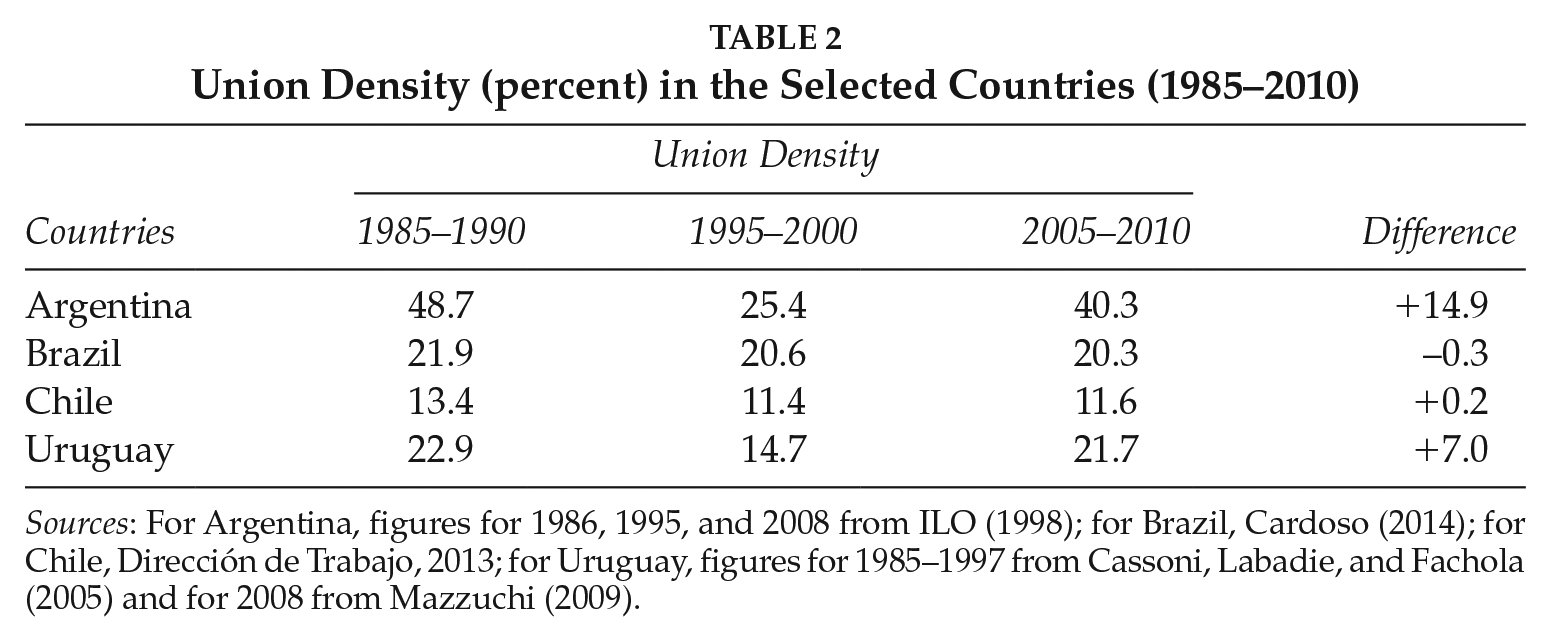
Sources: For Argentina, figures for 1986, 1995, and 2008 from ILO (1998); for Brazil, Cardoso (2014); for Chile, Dirección de Trabajo, 2013; for Uruguay, figures for 1985–1997 from Cassoni, Labadie, and Fachola (2005) and for 2008 from Mazzuchi (2009).
Explanatory Variables: Electoral Strategy and Union Fragmentation
As we have pointed out, the electoral victory of the progressive parties in southern Latin America did not involve uniform linkages with the union movements in each country. Differences were apparent both at the level of specific public policies toward organized workers and at the level of labor rights (Carneiro, 2017) and in formalized instances of bipartite or tripartite negotiations. These different formats for handling interests can be explained in terms of two political variables: the party’s coalitional strategy and the degree of union fragmentation at the moment the progressive party attained power.
With regard to the first variable, the left parties that adopted a strategy of pursuing electoral coalitions with center or center-right political forces in which the left parties were not in control moved farthest away from the union movement. This distancing was due to the fact that the progressive parties had trouble achieving passage of reforms that benefited the unions. In this context, there were no mechanisms for controlling coalition partners, and a set of prounion policies was blocked or toned down in negotiations with governing coalition partners. Moreover, the organizational fragmentation suffered by unionism during the liberalization period determined its possibilities for resurgence as a progressive party came to power. Holding a monopoly on representing workers through a unified federation is one of the union movement’s most important power resources for two reasons: first because it allows for coordination of protest actions and presenting credible threats of mobilization in confrontation with governments and business and second because it gives the government incentives to negotiate with the union movement, assured of a unified actor capable of disciplining and coordinating the actions of the organized workers. Therefore, fragmentation in the representation of workers is always a sign of weakness of its organizations in negotiations with the government (Murillo, 2001: 17).
Electoral Strategies of Southern Cone Progressive Parties
The electoral strategies of the governing parties have been a fundamental variable for analyzing the links between the political left and unions in Europe. In this literature, the strategies of the various social democratic parties for competing electorally determine the type of alliances they attempt to build and, in consequence, the closeness or distance of the organized workers. Insofar as the strategic lines prioritize capturing the “middle vote,” it can be expected that parties will choose to “liberate” themselves from strong commitments to the unions.
Kitschelt (1994) has suggested that left parties take more centrist positions as a way to capture larger portions of the electorate. The more difficult it is to incorporate new groups into internal party workings and the less autonomy leaders have to redirect the electoral strategy, the greater the difficulty for social democratic parties of expanding voter support. In addition to the electoral strategy, the closest links between the left and labor organizations have been growing weaker because of the influence of a number of factors, among them cultural and ideological aspects through which the unions have seen their ideological boundaries vanish and others considered structural, a product of the transformation of the production model and therefore of the job market. The decline in industrial jobs and the increase in white-collar and professional occupations have presented new challenges for political representation and the brokering of labor interests. In the case of Latin America, this process had been under way for decades, after the import-substitution industrialization model reached its limit. According to Weller (1998), the proportion of the economically active employed in the secondary sector (mostly industry) fell from 25 percent to 23.7 percent between 1980 and 1990. As an offset, employment in the tertiary sector (services) rose from 46.7 percent to 53.9 percent. Lastly, there have been changes in the political context and in guidelines for growth, in which political responses to economic crises (neoliberal restructuring) led by social democratic governments have placed those parties in confrontation with the unions and this tension has been capitalized on by right-wing nationalist parties (Hyman and Gumbrell-McCormick, 2010).
Haugsgjerd, Aylott, and Christiansen (2010) analyze this link from a clearly instrumental perspective, arguing that the relationship between unions and parties works as long as both sectors can benefit from the association. For the unions, allying themselves with a party is important in that it contributes to greater union membership and in that governments led by social democrats imply public policies closer to their interests and expectations. Moreover, for the parties, partnership with the unions may provide financing but primarily votes. When this interchange is carried out efficiently—in other words, with political profit for the partners—the connections remain strong. The above-mentioned new economic scenario for Western countries weakened the unions when it came time to ensure a significant number of votes. At the same time, the deterioration of the image of the social democratic parties stemming from their handling of the recent crises limited the possibility of those groups’ taking power and thereby ensuring the unconditional support of the unions.
An array of left parties in Latin America felt the same pressure as the social democratic parties when they focused on winning national elections. In the cases analyzed in this work, the parties developed electoral and government coalitions in order to increase their chances of winning the elections and ensuring governability. However, the coalition strategies developed by those parties took different paths: while the FA in Uruguay partnered with Nuevo Espacio (New Space [NE], a small center-left party that ended up joining the FA), the Frente para la Victoria (Front for Victory—FPV) in Argentina and the PT in Brazil had to form coalitions with various parties (mostly left or center-left and center) in order to preserve congressional majorities. Lastly, from the end of the dictatorship on, the Chilean PS was part of a coalition made up of the DC, the Partido por la Democracia (Party for Democracy—PPD), and the Partido Radical Socialdemócrata (Radical Social Democrat Party—PRSD) (the Concertación) with a clear centrist orientation as the dominant force in the coalition. These different coalition strategies for attaining the presidency determined the possibilities for carrying out reforms that benefited the most classic electoral bases of these parties (Table 3).
Coalitional Strategies of Left Parties
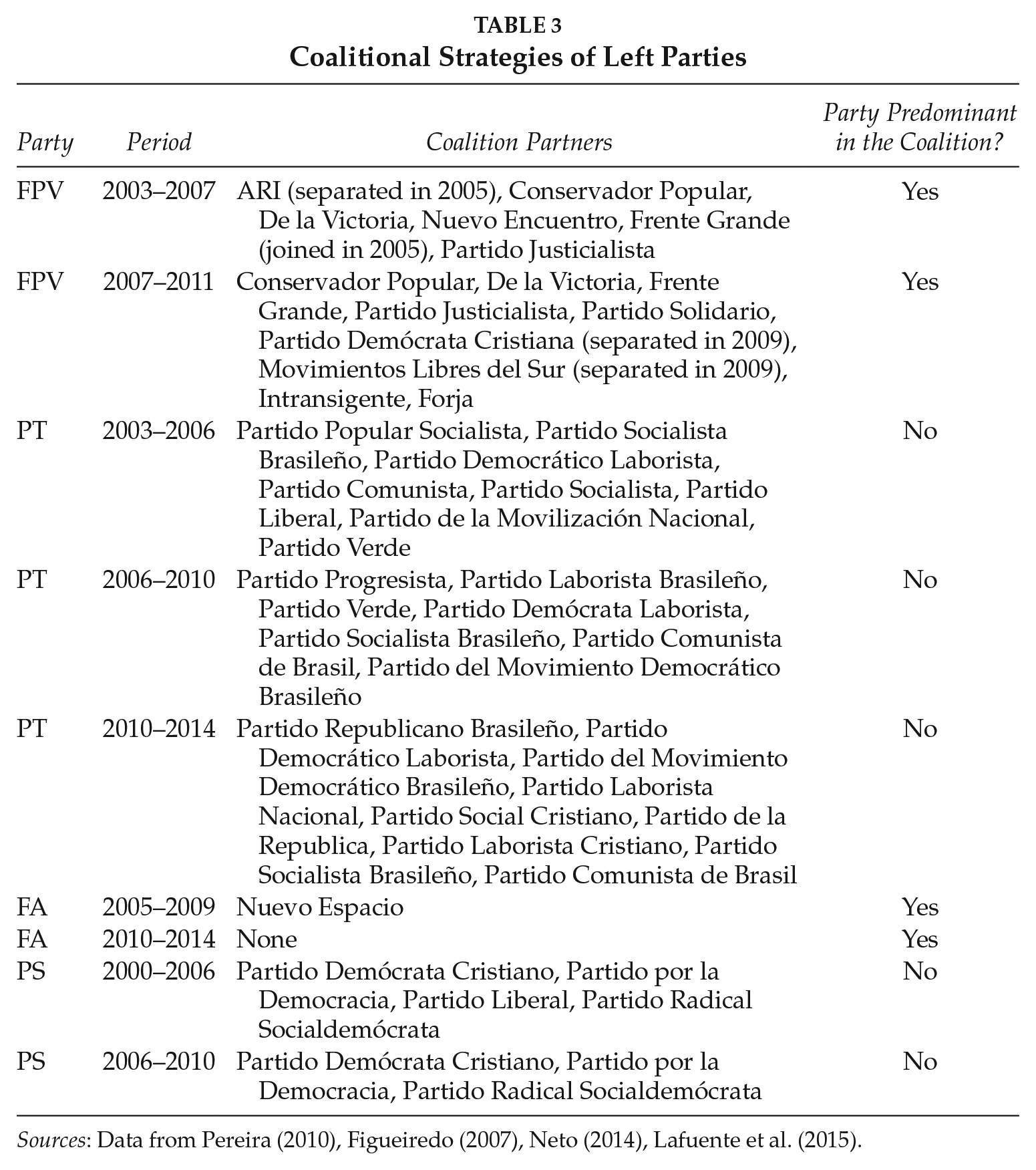
Sources: Data from Pereira (2010), Figueiredo (2007), Neto (2014), Lafuente et al. (2015).
Collective action by subaltern groups becomes an alternative power resource, of an instrumental sort, that makes it possible to modify the economic distribution produced by the market (Fairfield, 2015). The socioeconomic sectors with less privilege in the distribution of power resources will seek, through collective action demonstrated by parties and unions, to change the conditions and outcomes of market distribution (Korpi, 2006). Power resources theory focuses on the link between left parties and unions in order to explain the results of social policy.
Studies usually point to the importance of unions allied with social democratic parties in the construction of universal welfare states. The strength of social democratic parties partnered with powerful unions has been seen to have a positive effect on the state’s social spending, mainly on goods and services, and has been associated with greater redistributive results than those of Catholic or Christian Democratic parties (Huber, Ragin, and Stephens, 1993). The basic idea is that pressures for a universal welfare state emerge from the power of social-union actors and their ties to like-minded political parties in the electoral arena. While this is a widely accepted explanation for the degree of universalism of social policies in Europe, it has not been employed to explain the recent changes in social and labor policy under progressive governments. The late industrialization in Latin America never produced an industrial sector as extensive and significant as those of the industrialized democracies, and this led to much more fragmented labor markets. In addition, capital mobility and the pressure from international markets in the region limited the autonomy that social democratic projects needed to develop in Europe (Roberts, 2008). However, the cases of Uruguay and Argentina show that it is possible for alliances between organized workers and political parties to arise in those contexts. From this perspective, unity of the labor movement is important in explaining the ability of this actor to influence the formulation of public policies that guarantee its rights. Nevertheless, the consolidation or fragmentation of the union movement in Latin America developed differently in the various countries. Attempts by the political class to control or directly co-opt the union movement often intervened. Throughout the twentieth century, while import-substitution industralization fostered a favorable environment for the growth and empowerment of union activity and the unification of the movement, the regional adoption of a model geared toward the market and the institutional failures of democracy in the region brought with them a direct attack on the organizational and mobilization capacity of the unions (Table 4).
Principal Union Federations in the Southern Cone
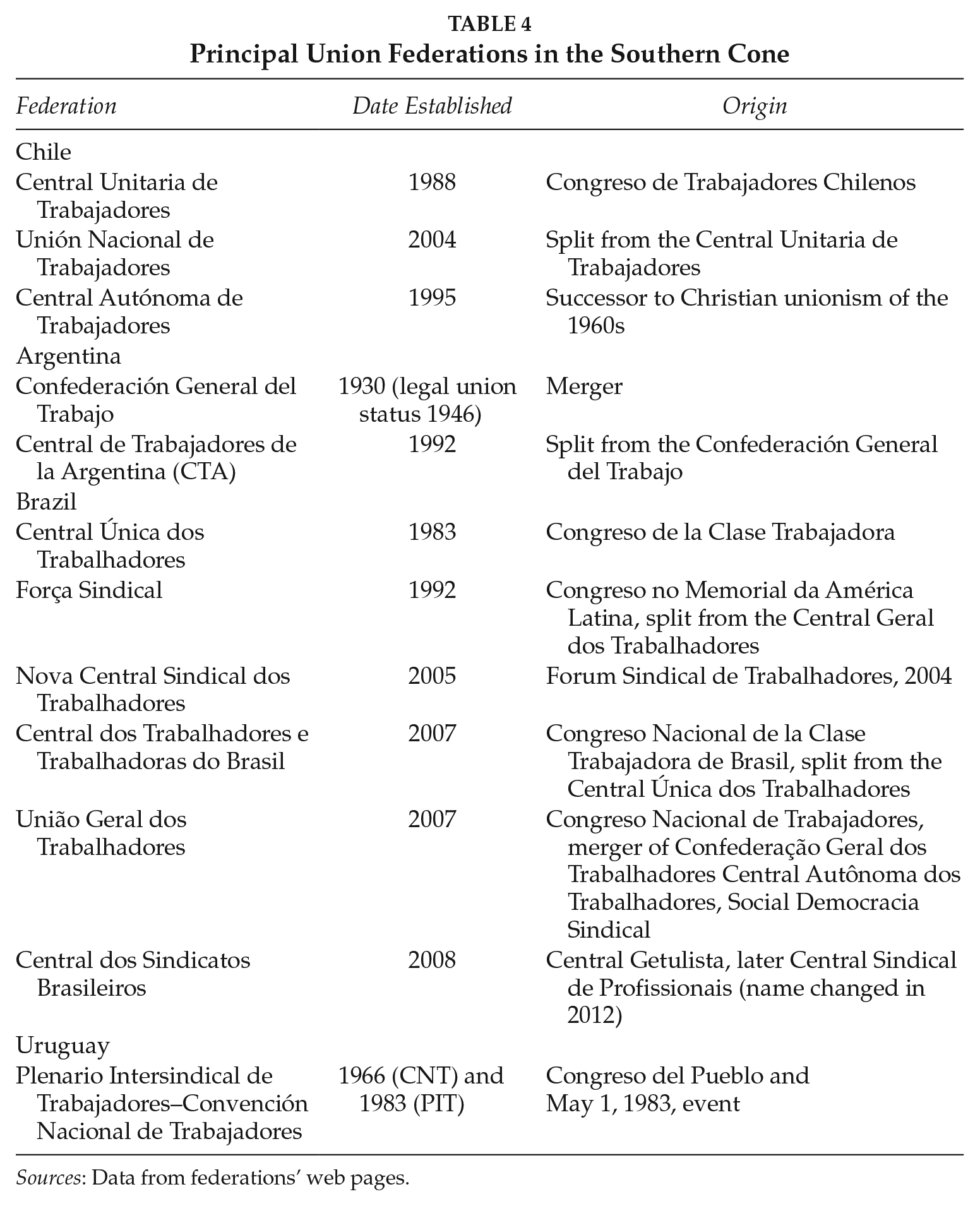
Sources: Data from federations’ web pages.
The transition to democracy that began in the cases studied from the mid-1980s coexisted with the change in the pattern of growth and accumulation geared toward the market. These processes affected the union movement in both its ability to influence decision making and its unity. For example, in the four cases analyzed, labor informality (measured by the number of workers who are not registered for social security) grew between 1990 and 2000, rising to 45.6 percent of Argentine workers in 2001 (Acuña, Kessler, and Repetto, 2002) and 52.5 percent in Brazil (Alejo and Parada, 2017). Moreover, the effects of the promarket reforms weakened the organizing capacity of unionism not only through job insecurity but also through the destruction of jobs. Unemployment increased from 5.9 percent to 14.8 percent in Argentina, from 4.5 percent to 11.4 percent in Brazil, from 8.7 percent to 10.8 percent in Chile, and from 8.9 percent to 13.5 percent in Uruguay (CEPALSTAT, n.d.). The distributive effects of the change in economic model intensified the organizational weakness of the working classes by increasing income inequalities and hindering collective action (Traversa, 2015). The Gini index increased between 1980 and 1988 from 0.398 to 0.502 in Argentina, from 0.574 to 0.592 in Brazil, from 0.529 to 0.555 in Chile, and from 0.402 to 0.440 in Uruguay (Bértola and Ocampo, 2013: 300). Promarket reforms, contrary to the assumptions that supported them, revealed that economic growth by itself did not sustainably enable reversing poverty, much less inequality. In this context, the relation between growth and equity became a pivotal point of the political debate in the region (Patroni and Poitras, 2002: 211).
It is on this point that the role of political parties close to unions gains vital importance, along with the positions of these collective actors with respect to neoliberal reforms. In cases where partisan associates were in government, promoting reforms that intended to relax labor rights, the union movement tended to break down between the federations that negotiated with the government to preserve certain collective privileges, accepting losses in individual rights (a position that tended to be reinforced where the threat of an authoritarian return was still credible, as in the Chilean case), and other groupings of labor organizations that opposed the reforms. As a counterweight, in countries where the left parties were in the opposition during the thrust of liberal policies, the union movement remained relatively united in an attempt to limit the extent of the reforms, building a defensive coalition with the left parties, as occurred in Uruguay.
Union-Party Linkage in the Southern Cone
Argentina
In Carlos Menem’s Argentina, serious restructurings of the formal job market (erosion of job contracts, outsourcing of activities, etc.) had a severe impact on the unity of the union movement (Etchemendy and Collier, 2008; Murillo, 2013; Novick, 2001; Svampa, 2007). The historical Central General de Trabajadores (General Confederation of Workers—CGT) experienced internal divisions. Its so-called progovernment tendency benefited from promarket policies by guaranteeing control over the classic resources of labor protections or developing business practices based on those of the privatized economic sectors. The alternative tendency within the confederation considered itself the “opposition CGT,” demanding a degree of state intervention and creating significant union pressure. A third position was represented by the so-called blue-and-white CGT, which attempted to maintain some distance from the next Kirchnerist administration.
In 1992 a breakup of the classic confederation occurred, creating a new one claiming independence of the political parties called the Central de los Trabajadores Argentinos (Federation of Argentine Workers—CTA) and made up basically of state workers (Svampa, 2007). The institutional power resources of these two labor organizations were unequal: the CGT had legal standing and therefore authorization by the state to represent and handle the sources of union financing, while the CTA had only union registration, which limited its capacity for action. The coming to power of the FPV marked the start of a new period of relationship between the PJ and unionism. Among the political gestures undertaken by Néstor Kirchner’s administration was the repeal of the Banelco Act (25.250), a law enacted during the government of Fernando de la Rúa that among other things undermined labor relations by increasing the probationary hire period and promoting negotiations by company. The repeal represented the debut of the FPV’s proper majority in 2004 and was approved 215 to 23. It had the support of the Unión Cívica Radical (Radical Civic Union—UCR) and the piquetero movement in addition to the government coalition. It also got the nod from the CTA, the progovernment CGT, and the “rebel” CGT (La Nación, December 15, 2003).
Brazil
In the case of Brazil, the long process of economic liberalization coincided somewhat with the new unionism of the 1980s. The outcome of this period, although it set in place a fragmented pattern of union action, was that the new federations not only conveyed differential views of capital-labor conflict but also established specific political formats for processing interests, creating linkages with the modern Brazilian political parties. During the push for liberal economic policies under the presidencies of Fernando Collor de Mello and Fernando Henrique Cardoso, unionism took a defensive stance in an attempt to preserve existing labor protections. In the broad universe of union federations, the four major organizations were the Central Única dos Trabalhadores (United Workers’ Federation—CUT), the Força Sindical (Union Strength—FS), the Nova Central Sindical dos Trabalhadores (New Union Federation of Workers—NCST), and the União Geral dos Trabalhadores (General Union of Workers—UGT), and they displayed distinctive strategies for political action. The CUT became a major union federation, obtaining broad national representation, integrating rural workers into its ranks, and maintaining close ties to the PT (Silva, 2011). The FS was second in importance and proposed creating an independent unionism, pragmatic and autonomous of the political parties, with the goal of establishing exchanges with the business class and the government. In turn, the NCST and UGT were twenty-first-century federations created in the context of the reorganization of units representing workers that took place under the leftist administrations. Both were reconfigurations of existing confederations (Radermacher and Melleiro, 2007).
Under the presidency of the PT there were significant achievements on labor issues, essentially regarding individual rights and substantive increases in the minimum wage, which registered a 54 percent increase by the end of Lula’s two terms as president (Cook and Bazler, 2013). However, the main government initiatives on labor barely attained partial approvals, and some capsized along the way (Radermacher and Melleiro, 2007). The two major reforms promoted, which required broad and solid political consensus because they involved a serious revision of the labor relations system in strategic areas such as union organization, collective bargaining, and the legal authorization of union federations, generated divisions in the union movement and political realignments in the Congress.
Although a tripartite space for dialogue, the Foro Nacional del Trabajo (National Labor Forum), was instituted to discuss this reformist agenda, the agreements reached were subject to revisions by congressional committees in which the business leaders managed to block some of the original proposals, suggesting alternatives that were a far cry from the crux of the government’s action. In addition, the law on authorization of federations approved in 2008 intensified the fragmentation of unionism, fostering political and economic competition in a political and administrative framework of scant regulation of the formation of new unions (Cook and Bazler, 2013). The limited results obtained in matters of labor reform can be explained by the type of government formed by the PT with centrist political forces such as the Partido del Movimiento Democrático Brasileño (Brazilian Democratic Movement Party—PMDB) and by the significant degree of segmentation of the union movement illustrated by the existence of several union federations.
The government coalition fit into a politico-institutional system enshrined in the 1988 Constitution, which combines a presidential system with a three-tiered federal structure of 26 states and 5,561 municipalities called “presidential coalition rule” (Souza, 2005). In this institutional system the power of the Union gained influence in determining the principal public policies, while the political forces of the various states had a strong presence in the Congress. For some analysts, the federative design tended to privilege the interests of the various states, since it increased the informal power of the governors (Mainwaring, 1999). For others, the constitutional standards also strengthened the power of the president in building the legislative agenda, halting individualist behavior, and increasing the participation of the executive in the decision-making process (Limongi and Figueiredo, 1998). Apart from these interpretations, there is no doubt that the elected government needed to form a coalition of support in the Congress that would ensure the processing and approval of the principal measures of its program (Souza, 2005). Thus the political views of the members of this coalition became crucial for processing various public initiatives—in this case, the labor reforms.
Chile
Under Augusto Pinochet’s dictatorship a new Labor Plan deregulated labor relations, promoting a market unionism. This new legal framework linking capital and labor, while recognizing the legality of the unions, authorized their actions only at the company level and limited strikes and collective bargaining while granting freedom of action to businesspeople to hire and fire workers (González and Zapata, 2015). The Central Unitaria de Trabajadores (United Workers’ Federation—CUT) was reinstituted in 1988, and although it was reinstalled as an interlocutor of government and industry, its activity was framed within the labor code adopted in the authoritarian period. The new CUT, whether by political choice or by the circumstances of the context, renounced mobilization of the masses and public opposition and consequently moderated its demands (Gutiérrez, 2016).
The position assumed by the federation coincided with the coalition policy established by the DC and the PS, which took over control of the social demands, in particular for economic distribution, on the pretext of ensuring democratic stability (Drake, 2003). The predominance of the DC in the government coalition and the influence of its more liberal wing prevented progress on more ambitious labor reforms that would have allowed for greater distancing from the legacy of commodification of labor relations established in the Labor Plan. In this setting of political moderation without substantive change in the rules of the labor game, a process of confrontation of different currents of opinion within the CUT began that eventually led to the breakup of the traditional union unity.
At the start of the twenty-first century, when the PS won positions in the government coalition (under the presidency of Ricardo Lagos), labor reform entered the public agenda, but only partial reformulations were reached (Frank, 2002; Gutiérrez, 2016). The diminished labor results obtained and the increase in internal conflict resulted in the breakdown of the long tradition of union unity, generating two new federations: the Central Autónoma de Trabajadores (Autonomous Federation of Workers—CAT) and the Unión Nacional de Trabajadores (National Union of Workers—UNT). Added to this context of union weakness, the political power of the CUT had suffered another loss from the alienation of the shop-floor unions, only a minority of which were federation members (Frías, 2008).
Uruguay
The Uruguayan union movement maintained its classic unity of action and recovered its alliance with the left party, the FA, developing strategies for joint action to halt or at least modify liberal economic policies. The classic Convención Nacional de Trabajadores (National Workers’ Convention—CNT) regained the traditional identity suppressed during the dictatorship and at the same time incorporated the restructuring of the transition to democracy under a new name: the Plenario Intersindical de Trabajadores (Interunion Workers’ Plenary—PIT). This combination of tradition and renewal took the form of an alternative designation for this federation, the PIT-CNT.
The absence of a labor code allowed the democratic governments of the 1980s and the 2000s to reinstate spaces for collective bargaining and then to remove them in the 1990s without having to adjust labor regulations—merely dealing with the dissatisfaction of union members (Carneiro, 2017; Senatore, 2009). In the political context, maintenance of the promarket growth guidelines adopted was, as in most Latin American countries, limited, particularly because of the joint action of the PIT-CNT and the FA, with regard to privatizations of public services and the slowdown in the pace of tariff reductions (Notaro, 2012). The constant increase in voter support for the FA, which resulted in three consecutive electoral victories in the new century, had a positive effect on the strengthening of the union federation (González and Zapata, 2015). With the FA in office a set of labor laws was enacted, including a broad-based labor law for private sector workers and another for the public sector that institutionalized tripartite negotiations in the country.
Conclusions
Analysis of the linkages between union actors and progressive parties is an issue that has been absent from comparative analyses on the region’s left turn. In this essay, we have pointed to the importance of a unified union movement and a progressive party that is predominant in the governing coalition as conditions for maintaining an alliance between unions and progressive parties in the period following the emergence of promarket reforms. While the role of unions and their influence on political parties was one of the principal theoretical perspectives in explaining the results of the structural reforms of the 1980s and 1990s, it has not been a significant factor in evaluating the policies of progressive governments in the region. In this work we have sought to underline that an approach focused on coalitions of social actors and politicians can be useful for explaining not only state withdrawal from the economy but also the new forms of intervention in the same period following the rise of structural reforms. The new political changes experienced in the region with the coming to power of right-wing leaders and parties strain these links but allow us to see the importance of the different legacies of activation of the union movement in order to confront the new neoliberal impetus.
Supplemental Material
carneiro,_fuentes,_and_midaglia_original_Spanish_for_Web – Supplemental material for Old Friends in New Times: Progressive Parties and Union Movements in the Southern Cone
Supplemental material, carneiro,_fuentes,_and_midaglia_original_Spanish_for_Web for Old Friends in New Times: Progressive Parties and Union Movements in the Southern Cone by Fabricio Carneiro, Guillermo Fuentes and Carmen Midaglia in Latin American Perspectives
Footnotes
Notes
Fabricio Carneiro is a researcher and professor in Facultad de Derecho and Facultad de Ciencias Sociales at the Universidad de la República. Guillermo Fuentes and Carmen Midaglia are both researchers and professors in Facultad de Ciencias Sociales at Universidad de la República, Uruguay. Victoria J. Furio is a translator and conference interpreter living in Yonkers, NY.
References
Supplementary Material
Please find the following supplemental material available below.
For Open Access articles published under a Creative Commons License, all supplemental material carries the same license as the article it is associated with.
For non-Open Access articles published, all supplemental material carries a non-exclusive license, and permission requests for re-use of supplemental material or any part of supplemental material shall be sent directly to the copyright owner as specified in the copyright notice associated with the article.
