



Abstract
Despite the presence of organized crime in northeastern Mexico, the region has a functioning economy that attracts new investment to energy projects, especially those involving fossil fuels. This may be because legal and illegal markets there tend to overlap and function under hybrid governance schemes. The hybridization of governance is an expression of the fact that legality and illegality are embedded in contemporary capitalist markets. This embeddedness is not an abnormal condition but the way in which societies deal locally with organized crime, and violence serves as the primary regulatory mechanism in disputed territories and markets.
A pesar de la presencia del crimen organizado en el noreste de México, la región tiene una economía funcional que atrae nuevas inversiones a proyectos energéticos, especialmente aquellos relacionados con combustibles fósiles. Esto puede deberse a que, ahí, los mercados legales e ilegales tienden a solaparse y funcionar en el marco de los sistemas de gobernanza híbrida. La hibridación de la gobernanza es una expresión del hecho de que la legalidad y la ilegalidad están incrustadas en los mercados capitalistas contemporáneos. Dicha incrustación no es una condición anormal, sino la forma en que las sociedades se ocupan localmente del crimen organizado, y la violencia sirve como el principal mecanismo regulador en los territorios y mercados en disputa.
This article addresses a puzzling reality: despite the presence of organized crime, some regional economies prosper, infrastructure develops, and new investment is attracted to strategic economic sectors. This is the case in northeastern Mexico, where, although there are several drug cartels, fossil-fuel projects are also being actively developed. We argue that this may be because economic activity there is taking place through an overlap of legal and illegal markets made possible by hybrid governance schemes. Our main finding is that such hybridization may help manage and reduce violence. From this perspective, hybrid governance is not a marginal or abnormal activity but a common socially embedded practice resembling those involved in the traditional concept of governance though with different goals. We will redefine governance, discuss its enforcing mechanisms, and identify its objectives in contexts in which authority shifts toward organized crime and “extralegal” institutions emerge (Cross and Peña, 2006: 52). Thinking of governance as a hybrid process is useful for explaining wide-ranging socioeconomic relations at local, national, or transnational scales while analyzing the grey areas between legal-illegal practices, capitalism, and violence.
As in other Mexican regions, illegal markets, rules, and authority in the Northeast can be traced to constant power rearrangements resulting from territorial and market disputes among criminal groups. This reorganization implies a “criminal accumulation of capital which takes advantage of the grey area between legality and illegality as an arena for the increase of value and control” (Fuentes Díaz, 2018: 131). “Illegality” here must be differentiated from “informality,” which describes activities that are legal but eschew state regulation (e.g., avoiding taxes or failing to provide consumer guarantees). Scholars point out that informal economic activities indicate participants’ inability to afford the costs of regulation (Cross and Peña, 2006: 51; Helmke and Levitsky, 2014). While informal markets avoid the law, they are considered legitimate and socially accepted because they provide affordable prices and well-being to the most defenseless social groups in emerging economies such as Mexico (Centeno and Portes, 2006; Felbab-Brown, 2018). In contrast, illegal markets are the result of criminal activities, producing illegal products outside the state regulatory system. Illegal markets develop an extralegal regulatory system based on violence.
There are two types of illegal markets using violence as their main enforcing mechanism. In the first there is violent acquisition in which only legal products are exchanged (e.g., reselling of contraband), while in the second the products and the sales themselves create violence (e.g., arms and human trafficking and illegal drug markets). The leaders in the latter type of market tend to be criminal organizations with the power to bribe and make violent threats. However, they also use informal and even legal mechanisms to diversify their activities, among them financial instruments or products that are legal in other countries but illegal in Mexico (e.g., arms legally produced or sold in the United States). This phenomenon creates criminal corporations with extralegal characteristics with which they extend their business, influence, and power transnationally (Fuentes Díaz, 2018: 129; Fuerte-Celis, Pérez, and Córdova, 2018).
We contend that such extralegal schemes function under hybrid governance. Although the relationship with informal markets is key to the development of hybrid governance, here we focus upon the way legal and illegal markets relate, since it is within this relationship that violence arises. We employ spatial analysis to territorialize violent expressions of the overlap between legal and illegal markets in northeastern Mexico. We consider control over the territory as necessary for legal-illegal embeddedness to function, since it represents control over the appropriation of local rents (Correa-Cabrera, 2017; Jagannathan, 1987: 71–74).
There is a dearth of literature on hybrid governance, and what little there is focuses mainly on processes during and after civil wars (especially in Africa), where state reconstruction has been the main goal. In contrast to these cases and despite increasing violence, Mexico’s northeastern states have booming regional economies and attract global strategic projects in the fossil-fuel sector. How is economic investment related to crime and violence? Why do local areas with high levels of violence undergo transformations after the arrival of significant economic investment? How is the territory reshaped and how do localities adapt to these new circumstances? What is the impact of an influx of strategic capital from the global economy upon institutions, development, and local governance?
Answers to these questions are presented in five sections. The first develops the concept of hybrid governance and its link to legal and illegal markets and crime organizations. The second introduces our methodological approach and explains how the data are analyzed. The third analyzes the way criminal organizations and energy markets operate in the Northeast. The fourth makes a territorial analysis of hybrid governance in the region by presenting the relation between the fossil-fuel sector and various forms of violence. The last compares the situations of hybrid governance before and after the energy reform in the Northeast and concludes that the concept of hybrid governance can be useful for studying regions in which legal and illegal markets crisscross local economies. We argue that hybrid governance is not an anomaly (Hudson, 2014) but may be the rule when criminal groups use violence to establish local extralegal regulatory systems.
Unpacking Hybrid Governance and Organized Crime
Traditionally, scholars conceive of governance in three ways: as networks of social interaction, as the institutionalization of actors’ agendas beyond those of the state through a combination of liberal values, and as political processes that link formal and informal power relations (Barnett and Duvall, 2005; Dingwerth and Pattberg, 2006; Keohane and Nye, 2000; Weiss, 2013). The idea of governance has also been described in terms of its reach (e.g., global, local, or transregional), its relations (e.g., network or multilevel), and the hierarchy of actors involved (e.g., polycentric). Its main characteristic is said to be that it is based on a moral and aspirational decision to provide and produce goods (public and private). The goal of governments worldwide is to comply with good governance practices by following the so-called rule of law.
These explanations assume that governance involves interdependent processes and mechanisms of cooperation for providing public goods. This article questions that assumption by exploring how cooperation mechanisms and mutual dependency find expression in regulatory systems outside legal and formal schemes. In regions like the Mexican Northeast with high crime rates and important production projects under development, governance is hybrid in that it links institutional and social processes of legality and illegality using cooperation mechanisms that are generally enforced by violence.
The approaches of the few studies that cover hybrid governance are of three kinds: The first focuses upon state building and argues that given prolonged political disarray, distinct governances either collaborate or claim their legitimate right to impose social order through security programs, conflict resolution, and social welfare. This is the case of the collaboration among vigilante groups, clans, and militias in Kenya, Tanzania, and Somalia (Boege et al., 2008). The assumption is that the local agreements are legitimate rather than symptoms of criminality and state failure (see also Meagher, 2012: 1078; Raeymaekers, Menkhaus, and Vlassenroot, 2008). The various governances in Africa and Latin America have resulted in the privatization of control and the erosion of what little power civil society had, social fragmentation of ethnic diversity, a continuation of colonial practices, an increase in inequality, and the promotion of neo-extractivism (Centeno, 2003; Leander, 2004; Taylor and Botea, 2008).
The second approach assumes that “governance with no government” erodes the state and “captures” institutions and their regulations (Centeno, 2003; Peters and Pierre, 1998; Rosenau, 1992; Taylor and Botea, 2008). According to Risse and Lehmkuhl (2006: 10), the capture of government institutions by different actors speaks of a limited capacity to carry out state functions (“limited statehood”) or, in Weberian terms, both a lack of ability to maintain sovereignty in the monopoly of force and a limited capacity to enforce political decisions through legal channels. The main goal of governance is assumed to be providing society with public goods by regulating collective behavior (Keohane and Nye, 2000; López-Vallejo, 2014; Risse and Lehmkuhl, 2006; Rosenau, 1992; Weiss, 2013). In other words, illegal aspects of governance detract from its reason to exist, and it becomes an impossible aspiration.
A third approach, applied primarily to Latin American cases, addresses grey areas between legality and illegality not as anomalies but as meriting study in new frameworks (Centeno and Portes, 2006; Cross and Peña, 2006; Felbab-Brown, 2018; Fuentes Díaz, 2018; Moncada, 2016). Adopting this perspective, we define hybrid governance as a set of institutional arrangements that overlap legal and illegal norms and practices in contexts where the state is unable to reinforce the rule of law, especially at the local level. We assume that hybrid governance articulates legal and illegal interests and the identities of different social actors relating to power. The discussion is not about state capture but about the embedded and normalized participation of crime in social, political, and economic processes. Hybrid governance is a fragile equilibrium in which responsibility and transparency are diluted (Castells, 2010), conflicts easily arise, and the state, the local economy, and organized society are eroded “from within” (Williams, 2002: 163).
Hybrid governance shares three main characteristics with traditional governance: (1) constant redistribution of authority to a wide range of actors, (2) privatization of authority relations in the provision of public goods (and “evils”), and (3) enforcement of agreements. Since power cannot be allocated within the law, the playing field for those with roles in governance widens to include illegal private actors. Hybrid governance reassigns authority to criminal groups with power (monetary, territorial, or armed). This means that regulation operates alongside the “abdication” of power by the state (Anderson, 1995; Cross and Peña, 2006: 59). Without state rules and enforcement, the location of authority is unstable. As Williams (2002: 179) suggests, organized criminal groups do not simply exercise power but in certain contexts represent authority. Thus, hybridization produces different interests, some of them geared toward procuring goods (e.g., reducing risk and violence or even providing actual public services). Extralegal collection of fees and their redistribution tend to channel wealth to society (Cohen and Eimicke, 2012; Hall and Biersteker, 2002).
This grants a certain legitimacy to criminal groups. In some cases, there are low levels of violence where there are high levels of illegality (Garzón, 2010: 20). This is the basis of what some have called the “mafia peace model,” in which governance pacts are broken and the legitimacy of agreements between the state and criminal groups is questioned (Chabat, 2005; Correa-Cabrera, 2017; Cross and Peña, 2006; Felbab-Brown, 2018). Other interests focus on obtaining public evils (e.g., drug dealing, oil bunkering, and extortion) (López-Vallejo, 2014: 20–24; Peters and Pierre, 1998; Risse and Lehmkuhl, 2006: 8; Schuppert, 2011). The resulting agreements are reinforced by third parties through nongovernmental channels (Helmke and Levitsky, 2004). The means employed to enforce property rights and territorial control (where competition for space becomes intense) are usually kidnapping, homicide, and other types of extortion by organized criminal groups (Cross and Peña, 2006: 54).
Being organized and committing crimes are not enough to identify an entity as an organized criminal group (Paoli and Vander Beken, 2014). We agree with Fincknauer (2005) that such a group must demonstrate a structured/hierarchical organization, continuity, violence or use of force, entry restrictions, illegal businesses, penetration of legitimate businesses, and corruption. Additionally, criminal organizations (especially drug cartels) use distinctive types of weapons, extreme forms of violence, specific tactics, overt messages to authority, and intimidation of competitors (Shirk and Wallman, 2015: 1351). When talking about criminal organizations, we are referring not to a list of specific crimes or types of criminals but to a way of operating (Bailey and Taylor, 2009: 5). Criminal organizations offer goods and services that are in high demand but limited supply because they are illegal, for example, drugs and stolen fuel (Asal, Forest, and Nussbaum, 2015). Criminal organizations also have legal businesses; they need them as a way of getting their income into the financial cycle (Hall, 2013), and they help cover up the logistics of their criminal activity (Hudson, 2014).
Organized crime also seeks to neutralize government and the state through corruption to keep its members from being investigated, arrested, or persecuted (Bailey, 2014; Casar, 2015; Sabet, 2013), but the resource that leads to most social harm (and in some cases recurring harm) is violence (Campbell and Hansen, 2014). Violence may be practiced against other organizations and the state but also against society as a whole or specific victims. Through violence, the criminal organization ensures that its goals—mainly its economic goals but also subsistence and continuity—are met (Pereyra, 2012). Homicide and kidnapping are common tools for guaranteeing the survival of criminal organizations and influencing the behavior of other actors. Some consider kidnapping a good business mainly for common criminal groups (Felbab-Brown, 2014), but others suggest that, under a cartel logic, there is a relationship between kidnapping and the enforcement of pacts. For instance, Lessing (2015: 1502) conceptualizes kidnapping as a tool of “violent lobbying” aimed at influencing the behavior of competitors and government. His data show that for the period from 2008 to 2011 in Mexico kidnapping was the preferred instrument used by cartels for this purpose. Additionally, kidnapping, alongside homicide, constitutes a channel of communication between competing criminal organizations (Shirk and Wallman, 2015: 1356).
High rates of violence, the interaction between criminal activity, government, and society, and weak institutions create a scenario in which legal, informal, and illegal activities overlap. As argued above, what this means is not that state institutions give up their traditional functions but that in some cases they hand over the provision of public goods (e.g., security and taxing) to private entities, allowing criminal groups to conduct their business in exchange for reduced violence and a working economy (Cross and Peña, 2006: 60). At this point, hybrid governance is most likely in place.
Methodology and Data
To examine hybrid governance territorially, we take as our regional focus (Buranelli and Tshahay, 2019; Kacowicz, 2018) the region of northeastern Mexico in which criminal groups overlap with fossil-fuel projects in the Burgos Basin. The Northeast is made up of 98 municipalities (31 in Coahuila, 48 in Nuevo León, and 19 in Tamaulipas). Its population is 6.7 percent of the nation’s total, and 25.65 percent of it is 15–29 years old. Unemployment in the region is 3.84 percent (INEGI, 2013). The Burgos Basin, a gas and oil basin that adjoins the Eagle Ford basin in Texas, contains energy projects resulting from several rounds of bidding conducted by the Mexican government (Figure 1).
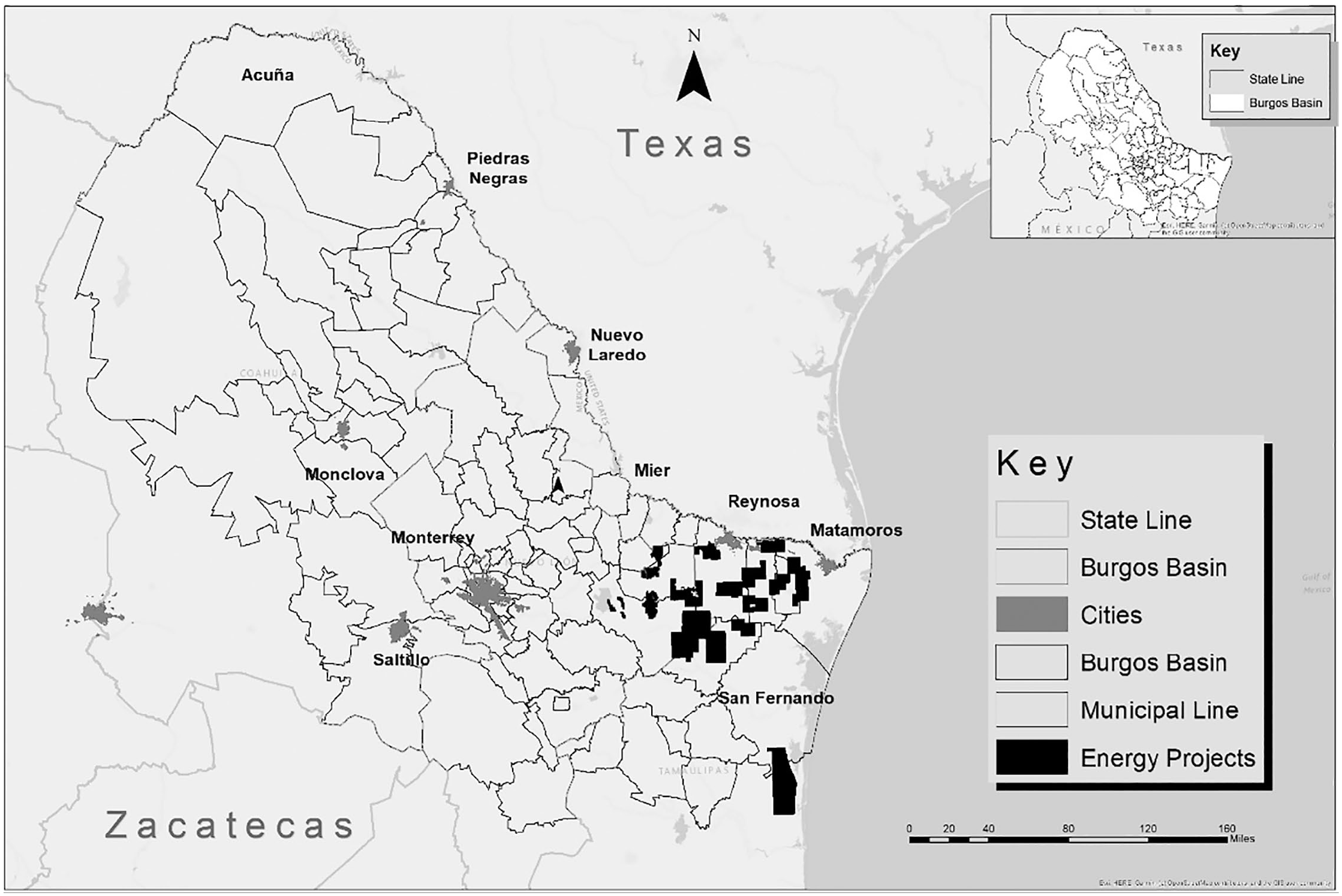
Energy projects in the Burgos Basin, northeastern Mexico (information from CNH, 2019).
The Northeast is one of the country’s most violent regions. Our spatial analysis has identified the territorial expressions of hybrid governance as follows: the locations of the criminal groups (drug cartels) over time, the locations by municipality of violent events (homicides and kidnappings) related to organized crime over time, and the locations of fossil-fuel projects undertaken since 2013, when the government opened up its formerly monopolized energy sector to private firms. Deregulation of the economy in the context of neoliberal reforms created the basis for decentralizing power, with new actors tending to dispute any monopoly on rent-seeking or force (Fuentes Díaz, 2018: 129; Pérez, 2017: 356).
The homicide data were provided by the 2006–2012 database of the drug policy program developed by the Centro de Investigación y Docencia Económicas (CIDE) (Atuesta, Siordia, and Madrazo, 2018). This database was useful for identifying the locations of drug cartels by municipality and was the only public source of municipal-level information available. The data were updated with information from administrative vital statistics records from 2007 to 2018 made available by the Instituto Nacional de Estadística y Geografía. The kidnapping data came from the Secretariado Ejecutivo del Sistema Nacional de Seguridad Pública and were processed through municipal-level judicial reports registered by the Secretaría de Seguridad Pública. Municipal-level data on adjudicated fossil-fuel projects were gathered from reports of the Secretaría de Energía and the Comisión Nacional de Hidrocarburos.
Mapping Organized Crime and Energy Markets
When there are strategic investment projects, local market leaders adjust their governance schemes in an attempt to manage extralegal uncertainty and so benefit from the new investment (Williams, 2002: 180). In the Northeast since the 2013 energy reform, important new oil and gas exploration and extraction projects have had to contend with the region’s violent situation. Although hybrid governance includes corruption, it reaches far beyond it to produce networks of coexistence, survival, and impunity (Moncada, 2016: 55–86). For example, the three states of northeastern Mexico report high levels of corruption (though below the national average). Society does not see illegal acts as corrupt, though impunity (in administering justice and security) is perceived as problematic. From 2014 to 2016, the three states registered increases in impunity much higher than the national average (INEGI, 2017; Le Clercq and Rodríguez, 2018). Only 1.5 percent of legal investigations in Tamaulipas and Coahuila and only 3.1 percent in Nuevo León led to judgments (Le Clercq and Rodríguez, 2018). Under hybrid governance, agreements may represent a reclassification of “safe” spaces for each actor and of “free” spaces in which hybrid activities and “conflicted” areas are normalized and actors dispute strategic points of control.
Increasing numbers of criminal groups in the Northeast are fighting over the traditional market niches related to drug production and trafficking (Osorio, 2015; Valdés, 2013). In 2009 the main cartels were the Sinaloa cartel and to a lesser degree the Juárez cartel (Fuerte-Celis and Pérez, 2017). By 2014, after intense territorial disputes, two of the country’s most violent cartels, the Gulf cartel and Los Zetas, had taken over. These groups were located mainly in border areas and along state lines; the Sinaloa cartel, for example, controlled neighboring municipalities, creating a criminal cluster (Fuerte-Celis and Pérez, 2017). An increase in the profits from drugs and illegal markets led to confrontations between the old drug-trafficking families and the new cartels, which operated like “decentralized” businesses in which leaders delegated functions to smaller cells but held onto decision-making power. Confrontations originally had to do with territorial demarcation and especially with cross-border routes to the United States (Starr and Thomas, 2005). In the past few years they have dealt with expanding their businesses (Espinosa and Rubin, 2015; Osorio, 2015). By 2011 criminal groups such as the Gulf cartel, Los Zetas, the Juárez cartel, and La Familia Michoacana had extended their presence in the Northeast (Figure 2).
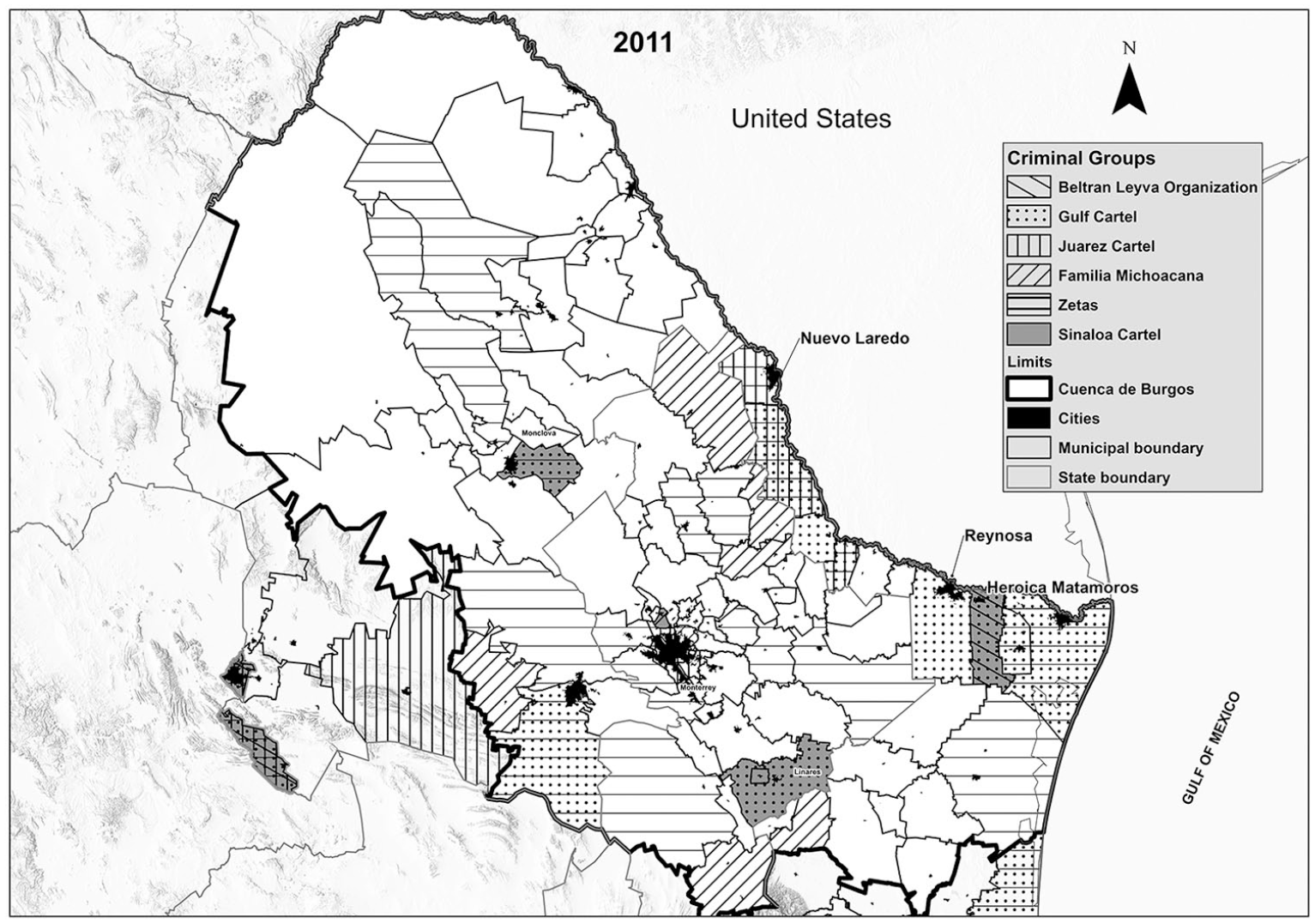
Distribution of organized criminal groups, 2011 (information from Atuesta et al., 2018).
The diversification of criminal activities includes the energy sector. Northeastern Mexico is one of the most important fossil-fuel producing zones in North America. In 2013 Coahuila, Nuevo León, and Tamaulipas together produced 24,500 barrels of oil per day, 146 million cubic feet per day of associated gas, and 1,173.8 million cubic feet per day of non-associated gas. The region produced approximately 14 percent of the nation’s gas reserves (SENER, 2015). By 2017 regional production of oil and gas had dropped to 11,600 barrels per day of oil, 32 million cubic feet per day of associated gas, and 726 million cubic feet per day of non-associated gas, but non-associated gas production still represented 70 percent of national production (CNH, 2018). Natural gas has been exploited in the region since the 1990s by multinational energy companies that have contracted with Petróleos Mexicanos (Pemex) (Correa-Cabrera, 2017: 162).
With the opening of the Mexican energy market by comprehensive energy reform in 2013, private firms started to participate in the extraction, transport, and marketing of fossil fuels. This energy reform had two main characteristics that could impact legal-illegal markets in northeastern Mexico. First, it decentralized concessions to individuals and localities, giving landowners the right to sell their territory at market prices. Since the state considers the energy sector a public and strategic utility, such “rights” are mandatory, and owners who are unwilling to sell or rent their land will be forced by the courts to do so under Article 96 of the Hydrocarbon Law. Furthermore, because energy is a public utility, states and municipalities must privilege these activities over other enterprises within a given territory. Thus the people living in these territories are completely unprotected from energy development. Second, the energy reform involved privatization through licenses and shared-risk contracts awarded in 2017 and 2018 (CNH, 2019). With the new federal administration in office since 2018, the last of the bidding rounds for these licenses has been postponed and may be canceled.
Violence, Markets, and Hybrid Governance
Official data suggest that there is an overlap of homicide and kidnapping with energy deployment projects in northeastern Mexico. Comparing the period before the energy projects with the following period, spatial analysis indicates that with the arrival of the energy projects violence tended to be displaced to the U.S. border.
Thanks to its significant profits in the past 10 years, fuel theft, once confined to local criminal gangs, became another activity dominated by drug-trafficking cartels. (Stolen fuel is reported to have brought in US$300 million for the cartels in 2016 alone [Montalvo, 2017].) Like other cartel businesses, fuel theft is transnational. In 2010, 2011, and 2012, Pemex filed lawsuits in Texas courts against U.S. companies for buying, using, and selling stolen gasoline. It is assumed that the fuel was stolen by Los Zetas and the Gulf cartel from facilities in Ciudad Madero (Tamaulipas) and Cadereyta (Nuevo León) and distributed in the U.S. cities of Río Grande, George West, Ingleside, San Antonio, Houston, and Port Arthur (Linares, 2016; Pérez, 2017: 363). In addition to gasoline, Los Zetas and the Gulf cartel are believed to have “exported” high-quality stolen condensed gas to Port Isabel, which is only 23 miles from Brownsville and 24 from Matamoros. The gas is stolen directly from the wells or facilities and then transported in Pemex pipes (Pérez, 2017: 359–363). Despite the inclusion of recorded conversations between cartel members and businessmen and the testimony of a Zetas leader, the three lawsuits were dismissed in 2016 for alleged lack of convincing evidence (Linares, 2016).
The new projects in infrastructure, oil, and gas are being developed in one of Mexico’s most violent areas. The region’s various criminal groups once worked primarily in the production, distribution, transport, and border crossing of illegal substances. When drug trafficking became a security issue for the Mexican government in 2006, these groups moved into other activities such as kidnapping, extortion, human and merchandise trafficking, and even ordinary theft (Campbell and Hansen, 2014; Shirk and Wallman, 2015). From 2009 on, fuel theft was a new market niche for organized crime, with a 400 percent increase in clandestine gas outlets in Nuevo León (Pemex, 2017; 2018a; 2018b).
The rate of homicides in the region slowly decreased in the period 2011–2014 (INEGI, 2011–2014; SESNSP, 2011–2017; 2015–2019). Municipalities located in the central sub-region such as Cadereyta Jiménez, Doctor González, and Los Ramones registered a rate of homicides per 100,000 people in 2011 of 347, 437, and 375, respectively. By 2014 rates had decreased to 92, 263, and 166. However, an increase in the number of municipalities with homicides was registered from 2011 to 2014 (Figure 3). Whereas in absolute numbers at a state level in 2007 there were 107 homicides in Coahuila, 279 in Nuevo León, and 193 in Tamaulipas, in 2011 there were 718, 2,149, and 1,097, respectively. The percentages of total national homicides for these years were 1.21 percent for Coahuila, 3.14 percent for Nuevo León, and 2.17 percent for Tamaulipas. In 2007 homicides in Nuevo León showed a 65 percent increase over 2006, while there was a 3 percent increase in Coahuila and a 46 percent decline in Tamaulipas. The corresponding figures for 2011 over 2010 were increases of 132 percent, 60 percent, and 14 percent.
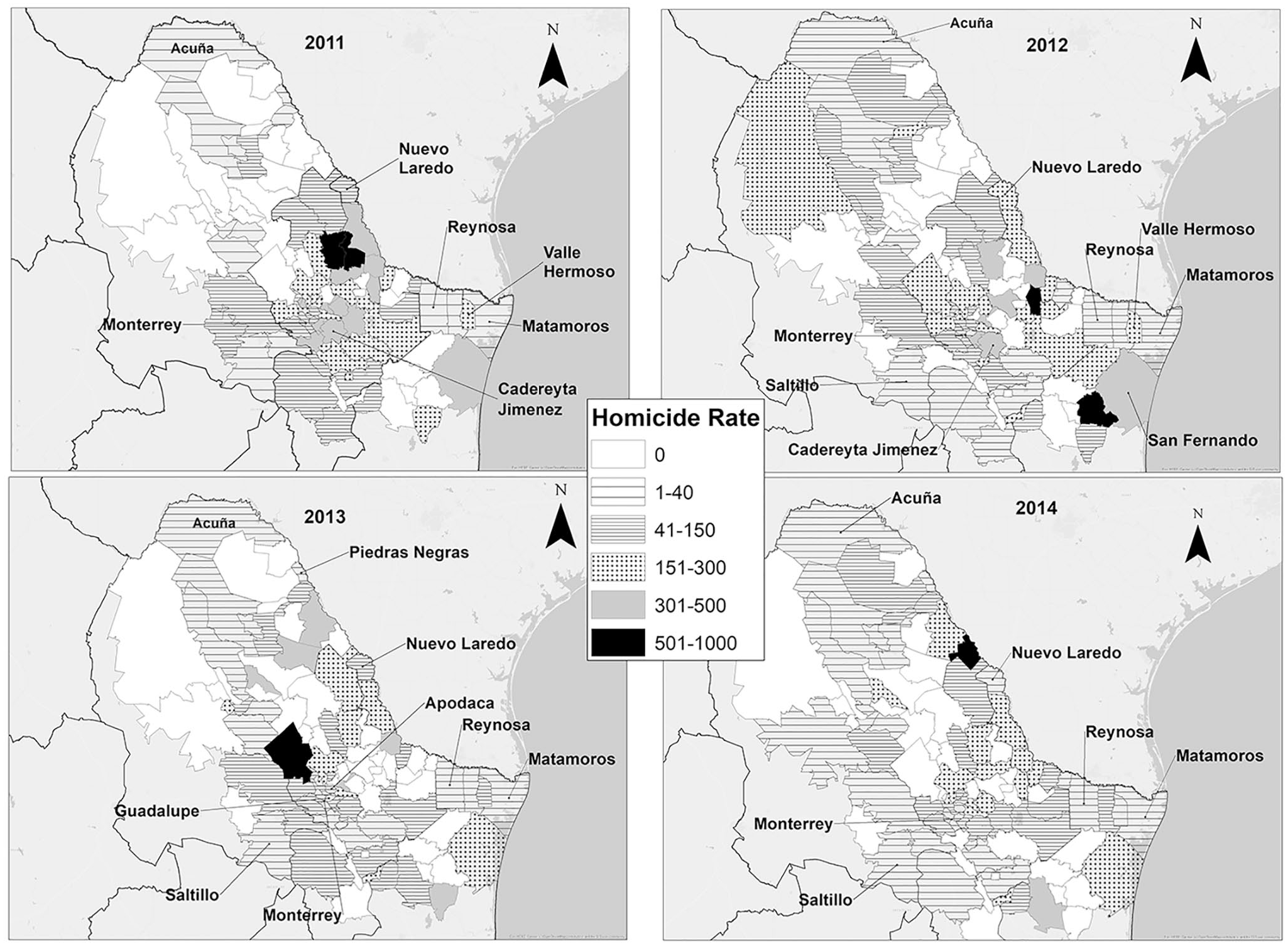
Homicide rates per 100,000 by municipality, 2011–2014 (information from INEGI, 2011–2014).
The number of kidnappings in the basin also increased (Figure 4). In 2011, the municipalities with the highest numbers of kidnappings were Monterrey, with 24, and Guadalupe and Reynosa. with 10 each. By 2014 municipalities such as Reynosa had increased to more than 40 kidnappings, and in Nuevo Laredo, Matamoros, Nicolás Garza García, and San Fernando kidnappings increased to double digits in 2014 (SESNSP, 2011–2017). Of a national total, the region accounted for 5.52 percent in 2011, 7.12 percent in 2012, 5.41 percent in 2013, and 10.11 percent in 2014. Kidnappings were concentrated in the metropolitan areas of Nuevo León and Tamaulipas and in areas with bidding activity in the basin.
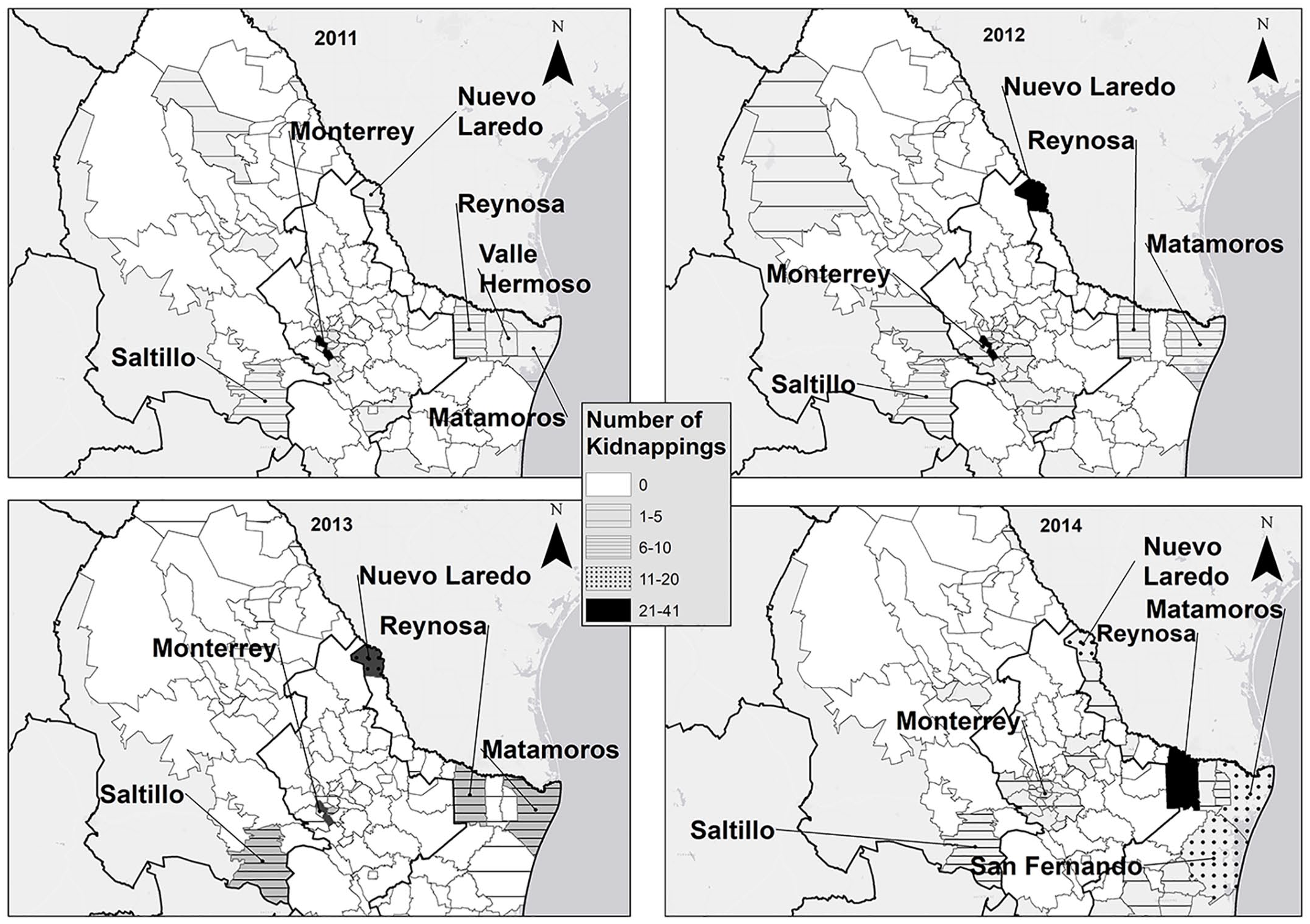
Number of kidnappings by municipality, 2011–2014 (information from SESNSP, 2011–2017).
Data on violence suggest that it may be concentrated in the region’s gas and oil reserves. Several experts argue that criminal groups (especially La Compañía) have gotten into the business of stealing oil and gas pipes and bunkering oil-and-gas pipelines in this area and that this move was facilitated by local governance arrangements (Payan, Staudt, and Kruszewski, 2014). It is reported that up to 2014 La Compañía and other criminal groups had bunkered 40 percent of the condensed natural gas in the region to sell on the black market in the United States. Between 2001 and 2011, Pemex brought 2,611 charges in U.S. courts against criminal groups for stealing and using clandestine gas outlets, but only 15 led to an actual judgment (Linares, 2016; Pérez, 2011: 5). Tamaulipas was the nodal point for the region’s fuel market (Figure 5).
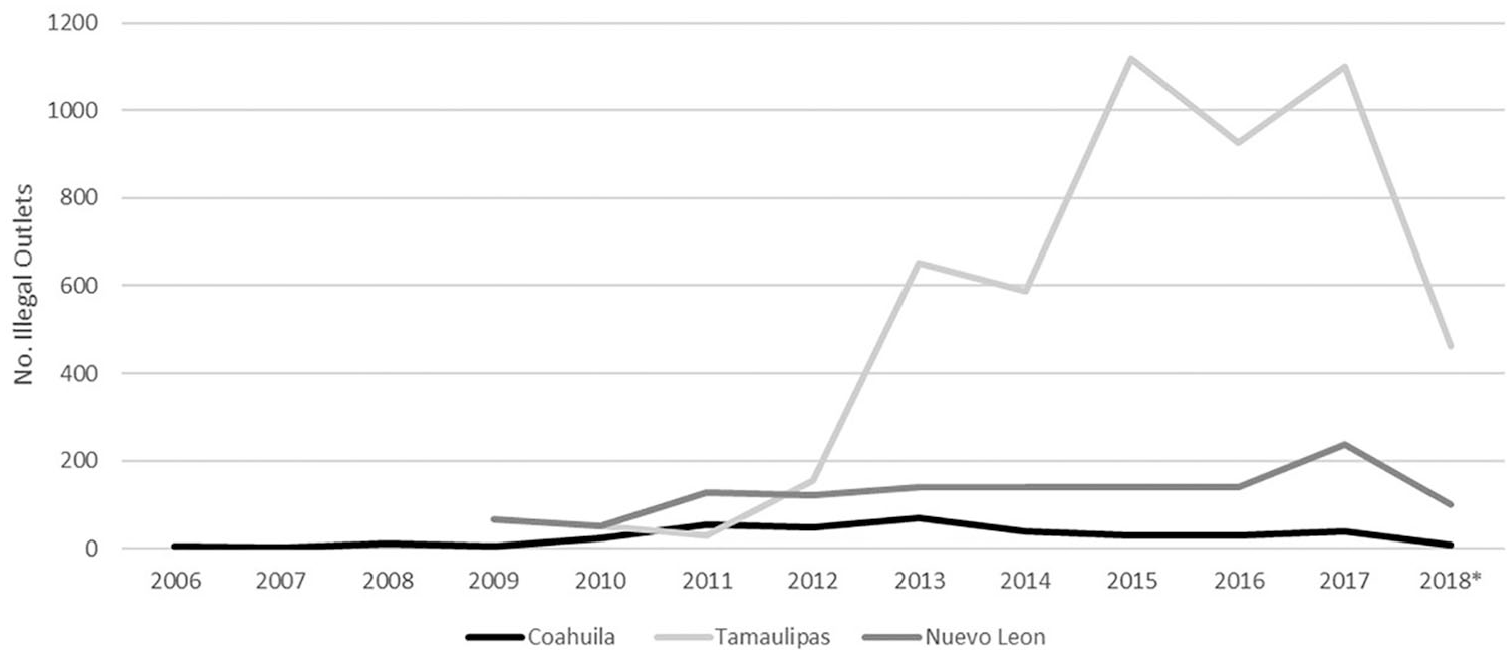
Number of illegal fuel outlets, 2006–(April) 2018 (information from PEMEX, 2017; 2018a; 2018b).
The presence of Pemex and other intensely fuel-oriented energy companies in the region seems to have had a positive effect on local economic development. In the first stage of the relationship between organized crime, society, and energy companies there were confrontations with government, but the business later evolved into a more proactive or forced cooperation, with new market niches such as the theft of fuel beginning to open. One of the main precedents for the sale of energy goods to local and U.S. buyers was the activity of Los Zetas in Coahuila. From 2005 to 2011 this group was associated with large mining enterprises and with the state government’s stealing coal and selling it through middlemen to the Federal Electricity Commission (Correa-Cabrera, 2017; Paley, 2014). As Correa-Cabrera (2017: 169–170) reports, mining companies owned by the governor of Coahuila and by some large oil-consuming businesses and Los Zetas grew tremendously in that period. From 2016 to 2019, the governor in question was under investigation in the United States and Spain on charges of aiding and abetting Los Zetas. Despite the testimony of a top Zeta leader linking the governor with bribes, the charges were dismissed (Court Listener, 2019; Forbes México, 2016).
In 2006 the theft of fuel from tankers and pipelines increased, subsequent sale to gas stations was observed, and distribution to other buyers began. The creation of this openly illegal energy market ran parallel to other criminal activities. There was an increase in extortion of public officials, business owners, and other members of society and in competition with legitimate companies for the sale of fuel (Pérez, 2017). In both Mexico and the United States this marked an evolution to hybrid governance schemes in which organized crime took part in businesses and governments, with members of the cartels acting as “employees” (Payan and Correa-Cabrera, 2014) and organized crime using hybrid instruments such as phantom companies, legitimate businesses, falsified contracts, and money laundering (Pérez, 2011: 12): During Felipe Calderón’s administration, the Burgos Basin turned into a supply center of condensate gas that was sold illegally to different U.S. and European corporations. In the absence of a reliable authority, the [Burgos] basin became a battlefield between criminal organizations, whose members put up roadblocks, expropriated lands, took over the right-of-way, and, as if that weren’t enough, controlled access to Pemex’s facilities.
In 2010–2011 the violence in the region led several companies to leave it (Payan and Correa-Cabrera, 2014: 4), but the large transnational companies “remained untouched and achieved great success during the most violent times in Mexico” (Correa-Cabrera, 2017: 165). The reason seems to be that criminal groups offered these companies protection to facilitate transportation (Correa-Cabrera, 2017). Contracts created in Mexico since 2000 have placed part of the region’s infrastructure energy maintenance and transportation services in private hands. Companies awarded projects during those years did not officially invest in regional security as their contracts required and therefore were easy prey for the cartels (Pérez, 2011). The hybridization of governance and its incentive for the development of a legal-illegal market were present in the logistics of gas transport between Mexico and the United States. According to Pérez (2011: 22), “shipments [of stolen fuel] are taken by formal customs agents—from Reynosa, Nuevo Laredo, and Tampico—to Texas and stored in private terminals in Port Isabel and Port Arthur.” Thus cross-border transportation corridors were key to legal-illegal market activities.
When hybrid governance has failed to operate in this region, the consequences have sometimes been tragic. In March 2011 the Drug Enforcement Administration, responding to information from a protected witness, captured two Zetas leaders, and in retaliation Los Zetas massacred most of the town. According to an analysis by Thompson (2017), the local authorities, the security apparatus (local and federal police, military groups), small, medium-sized, and large business owners, and important sectors of society were all somehow involved in illegal activities. People’s motives for participating in organized crime varied. Some people engaged in it to make money, escape poverty, or find employment (Pérez, 2017: 362), but others did so because they had no choice. As happened with the residents of Allende, citizens risked violent retaliation by the cartels if the cartels ceased to trust them (Thompson, 2017). Criminal groups also used “soft” control strategies such as business mergers, family ties, or marriage alliances to incorporate the population actively or passively into illegal activities.
Although during the next period from 2015 to 2017 homicide rates kept declining, to 2017, three municipalities registered a rate of more than 301 homicides (Figure 6).
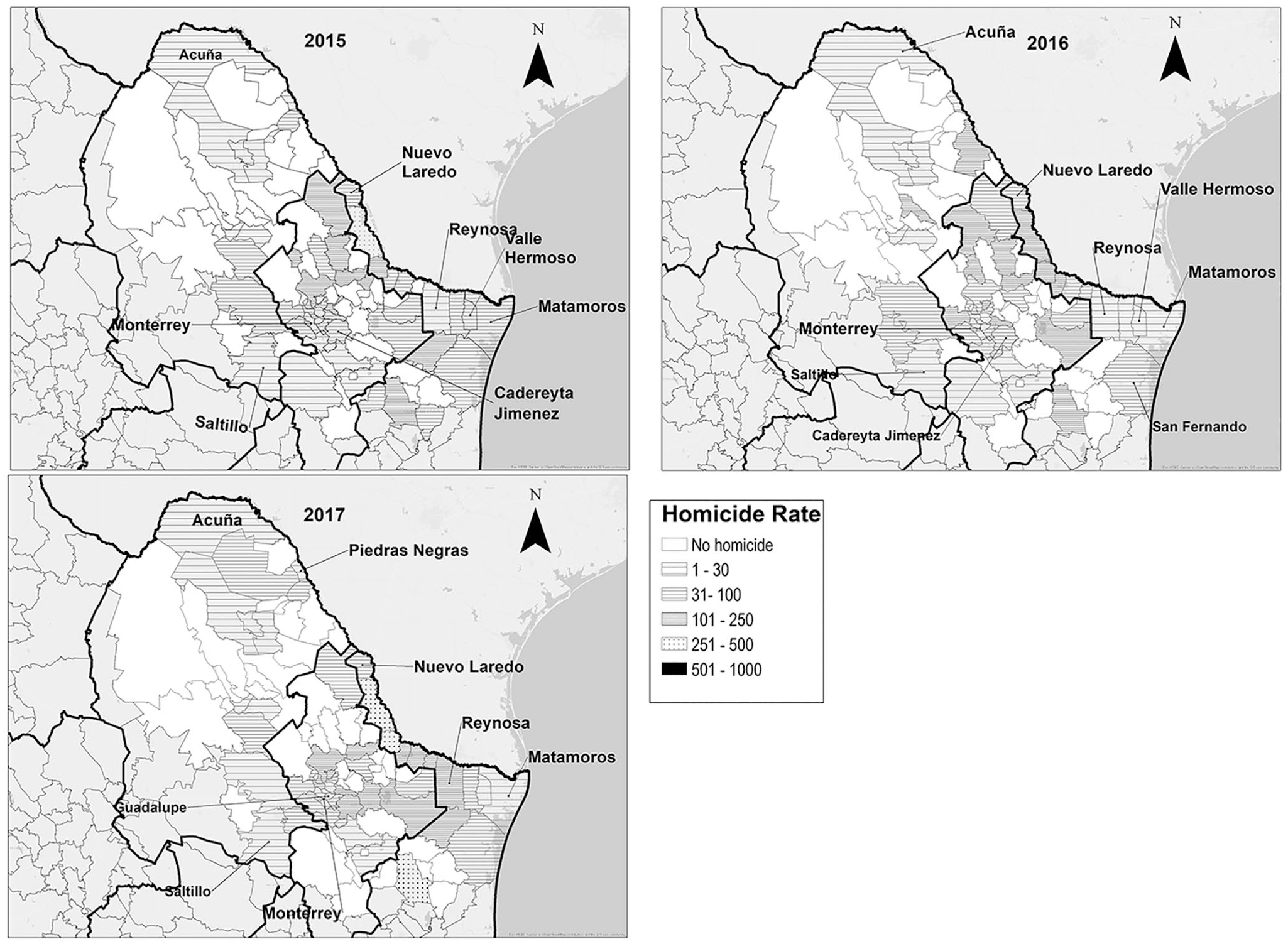
Homicide rates per 100,000 by municipality, 2015–2017 (information from INEGI, 2015–2018).
The data suggest that violence was displaced toward the border. The relocation of violence may reflect the need to expand regional cross-border markets (e.g., fuel bunkering) and consolidate market processes such as transportation of stolen fuel (Linares, 2016; Pérez, 2017). While in the prereform period the goal was to establish governance control mechanisms and create illegal-legal markets, later the aim seems to have been developing transnational relations. The displacement of homicides may confirm the consolidation of hybrid governance in previously disputed spaces, in which legal-illegal markets find ways to operate normally and homicide ceases to be the main enforcement mechanism for controlling the territory.
In 2015–2016, homicides were displaced from the metropolitan areas of the three states (especially Monterrey) to such border municipalities as Guerrero, Mier, Miguel Alemán, Río Bravo, and Valle Hermoso. The year 2017 was the most intense in the border area, with rates of over 500 homicides per 100,000, especially in Mier and Guerrero. Other municipalities, such as Gustavo Díaz Ordaz, Camargo, Reynosa, and Miguel Alemán, had rates of 200 homicides per 100,000. These municipalities are important for markets because they represent traditional routes for trafficking drugs and other merchandise such as fuel and gas to the United States (Dell, 2015; Enciso, 2015).
The decline of homicides may suggest that, in the context of the consolidation of hybrid governance, violence was traveling alongside the expansion of legal-illegal markets to other territories. To establish hybrid governance in new territories, authority must be disputed between the local criminal groups and newcomers, usually through violence. There were specific interests involved in reaching hybrid governance arrangements as soon as possible so as to allow for capitalist investment in energy and other markets. The decrease in homicides in production areas may even have been promoted by criminal organizations to signal economic stability to new investors (Cohen and Eimicke, 2012; Hall and Biersteker, 2002). In contrast, there was an increase in kidnappings that may be thought of as compensating for the drop in homicides, suggesting that homicide may have been too costly over time (Figure 7).
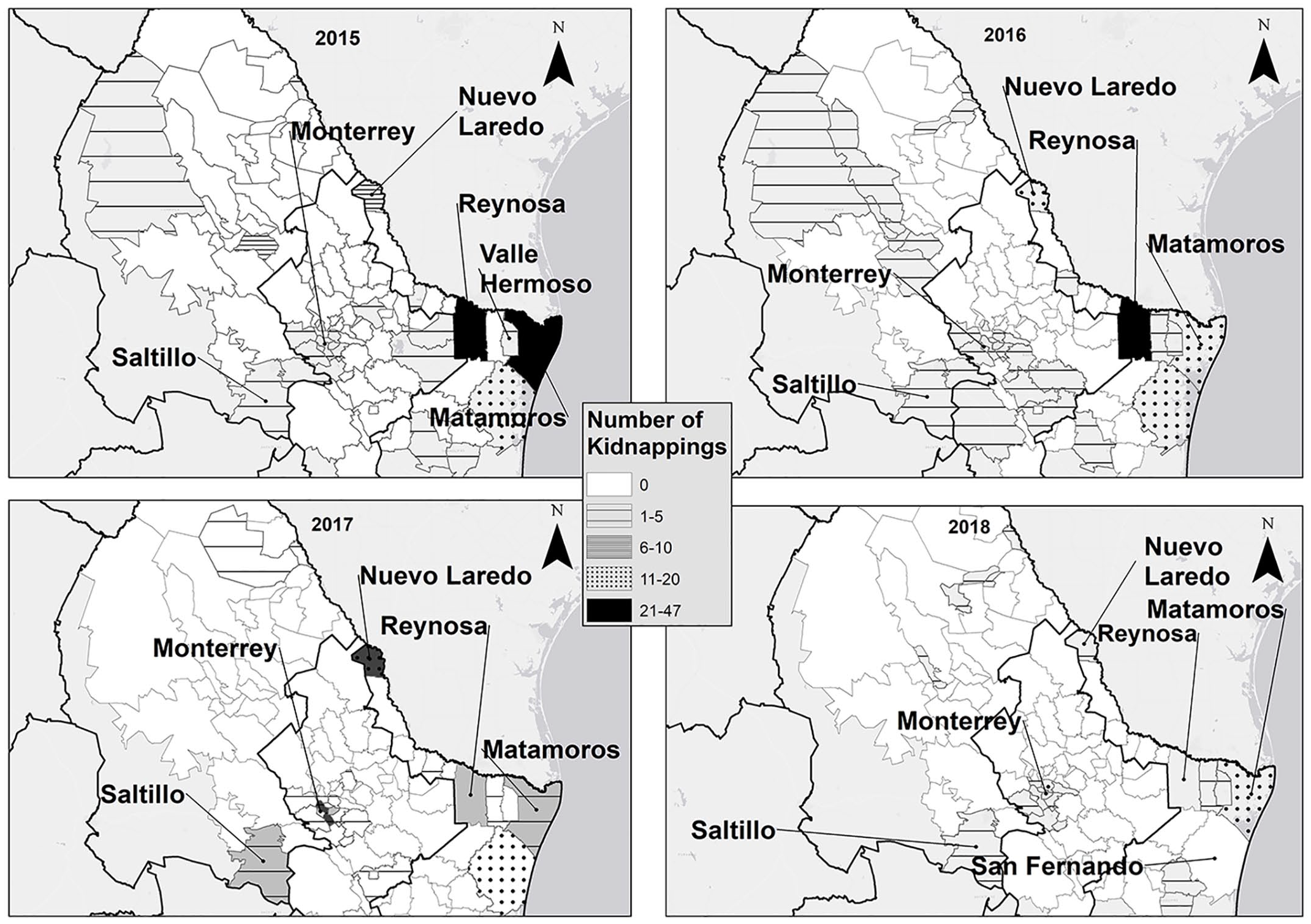
Number of kidnappings by municipality, 2015–2018 (information from SESNSP, 2015–2019).
Kidnappings may have become the control mechanism to keep hybrid governance functioning in territories with consolidated illegal-legal markets. Similar to homicides, kidnappings reinforce loyalty (Cross and Peña, 2006; Lessing, 2015). As Pérez (2017: 349-351) notes, Heriberto Lazcano (a Zetas member) was the leader of the fuel-bunkering industry in the region. He set the rules, fuel prices, salaries, and distribution mechanisms to all legal and illegal stakeholders involved. They had to pay quotas, and if they failed to do so kidnappings were common. Kidnappings are also part of a profitable business that supports legal-illegal market embeddedness (Lessing, 2015).
Discussion and Conclusions
Governance has traditionally been characterized as a structure with interdependence and negotiated coordination between systems and organizations resulting from cooperation between government and nongovernmental actors in making public policy. Based on collaboration, consensus, and the participation of different actors, arrangements are expected to improve results and ensure efficient governance relations. Governance is considered to focus on a normative determinism that identifies it with consensual, egalitarian, and democratic processes based more upon trust and deliberation than on power or market approaches to reproduce capital accumulation (Boege et al., 2008; Sørensen and Torfing, 2009). Since the 1990s, this normative definition has been promoted by international organizations that consider governance the aspiration of many governments.
In some regions, however, the reality is inconsistent with this interpretation. In northeastern Mexico, the concept of “hybrid governance” is useful for understanding a reality in which various actors, social systems, and organizations engage in legal and illegal negotiation, coordination, and interdependence. Hybrid governance allows legal and illegal markets to function in a given region with organized crime by creating extralegal structures. It has three main components: relocalization, diversification, and privatization of authority. On the one hand, the presence of organized crime may usurp authority (and sometimes legitimacy) and privatize the provision of such public goods as security and reduced violence while increasing formal and informal income. When there is asymmetry in the ability to maintain order, local governments may become mediators of governance processes.
The Mexican Northeast exemplifies this process. The emergence and consolidation of an extralegal system there may have been attractive to investment in a thriving energy market. Energy reform encouraged privatization of various production processes and services (Pérez, 2017). The cases of the municipality of Allende and fuel theft bring these processes into light. Data regarding the localization and displacement of violence suggest that the way to enforce hybridization is largely through homicide and kidnapping (Fincknauer, 2005; Fuerte-Celis et al., 2018; Lessing, 2015). Both before and after the awarding of concessions for energy projects in the Northeast, homicide and kidnapping (and other violent mechanisms) seem to have been used to allocate authority and create solid links with new investment. Data on oil bunkering by Los Zetas and the Gulf cartel in the region before the energy reform suggest that legal-illegal business networks began to consolidate in the first period. The decline in homicides after the reform might lead one to think that, once hybridization was consolidated, arrangements and pacts needed only milder enforcement such as kidnapping. This implies that within a hybrid governance framework, illegal relations may be based on private, usually local and implicit information and nonverifiable agreements. Property rights are likewise ambiguous and contested (Boesen, 2006; Li, Park, and Li, 2003). The cost of establishing an extralegal regulatory system is low, but maintaining it is expensive. The expansion of energy-embedded business to other municipalities closer to the border may be another characteristic of the postreform period. It may be that, as energy products develop, the hybridization of legal and illegal markets, enforced by homicide, is still in progress.
This research is a first step toward acknowledging the grey areas between legal and illegal markets. The concept of hybrid governance can allow us to open new lines of research. The next steps include analyzing how hybrid governance is involved with political parties in electoral processes and what roles private business and civil-society organizations play in reproducing extralegal embeddedness. It will also be necessary to develop theoretical and methodological models of societies and regions similar to those in northeastern Mexico. Further attention to territorial competition among criminal organizations in this framework could lead to exploring, for example, how fuel bunkering and violence move around the country and transnationally. Lastly, the concept of hybrid governance may shed light on similar processes around the world, linking energy with violence but also relating violence to global capitalist production.
Footnotes
Acknowledgements
We thank Daniel Zizumbo Colunga, Aldo Ponce Ugolini, and Manuel Corte Tapia for their insightful comments to this article.
Marcela López-Vallejo is a full professor in the department of Pacific-Rim Studies and in the Center for North American Studies at the Universidad de Guadalajara; she is Fellow at the North American Research Initiative. María del Pilar Fuerte-Celis is an assistant professor at the Geospatial Information Sciences’ Research Center (Centro Geo) and Catedrática CONACYT.