



Abstract
Although governance systems play a crucial role in securing an accountable public sector, they can grow overly resource demanding, cause problematic distortion of welfare tasks and crowd out motivation among employees. This study contributes to existing literature by conceptualizing co-creation as a pathway for solving dysfunctionalities in governance systems and explores the prospects of such an approach. Based on a case study of the development of a municipal supervision system, the study outlines the characteristics of co-creating governance systems. The results points to co-creation as a promising, although resource demanding, pathway for finding robust solutions to dysfunctionalities in governance systems.
Introduction
Governance systems play a significant role in coordinating, managing, and controlling public welfare tasks and therefor in many ways constitute the backbone of an accountable public sector (du Gay, 2000; Schnedler & Vadovic, 2011). While governance systems are used as a broader term in descriptions of institutions and their design (Duit & Galaz, 2008; Teisman et al., 2009), this study revolves around governance systems in a more narrow form: governance systems are defined as tools within public administration used to align employee capabilities, resources, activities, or performance with organizational goals, through the regulation of autonomy, counting, that is, systems for resource management, documentation, performance monitoring, and supervision (Edelenbos & Eshuis, 2012; Sitkin et al., 2010; Verhoest et al., 2004).
While productive and well-functioning governance systems play a crucial role in securing fundamental values like transparency, accountability, and equality, dysfunctions of such governance systems are also commonplace in public administration (Bozeman & Feeney, 2015; de Jongh, 2016; Hood & Dixon, 2015). Well-known dysfunctions include tendencies for governance systems to mushroom into resource-demanding, overly bureaucratic systems, as well as problematic side effects like tunnel vision, parking, and creaming (de Bruijn, 2002; Lipsky, 2010; Merton, 1940). Not only, are such dysfunctions feared for hampering efficiency and eroding quality in welfare tasks, but are also known for crowding out motivation among public employees.
Co-creation is increasingly explored as a strategy for solving wicked problems, characterized by high complexity, fragmentation, and a plurality of actors with different interests at stake (Rittel & Webber, 1973; van Bueren et al., 2003; Weber & Khademian, 2008). Originally developed in the private sector, the key question in co-creation was how to engage customers in private service markets in the creation of the service they are purchasing (Vargo & Lusch, 2004). Co-creation has later been adopted into the public sector as an approach to develop service solutions and policies with citizens and users (Brandsen et al., 2018; Nabatchi, 2012; Torfing, Sørensen, & Bentzen, 2019). However, the prospect of using co-creation to develop solutions to problems related to governance systems in the public sector has received scare attention in the literature (Farshchian & Thomassen, 2019; Simonofski et al., 2019). The ambition of this study is to contribute to fill this research gap by developing a framework for studying the prospects of using co-creation as a strategy for finding solutions to dysfunctional governance system in the public sector. Hence, the research question guiding this study is: How can co-creation be operationalized to address problems of dysfunctional governance systems within the public sector and what are the outcomes of such an approach?
First, drawing on the co-creation literature (Brandsen et al., 2018; Torfing et al., 2019a; Voorberg et al., 2015), a theoretical framework is developed which frames dysfunctionalities of governance systems as complex, “wicked problems,” requiring the mobilization of resources among all involved actors in order to co-create diagnoses, solutions, and robust implementation (Nabatchi et al., 2017; Voorberg et al., 2015).
Secondly, the case selection and methods are presented. The theoretical framework is applied to a case study of a co-creation process aimed at developing a new and more productive pedagogical supervision system in Roskilde Municipality, Denmark. The former supervision system was dysfunctional, in the sense that it is was perceived as invalid to actually estimate quality at Day Care institutions. Frontline workers felt detached from the supervision system, expressed lack of motivation to work with it, and criticized it for being inefficient. The newly developed supervision system differs from the old one in a number of ways: In the old system supervision was “one size fits all,” whereas the new one involves a more differentiated supervision tailored to fit local needs. The new supervision also involves a strengthened local involvement in collecting the information, which is used as a basis for the supervision as well as in the local follow-up dialogs among both employees and in parent boards. A central difference is also that, the new supervision is unannounced, rather than planned in advance. Therefore, institutions can no longer prepare for supervision but must be ready to receive supervision at any given time.
The study draws on policy documents, interviews, observations, and a survey evaluating the new supervision system.
Thirdly, the seemingly successful case study is analyzed to see how the theoretically principles of co-created control applies and play out in practice. Following that, it is analyzed if and how co-creating the pedagogical supervision system has helped solve the former mentioned dysfunctionalities in the old supervision system. Hence, guided by the dysfunctionalities defined in the empirical phase, it is analyzed if and to what an extent the newly, co-created supervision system is perceived to support professional quality, efficiency, and employee motivation.
Finally, future prospects, challenges, and research agendas connected with co-creating governance systems are discussed before the study’s conclusions are presented.
The Limits of a Traditional Single Actor Perspective on Dysfunctional Governance Systems
In this section, the argument that dysfunctions of governance systems may qualify as a wicked problem, relevant for co-creation, will first be developed. After that the theoretical framework is developed in which key principles of co-creation are contrasted with classical approaches to developing governance systems.
Dysfunctional Governance Systems as a Wicked Problem?
Although the causes, dynamics, and effects of dysfunctional governance systems have been addressed across several fields of research (Burden et al., 2012; Kaufmann & Feeney, 2012; Lipsky, 2010; Weibel et al., 2010), the question of how to practically solve such problems has only been addressed by very few scholars (DeHart-Davis, 2017; de Jongh, 2016; Sunstein, 2019).
From a Weberian or neoliberal point of view securing accountable governance systems lies within the exclusive domain of formal principals (Sitkin et al., 2010). However, the need for inter-organizational and interpersonal cooperation means that more informal aspects of governance such as participatory processes become increasingly more important as mechanisms to secure horizontal accountability (Romzek et al., 2012; Tuurnas et al., 2016).
While governance systems may arguably be seen as a problem predominantly residing within the hierarchy of public organizations, impacting primarily employees, and leaders, governance system may also potentially affect citizens, users, and private companies immensely (de Jongh, 2016; Herd & Moynihan, 2018; Sunstein, 2019). de Jongh (2016) compares the problem of dysfunctional governance systems with the tale of “the nine blind men and the elephant,” stressing that dysfunctions are always experienced from a particular perspective. Hence, diagnoses of whether governance systems are dysfunctional or productive may differ radically depending on the perspective from which they are perceived (DeHart-Davis, 2017; de Jongh, 2016). Even when dysfunctions primarily involves actors within the public sector, governance systems are affected by a multitude of actors with different professional values, levels of power, and perspectives on problems and solutions. In addition, governance systems are typically anchored across chains of command, professional fields, and sometimes sectors, adding to the complexity of diagnosing dysfunctions. Hence, de Jongh (2016) argue that the level of complexity and many interdependencies among various actors, point to the potential of engaging a multi-actor perspective when addressing dysfunctions of governance systems.
However, a multi-actor approach cannot be productive unless it is coordinated, integrated, and aligned, which is where the prospects of using co-creation as a strategy to re-design dysfunctional governance systems becomes interesting.
Toward Co-Created Governance Systems?
Co-creation shares common ground with other “co-” concepts such as co-production, coordination, cooperation, and collaboration, but is also distinct in several ways. Cooperation, coordination, and collaboration can be seen as located at different points on a continuum of integrative mechanisms, depending on the timely period of interaction, levels of knowledge sharing, and trust as well as intensity of interaction, power sharing, and mutual interdependence (Keast & Mandell, 2014; Keast et al., 2007). Cooperation is characterized by short-term relations, relatively few invested resourced and low levels of relational intensity and mutual risk taking, while Coordination advances risk taking and investment of resources further as planning, decision-making and policies are increasingly shared (Ciger, 2001; Keast & Mandell, 2014). Collaboration takes the density of relations a step further by investing in long-term relationships with high levels of reciprocal interdependency and high risks at stake (Ciger, 2001; Gray, 1989). Co-creation is an even more decentered version of collaboration (Ansell & Torfing, 2020) in which public authorities are merely one among many actors involved in distributed forms of interaction, aimed at joint problem solving. Co-creation is also characterized by early co-initiation and co-design, while the related concept of co-production mainly focuses on involvement later in the implementation of service solution (Brandsen & Honingh, 2016, 2018).
While co-creation has become a popular strategy for developing both public policy and services, the prospects of co-creating governance systems, has not yet been explored in the literature. Hence, in the following, general principles of co-creation are translated into a theoretical framework with a specific focus on problems related to governance systems as the subject of co-creation.
Inspired by collaborative governance, collaborative innovation, and participatory governance, co-creation emphasizes the potential of bringing together relevant and affected public and private actors in shared endeavors to solve wicked societal problems (Ansell & Torfing, 2020, 2021; Torfing, Sørensen, & Røiseland, 2019). Rather than letting single actors with formal power take decisions, the co-creation of governance systems is characterized by multi-actor processes (Bryson et al., 2017; Huxham & Vangen, 2000). The co-creation literature has paid particular attention to the involvement of citizens and users, who are even considered obligatory actors in co-creation among some scholars (Brandsen et al., 2018; Brandsen & Honingh, 2016; Voorberg et al., 2015). Other scholars merely underline the key principle that everybody who is relevant and can contribute to solve the problem at hand should be encouraged to participate (Bryson et al., 2017; Stickdorn & Schneider, 2012 ). Such potential, relevant actors could include politicians, public managers, professionals, and voluntary groups of citizens, civil society organizations, social enterprises, and private corporations (Nabatchi et al., 2017; Torfing, Sørensen, & Røiseland, 2019). Following this line of argumentation, co-creation is not characterized by the participation of any one specific group of actors. Rather, all actors, relevant to solving a problem, should be involved in defining the problem, develop solutions, and implement them robustly. The understanding of co-creation in this study is in line with this latter perspective, as it seems especially useful regarding problems with governance systems, which will sometimes—and sometimes not be relevant to citizens. Front-line personnel constitute a key group of actors when co-creating governance systems, given their central role in the practical use of such systems and the vast costs associated with motivation crowding in this particular group (Frey & Jegen, 2001; Le Grand, 2003). However, politicians, administrators, citizens, and users may also be immensely affected by the burdens or distorted side-effects of governance systems (Moynihan et al., 2015; Sunstein, 2019). Hence, as a rule, co-creation of governance systems, promotes participation of all relevant and affected actors, rather than only formal power-holders.
When involvement happens later in the process, previous decisions about, for example, the type of solution will often be closed for debate, delimiting involvement to questions of how to implement the solution. Hence, the co-creation of governance systems ideally entails not only early but also continuous involvement of key actors throughout the phases of diagnosis, solution development, implementation, and evaluation (Bentzen, 2020a). Early involvement of all actors is considered necessary to build common knowledge and ownership about the perceived dysfunctions of governance systems, as well as to get an overview of various needs and concerns which must be integrated into new solutions (Brandsen et al., 2018; Nabatchi, 2012; Torfing et al., 2019). Not only does early involvement of all perspectives allow innovative solutions, but it also increases the likelihood that these will be robustly implemented in practice (Voorberg et al., 2015).
Co-creation’s inherent focus on power sharing distances it from the ideals of full delegation of governance systems as the optimal level of involvement (Arnstein, 1969). Rather, an ambition of engaged collaboration can be contrasted with one-way communication with a short-term focus and the ambition of streamlining the implementation of already decided solutions (Hood & Dixon, 2015; Pollitt & Bouckaert, 2011). Engaged collaboration implies long-term processes in which sufficient time is invested in respectful exploration and inclusion of multi-actor perspectives on issues of governance systems (Nabatchi, 2012; Smith, 2009; Torfing et al., 2019). Rather than relying on lower levels of participation such as swift one-way communication or formal hearings (Arnstein, 1969; Nabatchi et al., 2017), co-creation depends on putting in the time to meet face-to-face and engage in a two-way dialog.
Traditionally, development of governance systems is designed at high power distances without direct contact with actors affected by such systems (Eisenhardt, 1989; Schillemans, 2013). Engaged collaboration, however, requires low power-distance in order to fully mobilize all involved resources in finding solutions to dysfunctional governance systems and to pave the way for intrinsically motivated compliance with them (Schillemans & Bjurstrøm, 2020; van Thiel & Yesilkagit, 2011). This requires a decentering of power as well as the nurturing of trust relations between the engaged actors (Klijn et al., 2010; Torfing et al., 2019). Hence, co-creating governance systems requires face-to-face dialog among involved actors, in which power differences are toned down.
Governance systems are traditionally designed and implemented top-down through the chain of command, and evaluated according to exogenous criteria defined by central power holders (May & Winter, 2009; Sabatier, 1998). Hence, experimentation is not encouraged, as this may lead to drift away from centrally defined goals. Co-creating governance systems, on the other hand, entails an ambition to build common diagnoses and solutions among all participants, which does not fit well with traditional, linear approaches. To allow common diagnoses and innovative governance systems solutions to develop among multitudes of actors, co-creation relies on iterative processes which encourage ongoing feedback loops about the governance systems being developed (Edvardsson et al., 2014; Langley et al., 2018). In order to reap the benefits of a multi-actor approach, ongoing testing, experimentation, and adjustment are key if co-creation is actually to result in the innovation of more productive governance systems (Bason, 2018).
In Table 1, below, the characteristics of co-created governance systems are contrasted with the characteristics of traditional approaches to designing governance systems. The traditional approach comprises a number of aspects of developing governance systems, which, despite many other differences, are common both to classical bureaucracy and NPM.
Contrasted Characteristics of Traditional Versus Co-Created Governance Systems.
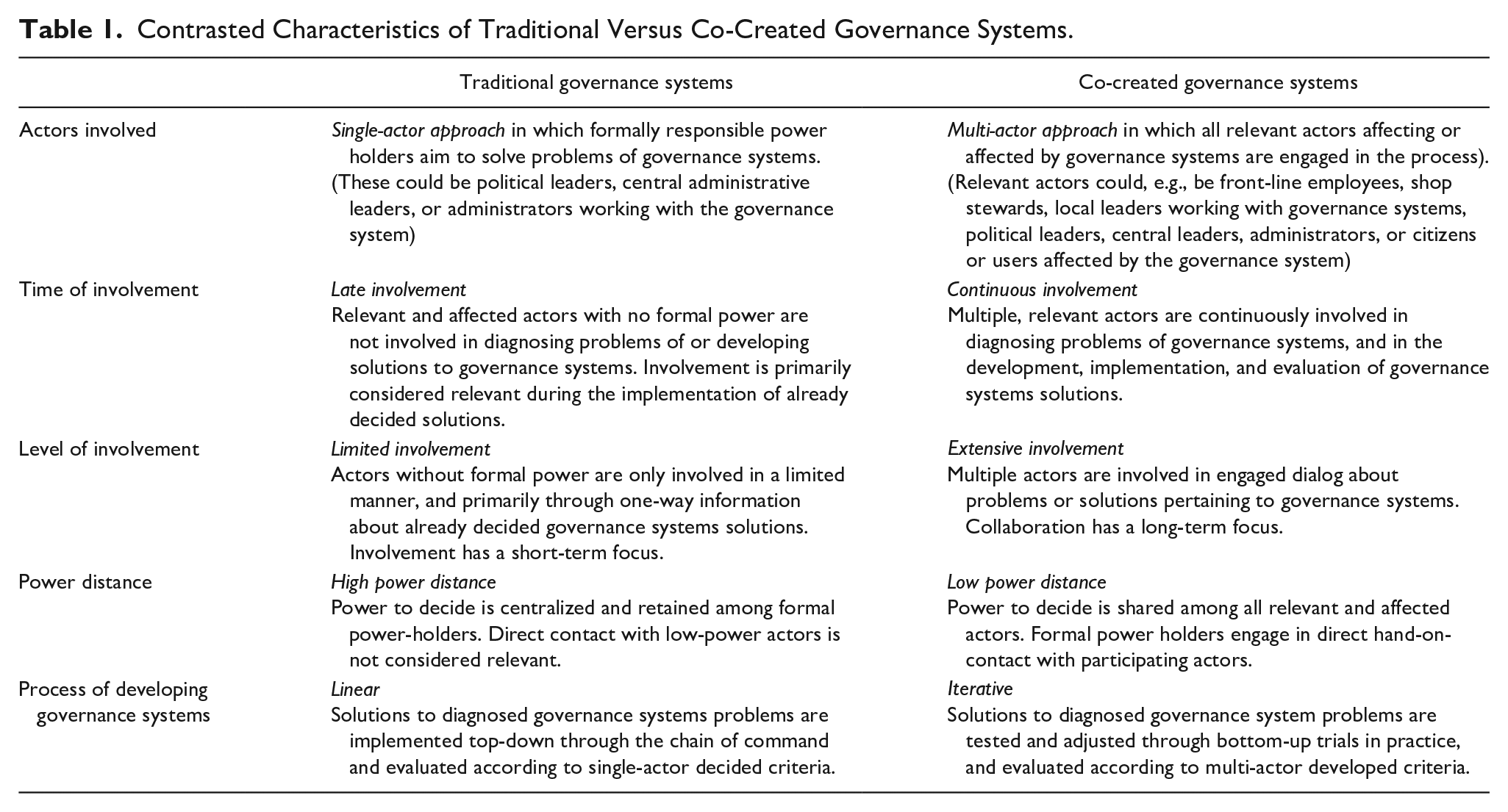
The variables outlined in Table 1, above, highlight two different approaches to the development of governance systems, which call for very different organizational patterns of involvement and facilitation. The variables outlined in the theoretical framework will guide the analysis of the development of a supervision system in Roskilde Municipality.
Outcomes of Co-Creating Governance Systems?
As already mentioned, the outcome focus of this study is guided by the perceived dysfunctionalities of the former supervision system in Roskilde Municipality. The investment of resources in a co-creation approach has been made with the ambition to create a supervision system perceived as supportive of task quality, efficient, and motivating for employees to work with. But what do we know about the prospects of reaching such ambitions through co-creation?
According to Agger et al. (2018), prospects of co-creation may be clustered into outcomes in terms of enhanced democracy, efficiency, innovation, and overall public value. Dysfunctional governance systems involve the unnecessary use of transactional costs which could have produced more value elsewhere, hence hampering efficiency. The many troublesome effects of dysfunctional governance systems, like tunnel vision, creaming, and parking (Lipsky, 2010), also risk eroding task quality and hence public value. In addition, crowding out employee motivation, constitute a well-known dysfunction of governance systems (Frey & Jegen, 2001; Le Grand, 2003). Hence, co-creation of governance systems would entail the hope of enhancing value creation by avoiding risks of hampered efficiency, erosion of task quality, and crowding out of employee motivation.
Some studies suggest that co-creation can foster solutions that strengthen the quality of services (Bentzen, 2020b; Voorberg et al., 2014), while others warn that because co-creation is a complex social phenomenon, there is no such clear cause–effect relationship (Steen et al., 2018; Voorberg et al., 2015). For example, co-creation can only enhance quality if participants are actually competent to solve the problem at hand and refrain from power abuse (Brandsen et al., 2018; Echeverri & Skålén, 2011). This point is no less important when co-creating governance systems, which is very much at the core of governance in public organizations, with all the risks involved if participants pursue their own interests at the expense of other actors. Co-creation is also believed to foster more efficiency, understood as the trade-off between resources invested and values created (Brix et al., 2020; Sørensen & Torfing, 2011), although empirical studies addressing this question do not provide univocal answers (Voorberg et al., 2014, 2015). One obvious challenge is that a collaborative approach involves extensive resource consumption stemming from the facilitation and coordination of participation in co-creative processes (Bovaird & Loeffler, 2012; Brandsen et al., 2018). Some scholars argue that the inherent focus on participation and empowerment of involved actors in co-creation is likely to spur employee motivation (Norris, 2011; Torfing et al., 2019; Warren, 2009). While studies supporting this argument are still scare in the co-creation literature, it does finds support in organizational studies suggesting that exercising influence over governance systems tends to create better conditions for employee internalization and compliance (Coletti et al., 2005; Frey & Jegen, 2001; van Thiel & Yesilkagit, 2011). Involvement of employees in questions of governance systems provide influence on solutions but also to understand other perspectives and needs in the governance system, which in turn is known to foster motivation (Cristina Costa & Bijlsma-Frankema, 2007). However, other scholars warn that co-creation may also undermine employee motivation if it becomes a pseudo process used primarily to legitimize decisions that have already been taken by formal power holders (Steen et al., 2018).
In the analysis, existing knowledge about possible of co-creation, will be used as a foundation for analyzing if—and if so—to what extent the co-creation of the new supervision system actually helps solve the earlier outlined dysfunctionalities.
Case Choice and Methods
The purpose of this study is to use the above-mentioned theoretical framework to analyze a seemingly successful case of a developed governance system, in order to determine whether the characteristics of co-creation applies, and to analyze the prospects of adopting the approach in question. The research reported here draws on a case study of a Danish municipality, which (apparently) successfully transformed a perceived dysfunctional governance system into a more productive one.
Case Introduction
The case revolves around the development of a new Pedagogical Supervision System (PSS) in daycare institutions in Roskilde Municipality, which took place in 2018 and 2019. As part of a larger de-bureaucratization reform in the municipality, the Day Care administration carried out a survey and a number of dialogs with employees and leaders at Day Care institutions with the ambition of pointing out governance systems perceived as dysfunctional. A re-occurring theme was the pedagogical supervision: Not only was it criticized for being inefficient and demotivating to work with but also perceived as unfit to provide valid insights into the quality of work in the local institutions in question. Hence, the chief of Daycare decided to launch a process to solve these dysfunctionalities through the development of a new supervision system. A key ambition was to involve all affected and relevant actors. A dedicated working group (WG), was given a mandate to develop and test a new PPS which was later pilot-tested among 18 institutions. The timeline of activities in the case as well as the data collection is illustrated in Figure 1.

Timeline of data collection and activities in empirical case.
The autonomy, ambition, and commitment necessary for solving problems of dysfunctional governance systems by engaging a multi-actor approach are all pronounced in Roskilde Municipality, making it an ideal case for exploring and generating knowledge under optimal conditions (Flyvbjerg, 2006). Danish municipalities are known for their extensive decentralization and autonomy (Houlberg & Ejersbo, 2020; Ladner et al., 2016). This is not least the case in the Daycare area, which, although obliged to submit to mandatory pedagogical supervision, enjoys considerable autonomy when it comes to designing the specific supervision systems and methods used. This extensive autonomy makes Roskilde Municipality an interesting best case for studying the co-creation of a governance system, which in other countries or sectors is regulated at the central level, leaving less space for local influence.
A number of methods are triangulated in the study, in order to gain insight into the co-creation of the supervision system and the many actors engaged in the process (see Table 2). Twelve semi-structured interviews, focusing on the outlined dimensions and prospects of co-creating governance systems, were conducted with leaders at all levels (CEO, Head of Daycare, and Area heads), local actors from institutions (leaders, employees and shop stewards), as well as daycare and supervision consultants engaged in working or dialog groups. Five observations were made of meetings in the WG, presentations, and educational activities at cross-organizational leader-meeting revolving around the development of the supervision system, providing tacit knowledge, and insight into real-life interaction among the involved actors. Hence, interviews and observations focus mainly on activities and actors directly involved in the co-creation process. Ten policy documents, including project descriptions, communication materials, invitations to meetings, and status rapports were used to understand decision-making processes prior to and during the co-creation of the new supervision concept.
Overview of Methods and Data in the Study.
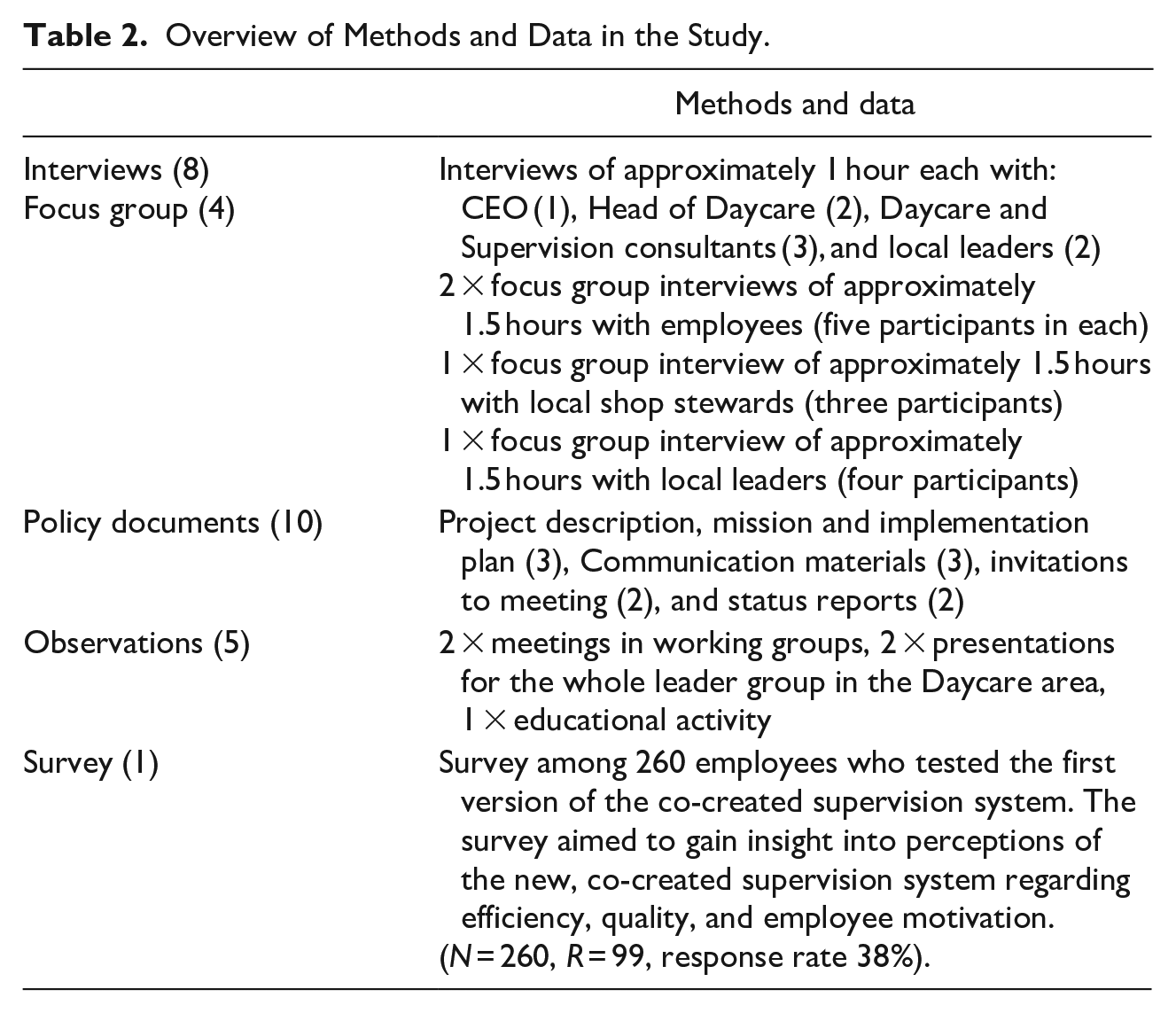
In order to gain further insight about perceptions of the newly co-created supervision system, beyond actors who have directly and extensively in co-creation processes, a survey was conducted among employees in 18 institutions, selected for testing the new supervision system. Ninety-nine out of 260 respondents answered the survey, resulting in a response rate of 38%. Questions were aimed at understanding how the co-created governance system was perceived in terms of solving the before mentioned dysfunctions in the old supervision system. Hence, the choice to focus on outcomes, in terms of how the PPS is perceived to support task quality, efficiency, and employee motivation (and not other potential outcomes, such as innovation or democracy), springs from an empirical ambition to heighten these particular outcomes. Hence, this study’s focus on these specific outcomes, is to a large degree empirically driven. Open commenting allowed the inclusion of qualitative remarks and elaborations pertaining to perceived outcomes.
All materials were subject to a deductive coding process conducted in Nvivo according to the five characteristics outlined in the theoretical framework conceptualizing co-created governance systems: actors involved, time of involvement, level of involvement, power distance, and process of development. In addition, the material was coded according to perceptions of the three outcomes: task quality, efficiency, and employee motivation.
One weakness must be mentioned: the sheer complexity of involving the multitude of internal actors, means that a relevant group of actors, namely parents in the boards of institutions, are only very limitedly involved in the process of developing the supervision system. Hence, the co-creation process in focus in this study end up being primarily intra-organizational. This weakness is also acknowledged in Roskilde municipality: Therefor plans are to continue the iterative approach in a second round in which parents in boards are to be engaged more extensively. Data focusing on parent’s perception of how the supervision system supports task quality, would certainly have provided a relevant external perspective, which could have strengthened the validity of results in this regard.
Analysis: Co-Creating a Pedagogical Supervision System?
In the following, the theoretical framework will be used to analyze the development of the new pedagogical supervision system in Roskilde Municipality. After that, outcomes in terms of how the new, co-created governance system is perceived to solve the outlined dysfunctionalities related to task quality, efficiency, and employee motivation, will be analyzed.
Who: Toward a Multi-Actor Approach to Developing a Supervision System
Traditionally, governance systems in the Daycare have been developed in the administration with only limited involvement of local actors. However, a new ambition reflected in both policy documents (project description, mission, and implementation plan) and in several interviews (i.e., Chief of Daycare and Project leader) is to engage a broader group of actors in the development of a new supervision system: “The new PSS must be developed in close collaboration with all local actors” (Implementation plan). While shop stewards and parents in the boards are also mentioned as relevant actors, pedagogical leaders, and employees constitute central actors of involvement (Project description, interview with, i.e., chief, Project leader, supervision consultant): “The employees are the ones experiencing supervision first hand in the Daycare institutions. Therefor it is so important that their perspectives are included. We have really had a lot of focus on how to involve them in this process” (Daycare consultant).
Ambitions of local involvement is partly achieved by inviting a number of local leaders, shop stewards, and employees to join of the WG, in charge of developing the new PSS (project description, observations of meetings in WG). In addition, broader groups of employees, local leaders, union representatives, pedagogical consultants, and administrative leaders in the Daycare area are invited to dialog-meetings with the WG to provide continuous input into the ongoing work (Implementation plan, interviews with project leader, supervision consultant, and Daycare consultant). During the testing phase, leaders of the 18 testing institutions, have also been involved in ongoing dialog with the WG to improve and adjust the PSS (observation of meeting with WG and leaders of testing institutions). Ambitions of involvement is not only vivid in several policy papers but are also reflected in observations and interviews with actors at all levels (observations of meeting in WG and focus-group interviews with employees, leaders and shop stewards): “Questions of governance systems – that is usually something the administration is in charge of. But I really feel that we have been included in a new way this time” (local leader participating in working group, focus-group interview with leaders). While a number of pedagogical employees have certainly been included more extensively than usually both through participation in WG and various forms of dialog meeting, interviews with both leaders and employees certainly indicate that there is still room for improvement: “Getting the employees to be a part of it has been somewhat difficult. I, don’t necessarily think we have succeeded completely in that area” (Local leader). As involvement of employees at this level depends thoroughly on each leader, such variations may be explained by different approaches or prioritizing between leaders of institutions.
As already mentioned, several informants feel that ambitions to include parent in the boards have not been fully realized: “There has been some involvement of the parents. . . but it has not been a lot” (local leader). This perception is backed up by the chief of Daycare: “Honestly, we did not manage to involve the parents the way we hoped. That will be our focus second time around” (Chief of Daycare). The general explanation for not including the parents as initially strived for, is that the complexity of involving local actors in itself has been challenging to handle (Interview with project leader, Chief of Daycare, focus group of leaders, and observation of meetings in WG).
Hence, the data indicates that involvement of employees varies somewhat from institution to institution and that ambitions of involving parents has been only limitedly fulfilled. However, summing up, the general picture is that relevant actors outside the administration have been much more extensively involved than usually in the development of governance systems.
When: Earlier and More Continuous Involvement
As vivid in Figure 1, endeavors to include inputs from the many involved actors starts early with an internal survey and a number of interviews with local actors about their perception of the old supervision system (i.e., status report, interview with Daycare consultant, area leader). After that, the WGs is established, with the mandate to develop a new supervision system: “We were invited on board right from the start” (local leader participating in WG, focus group with leaders). In the following period of time, the WG works intensively with developing three possible solutions for the PSS (interview with project leader, observations of WG meetings). Although the WG play a decisive role in this process, ongoing dialog-meetings about solutions at leader forum meetings and other relevant forums contributes to qualify the work of the WG (implementation plan, status reports, and observations of dialog meeting). Following the development of the three prototypes, the WG is given the task of deciding on one solution, which, is noted by several participators as a contrast to the traditional way of selecting governance system solutions: “That was a surprise. That they actually included us so much in the decision on the solution. Somehow I still kind of expected the chief of daycare to step in and make her choice. But they insisted it was our responsibility” (Employee participating in WG). This and supporting quotes show that such involvement in decisions on solutions are perceived as a radical change (Focus group interviews with leader and employees, observations of WG meeting). Following, the WG is concretizing the supervision concept, but also decide on how to implement and test the new supervision system by informing and educating all the local actors. Based on inputs from several dialog meetings with leaders, the WG decides that the newly developed supervision system is to be tested in one of the Daycare areas with 18 institutions. After the first test, the WG decides to conduct a survey among all employees in the institutions, to include their perspectives in revisions and adaptions of the new supervision system (project description, project plan, interview with project leader, focus-group interview with employees and leaders). “It’s such a good idea to include our experiences with the system. It makes you feel like our input is taken seriously.” (employee, qualitative remark in survey data). The WG uses this input, along with input from dialog meetings with local leaders, area leaders, and supervision consultants to further adapt and develop the supervision system (observation of WG-meeting, interview with project leader, area leader, and Chief of Daycare).
Summing up, relevant actors are involved in various and substantial ways throughout the early phases of diagnosing, developing, and selecting the governance system solutions, as well as throughout the implementation and evaluation of the supervision system.
How: Engaged Dialog Combined With Extensive Orientation
While involvement through hearings and shorter dialogs about governance systems is not uncommon in the organization, the process of developing the PSS is characterized by numerous, extensive, and ongoing dialogs among the many involved actors (implementation plan, status reports, and interview with project leader). “I actually feel like the contribution and the knowledge we have each brought to the table have become part of the debate and the process” (local leader, focus group interview with leaders). While the WG constitutes at central platform for such engaged dialogs, the communication with the rest of the organization about the PSS is also characterized by two-way-dialog, in which time is invested in sharing apprehensions, hopes, and suggestions (observations of dialog-meetings with leaders and educational activities, focus group interviews with leaders and leaders). These dialogs are perceived as challenging but also valuable in terms of obtaining a broader perspective on other actors’ needs and concerns regarding the governance system: “It has not just been chit-chat. And it is important to stress that involvement is not an open buffet for us leaders and our employees. The input of the consultants and the central leaders has been really important to incorporate too” (local leader, focus group with leaders). Several informants stress that co-creation does not mean “getting your way,” but implies building common understandings by sharing different perspectives on the supervision (Interview with chief of daycare, area leader and supervision consultants, focus-groups with leaders).
While the data material offers several examples of a more extensive use of engaged dialog, this appear to be supplemented with ongoing, classical one-way-information to especially local leaders, and employees at institutions (invitations to meetings, project plan, status reports, interview with project leader and chief of daycare). This, that is, involves information about the general process, status updates, upcoming seminars, educational activities, and guidance on how to facilitate local dialog about the supervision: “I have heard so much about it along the way, that I almost feel like I have been involved. That I am part of it.” (local leader, focus group interview with leaders). Although this kind of information does not qualify as engaged dialog, it generally appears to have supported a feeling of inclusion in the process among especially local leaders but also shop stewards (Focus group interview with shop stewards and leaders).
Hence, while the process is certainly characterized by a more extensive facilitation of engaged dialog among the many involved actors, a comprehensive use of one-way-information is, apparently successfully, used to supplement this development.
Power: Face-to-Face Meetings With Low Power Distances
Formal power is still in play in the process. The mode of involvement and timeline of the process is to a large degree decided by the Chief of Daycare. The decision to pursue the PSS suggested by the WG is also formally taken at the Chief of Daycare and approved at the political level (Project description, interview with CEO and Chief of Daycare). However, collaborating face-to-face on a regular basis in the WG has allowed low- and high-power actors to get to know each other, making formal roles less dominant. Several local leaders and employees in the WG describe a change of power dynamics in a direction of feeling more equal with their superiors (interviews with project leader and focus group interviews with leaders and employees): “Typically the area leaders and politicians just tell us what to do. Somehow that has been different this time. The distance between them and us doesn’t feel as big” (local leader participating in WG, focus group interview with leaders). Although all participants acknowledge that the chief of Daycare still holds formal power, the classical use of formal power appears to have been toned down in the WG: “There was no hierarchy. Not at all. And it was pretty late in the process when I looked at the head of daycare and thought to myself that she could actually just say ‘no’. But she never did” (Employee participating in WG, focus group with employees). The chief of Daycare explains that she has been careful not dominate meetings too much in order to encourage the WG to make decisions (interview with chief of Daycare). Several other interviews and observations support this pattern of formal leaders distributing power in the co-creation process to mobilize resources among all actors (observations of WG, dialog-meetings with leaders and educational activities, and focus group interviews with leaders and employees).
Process: Toward an Iterative Approach
Traditionally, governance system solutions have been developed by the top management and consultants in the Daycare department and then “rolled out” linearly to the local level (interview with CEO, Chief of Daycare, and focus-group interview with shop stewards). In several policy papers it is made clear, that an ambition regarding the PSS is to develop it in a more explorative process (status reports, project description): “The development of the PSS must focus on testing in practice, collecting knowledge about what works, without giving the answers beforehand” (implementation plan). Several interviews suggest that the process is perceived as less top-down and more explorative than usually (Focus groups with leaders and employees. Interviews with area leader, daycare consultant, and project leader). A leader explains: “It’s more experimental, I would say. The head of daycare is more insistent on finding a new approach in which solutions can evolve in collaboration. We are allowed to innovate in a way we are not used to” (Leader participating in WG, focus group interview with leaders). This change is also noticed among actors at the Day Care institutions: “I really like the idea of testing it. One thing is theory. Another thing is getting real life experiences from trial institutions. Letting it evolve like that. . . it is bound to improve supervision” (employee, qualitative remark from survey data). Hence, the development of the supervision system is characterized by a more iterative approach in which feedback from experimentation spurs continuous innovation of the governance system.
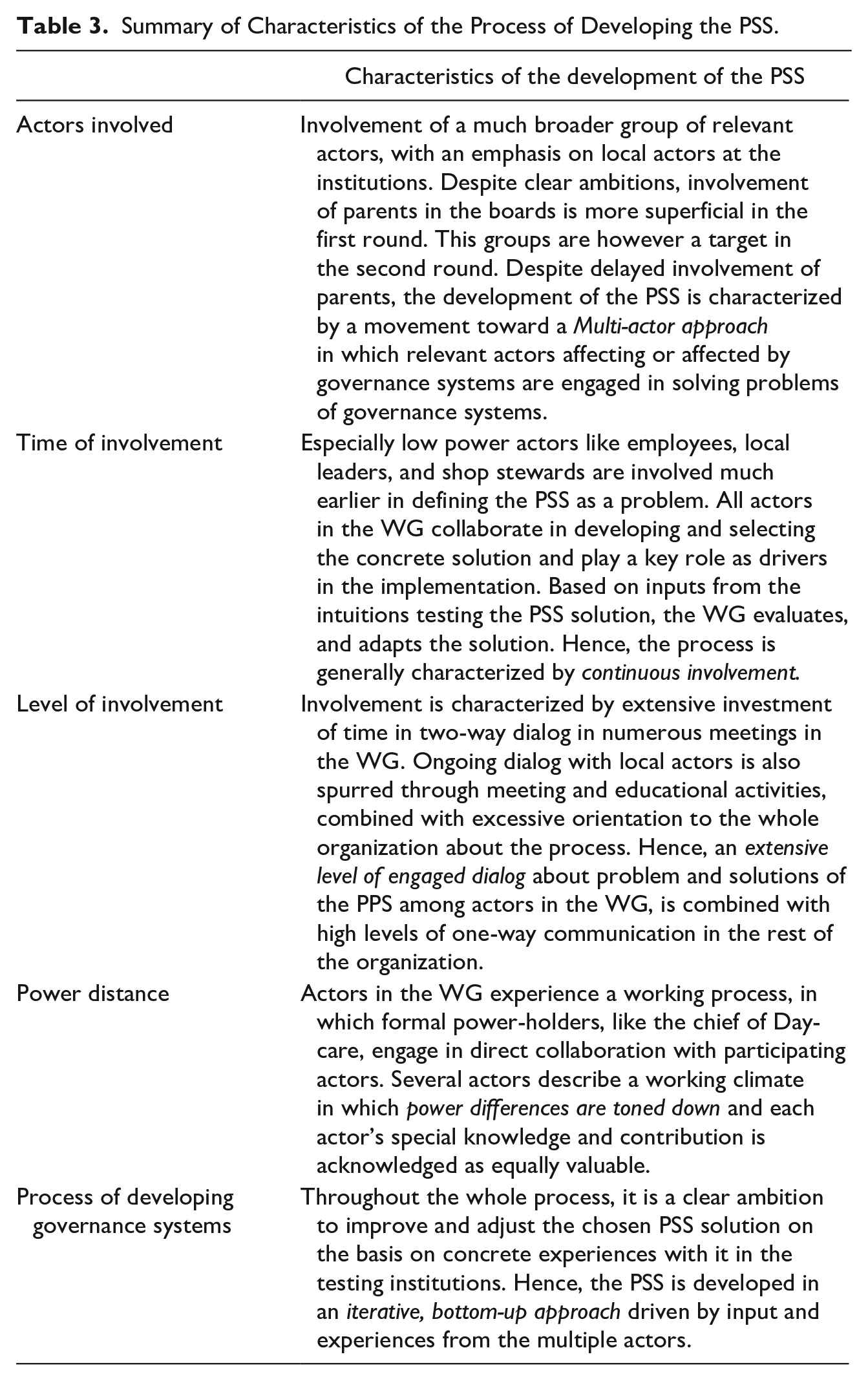
As summarized in Table 3 below, the overall development of the PSS, despite counter-patterns in some areas, like the lack of involvement of parents, reflects a shift toward co-creating governance systems along all dimensions.
Summary of Characteristics of the Process of Developing the PSS.
Analysis: Does Co-Creation Solve the Problems?
Do involved actors perceive the new, co-created supervision system to solve the dysfunctionalities of the old supervision system, which was criticized for eroding task quality, employee motivation, and for being inefficient? The general picture suggests that this may, in fact, be the case. However, as we shall see, resource consumption appears to be higher in the new supervision system than in the old one.
Generally, all involved actors agree that the new supervision system provides a much more valid assessment of the quality of work at institutions (open answers from survey, focus group with leaders and employees, and interviews with supervision consultants and area leader). This is explained with a number of significant changes in the new supervision system: With the old system, supervision consultants made shorter visits to all institutions. Now they focus their limited resources on institutions with the most challenges, while continuously, high-performing institutions receive observations from peer-daycare-leaders (interview with supervision consultant, project leader and Area leaders, status reports). In addition, external observations are now supplemented by observations from the local leader and an employee, who each spend 1 day making observations that are also incorporated into the supervision process: “Now we include three different perspectives. That marks a huge difference and a much deeper level of insight” (Head of Daycare). This is backed up by several leader of daycare institutions and employees, who describe the new supervision system as more differentiated and valid in terms of assessing pedagogical quality (open answers from survey, focus-group interview with leaders and employees): “It is a more versatile measurement of the quality of our work. It makes sense to include more views and to involve both leaders and employees, since we have different perspectives on the same subject and observe different days. It gives us a broader understanding of the quality of our work” (employee, qualitative remark in survey). Another interesting change is the choice to make the PSS unannounced rather than planned: “In reality this means that supervision is much sharper. Rather than spending time preparing for the annual supervision, we focus on securing continual quality (Leader, focus-group interview with leaders)”. Institutions will therefore no longer be able to prepare for supervision on a specific day but should, in principle, be ready to receive supervision at any given time. The qualitative data is backed up in the survey conducted among the 260 employees: 95% of all respondents agree somewhat, mostly or completely that the new PSS supports the quality of pedagogical work (see Table 4 below). Hence, in line with Voorberg et al. (2014), the results of this study suggest that co-creating the PSS has enabled a solution, which, unlike the old supervision system, is perceived to strengthen task quality.
Perceptions of Outcomes Related to the Co-created Supervision System.

Co-creating governance systems also appears to have created value in terms of higher employee motivation to work with supervision among local actors: “Somehow, supervision has become more alive and more exiting to work with” (employee, qualitative remark in survey). Survey data supports this as only 6.6% of the respondents disagree that supervision is motivating to work with in the new supervision system (see Table 4, above). The high employee motivation is explained as a result of the extensive involvement which has made it possible to integrate professional values and concerns (Focus-group interview with employees and shop stewards, interview with area leader, open answers in survey). A leader reflects on why the new supervision system is more motivating to work with: “The new supervision system creates involvement and ownership all the way through, and that really spurs motivation to work with your own pedagogical practice” (leader, focus-group interview). Hence, the extensive involvement in the process has allowed local actors to internalize and make sense of the governance systems, making it more motivating to comply with it—despite control actually being sharper than in the old system (Edelenbos & Eshuis, 2012).
As shown in Table 4, approximately 90% of respondents agree (completely, mostly, or somewhat) that supervision is efficient in terms of creating value for resources invested. However, more than 50% only agree “somewhat,” leaving a more lukewarm impression. A leader elaborates on this: “The new system creates more value. That is for sure. But I have definitely spent more time than with the old system” (leader, open answer in survey data). This statement is backed up by several informants, stating that although the work invested in written documentation is now considered much more meaningful, it still takes more time than before (Interview with area leaders, focus-group interview with leader and supervision consultant): “Involving the employees in two rounds makes it much more resource intensive. Not just for the leader but also the employees” (interview with Supervision consultant). Hence, in line with critical scholars (Bovaird & Loeffler, 2012; Brandsen et al., 2018) this study certainly indicates an increased use of resources with the newly, co-created supervision system. However, efficiency is still perceived to be higher in the sense that invested resources are generally believed to produce adequate value for money (interview with project leader, focus group with leaders, survey data).
Summing up, this study suggests that co-creating a new supervision system has in many ways contributed to solve the dysfunctionalities associated with the old supervision system, which was criticized for eroding task quality, employee motivation, and efficiency. However, co-creating the PSS has also entailed a higher resource consumption for the involved actors, in particular local leaders.
Discussion
Despite years of reforms aimed at solving problems caused by escalating, time-consuming, or distorting governance systems, de-bureaucratization, and the battle against dysfunctional governance systems still constitute an ongoing challenge in the public sector (Burden et al., 2012; Kaufmann & Feeney, 2012; Moynihan et al., 2015; Sunstein, 2019). This study contributes to the scarce existing public administration literature, addressing the question of how to solve dysfunctionalities of governance systems (DeHart-Davis, 2017; de Jongh, 2016), by pointing to the prospects of using co-creation as a pathway. While co-creation has been widely used to develop service solutions and policies with citizens and users outside the public sector (Brandsen et al., 2018; Nabatchi, 2012; Torfing, Sørensen, & Bentzen, 2019), this study contributes to the literature by operationalizing co-creation as an approach for solving problems related to governance systems within the public organization.
In central parts of the co-creation literature, involvement of citizens is seen as a prerequisite for co-creation (Brandsen et al., 2018; Voorberg et al., 2015). Seen from that perspective, a central critique of this study would undoubtly be the somewhat detached involvement of parents in the boards. It could even be questioned whether the case in this study is in fact at case of co-creation or merely internal collaboration? While the limited involvement of parents can certainly be seen as a flaw in the specific co-creation process, the ideal of co-creation helps them to acknowledge this flaw and fuel their aspiration to do better in the next round. Hence, framing the process as collaboration would limit perspectives regarding the involvement of relevant actors outside the organization. The study also stresses the importance of several other rather important criterions for co-creation, which besides involvement of relevant actors, create a challenging task for practioners aiming to co-create governance systems. Expectedly, as in the case of Roskilde Municipality, succeeding in meeting all criterions perfectly in such complex tasks will be demanding if not impossible. Hence, if processes which do not live perfectly up to these criterion are discarded as co-creation, it may be argued that co-creation may be reduced to an unachievable academic ideal. Instead, this study suggests that criterions for co-creation, though not necessarily perfectly performed, can inspire practitioners to reflect on and innovate their development of governance systems.
Although the results of a case study can never be statistically generalized, the findings of this study may inspire or inform more general debates about how to solve dysfunctionalities in governance systems, which remain a challenge in public sectors in many countries. The Danish municipal daycare area constitutes a unique case for studying the co-creation of governance systems: A high-trust country like Denmark, characterized by distributed leadership, extensive delegation of competences, and a work culture in which the involvement of professionals is commonplace (Houlberg & Ejersbo, 2020), can hardly be considered a typical case in an international context. Hence, an important question is how this study can inform debates about co-creating governance systems in more centralized countries or areas which do not enjoy the same level of autonomy as the unique case described in this study. Is co-creation valuable even when autonomy is more limited, or could invitations to co-create be perceived as pseudo-processes at the risk of hampering trust among participants (Bentzen, 2019; Fledderus, 2018; Steen et al., 2018)? Such questions certainly require more research across a wider range of contexts. That said, the key finding of the study—that co-creation can be operationalized as a relevant and promising approach to solve perceived dysfunctionalities of governance systems—appears promising enough to spur debate about the limits and prospects of co-creating governance systems in other public sector contexts.
The question of how co-creation may affect accountability has been critically debated in the co-creation literature as a potential dark side of co-creation (Papadopoulos, 2007). Accountability can be defined as a relationship between an actor and a forum, in which the actor has an obligation to explain and to justify her conduct and in which the forum can pose questions, judgement, and sanctions (Bovens et al., 2014; Papadopoulos, 2007). In this study, the co-creation of governance systems actually leads to a sharpening of control, but sharing formal power in such a delicate area could also potentially threaten accountability if the premises for co-creation are not present. Existing levels of trust (Fledderus, 2018), the willingness to co-create within the chain of command, actors refraining from sub-optimization, and the quality of facilitation all constitute examples of important premises for the successful co-creation of governance systems, which may profoundly affect outcomes (Steen et al., 2018). Further studies are needed to understand how these and other factors affect the premises for co-creating accountable governance systems.
The present study also adds to our, still somewhat limited, knowledge about outcomes of co-creation (Brix et al., 2020; Voorberg et al., 2014), suggesting that co-creation may be a promising pathway for solving perceived dysfunctionalities of governance system. However, the warning in the literature that co-creation requires resources is certainly also evident in this study (Bovaird & Loeffler, 2012; Brandsen et al., 2018; Steen et al., 2018). In this case-study co-creating governance systems appears to lead to more productive governance systems—but not necessarily to less time spent on them. This is perhaps not surprising as the values inherent in co-creation underline the importance of ownership, coherence, and mutual dialog as a pathway toward robust solutions (Brandsen et al., 2018; Nabatchi, 2012). In other words, the ambition to solve dysfunctions of governance system may come at the cost of spending more resources on co-creation processes. While certainly solving many of the dysfunctionalities of governance systems in regard to alienation, de-motivation, de-coupling, and other fending-off mechanisms (Hood & Dixon, 2015; Le Grand, 2003; Lipsky, 2010), co-creation does not necessarily solve the problem of the mushrooming resources needed for governance systems (de Bruijn, 2002). On the contrary, this study suggests co-creating governance systems appears to require additional investment of time and resources. This may be especially important to keep in mind in times of organizational down-sizing and cost reduction, in which the extra resources invested in governance systems may be difficult to justify, regardless of any perceived positive effects on value creation.
Conclusion
Governance systems play a crucial role in securing an accountable public sector but are also known to grow overly bureaucratic, cause problematic distortion of welfare tasks and motivation crowding among public employees. While the diagnosis’s, dynamics, and problematic side-effects of governance systems have been explored extensively, only scarce studies contribute with knowledge of how to find robust solutions to such dysfunctions at a practical level. This study addresses this research gap by operationalizing co-creation as a strategy for solving dysfunctionalities in governance systems and exploring prospects of such an approach. A theoretical framework for studying the co-creation of governance systems is developed and applied to a case study of the development of a supervision system in a Danish municipality, triangulating interviews, observations, policy documents, and a survey. The results suggest that co-creation, which has primarily been used to develop service solutions and policies with actors outside the public sector, can also be used as a pathway for solving dysfunctionalities in governance systems within the public organization. In the concrete case, co-creating a supervision system contributes to a governance system which is perceived to support task quality, employee motivation, and efficiency better. However, co-creating governance systems also brings new challenges of resource consumption associated with extensive coordination and negotiation among the involved actors.
Footnotes
Declaration of Conflicting Interests
The author declared no potential conflicts of interest with respect to the research, authorship, and/or publication of this article.
Funding
The author received no financial support for the research, authorship, and/or publication of this article.
