




Abstract
We present a cultural immersion experience as a pedagogical approach to integrate learning of psychological concepts and advancement of cultural competency. This course revolved around a one-week trip to Pine Ridge Reservation in South Dakota. This experience, paired with cultural readings on Native Americans, offers a framework for studying psychology. The course format, topics, assignments, and special considerations are discussed.
Traditional academic courses involve an explicit-instruction approach to pedagogy in which instructors determine the course content and convey that information to students (Gray, 1993). More recently, instructors have also begun using an “immersion” method in which teachers create an engaging environment for intellectual exploration (Ennis, 1989). One example of this approach involves cultural immersion. Cultural immersion experiences provide a social setting that naturally includes opportunities for critical analysis (Gray, 1993; Ishii, Gillbride, & Stensrud, 2009). Immersion experiences also serve as a means of teaching course content and prompting students to consider theories and concepts of a given discipline from a different cultural perspective (Scott, 1983). Finally, many instructors utilize cultural immersion to increase students’ cultural competency or awareness of one’s own worldview as well as knowledge of other cultural perspectives (Canfield, Low, & Hovestadt, 2009; Cordero & Rodriquez, 2009; Vaughn, 2005; Wood & Atkins, 2006).
Cultural immersion experiences have grown in popularity. Historically, such experiences have been reserved for students of foreign languages, anthropology, or history (Schwebel & Carter, 2010). However, other disciplines such as education (Zhao, Meyers, & Meyers, 2010) and nursing (Larson, Ott, & Miles, 2010) have adopted this approach. Moreover, some instructors now pair cultural immersion experiences with service learning. For instance, Cox, Falk, and Colon (2006) describe a course in which Spanish-speaking students of social work traveled to Costa Rica for a cultural immersion experience while participating in service projects during their stay. Tomlinson-Clarke (2010) explains an immersion model in which students engage in community service and undergo cultural immersion training in South Africa. In such courses, students reap the benefits of cultural immersion and service learning.
Although many psychology courses include a service-learning component (Beehr, LeGro, Porter, Bowling, & Swader, 2010; Conway, Amel, & Gerwien, 2009; Heckert, 2010; Miller & Yen, 2005), few have taken advantage of cultural immersion opportunities. In what follows, we present a cultural immersion, service-learning course that provides a context for studying psychology and increasing students’ cultural competency. This program is unique in three ways: (a) students read historical and cultural works both before and after the immersion experience, (b) students have direct experience with an invisible and oppressed cultural group within the United States, and (c) the cultural experiences relate to many different subdisciplines in the field of psychology. We also discuss some modest alternatives within the same framework, as the investment of time and money for this particular immersion experience may be prohibitive.
The Course
Overview
The course, “Psychological Perspectives of Native Americans: The Lakota,” was an elective, 3-credit, upper-level course for undergraduate students. The class met once a week for 2 hours. The 10 students enrolled in the course included nine females and one male. Eight students were Caucasian and two were Hispanic.
The general goals of the course were to (1) develop sociocultural awareness through the course readings, discussions, and experiences on the reservation, (2) apply and integrate knowledge of psychology with issues facing Native Americans on and off the reservation, and (3) critically consider psychological theories, concepts, and findings in relation to Native Americans.
Preparation for Reservation Experience
Students began reading cultural works before the trip to the reservation, including selected chapters from Bury My Heart at Wounded Knee (Brown, 1970), Black Elk Speaks (Neihardt, 2008), and Neither Wolf Nor Dog (Nerburn, 2002). The students wrote a summary and personal reflection on each of the readings in order to develop a solid knowledge base of Lakota history and a general understanding of Lakota culture. In addition, the readings provided context to the modern-day issues, attitudes, and perspectives of the Lakota.
Reservation Visit
The students and instructor traveled to Pine Ridge Reservation for 1 week. The experience on the reservation was organized by an external organization (Re-Member, see www.re-member.org). During that week, class members and other volunteers participated in various service projects on the reservation, including roofing, skirting and siding trailers, and building wheelchair ramps. Students also participated in cultural events. For example, the class heard Lakota speakers, attended a powwow, toured historical and cultural locations on the reservation (e.g., the mass grave at Wounded Knee, Oglala Lakota College, and Badlands National Park), and met Lakota people while working on homes and during a community picnic.
Postreservation Experience
Upon returning from the reservation, students read cultural readings and two assigned psychological articles each week. In addition, each week a pair of students selected a third psychological article that related to Native Americans for everyone to read and led discussion on that article.
Required cultural readings included Keeping Heart on Pine Ridge (Glover, 2004) and Genocide of the Mind (Moore, 2003). The book by Glover complemented students’ experiences on the reservation as it provided new details about life on Pine Ridge. Moore’s (2003) edited book includes essays written by Native peoples of the United States that address a variety of topics, including identity, stereotypes, and language. These powerful essays paired with the immersion experience provided a context for considering psychological literature. For instance, students read an article about acculturation in the Latino youth (Fuller & Coll, 2010). During class discussion, they observed the similarities and differences in the acculturation process for Latino and Native American youth. The cultural readings and the students’ observations on the reservation facilitated their understanding of the unique complexities of acculturation for Native Americans.
The assigned psychological articles addressed a broad variety of topics, including stereotypes, motivation, historical trauma, gender roles, stress, coping, acculturation, identity development, suicide, altruism, hate, oppression, language, and resilience. These assigned articles purposefully did not address Native Americans so that students could make connections between psychological concepts and the cultural readings on their own. During discussions students pointed out which concepts and theories applied to their experiences on the reservation and the cultural essays they read. For instance, after reading about the effects of stereotypes on intellectual identity (Steele, 1997), they used their understanding of Native peoples to discuss how they believed this may affect Native peoples both intellectually and emotionally. Students also noted the failure of traditional psychological concepts to account for behavior and experiences of Native Americans. For example, many students felt passionately that one current model of hardiness (see Maddi, 2008) did not adequately address Native Americans because it failed to take into account historical trauma, ongoing oppression, and cultural values. Thus, the students observed and openly discussed the limitations of viewing people from only one cultural perspective.
Students completed weekly written assignments in which they summarized and reflected on the relation between their observations on the reservation, cultural readings, and psychological articles. They then discussed these topics in an open forum. Thus, as students read the psychological works, they evaluated how well theories, hypotheses, and concepts apply to the unique situation of Native Americans living on and off the reservation. Students also completed a final project in which they considered an issue facing native peoples in the United States from a psychological perspective.
Course Evaluation
On the last day of class, students completed a course evaluation as a measure of their perceptions of learning experience (see student ratings in Table 1). Although students overwhelming expressed great enthusiasm, note that the class consisted of a self-selected group of 10 students who were willing to pay $800 to travel to South Dakota and live on a reservation for a week during their summer vacations. Therefore, these ratings may not represent the average student.
Student Ratings on Engagement and Diversity
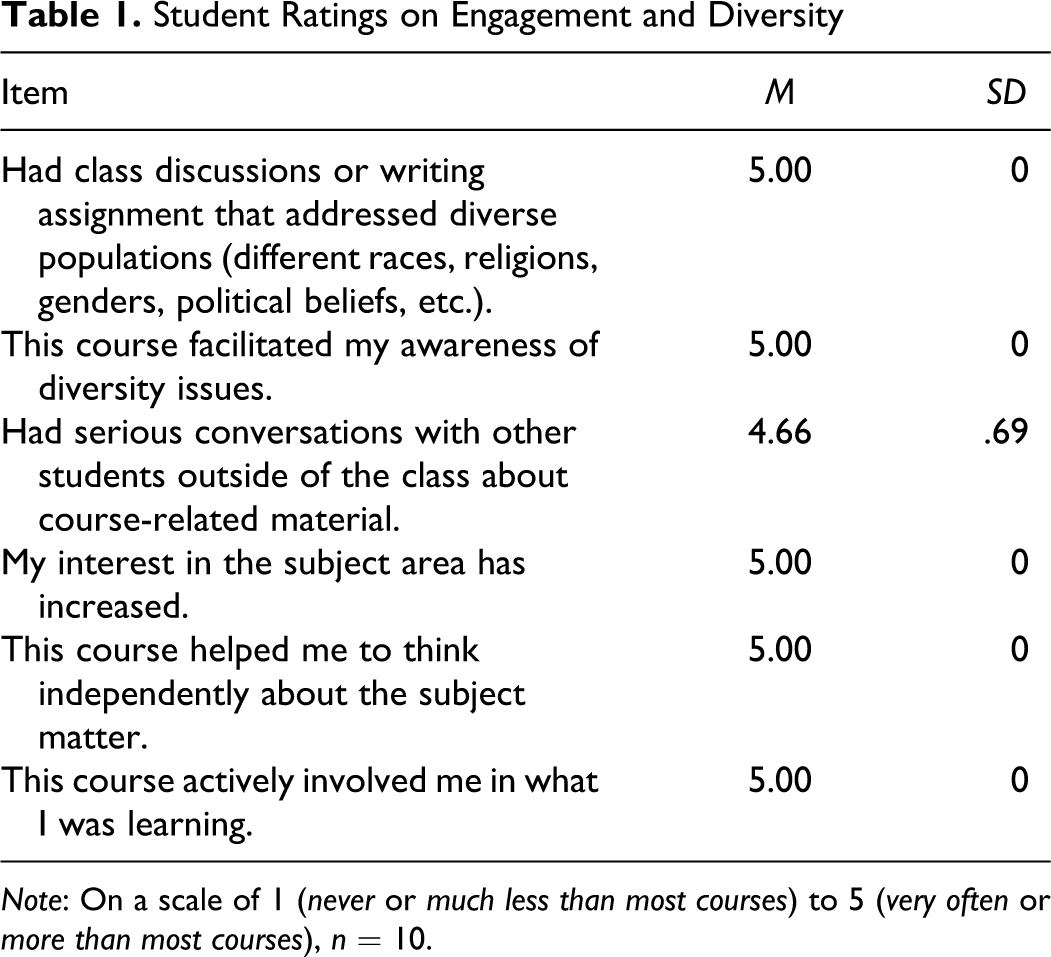
Note: On a scale of 1 (never or much less than most courses) to 5 (very often or more than most courses), n = 10.
Special Considerations
Debriefing
Although the immersion experience only lasts one week, it proves to be quite powerful. The students in the course as well as other volunteers who participated during the same week mentioned that the transition from the reservation experience to “civilian life” was difficult due to the general apathy of friends and family members; few individuals expressed genuine interest in, or understanding of, the students’ experiences and the suffering they witnessed. Therefore, a debriefing opportunity is important. The students in this class shared their experiences with faculty members in an informal presentation, allowing students to express the impact of the experience on their intellectual and personal growth to an interested audience.
Time and Cost
Although this particular class occurred over 8 months, the course could easily take place during a normal semester in which students read cultural works at the beginning of the semester, attend the immersion experience during a fall or spring break, and then consider the cultural experiences and readings in the context of psychology after the immersion. This same format could also work for intensive courses that occur in a short timeframe, with the cultural immersion experience occurring half way through the term. With some ingenuity and planning on the part of the instructor, this course could work within many different timeframes.
A more significant deterrent of the proposed course is the cost of travel (approximately $800). One way to defray the cost of the trip is to engage in fundraising activities (events, letters, etc.). Another possibility is for the instructor to apply for funding through a granting agency.
One solution that addresses the issue of both timing and cost is to arrange an immersion experience closer to the home institution or with a local organization that serves misunderstood, marginalized, and/or oppressed populations (see www.volunteermatch.org for local activities). For instance, students could help teach English as a second language in a situation where they get to know immigrant populations and the barriers they face in assimilating to a new culture. This experience could occur over the course of a semester or over a few weekends. Although the instructor would be more involved with the organization of this type of immersion experience, it could still provide a powerful learning opportunity for students.
Finally, although students in this course received elective credit, the class could certainly work as an honor’s class or a capstone experience. In addition, one could modify the course material to fit with specific course objectives; therefore, the cultural experience could easily be applied to other topics or even adapted for other courses such as Psychology of Oppression, Psychology of Women, and Social Psychology.
Conclusion
The current course serves as one example of how to incorporate a cultural immersion experience and service learning into psychological coursework. The entire course provides students with exposure to another way of life and encourages them to consider psychology in the context of culture. Instructors are encouraged to use the current course format as inspiration for a general pedagogical approach, taking into account the home institution, location, and resources available.
Footnotes
Acknowledgments
We thank Andrew Christopher and two anonymous reviewers for their comments on this manuscript. We are grateful for the projects and programming offered at Re-Member. Finally, we thank the Oglala Lakota oyate (people) for their generosity, kindness, and continued inspiration.
The authors declared no potential conflicts of interest with respect to the research, authorship, and/or publication of this article.
The authors disclosed receipt of the following financial support for the research, authorship, and/or publication of this article: Students’ travel expenses were partially funded by the Davis Educational Foundation to support Providence College’s initiative of fostering a culture of student engagement .