



Abstract
The current study examined relationships among online quiz parameters and students’ classroom exam scores. The authors analyzed data from undergraduate courses across four semesters. The results revealed that regardless of the different parameters set for the online quizzes, the number of attempts that students made on quizzes was unrelated to their classroom exam scores, yet the amount of time they spent on quizzes was correlated negatively with their classroom exam scores. The results also revealed that students’ scores on the online quizzes predicted their classroom exam scores, above and beyond the number of attempts, length of time allowed on quizzes, as well as their SAT Reading and SAT Math scores. The implications of these results are discussed subsequently. Future researchers may wish to provide empirical evidence on how not counting all of students’ online quiz scores toward their final grade may influence students’ quiz performance, given the anxiety that time limits can foster.
Today we will discuss Vygotsky’s theory and how it can be applied in educational settings. So, let’s start with the basics. What do you remember from the chapter about Vygotsky’s theory of scaffolding?
Scaffolding? Isn’t that the stuff construction workers stand on?
Perhaps this type of response is not surprising in an age when literacy and reading are on the decline. For example, despite the National Endowment for the Arts’ recent uplifting news that literary reading has increased for the first time since 1982, that report also indicated that the percentage of those who read any book within the past 12 months that was not required for work or school is 54% for adults, and 50.7% for 18- to 24-year-olds (2009). Regarding university students, one study found they reported that they read their textbooks less than 3 hr per week (Sikorski et al., 2002). And not surprisingly, given their relative lack of college experience, reading compliance is lowest in students who are relative novices and may or may not have mastered effective studying techniques for college courses, that is, those enrolled in 100- and 200-level undergraduate courses (Burchfield & Sappington, 2000). Some have suggested that reading compliance among college students is low for a variety of other reasons such as students’ lack of confidence, lack of interest, lack of motivation, lack of appreciation of the importance of reading assigned material, as well as instructors’ fear of poor student evaluations (Lei, Bartlett, Gorney, & Herschbach, 2010).
No matter the reasons for their noncompliance with assigned readings, how can we best scaffold or adjust our support to students’ current levels of readiness and motivation? Online quizzes may be beneficial because they provide students with immediate feedback on their comprehension of assigned material. Frequent assessments can also help students discipline themselves to read regularly, rather than immediately prior to an exam, because they reduce procrastination and massed practice studying for exams; this is especially true for exams that are typically scheduled after a period of time has occurred since students initially learned the material (Connor-Greene, 2000; Roediger & Karpicke, 2006).
Despite the appeal of online quizzes, a best principles review of the research on this topic found that time limits seem to prevent students from browsing through a textbook for quiz answers, a “quiz-to-learn” type strategy which can lead to a high score, but also mislead students into thinking they have mastered the material when they have in fact not (Brothen, Daniel, & Finley, 2004). As a result, the authors of this review suggested that students should be given less than the usual 1 min per question, and instead only be allowed 30–40 s, with accommodations made for students with disabilities. Yet, given students’ low levels of reading, both for class and for pleasure, their verbal skills may not be able to meet the demands of comprehending and responding to information in such a short period of time. The best principles review also suggested providing students with several attempts to encourage students to work toward mastery of the material. However, multiple attempts may be a concern for instructors using online quizzes that do not change or even randomize questions after each attempt.
The first purpose of the current study was to discern whether there is negative correlation between the amount of time students spend on online quizzes, regardless of different parameters that instructors may set (regarding number of attempts and time limits), and their classroom exam scores. The second purpose of the current study was to determine whether students’ scores on online quizzes are able to predict their scores on classroom exams, above and beyond the amount of time they spend on online quizzes, the number of attempts they make on online quizzes, and their SAT scores. The latter may be a proxy for college readiness, with the SAT verbal scores in particular assessing reading skills.
Method
Participants
Four groups of students, each group consisting of two sections of the same course in a semester, participated in this study. The first group consisted of students from two sections of Infant and Child Development that the first author taught during Spring 2007 semester. This group was assigned 10 online quizzes using CengageNow’s Learning Management System (which randomizes questions after each attempt) during the semester. The quizzes corresponded to their Rathus (2006) Childhood: Voyages in Development textbook. CengageNow’s online quizzes offer a pretest, personalized study plan (based upon pretest performance), and posttest format.
Students in these two sections were assigned 20 pretest questions, and 20 posttest questions. Only the posttest questions were counted toward their quiz grade, and students were provided up to 20 min to complete these posttest questions. These students were allowed unlimited attempts on the quizzes, and their last attempt was the score that was recorded for them. One point was deducted from their quiz grade for every hour their quizzes were submitted after the specific due date and time, which was an hour or two before class depending on which section it was.
The second group consisted of students from two sections of Infant and Child Development the first author taught during Spring 2008 semester. This group was assigned 16 online quizzes using CengageNow’s Learning Management System, which corresponded to their Rathus (2006) Childhood: Voyages in Development textbook. Students in these two sections were assigned 25 pretest questions, and 25 posttest questions. Only the posttest questions were counted toward their quiz grade, and students were provided up to 25 min to complete these posttest questions. Students were allowed three attempts on each quiz, and their last attempt was the score that was recorded for them. Five points were deducted from their quiz grade if their quiz was submitted after the specific due date and time, which was an hour or two before class depending on the section.
The third group consisted of students from two sections of Lifespan Development that the first author taught during the Fall 2008 semester. This group was assigned online quizzes using CengageNow’s Learning Management System, which corresponded to their Sigelman and Rider (2009) Lifespan Human Development textbook. Students in these two sections were assigned 20 pretest questions and 20 posttest questions. Only the posttest questions were counted toward their quiz grade, and students were provided up to 30 min to complete these posttest questions.
This last group consisted of students from two sections of Lifespan Development that the first author taught during the Spring 2009 semester. This group was assigned online quizzes using CengageNow’s Learning Management System, which corresponded to their Sigelman and Rider (2009) Lifespan Human Development textbook. Students in these two sections were assigned 20 pretest questions and 20 posttest questions. Both the pretest and the posttest questions were counted toward their quiz grade, and students were provided up to 75 min to complete these questions.
Procedure
SAT Writing scores were not available for many of the students, and therefore not used in data analysis. The first author added the SAT Reading and Math scores to the record of students’ scores on the online quizzes for each semester. Data regarding the length of time students spent on quizzes and the number of attempts students made for each quiz were accessed via CengageNow. Because the students who were allowed multiple attempts could attempt a quiz without necessarily submitting it for a grade, we had a Technical Support representative from CengageNow verify that students’ scores on quizzes reflected their last submitted attempt, given the CengageNow system counts both submitted and not submitted quizzes in their record of students’ total quiz attempts.
Given that CengageNow’s Learning Management System counts both submitted and not submitted quizzes in their record of students’ total quiz time, we chose to analyze their last attempt time. This is because the last attempt time also reflects a quiz attempt that may or may not have been submitted for a grade, it may also indicate the extent to which students had already invested time in a quiz. That is, if the last attempt time was a relatively short period of time, students had likely already devoted time to the quiz, which would be consistent with Brothen and Wombach’s (2001) finding that shorter online quiz times and fewer online quiz attempts are associated with stronger exam scores.
Results
Pearson product–moment correlations were computed among Exam Totals (i.e., total points earned across all in-class exams), SAT Reading scores, SAT Math scores, Attempt Totals (i.e., total number of attempts across all quizzes), Time Totals (i.e., total time spent across all quizzes), and Quiz Totals (i.e., total points earned across all online quizzes). As can be seen in Table 1, Exam Totals were correlated positively with SAT Reading scores (r = .44, p < .01) and SAT Math scores (r = .38, p < .01), correlated negatively with Time Totals (r = −.50, p <. 01), and correlated positively with Quiz Totals (r < .53, p < .01).
Correlations Among Variables
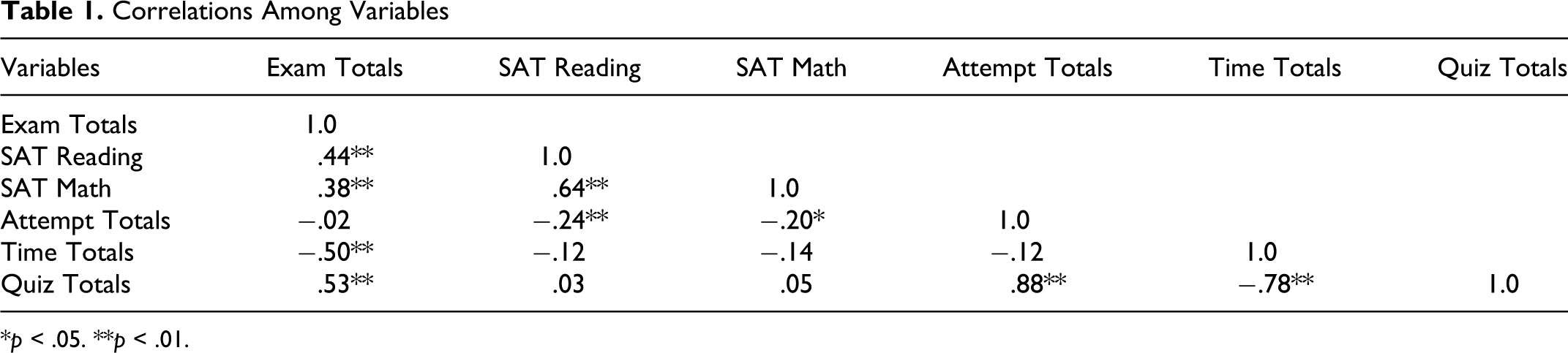
*p < .05. **p < .01.
A hierarchical multiple regression analysis was then conducted to determine if Quiz Totals were able to predict Exam Totals, above and beyond SAT Reading scores, SAT Math scores, Attempt Totals, and Time Totals. And as indicated in Table 2, Quiz Totals significantly accounted for the variance in Exam Totals, above and beyond the other variables, with an R 2 change of .07 (F = 12.54, p < .001). Table 2 displays F Change, R, R 2, R 2 change, and standardized regression coefficients (β) for all variables.
Hierarchical Multiple Regression of SAT Reading, SAT Math, Attempt Totals, Time Totals, and Quiz Totals on Exam Totals
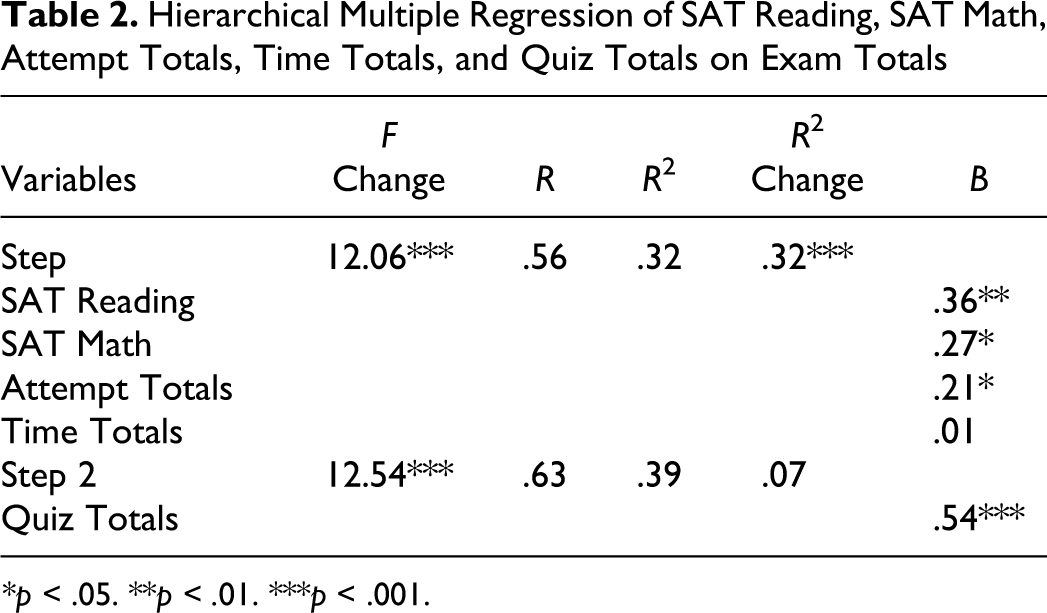
*p < .05. **p < .01. ***p < .001.
Discussion
The first purpose of the current study was to verify that there is negative correlation between the amount of time students spend on online quizzes, regardless of different parameters that instructors may set, and their classroom exam scores. The results revealed that although the number of online quiz attempts was not related to exam scores, the amount of time students spent taking online quizzes was correlated negatively with exam scores.
These results therefore did not support “quiz-to-learn” strategy in which students earn high scores on quizzes but not necessarily on classroom exams, given the current study’s positive correlation between online quiz scores and classroom exam scores. But consistent with the best principles review, the current study did find evidence that the amount of time students spend on online quizzes is correlated negatively with classroom exam scores. Therefore, instructors may wish to limit the amount of time students are allowed to take online quizzes in order to provide optimal conditions to best scaffold learning.
The second purpose of the current study was to determine whether students’ online quiz scores would predict their scores on classroom exams, above and beyond the amount of time they spend on online quizzes, the number of attempts they make on online quizzes, and their SAT scores. Indeed, the scores students earned on online quizzes predicted their exam scores, above and beyond their SAT Reading scores and their SAT Math scores, both of which were correlated positively with exam scores.
Because time, and not attempts, was correlated with exam scores, instructors may wish to design a course in which not all of students’ online quiz scores are counted toward their final grade, given the anxiety that time limits can foster. Future researchers may wish to provide empirical evidence on the role that syllabus policies, such as not counting all of students’ quiz scores toward their final grade, may have on students’ quiz performance.
In the meantime, it appears as if the online quizzes available in Learning Management Systems may very well enhance brick-and-mortar classroom teaching by assessing students’ learning outside of class—perhaps reducing procrastination by providing immediate out-of-class consequences for not reading—through immediate feedback regarding their reading comprehension of assigned material (Bartini, 2008). Therefore, they do appear to scaffold student learning.
Footnotes
Acknowledgments
The authors would like to thank Liz Elliot at CengageNow for her assistance with accessing and interpreting online quiz data, and the many students who participated in this study.
A portion of these data was presented at the National Institute on the Teaching of Psychology in 2009.
Declaration of Conflicting Interests
The authors declared no potential conflicts of interest with respect to the research, authorship, and/or publication of this article.
Funding
The authors received no financial support for the research, authorship, and/or publication of this article.