



Abstract
It has been 13 years since the last objective analysis of full-length introductory psychology textbooks was published and 15 years since the textbook copyright period used in that study, 1995–1997. Given the importance of informed textbook evaluation and selection to the introductory course but the difficulty of this task because of the large number of texts available, it is important to provide teachers with as much information about introductory texts as possible. Thus, to aid teachers in this arduous task, we objectively analyzed the most current editions of the 13 full-length introductory texts published since 1997. Our analyses also allowed us to objectively compare introductory texts from the 1990s with those from the 2000s.
Given the general popularity of the introductory psychology course with an estimated annual enrollment in the United States of more than a million students (Habarth, Hansell, & Grove, 2011; Steuer & Ham, 2008), the introductory course is critical to students’ first impressions of psychology. Because 98% of teachers use textbooks for the introductory course (Miller & Gentile, 1998), introductory textbooks play a major role in defining psychology for our students. Thus, informed textbook evaluation and selection are important to the course’s success. However, with the large number of introductory texts available (Griggs, 2006), it is difficult for a teacher to know many of the books well. A survey of teachers conducted by Weiten (1988) attested to this difficulty. Weiten asked a large sample of professors who taught introductory psychology to rate each of 43 textbooks, but only 4 of the 43 textbooks were rated completely by 50% or more of the 156 respondents. Griggs and Jackson (1989) found that introductory text editors and authors, like the psychology teachers, were also not very familiar with many of the available introductory textbooks.
Much of this difficulty stems from the sheer number of texts available for the introductory course. The large number of texts makes the text evaluation and selection process a complex, arduous task if teachers systematically seek to find the best texts for their introductory courses and students. In fact, the task’s difficulty has often led to the stereotyping of these texts as “all the same,” which is clearly not the case (Griggs & Marek, 2001). Stereotyping these texts leads teachers to ignore the individual strengths and weaknesses of the various texts and thus may inhibit their abilities to select the best book for their courses and students.
It has been 13 years since the last objective analysis of full-length introductory psychology textbooks in Teaching of Psychology (Griggs, Jackson, Christopher, & Marek, 1999). Griggs et al. analyzed the 37 full-length texts comprising the introductory psychology textbook market in the mid-1990s. They provided edition, authorship, and length data, an analysis of coverage of methods and nontraditional topics, and an analysis of coverage for all of the standard introductory text topics for each of these textbooks. Griggs et al. examined introductory texts with latest copyrights from 1995 to 1997. Since 1997, eighteen of the texts analyzed by Griggs et al. have disappeared from the market or have fallen off their revision cycle (i.e., have not been revised in the past 3 years), and 20 new full-length texts have entered the introductory psychology textbook market. Further illustrating the flux in this text market, 6 (30%) of the 20 recent entries have already left the market or fallen off their revision cycle and one is now only available in a briefer version. Thus, there are 13 new full-length introductory texts to be analyzed.
The present study eliminates this gap in introductory textbook coverage by providing all of the Griggs, Jackson, Christopher, and Marek (1999) objective analyses for the most recent editions of these 13 textbooks. 1 This information should be beneficial to introductory psychology teachers in evaluating and selecting textbooks for their courses. In addition, the overall averages for the various objective analyses for these 13 textbooks published initially in the 2000s can be compared to those for the set of introductory textbooks from the 1990s analyzed by Griggs et al. Thus, the present study not only provides important information for introductory teachers with regard to introductory textbook evaluation and selection but also archival information on the state of introductory textbooks across the past two decades.
Method
Given the 3-year revision cycle for introductory psychology textbooks, we examined the latest edition of the 13 full-length introductory textbooks published during the current revision cycle, 2010–2012. If a new edition with a 2013 copyright date was available at the time of our study, then we used it rather than the previous edition. We include complete reference information for all 13 texts in the References. Each of these references is preceded by an asterisk.
First, we noted the edition number, the number and gender of the authors, and the number of chapters, text pages (excluding front matter pages), and total pages (text plus back matter pages) for each textbook. In addition, for each text, we computed the average number of pages per chapter and checked its publisher’s website to determine whether a briefer version was available.
Next, we conducted a partial chapter content analysis. Because of the trend toward texts with fewer chapters and single-chapter coverage of standard topics (Griggs, 2006), we counted the number of chapters devoted to each of the following topics—developmental psychology, emotion/motivation, language/thought, sensation/perception, and social psychology. Historically, these topics have received two-chapter coverage in introductory textbooks (Griggs et al., 1999). We also checked to see whether research methods was given separate chapter coverage or combined with introductory material (e.g., history, perspectives, and career areas) in one chapter and whether coverage of statistics was in the text proper or relegated to an appendix. In addition, we noted whether any chapters were devoted to the following nontraditional topics—sex/gender, diversity, industrial–organizational (I–O) psychology, and applied psychology. Nontraditional topics are those that have not typically received full chapter coverage in the majority of introductory textbooks. Finally, we conducted a complete content analysis to determine the percentage of each text devoted to the 16 standard introductory textbook topics examined by Griggs et al. (1999). 2
The counting process was straightforward for topics given chapter length coverage. For topics embedded in a more inclusive chapter (e.g., language, thought, and intelligence), page allocation was more complicated. In such instances, we equally divided the chapter’s pages devoted to introductory outlines and chapter reviews and other preview or summary materials among the relevant topics. We then used these page counts for topics to compute the percentage of coverage of each topic in each text. Percentages were rounded to the nearest whole number. Finally, we computed the averages for all of the objective features that were analyzed. Both authors conducted all counts and jointly examined the texts to resolve any discrepancies.
Results and Discussion
Table 1 contains the edition, authorship, and length data for the 13 introductory textbooks and compares the overall text averages for these factors to those from Griggs et al. (1999) and Weiten (1988). The lower edition number average for the current set of texts versus that for Griggs et al. (2.69 and 4.27, respectively) is likely due to the fact that none of the texts that were published in the first 5 years of the period covered in the present study (1998–2002) is still in the market. Thus, the time period for the 13 texts analyzed is functionally only 10 years, which delimits the edition numbers, given the 3-year revision cycle for introductory texts. The average number of authors (2.08) has increased back to near where it was in Weiten’s study (1.95). Only three of the texts are single authored; 10 (77%) have two or more authors. This is likely due to the continued accelerated growth of psychology and the incredibly difficult task for one author to keep up to date on all of the various topics covered in an introductory text. The percentage of female authors in the total pool of authors has also increased, 37% versus 23% in Griggs et al. and 16% in Weiten. There are also three female first authors, 23% versus 16% in Griggs et al. We will incorporate discussion of the text length results within our discussion of the topic coverage analyses.
Edition, Authorship, and Length Data for 13 Introductory Psychology Textbooks.
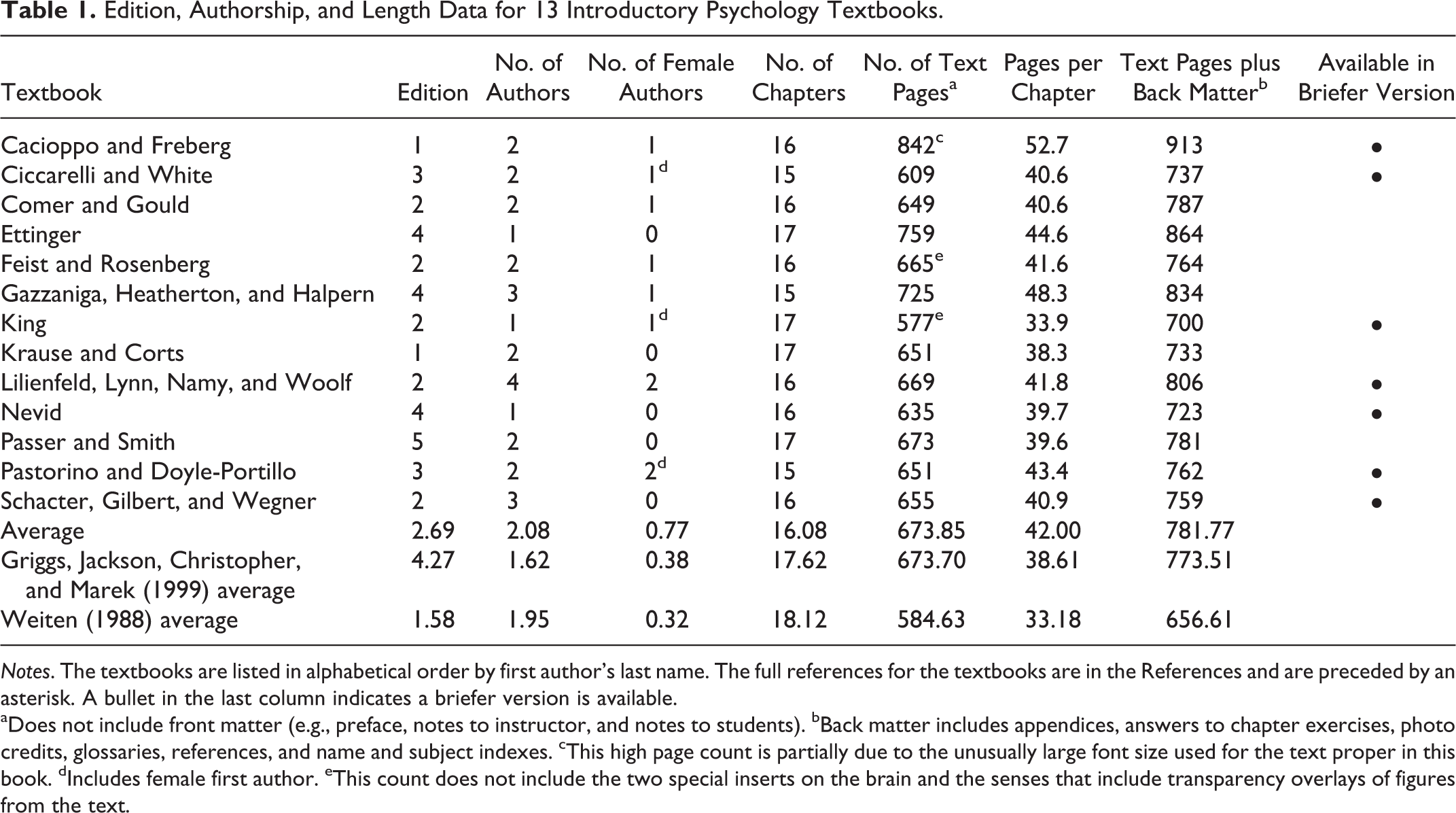
Notes. The textbooks are listed in alphabetical order by first author’s last name. The full references for the textbooks are in the References and are preceded by an asterisk. A bullet in the last column indicates a briefer version is available.
aDoes not include front matter (e.g., preface, notes to instructor, and notes to students). bBack matter includes appendices, answers to chapter exercises, photo credits, glossaries, references, and name and subject indexes. cThis high page count is partially due to the unusually large font size used for the text proper in this book. dIncludes female first author. eThis count does not include the two special inserts on the brain and the senses that include transparency overlays of figures from the text.
Our analysis of nontraditional chapter topic coverage revealed that none of the 13 texts included a chapter on diversity. Griggs et al. (1999) found that 6 (16%) of the 37 texts that they analyzed had such a chapter. Three texts (Comer & Gould, Pastorino & Doyle-Portillo, and Schacter, Gilbert, & Wegner). however, did include boxed inserts on diversity throughout the text. These were entitled How We Differ, Spotlight on Diversity, and Culture and Community, respectively. Thus, some text authors chose to integrate diversity information via boxed inserts throughout the text, but none of the authors elected to dedicate a separate chapter to it. Based on our findings, it does not appear that Hogben and Waterman’s (1997) call for improvement in both the quantity and the quality of diversity coverage in introductory texts has been heeded. Our findings on diversity coverage also seem at odds with the predictions of psychology editors at major textbook publishers in the late 1990s that cross-cultural psychology would both receive more emphasis in and likely be a strong influence on introductory texts in the next decade (Cush & Buskist, 1997).
We found that four texts (Ciccarelli & White, King, Nevid, and Pastorino & Doyle-Portillo) included chapters on sex/gender, and two (King and Krause & Corts) included chapters on I–O psychology. In addition, two texts (Ciccarelli & White and Pastorino & Doyle-Portillo) included an appendix on applied psychology. Compared to the findings of Griggs et al. (1999), the inclusion of a sex/gender chapter appears to have increased slightly (22% vs. 31%), and the inclusion of an I–O or applied psychology chapter seems to have decreased (32% vs. 15%). However, if the two appendices on applied psychology were also counted, then the 15% would jump to 31%, essentially what Griggs et al. observed.
Our content analysis identified one other nontraditional chapter topic, behavioral genetics/evolutionary psychology. A chapter on this topic was paired with the standard biological chapter on brain and behavior in the Cacioppo and Freberg and Passer and Smith texts. Thus, it would appear that behavioral genetics/evolutionary psychology is not, at least at this point in time, an emerging standard chapter topic but rather another nontraditional topic that only appears in a small set of texts. The psychology editors in Cush and Buskist’s (1997) study also included genetics and evolutionary theory among the topics that would most likely influence introductory textbooks in the next decade. Our findings provide limited evidence for this prediction.
Our examination of the extent of coverage for developmental psychology, emotion/motivation, language/thought, sensation/perception, and social psychology found that coverage of each of these topics has decreased slightly in comparison to the amount of coverage observed by Griggs et al. (1999). The average coverage for sensation/perception and social psychology is exactly one chapter versus 1.32 for both topics in Griggs et al. Developmental psychology and emotion/motivation average just slightly more than one chapter (1.18 and 1.08, respectively, vs. 1.57 and 1.23 in Griggs et al.) because two texts (Ettinger and Nevid) had two chapters on developmental psychology and two others (Comer & Gould and Ettinger) had a separate chapter on motivation and combined emotion with stress and health psychology in another chapter. The decrease in coverage for language/thought (0.83 vs. 1.09 in Griggs et al.) is probably attributable to six texts (Cacioppo & Freberg, Ciccarelli & White, Gazzaniga, Heatherton, & Halpern, King, Nevid, and Pastorino & Doyle-Portillo) combining language/thought (or just thought in one text) with intelligence in one chapter.
For the current set of 13 texts, the average number of chapters is 16.08 (see Table 1), which is less than the 17.62 observed by Griggs et al. (1999) and the 18.12 found by Weiten (1988). Thus, the average number of chapters has continued to decrease over the past three decades. This reduction in chapter count is important because a continuing criticism of introductory psychology textbooks has been that they are too long (e.g., Landrum, 2000; Nallan, 1997). In their national survey of introductory psychology teachers, Miller and Gentile (1998) found that about 90% of our introductory psychology courses are only one term in length and that teachers reported covering an average of only 68% of the text topics. Hence, having fewer chapters would seem to be much more congruent with the typical introductory course demands.
Griggs et al. (1999) also found that although the average number of chapters had decreased, the number of text pages had increased, leading to an increase in number of pages per chapter. We too found an increase in the average number of text pages per chapter. The average number of text pages per chapter was 42.00, which is more than the 38.61 observed by Griggs et al. and the 33.18 observed by Weiten. Thus, when judging text length, the average number of pages per chapter should be considered because the number-of-chapters measure taken alone can be deceiving. 3 The average number of pages per chapter ranges from 33.9 pages (King) to 52.7 (Cacioppo & Freberg) for the current set of texts. In regard to text length, briefer versions of 7 of the 13 texts are available (see Table 1) for teachers who like a particular text but think that the full-length version is too long.
With respect to including a separate chapter on research methods, 10 (77%) of the 13 texts did so, and the other three combined this material with the typical introductory chapter topics (e.g., history, perspectives, and career areas) in a chapter. Ciccarelli and White, Nevid, and Pastorino and Doyle-Portillo were the texts with combined chapters. The 77% finding is greater than the 54% observed by Griggs et al. (1999). Thus, it would appear that such a chapter is becoming more standard. Eight (62%) of the 13 texts provided coverage of statistics in the text proper; the other five texts (Ciccarelli & White, Ettinger, Nevid, Passer & Smith, and Pastorino & Doyle-Portillo) relegated statistical coverage to an appendix. For three of these texts (Ciccarelli & White, Nevid, and Pastorino & Doyle-Portillo), this may be due to the fact that they had combined introductory/research methods chapters and thus possibly not sufficient space to allocate to statistics in those chapters.
Table 2 provides the coverage information for the 16 standard introductory text topics and for the nontraditional I–O/applied psychology and sex/gender topics. Because there were no chapters on diversity, it was not included as a topic in Table 2. Coverage of behavioral genetics/evolutionary psychology was included as part of the biology topic. As in Griggs et al. (1999), the average proportion of coverage for most standard topics was confined to a range of 5% to 7%. Only the average proportions of coverage of the introduction, intelligence, and developmental psychology topics were outside of this range—4%, 4%, and 8%, respectively. In Griggs et al., the average proportions of coverage of five topics were outside this range. The average proportions of coverage for the introduction, research methods, and intelligence topics were all 4%, 9% for sensation/perception, and 10% for developmental psychology. Coverage of the introduction and intelligence topics remained at 4%; but coverage of research methods went up to 5%, possibly due to the increased percentage of texts devoting a separate chapter to this topic. Coverage of both sensation/perception and developmental psychology went down in the present study to 7% and 8%, respectively. However, there seems to be more variability in coverage across current texts for developmental psychology, ranging from 7% to 13% (SD = 1.94) than for sensation/perception with a range from 6% to 9% (SD = 0.76). This variance in coverage of developmental psychology is likely impacted by the two texts (Ettinger and Nevid) that provide two-chapter coverage of this topic. Similarly, the variability for coverage of biological psychology with a range from 6% to 11% (SD = 1.51) is probably impacted by the two texts (Cacioppo & Freberg and Passer & Smith, 2011) that provide two-chapter coverage of this topic by including a chapter on behavioral genetics/evolutionary psychology. Coverage of the remaining standard topics is not that variable except for language/thought and intelligence (SD = 1.42 and 1.61, respectively), and their variability is likely due to the fact that six of the 13 texts combine these three topics and the other seven texts do not.
Percentage of Text Devoted to Standard Chapter Topics and Industrial–Organizational/Applied and Sex/Gender for Each Textbook.
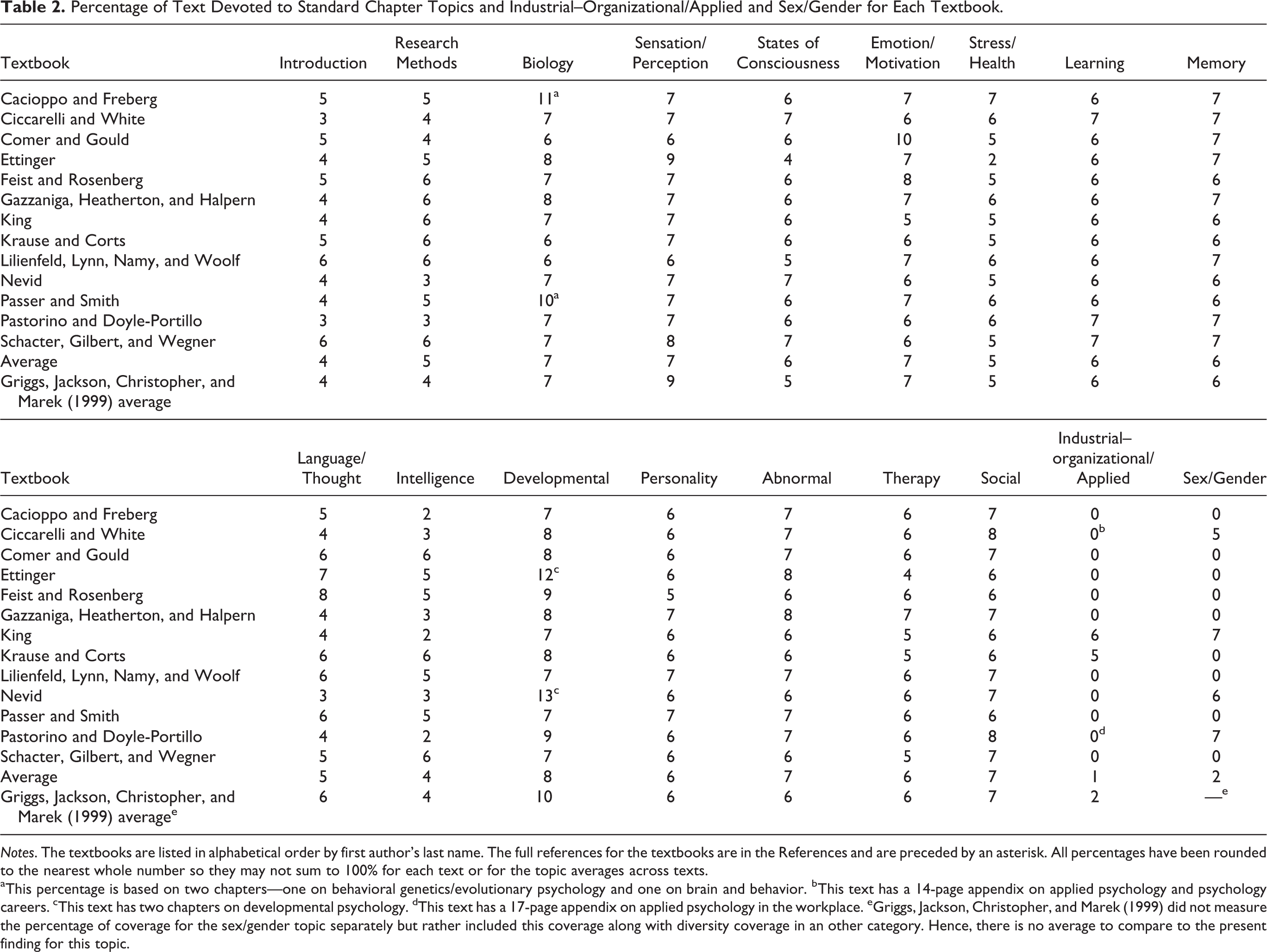
Notes. The textbooks are listed in alphabetical order by first author’s last name. The full references for the textbooks are in the References and are preceded by an asterisk. All percentages have been rounded to the nearest whole number so they may not sum to 100% for each text or for the topic averages across texts.
aThis percentage is based on two chapters—one on behavioral genetics/evolutionary psychology and one on brain and behavior. bThis text has a 14-page appendix on applied psychology and psychology careers. cThis text has two chapters on developmental psychology. dThis text has a 17-page appendix on applied psychology in the workplace. e Griggs, Jackson, Christopher, and Marek (1999) did not measure the percentage of coverage for the sex/gender topic separately but rather included this coverage along with diversity coverage in an other category. Hence, there is no average to compare to the present finding for this topic.
Summary and Conclusions
Introductory text authors of the 13 recently published full-length introductory texts analyzed in this study have reduced the typical chapter count in a text to 16. However, in doing so, they have increased the average chapter length. For example, the average chapter length for one of the texts in the present study was over 50 pages. For all 13 texts, the average chapter length was 42 pages. Thus, introductory teachers evaluating textbooks should pay just as much attention to average chapter length as to the number of chapters. In addition, it is very uncommon for any of the standard introductory topics to receive two-chapter coverage. Thus, introductory teachers wanting such extended coverage have fewer textbooks to consider for selection.
We also found that it is becoming more common to include a separate chapter on research methods and to combine language/thought and intelligence in one chapter. In addition, it appears that in texts that combine introductory material (e.g., history, perspectives, and career areas) with research methods in one chapter, coverage of statistics is often relegated to an appendix. With respect to nontraditional topics, not one text included a chapter on diversity. Five texts, however, included chapters on sex/gender and/or I–O psychology, and two others had appendices on applied psychology. Another nontraditional topic, behavioral genetics/evolutionary psychology, received chapter coverage in two texts. Thus, introductory teachers who like to use texts that include chapter coverage of any of these nontraditional topics will have fewer new texts to consider. In the case of diversity, there are none. Although coverage for most of the standard topics ranged from 5% to 7%, individual introductory teachers who desire more coverage on some topics that they emphasize and less on others that they do not emphasize in their course should be able to find textbooks within this set of 13 that satisfy their preferences.
Finally, considering the time between conducting a textbook study and its publication, we acknowledge that ongoing revision of textbooks is a shortcoming of any textbook study. However, we also note the considerable thematic, stylistic, and structural continuity across different editions of a textbook that counterbalances the ongoing revision process. By providing data on several objective measures for the 13 most recent full-length introductory textbooks, we hope that we have provided introductory teachers with sufficient objective information to use to narrow down the set of textbooks that they need to compare more intensively. Once this is done, we strongly recommend that teachers actually read these texts to compare them. We believe that there is no better way to make the final selection decision. As pointed out by Griggs (2006, p. 21), “You truly do not know a text until you read it and teach from it. Obviously, the former should precede the latter.”
Footnotes
Declaration of Conflicting Interests
The author(s) declared no potential conflicts of interest with respect to the research, authorship, and/or publication of this article.
Funding
The author(s) received no financial support for the research, authorship, and/or publication of this article.