



Abstract
Because 98% of teachers use textbooks for the introductory psychology course and the majority of introductory teachers do not assign reading beyond the textbook, examining the topical coverage allocation pattern in introductory textbooks versus that in introductory course lectures is important for our understanding of how introductory students are being educated about our discipline. We examined this relationship by comparing chapter topical allocation findings for textbooks with lecture allocation findings based upon analysis of introductory course syllabi. The two patterns of topical allocation were very similar, indicating that, for the most part, teachers teach the text (allocate lecture time to chapter topics in proportion to the space allocated to them in introductory texts). The implications for textbook selection are discussed.
Introductory psychology is the most popular course in psychology with an estimated annual enrollment in the United States of 1.2–1.6 million students (Steuer & Ham, 2008) and the second most popular college course, second only to English composition (Landrum & Gurung, 2013). Because 98% of teachers use textbooks for the introductory course and the majority of introductory teachers, even at top-ranked liberal arts colleges, do not assign reading beyond the textbook (Miller & Gentile, 1998; Oldenburg, 2005), it would appear that introductory teachers likely “teach the text.” In this context, “teach the text” means that introductory teachers allocate the amount of lecture time for the various textbook chapter topics in about the same proportions as their coverage in introductory textbooks. Therefore, topics receiving more coverage in introductory textbooks receive more coverage in lecture. In brief, introductory courses likely mimic the textbooks used for the courses.
To determine whether teachers do indeed teach the text, Griggs (2014) examined the relationship between the topical allocation patterns of introductory textbooks and lectures by comparing the textbook topical allocation findings of Griggs and Jackson (2013a, 2013b) to the lecture topical allocation findings of Homa et al. (2013) based on their analysis of 158 introductory psychology syllabi. Griggs found that the overall patterns of topical coverage allocation in lecture and in introductory textbooks were very similar. The actual percentages for both coverage patterns were nearly identical. Griggs concluded that introductory textbooks greatly impact the structure of the introductory course and teachers teach the text (allocate lecture time to topical areas in proportion to the space allocated to them in introductory texts).
However, Griggs (2014) included a caveat to his conclusions. The topical coverage comparison between textbooks and lectures employed the categorical groupings of textbook chapter topics that had been used by Homa et al. (2013) and not individual chapter topics as in the textbook studies. The categorical groupings (called “content areas” by Homa et al., 2013) for this comparison were (a) history and scope of psychology; (b) research methodology; (c) physiological, which included neuroscience, consciousness, sensation, and perception; (d) cognitive, which included learning, memory, thinking, intelligence, and language; (e) clinical, which included psychological disorders and therapies; (f) social, which included social and personality; (g) developmental; (h) “other,” which included emotion/motivation, stress/health, industrial–organizational, applied psychology, and sexuality/gender. As Griggs explained, this categorical grouping of chapter topics confounded the results because the more extensive categorical coverage (the more chapters in a categorical grouping) in the text, the higher the probability for inclusion in lecture. Thus, we do not know whether the lecture coverage allocations were due to the extent of coverage of the content (number of chapters) in the textbook or the nature of the content itself.
Because Homa et al. (2013) did not code their lecture data in terms of individual chapter topics, a direct comparison between textbook and lecture chapter topical coverage was not possible. It was the purpose of this study to provide such a comparison. Bates (2004) analyzed 107 introductory psychology course syllabi from a random sample of 51 four-year, public institutions in terms of 17 introductory textbook chapter topics, which closely align with the chapter topics used in introductory textbook analysis studies. He computed the average lecture time (in minutes) devoted to each of these topics. Thus, Bates’s data enable a direct comparison of lecture chapter topical coverage to such coverage in introductory textbooks. We hypothesized that, as in Griggs (2014), the teachers teach the text—lecture chapter topical allocation parallels textbook chapter topical allocation. If this is the case, then introductory textbooks play a major role in structuring the introductory course; and hence, as psychology teachers, we should be aware of introductory textbook topical allocation so we have a more accurate understanding of how students are being educated about our discipline.
Method
First, as in Griggs (2014), we made the chapter topic labels uniform by converting the labels used by Bates (2004) to those used in the most recent introductory textbook study (Griggs & Jackson, 2013a). Because the labeling in both studies was nearly identical, we needed only to make some minor label changes involving the combination of topics. For example, some individual topics in Bates’s study were combined (e.g., sensation and perception became sensation/perception), and two topics (language/thought and intelligence) were combined in Bates’s study so they were combined in the textbook studies for the present analysis. These label changes resulted in 16 chapter topics (given in Table 1).
Average Percentages of Chapter Topical Coverage in Introductory Psychology Textbooks and Course Lectures.
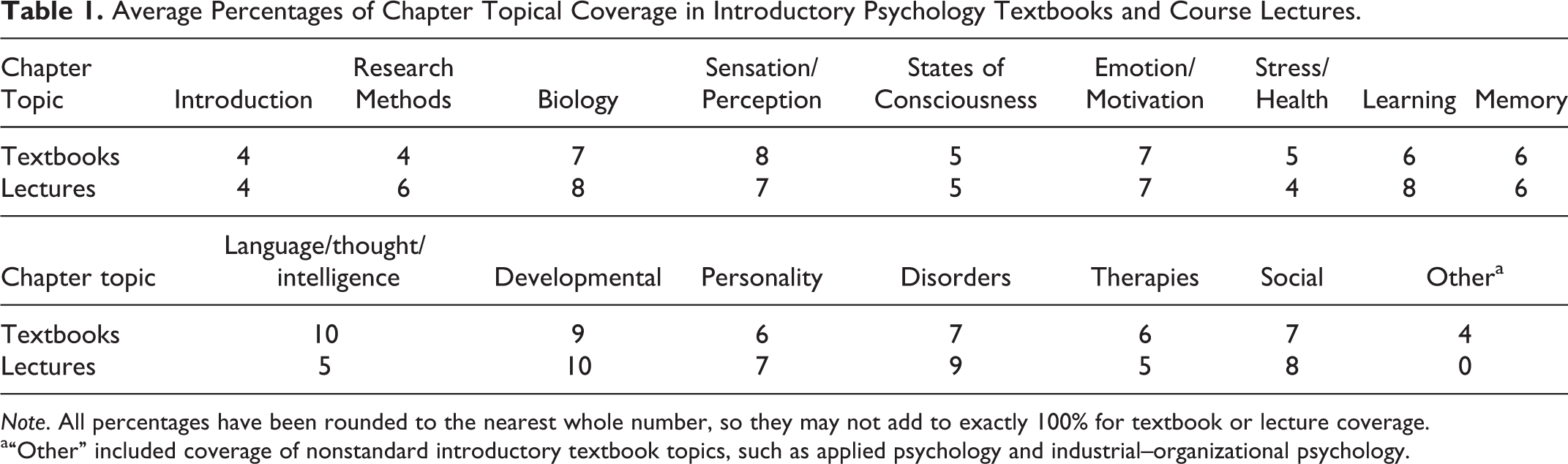
Note. All percentages have been rounded to the nearest whole number, so they may not add to exactly 100% for textbook or lecture coverage.
a“Other” included coverage of nonstandard introductory textbook topics, such as applied psychology and industrial–organizational psychology.
Homa et al. (2013) did not provide a list of the textbooks used in the courses whose syllabi they analyzed. Thus, Griggs (2014) had to compare Homa et al.’s lecture allocation data to generalized average data for introductory texts from the 2000s (Griggs & Jackson, 2013a, 2013b). Bates (2004), however, provided the list of 24 books used in the courses whose syllabi he analyzed. Thus, topical allocation data for these specific textbooks could be used for the comparison to the lecture allocation data. We decided to use the topical allocation data for the full-length versions of these textbooks because (a) the vast majority of the texts that were used by teachers (77%) were full-length versions, (b) the texts that were used in their briefer versions were not so identified, and (c) Griggs and Jackson (2013a) found that the topical allocation patterns for full- versus briefer-length versions of a text are very similar. 1 One of the texts had not been analyzed in any of the studies of introductory textbooks because it disappeared from the market soon after it was published, and another was not a textbook but rather a trade psychology book. Hence, topical allocation percentages were not available for these two texts, so we only included the other 22 textbooks in our study.
Bates (2004) did not include edition information for these 22 textbooks. Hence, we used the chapter topical coverage data from the textbook study that analyzed editions as close as possible to those likely used in the courses analyzed in Bates’s study. Coverage data for 19 of the 22 textbooks were taken from Griggs, Jackson, Christopher, and Marek (1999) because, given the 3-year revision cycle for introductory texts (Griggs, 2006), the editions analyzed in that study would be very close to those used in the introductory courses analyzed in Bates’s study. Coverage data for two textbooks were taken from Griggs and Jackson (2013b) and for one text from Griggs and Jackson (2013a) because these three texts were first published in the 2000s and the Griggs and Jackson studies provide the only coverage data available for such textbooks.
For each of the 16 chapter topics, we averaged the topical allocation coverage percentages for the 22 textbooks. These 16 average percentages were rounded to the nearest whole number. For comparison to these textbook topical allocation data, Bates’s lecture topical allocation time data were converted from average lecture time per chapter topic in minutes to average percentages of total lecture time for the 16 chapter topics. These percentages were also rounded to the nearest whole number.
Results and Discussion
The 16 average chapter topical allocation percentages for both the 22 introductory textbooks and the course lectures appear in Table 1. As hypothesized, the two patterns of topical allocation were very similar, indicating that for the most part, teachers teach the text. For 11 of the chapter topics, the allocations are either the same or only 1% different, and for three topics (research methods, learning, and disorders), 2% different. The only large differences in allocation are for language/thought/intelligence (5% less in lecture) and “other” (4% less in lecture). Why might teachers lecture less on these two topics? Lesser coverage of the topics in the “other” category would be expected, given that lecture time is limited and these topics are nonstandard topics in introductory textbooks (not included in the majority of introductory textbooks).
With respect to language/thought/intelligence, lesser coverage may not only be due to the constraint of time but also simple teacher preference. Given that memory, a major cognitive topic, is given 6% coverage, teachers may limit their coverage of these other cognitive topics. One of the topical assignment rules that Bates (2004) used may also be partially responsible. Half of the lecture time spent on language was given to the developmental domain and the other half to the cognitive (language/thought/intelligence). Congruent with lesser coverage of language/thought/intelligence in introductory course lectures, Griggs (2014) found that coverage of this topic has followed suit and decreased in introductory textbooks over the past two decades. In addition, in introductory textbooks published initially since 2000, these topics are now more frequently merged into one chapter (Griggs & Jackson, 2013a, 2013b), leading to less coverage.
As Griggs (2014) noted, contrary to the conclusions of Homa et al. (2013), developmental psychology is not one of the least-lectured-on topics but one of the most-lectured-on topics. According to Bates’s data, it is the most-lectured-on topic with a 10% allocation of lecture time, paralleling its textbook allocation of 9%. Such lengthy coverage is likely due to the breadth of developmental psychology—life span coverage of physical, cognitive, social, and personality development. Given this extensive subject matter, historically, developmental psychology was given two-chapter coverage in introductory textbooks (Griggs, Jackson, Christopher, & Marek, 1999). However, given the pressure on publishers and authors to decrease the length of and number of chapters in introductory psychology textbooks, coverage of developmental psychology has decreased to only one chapter over the past two decades (Griggs & Jackson, 2013b), but it still, however, receives the most coverage in introductory textbooks (Griggs, 2014).
In sum, because the chapter topical coverage allocation patterns for introductory textbooks and course lectures are so similar, it appears that introductory teachers, for the most part, teach the text. It is highly likely that different teachers vary in exactly which subtopics they cover within a topical area, and how much time they spend on the various subtopics, but the average overall lecture time spent on the various chapter topics maps very well onto their average coverage in introductory textbooks. Thus, introductory textbooks provide an excellent window for viewing how the introductory course is typically taught with respect to chapter topic coverage, and thereby play a major role in how our discipline is defined for introductory students.
It is important to note, however, that introductory textbook authors do not define the topical coverage allocation pattern in their texts entirely on their own. They are generally guided by introductory teacher feedback gained through publisher-solicited reviews, focus groups, and surveys about which topics and the extent of their coverage are desirable. Input is also gathered from content expert reviews and the publisher editorial staff. In sum, the topical coverage allocation pattern in an introductory textbook is the product of the author, publisher, topic experts, and introductory psychology teachers.
It is also important to note a limitation of all the textbook data used in this study. These data were all collected at the chapter level of analysis. This level of analysis may not be sufficiently accurate to capture true textbook topic coverage for broader standard chapter topics, such as biological psychology, and nonstandard chapter topics, such as cultural diversity. Discussions of such topics may be embedded throughout the text and not entirely limited to a specified chapter. Thus, future research on topical coverage in introductory psychology textbooks should employ a broader level of analysis, examining topic coverage within the text as a whole and not only at the chapter level.
A final caveat involves the age of the syllabi data from Bates (2004), roughly a decade old. Because we were able to use textbook allocation data of roughly the same age for the textbooks identified in the syllabi analysis, the relationship observed between the topical allocation data for textbooks and lectures is on solid ground. It is possible though that this relationship may have changed over the past decade. However, this would seem unlikely, given the findings of Griggs (2014) for current introductory psychology syllabi and textbook data. Although somewhat compromised by the categorical grouping analysis, Griggs’s findings are consistent with the present findings, and both Homa et al.’s (2013) and Bates’s topic allocation results are generally consistent with Miller and Gentile’s (1998) topic assignment results. Thus, the age of the data used in the present study is likely not problematic, but only future research could provide a firm answer to this question.
Given the important role of the textbook in the introductory course, informed textbook evaluation and selection would seem critical to the course’s success and one of the most important decisions that an introductory teacher makes (Chatman & Goetz, 1985). The arduous task for introductory teachers of systematically seeking to find the best texts for their introductory courses and students has often led to the stereotyping of these texts as “all the same,” which is clearly not the case (Griggs, 2006; Griggs & Marek, 2001). Stereotyping these texts will lead teachers to ignore the individual strengths and weaknesses of various texts and thus not select the best book for their course and students. Clearly, there are many different methods for selecting a textbook, and, just as there is no one-size-fits-all textbook, there is no one-size-fits-all strategy for text selection. Altman, Ericksen, and Pena-Shaff (2006) and Griggs (2006), however, do provide valuable discussions of fairly inclusive ways to go about the text selection process. Moreover, regardless of whatever selection strategy is employed, we believe that it is essential that textbook selection decisions are made systematically, thoughtfully, and with appropriate regard to the textbook’s central role in our students’ understanding of psychology.
Footnotes
Declaration of Conflicting Interests
The authors declared no potential conflicts of interest with respect to the research, authorship, and/or publication of this article.
Funding
The authors received no financial support for the research, authorship, and/or publication of this article.