



Abstract
This study empirically tested the effectiveness of a brief, inexpensive aging simulation activity to educate traditional-aged students about sensory declines and their potential causes in older adulthood development. Students in a life-span development course wore specific props (e.g., thick gloves, earplugs, and obscured glasses) to simulate neuropathy, arthritis, sensory impairment, and fatty tissues loss, while carrying out a variety of physical tasks. Pretest–posttest analyses revealed that students who engaged in the simulation activity with discussion learned far more regarding sensory changes of aging than did students who passively listened to a lecture on the topic. These results provide evidence that an economical role-playing simulation can be a successful means for teaching students about sensory changes in older adulthood.
Keywords
Traditional-aged undergraduates find it difficult to understand physical changes of aging, especially when they encounter the information only via readings and lectures (Allen & Johnson, 2009; Wurtele & Maruyama, 2013). Students enjoy experiential activities simulating the aging process (Anderson-Hanley, 1999; Clark, Foos, & Faucher, 1995; Dillon, Ailor, & Amoto, 2009; Massachusetts Institute of Technology, 2011; Taggersell, 2009; Wight, 1989), and researchers have documented the effectiveness of using expensive kits to simulate aging (Pacala, Boult, & Hepburn, 2011; Varkey, Chutka, & Lesnick, 2006), or employing longer term activities involving students from several weeks to a semester (Angiullo, Whitbourne, & Powers, 1996; Knapp & Stubblefield, 2000; O’Hanlon & Brookover, 2002). Although some have described less expensive simulation kits to provide students an opportunity to develop an awareness of the aging process (Van Son & Fitzgerald, 2012; Wood, 2002), research does not yet exist on whether these inexpensive simulations have a measurable impact on students’ learning about specific physical declines in aging. The goal of this study is to help students learn specific conceptual knowledge about sensory changes in late adulthood in addition to helping students develop a more general awareness of the challenges of aging, using inexpensive materials. Toward that end, we substantially modified Wood’s and Van Son and Fitzgerald’s simulation methodologies to structure an activity in order to ensure students would experience several specific elements of sensory change in a significantly briefer time frame (20 min). We also carefully designed an accompanying 30-min discussion activity requiring students to make connections between their experiences of sensory impairment and the specific illnesses and disabilities that may cause such declines. Furthermore, we empirically assessed the effectiveness of this specific simulation with discussion experience by conducting pretest–posttest analyses with a control group to measure precisely what knowledge students gained as a function of completing the activity.
Method
Participants
Traditional-aged students (n = 50, 42 women) in two sections of a life-span development course at a private liberal arts college participated. The same professor taught both sections, which had identical syllabi, readings, exams, and in-class multimodal learning assignments, other than the target activity. On the due date for the textbook reading assignment on late adulthood for both groups (Santrock, 2011), one section, the experimental group (n = 26, 24 women), engaged in the target 20-min aging simulation with 30-min discussion. The second section, the control group (n = 24, 18 women), listened to a 50-min lecture on physical changes in aging (e.g., neuropathy, sensory impairment, and loss of fatty tissue) and common misconceptions of aging (e.g., senility, loneliness, and stubbornness).
The Simulation Activity With Discussion
Students worked in triads, such that one person played the role of an “elderly person,” one a “nagging adolescent,” and the third a “safety guide.” The professor randomly assigned students to their roles. First, the student in the role of the “elderly person” donned a set of props, in the following order: (1) thick latex dish-washing gloves to reduce dexterity to simulate neuropathy and arthritis; (2) foam earplugs to simulate hearing impairment; (3) reading glasses of 2.75 strength to simulate cataracts and eye fatigue from presbyopia; (4) nose plugs to simulate the reduction in olfactory senses and the impact such loss has on taste; (5) 15 small beads in each shoe to simulate the discomfort related to the loss of fatty tissue.
The professor instructed the “nagging adolescent” to act as an impatient teenager might, pestering the “elderly person” to complete each task as quickly as possible. The purpose of this was to simulate the harassment and self-consciousness that elderly persons may experience on occasions when their slower pace impedes other people. In addition, the “nagging adolescent” served to ensure that the “elderly person” completed all of the tasks during the limited time frame. Finally, the purpose of the “safety guide” was to protect students from injury (e.g., intervene if the “elderly person” began to trip).
With the “nagging adolescents” and “safety guides” alongside, the “elderly persons” completed a series of tasks. First, after donning the gloves, glasses, earplugs, and nose plugs, the “elderly persons” put on a long-sleeved button-down shirts requiring fastening eight tiny buttons, then picked up 30 tiny beads one at a time to place in their shoes, and, finally, tied their shoelaces. The professor then gave each “elderly person” instructions in small print to walk to a specific location on campus (with “nagging adolescent” and “safety person” in tow) where the “elderly person” had to locate and read a second set of small print instructions. These instructions sent them to another location where they read and memorized an address before returning to the classroom by a specified time, where the “elderly persons” wrote the address on the whiteboard. In addition to requiring the “elderly persons” to read tiny print with obscured vision, each of these walks gave the “elderly persons” 20 min to experience the discomfort and instability of walking at a fast pace, up and down two flights of stairs and on grass-cracked cement, with beads in their shoes, and with obscured vision and hearing. Moreover, fastening buttons, picking up tiny beads, and writing on the white board while wearing thick gloves gave the elderly person opportunities to experience a reduction in dexterity. Finally, after students returned to the classroom, each of the “elderly persons” tasted lemon drops, raisins, cinnamon, and saltine crackers to experience specific taste genres (e.g., salty, sour, and bland) with muted senses of smell and hearing.
Immediately after the simulation, the professor led students in discussion. In addition to posing questions similar to those Wood (2002) suggested regarding emotions students experienced during the simulation, for this study the professor asked several precise questions to guide the students in making connections between their simulation experience and the particular diseases and disabilities they had studied in the reading assignment due that day (Santrock, 2011). Specifically, the professor asked students to identify which physical conditions (e.g., neuropathy, cataracts, and fatty tissue loss) each prop simulated. The professor also asked the groups of students who played each role to compare their experiences (i.e., to compare the experiences of being the “elderly person” to that of being the “nagging adolescent” or “safety guide”). Finally, the professor prompted students to discuss the illnesses and disabilities that may contribute to these specific sensory declines. The entire discussion lasted 30 min, such that students completed both the simulation and the discussion within one 50-min class period.
The Control Group Lecture
Students in the control group listened to a 50-min lecture covering the same sensory declines and contributing factors that students in the experimental group encountered in the simulation activity with discussion. The difference between the control and experimental groups was the mode of delivery for the information. The experimental group first experienced the physical impairments and then through discussion made connections between their simulation activities and the factual information they had read in their textbook. In contrast, the control group passively listened to a lecture elaborating on the identical textbook information they had read.
The Assessment
To assess learning outcomes, we collected pretest–posttest data on students’ knowledge of physical aspects of aging. We developed a 22-item multiple choice quiz on late adulthood sensory change (see Appendix A) and adapted Palmore’s (1977) Facts on Aging Questionnaire to create a separate 23-item true/false quiz on common beliefs about aging (e.g., boredom, safety, and poverty; see Appendix B). Both groups completed these measures as an unannounced pretest during the third week of the semester. Students completed the aging simulation with discussion (experimental) or lecture (control) the tenth week of the semester, and the same quiz and questionnaire as unannounced posttests one week later.
Results
A 2 (group) × 2 (test time) repeated measures analysis of variance (ANOVA) on sensory change quiz scores yielded statistically significant main effects of group, F(1, 48) = 170.30, p < .001, η2 = .780; test time, F(1, 48) = 429.31, p < .001, η2 = .899; and a Group × Test Time interaction, F(1, 48) = 332.89, p < .001, η2 = .874. Planned comparison independent sample t-tests revealed that the experimental group performed significantly better than the control group on the posttest (see Table 1), indicating that students who engaged in the simulation activity learned far more regarding sensory changes of aging than did students who passively listened to a lecture on the topic. Similarly, a 2 (group) × 2 (test time) repeated measures ANOVA on students’ scores on the common beliefs about aging quiz yielded statistically significant main effects of group, F(1, 48) = 32.20, p < .001, η2 = .401; test time, F(1, 48) = 110.75, p < .001, η2 = .698; and a Group × Test Time interaction, F(1, 48) = 68.66, p < .001, η2 = .589. Planned comparison independent sample t-tests again revealed that the experimental group’s scores were significantly more accurate than those of the control group, indicating that students who engaged in the simulation activity had a more accurate set of conceptions about aging than did students who heard the lecture.
Students’ Knowledge of Sensory Change and Aging Before and After Completing the Simulation Activity With Discussion.
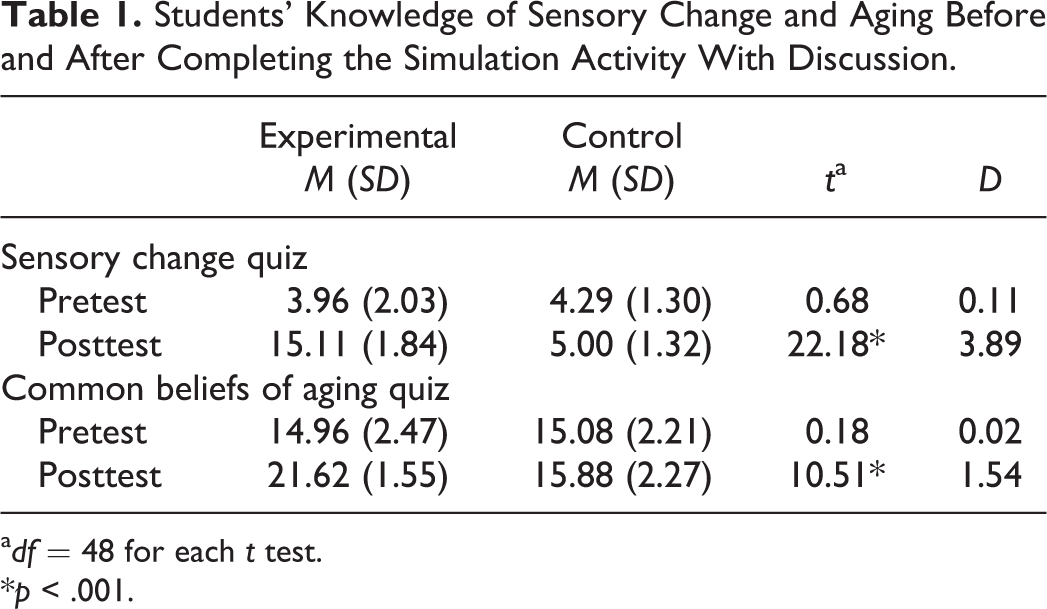
a df = 48 for each t test.
*p < .001.
Discussion
This study provides an important empirical assessment of the effectiveness of this inexpensive aging activity as a means for teaching students about sensory changes in older adulthood. One critical way this project differs from previous work is our focus on teaching several specific concepts of sensory change and the particular illnesses and disabilities that may cause such declines. This activity goes deeper than previous work (e.g., Wood, 2002), which focused on merely providing students an opportunity to develop a more general “awareness” of the potential difficulties of aging, rather than learning about specific illnesses and disabilities of late adulthood. With the ever-increasing emphasis on measurable learning outcomes, this empirical investigation provides important evidence of the effectiveness of this activity for teaching these specific concepts.
In addition, this activity is quite feasible for faculty with time and/or budget constraints. The authors purchased all supplies at a dollar store for a total cost of less than US$50.00. The entire activity with discussion fits easily into a single 50-min class period.
Another way this activity differs from those in prior simulations (e.g., Clark et al., 1995; Wight, 1989; Wood, 2002) is the addition of the “nagging adolescent” in the role play. Future research might examine whether students’ knowledge gains vary as a function of which role they play in the simulation (e.g., “nagging adolescent” compared to “elderly person”). Additionally, future research might examine whether students’ knowledge gains translate into measurable behavioral changes outside the classroom. For example, one might investigate whether students are more likely to express interest in professional work with older adults after engaging in this activity. Alternatively, one could systematically observe students interacting with older adults before and after engaging in the simulation activity to see whether students display more patience or positive interactions with older adults after experiencing the simulation.
Footnotes
Appendix A
Appendix B
Acknowledgments
We thank Marjorie Sanfilippo, Jeff Johnson, Andrew Christopher, and anonymous reviewers for valuable feedback on earlier versions of this article. We also thank Miranda Watrous for her work as a research assistant on various aspects of the project.
Authors’ Note
We presented a similar activity in a poster at the 33rd Annual National Institute on the Teaching of Psychology Conference (January 2011).
Declaration of Conflicting Interests
The authors declared no potential conflicts of interest with respect to the research, authorship, and/or publication of this article.
Funding
The authors received no financial support for the research, authorship, and/or publication of this article.