



Abstract
Previous studies have documented small differences between the bachelor of arts (BA) and the bachelor of science (BS) psychology degrees in their general education core requirements, particularly mathematics and science courses. But are there differences between the BA and BS degrees within the psychology curriculum? Using data from the Undergraduate Study in Psychology, we examined the psychology curriculum of 329 accredited, nonprofit institutions awarding bachelors’ degrees in psychology. We investigated potential differences between BA and BS programs as well as programs awarding both the BA and the BS. Overall, we discovered relatively few differences. The largest contributor to differences in baccalaureate degrees was not the type of degree but the level of the degrees awarded at an educational institution. Implications center on correcting student perceptions, faculty advising, and curricula planning regarding the differences between the BA and the BS in psychology.
By tradition and choice, institutions of higher education in the United States use different degrees to designate completion of academic programs at the baccalaureate level. The bachelor of arts (BA) degree traditionally has been awarded to undergraduates undertaking major coursework in the humanities and arts. By contrast, the bachelor of science (BS) degree traditionally has been conferred to undergraduates completing majors in natural/physical sciences and mathematics.
At the same time, there is no formal convention or standardization for awarding the BA versus the BS degree. One occasionally finds BS degrees awarded in English, history, and philosophy—academic disciplines traditionally associated with the BA degree. These BS degrees typically require students to take additional coursework in the natural/physical sciences and mathematics. Different institutions seem to make distinctions between the BA and the BS degrees at the local level.
Students and faculty alike frequently inquire about differences between the BA and the BS degree in psychology. Of course, differences generally exist between the two degrees in the general education (GE) core requirements (Perlman & McCann, 1993). But what are the differences within the psychology curriculum itself? The present study sought to identify differences in the psychology curriculum between BA and BS psychology programs.
Psychology is a hub discipline (Cacioppo, 2007) and a bridge between the natural sciences and the humanities (Halpern, 2010); as such, it sits the middle of the purported BA and BS divide. Perlman and McCann (1999) found, in a sample of 500 college catalogs, 45% of the baccalaureate programs in psychology awarded the BA only, 10% awarded the BS only, and 45% awarded both the BA and the BS. Institutions awarding only a BS degree in psychology were a rarity.
The differences between a BA and BS degree in psychology are often subtle and present themselves outside the major. In a national survey of 520 psychology departments, Perlman and McCann (1993) found that the GE core requirements for math and sciences were nearly identical, with the exception of BS psychology programs requiring slightly more three-credit math courses than BA psychology programs. Despite a statistically significant difference, the median and mode of three-credit required math courses were 1.0 for both BA and BS programs. The authors concluded that the statistical difference was meager, what we characterize as a dubious distinction.
We located only a single study that empirically examined variances in psychology coursework between BA and BS programs. Messer, Griggs, and Jackson (1999) conducted an analysis of the psychology curriculum using course catalogs of institutions found in the Carnegie Foundation for Advancement of Teaching database. Program information and course descriptions of undergraduate psychology programs were drawn from the 1993-1994 College Catalog Collection (Career Guidance Foundation, 1994). Catalog descriptions and course requirements of the BA and BS psychology programs were generally equivalent, with the exception that the BS degree required more statistics and method courses (M = 2.55 vs. M = 1.96) than general degree types (a category which included the BA degree). Despite finding a statistically significant difference in the number of statistics and method courses, the authors concluded that they found nothing substantial.
Although there is a dearth of research evidence on the differences between BA and BS psychology programs, public perceptions are plentiful and apparently unburdened by the lack of research evidence. Common perceptions purport that the BA is intended for individuals who wish to enter the workforce immediately upon completion of the degree, whereas the BS is intended for individuals who plan to pursue rigorous graduate training in psychology. Another popular claim is that students who earn a BA in psychology will be better suited for careers outside of psychology (such as law), whereas students who earn a BS will be best served for careers in medicine or science. Perhaps the most perplexing is that the BS in psychology is superior to the BA in terms of future employment opportunities and admissions into graduate school. To our knowledge, there are no data to support such claims.
The inconsistency between the research evidence and public perception on the differences between BA and BS psychology programs warrants further investigation. Are the differences between BA and BS psychology degrees meaningful or dubious? This study was designed to investigate that question.
Method
In 2014, the American Psychological Association (APA) launched the Undergraduate Study in Psychology (USP) to gather national data on the undergraduate psychology curriculum and program outcomes (Norcross et al., in press). The USP questionnaire was a multipage, electronic survey comprised of two sections. The first section asked program directors about the psychology courses offered and required at their institution, the psychology minor, and tracks/concentrations. The second section asked about program learning goals and assessment measures. Core results on the introductory course, baccalaureate curriculum, the psychology minor, tracks/concentrations, learning goals, and assessment methods have been presented elsewhere (Norcross et al., in press); however, specific differences in these areas for BA and BS programs have not been heretofore addressed.
The population of interest was the 2,988 regionally accredited, nonprofit U.S. institutions included in the Carnegie Foundation for the Advancement of Teaching (2010) database, which offer undergraduate education in psychology. Personalized e-mails containing individualized links were sent to a random sample of 1,000 program directors and department chairs, inviting them to complete the USP. The total response rate was 45.2%. For the baccalaureate institutions used in this study, the response rate was 56%.
The USP database encompassed five strata to capture the multiple contexts in which undergraduate psychology is taught: (a) institutions awarding only an associate degree, (b) institutions primarily awarding associate degrees but also awarding bachelor’s degrees, (c) institutions awarding bachelor’s degrees only, (d) institutions awarding bachelor’s and master’s degrees, and (e) institutions awarding bachelor’s, master’s, and doctoral degrees. Only institutions from strata c, d, and e were used in this study because institutions surveyed from strata a and b did not award bachelor’s degrees.
In this study, we interchangeably refer to the different strata as “institution type” and “level of degrees awarded”; however, the Carnegie Foundation for the Advancement of Teaching (2010) database names this variable differently.
Results
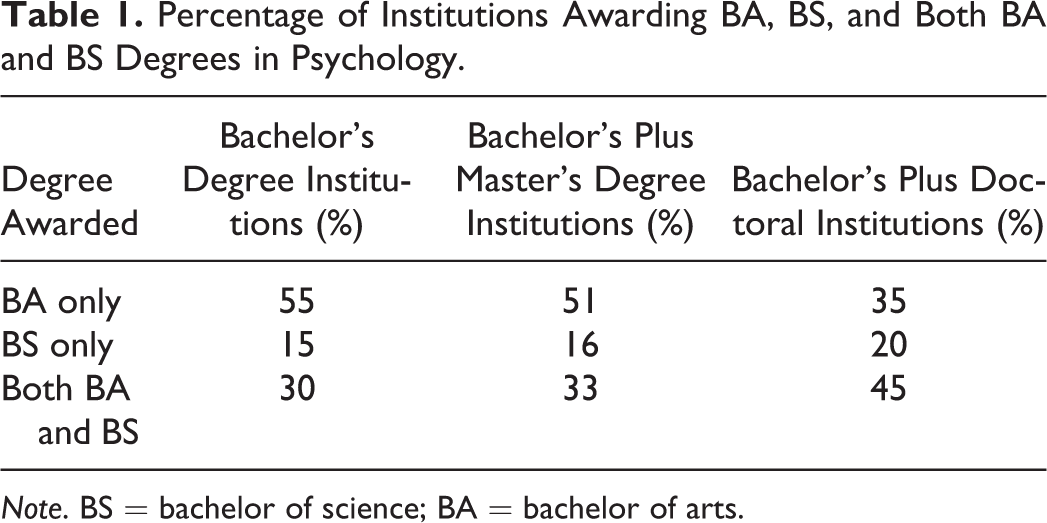
Three hundred twenty-nine institutions awarding a bachelor’s degree in psychology were included in this study: 48% (n = 159) awarded a BA, 17% (n = 55) a BS, and 35% (n = 115) both a BA and BS, hereafter referred to as “both” programs. Of interest was the apparent trend for proportionally more undergraduate psychology programs to award BS degrees in recent years. During the 1990s (Perlman & McCann, 1999), it was approximately 10%, and in 2014, it was 17%.
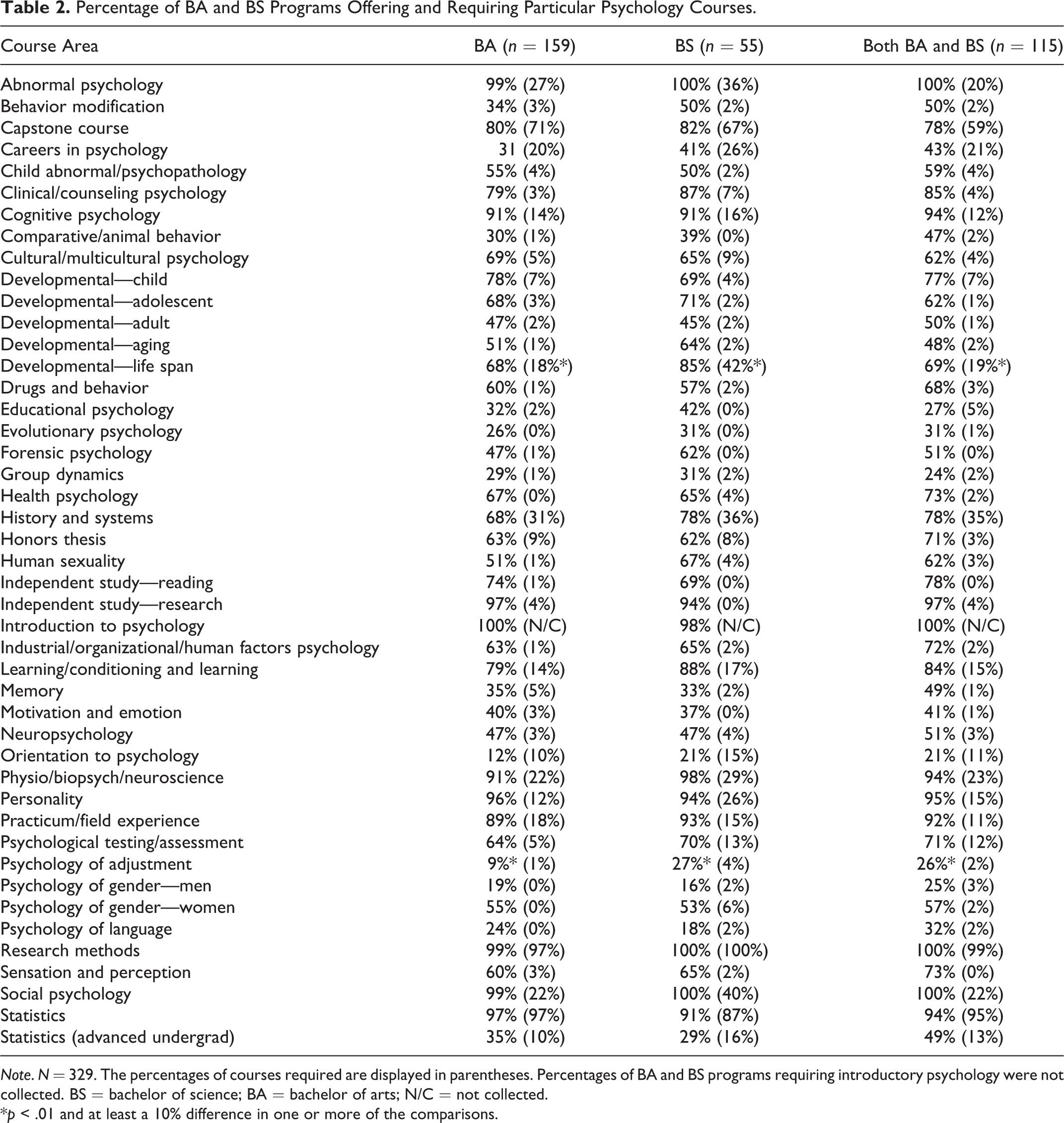
We systematically examined 213 variables related to the psychology curriculum for differences among BA, BS, and both BA and BS programs. Given the large number of comparisons—a Bonferroni bonanza—we defined a rule of significance as a statistical test resulting in a p value less than .01 and a 10% difference between at least one of the comparisons.
There was a tendency for doctoral-granting institutions to offer proportionally more of both BA and BS programs in psychology than the other two types of institutions, as shown in Table 1. However, a χ2 analysis did not reveal a statistically significant difference (p = .10) and thus we do not consider the level of programs awarded to substantially confound the results. At the same time, we decided to analyze psychology curriculum by the type of institution.
Percentage of Institutions Awarding BA, BS, and Both BA and BS Degrees in Psychology.
Note. BS = bachelor of science; BA = bachelor of arts.
The level of degrees awarded by an educational institution can also be conflated with its public or private status. Private institutions were more likely than public institutions to award bachelor’s degrees only (46% vs. 15%), and public institutions were more likely than private institutions to award doctoral degrees (36% vs. 16%; p < .01). In the sample as a whole, 56% of baccalaureate programs were located at public institutions and 44% were located at private not-for-profit institutions. Private for-profit institutions were not sampled in the USP (Norcross et al., in press), thus, they were excluded in the present study.
Overall, we discovered relatively few differences among BA, BS, and both programs within the psychology curriculum. There were no differences observed in the titles of “psychology” programs, number of psychology credits required for the baccalaureate degree, prevalence of a psychology minor, incidence or types of tracks/concentrations, or the structure of the introductory course. Below, we summarize the differences among BA, BS, and both BA and BS programs, bearing in mind that these are the exceptions rather than the rule.
Offered and Required Courses by Degree Type
The first section of the USP questionnaire asked program directors about the psychology courses offered and required at their respective institutions. Table 2 presents the percentages of BA, BS, and both BA and BS programs offering particular psychology courses. The percentage of those programs requiring psychology courses are displayed adjacently in parentheses. In terms of the offered courses, psychology of adjustment emerged as the only course reaching our rule of significance: BA programs were less likely to offer this course than either the BS or both programs (9% of BA programs, 27% BS programs, and 26% both programs). In terms of required courses, there was also only a single course that reached statistical significance: BS programs were more likely to require developmental—life span than BA only and both programs. However, it is possible that this finding is potentially confounded by the many undergraduate programs that require students to choose a single developmental course among many developmental offerings.
Percentage of BA and BS Programs Offering and Requiring Particular Psychology Courses.
Note. N = 329. The percentages of courses required are displayed in parentheses. Percentages of BA and BS programs requiring introductory psychology were not collected. BS = bachelor of science; BA = bachelor of arts; N/C = not collected.
*p < .01 and at least a 10% difference in one or more of the comparisons.
The USP questionnaire also asked program directors about the prevalence of labs accompanying each of the courses listed in Tables 2 and 3. We chose to examine only the five courses—research methods, statistics, behavioral neuroscience, cognitive psychology, and learning/conditioning—offering labs at least 20% of the time because of the relatively low prevalence of labs accompanying psychology courses. There were no significant differences between BA and BS programs in the percentage of programs offering labs. In sum, in 93 comparisons of offered and required psychology courses (and the five labs) by degree type, only two statistically significant differences were found.
Percentage of Baccalaureate Programs Offering and Requiring Particular Psychology Courses by Level of Degrees Awarded.

Note. N = 329. The percentages of courses required are displayed in parentheses. Percentages of BA and BS programs requiring introductory psychology were not collected. BS = bachelor of science; BA = bachelor of arts; N/C = not collected.
*p < .01 and at least a 10% difference in one or more of the comparisons.
Offered and Required Courses by Level of Degrees
Although we did not consider the level of degrees awarded to substantially confound the results (Table 1), we investigated potential differences between psychology coursework among institutions awarding bachelor’s degrees only, institutions awarding bachelor’s and master’s degrees, and those awarding bachelor’s, master’s, and doctoral degrees. Table 3 presents the percentage of institutions from these three strata offering and requiring particular psychology courses. As in the previous table, the percentages of required psychology courses are displayed in parentheses.
Bachelor’s programs in doctoral-granting institutions were more likely to offer 12 psychology courses than bachelor’s only and bachelor’s plus master’s institutions. Bachelor’s plus master’s institutions were more likely to offer courses in behavior modification, comparative psychology, and developmental—aging. Bachelor’s only institutions were more likely to offer a capstone course and educational psychology than institutions in the other two strata.
Two courses were differentially required by baccalaureate psychology programs in institutions awarding different levels of degrees. A capstone course was more likely to be required by bachelor’s only institutions (80%) compared to bachelor’s plus master’s (69%) and bachelor’s plus doctoral institutions (42%). The other course, history and systems, was required by more bachelor’s plus master’s institutions (41%) than bachelor’s only (36%) and bachelor’s plus doctorate institutions (15%).
No significant differences were observed between the BA and the BS programs in the frequency of psychology labs offered. In the 93 comparisons of offered and required courses (and labs) by the level of degrees awarded, 19 emerged as statistically significant.
Discussion
This study identified meager differences in the psychology curriculum among representative BA only, BS only, and BA plus BS psychology programs in the United States. When asked about the difference between a BA and a BS degree in psychology, faculty can respond with evidence-based certainty that there are a couple of differences in math GE core requirements but not many differences within the psychology curriculum itself.
Our 2014 results do not correspond with the 1994 findings of Messer and colleagues (1999). They found that BS programs required more statistics and methodology courses than general degree types. By contrast, we found no differences among BA and BS psychology programs in the percentage of programs offering or requiring courses in statistics or research methods. Indeed, virtually all baccalaureate programs now require a course in statistics (96%) and research methods (98%; Norcross et al., in press). Whatever differences existed in the 1990s have apparently vanished.
Our results suggest that the differences in undergraduate psychology coursework do not depend on the degree type so much as the level of degrees awarded by educational institutions. We found only two differences in the offered and required psychology courses among BA, BS, and both programs. By contrast, we found 19 significant differences—almost 10 times as many—in the same courses among institutions of different levels of degrees awarded.
Public perceptions on the differences between BA and BS programs advance many dubious distinctions. Claims about preparation for graduate training and future employment opportunities have serious implications for students pursuing undergraduate degrees in psychology. At the same time, the extant empirical evidence indicates there are few differences between BA and BS psychology degrees. These common claims may reflect a long-standing perception rather than contemporary reality.
Our results do not suggest that either degree will lead to meaningful distinctions in psychology coursework. The data show that virtually all psychology majors, regardless of the type of baccalaureate degree, are required to take courses in statistics and research methods. Outside of these required courses, programs seem to provide students with a menu of courses for them to choose among (Norcross et al., in press; Stoloff et al., 2010). Students seeking exposure to a wider variety of psychology courses may consider attending a doctoral-granting institution rather than choosing between the BA and the BS degrees.
Perhaps we and previous researchers (Messer, Griggs, & Jackson, 1999; Perlman & McCann, 1993) are not looking at the correct variables. Rather than differences in the number of required, nonpsychology math and science courses, we suspect that the differences between the BA and the BS psychology degrees lie in the difficulty of these courses. Students earning a BS in psychology may be required to take math and science courses of higher difficulty (e.g., calculus vs. precalculus or biology for biology majors vs. biology for biology nonmajors) compared to students earning a BA in psychology.
To investigate this possibility, we conducted a brief, informal survey of members of the Society of Multivariate Experimental Psychology. The survey asked whether their psychology department awarded the BA, BS, or both degrees and then on the content of the math courses required for the degree. Nineteen members, all from doctoral-granting institutions awarding the BS and/or BA degree, responded. At least one calculus course was required by the majority of BS programs. By contrast, almost no BA programs required a calculus course. Caution is advised here as these are specific and larger types of institutions in which many of the doctoral faculty may not be intimately familiar with the undergraduate curricula.
Alternatively, the distinction between BA and BS psychology programs may not reside in the particular courses offered or required, but instead in their learning goals and outcomes. The APA Guidelines for the Undergraduate Psychology Major: Version 2.0 (2013) “captures a set of optimal expectations for performance by undergraduates who are engaged in the study of psychology” (p. 3). Eighty-two percent of baccalaureate programs incorporate the Guidelines 2.0 in some way to develop learning goals and outcomes (Norcross et al., in press). The learning goals established by BA and BS programs might prepare students differently for graduate study in psychology and the professional workforce.
Recent efforts to promote psychology as an Science, Technology, Engineering, and Mathematics (STEM) discipline (APA Presidential Task Force, 2010) may impact the degree differentiation. STEM disciplines such as biology, chemistry, and physics are consensually perceived as BS degrees. Yet, our results demonstrate that psychology programs nationwide offer more BA degrees than BS degrees. Furthermore, STEM disciplines routinely provide a two-semester introductory sequence with required laboratories. However, 92% of higher institutions teach psychology as a single-semester course, and 90% of undergraduate psychology programs do not offer a lab for their introductory course (Norcross et al., in press). These discrepancies may perpetuate psychology’s inconsistent recognition as an STEM discipline in undergraduate education.
Future research on BA and BS psychology programs should pursue several avenues. First, research could examine differences in the content difficulty of the required GE core math courses. Results of our informal survey suggest a difference here between BA and BS programs, but they do not constitute sufficient empirical evidence. Second, research could explore differences in student learning goals and outcomes between BA and BS psychology programs. Such investigations may resolve competing claims about preparation for graduate training and employment opportunities. Third, research could compare our survey results with courses listed in course catalogs. The survey method may reflect errors in reporting (Norcross et al., in press; Stoloff et al., 2010), thus confirmation with course catalogs may produce more accurate data.
The purported differences between the BA and BS within the psychology curriculum strike us as dubious and outdated. Faculty advising undergraduates about distinctions between the BA and the BS within psychology can accurately say there are few. Our results suggest that there are virtually none; rather, any differences between the two degrees are largely attributable to the level of degrees awarded by educational institutions.
Footnotes
Authors’ Note
Portions of these results were presented at the 2015 convention of the American Psychological Association.
Declaration of Conflicting Interests
The authors declared no potential conflicts of interest with respect to the research, authorship, and/or publication of this article.
Funding
The authors received no financial support for the research, authorship, and/or publication of this article.