



Abstract
It is important to assess periodically how introductory textbooks portray our discipline because introductory psychology is the most popular psychology course, almost all teachers use textbooks for it, and textbooks play a major role in defining the course for students. To do so, past studies have used textbook citation analyses. We analyzed current textbooks to update the citation findings of these studies for the most cited articles, books, and psychologists. Many highly cited articles and books have decreased in citation frequency, likely due to a currency bias and authors’ citation preferences. Freud had the highest citation page count, reinforcing students’ misconception of his importance in contemporary scientific psychology. Our findings should help teachers in making choices about course content and emphases.
Introductory psychology is a popular course, enrolling between 1.2 and 1.6 million students a year (Steuer & Ham, 2008), and may be the only psychology course taken by most of these students. Because the vast majority of introductory teachers use textbooks for the introductory course (98%; Miller & Gentile, 1998), introductory textbooks play a major role in defining the introductory course for students. In fact, in his classic book on teaching, McKeachie (2002) pointed out that “research on teaching suggests that the major influence on what students learn is not the teaching method but the textbook” (p. 14). It is therefore essential to assess periodically how these textbooks are portraying our discipline. What articles and books are consistently cited in introductory textbooks? Whose work is given prominent coverage in introductory textbooks? Is there a currency bias in citation in introductory textbooks? To answer such questions about content coverage in introductory textbooks, previous researchers have used citation analyses of the reference sections and name indexes in these texts (e.g., Gorenflo & McConnell, 1991; Griggs & Proctor, 2002; Knapp, 1985).
A large citation analysis study analyzed the reference sections in a sample of 24 introductory textbooks published between 1985 and 1989 (Gorenflo & McConnell, 1991). These researchers identified 37,590 individual bibliographic entries in the reference sections, but, surprisingly, not one specific journal article was cited in all of the texts. In fact, only 11 articles were cited in at least 80% of the texts and 40 articles in at least a simple majority (more than 50%) of the texts. 1 These findings corroborate Griggs and Marek’s (2001) conclusion after doing a systematic review of the extant research on introductory textbooks, that the perceived similarity of these texts was a case of stereotyping and that these texts were far more dissimilar than similar.
Gorenflo and McConnell (1991) also found that the names of many historically eminent psychologists—Freud, Piaget, and Skinner, to name but three—were missing from the set of most frequently cited articles. To explain this finding, Gorenflo and McConnell suggested that cited references to the work of such psychologists were primarily to their books and not their research articles. Griggs, Proctor, and Cook (2004) tested Gorenflo and McConnell’s proposal that historically eminent psychologists are represented in introductory textbooks more via book than article citations by examining the commonality of book citations in introductory textbooks. Griggs et al. hypothesized that the books of influential psychologists such as Freud and Skinner should be more commonly cited than their articles because they have more impact than their journal articles (Heyduk & Fenigstein, 1984; Simonton, 2002). However, Griggs et al. also pointed out that because some historically eminent psychologists, such as Freud and Piaget, have numerous books that could be cited, different text authors may prefer to cite different books, thereby lessening the commonality of citation for these psychologists. In addition, the currency citation bias—the emphasis on currency of referencing in introductory textbooks (e.g., Blumenthal, 1990–1991; Griggs et al., 2004; Weiten & Wight, 1992)—may reduce the citation to the books of these historically eminent psychologists.
Given this currency bias in citation, Griggs and Jackson (2007) examined the citation status of the 40 articles that Gorenflo and McConnell (1991) identified as cited in a simple majority of introductory textbooks from the late 1980s. How many of these articles had already been impacted by this emphasis on citation currency? Only 22 (55%) of the 40 articles still met this criterion, and only 7 (18%) were cited in 80% or more of the sampled textbooks. In further support for the currency citation bias, the majority of articles (25 of 40; 63%) had decreased in citation frequency. In sum, it appears that this currency citation bias can impact article citation in introductory textbooks.
Next, we consider whether this currency bias is also operating in book citation in introductory textbooks. Gorenflo and McConnell (1991) did not address this question, but Griggs et al. (2004) did so, along with the question of whether there is any more commonality in book citation than what was observed for article citation. Consistent with the findings of Gorenflo and McConnell, Griggs, et al. (2004) found little commonality in book citations in their sample of 15 texts (see Table 1, p. 114). Seventy percent of more than 3,000 unique book citations were cited in only one text, no book was cited in all of the texts, and only 17 books met the commonality criterion of citation in at least 80% of the texts. Of these 17 books, 7 were by historically eminent psychologists, but most eminent psychologists of the 20th century were missing. Only 8 of the 99 most eminent psychologists of the 20th century listed in Haggbloom et al. (2002) had a book cited in 80% or more of the sampled introductory texts. Of note, none of Freud or Piaget’s books was cited in 80% or more of the texts. However, as Griggs et al. suggested, different text authors cited different books for these two psychologists. Freud had more references to his books (55) than anyone, but the references were to 21 of his books. Similarly, Piaget had 42 citations to 16 of his books. With respect to the emphasis on currency of citation, Griggs et al. (2004) found that this was the case (see Table 3, p. 115). Forty-four percent of the more than 3,000 uniquely cited books were published in the 1990s and another 25% in the 1980s. Thus, as Gorenflo and McConnell observed for article citation, Griggs et al. found both little commonality and an emphasis on currency in book citation for introductory textbooks.
Article and book citation analyses are beneficial in identifying the most cited articles and books in introductory textbooks, but they do not provide a measure of the extent of coverage of a psychologist’s work within these textbooks. An analysis of name indexes to compute the total citation pages for psychologists, however, does provide such a measure. It is a metric for deciding the degree to which introductory textbook authors think that a psychologist’s work is important (e.g., Haggbloom et al., 2002). Pursuing this goal, Griggs and Proctor (2002) examined the name indexes of 10 introductory textbooks published between 1999 and 2001 and counted the number of page citations listed for each name in the texts’ indexes. In stark contrast with the prior analyses of article and book citations in introductory textbooks, Freud was cited most often. His citation average was 28 pages per text, which was more than twice that for Piaget, who was second on the list followed by Skinner. In fact, 8 of the top 10 were historically prominent researchers. One of these eight, Darwin, was not a psychologist, but his appearance on the list was likely due to the emerging coverage of the evolutionary psychology approach in introductory texts at that time.
Griggs and Proctor’s (2002) findings indicate that although the publications of these historically eminent psychologists, especially their articles, may not appear on the most frequently cited lists for introductory texts, their work receives ample coverage in these textbooks. However, Griggs and Proctor also found that four contemporary psychologists (Ronald Kessler, Robert Plomin, Robert Sternberg, and Shelley Taylor) were in the top 15, and none of these had been in the top 15 in Knapp’s (1985) earlier name index citation study. Given that the textbooks that Griggs and Proctor examined are now 14 to 16 years old and that they provided a longer list than Knapp did, an analysis of current introductory psychology textbooks for the top 25 psychologists on their list would likely reveal a different rank ordering for total citation pages, giving us a more up-to-date picture of which of these prominent psychologists current introductory textbook authors tend to cite more often.
Current citation data are important because they will allow teachers to compare their own course emphases and coverage with those of introductory textbook authors. Because introductory textbooks are encyclopedic in nature and introductory courses are overwhelmingly one-term courses (Miller & Gentile, 1998), an entire introductory text is difficult, if not impossible, to cover in the introductory course. Current citation coverage data would provide one source of information for teachers to consider in making their decisions about what to teach. Secondly, a conflict between the emphases in their courses versus those reflected in current citation data in introductory textbooks might be considered cause for a reassessment of course content coverage. Topics that were previously not assigned might become part of the course. For example, if the total page citation count for Freud is greater than for any other psychologist, as Griggs and Proctor (2002) found, and a teacher normally devoted minimal coverage to Freud, that teacher might consider extending their coverage of Freud. Alternatively, a teacher might consider having students rely on the text to learn about Freud’s work and theory and then spend class time putting his theory into its proper contemporary perspective, discussing criticisms and the theory’s nonscientific nature. In brief, current citation data should prove helpful to introductory teachers in making course coverage and lecture choices either more consistent with or complementary to textbook content coverage.
Because of its large yearly enrollment, more textbooks are available for adoption in the introductory psychology course than for any other psychology course. Thus, we decided to use a relatively large text sample. We settled on a sample size of 20. Given this sample, we decided to maximize the value of our study to teachers not only by updating the Griggs and Proctor (2002) index citation study (our main purpose) but also by updating the latest book citation study (Griggs et al., 2004) and article citation study (Griggs & Jackson, 2007). Study 1 is concerned with current article citation, Study 2 with current book citation, and Study 3 with current total page coverage of individual psychologists’ work. Hence, we are doing a complete citation analysis redux.
Study 1
Griggs and Jackson (2007) provided citation frequencies for the 40 articles that Gorenflo and McConnell (1991) found to be in a simple majority (greater than 50%) of their textbook sample. However, only 22 of these articles remained in a simple majority of Griggs and Jackson’s text sample. Thus, to update their findings, we used these 22 articles for our study.
Method
Our textbook sample included the latest editions of 20 current introductory psychology textbooks. The most recent copyright dates of 16 of these texts were 2013–2015, the current 3-year revision cycle for introductory textbooks at the time of this study. We included four texts with a 2016 copyright date in the sample because they were already published and available when the present study was conducted. Complete reference information for all 20 texts is given in Appendix A. As a control measure to control for any textbook-age bias that might exist and to ensure that our text sample was representative of the introductory textbook market, we structured the text sample so that it included 10 older (initial copyright before 2000) textbooks and 10 newer (initial copyright after 2000). The edition numbers of the 20 sampled textbooks ranged from 1 to 20 (M = 6.7 and Mdn = 5.5).
We identified the 22 articles cited in more than 50% of the textbooks that Griggs and Jackson (2007) examined and alphabetized them by first author’s last name. Next, we tabulated the citation frequency for each of these articles in the reference sections of our text sample. The 22 articles are listed in Appendix B.
Results and Discussion
Because our study used a different size textbook sample than did Griggs and Jackson (2007), we converted the citation frequencies in both studies to percentages so that we could directly compare the findings. Table 1 provides these two sets of citation percentages. More articles decreased in citation rate in the present study than increased relative to the citation rates that Griggs and Jackson observed. The citation rate of 13 articles (59%) decreased (M decrease = 11.8%, Mdn = 12%, and the range was 1–22%). The citation rate for two articles (9%) remained the same, and the rate for seven articles (32%) increased (M increase = 5.1%, Mdn = 2%, and the range was 2–16%). These changes are similar to the pattern found by Griggs and Jackson when they compared their citation findings to those of Gorenflo and McConnell. Sixty-three percent decreased, 10% remained the same, and 28% decreased.
In the present study, only 7 of the 22 articles (32%) were cited in 80% or more of the 20 textbooks. These are the same seven articles that Griggs and Jackson (2007) found were cited in 79% or more of their text sample. None of these seven articles were cited in all 20 textbooks. Miller (1956) was cited in 19 of 20 textbooks. The textbook that did not cite this article in the reference section discussed it in the text, but in a manner for which citation was deemed unnecessary. Three articles were cited in 17 textbooks and three others in 16 textbooks. Of the remaining 15 articles, 6 were no longer cited in more than 50% of the sampled texts. Thus, only 16 of the 22 articles (73%) were cited in at least a simple majority of the texts. This decrease corroborates the findings of Griggs and Jackson, but it is not as large as what they found, 27% versus 45%.
Citation Percentages for the 22 Articles Analyzed in Study 1 and Griggs and Jackson (2007).
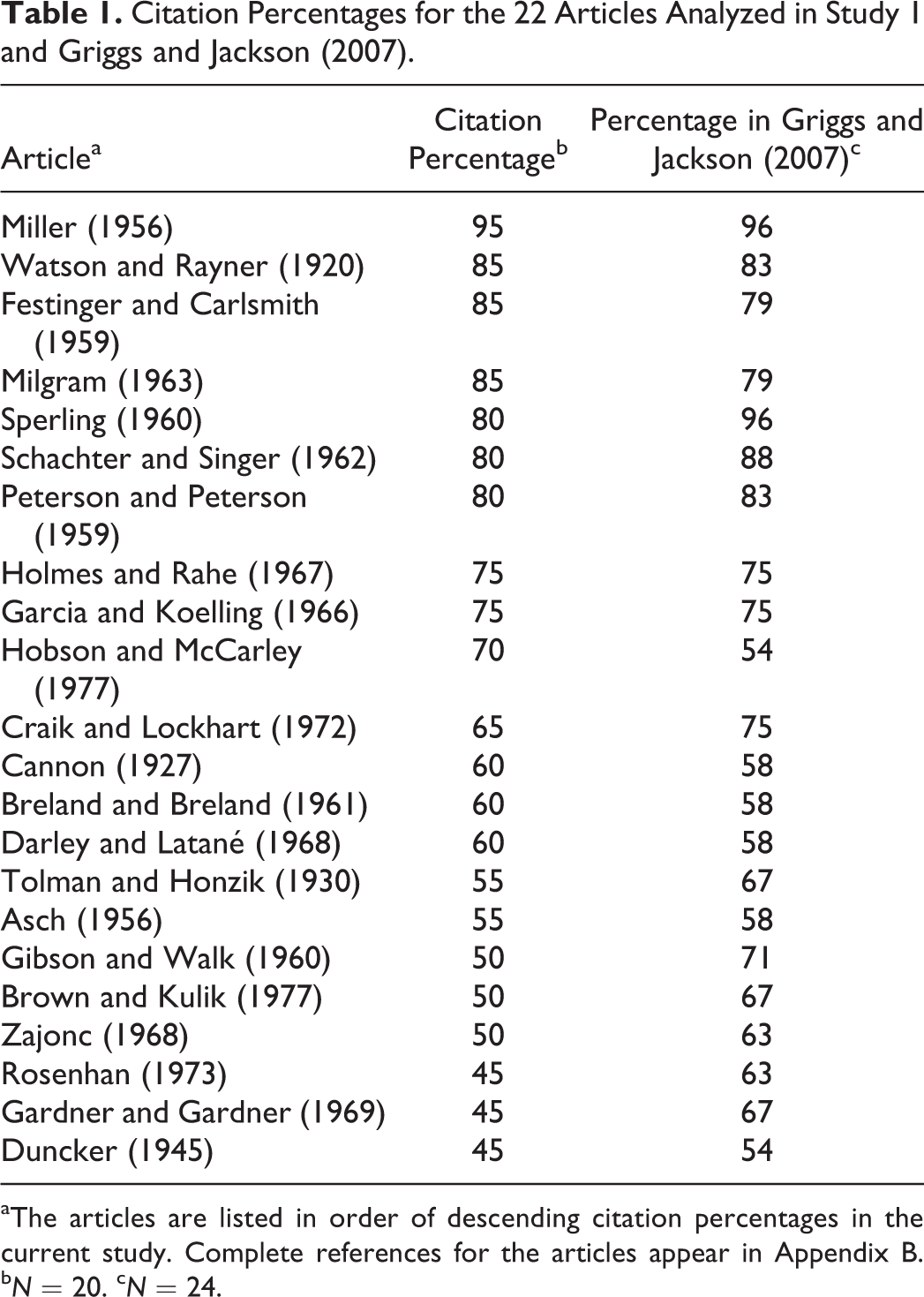
aThe articles are listed in order of descending citation percentages in the current study. Complete references for the articles appear in Appendix B. b N = 20. c N = 24.
If the two articles in Griggs and Jackson (2007) with a 79% citation rate are included, the seven articles currently cited in at least 80% of the text have been cited at this level for more than a decade, and given that Gorenflo and McConnell’s text sample spanned 1985–1989, four of them for almost 30 years. Why? Three of these four articles (i.e., Miller, 1956; Peterson & Peterson, 1959; Sperling, 1960) are concerned with information processing in human memory, specifically with characteristics of the seminal three-stage model of memory that Atkinson and Shiffrin proposed. Discussion of this model and its characteristics is an essential part of the memory chapter in introductory textbooks, and these articles were essential in defining the characteristics of the three stages in the model. Sperling demonstrated the existence of the first stage—sensory memory, specifically iconic sensory memory, and its fleeting photographic nature; Peterson and Peterson demonstrated that the second stage, short-term memory, was short lived—less than 30 s; and Miller discussed the storage capacity of short-term memory—the magic number 7 ± 2, in this case chunks of information. The fourth article, Schachter and Singer (1962), is a classic in the study of emotion because it led to the two-factor theory of emotion and demonstrated the importance of cognitive processing in our ability to identify emotions. The other three articles that met the 80% citation criterion in the present study are also classic studies. Two are classics in social psychology, Festinger and Carlsmith (1959) and Milgram (1963), providing empirical evidence for two major findings in social psychology, cognitive dissonance and obedience to authority, respectively. The third, Watson and Rayner (1920), is a classic study in behavioral psychology (often referred to as the Little Albert study) that played a significant role in popularizing the behavioral approach in psychology. In sum, these seven articles played critical roles in the development of some major theories of human behavior and cognitive processing and thus remain essential to discussions of these theories.
Similar to the articles that remained above the 80% citation criterion level, other articles on the list also played important roles in our understanding of human behavior and cognitive processing. Why then were they below this criterion level? One reason is authors’ citation preferences—there are multiple articles that could be cited in support of a specific claim and individual authors may prefer to cite different articles, thereby lowering the citation rate for each article. Good examples are the Craik and Tulving (1975) article instead of the Craik and Lockhart (1972) article and Asch (1951), (1952), or (1955) instead of Asch (1956). We checked the reference sections in the 20 introductory textbooks for these alternative articles, and indeed, they were cited often enough by themselves to reduce the citation counts for the articles that used to be on the list but not often enough to make the list themselves.
In other cases, the currency citation bias and authors’ citation preferences working in concert may explain the lower citation rates of some of the articles, especially those that fell below the simple majority criterion. A good example is Rosenhan (1973). Rosenhan’s study was concerned with the validity of the diagnostic process used to classify people with mental disorders at that time and with the perceptual biasing effect of the labels attached to these people. A check of some of the textbooks that did not cite the Rosenhan study indicated that a variety of more recent articles and books critical of the latest two editions of the American Psychiatric Association’s Diagnostic and Statistical Manual of Mental Disorders (DSM; e.g., Frances & Widiger, 2012; Horwitz & Wakefield, 2007; Watts, 2012) were cited in these texts. It appears that there are many recent choices for authors to cite in this case. For other articles that fell below the simple majority criterion, either the currency citation bias or authors’ citation preferences alone may explain their low citation rates. For example, the currency citation bias likely played a major role in the relatively low citation rate (45%) for Duncker (1945), and authors’ citation preferences for the low citation rate (60%) of Darley and Latané (1968), with articles such as Darley and Batson (1973) or Latané and Darley (1968) or their book, Latané and Darley (1970), cited instead. These two factors, currency citation bias and authors’ citation preferences, also likely played a role in the lack of commonality in book citation in introductory texts that Griggs et al. (2004) observed. We examined the current status of Griggs et al.’s findings in Study 2.
Study 2
Griggs et al. (2004) examined a sample of 15 introductory textbooks to find the most frequently cited books in these texts. They found little commonality in book citations, with the vast majority (70%) cited in only one text. However, they did find 17 books that met the commonality criterion of citation in at least 80% of the sampled texts. In Study 2, we examined the citation frequencies for these 17 books to determine how many still meet this criterion in current introductory textbooks.
Method
The method was the same as employed in Study 1 except that in this study we examined the reference sections of the 20 current introductory textbooks for citation of the 17 books that Griggs et al. (2004) found to be cited in 80% or more of their introductory text sample. Griggs et al. did not provide citation data for any books other than these 17, so these are the only books we could update citation frequencies for in our study. Because different texts may cite different translations or reprints of a particular book, we counted all such citations for the book.
Results and Discussion
Because different size textbook samples were used in our study and Griggs et al. (2004), we converted the citation frequencies in both studies to percentages, so that we could directly compare the findings in the two studies. Table 2 provides these two sets of citation percentages. More books decreased in citation rate in the present study than increased relative to the citation rates observed by Griggs et al. The citation rates of 12 books (71%) decreased (M decrease = 22.7%, Mdn = 27%, and the range was 8–42%). The citation rates for the other five books (29%) increased (M increase = 8%, Mdn = 5%, and the range was 3–20%). In sum, not only did the citation percentage decrease for more books, but these decreases were fairly large—8 of the 12 decreases were 20% or more.
Citation Percentages for the 17 Books Analyzed in Study 2 and Griggs et al. (2004).
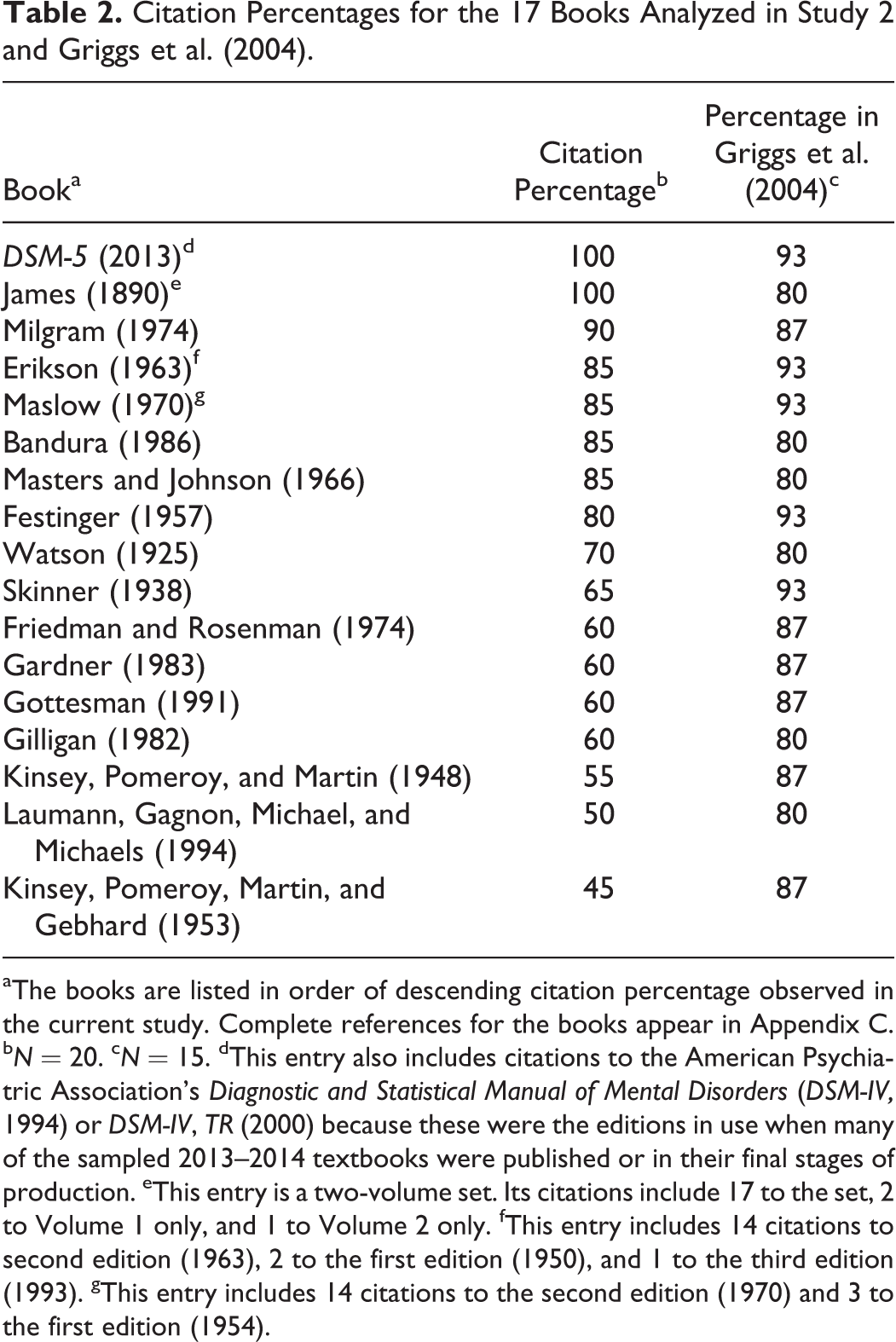
aThe books are listed in order of descending citation percentage observed in the current study. Complete references for the books appear in Appendix C. b N = 20. c N = 15. dThis entry also includes citations to the American Psychiatric Association’s Diagnostic and Statistical Manual of Mental Disorders (DSM-IV, 1994) or DSM-IV, TR (2000) because these were the editions in use when many of the sampled 2013–2014 textbooks were published or in their final stages of production. eThis entry is a two-volume set. Its citations include 17 to the set, 2 to Volume 1 only, and 1 to Volume 2 only. fThis entry includes 14 citations to second edition (1963), 2 to the first edition (1950), and 1 to the third edition (1993). gThis entry includes 14 citations to the second edition (1970) and 3 to the first edition (1954).
With respect to individual books, whereas Griggs et al. (2004) did not find any books to be cited in 100% of the sampled textbooks, we found two such books. However, both of these citation percentages need some explanation. The DSM-5 (American Psychiatric Association, 2013)citation percentage includes 11 citations to it and 9 citations to the DSM-IV (American Psychiatric Association, 1994) or the Text Revision of that edition (American Psychiatric Association, 2000), which were the versions in use when many of the sampled 2013–2014 textbooks were published or in their final stages of production. The DSM-5 was not released until May 2013. It is important to realize that the publication date for a textbook may be a year before its copyright date. For example, the four textbooks with a 2016 copyright date in our sample were already available in early 2015. Thus, it would have been impossible for many of the textbook authors to have cited and discussed the DSM-5. We therefore counted the edition in force at the time each text was published. The other book that we found to be cited in 100% of the sampled texts was William James’s Principles of Psychology (1890), a two-volume set. Hence, we counted citations to the set or either volume. The 20 citations for this book included 17 to the set, 2 to Volume 1 only, and 1 to Volume 2 only.
The citation percentages for two other books, Erik Erikson’s Childhood and Society and Abraham Maslow’s Motivation and Personality, also require explanation. Each of these books is available in three editions. Thus, to be equitable, we counted citations to any of the three editions for each book. The citation percentage for Erikson’s book includes 14 citations to the second edition (1963), 2 to the first edition (1950), and 1 to the third edition (1993). The citation percentage for Maslow’s book includes 14 citations to the second edition (1970) and three to the first edition (1954). The third edition (1987) was cited once, but in concert with the second edition, so its citation did not increase the percentage of books citing Erikson’s book.
Griggs et al. (2004) found that Freud had more references to his books (55) than any other psychologist, but that these references were to 21 of his books. Similarly, Piaget had 42 citations to 16 of his books. Thus, we examined the sampled texts to determine the number of book citations and the number of different books cited for both Freud and Piaget. Twenty-two of Freud’s books were cited, and he had a total of 79 book citations. Eighteen of Piaget’s books were cited, and he had a total of 42 book citations. Thus, our findings for citations to Freud and Piaget’s books are very similar to those observed by Griggs et al.
Next, we will consider possible explanations for why only eight books met the citation criterion of at least 80% and nine did not. We will first consider some reasons for the eight books that met the citation criterion. The American Psychiatric Association’s DSM is inevitably cited in the abnormal psychology section of introductory texts in which disorders are discussed because it is the accepted diagnosis and classification system for mental and behavioral disorders. The current edition in force at the time a text is published is the one that is cited, and sometimes reference is also made to older editions and the history of the DSM. Hence, it is not surprising that this book stayed on the list and was cited in 100% of the texts. The authors of six of the remaining seven books (Bandura, Erikson, Festinger, James, Maslow, and Milgram) that met the 80% criterion are historically prominent psychologists whose work is typically covered in introductory texts, and the book by each psychologist that met the citation criterion is probably the one most apt for the specific topics covered in the introductory course. Good examples are Milgram (1974) for coverage of his obedience study and Festinger (1957) for coverage of his cognitive dissonance theory. William James’s Principles of Psychology (1890), however, is relevant to many topics covered in these texts and thus would have multiple opportunities for citation. It is also worth noting that the book cited for five of these six historically prominent psychologists is their highest cited publication of any type (see Diener, Oishi, & Park, 2014, Table 7, p. 29).
There are, however, some books by historically prominent psychologists that fell off the list—Watson’s (1925) Behaviorism and Skinner’s (1938) The Behavior of Organisms. In Skinner’s case, it appears that because he now has several other books cited in introductory texts (10 others in the present textbook sample), it is more difficult for one of them to meet the 80% citation criterion. This type of explanation would not apply to Watson’s book. However, it may be that some textbook authors have begun citing only the Watson and Rayner (1920) study and not Watson’s book. The high citation rate observed in Study 1 for the Watson and Rayner article is consistent with this explanation, and Watson’s book dropped only 10% and was still cited in 70% of current textbooks.
Masters and Johnson (1966) is the only one of the four books on sexual behavior that stayed on the list, and this is likely due to its status as the classic study of the human sexual response cycle that is discussed in introductory texts. The two books by Kinsey, Pomeroy, and Martin likely dropped off due to their age, but this explanation would not apply to the Laumann, Gagnon, Michael, and Michaels book, the most recent of the four books concerned with sexual behavior. This decrease in citation for this book is somewhat puzzling, given that this book reports the most comprehensive, representative survey of sexual practices in the adult population of the United States and that to the best of our knowledge has not been superseded by a more recent survey. Griggs (2014) did, however, find a decrease in the coverage of an “other” content category that included coverage of sex/gender in introductory textbooks from the 2000s compared to those from the 1990s. Hence, the decrease in citation of the Laumann et al. book and possibly the two Kinsey et al. books could be partially due to text space constraints for the coverage of sex in introductory texts. The other four books by Friedman and Rosenman, Gardner, Gilligan, and Gottesman that dropped off the list were still cited in 60% of current textbooks, meeting a simple majority criterion. Their decrease is likely due to authors’ citation preferences for the topics covered by these books. For example, in texts that did not cite Howard Gardner’s Frames of Mind (1983), a check of their reference sections indicated that one or more of his other publications on his theory of multiple intelligences were cited (e.g., Gardner, 1999, 2006).
Frequent citations of a specific book in introductory textbooks might be considered an indicator of the author’s prominence in these textbooks. However, it may be that a smaller number of a psychologist’s publications are cited liberally in introductory textbooks, indicating that prominence could also be a function of the frequent citation of a smaller number of highly influential works. Given this possibility, the total citation pages for a psychologist would seem to be a good indicator of their prominence in introductory textbooks. Indeed, many researchers have used this metric to determine who’s who in introductory textbooks (e.g., Knapp, 1985; Weiten & Wight, 1992). Hence, we decided to update the last study of this type, Griggs and Proctor (2002).
Study 3
Griggs and Proctor (2002) examined the name indexes in a sample of 10 introductory textbooks to discern the total numbers of pages on which authors cited the work of individual psychologists. We updated their work by examining the name indexes in current introductory textbooks for citation rates for the top 25 psychologists in their study. However, because the Griggs and Proctor data are more than a decade old, any psychologists who during this decade became more heavily cited in introductory textbooks may not be in their top 25 list. Fortunately, a more recent study, Diener, Oishi, and Park (2014), included the number of pages in introductory textbooks on which a psychologist was cited as one of their metrics to determine the most eminent psychologists, both historically and currently. Although the text sample used by Diener et al. was small (only five texts), it was more current than Griggs and Proctor’s text sample (the most recent copyright dates for the five texts were 2000, 2009, 2010, 2011, and 2011), and the resulting citation data were strongly correlated (r = .86) with the citation data of Griggs and Proctor. Diener et al.’s data for this metric thus comprise a bridge (time wise) between the Griggs and Proctor study and the present study. Hence, we expanded the set of psychologists that we examined in Study 3 by including those that were not on the Griggs and Proctor’s top 25 list but were among the top 25 most cited psychologists in Diener et al. (2014). 2 Because the two lists were so strongly correlated, only eight psychologists needed to be added to the Griggs and Proctor list.
Method
We used the same 20 textbooks that we used in the first two studies. Using the name index for each textbook, we determined the total citation page count for each of the top 25 psychologists in Griggs and Proctor’s (2002) research and the eight psychologists in the top 25 in Diener et al. (2014) that were not among the Griggs and Proctor’s top 25. In some cases, a psychologist (e.g., E. H. Erikson) appeared in the same name index with one initial and two initials. For such cases, we inspected the textbook’s references section to make sure the citation in the name index corresponded with that specific psychologist. We summed the total number of citation pages for each psychologist.
Results and Discussion
Table 3 displays the total number of citation pages for the 33 psychologists examined in the present study. Because the current textbook sample was twice as large as the one Griggs and Proctor (2002) used, we provide the citation rankings in both studies in Table 3 for comparison purposes. Sigmund Freud continued to be the most cited author. His total citation page count was 88 more pages than that for the second ranked psychologist, B. F. Skinner. It is clear that Freud’s body of work remains quite prominent in introductory textbooks. As first pointed out by Griggs and Proctor, this finding compounds what Stanovich (2001) referred to as the “Freud problem”—rectifying introductory students and the general public’s misconception of Freud’s importance in contemporary scientific psychology—by reinforcing this misconception with such extensive coverage of Freud’s work. Hence, introductory teachers should discuss Freud’s work and legacy but put these within the appropriate historical context and discuss the shortcomings of his psychoanalytic approach (e.g., failure to satisfy the falsifiability criterion). Such discussion would help to combat the Freud problem by providing an assessment of the importance of Freud’s work in contemporary psychology.
Total Citation Page Data for Top 33 Cited Psychologists in Griggs and Proctor (2002) and Diener et al. (2014).
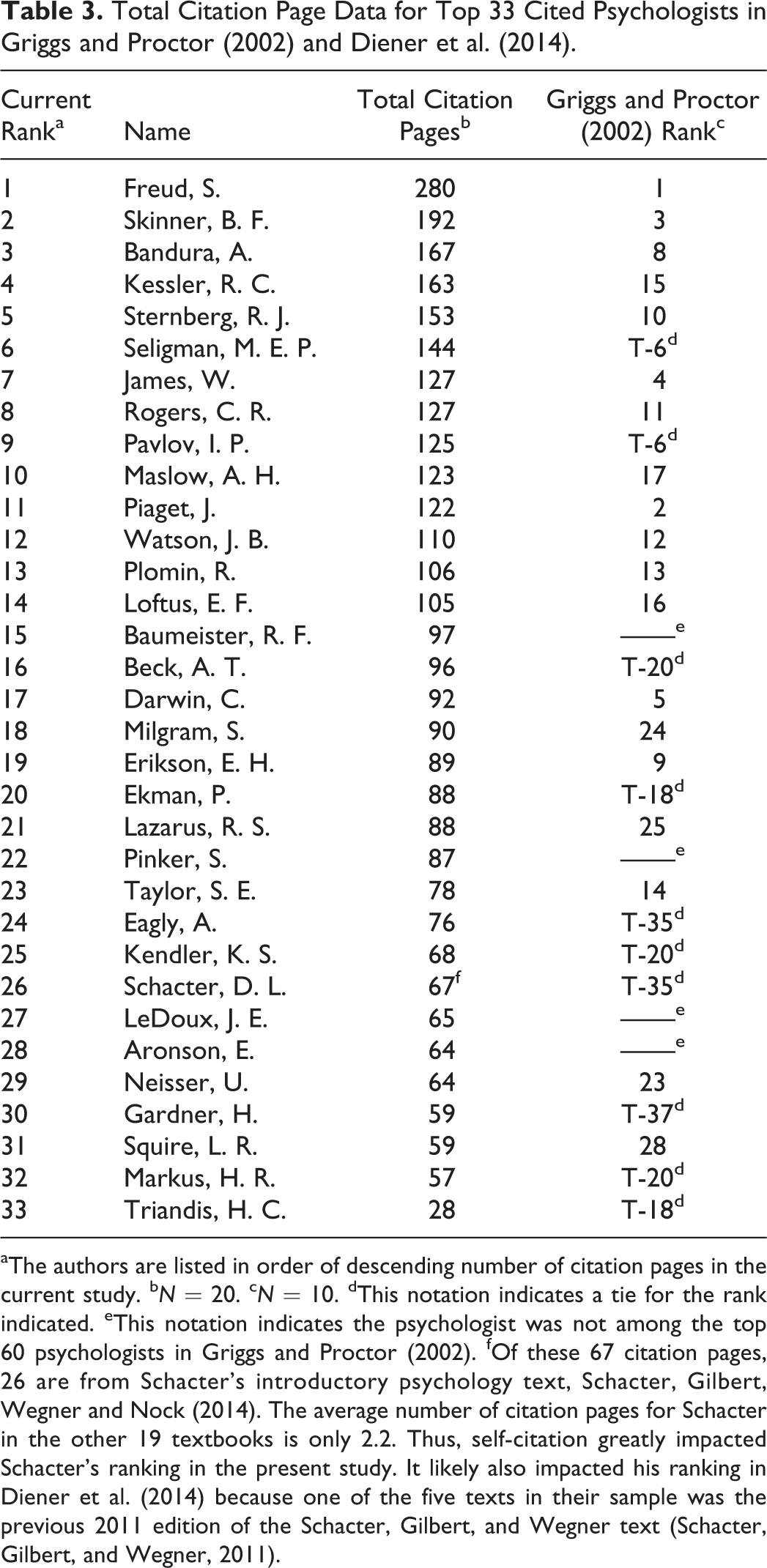
aThe authors are listed in order of descending number of citation pages in the current study. b N = 20. c N = 10. dThis notation indicates a tie for the rank indicated. eThis notation indicates the psychologist was not among the top 60 psychologists in Griggs and Proctor (2002). fOf these 67 citation pages, 26 are from Schacter’s introductory psychology text, Schacter, Gilbert, Wegner and Nock (2014). The average number of citation pages for Schacter in the other 19 textbooks is only 2.2. Thus, self-citation greatly impacted Schacter’s ranking in the present study. It likely also impacted his ranking in Diener et al. (2014) because one of the five texts in their sample was the previous 2011 edition of the Schacter, Gilbert, and Wegner text (Schacter, Gilbert, and Wegner, 2011).
In addition to Freud, six other prominent psychologists (Bandura, James, Pavlov, Seligman, Skinner, and Sternberg) remained among the top 10 most cited psychologists. Thus, although there was some shifting in exact ranks, there was 70% commonality in the two studies with respect to the top 10 cited psychologists. In addition, some psychologists in the top 10 in one study were just outside the top 10 in the other study. For example, Rogers was ranked 11th in Griggs and Proctor (2002) and moved to 7th in the current study.
Although there was stability in the top part of the list, there were also some interesting shifts between the current findings and those of Griggs and Proctor (2002). For instance, Kessler ranked 15th in Griggs and Proctor’s study, but ranked 4th in the current study. This jump is likely due to many citations to his numerous publications in the last 10 to 15 years on the epidemiology of mental disorders, especially those based on the first and second national comorbidity surveys of the prevalence and correlates of mental disorders in the United States that he directed. An examination of the reference sections of the 20 textbooks indicated that these publications were heavily cited. We found that 19 of the 20 textbooks cited one or more of Kessler’s first-authored publications. Forty-three different publications were cited. The mean and median numbers of citations per book were 5.1 and 4.5, respectively. Actually, Kessler is not a psychologist or a psychiatrist but rather a medical sociologist who is a professor of health-care policy in the Harvard Medical School.
There were some notable declines in the present findings as well. Darwin, Erikson, and Piaget fell 12, 10, and 9 spots, respectively. Darwin’s descent is likely due to the fact that evolutionary psychology has grown considerably over the past decade as a research area and become more entrenched as a topic in introductory textbooks. Thus, because space is at a premium in introductory textbooks, it is likely that the allotted space for this topic is now more devoted to recent research in evolutionary psychology than to Darwin’s theory, accounting for Darwin’s decline. Erikson and Piaget’s descents would also seem to be at least partially due to the same reason—in order to make space for more recent research in developmental psychology, discussions of their work have been shortened. However, although Piaget dropped 9 spots, he was still ranked 11th, whereas Erikson fell to 19th.
It is also worth noting that only two frequently cited psychologists (J. B. Watson and S. Milgram) authored one of the frequently cited articles in Study 1. However, seven of the frequently cited psychologists authored a frequently cited book in Study 2. These findings suggest the relative importance of books to articles in establishing eminence as measured by total citation pages in introductory textbooks and are congruent with the argument that books of influential psychologists have more impact than their journal articles.
Lastly, the finding that only one (Roy F. Baumeister) of the eight contemporary psychologists from Diener et al.’s (2014) study was ranked in the top 20 in the present study also indicates the stability of the top part of Griggs and Proctor’s (2002) top 25 list over time. Baumeister’s citation count is especially impressive because he was not even ranked in the top 60 in the earlier Griggs and Proctor study. Baumeister’s work on the self has gained acclaim not only in psychology but also in the popular media, which likely contributes to his current high citation count. The rankings of the other seven psychologists ranged from 22nd to 30th. The four psychologists (Aronson, Baumeister, LeDoux, and Pinker) who were not among Griggs and Proctor’s top 60 psychologists on average actually ranked higher than the four that were on the top 60 list (Eagly, Gardner, Schacter, and Squire). Of the latter four psychologists, Alice Eagly was ranked the highest at 24th. Perhaps her work on both attitudinal processes and gender is becoming regarded as classic work in the vein of the other psychologists who have remained highly cited in introductory textbooks. She joins Elizabeth F. Loftus and Shelley F. Taylor as the only female psychologists in the top 25.
General Conclusions
It is interesting that Freud was by a wide margin the most cited psychologist among the 33 psychologists that were examined in Study 3. Given that each introductory text in the sample that we used emphasized the importance of psychology as a science, it may seem counterintuitive that Freud and his work would receive the most coverage in these texts. As mentioned previously, such extensive coverage could perpetuate the Freud problem (Stanovich, 2001). However, inspection of the Freud coverage in some of the texts suggests that they are accompanied by appropriate caveats. For instance, when discussing the functions of dreams, one text embedded Freud’s ideas within other theories of dreaming, providing evidence for and against each theory, including Freud’s. With this type of textbook coverage, the inclusion of Freudian theory in their courses provides introductory teachers with ample opportunities to illustrate what constitutes a good theory, the bedrock for scientific work. This type of coverage would function to combat the Freud problem and help students to view Freud’s work in the proper perspective. However, psychology teachers using textbooks without such caveats will need to provide them in their lectures.
Across our three studies, we found a certain degree of both consistency and change in the articles and books cited in introductory textbooks as well as in individual citation rates for prominent psychologists. Close inspection of the 22 articles (Table 1) and 17 books (Table 2) revealed significant decreases in the citation percentages versus those from prior studies. Whereas the most cited articles and books in prior studies remained highly cited in our study, it appears that there is more turnover among the relatively less cited articles and even more so among such books. Taken together, these observations suggest a small “core” of articles and books that introductory text authors deem essential to cover in introductory textbooks. Outside of this core, there is less agreement among text authors on the articles and books to be cited in introductory textbooks. It is not surprising that this core is small because there is not even a substantial common core of concepts found in introductory textbooks (e.g., Griggs & Mitchell, 2002; Landrum, 1993; Zechmeister & Zechmeister, 2000).
This core of cited references has certain implications for teachers of the introductory as well as more advanced courses. With regard to the article and book citations examined in Study 1 and Study 2, respectively, the consistency of our work with that of work conducted a decade ago suggests that this common core of references would seem essential to cover in the introductory course. Thus, introductory teachers who are not covering these works should consider covering them. Introductory teachers who use supplementary readings in their courses should also consider assigning some of these studies to their reading list. Remember, the purpose of Gorenflo and McConnell’s (1991) study was to identify the most cited studies to include in a supplementary reader for the introductory course. Teachers of general advanced courses, such as history of psychology or classic readings in psychology, might consider these consistently highly cited articles and books to be core readings in their classes. In addition, the present citation data will help to inform teachers of more specific advanced courses the perception of psychology that introductory students will likely bring to their courses. Such information would prove especially informative to teachers at public universities where there are many transfer students who took the introductory course at a 2-year community college. In sum, the citation data provide useful information for psychology teachers by informing them how current introductory textbooks are portraying their discipline to introductory students.
Footnotes
Appendix A
Appendix B
Appendix C
Declaration of Conflicting Interests
The authors declared no potential conflicts of interest with respect to the research, authorship, and/or publication of this article.
Funding
The authors received no financial support for the research, authorship, and/or publication of this article.