



Abstract
To identify where ethics is presented to undergraduate psychology students, this study reviewed a national sample of 706 syllabi for required mandatory psychology courses. The results indicated that 6 syllabi were designated as ethics courses and 65 syllabi did not mention ethics at all. Even though 641 syllabi mentioned ethics, the most frequent listing was under course policies, usually as a standard statement (e.g., academic honesty and plagiarism) required by many institutions. Our recommendation is that ethics should be intentionally included in the learning goals/objectives/outcomes with a corresponding assessment (assignments) in all syllabi in addition to policy statements.
Ethics is an issue of interest in higher education. At the institutional level, policies advancing ethical and moral values often appear in mission and vision statements, student conduct codes, and academic policies. Those academic policies generally relate to issues of plagiarism, academic honesty, honor codes, academic integrity, and penalties for policy violations and are written into syllabi as a matter of institutional mandate. But the actual teaching of ethics goes beyond the listing of institutional academic policies in the syllabus. Research indicates that merely providing students with academic misconduct guidelines or honor codes is not sufficient to influence ethical conduct (Gullifer & Tyson, 2010; McCabe, Treviño, & Butterfield, 2001). Handelsman (1986) stated that educators cannot assume that students will incorporate ethical principles by “osmosis.”
At the program level, the question of how, when, and where to teach ethics to undergraduate psychology students has been around for decades (Haemmerlie & Matthews, 1988) and is not unique to the discipline of psychology. Many undergraduate programs such as business, engineering, biology, and health sciences struggle with how and where to infuse the teaching of ethics, ethical decision-making, and ethical reasoning into their curriculum and with an even more difficult question of how to assess the learning. Parkes and Harris (2002) stated that examining the syllabi of the required courses of an academic major provides information about what students are expected to know when it is time for them to graduate. Also, Griffith, Domenech Rodríguez, and Anderson (2014) suggested that an examination of psychology syllabi is a starting point in identifying classroom practices related to ethics.
Whereas many undergraduate programs such as business and health-care sciences are subject to their respective accreditation standard which requires ethics education, undergraduate psychology programs do not have accreditation status. They do, however, have the Guidelines for the Undergraduate Psychology Major which were first introduced in 2007 and revised in 2013 (American Psychological Association [APA], 2007, 2013). The Guidelines include five broad goals with corresponding indicators that represent the expected learning outcomes for the undergraduate psychology major. The five goals are (1) knowledge base in psychology, (2) scientific inquiry and critical thinking, (3) ethical and social responsibility in a diverse world, (4) communication, and (5) professional development. The indicators for Goals 3 and 5 address ethics specifically: 3.1A Evaluate psychological research from the standpoint of adherence to the APA Ethics Code in psychological research involving human or nonhuman research participants. 3.1B Justify recommendations for consequences for ethical violations based on APA Ethics Code requirements. 3.1C Explain how the APA Ethics Code can be used to guide decisions in ethically complex situations. 3.1D Evaluate critically or complete an Institutional Review Board (IRB) application that adheres to ethical standards. 3.2D Describe, explain, and uphold academic integrity within the context of psychology as a discipline and an academic profession (p. 26). 5.1F Apply the ethical principles of psychology to nonpsychology professional settings (p. 34).
One of the suggestions in the Guidelines (APA, 2013) is that ethics should be included in the whole curriculum rather than presented in a single course. The indicators listed above are broad enough to be incorporated into any psychology course. Additionally, the benchmarks for a quality undergraduate psychology program suggest that the APA Code of Ethics be included at all appropriate levels of the curriculum (Dunn, McCarthy, Baker, Hallonen, & Hill, 2007).
Homa et al. (2013) conducted an analysis of learning objectives and content coverage in introductory psychology syllabi based on a national sample (N = 158). Their analysis was based on the 2007 Guidelines. Since ethics is incorporated in the 2007 Guidelines as values, rather than explicitly articulated as a goal, not surprisingly, values was only mentioned in 13% of the syllabi, compared to knowledge base, which was listed as a learning objectives in 85% of the syllabi.
In a study of ethics in undergraduate psychology syllabi, You, Warchal, and Ruiz (2011) examined a convenience sample of psychology syllabi from Project Syllabus (N = 161) that were posted on the website of the Office of Teaching Resources of Psychology to investigate where psychology instructors present ethics in their syllabi. Based on the descriptive analysis, out of the 161 syllabi, only one syllabus focused exclusively on the teaching of ethics. Twenty-four (14.91%) syllabi did not mention ethics at all. For the 137 syllabi that addressed ethics in some way, course policy (such as plagiarism and honors code) was the category where ethics was most frequently listed (89.1%). The authors pointed out “that ethics is not being presented or assessed systematically as a critical concept in undergraduate psychology model syllabi. The fact that ethics is mentioned in a syllabus with respect to course policies and procedures does not translate into an identifiable ethics learning outcome” (You, Warchal, & Ruiz, 2011, p. 85).
The goal of this project is to identify where ethics is presented in undergraduate psychology syllabi. This project replicates and extends You et al.’s (2011) research by utilizing a more representative sample.
Method
Sampling of Syllabi
Based on Carnegie’s classification of higher education (2011), in Fall 2014, the researchers identified 1,644 institutions that offered at least a baccalaureate degree. Among those 4-year institutions, 1,336 of them offered a BA/BS degree in psychology. After obtaining IRB approval, the researchers contacted the department chair/program director of psychology at each institution, explained the purpose of the project, and asked for their participation by providing the researchers with the syllabi for all required mandatory courses for their psychology major. One hundred and forty-nine of them responded (11.15% response rate) and provided the researchers with a total of 706 syllabi dated from 2007 to 2015. When multiple syllabi were provided for the same course (e.g., for a given university, there might be 12 sessions of introductory psychology taught by several instructors), the researchers randomly selected one to include in the analysis.
Analysis of Syllabi
The format of any individual syllabus varies widely but generally includes the following sections: learning outcomes/objectives/goals, course description, assignments, textbooks, grading, schedule, and policy. Based on You et al. (2011), the researchers selected the following key words to identify where ethics was mentioned in a syllabus: ethic, code, plagiarism, conduct, case study (ethics-related), academic honesty, integrity, APA Code of Conduct, and code of conduct. After the researchers used all the key words to do the initial search, they also read through the entire syllabus to make sure all ethics-related concepts had been identified, which resulted in the identification of three more terms: IRB application, Collaborative Institutional Training Initiative (CITI) training, and National Institutes of Health (NIH) training. Both CITI and NIH training are a set of courses meant to educate researchers in general how to conduct, review, and oversee research with human participants in an ethical way. Participants get a certificate after successfully completing the training.
In order to assure the quality of the coding, two researchers coded each syllabus. Any discrepancy between the two coders’ coding was discussed and resolved. Therefore, for all 706 syllabi, there was 100% inter-rater agreement. In other words, for a given syllabus, the two raters agreed on all ethical statements for all the categories.
Results
For the 706 syllabi reviewed, 6 of them were specifically designed as ethics courses (0.85%). Sixty-five did not have ethics included in any sections in the syllabi (9.21%). While 641 (90.79%) of the syllabi mentioned one of the ethic key words, 256 (36.26%) of them only addressed ethics in the policy section of the syllabus, 311 (44.05%) addressed ethics both in policy and other sections of the syllabus, and 68 (9.63%) addressed ethics in sections other than the policy (Table 1).
Frequency of Syllabi by Where Ethic Key Word Is Mentioned.

The required ethics courses were clear from the description of their intentional, extensive focus on ethics. For instance, “Weekly seminars focus on ethical, clinical, and professional issues.” They also presented ethics in their objectives, text, requirements, schedule, grading, and policy.
Based on frequency, of the 641 (90.79%) syllabi that addressed ethical issues one way or another, policy was the syllabus section where ethical issues were addressed the most (571 of the syllabi, or 89.08%), followed by schedule (182, or 28.39%), goals/outcomes (179, or 27.93%), assignments (163, or 25.43%), description (57, or 8.89%), grading (21, or 2.97%), and textbook (13, or 2.03%; Table 2). In the policy section (571 syllabi), the most common term presented was plagiarism in 430 syllabi, followed by academic honesty in 389, integrity in 303, conduct in 195, code in 139, ethic in 101, code of conduct in 94, and APA Code of Conduct in 6 syllabi. Some statements of ethics in the policy section are: “Plagiarism constitutes an automatic failure of this course according to the institution’s policy” or “Any instances of cheating or unethical behavior will be handled according to university policies.” Some of the examples provided details defining the behavior that is unacceptable such as “examples of cheating include but are not limited to: copying someone’s work, turning someone else’s work as your own….”
Number of Syllabi That Mention Key Words in Each Syllabi Section (N = 641).
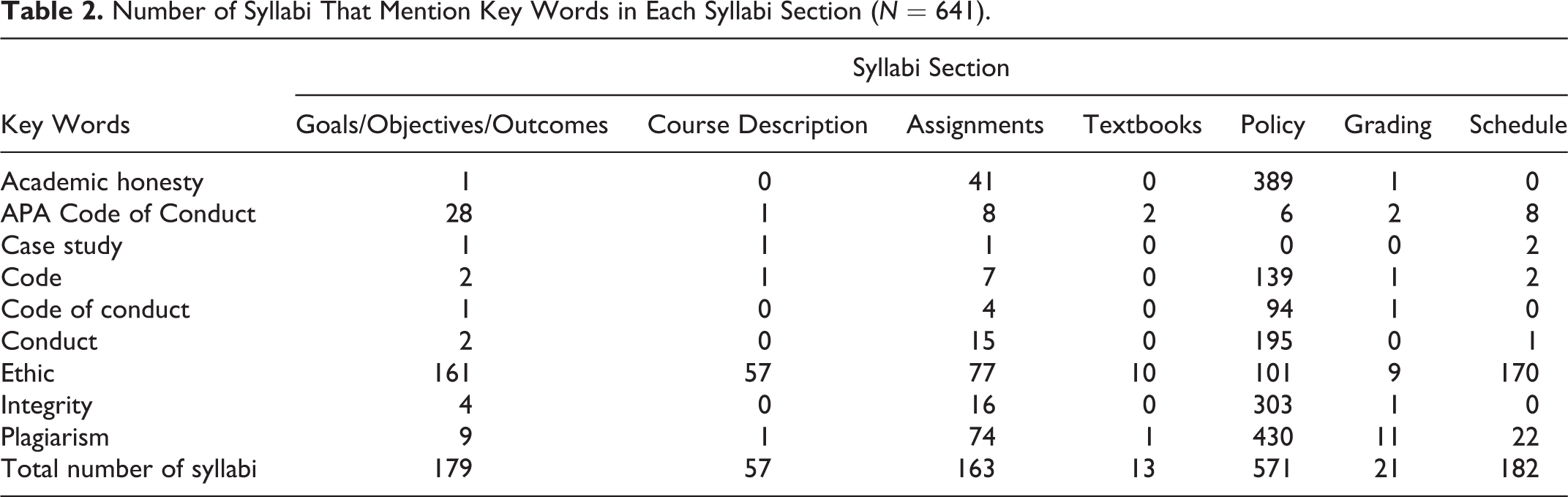
The next section of syllabi with most terms identified was schedule (182 syllabi). In this section, the terms presented were ethics in 170 syllabi, plagiarism in 22, APA Code of Conduct in 8, code and case study in 2 each, and conduct in 1 syllabus. Some examples of ethics in the schedule section included, under topic to be covered at a particular date: ethics in psychology, research ethics and the mandate of science, and honor code policy.
For the learning goals/objectives/outcomes (179 syllabi), the most common term identified was ethics presented in 161 syllabi, followed by APA Code of Conduct in 28, plagiarism in 9, integrity in 4, followed by code and conduct each in 2, and academic honesty, case study (ethics-related), and code of conduct in 1 syllabus each. Some statements of ethics in goals/objectives/outcomes were “increase their knowledge in the following areas: history and scope of psychology; careers in psychology; ethics in psychology; research methodology; biological bases of behavior; sensation and perception; learning; memory; theories of personality; social psychology; psychological disorders; and therapies”; “increase their understanding of the importance of ethics in psychology and be able to describe the five general ethical principles of the APA code of ethics”; “demonstrate ethical awareness in their personal and professional life”; and “understand the complexities involved in social psychological research, including ethical issues.”
For the section labeled assignments (163 syllabi), the most common term was ethics addressed in 77 syllabi, plagiarism in 74, academic honesty in 41, integrity in 16, conduct in 15, APA Code of Conduct in 8, code in 7, code of conduct in 4, and case study (ethics-related) in 1 syllabus. Some statements of ethics in assignments were: “All students are expected to adhere to the university’s Academic Honesty Policy, as outlined in the Student Handbook…”; “Homework: You will regularly read and write about assigned readings. For example, early in the semester, you will be given an ethical dilemma to read and consider….”
For the section labeled course description (57 syllabi), ethics was the most common term addressed in 57 syllabi, followed by APA Code of Conduct, case study (ethics-related), code, and plagiarism presented in one syllabus each. Some statements of ethics in the course descriptions were: “…Psychology is a discipline that covers many controversial and sensitive topics on which class members may have significant diversity of opinions, which is one of many reasons why you will hear a lot about ethics in this class, from theoretical, theological, and applied (research and clinical) perspectives…” and “How many people cite statistics, but cannot tell you where they came from, and how reliable they are? Are the results ethical, and are they interpreted ethically? This course is designed to assist the students to properly and appropriately understand and use this valuable tool….”
For the section on grading (21 syllabi), the most common term presented was plagiarism in 11 syllabi, followed by ethics in 9, APA Code of Conduct in 2, and academic honesty, code, code of conduct, and integrity in 1 syllabus each. Some examples of ethics terms in grading were: points assigned for a lab exercise on ethics or for IRB proposals; as well as statements such as: Academic Integrity. The rule that all assignment writing must be done individually will be strictly enforced. Any sharing of writing drafts will normally lead to a zero grade on that assignment for all individuals concerned. In addition, cases of plagiarism (taking material from a source without acknowledgment) or inappropriate collaboration may be referred to the University Committee on Discipline. See the University Student Handbook and the Academic Integrity links for details of the Academic Integrity Code of Conduct.
After the key words search, the researchers also found that 46 syllabi (all research courses) included the IRB application as a course requirement, 10 required CITI training and 7 required NIH training. In addition, 28 syllabi explicitly listed APA Guidelines for the Undergraduate Psychology Major, Version 2.0.
Discussion
The researchers examined undergraduate psychology syllabi for required mandatory courses from a national sample to identify where ethics was presented. It is encouraging to know that the majority of the syllabi addressed ethical issues one way or another. For the 706 syllabi analyzed, six of them were designated as an ethics course while only 65 (9.2%) did not mention ethics at all. One quarter of the syllabi addressed ethics in the learning goals/objectives/outcomes. One quarter of the syllabi mentioned ethics in assignment. A little more than a third of the syllabi mentioned ethics in the policy section only, with plagiarism being the most mentioned term.
Some of the results are noteworthy. A significant number of syllabi that addressed ethics (36.26%) presented it only in the policy section. When ethics is addressed in the policy section, many times the policy is established by the institution and may be used to prevent or address problems and not for the teaching and learning of ethics. For example, issues that are generally covered in institutional or program policy statements are academic integrity, honesty, cheating, and plagiarism, which, of course, are central issues to ethical psychological research and practice. It is not sufficient to address these issues only in institutional policy statements, which are often presented in the syllabus by institutional mandate.
The Guidelines (APA, 2013) and corresponding indicators address issues of academic integrity (3.2D), but they go further by emphasizing the application of the APA Ethics Code (3.1B and C) to research (3.1A and 3.1D), and practice (5.1F). In other words, the fact that some ethics-related terms are included in the policy section, because it is mandatory for the institution, does not mean that it will be intentionally taught as suggested by the Guidelines (APA, 2013).
Most importantly, researchers from various disciplines argued that ethical reasoning is a skill and should be intentionally taught (Driscoll & Finn, 2005; Handelsman, 1986; Madison & Schmidt, 2006). Based on our data, only 25% of the syllabi addressed ethics in the objectives/outcomes. Further, 7.2% (51) of syllabi addressed ethics in both learning goals/objectives/outcomes and assignments. Given the national emphasis on higher education assessment, we expected a stronger correlation between outcomes and assignments because the latter is one of the recommended tools for assessment of course outcomes. For instance, Project Syllabus provides “Pointers for Preparing Exemplary Syllabi” (Slattery & Carlson, n.d.) and suggests that syllabi should “relate assignments to course goals” (http://teachpsych.org/Resources/Documents/otrp/syllabi/exemplary_syllabi.pdf).
Similarly, the researchers noticed other inconsistencies in the presentation of ethics terms in the syllabi. For instance, while 161 syllabi included the term ethic in goal/outcome, 57 presented it in course description, 77 in course assignment, 10 in grading, and 170 in schedule. Only 3.4% (24 syllabi) presented ethics in both description and goal/outcome. Another example of inconsistency was the presentation of the term plagiarism, which was listed in 1 course description, 9 courses goals, 74 assignments, 1 text, 11 grading, and 22 schedules (Table 2).
A comparison of these results to those of You et al. (2011) seems to indicate that ethics presentation in syllabi has changed very little. In both studies, a large number of syllabi provided terms related to ethics (from 85% in 2011 to 90% in this study). However, most of the terms were presented in policy (75% in 2011, and 80% in this study). There was a small change regarding the number of syllabi that presented ethics both in outcomes and in assignments, from 6.6% in 2011 to 7.2% in this study. One significant difference was the number of syllabi that mentioned the APA Code of Conduct, which decreased from 16.7% in 2011 to 7.7% in the current sample.
This project has some limitations. Even though we used a random sampling technique with our selection of samples, given the response rate (11.15%), there is potential bias that threatens the representativeness of the sample. In addition, the syllabi included in the current study dated from 2007 to 2015, and the Guidelines (APA, 2007, 2013) was first published in 2007 and revised in 2013. However, compared to You et al. (2011), there was a small change in the percentage of the number of syllabi that addressed ethics in one way or another (as indicated above, from 85% in 2011 to 90% in this study). When multiple syllabi for the same course were provided, one was randomly selected. It is possible that the syllabi for the same course vary in many aspects. In addition, we realize that syllabi are not the only way faculty communicate with students, it is possible that faculty share some information with students that are not reflected in the syllabi.
Overall, 45% of syllabi did not present ethics (9.21%) or presented it in the policy only section (36.26%). More work needs to be done to ensure that ethics, as one of the goals listed in APA Guidelines for the Undergraduate Psychology Major, Version 2.0. (2013), is presented more intentionally in syllabi provided to undergraduate students. Our recommendation is that ethics should be included in all syllabi for undergraduate courses, in the learning goals/objectives/outcomes with a corresponding assessment (assignments), besides listing ethical issues (e.g., academic honesty, plagiarism) as a standard statement under policy as required by many institutions.
After graduation, most students will encounter complex ethical issues in their work place that only effective and deliberate ethical training will prepare them well. Ruiz and Warchal (2014) proposed that even though departments may tailor their specific goals related to ethics education, all departments should treat ethics education as a common thread in their undergraduate curriculum. For example, ethics education can start with the introductory psychology course, followed by research methods. When students start to take upper-level courses, ethics education should be addressed in content-specific courses and finally be an important component of the capstone course. Some resources are available on teaching ethics for undergraduate psychology students at Society for the Teaching of Psychology (2017; http://teachpsych.org/page-1603066), Association for Psychological Science (2017; https://www.psychologicalscience.org/members/teaching/classroom-resources), and Teaching Ethics to Undergraduate Psychology Students (Ruiz & Warchal, 2017; https://de.alvernia.edu/teachingpsychethics/). Regarding the presentation of ethics in the syllabi, an important question still remains unanswered: Is the teaching of ethics being overlooked in undergraduate psychology syllabi?
Footnotes
Declaration of Conflicting Interests
The authors declared no potential conflicts of interest with respect to the research, authorship, and/or publication of this article.
Funding
The authors disclosed receipt of the following financial support for the research, authorship, and/or publication of this article: This research was supported in part by Alvernia Faculty Excellence Grant.