



Abstract
Recent research compared the use of case studies to online discussion boards to teach about anxiety disorders. The current study extends this research to mood disorders, reports pretest and posttest scores on four learning outcomes, and compares midterm exam scores from Fall 2016 and Fall 2017 when case studies and online discussion boards were used as supplementary learning material, respectively. The results indicate students in the discussion board condition (DBC) rated their learning outcomes significantly higher than students in the case study condition, and midterm exam scores were significantly higher for students who took part in the DBC as a learning exercise. These findings provide evidence that the usefulness of online discussion boards extends to other types of disorders and may even surpass the use of traditional case studies as a pedagogical tool when teaching about psychological disorders.
Abnormal psychology has always held strong interest among university students. Fascinated by human behavior, students are particularly interested when behavior interferes with a person’s ability to function or causes significant psychological distress. One challenge that instructors of abnormal psychology face is their students’ lack of exposure to more than 150 different kinds of psychological disorders that exist (DSM-5). Teaching abnormal psychology effectively, therefore, relies on an instructor’s ability to provide students with a clear mental picture of how each psychological disorder is manifested in a person’s life. To achieve this, instructors usually supplement course material, such as textbooks and PowerPoint slides, with case studies to help illustrate the etiologic and diagnostic patterns, symptoms, and treatments for different psychological disorders (Perkins, 1991; Tomcho, Wolfe, & Foels, 2006). Indeed, the use of case studies as an active learning strategy has been used across many disciplines and has been shown to correlate positively with student engagement, critical thinking, and development of analytical skills (Fisher & Kuther, 1997; McDade, 1995).
However, although case studies will always be a mainstay of the classroom, instructors are increasingly turning to the Internet to find ways of capturing student interest and contextualizing psychopathology in the classroom. Indeed, this very journal has reported some of the innovative ways in which instructors have used the Internet to increase student learning, some of these include the use of weblogs (Martindale & Wiley, 2005), celebrity interviews (Ferrari, 2016), Facebook (Baker, Wentz, & Woods, 2009), YouTube videos (Casteel, 2003), movie clips (Badura, 2002), and even animated films (Melchiori & Mallett, 2015). More recently, a study conducted in the United Arab Emirates (UAE) compared the effectiveness of using online discussion boards to the more traditional use of case studies for teaching naive, second-language students about anxiety disorders (Sheen, AlJassmi & Jordan, 2017). Their results showed that students in the discussion board condition (DBC) rated four different learning objectives significantly higher than students in the case study condition (CSC). Specifically, students in the DBC reported higher levels of empathy and understanding for those suffering from an anxiety disorder as well as an appreciation for the individual differences with which people experience these types of disorders. The authors suggested that this may have been due to the jargon-free firsthand information often available on discussion boards versus the more formal language and narrow scope of using single-case studies.
The results of the Sheen, Al Jassmi, and Jordan (2017) study may be particularly useful for learning how to reduce stigma and increase awareness about mental illness in regions where psychology is still a relatively new field. In the Middle East and Africa (often called the MENA region), for example, there is still a great deal of stigma associated with psychological disorders with those suffering from mental illnesses often considered as being possessed by evil forces or the evil eye (Ciftci, Jones, & Corrigan, 2013; Wesselmann & Graziano, 2010). Indeed, stigma does not just exist in countries where psychology is still a new field. The World Health Organization (2001) reported that up to 25% of the world’s population suffer from some type of mental disorder, with anxiety and mood disorders being among the highest (Kessler, Chiu, Demler, & Walters, 2005), yet few seek professional help due to the stigma associated with mental illness (Bathje & Pryor, 2011). Moreover, even professionals who deal with persons afflicted with mental illness report high levels of stigma toward people suffering from schizophrenia and major depression (Nordt, Rössler & Lauber, 2006). The effect of this stigma does not just worsen outcomes on a personal level by increasing levels of social isolation and self-stigma (Watson, Corrigan, Larson, & Sells, 2007) but also affects the care and resources made available to those suffering from a mental illness. The Centers for Disease Control and Prevention (2012), for example, recently noted that stigma surrounding mental illness results in lower prioritizing of resources. This was recently illustrated in the United Kingdom where mental health illness accounts for 23% of the economic burden for government health care but receives only 13% of the funding (Langford, 2013).
One way of changing attitudes and reducing stigma in the classroom is to increase contact with those afflicted with mental illness (Vogel & Wade, 2009). Some instructors have found face-to-face contact with a person experiencing a mental illness in an educational setting useful (Matteo & You, 2012), but this may not always be practical or even possible. The use of discussion boards as a pedagogical tool may be one, more accessible, way of providing contact with persons experiencing a mental illness. “Threads” on discussion boards are often interactive and frequently include questions and follow-up answers regarding specific issues related to psychological disorders. Afforded by the anonymity that the Internet provides, online discussions frequently include intimate and private information that might not be as forthcoming from a guest speaker in a classroom or available in a case study where there is no opportunity to ask questions or seek clarification on something contained therein.
Another factor emerging from the Sheen et al. (2017) study was the usefulness of using online discussion boards in a classroom made up of students who are learning in a language other than their mother tongue. For example, reading “the door closed and instantly I couldn’t breathe, couldn’t swallow, I thought my heart would burst out of my chest, and I felt like I was outside of my body watching me but I couldn’t hear or speak” (taken from a discussion board) compared to “Patient A experiences acute autonomic arousal when he/she is in enclosed spaces” (taken from a case study) appears to be more meaningful, and this seems to be especially so for second-language speakers. Indeed, with English emerging as the teaching language in universities worldwide (Green, Fangqing, Cochrane, Dyson, & Paun, 2012), the colloquial language used in online discussion boards may prove to be very helpful to those learning about psychological disorders and, any pedagogical tool which can improve upon current methods of teaching, is worthy of further investigation.
The current article, therefore, includes two different studies which extend the scope of the previous article (Sheen et al., 2017) by measuring students’ experiences of learning about mood disorders and uses a pre- and posttest design to collect data on self-reported student learning. Also included are objective measures of learning through the comparison of midterm exam grades from the Fall 2016 semester, where students used case studies in a learning exercise, to the Fall 2017 semester, where students used online discussion boards in a learning exercise. The extension of the previous research from anxiety disorders to mood disorders is also important because mood disorders typically present with much less dramatic symptoms than anxiety disorders (Sansone & Sansone, 2009), which are frequently characterized by sudden and frightening feelings of unreality and autonomic arousal. Enabling naive students, therefore, to understand the variability that exists in the ways in which people suffer from mood disorders might prove more difficult. We were interested, therefore, to see whether the difference in students’ learning experiences observed between CSC and DBC would be maintained when teaching about a group of psychological disorders which may not be as vivid and dramatic as the class of anxiety disorders previously investigated and whether this difference would be manifested in objective measures such as midterm exam scores.
Study 1
Learning Objectives
This class exercise investigates whether case studies or discussion boards will foster a better understanding of mood disorders and measures four key learning objectives (a) to understand the amount of distress that mood disorders can cause, (b) to understand how mood disorders can manifest themselves physiologically, (c) to increase empathy for those suffering from a mood disorder, and (d) to illustrate the individual variation with which people experience their symptoms.
Method
Twenty-eight female students between the ages of 19 and 21, enrolled in an abnormal psychology class in the United Arab Emirates, were given an introductory lecture on mood disorders. Students were then asked to rate their understanding of mood disorders on a 1 (strongly disagree) to 7 (strongly agree) response range based on four learning outcomes: (1) this lecture helped me better understand the distress a mood disorder causes, (2) this lecture helped me understand that mood disorders can cause physical symptoms in people, (3) this lecture increased my feeling of empathy for people with mood disorders, and (4) this lecture showed me that different people can have the same mood disorder but experience it differently. During the next class session, students were randomly assigned to either the CSC or the DBC with 14 students in each group. Students in both conditions were given the same written instructions: “Please use the class time (90 min) to peruse the information you have been given and make a note of anything you observe about the human experience of mood disorders.” Students in the CSC were given the links to three online case studies, supplied by the textbook, describing different types of mood disorders, while students in the DBC were given the links to three popular online mood disorder discussion boards (http://patient.info/forums/discuss-/browse/bipolar-affective-disorder-271, http://www.psychforums.com/mood-disorders, http://forums.psychcentral.com/bipolar) and instructed to spend an equal amount of time on each forum. For ethical reasons, students were under strict instructions to not participate in any of the online discussions, just to observe what was in the public domain as a nonparticipant observer. Data on which specific threads the students viewed were not collected. After the allotted time, students were again asked to rate their understanding of mood disorders based on the same four learning outcomes (Figure 1).
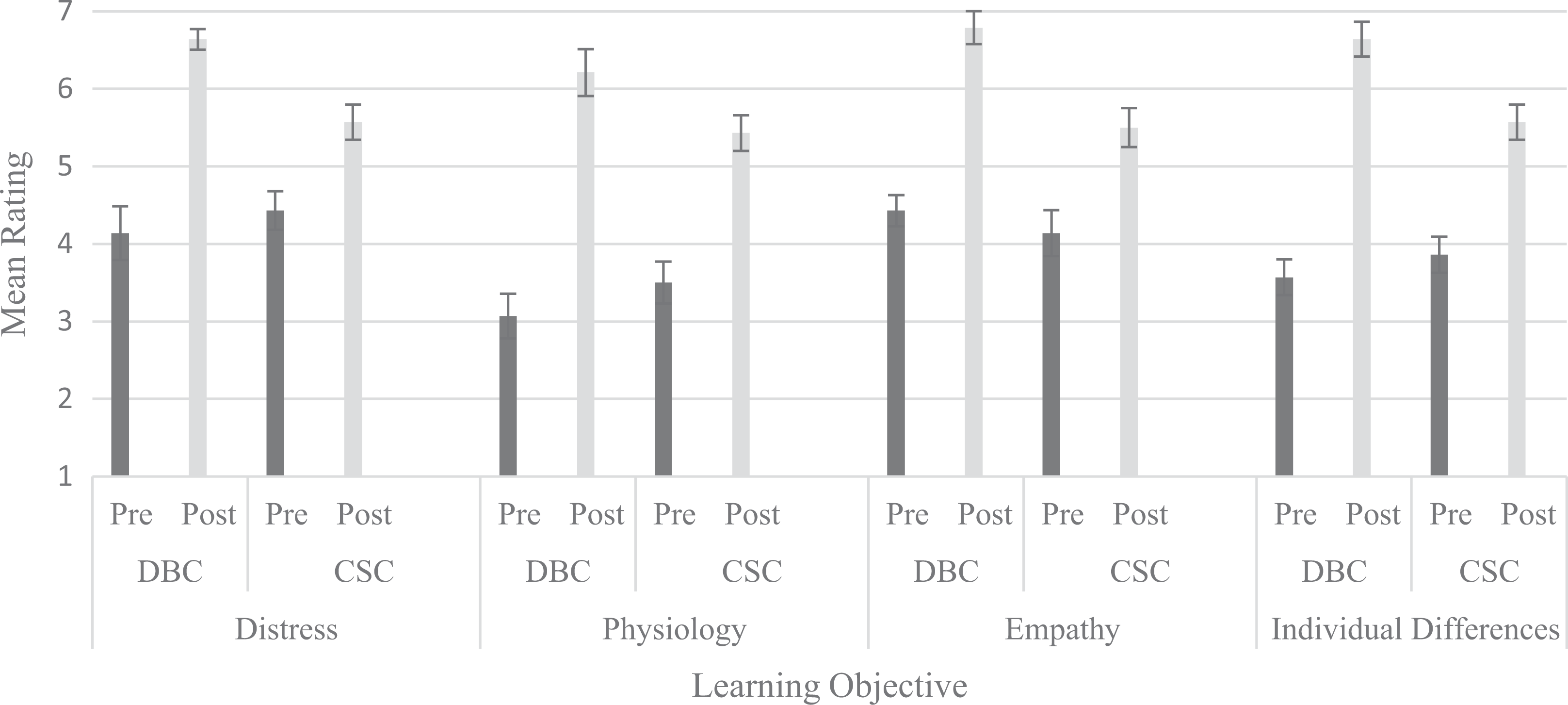
Participants’ mean ratings (with standard error bars) for each learning objective. DBC = discussion board condition; CSC = case study condition.
Results
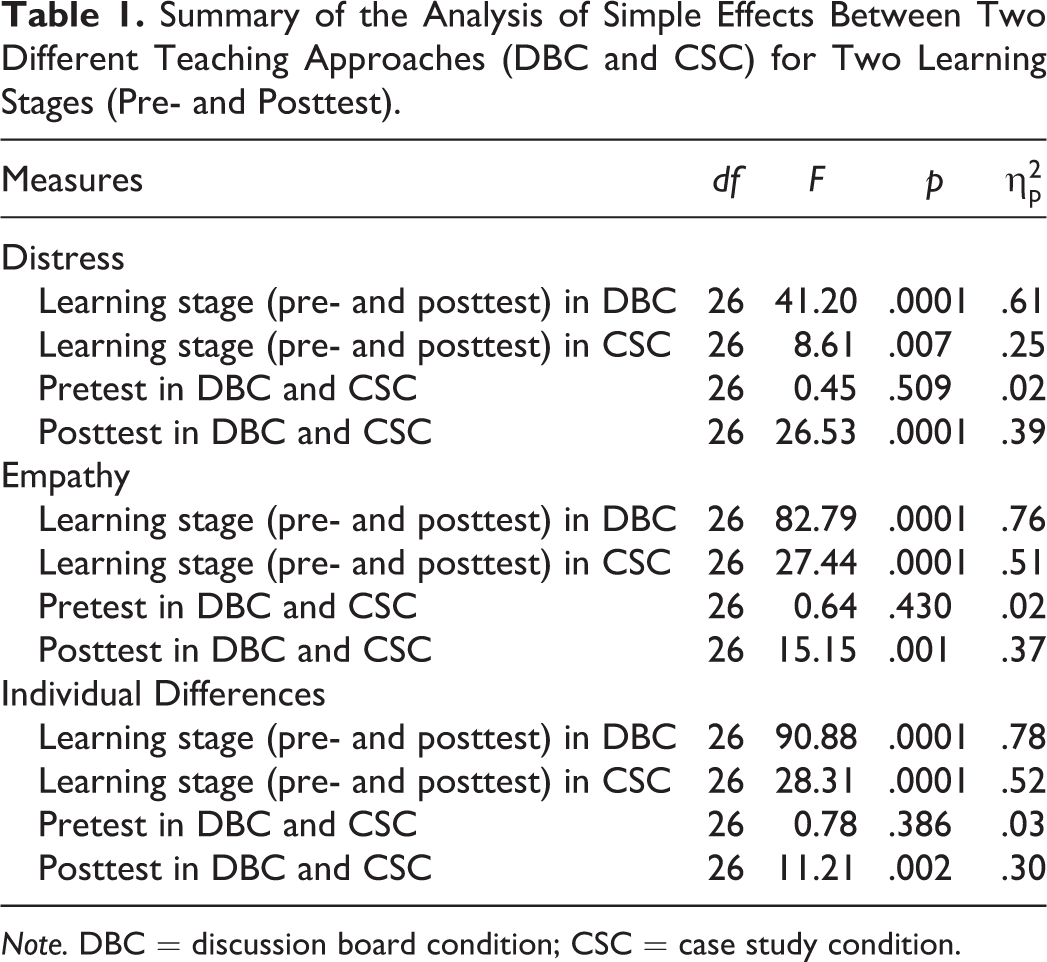
Four mixed factors design ANOVAs were conducted to determine the effect of learning stage (pretest and posttest) and teaching condition (DBC and CSC) on the four different learning outcomes of distress, physiology, empathy, and individual differences (see summary in Table 1).
Summary of the Analysis of Simple Effects Between Two Different Teaching Approaches (DBC and CSC) for Two Learning Stages (Pre- and Posttest).
Note. DBC = discussion board condition; CSC = case study condition.
Students’ responses to all four learning outcomes showed the main effect of learning stage: distress, F(1, 26) = 43.74, p < .001,
Study 2
Learning Objectives
To objectively measure whether there was any difference between using case studies or discussion boards on actual student learning, we compared midterm exam grades (on mood disorders) from two different abnormal psychology classes across two semesters.
Method
Midterm exam grades of 56 students enrolled in an abnormal psychology class were compared across two semesters: Fall 2016, where 28 students were given an introductory lecture on mood disorders and took part in a supplementary learning exercise using case studies, and Fall 2017, where 28 students were given the same introductory lecture on mood disorders and took part in a supplementary learning exercise using discussion boards. Students each had the same instructor, and classes were scheduled in the same time slot twice per week for 90 min each on a Monday and Thursday. The exam, which was the same for both semesters, consisted of 50 MCQs and 1 open-ended question “what is major depressive disorder and how is it manifested differently in people diagnosed with it.” Answers to the open-ended essay questions were transcribed and two trained coders, naive to the study hypothesis and learning exercise condition, graded the essay questions, the average of which was added to the MCQ scores yielding an overall exam score. Exam scores for one student who did not take part in both the lecture and learning exercise were not included in the analysis.
Results
The coders’ grades for each essay question answer were significantly correlated (r = .91, p < .001), and the average between them was added to the MCQ scores (see Figure 2) resulting in an overall midterm exam grade. An independent sample’s t test was conducted to compare midterm exam grades across both semesters. The results revealed that students who took part in the DBC exercise (M = 84.07, SD = 9.93) scored significantly higher in their midterm exams than students in the CSC exercise (M = 77.46, SD = 12.82), t(54) = −2.16, p < .05, Cohen’s d = .58.

Participants’ mean midterm exam scores (with standard error bars) for each supplementary learning exercise condition. CSC = case study condition; DBC = discussion board condition.
Discussion
The results of the current studies provide further evidence that online discussion boards improve student learning subjectively, through the use of pre- and posttest self-reported measures on four learning outcomes and, objectively, through the comparison of midterm exam grades across two semesters using both case studies and discussion boards as supplementary learning exercises.
Specifically, the results obtained indicated that at posttest, students’ responses to all four learning outcomes showed significant improvement compared to pretest, illustrating the utility of both teaching methods, discussion boards (DBC) and case studies (CSC). Importantly, however, average responses at DBC posttest were numerically higher than CSC posttest for all four learning outcomes. This was underscored by a significant interaction of the Learning Stage (pretest and posttest) × Teaching Condition for all measures, except physiology. This is highly informative because it suggests that when attempting to learn about the distress associated with mood disorders, develop empathy with sufferers, and appreciate the different ways different individuals experience the mood disorders (Learning Objectives a, c, and d), discussion boards facilitate better outcomes than case studies. By contrast, learning about the physiological symptoms associated with mood disorders (Learning Outcome b) is facilitated by both teaching methods to a comparable extent.
It is possible that the areas covered in Learning Outcomes a, c, and d involve more student, and patient, subjective views and experiences, compared to Learning Outcome b which deals with the more objective physiological symptoms associated with mood disorders. Online discussion boards typically provide readers (and contributors) with a varied and rich source of subjective, firsthand information from a variety of perspectives and experiences. This perhaps explains why discussion boards were more effective, compared to case studies, in these three outcomes (a, c, and d), with the efficacy of discussion boards being statistically supported by significant interactions between Learning Stage × Teaching Condition. By contrast, learning about the more objective physiological symptoms of mood disorders was well-served and almost equally served by both teaching methods (discussion boards and case studies).
The significant interactions obtained for Outcomes a, c, and d, but not in Outcome b, may also underscore the fact that conversations, or threads, within discussion boards also tend to be interactive, with individuals, or posters, often exchanging information and advice in plain, jargon-free language, making it easier for students to appreciate the uniqueness of each case and each viewpoint. Conversely, case studies provide factual information but are limited in scope to one particular person and cannot be generalized to other people. Overall, these findings provide further evidence that using online discussion boards as a pedagogical tool to supplement conventional lecture material can be more beneficial as an active learning strategy, compared to the traditional use of case studies alone. The findings also seem to indicate that different learning outcomes are facilitated to varying degrees by discussion boards and case study approaches.
As suggested above, the effective teaching of psychological disorders is dependent upon the instructor’s ability to provide students with a well-defined mental picture of what a person suffering from a psychological disorder is experiencing. It may be that online discussion boards are particularly useful as a pedagogical tool in regions where there is still a great deal of stigma associated with psychological disorders such as the MENA region. It may also be that the jargon-free and straightforward nature of online discussion boards is especially beneficial for students for whom English is not their native language but is their language of instruction as is becoming the case more frequently around the world (Green et al., 2012). Our findings support previous research and suggest that the use of online discussion boards may be particularly useful for fostering knowledge development and increasing students’ understanding of the many ways which a psychological disorder can impact upon a person’s life. Any pedagogical tool, therefore, which can improve student learning is a welcome addition to an instructors’ arsenal.
A limitation to the use of discussion boards as a learning tool may be the lack of control over the specific content of a discussion board at any given time. This limitation could be overcome, however, by only providing links to online discussion boards that have a lot of active members or by directing students to specific areas on discussion boards that focus on posters’ descriptions of their own symptoms rather than general “chat” areas. Despite this limitation, it is conceivable that the use of online discussion boards as an educational tool might benefit areas other than mental illness or where case studies are typically used such as quitting smoking, the psychology of pain, or understanding of anorexia nervosa.
Footnotes
Declaration of Conflicting Interests
The authors declared no potential conflicts of interest with respect to the research, authorship, and/or publication of this article.
Funding
The authors received no financial support for the research, authorship, and/or publication of this article.