



Abstract
How can instructors help students adopt effective learning strategies? In this study, students in a large introductory psychology class completed a “learning how to learn” assignment in which they read one of four randomly assigned empirical articles about the utility of a learning strategy (i.e., distributed practice, rereading, practice testing, or forming mental images) and wrote a paper summarizing, analyzing, and applying the article’s findings. Students relied significantly less on low-utility strategies and significantly more on moderate and high-utility strategies at the end of the semester than at the beginning. Furthermore, students who completed this assignment outperformed their peers in a control semester of the same course, improving by about one-third of a letter grade. Suggestions for effective implementation of a similar assignment are presented.
Many first-year college students are unprepared for the academic rigors of college, with as few as 27% of American high school students demonstrating proficiency in English, reading, mathematics, and science on the ACT college entrance exam (ACT, 2017). College students may rely on study habits they have developed throughout their elementary and secondary education which served them sufficiently in the past but which are not well suited for higher education. Perhaps students are unaware of better learning strategies, perhaps they are not convinced that other strategies may work better, perhaps they do not know how to implement those strategies successfully, or perhaps they simply find comfort in what they have always done.
In fact, students are often incorrect in their assumptions about effective ways to learn and simultaneously have difficulty assessing their own learning accurately (Bjork et al., 2013; Brown et al., 2014). Performance on early assessments is a strong predictor of performance later in a course (Bowen & Wingo, 2012), suggesting that students who begin a course using effective learning strategies may continue to use them throughout the course and likewise for students who start out with less effective strategies. Thus, an intervention to improve students’ learning strategies, particularly early in the semester, might yield substantial benefits in course performance.
The amount of time students spend studying is positively correlated with exam scores, but this relationship is sometimes distressingly weak (Gurung, 2005). What students do while studying, in contrast, is very important (Dunlosky & Rawson, 2015). For instance, listening to music, watching television, and using the internet while studying all impair students’ learning and subsequent exam performance (Gurung, 2005).
The study strategies on which students rely also may impact student learning, and these strategies differ in their effectiveness. Dunlosky and colleagues (2013) reviewed 10 such strategies, reporting on their utility for improving student learning and generalizability across different types of learners, materials, criterion tasks, and educational contexts. They categorized these strategies into three groups based on their utility. High-utility strategies included practice testing and distributed practice. Moderate-utility strategies included elaborative interrogation, self-explanation, and interleaved practice. Low-utility strategies included summarization, highlighting or underlining, use of the keyword mnemonic, forming mental images, and rereading. Other researchers have found that practice testing and self-explanation are positively correlated with introductory psychology exam scores, whereas summarizing is negatively associated (Bartoszewski & Gurung, 2015). Unfortunately, but perhaps not surprisingly to many instructors, students seem to underutilize some of the most effective strategies (e.g., practice testing) in favor of less effective strategies (e.g., rereading, use of mnemonics; Gurung, 2005).
Simply telling students about effective strategies is relatively ineffective (Balch, 2001), so some instructors have conducted successful classroom experiments or demonstrations to show students the utility of certain learning strategies (e.g., Balch, 2006; Cathey et al., 2016; Fleming, 2002). For instance, Cathey and colleagues (2016) invited students in an introductory psychology course to attend a study skills intervention midway through the semester, which was attended heavily by students who had underperformed on exams. After watching a five-part video series on effective studying (Chew, 2011) and responding to a set of self-reflective questions about how they studied and the likely effectiveness of those study habits, the differences in exam scores between those who attended the intervention and those who did not attend disappeared. This suggests that in-depth reflection on their own study skills may encourage students to adopt more effective strategies and thus improve their course performance. Even a self-administered intervention to encourage reflection on learning improves students’ effective use of available resources and subsequent course performance (Chen et al., 2017).
The current study was designed to test the effectiveness of an intervention to encourage students to shift from reliance on low-utility learning strategies to moderate- and high-utility strategies. I attempted to replicate prior findings on the relationships between learning strategies and course performance (e.g., Bartoszewski & Gurung, 2015) while testing the efficacy of four versions of a class assignment, without adding substantial out-of-class student work or in-class time to implement. Students were randomly assigned to read one of four empirical psychological research articles about different learning strategies as part of a “learning how to learn” term paper assignment in which they evaluated and applied the research to their own behavior. In addition, data were collected on students'use of various strategies at the beginning and end of the semester as well as their course performance. I also compared student performance across semesters to determine whether the learning how to learn assignment improved students’ performance relative to a control semester in which students completed a traditional research paper assignment.
The key research question was Does reading and analyzing empirical research about learning strategies improve students’ own study habits and course performance? In order to test this research question, the following hypotheses were formulated:
Data were collected during the experimental semester using self-report surveys at the beginning and end of the semester to assess students’ use of learning strategies. In addition, I collected students’ exam scores, paper assignment scores, and overall course grades for both the experimental and control semesters.
Method
Participants
Four hundred thirty-six students enrolled in a large introduction to psychology course at a large Midwestern research university in the fall of 2017 were invited to participate in a study on student learning activities. Because honors students (N = 20, 4.6%) completed a different paper assignment in the course, they were excluded from the sample. Of the remaining students, 361 (86.8%) consented to participate and completed one or both surveys. Most participants (N = 257, 71.2%) completed both of the surveys, 99 (27.4%) completed only the beginning-of-semester survey, and five (1.4%) completed only the end-of-semester survey. The sample was predominantly comprised of women, European Americans, and first-year students. The median high school GPA was between B+ and A−; see Table 1 for additional participant demographic information.
Participant Characteristics.
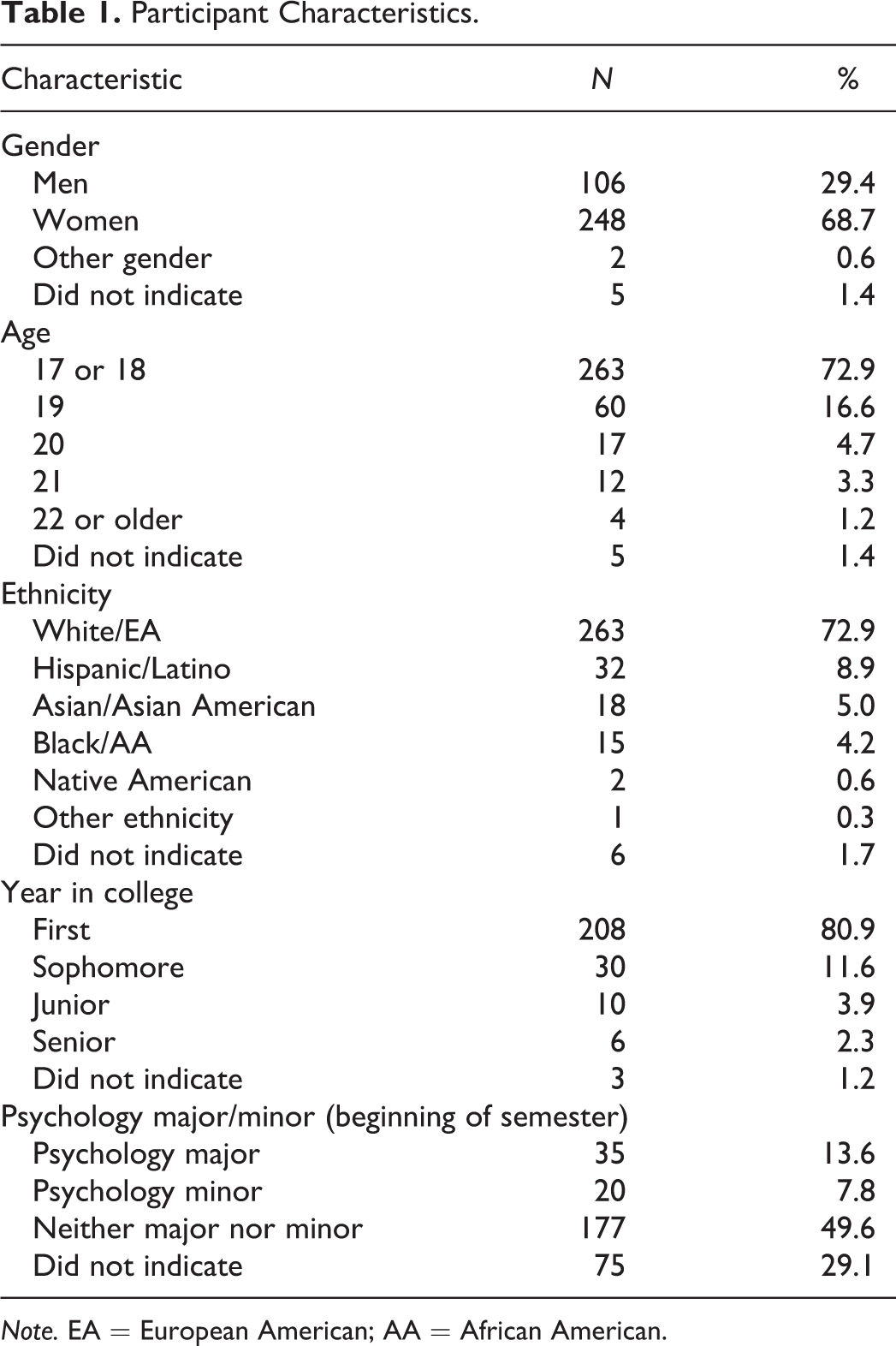
Note. EA = European American; AA = African American.
For the control semester, the same introduction to psychology course was taught by the same instructor the previous year (fall 2016) with a similar enrollment (N = 415 students) and similar student characteristics (approximately 80% first-year students; students reported similar ACT scores, high school GPAs, levels of procrastination, and self-efficacy across semesters). The two courses were taught as similarly as possible, with the same course structure, textbook, lectures, exams, and attendance requirements. Both semesters included a consistent set of information on effective studying, including an in-class demonstration early in the semester emphasizing the importance of and strategies for deep processing (based on Chew, 2010); an introduction to the survey-question-read-retrieve-review (SQ3R) method of studying (Myers & DeWall, 2016); and assigned textbook readings on content relevant to effective learning, such as distributed practice, use of mnemonics, and the self-reference effect (Myers & DeWall, 2016). The only substantial changes to the course across these semesters were the addition of the two brief surveys and the changes to the paper assignment described below.
Procedure
All data were collected in accordance with American Psychological Association ethical guidelines and institutional review board approval. At the beginning of a 16-week semester, students were invited to participate in a study about student learning as part of an effort to improve students’ academic outcomes. They were told the study would involve completing brief in-class surveys during the second and 15th weeks of the semester, as well as the collection of grade data throughout the semester. Students received full in-class participation credit for their attendance on survey administration dates, regardless of whether or not they completed the survey or chose to participate at all, and students absent during survey administration dates were given in-class participation credit if they completed the survey separately.
The first survey was administered during class in the second week of the semester by graduate assistants unrelated to the research study. Students completed an informed consent form and filled out the survey and were then dismissed from class.
In both the experimental semester and the control semester, students were assigned to read an empirical psychological research article and write a three- to four-page paper summarizing and analyzing it critically. Two changes were made to the paper assignment for the experimental semester. First, rather than all students reading the same article (as in the control semester), students in the experimental semester were randomly assigned in the fifth week of the semester to read one of four articles about various learning strategies. Second, the paper assignment in the experimental semester added a brief (approximately one-half page) section requiring students to apply the learning strategy they had read about to their own lives. Students were taught during the fifth week of the semester how to read and interpret research articles and were encouraged to consult with their instructor on their paper before their required first draft was due in the 10th week of the semester. All students received written feedback on their first draft within 2 weeks of submission and were encouraged to complete revisions supported by consultations with their instructor. Final revised papers were due in the 15th week of the semester.
The second survey was administered during class in the 15th week of the semester and was again administered by graduate assistants. The surveys each took approximately 15–20 min to complete.
Other relevant course components included four multiple-choice exams throughout the semester, administered in weeks 4, 8, 13, and 16. Thus, the first two exams were completed before students read their assigned article and wrote their paper draft, the third exam was completed after they submitted their paper draft, and the fourth exam occurred after their final paper was submitted.
Measures and Materials
Beginning-of-semester survey
Data were collected on the initial survey about students’ demographic and academic backgrounds (e.g., year in school, high school GPA). Students completed the learning self-efficacy subscale of the Motivated Strategies for Learning Questionnaire (Pintrich et al., 1991), which included eight items on a scale from 1 (not at all true of me) to 7 (very true of me), such as “I’m certain I can understand the most difficult material presented in the readings for this course” (α = .94). Students’ tendency to procrastinate was assessed through 10 items such as “I invent reasons and look for excuses for not acting on a problem,” on a scale from 1 (strongly disagree) to 4 (strongly agree; Ferner, 1980; α = .86). To assess students’ use of learning strategies, they completed a 30-item inventory adapted from Bartoszewski and Gurung (2015) assessing their use of each of 10 learning techniques. The learning techniques included highlighting or underlining, summarization, use of the keyword mnemonic, forming mental images, rereading, interleaved practice, self-explanation, elaborative interrogation, practice testing, and distributed practice, with endpoints of 1 (strongly disagree) to 6 (strongly agree). For instance, the key item for rereading included, “I go back to reread assigned readings when preparing for an exam.” Finally, in order to match students’ responses on the two surveys and their course grades, they provided their student ID number.
Paper assignment
Students read one of four empirical psychological research articles about a learning strategy and its utility for students. The learning strategies and corresponding articles included distributed practice (Seabrook et al., 2005), rereading (Rawson & Kintsch, 2005), practice testing (McDaniel et al., 2011), and forming mental images (Schmeck et al., 2014). These articles were selected because they all used experimental designs, included two studies (except the Seabrook et al., 2005, article, for which students were assigned to read only the second and third studies), and were of similar lengths, ranging from 9 to 13 pages of text. Ninety-two students (25.5%) read the article on distributed practice, 91 students (25.2%) read the article on rereading, 88 students (24.4%) read the article on practice testing, 81 students (22.4%) read the article on forming mental images, and nine students (2.5%) did not indicate on their final survey which article they read. There were no significant differences in student characteristics at the beginning of the semester across the four article conditions.
The paper assignment in the experimental semester required students to write a three- to four-page paper with three sections; the control semester required the paper to include the first two of these sections. First, students summarized their assigned article (approximately 1.5–2 pages), including the relevant prior research, purpose, rationale, and hypotheses; its method, including participants, research design, and variables of interest; and its results, including the results for each study, identifying whether the results supported the hypotheses, and the article’s overall conclusions. Second, they wrote a critical review (approximately 1−1.5 pages) in which they identified the significance and real-world relevance of their article’s results and critiqued the article’s internal and external validity, accessibility to an undergraduate audience, and potential future directions. Third, students in the experimental semester—but not those in the control semester—then applied the article to their own life (approximately 0.5 page), drawing specific connections to how they study, how they could use the article’s results to improve their studying behavior, and their plans to adopt (or not to adopt) the strategy about which they had read. The full paper assignment and grading rubric are available upon request.
End-of-semester survey
Students completed the same eight-item Learning Self-Efficacy subscale of the MSLQ (α = .95) and the same 30-item inventory on their use of each learning strategy as in the survey at the beginning of the semester. Students again provided their student ID number to match their responses and indicated their consent to have their study data used for research purposes.
Results
Students’ use of learning strategies and course performance were compared both within the experimental semester (Hypotheses 1, 2, and 4) and across the control and experimental semesters (Hypothesis 3). Students in the experimental semester did not differ at the beginning of the semester across conditions in their use of any of the 10 learning strategies or any of the background characteristics assessed (all Fs < 2.20, all ps > .05).
Hypothesis 1: Students’ Use of Learning Strategies Over the Semester
Over the course of the semester, students’ self-reported use of underlining/highlighting, summarizing, and rereading decreased significantly (ts > 2.15, ps < .05, ds ranged from .15 to .28); their use of keywords, self-explanation, and practice testing increased significantly (ts > 2.30, ps < .05, ds ranged from .17 to .48); their use of interleaving increased marginally (t = 1.80, p < .10, d = .14); and their use of mental images, elaborative interrogation, and distributed practice did not change (ts < 1.00, ps > .05, ds < .07).
Using Dunlosky and colleagues’ (2013) categories of low, moderate, and high-utility learning strategies, students decreased their use of three of the five low-utility learning strategies (highlighting/underlining, summarization, and rereading) and increased their use of three of the five moderate- and high-utility strategies (interleaved practice, self-explanation, and practice testing). This finding supports Hypothesis 1 that students would shift from lower- to higher utility learning strategies throughout the semester. Interestingly, however, the four conditions produced little or no intergroup differences in students’ self-reported use of the 10 learning strategies at the end of the semester (Fs < 1.85, ps > .05, rs < .15). Thus, although students did change their use of several of the learning strategies over the course of the semester, they seem to have done so consistently across conditions rather than differentially adopting or rejecting the learning strategies that corresponded to their assigned article.
Hypothesis 2: Course Performance Across Conditions
In the experimental semester, student scores on Exam 1 and Exam 2, which were completed before the research articles were introduced, were equivalent across conditions (Fs < 2.07, ps > .05, r < .13). Scores on the paper assignment were scaled across conditions to remove any grading inequity across conditions. After students read their assigned article and wrote a draft of their paper, however, differences in student achievement emerged across conditions on Exam 3, Exam 4, and in the course overall. Students who read the article about practice testing earned significantly higher exam scores than students who read the article about rereading, scoring more than six percentage points higher on both Exams 3 and 4 (Fs = 3.08 and 3.64, respectively; ps < .05; rs = .16 and .18, respectively). In addition, students who read the article about practice testing earned significantly higher grades in the course overall compared to students who read the article about distributed practice (84.37% vs. 77.74%; F = 3.11, p < .05, r = .16). There were no other significant differences across the four conditions in student performance.
These findings partially support Hypothesis 2 that students who read about higher utility strategies would earn higher grades than students who read about lower utility strategies. In particular, the article on practice testing (McDaniel et al., 2011) appeared to produce the greatest benefit for students’ subsequent performance.
Hypothesis 3: Comparing Exam and Overall Course Performance Across Semesters
Students’ scores on the first two exams, administered prior to the introduction of the paper assignment, were equivalent across the control semester and the experimental semester (ts < 1.40, p > .05, ds < .10). This underscores the initial equivalence of the classes across semesters. Students’ grades on the paper assignment also did not differ across semesters (t = 1.38, p > .05, d = .10).
Performance on the third and fourth exams did differ across semesters, however, with students in the experimental semester outperforming those in the control semester by seven percentage points on the third exam (t = 6.28, p < .001, d = .45) and 10 percentage points on the fourth exam (t = 11.00, p < .001, d = .80). Course grades overall were also significantly higher in the experimental semester than in the control semester (t = 2.02, p < .05, d = .14); students in the experimental semester finished the course with an average grade of 81.40% (B−) compared to an average grade of 79.11% (C+) for students in the control semester.
Student performance increased at both the top and bottom of the grading scale. There was a significant increase in the proportion of students earning A and B grades in the experimental semester compared to the control semester, χ2(1) = 8.85, p = .003, as well as a significant decline in the proportion of students earning D and F grades in the experimental semester compared to the control semester, χ2(1) = 5.35, p = .021. Taken together, these results support Hypothesis 3 that students would earn higher grades in the experimental semester than in the control semester.
Hypothesis 4: Correlations Between Learning Strategies and Performance
Students’ use of learning strategies were generally positively correlated with each other on the initial survey, on the final survey, and across the two time points (most rs between .11 and .38, most ps < .05). Students tended to use multiple learning strategies rather than sticking with only one strategy, and they were fairly consistent in their use of learning strategies over the course of the semester.
Students who more frequently used the moderate- and high-utility strategies of self-explanation, elaborative interrogation, and practice testing at the beginning of the semester, as well as those who used these same strategies at the end of the semester, performed better on each of the four exams and in the course overall (rs ranged from .11 to .26; ps < .05). None of the low-utility strategies were significantly correlated with performance on any of the four exams or on overall course performance (rs < .10, ps > .05), with the exception of summarization, which was actually negatively correlated with overall course performance (r = −.15, p < .05). These findings support Hypothesis 4 and replicate prior findings that higher-utility strategies would be positively associated with course performance, and lower-utility strategies would be unrelated or negatively associated with course performance (Bartoszewski & Gurung, 2015).
Discussion
Results indicated that students who completed the learning how to learn assignment used more moderate- and high-utility learning strategies and fewer low-utility learning strategies at the end of the semester, compared with the beginning of the semester. Compared with performance during the control semester, students who completed the learning how to learn assignment performed significantly and substantially better on exams after the introduction of the empirical articles and earned significantly higher course grades overall, finishing the course a third of a letter grade higher than students in the control semester. Exam score improvement was particularly strong among students who read the article on practice testing (McDaniel et al., 2011). Given that all aspects of the course aside from the learning how to learn paper assignment were held constant across semesters and that student characteristics and course performance prior to the introduction of the assignment were equivalent, the assignment appears to have improved student performance in the second half of the course.
Interestingly, across conditions in the experimental semester, students were equally likely to adopt higher utility learning strategies rather than adopting only the strategies they read about in their assigned article. Perhaps students talked with each other about the articles they had read and their experiences using various learning strategies, encouraging their peers to adopt higher utility strategies. Alternatively, the paper assignment might have increased students’ metacognition about effective learning, underscoring the importance of considering more broadly why they used the learning strategies they did and whether other strategies might be better. This may be good news for students, as a general reconsideration of their learning strategies may help students identify both problems in their current strategies and areas for improvement. This is also good news for instructors, as communicating the importance of effective learning strategies may lead students to reconsider many aspects of how they learn, not just to adopt one particular strategy they hear about from their instructors.
Based on the results presented here, the learning how to learn assignment appears to have improved students’ learning strategies and course performance above and beyond that expected in a standard introduction to psychology course. As noted above, the control semester included a variety of recommendations for improving students’ study habits sprinkled throughout the course. The experimental semester included these recommendations and also required students to explore one particular learning strategy in depth and apply it to themselves. The improvement in student performance in the experimental semester relative to the control semester suggests that instructors may need to do more than simply pointing out the importance of high-utility strategies, even if such recommendations are incorporated repeatedly throughout a course. This corroborates findings by Cathey et al. (2016) that demonstrated the benefits of in-depth exploration and self-relevant application of effective study skills. These two components—examining study strategies in depth and having students explicitly apply those strategies to themselves—seem to be key ingredients in the success of the present intervention. That said, although students generally moved toward higher utility strategies after the introduction of the learning how to learn assignment, they did not abandon their lower-utility strategies altogether. Thus, rather than being a panacea for poor study habits, this intervention should be viewed as a helpful “nudge” in the right direction.
Two potential limitations to these findings should be noted. First, this study examined students from one course at a single institution and included primarily first-year students, women, and European Americans. The present findings on the association between use of learning techniques and course performance parallel those of Bartoszewski and Gurung (2015), but additional research with more diverse samples may clarify the generality of these findings. Second, the increase in student performance from the control semester to the experimental semester may be due simply to improvements in instructional quality over time rather than to the introduction of the learning how to learn assignment. Note, however, that the course was taught as similarly as possible and student performance on the first two exams was equivalent across semesters, only diverging after the learning how to learn assignment was introduced in the experimental semester. Although this suggests that the differences may not have been caused by changes to overall instructional quality, this possibility cannot be eliminated.
Future research on this topic could clarify the extent to which students’ use of high-utility learning strategies increases simply by virtue of taking an introductory psychology course, given that many aspects of the course content are relevant to effective studying. By comparing students’ use of learning strategies at the beginning and end of a semester in which this learning how to learn assignment is not used, and by comparing those results against data from students enrolled in a nonpsychology course over the same period, researchers could glean valuable comparative data for students’ use of learning strategies over time. Further, assessing students’ use of various learning strategies for each exam rather than only at the beginning and end of the semester would allow researchers to draw clearer conclusions about the nature of the relationship between learning strategies and both short-term and long-term performance.
There are important and predictable connections between students’ use of high-utility learning strategies and course performance (Bartoszewski & Gurung, 2015; Dunlosky et al., 2013). Incorporating regular, in-depth, evidence-based, and personally relevant discussions of effective learning strategies throughout a course may benefit students. The introduction to psychology course presents a particularly compelling opportunity to present effective learning strategies and dispel myths (e.g., students’ persistent belief in the importance of matching their “learning style” with how a class is taught; Pashler et al., 2009). Incorporating self-reflection and planning into students’ exploration of effective learning strategies may boost the effectiveness of the intervention described here. By having students reflect on their current versus ideal learning strategies, and by having them form implementation intentions to employ higher-utility strategies (Gollwitzer & Sheeran, 2006), they may be more likely to actually carry out those plans rather than treating the assignment as just another class assignment. As experts in learning, instructors are in a strong position to help students develop their skill with high-utility learning strategies. The present intervention can help them do just that.
Supplemental Material
Supplemental Material, 18-089_supplementary_materials - Improving Students’ Study Habits and Course Performance With a “Learning How to Learn” Assignment
Supplemental Material, 18-089_supplementary_materials for Improving Students’ Study Habits and Course Performance With a “Learning How to Learn” Assignment by Carolyn R. Brown-Kramer in Teaching of Psychology
Footnotes
Acknowledgments
The author wishes to thank Dr. R. Eric Landrum for his mentorship on this project and two anonymous reviewers for their helpful suggestions for revision.
Declaration of Conflicting Interests
The author declared no potential conflicts of interest with respect to the research, authorship, and/or publication of this article.
Funding
The author received no financial support for the research, authorship, and/or publication of this article.
Supplemental Material
Supplemental material for this article is available online.
References
Supplementary Material
Please find the following supplemental material available below.
For Open Access articles published under a Creative Commons License, all supplemental material carries the same license as the article it is associated with.
For non-Open Access articles published, all supplemental material carries a non-exclusive license, and permission requests for re-use of supplemental material or any part of supplemental material shall be sent directly to the copyright owner as specified in the copyright notice associated with the article.
