




Abstract
Research examining excellence in teaching is extensive. Nevertheless, research examining the inverse—what constitutes poor or ineffective teaching—has not been as systematic. The current research addresses this gap in the literature by examining student and faculty perceptions of the qualities and behaviors of ineffective teachers. Students and faculty identified being disrespectful as the number one perceived quality of ineffective teachers. Both groups of respondents also agreed that having weak rapport was indicative of ineffective teachers. Overall, students had a tendency to focus more on the social aspects of the student–teacher relationship, whereas faculty focused more on professional competencies. These findings provide additional support on teaching misbehaviors to avoid both in and outside of the classroom.
Psychologists have attempted to empirically study teaching effectiveness for several decades (Buskist & Keeley, 2015). Research in the area of excellent teaching has primarily focused on self-report evaluations of teachers from students. For example, prior research asked students to differentiate between ideal and typical teachers across a range of personal characteristics as well as classroom behaviors and course design (Epting et al., 2004). Although students reported few significant differences between their typical and ideal teachers, they articulated that ideal or most effective teachers provide students with clear expectations (Buskist et al., 2002; Epting et al., 2004). Vulcano (2007) conducted similar research, asking 629 Canadian undergraduate students to describe their “perfect instructor.” Across 26 categories of behaviors, students continued to emphasize items such as knowledgeability, creative and interesting lectures, and fair or realistic expectations of students, corresponding to other studies assessing student perceptions of effective teaching (Buskist et al., 2002; Epting et al., 2004). In an attempt to specifically test the “creative and interesting lecture” component of effective teaching, Revell and Wainwright (2009) found that students prefer lectures that engage them in participation, provide a clear structure, and are delivered enthusiastically.
The development of the Teacher Behavior Checklist (TBC) by Buskist and colleagues (2002), and its subsequent conversion to an evaluative instrument, has allowed for more quantifiable examination of effective teacher characteristics (Keeley et al., 2006). The 28-item evaluation measures perceptions of teacher behaviors on two subscales: Caring and Supportiveness as well as Professional Competence and Communication Skills. Items from both subscales include broader characteristics paired with specific behaviors (i.e., “Approachable/personable (Smiles, greets students, responds respectfully to student comments)”; “Provides constructive feedback (writes comments on returned work, answers students’ questions, and gives advice on test taking)”; Keeley et al., 2006). The inclusion of these elements allows the TBC to highlight teachers’ strengths and simultaneously identify specific behaviors that may help improve teaching effectiveness. Studies using the TBC revealed that knowledge of the subject matter, enthusiasm, and realistic expectations of students are among the most important qualities of excellent teaching (Buskist & Keeley, 2015; Keeley et al., 2006). Landrum and Stowell (2013) found that students were particularly reliable in identifying and measuring master teacher behaviors related to TBC categories through viewing video clips of teachers. Across multiple studies, students reported core characteristics of excellent teaching as including a knowledge of the subject matter, setting realistic expectations for students, approachability, interesting and creative lecture materials, and respect for students (Buskist et al., 2002; Buskist & Keeley, 2015).
Faculty Perceptions of Effective Teaching
Although student perceptions of effective teaching are more commonly assessed, research has also explored faculty perspectives. Recently, researchers examined excellent teachers’ perceptions of effective teaching practices (Keeley et al., 2016). Professors who received national teaching of psychology awards reported on what they believe are the most effective teaching practices. Using the TBC categories, participants consistently ranked enthusiasm as the most important characteristic, which was similar to faculty rankings from other studies (e.g., Buskist et al., 2002; Ismail & Groccia, 2017; Schaeffer et al., 2003). Award-winning faculty also emphasized the role of rapport with students in excellent teaching practices (Keeley et al., 2016).
The qualities of effective teaching have also been studied in cross-cultural contexts, revealing that perceptions of excellent teaching characteristics differ minimally; Eastern cultures typically do, however, value structure and faculty expertise slightly more than Western cultures (Keeley et al., 2012; Liu et al., 2015). A recent meta-analysis attempted to ascertain universal faculty perspectives on excellent teaching characteristics based on the TBC (Buskist & Keeley, 2018). Across 12 studies, faculty ranked being knowledgeable about course content, enthusiasm for the subject matter and teaching, and promoting critical thinking as three of the most important aspects of teaching effectiveness. There was also agreement across a majority of the studies that aspects such as approachability, creativity, and strong communication skills contribute to excellent teaching (Buskist & Keeley, 2018). Although effective teacher qualities/behaviors may differ slightly across various contexts, taken together, these studies have identified several “near-universal” qualities and attending behaviors that faculty and students agree are indicative of master teachers.
Perceptions of Ineffective Teaching
Research examining excellence in teaching is extensive (Gurung et al., 2018). Nevertheless, research examining the inverse—what constitutes ineffective teaching—has not been as systematic. Early research by Kearney et al. (1991) examined “teacher misbehaviors,” which were defined as behaviors that interfere with instruction and student learning. In their study, they identified 28 categories of teaching misbehaviors that were placed into three dimensions: (1) incompetence or lack of basic teaching skills, (2) offensiveness (e.g., making fun of students, being rude), and (3) indolence (e.g., always late to class, fails to return papers, makes exams too easy). Subsequent research on these three dimensions of teaching misbehaviors suggests they may contribute to decreases in student affect toward the instructor and reductions in credibility (Banfield et al., 2006), student interest and motivation (Broeckelman-Post et al., 2016; Zhang, 2007), and student participation and learning (Goodboy & Bolkan, 2009).
More recently, Busler et al. (2017) attempted to create a typology of poor teaching qualities. Across three phases, the research explored undergraduates’ evaluations of what constitutes a poor teacher. Participants emphasized being disrespectful of students (e.g., talks down to students, ignores students, will not answer questions) and using unrepresentative course assessments as indicators of poor teaching habits. Additionally, students perceived unrealistically high expectations, lack of knowledge about the topic, and poor communication skills as key indicators of teaching ineffectiveness (Busler et al., 2017). These results suggest that poor teaching qualities may not be the exact inverse of behaviors listed on the TBC.
Although the research by Kearney et al. (1991) and Busler et al. (2017) provides valuable insight into students’ perceptions of ineffective teaching behaviors, little work has been conducted to ascertain teachers’ perceptions of ineffective teaching qualities. Assessing similarities and differences between student and faculty perceptions of ineffective teaching is an important step, as students and faculty observe the teaching process from different vantage points. Therefore, the current research was designed to address this gap in the literature by surveying both students’ and faculty members’ perceptions of the qualities of ineffective teachers.
Study 1
Method
Participants
Seventy students from an introductory psychology course at a small, private, liberal arts university in the Southeastern United States were recruited to participate in Study 1. Of these students, 46 (65.7%) were women; the mean age of all participants was 19.56 years (SD = 3.99 years). Participants received partial course credit in exchange for their participation.
Teachers from the same university were also recruited to assess whether students and instructors share similar attitudes toward the qualities of ineffective teachers. An email was sent to all faculty members and offered the chance to win a US$10 gift card in exchange for their participation. One hundred and three faculty members participated in the study. Of these faculty, 56 (54.4%) were men, 94 (91.3%) indicated they were White/Caucasian, and 75 (72.8%) were full-time. The mean number of years spent teaching at the college level was 14.99 (SD = 11.36).
Procedure
All protocols were approved by the university’s institutional review board prior to data collection. At the beginning of class, student participants provided informed consent and reviewed a hard copy of the 15 qualities/behaviors of a poor teacher used by Busler et al. (2017). Faculty participants provided informed consent and completed the survey online through a SurveyMonkey link that was emailed directly to them. After answering demographic questions, participants selected (rather than rank-ordered) five qualities/behaviors that described what they perceived to be indicative of the most ineffective teachers.
Results and Brief Discussion
One participant was excluded from the analysis because he selected more than five items from the list. Table 1 indicates the overall rating of each quality based on the percentage of times it was selected by the student participants for their “top five” list. For students, being disrespectful toward others in the classroom was the most commonly reported quality associated with being an ineffective teacher. Having unrealistically high expectations, being uncaring, and having unrepresentative assessments appeared next in their top five list. The inclusion of irrelevant course content, and faculty who were perceived as not being helpful, tied for the fifth position. Students selected a lack of confidence, being inflexible, and being unprepared the fewest number of times.
Students’ Top Five Ratings of the 15-Item Poor Teaching Typology From Study 1.
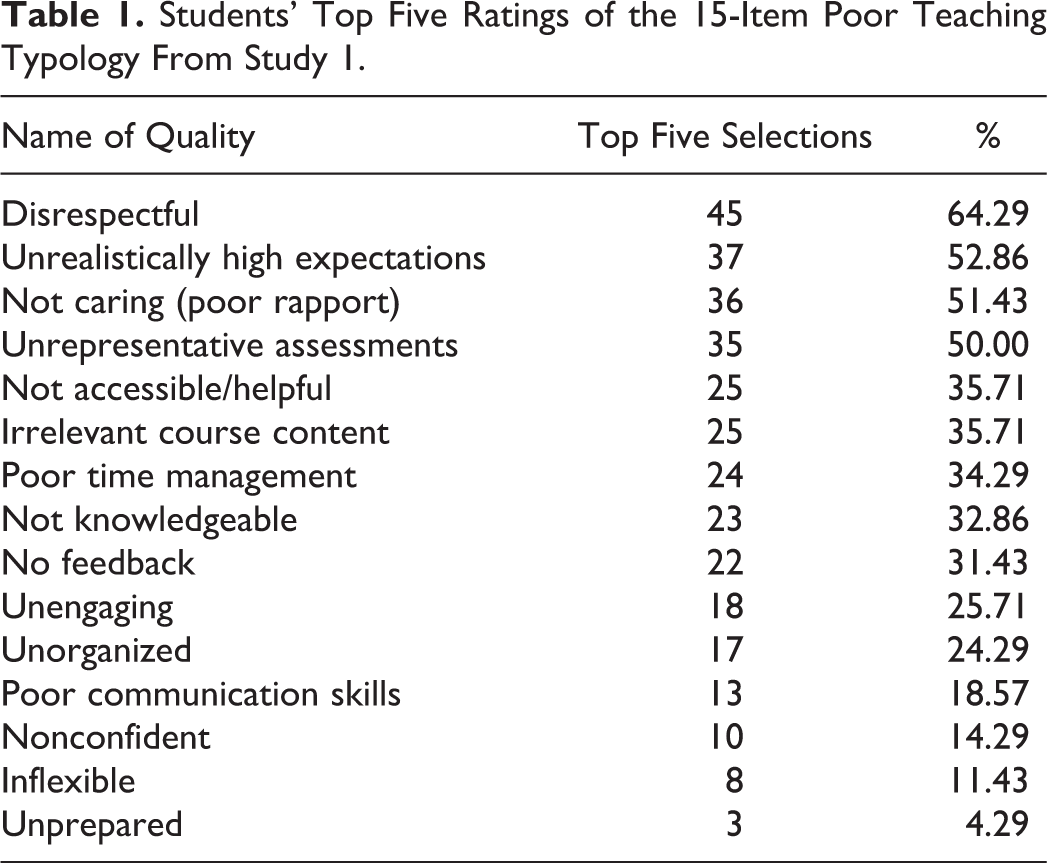
Table 2 shows data collected from faculty at the same university. Faculty also selected being disrespectful as the most common quality associated with ineffective teachers. Teachers who are not knowledgeable, uncaring, unengaging, and poor communicators composed the rest of faculty members’ top five list. Poor time management, unrepresentative assessments, and unrealistically high expectations were reported the fewest number of times by faculty.
Faculty Members’ Top Five Ratings of the 15-Item Poor Teaching Typology From Study 1.

Similar to Busler et al. (2017), the current study revealed that students reported disrespect as indicative of an ineffective teacher more often than any other quality/behavior. Interestingly, faculty also reported being disrespectful as the number one perceived indicator of an ineffective teacher. These data also show that students and faculty agreed that being uncaring was one of the top five perceived indicators of ineffective teaching. Although students and faculty concurred on several qualities/behaviors of ineffective teachers, they also diverged significantly from each other in other areas. For example, students selected unrealistically high expectations and unrepresentative assessments in their top five perceived indicators of ineffective teaching, whereas faculty selected those qualities the fewest number of times.
In combination with Busler et al.’s (2017) findings, these results provide valuable information about perceived qualities/behaviors that contribute to ineffective teaching. However, additional data are necessary in order to explore the generalizability of these findings. Therefore, we sought to expand on Study 1 by collecting data from students and faculty at a public, regional, comprehensive 4-year institution.
Study 2
Method
Participants
Students were recruited from a medium-sized, regional, comprehensive university located in the Southeast United States to participate in this study through email announcements and postings on social media accounts. Six hundred and twenty-one students participated in the study. Of these students, 474 (76.3%) were women; the mean age of all participants was 21.8 years (SD = 5.49 years). Participants’ class standing was as follows: first year = 64 (10.3%), sophomore = 183 (29.5%), junior = 161 (25.9%), senior = 202 (32.5%), and postgraduate = 12 (1.9%). Participants reported majoring in one of the following eight areas: medicine and health sciences (n = 206, 33.3%), social/behavioral science (n = 146, 23.6%), education (n = 88, 14.2%), life sciences (n = 75, 12.1%), arts and humanities (n = 52, 8.4%), business (n = 38, 6.1%), physical sciences and math (n = 6, 1.0%), or other (n = 7, 1.1%).
Faculty from the same university and other regional institutions were also recruited to participate in the study through email. Fifty-nine faculty participated in the study. Of these faculty, 51 (86.4%) were women; the mean number of years spent teaching was 12.68 (SD = 8.80 years). The majority of faculty reported working at a 4-year, public university (n = 44, 74.5%), with the other participants working at a 4-year, private university (n = 11, 18.6%), or community college (n = 4, 6.9%). Participants’ academic rank was as follows: professor = 8 (13.8%), associate professor = 14 (24.1%), assistant professor = 19 (32.2%), and lecturer/instructor = 18 (31%).
Procedure
All protocols were approved by the university’s institutional review board prior to data collection. After providing informed consent, participants completed a series of demographic questions administered through Qualtrics. Participants were then presented with the 15 qualities and attendant behaviors of poor teachers described by Busler et al. (2017) and asked to rate, using a 1 (strongly disagree) to 5 (strongly agree) Likert-type scale, the extent to which they agreed that poor/ineffective teachers possess the qualities listed and exhibit the corresponding behaviors. Participants were then asked to create a top five list using the provided typology of characteristics/behaviors of their most ineffective teachers. Finally, participants identified the percentage of college instructors they had who were (a) excellent, (b) above average, but not excellent, (c) average, (d) below average, but not totally ineffective, and (e) totally ineffective.
Results and Brief Discussion
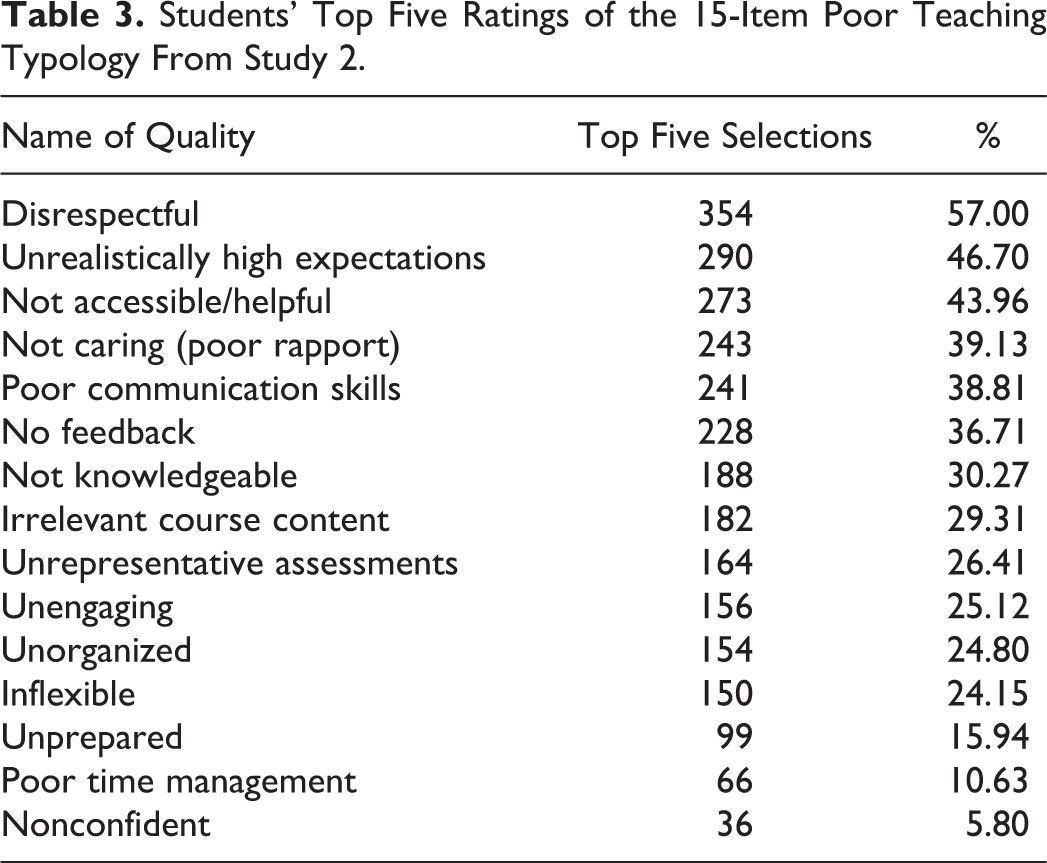
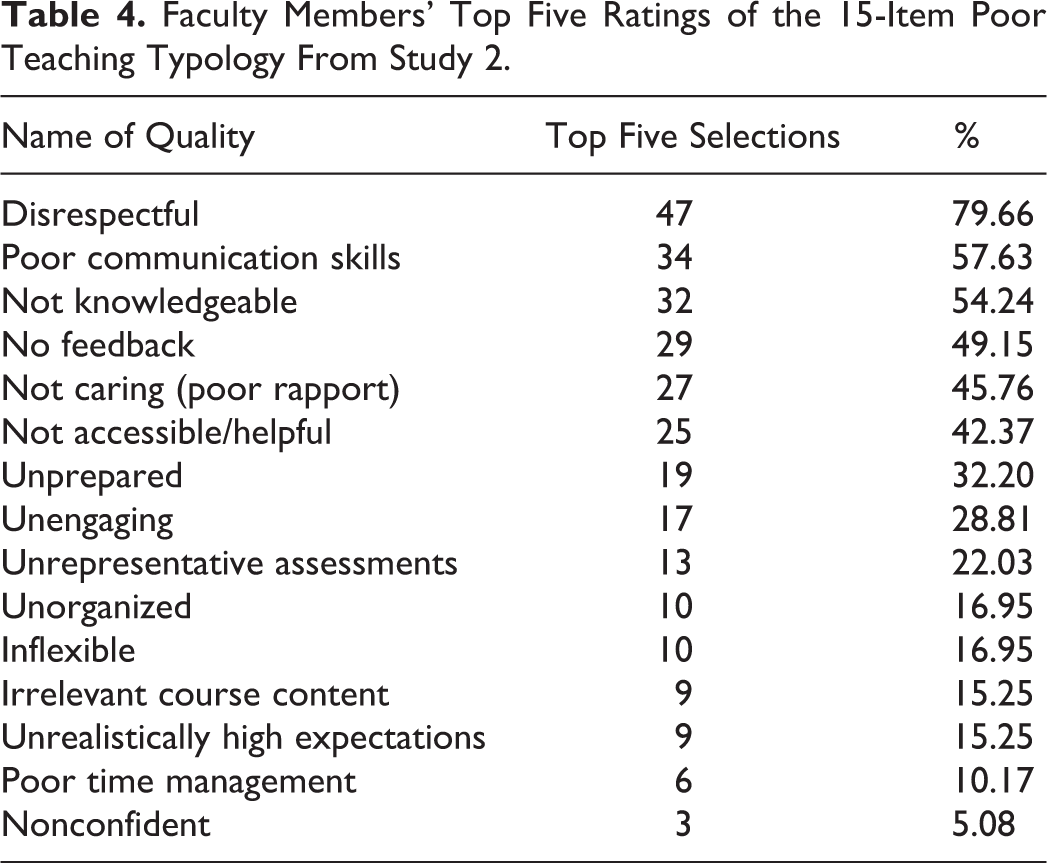
Tables 3 (students) and 4 (faculty) display the top five selection percentage for each item on the poor/ineffective teaching qualities list. Similar to Busler et al. (2017) and our findings in Study 1, both students and faculty members overwhelmingly identified being disrespectful as the number one perceived quality of ineffective teachers. Interestingly, similar to students in Study 1, students in Study 2 also selected having unrealistically high expectations, not being accessible/helpful, and not caring (poor rapport) for their top five. When comparing faculty responses between Study 1 and Study 2, respondents also agreed on four of the top five perceived qualities of ineffective teachers (disrespectful, not knowledgeable, poor communication skills, and not caring/poor rapport), although with several differences compared to students’ selections. Additional similarities and differences across student and faculty respondents may be seen in Table 5. The table indicates the overall rating of each quality based on the percentage of times it was selected by the participants for their top five list.
Students’ Top Five Ratings of the 15-Item Poor Teaching Typology From Study 2.
Faculty Members’ Top Five Ratings of the 15-Item Poor Teaching Typology From Study 2.
Comparative Ratings of the Poor Teaching Typology Across Studies.

Table 6 shows the mean student and faculty ratings of the 15 items listed on the typology of poor teaching qualities/behaviors. Notably, students viewed each of the qualities/behaviors listed as less indicative of ineffective teaching (as measured by the mean scores provided) than faculty members. This may be due to the fact that students reported not experiencing a high percentage of ineffective teachers (4.4%). In fact, 64.6% of student participants said their teachers were above average or excellent. In contrast, faculty participants reported that only 34.6% of instructors were above average or excellent—indicating that faculty members may be judging their colleagues teaching more critically than students.
Mean Ratings of the Poor Teaching Typology by Students and Faculty From Study 2.

The mean scores reported by students and faculty are also interesting, in that they do not perfectly align with participants’ top five selections (see Tables 3 and 4). The most likely explanation for this finding is due to the formatting of questions on the Qualtrics survey. When participants were asked to rate each item, they were presented with five qualities and their corresponding behaviors per page (in alphabetical order). However, when participants were asked to select their top five qualities, all of the items were presented simultaneously. Therefore, it is possible that when presented with all of the items concurrently, participants made additional judgments regarding the level of severity for each teaching quality.
A one-way between-groups analysis of variance was conducted to explore the relationship of students’ major with perceptions of ineffective teacher qualities. Participants identified their majors from one of the following categories: medicine and health sciences (n = 206), social/behavioral science (n = 146), education (n = 88), life sciences (n = 75), arts and humanities (n = 52), business (n = 38), physical sciences and math (n = 6), and other (n = 7). There were statistically significant differences at the p < .05 level by major for all of the qualities assessed.
Notably, students majoring in education rated each of the 15 qualities significantly higher than other majors. Effect sizes were all in the moderate range (d = .45–.77). The largest effect sizes were for the quality of “unengaging.” The effect size between education majors and life sciences majors on the unengaging quality was d = .77. Similarly, the effect size between education majors and business majors was d = .72, with both approaching Cohen’s (1988) convention for a large effect (d = .80). One possible explanation for this finding is that by receiving specific instruction on pedagogy and teaching effectiveness (Evens et al., 2018), education majors would be more likely to perceive the qualities listed as being indicative of an ineffective teacher.
General Discussion
Similar to prior research using the TBC to evaluate the qualities of master teachers (Buskist et al., 2002; Schaeffer et al., 2003), our studies of the perceived qualities of ineffective teachers revealed that students had a tendency to focus more on the social aspects of the student–teacher relationship (e.g., being disrespectful, not accessible/helpful), whereas faculty focused more on professional competencies (e.g., not knowledgeable, poor communication skills). However, students and faculty did show unanimous agreement that being disrespectful is the number one perceived indicator of ineffective teachers. Additionally, both groups of respondents in our study agreed that faculty who fail to develop rapport with their students are at risk of being perceived as ineffective instructors. This is not surprising, given the strong relationship that has been demonstrated between rapport and students’ perceptions of amount learned in a course (Demir et al., 2019; Rogers, 2015; Wilson & Ryan, 2013).
There are hundreds of behaviors that instructors may engage in that could be perceived as being indicative of an ineffective teacher; so why are behaviors associated with being disrespectful (e.g., demeaning a student, ignoring a question) consistently identified as the most egregious quality of poor teachers? Perhaps it is because being disrespectful toward a student indicates deficits across multiple categories (e.g., not caring/poor rapport, poor communication skills, inflexible) associated with poor teaching. Alternatively, given students’ proclivity to focus on the social aspects of the classroom environment, being disrespected may contribute to feelings of nonacceptance or a damaged reputation (De Cremer & Tyler, 2005). In turn, feeling ostracized may overshadow any other qualities of effective teaching. Interestingly, research indicates that even if students are able to identify external factors (e.g., student incivility) that have evoked an instructor’s expression of disrespect, students will still largely make internal attributions to the teacher’s behavior (McPherson & Young, 2009). In fact, if students perceive the classroom to be a hostile environment, they may engage in further maladaptive behaviors, creating a cycle of disrespect that is difficult to break (Goodboy, 2011).
Because learning is often a cooperative process, trusting the teacher is important in creating a classroom environment that is conducive to learning (Pachler et al., 2019; Wooten & McCroskey, 1996). Without a sense of trust and rapport with the instructor, students are less likely to open themselves up “to the perilous uncertainties of new learning” (Brookfield, 1990, p. 162). Repeated demonstrations of disrespect toward students are likely to break any trust that had already been developed in the classroom, with a low likelihood of forgiveness (Vallade & Myers, 2014). Fortunately, students have shown a willingness to forgive less severe instructor transgressions, especially if they view their relationship with their teacher positively prior to the misbehavior(s) (Vallade & Malachowski, 2015). Ultimately, it is in the teacher’s (and students’) best interest to avoid engaging in these kinds of behaviors in the first place.
It is important to note that the current data—and those from earlier studies (e.g., Busler et al., 2017; Goodboy & Bolkan, 2009; Kearney et al., 1991)—are only reflective of participants’ perception of the qualities of ineffective teachers and were not examined in relation to actual student learning outcomes or course performance. Nevertheless, a student’s perception that a faculty member is an ineffective teacher can have direct impacts on their learning due to decreased class attendance and lower motivation/participation (Myers, 2002; Myers et al., 2007; Roca, 2004). Recent research examining two reciprocal qualities (not caring vs. rapport; inflexible vs. autonomy support) represented on the poor teaching typology list suggests some relationship between student perception of these qualities and student learning outcomes (Demir et al., 2019). However, additional research is necessary to gain a clearer understanding of the relationship between the perceived qualities of ineffective teachers and course performance. Future research might also explore the generalizability of the current studies’ findings by examining the perceptions of students and faculty from (a) different countries, (b) educational settings, (c) major areas of study, and (d) course delivery methods (i.e., online degree programs).
Given our understanding of the role of implicit personality theories in making judgments about others (Schneider, 1973), it is reasonable to presume that if a student (or faculty member) perceives an instructor as having one of these qualities (e.g., is disrespectful), then the instructor may also be perceived as possessing other similar poor teaching qualities (e.g., not caring, not accessible/helpful)—even if the individual has not had direct experience related to those qualities and attendant behaviors. Therefore, instructors striving to be better teachers should focus not only on strengthening the qualities and behaviors that have been identified with being a master teacher (e.g., knowledge of the subject matter, engaging, realistic expectations of students) but also avoid engaging in the teaching misbehaviors identified by Busler et al. (2017) and discussed in this article. Particular attention should be focused on the consensus top five perceived qualities of ineffective teachers selected by students (being disrespectful, having unrealistically high expectations, using unrepresentative assessments, not being accessible/helpful, and not being caring). Fortunately, there are a number of excellent resources available to both new instructors (e.g., Buskist & Benassi, 2012) and seasoned faculty to assist them in strengthening their teaching repertoire (e.g., Davis & Buskist, 2002; McGovern, 2012) and avoiding instructor misbehaviors. By having a clearer understanding of what qualities and corresponding behaviors contribute to effective and ineffective classroom performance, ideally, instructors will be able to improve their teaching quality and, by extension, student learning.
Footnotes
Declaration of Conflicting Interests
The authors declared no potential conflicts of interest with respect to the research, authorship, and/or publication of this article.
Funding
The authors received no financial support for the research, authorship, and/or publication of this article.