



Abstract
The goal of the current study was to explore how psychology majors decide whether to enter the workforce or attend graduate school. Thirty-two psychology alumni, including 22 women and 10 men (Mage = 28.88 years, SD = 5.25) participated in semi-structured interviews about their ending time as an undergraduate and figuring out next steps. Using consensual qualitative research (CQR) themes emerged related to gaining experience, relationships, uncertainty, and self-knowledge. Alumni entering the workforce reflected on internship experiences, uncertainty, and finances, while alumni entering graduate school emphasized first-hand experiences, self-knowledge, goals, and location. Additional differences emerged for alumni identifying as first-generation students. Results highlight diverse factors influencing the decision to enter the workforce or attend graduate school.
One of the most common questions facing psychology students is what to do following graduation. How do students decide whether to attend graduate school or enter the workforce? What factors are considered in decision making? Answers to these questions deserve more research since psychology continues to be one of the most popular undergraduate majors in the United States (National Center for Education Statistics, 2018).
Understanding how students decide whether to enter the workforce or go to graduate school is important for several reasons. First, we know that psychology majors may enter the workforce with limited or inaccurate information creating additional barriers to securing employment (Martini et al., 2015). At the same time, many faculty advisors feel unprepared to provide career information for workforce graduates (Halonen & Dunn, 2018). Facilitating the school to work transition requires knowledge of factors students identify as important to choices (i.e., relationships) and how planning influences these choices (i.e., job search timelines) (Hettich, 2010; Vespia et al., 2018). Second, we know very little about why psychology majors choose to attend graduate school (Lancaster & Smith, 2004; Zimak et al., 2011). Since psychology majors attend graduate school at higher rates relative to other majors (APA, 2016) we need more research about factors relevant to choosing this path. Third, we know little about how finances influence career plans even though most college students graduate with an average of $28,500 debt (College Board, 2017). Given that psychology majors overestimate salary for careers in the field (Briihl, 2001; Nauta, 2000), it is critical to know how finances may influence career choices. Fourth, some research suggests that psychology majors have difficulty with career decision making since there is no well-defined script or job title corresponding to the major (Hettich, 2010; Landrum, 2018). If psychology majors experience uncertainty as they transition away from college, a more directive and prescriptive approach to career advising may be needed (Vespia et al., 2018). Finally, first-generation students, undergraduates who are the first in their family to attend college, need more help with career development (Tate et al., 2015a). First-generation students are majoring in psychology more frequently than in the past (Trejo, 2016), yet no research focuses on this group. Given that 40% of undergraduates at our institution identify as first-generation students (Oregon Higher Education Coordinating Commission Report, 2016), we were interested in understanding how first-generation psychology majors transition into the workforce or decide to pursue graduate school.
Several theories provide insight into factors relevant to psychology majors’ career decision making (Bandura, 1997; Krumboltz, 2009; Pryor & Bright, 2003). These theories differ with respect to importance placed on knowledge, goal setting, planning, and certainty. Bandura’s concept of self-efficacy (1997) suggests that belief in one’s ability to succeed influences choices, performance, and persistence. Students with higher career decision making self-efficacy understand personal strengths and weaknesses, have spent time gathering information about careers in the field, are able to select a career goal, engage in planning, and take steps toward a career goal (Lent & Brown, 2013). Other approaches emphasize chance and uncertainty in the career development process. According to happenstance learning theory (Krumboltz, 2009) careers cannot be planned in advance. Uncertainty and anxiety about career decision making are normal and should be reframed as remaining open to new opportunities, as career decision making is not a single decision, but a series of unplanned steps taken to achieve a meaningful life. Likewise, chaos theory of careers (Bright et al., 2005) emphasizes the unpredictable nature of career development and the role of contextual factors (i.e., input from parents), interacting with personal traits, skills, and interests. Chance events such as being in the right place at the right time, or obstacles in an original career plan a large role in career development.
While there is no prior research examining why psychology majors choose to enter the workforce or go to graduate school, a few studies shed light on factors related to choices. Prospective studies comparing undergraduates planning to attend graduate school with those who intend to enter the workforce show differences in personality, beliefs, and behaviors. For example, students who plan to attend graduate school scored higher on dimensions of conscientiousness, openness to experience, they reported higher levels of in-class participation (Scepansky & Bjornsen, 2003), they score higher in personal belief in their own academic success, beliefs about adequacy of undergraduate training, importance of outside activities, and were more likely to hold an internal locus of control relative to students who planned to enter the workforce (Landrum, 2010). Unfortunately, for many students plans change with one study finding that only one third of students planning to attend graduate school in psychology were actually enrolled in a graduate program a year later (Lancaster & Smith, 2004).
Likewise, no prior research examined why psychology alumni chose to enter the workforce or attend graduate school. Psychology workforce alumni typically report low satisfaction with undergraduate preparation for entering the workforce (Ogletree, 1998), low relatedness between their undergraduate major and employment post-graduation (Borden & Rajecki, 2000), they desire more support for the transition to the workforce (Landrum et al., 2010) and emphasize the importance of being adaptable to diverse job paths (Landrum, 2009). Alumni with lower undergraduate GPAs may need even more support with career preparation and transitions (Landrum & Bowers, 2009). For psychology alumni attending graduate school, higher family income, perceived quality of interaction with an undergraduate mentor, and participation in undergraduate research activities were related to perceived preparedness (Huss et al., 2002). In another of study of graduate students enrolled in clinical psychology PhD programs, Zimak et al. (2011) assessed rationale for timing of graduate school. They compared students who delayed entry, those who completed a terminal master’s degree first, and those who entered the PhD program right after completing the bachelor’s degree. Postponing graduate school was associated with wanting more research experience, needing a break, and being unsure about graduate school. Students completing a terminal master’s degree first wanted more research experience, and felt certain about career goals, however some students indicated they were not sure why they had completed a master’s degree. Students going directly into the PhD program, believed it was the next logical step, they felt prepared, and were certain about their goals, however, some reported going to graduate school because they were not sure what else to do.
Summary and Research Questions
Despite the popularity of the psychology major, and increased emphasis on career advising and planning, we know little about factors influencing choices as students approach graduation. The goal of the current study was to provide descriptive information regarding the experience of ending time as an undergraduate and figuring out next steps. With limited prior research, and the mismatch between intention to pursue graduate education and outcomes (Lancaster & Smith, 2004), we asked alumni to reflect on their ending time experiences. We used consensual qualitative research (CQR; Hill et al., 1997, 2005) as a framework to examine ending time narratives without making judgements about expected findings. Thus, we used CQR to answer three main research questions: a) What themes emerge when psychology alumni reflect on their ending time as an undergraduate and figuring out next steps?, b) Do workforce alumni differ from graduate school alumni with respect to ending time narratives?, and c) What factors appear in the narratives of first-generation psychology alumni?
Method
The study design consisted of an in-depth examination of narrative text collected for a larger qualitative investigation of career stories for psychology alumni. The original study involved semi-structured interviews with 61 alumni representing different identities and following diverse career paths within 10 years of completing an undergraduate degree in psychology from Western Oregon University (Hoover et al., 2018). For the current study, we selected a subsample of including alumni within 5 years of graduation at the time of the interview. We believed that the most recent alumni might have the most accurate recollection of feelings and experiences (Landrum et al., 2010) and be more likely to share challenges associated with the transition (Landrum & Bowers, 2009).
Participants
Alumni
Participants were 32 Western Oregon University Psychology alumni graduating within 5 years of interviews (2009–2013). Participants included 22 alumni who entered the workforce following graduation and 10 alumni who entered a graduate program. Thirteen alumni identified as being a first-generation student. Demographic information appears in Table 1. For workforce alumni, all but one were employed, and had been with their current employer for an average of 2 years (SD = 1.5, range 0–7 years). Seventeen reported working full-time (30 or more hours per week), and four reported working part-time (less than 30 hours per week). Job titles included Bilingual Financial Aid Counselor, Counselor III, Social Service Specialist, Market Research Analyst, Director of Community Education, Regional Director, Family Health Services Supervisor, Residential Services Coordinator, Marketing Director, Alternative Instructional Strategies Program Instructional Assistant, Program Coordinator for a Marriage and Family Therapy program, Dependency Case Manager, Child Welfare Caseworker, Residential Counselor, and Head of Children’s Education and Services.
Demographic Characteristics for Alumni.

Note. 1 Racial Identity and Self-Reported Learning Disabilities: Some participants did not respond to these questions. 2 First-Generation Student defined as student for whom parents have not earned an associate’s degree or higher. 3Non-Traditional Student defined as student who was 25 years or older or has children or is returning after a break from school. 4Transfer Student defined as student who transferred from another school.
For alumni who went to graduate school, five were pursuing or had completed master’s degrees in Rehabilitation Counseling, Marriage and Family Therapy, Clinical Neuropsychology, and Clinical Mental Health Counseling. Three alumni were enrolled in doctoral programs including Experimental Psychology, JD Law, and Marriage and Family Therapy. Two alumni were working on degrees in nursing and alcohol and drug addiction certification.
Researchers
This project involved collaboration between the principal investigator (PI) and teams of undergraduate psychology majors involved in interviewing alumni, transcription and deidentification of interviews, and coding and data analysis. Details regarding the undergraduate interviewers appears in Hoover et al. (2018). Seven undergraduate psychology majors were involved in transcription checks and deidentification of transcripts. Four undergraduate students participated in the data analysis team.
Measures
Demographic questionnaire
We used a questionnaire to collect demographic information including gender, race, ethnicity, age, self-reported disabilities, and other possible identities including nontraditional student, first-generation student, and transfer student. Alumni were asked about participation in two career related courses, participation in department sponsored internships, participation as a research assistant, or teaching assistant, and involvement in the Psi Chi honor society. Participants were asked about current employment and if they had pursued any additional education. See Table 1.
Interview protocol
The purpose of the interview was to elicit an alumni career story including information about decision making. In the current study we focused on participants’ responses to the following prompt “Tell me about your experience ending your time as an undergraduate and figuring out your next steps when you were graduating.” Probes included asking about anticipated work, plans, preparation for first job, difficulties, challenges. Participants who attended graduate school were asked about how they made the decision to attend graduate school and to describe the graduate school experience. Emphasis was on the collaborative nature of the interview and alumni were encouraged to share any information that they felt was relevant.
Procedure
Recruiting alumni
Several strategies were used to identify alumni from diverse career paths. In prior assessments, some alumni volunteered to participate in research regarding career paths. Psychology faculty nominated alumni who went to graduate school or entered the workforce. The alumni association provided contact information for psychology alumni within 10 years of the study. The PI used social network sites (i.e., Facebook, LinkedIn) to secure recent email contact information. After gaining approval from the Institutional Review Board (IRB), alumni (N = 141) were contacted via email and invited to participate in the study. We emphasized wanting to hear from diverse voices. Emails were returned as undeliverable for 11 alumni. Sixty-five alumni expressed interest in participating, with 61 alumni completing the interview process. For the current data analysis, we included alumni within 5 years of graduation. The demographic composition of the current sample reflects the larger sample of alumni interviews and matches overall demographics for graduating alumni.
Interviews
Interviews were conducted by an undergraduate researcher by phone or in person at an agreed upon quiet location (i.e., the campus library, private meeting room in local coffee shop) (Hoover et al., 2018).
Transcribing and deidentifying the interviews
A professional transcription service transcribed the interviews. Transcription checks for accuracy were performed by trained undergraduate research assistants to ensure that discipline specific terminology was accurately transcribed and transcripts were de-identified to maintain confidentiality of participants.
Results
Data Analysis
Data analysis with consensual qualitative research (CQR) was conducted using procedures recommended in the literature (Hill et al., 2005). First, we reviewed all ending time narratives and developed a starting list of themes or domains. The team met to discuss themes generating an initial list of domains. Each member independently coded each block of transcript into the initial domains. The team then met to discuss coding and argued to consensus regarding the initial domains and adding new domains. The team argued to consensus over what label best fit each domain. The team continually revised and regrouped the domains to further clarify and distinguish domains and eliminate overlap. Next, the team developed core ideas or categories for each domain and argued to consensus about wording. The codes were sent to an outside auditor who examined the domains and core ideas, returned her comments and met with the team to clarify disagreements. Cross analysis was done such that the team independently reviewed the categories under each domain across the cases and looked for additional ways to group ideas into categories. The final version of codes appears in the results below.
Six domains emerged in narratives. Under each domain, categories were generated that captured the core ideas in the data. Following the CQR procedures (Hill et al., 1997), we considered a category to be general if it applied to all the cases, typical if it applied to more than half of the cases, and variant if it applied to less than half but more than two cases. Categories with only one or two cases were not included in the analysis. Table 2 shows the data for the sample grouped into alumni who entered the workforce (WF) or went to graduate school (GS). Table 3 shows the data for the sample grouped by alumni who identified as first-generation (FG) or non-first-generation (NFG). Table 4 shows supporting statements for domains and categories. Specific information that could be linked to participant identity appears as NR—Name Removed. χ2 tests of independence were used to evaluate patterns across groups using α = .05 and reported with Cramer’s V as a measure of effect size.
Domains and Categories for Alumni Narratives By Career Path of Entering the Workforce or Attending Graduate School.
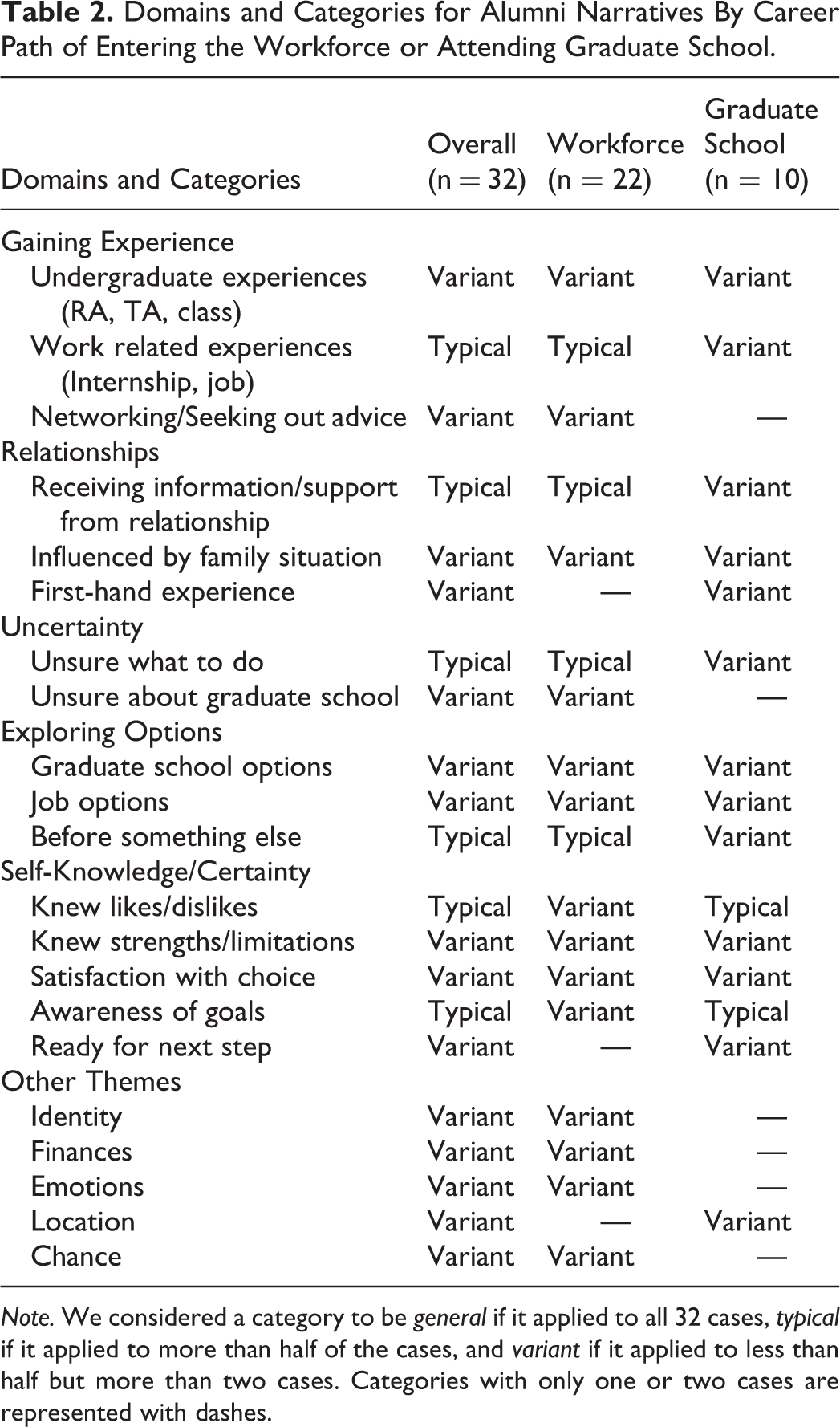
Note. We considered a category to be general if it applied to all 32 cases, typical if it applied to more than half of the cases, and variant if it applied to less than half but more than two cases. Categories with only one or two cases are represented with dashes.
Domains and Categories for Alumni Narratives Based on First-Generation Identity.
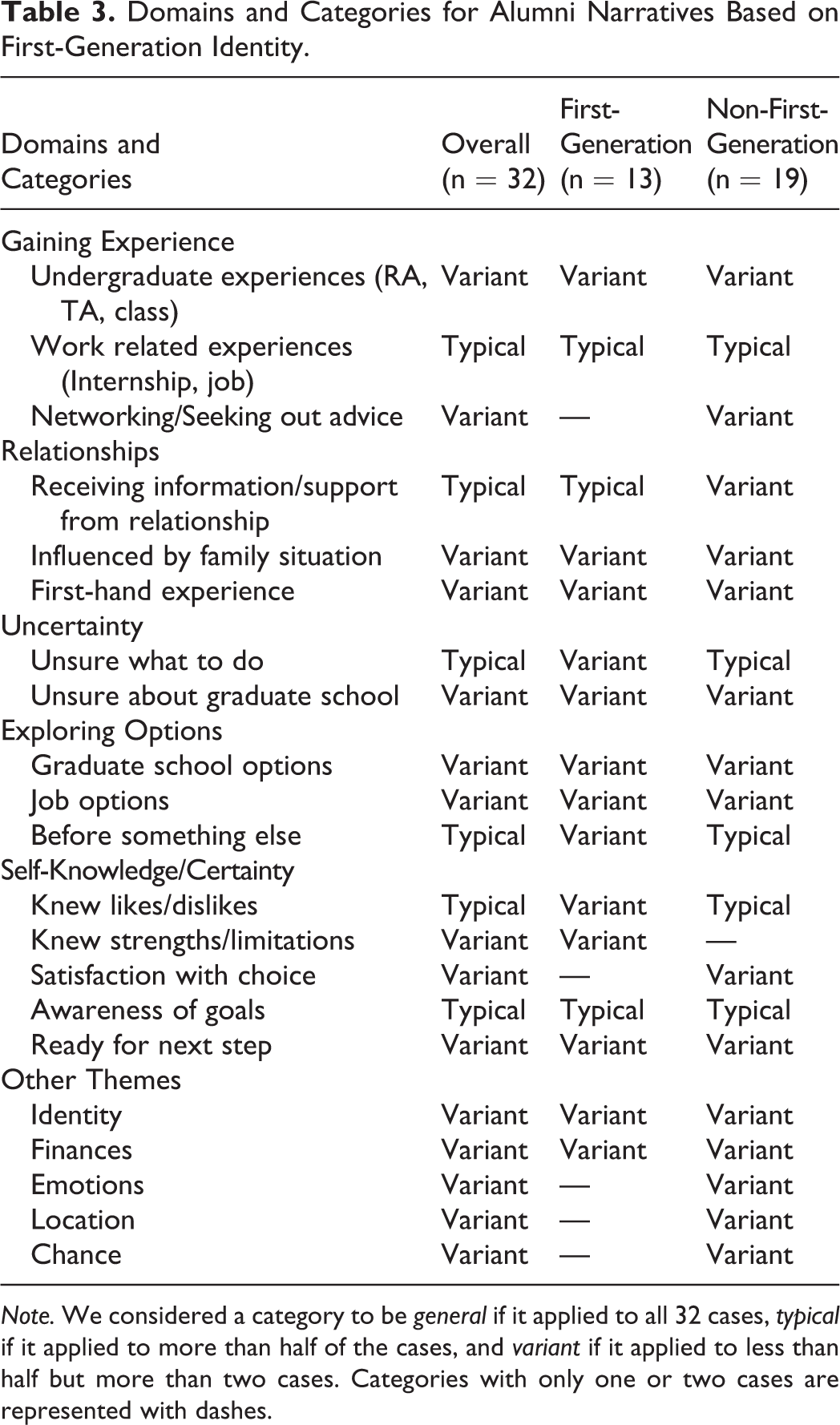
Note. We considered a category to be general if it applied to all 32 cases, typical if it applied to more than half of the cases, and variant if it applied to less than half but more than two cases. Categories with only one or two cases are represented with dashes.
Domains and Categories with Supporting Statements from Alumni Narratives by Workforce (WF) or Graduate School (GS) Alumni and First-Generation Identity (FG).

Gaining experience
Alumni described being actively involved in experiences during their ending time. Experiences included a) participation in undergraduate experiences (i.e., being a research assistant); b) participation in work related experiences (i.e., having a job); and c) networking/seeking out advice. WF and GS alumni were equally likely to talk about undergraduate experiences in their ending time narrative. FG and NFG alumni included undergraduate experiences in their narratives. More than half of the sample talked about work related experiences. WF alumni shared work related experiences more so than GS alumni did χ2 (1, n = 32) = 3.86, p < .05, V = .347. Networking occurred more frequently in the narratives of WF alumni relative to GS alumni χ2 (1, n = 32) = 4.61, p < .05, V = .379. Additionally, NFG alumni engaged in networking more than FG alumni χ2 (1, n = 32) = 6.23, p < .05, V = .441.
Relationships
Alumni reflected on relationships across three categories a) receiving information from a relationship (i.e., being offered information about a career option); b) influenced by family situation (i.e., getting married); and c) first-hand experiences (i.e., seeing someone else go to graduate school). Receiving information from the relationship appeared in more than half of the cases in the sample. WF alumni talked about receiving information more than GS alumni χ2 (1, n = 32) = 4.76, p < .05, V = .385. Additionally, FG alumni included receiving information more than NFG alumni did χ2 (1, n = 32) = 4.27, p < .05, V = .365. WF and GS alumni, FG and NFG alumni, all talked about being influenced by a family situation. GS alumni talked about the first-hand experiences more than WF alumni did χ2 (1, n = 32) = 9.32, p < .05, V = .539.
Uncertainty
Uncertainty was a common theme in alumni interviews. We observed two categories of uncertainty including a) unsure about next steps (i.e., what to do with a degree in psychology); and b) uncertainty regarding graduate school. Being unsure about next steps appeared in more than half of our sample. WF alumni expressed uncertainty more than GS alumni. χ2 (1, n = 32) = 5.23, p < .05, V = .404. Additionally, NFG alumni talked about uncertainty more than FG alumni χ2 (1, n = 32) = 4.81, p < .05, V = .388. Being unsure about graduate school appeared in many narratives of WF alumni. Both FG and NFG alumni noted uncertainty regarding graduate school.
Exploring options
This domain included researching options and was grouped into a) exploring graduate school options; b) exploring job options; or c) exploring before something else (i.e., getting a job before going to graduate school). GS and WF alumni, FG and NFG alumni were equally likely to discuss researching graduate school options. GS and WF alumni were equally likely to describe exploring job options. Both FG and NFG alumni reflected on exploring job options. Finally, more than half of the sample talked about exploring prior to something else. Exploring before something else appeared predominantly in WF and NFG alumni narratives.
Self-knowledge/certainty
This domain emerged as a contrast to uncertainty and included the a) knew likes/dislikes; b) knew strengths/limitations; c) satisfaction with choice; d) awareness of goals; and e) ready for next step. More than half of the sample included knowledge of likes/dislikes in narratives. GS alumni talked about likes/dislikes more than WF alumni χ2 (1, n = 32) = 5.24, p < .05, V = .405. NFG alumni talked about likes/dislikes more than FG alumni χ2 (1, n = 32) = 5.16, p < .05, V = .401. FG alumni included strengths/limitations in their narratives more than NFG alumni χ2 (1, n = 32) = 7.17, p < .05, V = .473. GS and WF alumni talked about satisfaction with choices. NFG alumni were more likely to include satisfaction relative to FG χ2 (1, n = 32) = 3.92, p < .05, V = .350. GS alumni talked about awareness of goals more than WF alumni χ2 (1, n = 32) = 4.12, p < .05, V = .358. GS alumni talked about being ready for next steps more than WF alumni χ2 (1, n = 32) = 6.73, p < .05, V = .459.
Other themes
Several other categories did not fit into the above domain including a) identity (i.e., first-generation); b) finances; c) emotions; d) location; and e) chance. WF alumni noted identity more than GS alumni χ2 (1, n = 32) = 4.73, p < .05, V = .384. WF alumni talked about finances more than GS alumni χ2 (1, n = 32) = 4.69, p < .05, V = .383. WF alumni who were NFG included emotions in their narratives. While we did not categorize distinct emotions, most related to uncertainty about next steps. GS alumni talked about location more than WF alumni χ2 (1, n = 32) = 9.50, p < .05, V = .545. NFG included location in narratives more than FG χ2 (1, n = 32) = 3.86, p < .05, V = .347. WF participants who were NFG indicated chance or the random nature of the path taken.
Discussion
The goal of the current study was to provide descriptive information regarding psychology majors’ ending time experiences. In the paragraphs that follow, we examine differences for workforce and graduate school participants, and for those who identified as first-generation students. Then we highlight common themes as we integrate findings with prior research and make recommendations.
Workforce Alumni
Workforce alumni talked about work-related experiences (i.e., internships) and networking, suggesting that they understood the importance of these experiences for career development (Landrum, 2009). Workforce alumni passively received information from people in relationships (i.e., advisors, parents). Some psychology majors may appreciate a more directive approach to advising (Vespia et al., 2018). Workforce alumni were unsure about next steps and felt worried and anxious. This is not surprising given that career options for psychology majors may be less obvious than other majors (Peterson et al., 2014). While an elective careers course is available for psychology majors at our institution, only 22% of alumni in the sample had taken this course, with a larger percentage representing graduate school alumni. Additionally, many workforce alumni described uncertainty about graduate school. Uncertainty regarding graduate school may be associated with gaining more experience and applying to graduate school in the future (Zimak et al., 2011). Workforce alumni described identities related to ending time decision making. Culture, relationships, and identity interact in complex ways to influence career decision making (Pryor & Bright, 2014). Workforce alumni talked about finances more than graduate school alumni. In other research, family income was associated with feeling prepared for graduate school (Huss et al., 2002). Finally, workforce alumni talked about how chance or something unplanned occurred during their ending time. Prior research highlights the importance of chance in the career development process (Krumboltz, 2009), with chance events triggering important career transitions (Williams et al., 1998).
Graduate School Alumni
Graduate school alumni reflected on first-hand experiences such as seeing a friend struggle with addiction, watching a peer go through graduate school, or having family members in counseling. While these experiences may be idiosyncratic, they highlight the role of contextual factors in career decision making (Pryor & Bright, 2003). Graduate school alumni reflected on how preferences affected choices. Prior research emphasized the importance of self-knowledge in career decision making (Lent & Brown, 2013). Additionally, graduate school alumni discussed goals and readiness for next steps more than workforce alumni. Zimak et al. (2011) also found that students directly entering graduate school were more certain about goals and felt more prepared relative to peers who delayed graduate school.
First Generation Alumni
Participants who identified as first-generation students were less likely to talk about networking relative to non-first-generation peers. First-generation students have less social capital (Tate et al., 2015a) and may be less familiar with strategies for finding a job (Tate et al., 2015b). Additionally, first-generation alumni were less likely to talk about exploring options before something else. First-generation students may feel pressure to complete an education, get a job, and build assets for the family (Leyva, 2011). First-generation alumni did not talk about personal preferences, and they were less likely to include satisfaction with choices relative to non-first-generation alumni. Conversely, first-generation narratives included more reflection on strengths and limitations. Perhaps first-generation alumni are focused on practical concerns (i.e., finances) more than personal interests or satisfaction in career transitions (Blustein et al., 2002).
Common Themes of Psychology Alumni
Despite differences, we observed commonalities in alumni narratives. Prior research showed that psychology majors planning to attend graduate school rated undergraduate experiences such as being a research assistant as more important than psychology majors planning to enter the workforce (Landrum, 2010). Our findings suggest that both workforce and graduate school alumni recognize the value of these activities. Additionally, first-generation and non-first-generation narratives included participation in undergraduate experiences. Historically, first-generation students were less likely to be involved in undergraduate research (Willison & Gibson, 2011). First-generation alumni talked about work related experiences to the same extent as non-first-generation peers, indicating that they understood the value of gaining hands-on experience. Alumni across all groups discussed how family situations influenced choices. Alumni talked about exploring graduate school and job options. Graduate school alumni explored job options, and workforce alumni explored graduate school options. Clearly alumni were gathering occupational information (Savickas, 1999), and open to alternative career options (Krumboltz, 2009).
Implications for Faculty Advisors and Career Planning Curriculum
Synthesis of the findings suggests two recommendations for supporting psychology majors’ career development. First, many students feel uncertain and anxious about career decision making and are open to exploring diverse options. While some uncertainty might be expected developmentally (Atwood & Scholtz, 2008; Hettich, 2010), we need to normalize career uncertainty or reframe it as being open-minded (Krumboltz, 2009). Normalizing feelings of uncertainty may alleviate any expectation that students “should” have it all figured out, and lead to productive conversations that clarify the nature of uncertainty and prompt action (Ludwikowski et al., 2009). Students may be uncertain about various aspects of career development at different points in their academic career (Ciarocco, 2018; Schwartz et al., 2018), and career decision making is a process, not a “one and done” decision (Pryor & Bright, 2014). The faculty advisor can serve as a point person to different resources depending on the needs of the student, and availability of departmental and campus resources.
Faculty advisors should also recognize that some graduate school bound students experience uncertainty. Students may have been accepted to a graduate program without a career in mind or because they were unaware of other career options (Zimak et al., 2011). Students may believe that graduate school will help them figure out a career not understanding that content becomes more specialized and less transferable to another field (Ciarocco, 2018). We should encourage graduate school bound students to continue learning about career options associated with the intended degree through professional organizations associated with their graduate program (i.e., American Psychological Association (APA), American Counseling Association (ACA)). Going to graduate school for the wrong reasons can set the student on the wrong career path, and waste time and money (Walton, 2012).
Additionally, career planning curriculum needs to carefully balance gathering occupational information and committing to a career path (Atchley et al., 2012) with exploration of diverse options, and remaining flexible to changing plans (Krumboltz, 2009). While some approaches encourage specialization as students progress through the degree (Ciarocco et al., 2016; Schwarz et al., 2018), plans change for many students. Career planning curriculum needs to include opportunities for students to change paths, to change their mind, to respond to changing circumstances, and failure, as these will all occur (Pryor & Bright, 2006).
Second, faculty advisors need to recognize that students are making important career decisions within the context of complex lives and diverse identities. They are choosing to enter the workforce or go to graduate school with relationships in mind (Whiston & Keller, 2004a). Within this study, psychology students made decisions within the context of having children, getting married, dealing with family member illness, navigating romantic relationships, serving as a caregiver to a parent or a child, or being a trailing partner. These contextual factors are affected by culture, race, ethnicity, gender and socioeconomic status (Tate et al., 2015b). Alumni cited multiple identities affecting choices. Being a first-generation student, being in the military, being a student athlete, or identifying as student with a disability were all cited as relevant to decision making. Students do not fall into “neat little boxes,” and multiple identities affect career decisions (Whiston & Keller, 2004b). Family and relationship support may play a more critical role in career development of African American, Latinx, and first-generation students (Leyva, 2011; Tate et al., 2015b; Whiston & Keller, 2004a). Psychology is fourth most popular undergraduate majors for all racial and ethnic groups in the United States (National Center for Education Statistics, 2019). Psychology majors are increasingly likely to be first-generation students (Trejo, 2016). Career planning curriculum that includes consideration of diverse identities and family impact on decision making would benefit students who need it the most (Ciarocco et al., 2016; Peterson et al., 2014).
Limitations and Future Directions
The present study examined ending time narratives for a convenience sample of psychology alumni from a small liberal arts college in the Pacific Northwest. Given that many of our alumni were non-traditional students (38%), they identified as first-generation students (40%), and had transferred from another institution (60%) we urge caution in generalizing these results to alumni from other institutions. Additionally, we solicited alumni following diverse career paths but heard from very few who were unemployed or working at home. We considered retrospective accounts of alumni within 5 years of graduation, but longitudinal or time lag research examining decision making and transitions for psychology undergraduates becoming alumni may provide more accurate information about factors influencing choices (Lancaster & Smith, 2004; Seibert et al., 2013). Some have argued that career decision making appears logical, and planned when reviewed retrospectively (Bright et al., 2005; Williams et al., 1998). Chance events may have played a larger role than observed (Pryor & Bright, 2014).
We encourage researchers to employ qualitative or mixed methods to examine changes in career decision making across time. Qualitative inquiry is well suited to incorporate the voices of students, promote dialogue, and offer culturally contextualized knowledge (Hoover et al., 2018). Psychology majors will continue to ask what to do following graduation. Understanding factors important to choices (i.e., finances, undergraduate experiences, relationships), helps answer this question. Knowledge of diverse factors influencing decisions enables psychology programs to develop curriculum relevant to career decisions across time (APA, 2013; Krumboltz, 2009), it facilitates productive faculty-student dialogues about career plans (Halonen & Dunn, 2018; Vespia et al., 2018), and helps undergraduates transition from students to professionals well equipped to navigate changes within their own career story (Ciarocco, 2018; Hettich, 2010).
Footnotes
Acknowledgment
We are grateful to Stephanie Hoover and Lauren Roscoe for development of the interview protocol, training of the interview team and the transcription and deidentification team, recruitment of participants, and assistance with data auditing. We acknowledge Danica Drapela, Marsha Warren, Kimberly Lanning, Ashley Flores, Cierra Henderson, and Isabel Dryden who provided invaluable assistance in transcription checks and deidentification of transcripts.
Declaration of Conflicting Interests
The authors declared no potential conflicts of interest with respect to the research, authorship, and/or publication of this article.
Funding
The authors received no financial support for the research, authorship, and/or publication of this article.