



Abstract
This article examines how food practices contribute to the lived experience of the West African diaspora in Hong Kong. Drawing on in-depth interviews and participant observations of Africans in different African restaurants, grocery stalls and cultural events, this article proposes the concept of a “culinary diaspora space” to examine how they navigate spaces of solidarity and struggle during their integration process through African food-related practices. It highlights the point at which boundaries of inclusion and exclusion are contested by revealing the practical and symbolic roles played by migrants’ traditional food culture throughout the integration process. This research argues that African food outlets are a space of social frictions but also of possible cultural encounters between the Africans and Hong Kong Chinese. By focusing on food-related practices, this research demonstrates how the West African diaspora is felt, embodied and perceived by the host society.
Introduction
Hong Kong is one of the major cities in China that has hosted African migrants since the turn of the 21st century. According to the Immigration Department of the Hong Kong Special Administrative Region government, 4,670 African migrants (both regular and irregular) resided in the city in 2016. Although their number is smaller compared with the African population in Guangzhou (Bodomo, 2012), their lived experience in Hong Kong can offer another perspective in understanding the presence of Africans in China. The Africans in Hong Kong come from 30 different African countries, including South Africa, Nigeria, Ghana, Tanzania, Madagascar and Kenya. According to Bodomo (2012, 2016), many Africans came to Hong Kong for business (e.g., opening bars and hairdressing salons), some were football players and a few were asylum seekers. There were also Africans in Hong Kong in the trading and logistics businesses (Mathews, 2011). Despite being separated from their home countries, they have managed to recreate familiar social spaces, such as African restaurants and grocery stores. A sizable body of scholarship on Africans in Hong Kong has developed, providing insights on economic, socio-cultural, linguistic and education issues (Bertoncello and Bredeloup, 2007; Bodomo, 2007, 2012; Mathews, 2007, 2011; Mathews and Yang, 2012; Tsui and Tang, 2015). This article seeks to build on the existing literature by providing a more in-depth picture of African diasporic cultures in Hong Kong. This article focuses on food because it is an expressive practice through which the negotiation of identity is mediated (Turino, 2008). This embodied practice can help maintain and create new socio-cultural relations both within and across borders. Food is a key component of human cultures and is central to our sense of identity. This is especially true in the case of migrants, who must deal with adaptation or resistance to lifestyle changes in host societies. Of interest in this article are West African migrants (largely Ghanaians, Nigerians) and their food culture, for two reasons: First, they are a big group in Hong Kong and have opened several restaurants and grocery stores and second, because West Africans experience discrimination due to their black skin color.
In this article, unless otherwise specified, references to Africa or Africans pertain to West Africans, and in the context of Hong Kong, the West African community is largely made up of migrants from Ghana and Nigeria. 1 In addition to geographical reasons, I identify the research participants as African which reflects the Hong Kong Chinese people’s lack of awareness of differences of peoples coming from various African countries. There is also an emerging consciousness of “pan-African diasporic identities layered through discrete national and ethnic identities” (Creese, 2011: 15). Borrowing the definition proposed by Bodomo (2012:4), the term, African, refers to “someone who is a citizen of any of the countries in Africa. It also includes people who are not citizens of any of the countries in Africa but who consider themselves to be from Africa or to be of African origin.”
Regarding the integration of migrants, some studies (e.g., Shum, 2019) have already highlighted the importance of cultural encounters with locals. In this research, I frame integration as a two-way process that requires meaningful contacts between migrants and the local population, and diasporic cultures play a crucial role in this regard (Shum, 2019). Most Africans in Hong Kong gather in Chungking Mansions and Mirador Mansion, two buildings located in Tsim Sha Tsui, Hong Kong’s major business and tourist district (see Figures 1 and 2). Both are multi-story, multi-purpose buildings that contain cheap guesthouses, retail and wholesale businesses, restaurants and grocery stores. There are four African restaurants and two grocery stores in these two buildings. These food places attract not only Africans but also other nationalities. The role of these restaurants in the lives of migrants raises the question: What can the food cultural experience of Africans suggest about the integration functions in Hong Kong today?
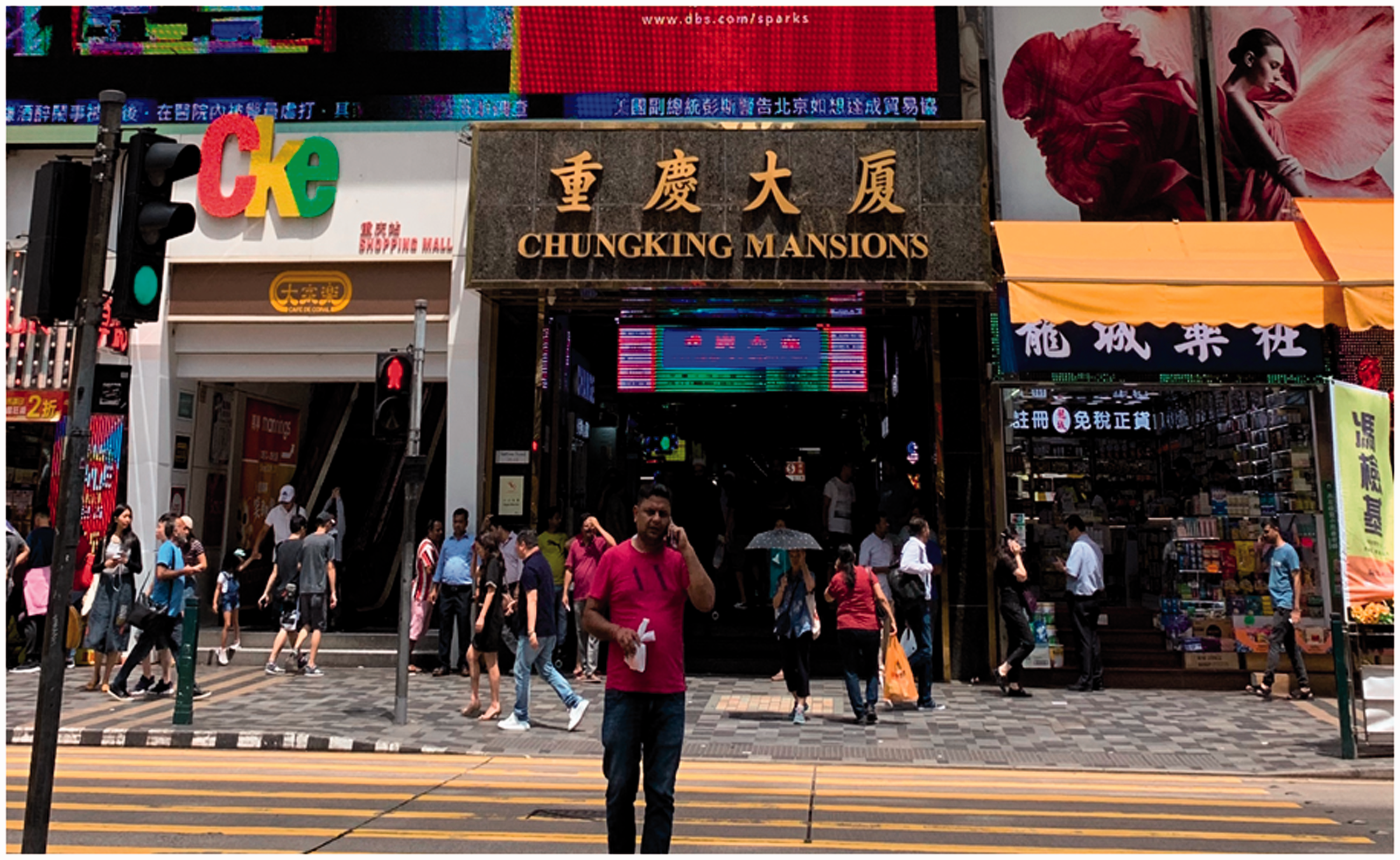
Main entrance of Chungking Mansions, Tsim Sha Tsui, Hong Kong.

Main entrance of Mirador Mansion, Tsim Sha Tsui, Hong Kong.
I use the concept of “culinary diaspora space” to examine the symbolic and functional roles of African food in maintaining ties with homelands, creating a sense of belonging, facilitating cultural encounters and promoting the inclusion of ethnic minorities in the host society. My approach is informed by the works of Brah (1996) and Creese (2011), who suggested that belonging is negotiated at sites such as neighborhoods and shops. My analysis highlights food as a contradictory site of power negotiation and solidarity (Mintz, 1996) and food practices, such as sourcing, preparing, serving and eating, as sites of cultural work (Christie, 2003). This approach sheds light on the particular “social dynamics within the spaces into which transnational flows are locally channeled” (Tomlinson, 1999: 140). In this research, I first focus my analysis on four eating and two food retail establishments in Chungking Mansions and the Mirador Mansion, which serve as the nerve center of the African community in Hong Kong (Bodomo, 2012). The analysis of the African community in Hong Kong should not only be limited to these two buildings (Bodomo, 2012), but should attempt to examine the broad picture of African conditions in Hong Kong. This article tries to address this call by expanding the existing conceptual framework for understanding the relationships among diaspora, food and migrants’ integration.
The article is organized into several sections which include the following: a discussion of the theoretical framework of the study; methodology; and particularly the role of West African food in creating a sense of place, establishing cultural encounters and promoting the inclusion of ethnic minorities in the host society. Finally, this article concludes by arguing that African food culture in Hong Kong offers a specific focus for research on the emerging ground-level African-Hong Kong Chinese relationship.
Theoretical framework: Integration, diaspora and food
Integration has been defined by scholars in various ways. Among these, Ponzo et al. (2013: 6) more generally define integration as “the dynamic, multi-actor process of mutual engagement that facilitates effective participation by all members of a diverse society in the economic, political, social and cultural life, and fosters a shared and inclusive sense of belonging.” I have argued for the multidimensional approach in probing the integration of migrants, which conceptualizes “integration as a complex process of participation as well as personal and social change that involves not only the migrants but also the host population” (Shum, 2019: 40). In Hong Kong, African migrants form an ethnic minority group that comprises both regular and irregular migrants (asylum-seekers). 2 This research adopts the approach proposed by Mayblin et al. (2016: 962) that focuses on “the production of new multicultural forms of living together as a result of a mutual openness to change, the breaking down of boundaries, and the mixing or hybridization of cultural practices.” Cultural diversity is a reality in the modern world. If we understand integration as a multidimensional and two-way process involving migrants and the local population, integration requires accepting and respecting differences between and within cultures. Many global cities, such as Hong Kong, have started to deal with these issues in the past three decades. In Hong Kong, the government sponsors several programs, including educational support, language courses and community support teams (Hong Kong Government, 2017) to help migrants adjust to Hong Kong. However, this approach neglects an important part of multicultural life, which is the lived experience of migrants (Wise and Velayutham, 2009: 2). This research focused on how Africans carried their food culture in Hong Kong and how it contributed to the assertion of African identity, community formation and transnational connections. To some extent, African food can also initiate dialogue and understanding between Africans and the Hong Kong Chinese.
From the moment of arrival in a foreign country, migrants face a range of everyday life challenges. How diasporic communities forge their distinctive sense of identity has been an important research question addressed by different scholars (Brah, 1996; Clifford, 1994; Crang, 2010; Datta, 2008). Vertovec (1999: 1) defined diaspora as “any population which is considered ‘deterritorialized’ or ‘transnational’—that is, which has originated in a land other than the one in which it currently resides, and whose social, economic and political networks cross the borders of nation-states or, indeed, span the globe.” Diasporic communities maintain a connection with their homelands in various ways, such as remitting money back to their homeland to improve household welfare (Ajaero et al., 2018), and in destination countries, they form migrant associations (Marini, 2014). This community building approach espoused by Butler (2001) tends to treat the diaspora as a bounded community and focuses on the connections between the diaspora and the homeland. Brubaker (2005: 13) proposed diaspora “as a category of practice, project, claim and stance, rather than as a bounded group.” Following this notion, the food-related practices of Africans play an important role in how migrants maintain their ties to their home countries.
Diaspora studies also raise interesting questions about the conceptualization of home. Homemaking is described by Bhatti and Church (2004) as “an active process seeking to capture individual agency and household practices in constructing and constituting the meaning and value of the home.” It is here that performing food culture is crucial. Food, as a cultural and material practice, is closely related to the maintenance, expression and reworking of identity of diasporic members (Avieli, 2005; Plaza, 2014). The meanings of food come from its ability not only to fulfill basic biological needs but also to evoke vital physiological associations, namely our senses, emotions and memories (Counihan, 1999). Through the preparation, eating and sharing of food and the creation of different cultural communities in a host society, migrant groups’ memories of home can be triggered, revealing the important role of food in diasporic experiences. Migrants’ knowledge and experience of food first come from home, and the memory is later perpetuated, contested and negotiated in various ways (Plaza, 2014). Food provides the comfort of home and a link, both tangible and intangible, to places, times and people of importance. The recollection of the past is not simply cognitive but also emotional and physical (Sutton, 2001). This is especially significant for those who migrate to a new place and aspire to have connections to their past. Since the second half of the 1990s, diaspora memory has gained attention in academic debate (Brah, 1996; Brightwell, 2015; Fortier, 2000; Tolia-Kelly, 2004). Scholars have pointed out that “remembrance is the primary modality of diasporic identity formation,” linking “the creation of identity of places” (Fortier, 2000: 184). Food production and consumption experiences under diaspora conditions can evoke memories of home that allow migrants to cross geographical boundaries. Rabikowska (2010: 388) argued that “without epiphanic objects, transgression into the past, into the imagined space ‘there,’ enacted in the present ‘here,’ would not be possible.” Food, therefore, needs to be verified as “authentic,” as authenticity plays a vital role in the process of building social relationships inside and outside of the diaspora (Rabikowska, 2010). In their research on the relationship between food and the process of community formation and on identity shaping among African traders in two urban Chinese cities, Bodomo and Ma (2012) suggested that food and the places for eating food have played and are playing a vital role in the processes of identity and community formation among Africans in China. By seeing the names of African dishes on the menu, the researched Africans felt like they were “back home in Africa,” as they found the names familiar. Food is an embodied and visceral experience that can create and re-create “home” and “memory” through multiple senses (Longhurst et al., 2009). Sutton (2001) argued that food is a “cultural site” through which worlds displaced in space and time can be imagined through tangible means. Food is highly symbolic and embedded in history and social structures. My research highlights how West African food is not only nostalgic at times but is also indicative of a tool of ground-level cultural diplomacy that actively connects people of different nationalities, particularly the Hong Kong Chinese, to the transnational West African culinary field. The concept of “culinary diaspora space” proposed in this article is used to tease out migrants’ experiences of home engagement and host-society integration through food.
Methodology
This article is based on in-depth interviews and ethnographic observation of 35 Africans between June 2017 and June 2018. The research participants were identified, contacted and selected from various African organizations in Hong Kong (e.g., African Community Hong Kong, the Ghanaian Community of Hong Kong and Hong Kong African Association). Over the years, as a volunteer for various organizations, I have attended different activities and social gatherings that enabled me to build rapport with the core research participants. Some of them have invited me to have lunch or drink with them after the organizations’ activities. My observations of and interactions with them in the African restaurants and grocery stores in Chungking Mansions and the Mirador Mansion in Tsim Sha Tsui motivated the conduct of this study. Through snowball sampling, I was introduced to other research participants by these personal networks.
Participant observation is a method that enables the researcher to observe and experience cultural practices. To “understand another life world” (Ortner, 1995: 173), the researcher analyzes everyday life practices from the perspective of those being studied. This research method allows researchers to understand how research participants from different cultures make sense of their lived reality in a natural setting. It also gives insights into aspects that research participants may otherwise forget to mention or would not normally want to discuss in interviews (O’Reilly, 2009: 155). I used this research method to examine the food culture experience of Africans in Hong Kong.
Research sites
The main field sites are four eating and two shopping places (referred to here as Nigerian Taste, G Kitchen, Mama Kitchen, Ghanaian Express, and The Grocery Shops) owned by either Ghanaians or Nigerians in Chungking Mansions and the Mirador Mansion. To ensure confidentiality and anonymity, I have used pseudonyms to represent the shops and research participants in this article.
The restaurant Nigerian Taste was opened by a Nigerian in 2013. When the owner first came to Chungking Mansions, he noticed that many migrants from the African region gathered in this building for business and social purposes. However, there was no place in this building where they could relax and enjoy traditional African food. This was his reason for starting the business. The clientele of Nigerian Taste consists mainly of people from West Africa, such as Nigeria, Ghana and Niger. Throughout the course of my fieldwork, I sometimes saw a few of my Somali research participants and also a number of Hong Kong Chinese and Korean tourists enjoying their food there. G Kitchen was opened in 2016. Peter, the Ghanaian restaurant owner said: It’s very expensive and it’s not easy to make a life in Hong Kong. When I saw so many blacks—some of them are refugees, who don’t have a paper to stay in Hong Kong and do not have enough money to buy food or even go to a restaurant—then I had an idea to open a restaurant where they can relax (Peter, male, age 40s, 20 years in HK).
Research participants
In-depth interviews were conducted with individual Africans, restaurant owners and grocery store owners. The interviews probed the participants’ current experiences in Hong Kong and their opinions about the socio-cultural setting of Hong Kong. Questions covered topics, such as the reasons why they set up African food businesses in Hong Kong, the operation of transnational food business networks, their feelings about practicing their own food culture as migrants, and their ways of asserting a unique African cultural identity in Hong Kong. I used a digital recorder to record the interviews. I then listened to their stories and wrote them down in interview transcriptions. The interview materials and field data were coded using NVivo 12 software to assist with the identification of themes. The profile of research participants is provided in Table 1.
Profile of the research participants.

West African foodways in Hong Kong
The relationship between Africa and China developed rapidly in the first decade of the 21st century, which is evidenced by intensified human mobility between the two places (Bodomo, 2010). This has resulted in a proliferation of literature examining Chinese migrations to Africa (e.g., Huynh and Park, 2018; Schmitz, 2018; Huynh, 2018) and African migrations to China (e.g., Bertoncello and Bredeloup, 2007; Bodomo, 2007, 2012; Mathews, 2007, 2011; Mathews and Yang, 2012; Tsui and Tang, 2015; Wilczak, 2018). During this time, there has been a sharp increase in the number of Africans coming to various Chinese cities.
Before looking into the African communities in Hong Kong, first, a broad overview of the African presence in China (i.e., Guangzhou, Yiwu, Beijing, Shanghai, Macau and Hong Kong) is provided. According to Bodomo (2012), Guangzhou, the capital of Guangdong Province, has the largest concentration of various African nationals in China (more than 100,000), and the majority are traders. One can easily find West Africans (e.g., Nigerians, Senegalese, Guineans and Ghanaians) in Xiaobei Road and Guangyuan Xi Road—the heart of Guangzhou. These are the areas where different African shops and restaurants are located. Yiwu, a city in Zhejiang Province, is the world’s largest commodities city and attracts Africans from Mauritania, Morocco, Egypt, Libya, Tunisia, North Sudan and Algeria (Bodomo, 2012). Beijing, the capital city of China, hosts a very diverse profile of Africans, including “students, traders, businesspeople, company representatives, teachers, artists and officials from national and international organizations” (Bodomo, 2012:131). The African communities in Shanghai, a cosmopolitan city in China, are “barely noticeable” (Bodomo, 2012:128) because they are spread throughout the city (Bodomo, 2012). Hong Kong and Macau are two Special Administrative Regions in China which were handed over to China in the 1990s. According to Bodomo (2012), the Africans in Macau are Lusophone or Portuguese speakers while the African nationals in Hong Kong are mostly South Africans and a sizable population of West Africans in and around Chungking Mansions (Bodomo, 2012).
African communities started to emerge in Hong Kong after the Asian financial crisis in 1997 and China’s entry into the World Trade Organization in December 2001 (Bodomo, 2012). Since then, migration and different diasporic networks between Africa and Hong Kong increased. In general, Africans experience more challenges and difficulties than the South and Southeast Asian groups due to their different skin color and physical appearance. In Hong Kong, Africans have often been negatively stereotyped by Hong Kong Chinese in the media and public discourses as Ebola virus carriers (South China Morning Post, 2014). When asked about their preference for making friends in Hong Kong, they all expressed that they wanted to befriend both Africans and the Hong Kong Chinese. However, they found it difficult to interact with the Hong Kong Chinese. They continue to be emotionally attached to their home country while staying in Hong Kong. When I asked my research participants what they missed most about their homelands, no response was repeated more often than African food. They all agreed that regular visits to different African restaurants and grocery stores helped establish and maintain imagined connections to their home country. In his research, Bodomo (2012) also found that majority of his West African research participants in Hong Kong ate food from their country of origin quite frequently. My experiences and encounters in those African food establishments raised two essential questions for this article: How do restaurants and grocery stores help migrants engage with their homelands? What can the African diasporic food culture teach us about migrants’ integration in Hong Kong today?
The making of African foodways in Hong Kong
Chungking Mansions has traditionally hosted businesses mainly owned by ethnic minorities, and as mentioned earlier, it is a gathering place of various African nationals (Mathews, 2011). In one of my visits to Chungking Mansions to meet some African informants after their prayer session at the mosque nearby, people of different nationalities were walking in and out of the building. I met Don, a Ghanaian, at the information counter on the ground floor where a few other Africans were waiting for their friends to come. “Brother, let’s go to the African restaurant upstairs. We eat and talk in there. I feel more relaxed,” he suggested (Don, male, age 30s, 15 years in HK). Don brought me to G Kitchen. This restaurant occupied two individual shops: one shop was used for cooking, while the other was used for dining. The eating place was informal, like a canteen; the wooden folded tables and plastic chairs were tightly packed together. When we arrived, the restaurant was full of people, noisily chatting about different issues. Most of the diners, according to Don, were West Africans (e.g., Ghanaians and Nigerians), and several were Hong Kong Chinese. The chefs and servers were all Ghanaians, who warmly welcomed us after we found the only unoccupied table in the dining room. Don ordered banku (whitish paste from fermented corn and cassava dough), and okra soup with goat meat and fufu (dough made from boiled and ground plantain or cassava) and pepper soup with cow’s leg. Don said he came to this restaurant almost every day because he could taste West African food here and receive updates from fellow Africans. The African restaurants mainly serve West African dishes, such as semolina, egusi soup (soup made with ground melon seeds) with fufu (with fired-roasted chicken, cow’s tail, cow’s leg, dried fish or goat meat), yellow gari (yellow paste made by fermenting and roasting cassava root), banku and okra soup, bitter leaf, and pepper soup, among many others. Since the first West African restaurant opened in Chungking Mansions, the location has been a constant and evolving source of West African food in the neighborhood. Meanwhile, the two grocery shops in Mirador Mansion, which are owned by Nigerian women, sell food and ingredients imported from Africa, such as soft drinks, snacks, tomato sauces, instant noodles, tea bags, daily necessities, bitter kola and melon seeds. There are fewer African-owned restaurants and grocery stores in Hong Kong compared to other Chinese cities, such as Guangzhou and Yiwu (Bodomo and Ma, 2012). The restaurants in Hong Kong foster more frequent interactions and closer bonding among West Africans. Besides West Africans, there are a number of East Africans, such as Somalis and Ethiopians, living in Hong Kong. Arthur, a Somali, told me that the traditional food of Somalis and Ethiopians is a pancake called anjero/injera (sour fermented flatbread). Back in their African homes, they eat anjero/injera with sesame oil, sugar, banana and a cup of tea. Since there is no East African restaurant in Chungking Mansion, whenever he feels homesick, he would have meals in an Indian restaurant and would grab a cup of milk tea from a nearby South Asian grocery store. For East Africans, Indian roti and Indian milk tea are closer to their traditional East African food cultures.
For many Africans in Hong Kong, the restaurants and grocery shops showed, to their surprise, that most of the food items and ingredients that they consumed and bought were directly imported from West Africa. The transnational flow of various West African foods and ingredients to Hong Kong depends on a panoply of efforts by restaurant owners in Hong Kong—phone calls, Internet and individual trips between Africa and Hong Kong. The restaurant owners import food and ingredients directly from West Africa, from countries such as Ghana and Nigeria (see Figure 3). The imported items include egusi (melon seeds/ground seeds), bitter leaves, bitter kola nuts, red palm oil, dried smoked catfish, oha leaves (African rosewood leaves), ogbono seeds (seeds from mango-like fruits; used as a soup thickener), ogi (fermented oil seeds), packs of banku, packs of fufu and snacks (e.g., dried plantain chips). These are typically delivered via air freight. The cost of air transportation is high, but it is a reliable way to prevent the food from becoming spoiled. Ken from Ghanaian Express said the following:

Transnational and local food networks between Africa and Asia.
The food comes through the airlines. That’s the fastest way to get the food here. We have just started (the business), we have no plan to import the food through sea cargo. The reason is, sea cargo takes much longer time. It takes over 30 days for the food to get here, and therefore if the food is something that can easily perish, it will be spoiled by the time it finally gets here. So, the most reliable route is by air (Ken, male, age 50s, 22 years in HK).
Friends or relatives in West African countries help to source and buy food and ingredients in the local markets. The food and ingredients are then packed into different carton boxes and delivered to Hong Kong. Hong Kong does not have a restriction on importing seeds, spices or vegetables for consumption. Therefore, the restaurants do not need to apply for any license or permission from the government to import these foods and ingredients. However, the cost is still high for small businesses. Typical air freight and land transportation costs are approximately USD 3,000 to 4,000 3 depending on the weight of the cargo. The delivery usually takes from 18 hours to three days. Once the food arrives in Hong Kong, the restaurant owner or staff needs to pick up the cargo from the airport and use a van to deliver the products to the restaurants.
All restaurant owners reveal similar transnational food networks providing them with food from West Africa. Among the networks, a slight difference can be observed in the delivery method of some relatively small amounts of food purchases, such as small bags of bitter kola. Some of the owners use the networks of West African traders between Africa and China via Hong Kong to facilitate the transnational flow of some food and ingredients. The traders carry some lightweight food items, such as bitter kola, on a limited basis during their business trips to Hong Kong and/or China and unload them at Chungking Mansions and/or at the Mirador Mansion. In the eyes of the restaurant and grocery stall owners, West African traders are reliable food delivery agents because they travel back and forth between Africa and China frequently (Mathews, 2011). Such people-to-people food delivery methods lower the cost of food transportation compared to food delivery by cargo companies. Aside from West African traders, the restaurant and grocery owners speak of West Africans in some Southeast Asian countries as their alternative food suppliers. In a situation when there is an interruption in the food supply from their friends and families in their home countries, the restaurant owners buy their food items from Southeast Asian countries, such as Thailand and Indonesia, which have been places of settlement of West Africans for a long time. They make phone calls or send WhatsApp messages to their friends living in Southeast Asian countries to place orders. For example, the owner of Mama Kitchen has bought dried catfish from Thailand; other restaurant owners have bought red palm oil from Indonesia.
Not all food items are imported from overseas. Some sauce, maize flour and cassava flour are sourced in Hong Kong. Also, for vegetables and meat, (e.g., chicken, beef, cow’s tail, cow’s leg and goat), restaurant owners buy these fresh ingredients at the wet markets in Hong Kong (such as those in Shek Kip Mei, Jordon and Tsim Sha Tsui).
The efforts to acquire the necessary ingredients to produce the desired “food from home” taste by Africans in Hong Kong are made possible by the cooperation of people from different African and Southeast Asian countries. These links promote the formation of transnational West African foodways in Hong Kong. The formation of these foodways is facilitated by a phenomenon that Mathews (2007) calls “low-end globalization,” involving relatively small amounts of capital and sometimes informal transactions, which are commonly associated within the developing world. African foodstuffs that are difficult to obtain in Hong Kong are available at the food markets in African and some Southeast Asian countries. As Hong Kong is a center of free trade with minimal customs duties, goods from around the world can be purchased at a low cost. African foodstuffs and ingredients can be procured from elsewhere and transported quickly to Hong Kong by air. With West Africans migrating to and staying in Hong Kong and others traveling between West Africa and Hong Kong for leisure or business, there are strong links across the diaspora communities between countries in the culinary field. Many African tourists, businessmen and traders who travel to Hong Kong from around the world also have meals in these restaurants and buy from the grocery shops, creating transnational African foodways in Hong Kong that bind Africans together.
Authentic food and culinary citizenship
In the West African restaurants in Chungking Mansions, foods such as fufu and okra soup are among the most popular on the menu. The authenticity of food plays a vital role in the process of building social relationships inside and outside of the diaspora (Rabikowska, 2010). All of the Africans agreed that the taste of food is important. The practice of eating authentic African traditional food evoke experiences of places and recreate “sensory landscapes of home” (Seremetakis, 1994). The restaurant owners emphasized that they prepared the dishes in such a way that they taste the same as those in Africa. Peter of G Kitchen said, “after they finish (eating), we ask them; they said they like it, the taste is good” (Peter, male, age 40s, 20 years in HK). Ken of Ghanaian Express, also makes a great effort to make the food taste the same as it does in Ghana. He said: We cook all the food we serve here by using the same recipe [as] in our home country. The ingredients are mostly imported. Banku and fufu are our own culture and identities. We do not have the recipe [ingredients] in Hong Kong. We only have the recipe [ingredients] from Ghana. Because we want to give you [non-West African customer] the taste of Ghana, something that you eat here should be the same as what you can eat in Ghana (Peter, male, age 40s, 20 years in HK).
Nancy, a Cameroon woman, came to Hong Kong in 1993. She has been active in promoting African food and music cultures in Hong Kong in the past two decades. At first, she ran an African arts business. Ten years later, she opened the first and the most popular West African restaurant in a central business district in Hong Kong. When asked the reason why she opened the restaurant in 2003, Nancy immediately said, “back then, African culture was not popular in Hong Kong, so I wanted to educate the Hong Kong Chinese what authentic African food culture was” (Nancy, female, age 50s, 27 years in HK). Although Nancy has been living in Hong Kong for more than 27 years, she insisted on cooking authentic African food. She explained: The food is something you know, when you need comfort food, so you always go back inside the … yourself, and the inside myself, is Africa. When I eat African food, I feel a little bit, you know, yeah, at ease and comfortable. I cook chicken in Cameroonian style with black pepper, tomato, carrots and leeks. In Cameroon, we call chicken DG. Why DG? Because it’s in French, it means Directeur Général. It means when the bosses go to a restaurant, they eat that sort of chicken very rapidly because they can eat chicken and vegetables at the same time. So, it is easy and they use their hands (Nancy, female, age 50s, 27 years in HK).

Shrimp, aloco and moi moi (in the spoons) (from left to right).

Yam, tiep boudien (stew made from rice, vegetables and fish), mafe and chicken DG (from left to right).
In food studies, authenticity is frequently “simply a static and representational concept, a way of communicating a romanticized image” (Wight, 2008: 155). However, in the case of diasporic members, such as the Africans in Hong Kong, what they seek is something that reminds them of their roots, that brings them back to an African country. In this regard, the African restaurants, grocery stores and the cultural events are perceived as the real places that they go to for authentic products and authentic flavors. Yeoman et al. (2007) have highlighted the importance of “authenti-seeking” as a process that describes “consumers searching for authenticity from a range of products, services and experiences and looking for it within themselves” (Yeoman et al., 2007: 1128). In this research, the Africans are searching for an “authentic” African food experience in Hong Kong. This is because all food has a story or a meaning behind it that can be related to place and culture (Sims, 2009). This meaning is particularly important for diasporic members because the search for existential authenticity can also be interpreted as a search for meaning. Thus, Africans choosing to consume particular food may not simply be enjoying the physical taste of the food. Rather, they are consuming the stories behind it, which are mostly related to their family, friends and neighborhoods. One afternoon, when Don and I were eating jollof rice with deep-fried fish in Ghanaian Express, he told me how the smells, tastes and visual aspects of food triggered his memories of places and people. When my family members cook food, they cut onions, spicy chili differently. They use different salts and arrange these ingredients on different tables. We have a big kitchen in our house. My family uses quality oil to cook. Oil is an important ingredient. The food would taste … some of the … I mean the smell and taste would come from the oil. If we wanted to cook a fish like this (pointing to the fish he was eating in the restaurant), we need to set up fire to steam it. This is a Chinese fish, right? (he laughed) Back home, I caught fish from the river in my village. I also picked mangoes down from the trees in the garden, hunted animals and even tried to do gold mining in the cliffs of the seashores. Boys must do risky things at that age. It is the road to becoming a real African man (Don, male, age 30s, 15 years in HK).
Culinary cultural encounters
The marketing of African food cultures in Hong Kong is exemplified by various promotion strategies that present African food as exotic, unique, healthy and tasty. One such example is a television food program that promotes African food in Hong Kong. Over the years, the restaurant owners have actively promoted African cultures and foods in different media channels. For example, in 2017, a team of CNN anchors, reporters and cameramen interviewed Peter in front of G Kitchen. The interview was part of a world traveler television program that gave insider tips on top local food to try and the best eateries to visit. On the interview day, Peter talked about the background to his restaurant, African food culture and food recipes. When the cameramen were filming, a group of Hong Kong Chinese passers-by was engaged. They seriously listened to what Peter said about African restaurants and food in Hong Kong. While he was talking, the passersby began to whisper to each other. I talked to them and found out that they were a group of Hong Kong Chinese food bloggers who were exploring exotic dishes in different ethnic restaurants and were planning to write a blog about ethnic food in Hong Kong. They said that it was their first time visiting Chungking Mansions, and they were actually trying to find their way to an Indian restaurant. Chungking Mansions is famous for South Asian food. There are about 12 legal restaurants there serving South Asian food. The restaurants employ Cantonese-speaking waiters and attract several Cantonese-speaking diners. As Mathews (2011: 31) observed, “they are the only businesses in Chungking Mansions that manage to bring many Hong Kong people to their doors.” Peter invited the bloggers to his restaurant after the interview and showed them the food menu. At first, the bloggers refused. However, Peter encouraged them to explore something new. After a few minutes of hesitation, they went into the restaurant and Peter ordered a number of signature dishes for them to taste and described how he sourced his food ingredients both inside and outside of Hong Kong. When he served the dishes, he emphasized the authenticity and uniqueness of African food. He said, “All ingredients were imported from Africa. We use the same recipe we used in Africa.” Peter’s professionalism and passion for African cuisine impressed the Hong Kong Chinese. The guests later wrote a very positive comment on Open Rice, a very popular online restaurant reservation and review network in Hong Kong.
During my fieldwork, I observed that Hong Kong Chinese customers had no idea how to eat traditional African food. One day, when I was doing participant observation in one restaurant, two Africans took a group of seven Hong Kong Chinese and two Europeans to taste African food. Later, I found out that this tour was organized by a group of Africans who wanted to promote African culture in Hong Kong. Before sitting down to eat, five water bowls were placed on the dining tables. The Hong Kong Chinese looked very puzzled because they had no idea what these bowls of water were used for. One of them asked his Hong Kong Chinese friend sitting next to him, “So hot here, can I drink this?” In Chinese culture, restaurant customers are served with cups of water or tea before they order food. They thought it was the same in African restaurants. Before his friend could respond, he had already waved to an African waiter, asking for two more bowls of water. The African waiter came with two plates of fufu and two bowls of egusi soup and told them that the water bowls were used for washing hands before and after the meal. The waiter asked, “Do you know how to eat fufu?” The Hong Kong Chinese answered, “No, we don’t. Could you show us?” The waiter’s demonstrations drew attention from the other African customers, and some of them even offered to help teach the Hong Kong Chinese how to make a small indentation in the starch. Conversations then started between the Africans and Hong Kong Chinese on the topic of cooking and the ingredients of fufu and egusi soup. Peter highlighted that many West African foods have beneficial effects on health. For example, bitter kola can treat cold symptoms. He then searched for some online news and articles regarding the health benefits of African food and showed them to the Hong Kong Chinese customers. The Africans also expressed their curiosity about Chinese food and cooking methods. The dialogue continued and more conversations about food ensued. They laughed, ate, chatted and had a lot of fun in the restaurant.
The celebration of traditional African festivals also provides venues for African-Hong Kong Chinese interaction. One good example is New Yam Festival in November 2017, which symbolizes the conclusion of a harvest and the beginning of the next work cycle. The most important part of the ceremony is the cooking and consumption of boiled yams. They explained to the Hong Kong Chinese that in Nigeria, for example, the women cooked the food and prepared ugba (oil beans), while the men brought palm-wine. Clifford, a Ghanaian, proudly said in front of a group of Hong Kong Chinese: The yams you see here came all the way from Africa! Back home, we worship and share food together. We will do the same thing here. This is our style, African style. We are going to cook the yams now. You can taste the yams later (Clifford, male, age 50s, 24 years in HK).

A Nigerian was explaining to the Hong Kong Chinese how to cook yam in traditional ways in New Yam Festival celebration in 2017.

A Hong Kong Chinese making mashed yam at the New Yam Festival celebration in 2017.
In a culturally diverse society, discovering and engaging with different groups foster understanding. Philipps (2016: 127) proposes that “curiosity can be instrumental in the practices and politics of recognition … [it] may offer a fresh perspective on the recognition and encounters with strangers.” Initiating friendly connections between Africans and Hong Kong Chinese mostly comes from the “hard work” of Africans to start genuine dialogues with the Hong Kong Chinese, one of which is through food. As discussed above, culinary curiosity triggered the Hong Kong Chinese customers’ interest to know more about Africans. However transient these culinary cultural encounters between Africans and Hong Kong Chinese, both groups experience a shared identification, i.e., as food enthusiasts. According to Bigby and Wiesel (2019), these encounters should be valued in their own right as an essential element of social inclusion. Every friendship starts as an encounter between strangers. Some Africans and Hong Kong Chinese became friends through repeated culinary cultural encounters. Some Hong Kong Chinese invited the West Africans to have meals in Chinese restaurants and showed them how to use chopsticks. “We promote African food here because we want to tell Hong Kong people that they should not think African people are bad. We are not bad people; we are very nice people” (Peter, male, 40s, 20 years in HK). Over the years, the research participants invested much effort and time in maintaining more encounters with the Hong Kong Chinese through food, which they all deeply believe will lead to social inclusion in the near future.
Conceptualizing culinary diaspora space
Brah’s (1996: 209) concept of “diaspora space” highlights that “differences in social relation, experience, subjectivity and identity are relational categories situated within multiaxial fields of power relation. The similarities and differences across the various axes of differentiation—class, racism, gender, sexuality, and so on—articulate and disarticulate in the diaspora space, marking as well as being marked by the complex web of power.” Migrants navigate diaspora space as they negotiate the social, cultural and psychic borders that separate “us” from “them.” For migrants under diasporic conditions, the process entails the enactments of home, identity and belonging. In this research, I use food as an integral connecting site to explore how Africans use culinary familiarity to access a sense of nearness to home in Hong Kong. Classical migration research tends to use “authenticity” and “difference” to understand the relationships among food, identity and belonging. While some scholars (e.g., Mannur, 2009) have stated that products, including food from the home country, can offer migrants a sense of comfort, others (e.g., Lai, 2008) have argued that certain “foreign” tastes, smells and food practices may lead to the process of othering, which may be used to portray migrants as different and inferior. Such approaches tend to dichotomize opposite qualities of food that either foster or hinder the enactment of a sense of belonging among migrants. As an alternative to this binary approach, the concept of “culinary diaspora space” highlights the positive functions of food in creating a sense of place, facilitating cultural encounters and promoting the inclusion of ethnic minorities.
African foodscapes provide a link to their home countries, bringing moments of peace and relaxation, and a space where migrants reaffirm their African identity through everyday food practices under diasporic conditions. African food culture is created and consumed by Africans and others such as the Hong Kong Chinese. African food culture practice not only makes this minority group visible in Hong Kong, but as a foreign food of a marginalized minority, it is also a marker of difference.
Regarding their identity, when I asked them questions, such as “how do you identify yourself in Hong Kong?,” almost all of them identified themselves as an “African in Hong Kong” or specifically identified themselves according to their nationality, such as “Nigerian living in Hong Kong.” Their idea of home is the place where they are living as well as the place where they originally come from. Regardless of their status (regular or irregular), they all considered both Hong Kong and their country of origin in Africa as their “home.” Some of them ranked Africa as their first home and Hong Kong as their second home, whereas others ranked these places the other way around. They are either making a living or seeking protection (in the case of forced migrants) in Hong Kong, but at the same time, they are emotionally attached to Africa as an imagined community through various channels. Regular visits to African restaurants are one way of maintaining connections to their home countries.
As mentioned before, Africans have often been discriminated against by the Hong Kong Chinese in different social domains, thereby limiting their sense of belonging to the host society. Peter aired his frustration, “one time, I wanted to offer my seat to an old lady in the bus. She strongly refused and said ‘no! no! no! you are black, I won’t sit here.’” In response, the research participants used culinary spaces as a platform to reach out to the Hong Kong Chinese. They also partnered with local schools, institutes and companies in organizing regular cultural tours of Chungking Mansions and the Mirador Mansion. They likewise partnered with local and international media to balance the negative stories and cultural stereotypes with positive stories. The African migrants know and respect their own identity and work at finding ways for the Hong Kong Chinese to understand and respect the real “them.”
Conclusion
In analyzing the food culture of the African diaspora in Hong Kong, the restaurants and grocery shops are not only business places but also spaces that convey sociality, memories, identities and perceptions of similarities and differences. They represent cultural capital for the African diasporic members, which the migrants assert as centers of sociality and places that link them to their distant home countries. Findings from the study suggest that the collective experience of production and consumption of African food in African restaurants contributes not only to migrants’ greater sense of comfort and familiarity but also to the negotiation and reconstruction of the West African identity in Hong Kong. African food continues to exert cultural influence in cities in China hosting a growing presence of various African nationals (Bodomo and Ma, 2012). In Hong Kong, the local population has yet to fully appreciate African food culture; stereotypes of and subtle discrimination against Africans remain. Despite these challenges to restaurant owners and the African diasporic community, they continue to introduce their culture through their food to their Hong Kong Chinese friends, and as such, migrants play a role as cultural ambassadors and cross-cultural builders (Bodomo and Ma, 2012). Through the production and consumption of African food, Africans build a community in Hong Kong, maintain transnational links with their home countries, and promote on-the-ground African-Hong Kong Chinese relationships.
Footnotes
Acknowledgments
The author would like to thank Kenneth Tong for research assistance as well as the anonymous reviewers for their scholarly comments on a previous draft.
Declaration of conflicting interests
The author declared no potential conflicts of interest with respect to the research, authorship, and/or publication of this article.
Funding
The author disclosed receipt of the following financial support for the research, authorship, and/or publication of this article: This work was supported by the Research Grants Council of the Hong Kong Special Administrative Region, China (UGC/FDS25/H02/15).

1
West Africa is a sub-region comprising of 16 countries: Benin, Burkina Faso, Cape Verde, The Gambia, Ghana, Guinea, Guinea-Bissau, Ivory Coast, Liberia, Mali, Mauritania, Niger, Nigeria, Senegal, Sierra Leone and Togo, as well as the United Kingdom Overseas Territory of Saint Helena, Ascension and Tristan da Cunha.
2
In this research, asylum-seekers are considered irregular migrants because Hong Kong is not a signatory party to the 1951 Refugee Convention. Asylum-seekers have no legal status in this transit society. While some asylum-seekers entered Hong Kong through illegal channels, others entered Hong Kong with valid travel documents but are required to overstay their visa before they can file their protection claims at the immigration department.
3
The air freight costs USD 17 per kilo. Peter usually imports 1,000 kilos of products from West Africa every month. He spends approximately USD 2,200 and USD 800 for air freight and land transportation, respectively. During peak seasons, such as around the New Yam Festival, Peter imports more than 1,000 kilos of products from West Africa.