



Abstract
This exploratory mixed methods study sought to determine the financial capabilities of remittance-receiving households from two rural municipalities in the Philippines: San Nicolas in Ilocos Norte province and Moncada in Tarlac province. The broader concept of financial capabilities not only looks at people’s financial literacy but also their financial inclusion (access to financial products) and financial functionings (actions on finance). Quantitative household surveys and qualitative data gathering methods that fall under a rapid qualitative inquiry (RQI) design were employed. Results and findings show that more remittance households from San Nicolas saved, invested, and did business in their hometown compared to counterpart migrant household respondents from Moncada. Differences in migrant households’ levels of financial literacy, as well as the geographic make-up and economic activities of the two municipalities, may help explain why one municipality had more migrant investors, savers, and entrepreneurs over the other.
Keywords
Introduction
Overseas remittances continue to become a relevant development resource for the origin countries of international migrants, and they provide visible economic development potentials (Opiniano and Ang, 2020). Optimizing remittances for developmental purposes, however, is not just about encouraging migrants and their families to do so. Remittances for development are a cognitive affair, targeting the behaviors of its owners. One major policy and programmatic response toward this end is financial literacy (Lusardi, 2019). Financial literacy interventions matter if we are to improve the financial practices of remittance senders and receivers (Rosenberg et al., 2017). Financial literacy encompasses knowledge of financial concepts, skills in financial decision-making, and attitudes in making those decisions (Jang et al., 2019). In short, financial literacy covers both financial knowledge and financial behaviors (Lusardi, 2019).
The concept of financial literacy, however, may be insufficient in understanding the ability to use incomes in general and remittances in particular because it does not consider individuals’ ability and opportunity to act about money matters. Ability and opportunity plus knowledge are better captured by the broader concept of financial capabilities (Birkenmaier and Huang, 2014; Sherraden and Ansong, 2016), which is to be discussed in detail later. This exploratory study applies the concept of financial capabilities to migrant households in two rural municipalities in the Philippines. 1
Financial capabilities and migrants’ remittances
The concept of financial capabilities was developed by social work scholars from the United States of America (USA) like Margaret Sherraden and Julie Birkenmaier. They defined financial capabilities as an individual’s ability and opportunity to act about money and finances in ways that contribute to financial functioning (Birkenmaier and Huang, 2014). These scholars developed the financial capabilities concept by embracing the human capabilities 2 approach of Nobel Prize Laureate Amartya Sen and philosopher Martha Nussbaum (Nussbaum, 2011; Sen, 1999).
The concept of financial capabilities has three dimensions: (1) financial literacy (knowledge, skills, and attitudes); (2) financial inclusion (or access to financial products and services); and (3) financial functionings (one’s actions on finance and options of financial behaviors). Financially capable people must not only have financial knowledge and skills but must access financial products and services, as well as claim opportunities to build savings and other assets (Sherraden and Ansong, 2016). Taking a cue also from Sen (1999) and Nussbaum (2011), the concept of financial capabilities recognizes the relationship between people and institutions (i.e., agency and structure, of one’s conduct and its context). Thus, interventions to improve people’s financial capabilities do not only necessitate the changing of individual behaviors but “changing institutions to increase (people’s) access to financial opportunities” (Sherraden and Ansong, 2016: 7). Financial capabilities also imply that financial decisions are not placed in a vacuum, but these emanate from specific contexts where financial decisions and actions are made.
International migration and remittances thus present opportunities for financial capabilities research, with a view toward capacitating migrants and their families to utilize their earnings productively. Studies, however, reveal that the prevailing financial practices of im/migrants and their families back home suggest the need for financial education. In their study, Nam et al. (2016) found that only a fifth of low-income Asian immigrants in the USA save regularly. Natoli’s survey (2017) of Vietnamese immigrants in Australia pointed to respondents’ low levels of educational attainment and financial knowledge, prompting the need for financial literacy interventions. Riding and Rostamkalaei (2020) found that immigrants, versus individuals born in Canada, are less likely exhibit high financial knowledge, prepare financially for retirement, and own long-term investments. Among the left-behind families of migrants in Bangladesh, Orozco (2020) found low ownership of financial products by the families of migrants. Based on findings from their studies of migrants in various host countries, Padua and Doran (2016) and Prandini and Baconguis (2021) recommended the need for financial literacy interventions.
This current study builds on these previous studies by embracing the financial capabilities concept. The study aims to examine the levels of financial literacy, financial access, and financial functionings by migrant households in specific geographic contexts. Note that remittance usage (for consumptive and productive purposes) considers what the origin communities of migrants have to offer, what financial institutions serve these remittance owners, and what local opportunities remittance-owners can capitalize on. I thus seek to answer the research question What are the levels of financial capabilities of migrant households from rural municipalities?
Data and methodology
In addressing the above research question, I employed a mixed methods research tool called the Remittance Investment Climate Analysis in Rural Hometowns (RICART). 3 This tool studies both the rural municipality and its resident households (with and without migrant household members). RICART analyzes the conduciveness of a locality’s business and investment climate for all sorts of economic activities and the financial capabilities of rural households in using or investing in their local communities (Opiniano and Ang, 2020).
This study is on a RICART project that was implemented in two municipalities that are proximate and remote to their provinces’ nearest cities: San Nicolas, Ilocos Norte province (which is sandwiched between two cities, Laoag and Batac), and Moncada, Tarlac province (some 30 km distant from Tarlac City). A rural municipality located near a city may gain from the spill-over economic benefits of urbanization (e.g., job opportunities, access to consumers and markets, and access to financial services), which may enable these communities to harness remittances for local investments.
Household surveys
I implemented surveys of migrant and non-migrant households interviewing their household heads and a rapid qualitative inquiry or RQI 4 (Beebe, 2017) over four-month periods per municipality (from September 2018 to June 2019). Migrant household heads must affirm that their households receive overseas remittances at least once a year. In the absence of reliable local lists of resident households with overseas migrant members, quota and referral sampling were employed to find households who agree to participate in the surveys. The study included non-migrant households which did not receive remittances to serve as a comparison group, thereby allowing a comparison of the levels of financial capabilities of both migrant and non-migrant households.
Summary of data gathering activities, September 2018 to June 2019.

This study presents results from survey questionnaire items such as demographic and migration profiles of the household, and the three dimensions of the financial capabilities concept (financial literacy, financial inclusion, and financial functionings). 5 Items on financial literacy used Likert scales while those for financial inclusion and financial functionings were “yes or no” questions. The survey was rolled out to all 24 and 37 villages (barangays) of San Nicolas and Moncada, respectively.
Data on the profiles of survey respondents show that seven in 10 household heads/members who answered the survey were women (69 percent in San Nicolas and 73 percent in Moncada). By age, respondents from Moncada (x¯ = 51.4 years old) are older than those from San Nicolas (x¯ = 48.3). Seven in 10 respondents from both municipalities are married, while at least 58 percent of these respondents are Roman Catholic. Some 33.5 percent of respondents from San Nicolas are university graduates, while 44.6 percent of those in Moncada are high school graduates. San Nicoleño migrant households have higher average monthly household incomes than their counterparts in Moncada. Most households in San Nicolas (38 percent) and Moncada (45 percent) have two income earners.
Rapid qualitative inquiry
As shown in Table 1, the RQI involved the following data gathering tools: a) Key informant interviews (KIIs) and focus group interviews (FGIs) were held with community stakeholders and overseas migrants (the latter through field work in Hong Kong and Singapore). There were a total of 95 respondents in San Nicolas and 58 respondents in Moncada for these KIIs and FGIs. Respondents represented municipal governments, financial institutions, national government agencies helping the two towns, community groups, and migrant family associations; b) documentary analysis (Tight, 2019) was also done, with the researcher collecting 74 and 88 sets of documents in San Nicolas and Moncada, respectively; c) object-centered interviews (OCIs) were also conducted with migrant household survey respondents (identified through nested sampling) who agreed to be interviewed a second time. For the OCIs, the researcher employed objects during the qualitative interviews to inquire about family finance; and d) participant observation methods were also done during fieldwork in San Nicolas and Moncada. These qualitative data gathering methods under the RQI provided and validated information on the socio-economic, investment and business conditions of the two municipalities.
Mixed methods analysis
Data generated from the various methods were then subjected to mixed methods integration and analysis, using joint display tables (Guetterman et al., 2015) that put together quantitative results and qualitative findings. Joint display tables helped me draw meta-inferences (integrated inferences and conclusions accounting for both quantitative and qualitative data) as well as analyze the links between individual decisions and the social structures where economic agents (like remittance owners) are embedded (Starr, 2014).
The study has some limitations. It is limited to the investment conditions of both municipalities; the findings are generalizable only up to the level of surveyed respondents. Additionally, there are no available local data on the incomes of migrant households that can help approximate the size and scale of overseas remittances locally.
Investment conditions in the rural hometowns
San Nicolas is a second income class 6 municipality in Ilocos Norte province that is sandwiched between the provincial capital city of Laoag and Batac City. Moncada, for its part, is a first income class municipality that is some 30 km distant from Tarlac City. San Nicolas belongs to a province with a century-long history of emigration of residents to the USA (Pertierra, 1992). Moncada belongs to a province that is a melting pot of local ethnic groups, but the predominant group is Ilocano (mostly originating from the Ilocos geographic region, where Ilocos Norte belongs). The 500 km MacArthur National Highway traverses both San Nicolas and Moncada; the first full northern stretch of this highway is found in San Nicolas.
San Nicolas embraces agriculture and urbanization, the latter because of a shopping mall, Robinsons Place Ilocos, that is found within municipal premises. Since 2009, the mall has spurred the creation of local enterprises, and the operation of business process outsourcing (BPO) companies and branches of foreign car manufacturers (based on KIIs). These businesses enjoy the municipality’s strategic geographic location and the availability of commercial spaces along the MacArthur Highway stretch. San Nicolas is a landlocked municipality with no natural body of water, thus, the municipal government had constructed at least 14 small water impounding projects (SWIPs) to collect rain and to irrigate rice fields (based on KIIs and documentary data).
Agriculture is the main economic activity in Moncada. Rice, corn, and high-value crops (HVCs) such as sweet potato and onions are the leading crops. Farmers can earn at least PHP 262,906 (USD 5,477.21 at USD 1 = PHP 48) a year from planting rice and corn, crops for which Moncada is recognized as a top producer by the Department of Agriculture (based on documentary data). A barangay in Moncada, Abang-Sapang, “benefitted” from lahar (coming from Mt. Pinatubo that exploded in 1990) that has made the soil there fertile for sweet potato and onions [KIIs and documentary data]. Moncada, however, does not have enough commercial and industrial spaces. The center of non-agricultural commercial activity is the public market (in Barangay Poblacion 1), where financial institutions are also present. The only remarkable Philippine-wide businesses operating in Moncada are a fast-food chain and a pharmacy.
Both municipal governments concerned have been cited by the national government for good local governance (Moncada thrice and San Nicolas twice). These recognitions suggest that the municipal governments have streamlined their frontline services and have rolled out economic programs for residents. Transactions to secure business, occupancy, and building permits can be completed within a day, thanks to the automated business permits and licensing systems installed by these two municipalities.
Local entrepreneurship conditions differ in the two towns. Documentary data as of 2017 show that San Nicolas had 1,352 registered businesses versus 511 in Moncada. Local revenues generated by San Nicolas (PHP 75.09 million) were nearly twice bigger than Moncada’s (PHP 33.09 million). These local revenues exclude internal revenue allotments from the national government. Business taxes in San Nicolas are about 30 times higher than Moncada; real property taxes are also five times higher in San Nicolas than Moncada (based on documentary data).
Apart from limited commercial spaces, another constraint for Moncada is flooding in the southern part which has a catch basin-like topography. Based on interviews, flooding affected the decisions of prospective local and external investors to set up shop in Moncada. San Nicolas, for its part, benefits from the commercial activities spurred by the presence of Robinsons Place Ilocos. Residents have also constructed apartments and transient houses for workers of BPO companies living outside San Nicolas.
In terms of overseas migrants, as of 2017, San Nicolas had more overseas migrants (7,938) than Moncada (4,653). About 5,123 migrants in San Nicolas are permanent migrants, most of whom are residing in the USA. About 3,314 Moncadenian migrants are temporary migrant workers. The overseas migrant population accounts for 21.6 percent and 8.1 percent of the total population of San Nicolas and Moncada, respectively (based on documentary data). The municipal governments have designated migrant desk officers that provide economic and psycho-social services for migrant workers and their families. These offices, however, do not have stable funds and they thus provide occasional services to this population group. Noticeably, migrants from the two towns have yet to be included in overall local development plans (based on documentary data).
The financial capabilities of migrant households: Survey findings
Migration profiles
About 62 percent and 87 percent of respondents from San Nicolas and Moncada, respectively, have household members who are land-based migrant workers. About 20 percent of respondents from San Nicolas have household members who are immigrants abroad but are still Filipino citizens, versus only 3 percent for Moncada. Seven in 10 San Nicoleño respondents, and nine in 10 Moncadenian respondents, have one migrant household member. Some 34 percent of respondents in San Nicolas and 40 percent in Moncada have female migrant members who are domestic workers. The top destination country of migrants from San Nicolas is the United States (18 percent) while that for Moncada is Saudi Arabia (12 percent).
At least six in 10 respondents from both towns receive remittances via money transfer organizations or MTOs (especially pawnshops that serve as retail outlets of foreign-run MTOs). About 54 percent and 75 percent of respondents from San Nicolas and Moncada, respectively, receive remittances monthly. Most respondents from both towns have been receiving remittances for at most 4 years. Moncadenian households receive higher average remittances (PHP 13,218.5) than their counterparts from San Nicolas (PHP 9,919.2).
Financial capabilities
Financial capabilities of migrant households in San Nicolas and Moncada.
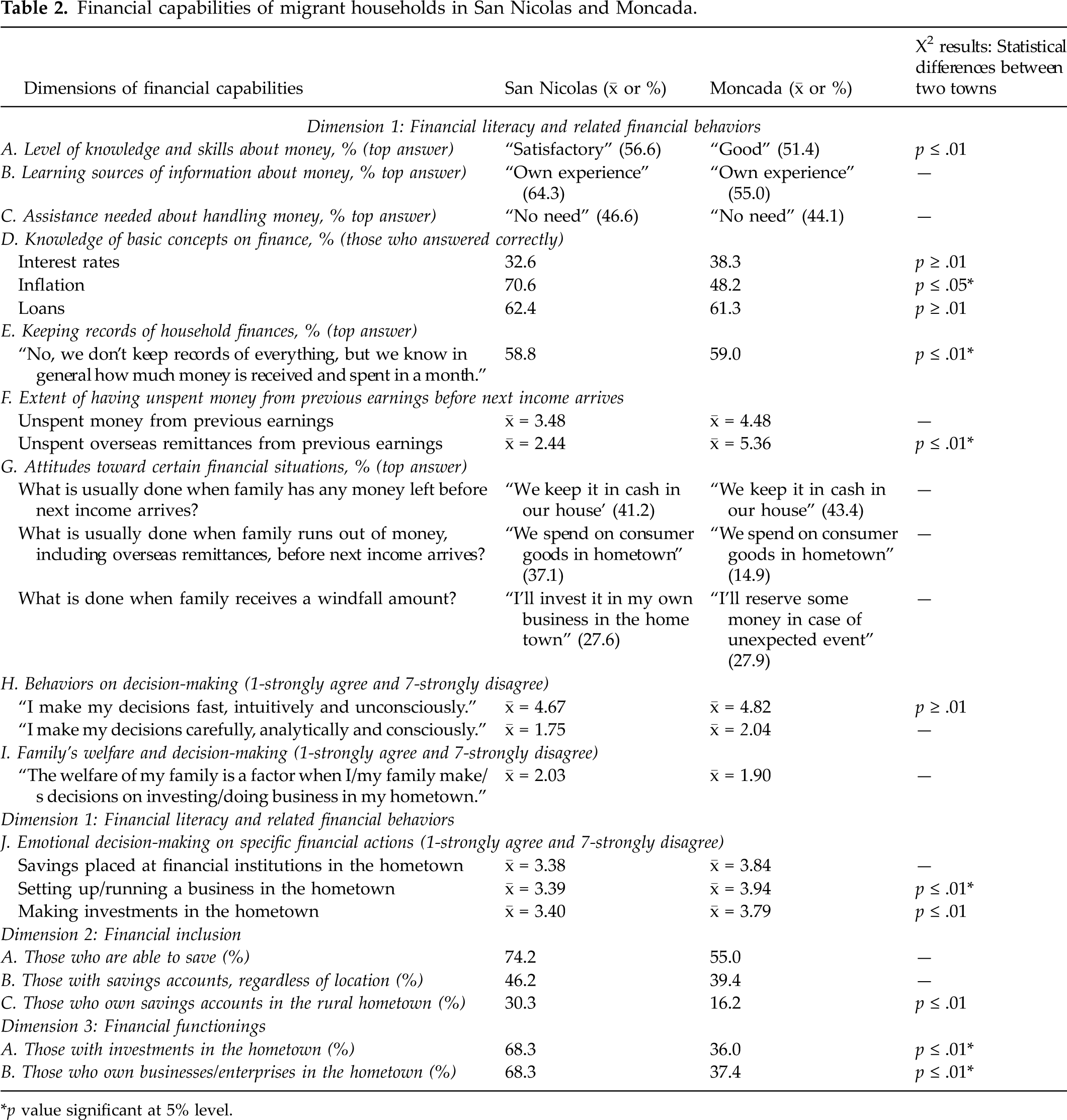
*p value significant at 5% level.
Dimension 1: Financial literacy. Over half of respondents in San Nicolas and Moncada claimed to have “satisfactory” and “good” levels of knowledge and skills about money, respectively. At least 55 percent of respondents from both towns first learned about money through their own experience; at least 44 percent of respondents from both municipalities do not need assistance about handling money.
Respondents were also asked objective questions on three basic concepts of finance: interest rates, inflation, and loans. Most Moncadenian respondents got the interest rate question correctly, while most San Nicoleño households got the inflation question right. There were no statistically significant differences in municipal respondent groups’ answers to the questions on interest rates and loans (both at p ≥ .05). However, there were statistical differences by municipality for inflation (p ≤ .01). San Nicoleño residents seem to be more knowledgeable on inflation given the changing prices of goods in the public market versus commercial centers. However, the little knowledge by respondents from both towns on interest rates and loans may give them difficulties when they assess returns on investments and when they try to understand repayment rates on loans.
Respondents were then asked about their financial practices, which provide hints on whether respondents in migrant households practice what they claim to know. At least 58 percent of respondents from both towns do not keep financial records but “know in general” how much money is earned and spent monthly. There were also statistical differences in respondent groups’ answers to this question (p ≤ .01)—implying that the recording of household incomes and expenses vary by municipality.
When asked to what extent they have unspent money from all previous earnings and from remittances, San Nicoleño respondents agree that they do not have unspent incomes and remittances; Moncadenian respondents were more likely to be neutral regarding having unspent incomes, and to agree having unspent remittances before the next incomes/remittances arrive. There were statistically significant differences (p ≤ .01) to the answers on having unspent remittances by respondents from San Nicolas (x¯ = 2.44) and Moncada (x¯ = 5.36). These differences indicate that San Nicoleño respondents tend to have spent their previous remittance incomes, while Moncadenian counterparts may be more judicious users of remittances and have some incomes to spare.
Respondents were also asked about their actions when they run out of money, including remittances. In San Nicolas, 37 percent spend on consumer goods compared with 14 percent in Moncada. If the family has any money left before the next income arrives, at least 41 percent of respondents from both municipalities keep their cash at home. When a migrant household receives a windfall, most respondents said they will invest in their own businesses in San Nicolas, while respondents in Moncada said they will reserve money for emergencies.
Using a seven-point Likert scale, where 1 = strongly agree and 7 = strongly disagree, respondents were asked about their behaviors on financial decision-making. Respondents’ mean scores—San Nicolas, x¯ = 1.75 and Moncada, x¯ = 2.04—show they tend to decide carefully, analytically, and consciously. In terms of deciding quickly and unconsciously, respondents from both towns tend to be neutral. On the family welfare being a factor in financial decision-making, Moncadenian respondents (x¯ = 1.90) agreed more to this statement than counterparts from San Nicolas.
Respondents were also asked if they decide on important financial transactions with emotions. Respondents from San Nicolas had higher mean scores (i.e., “strongly agree”) than their counterparts from Moncada on saving, investing, and doing business in their rural hometowns. There are statistical differences (p ≤ .01) in respondent groups’ answers to the questions on emotional decision-making for opening/running a business. Opening enterprises in their hometowns may have to account for how remittance owners feel the ease or difficulty of doing business locally.
The results on financial literacy imply that respondents from both municipalities do not practice what they claim to know about money and finance. Their responses to statements on handling money reveal behaviors that may contradict their (acquired) knowledge on money management. While both towns may largely have similar survey results, San Nicoleño migrant households may be more emotional when making productive financial decisions. Moncadenians claim to have a higher level of knowledge and skills about money.
Dimension 2: Financial inclusion. San Nicolas had more financial institutions than Moncada (27 in San Nicolas; 23 in Moncada) such as banks, cooperatives, and microfinance institutions (based on documentary data). Also, there are more migrant household savers in San Nicolas (30.3 percent) than those who save at financial institutions in Moncada (16.2 percent).
Dimension 3: Financial functionings. This part looked into those who invested and ran businesses in their hometowns. The results show that there are more migrant household investors and entrepreneurs from San Nicolas than those from Moncada. These results may reflect what the two hometowns offer to residents in terms of economic opportunities, and the topographical characteristics of the municipalities (e.g., in San Nicolas, enterprises are spread out across all 24 villages; the southern part of Moncada has flooding issues). The top investments were services-related businesses and purchase of farmlands by households in San Nicolas and Moncada, respectively. There are statistically significant differences (at p ≤ .01) for both business ownership and investment, indicating disparities in local investment conditions.
Discussion and conclusion
I have explored the financial capabilities of remittance-receiving households in two Philippine rural municipalities. Data reveal how remittances and development outcomes largely hinge on geography (Gamlen, 2014), which shapes the use of remittances for savings, investment and entrepreneurship in their local communities. The levels of financial capabilities by remittance recipients also help account for the types of economic activities the households of migrants decide to invest in: commercial plus agricultural activities in San Nicolas and largely agricultural activities in Moncada. The results for Moncada also reveal that migrant households are constrained from more productively using their remittances for entrepreneurship due to prevailing social and economic limitations (e.g., limited commercial spaces).
The survey findings reinforce the results of earlier RICART studies (Ang and Opiniano, 2016a, 2016b, 2016c) which found that migrant households do not seem to practice what they claim to know about money and finance. Migrant households’ financial inclusion and financial functioning could improve with financial literacy interventions targeting all residents. Should the municipal government of San Nicolas and Moncada integrate migration in their development policies and programs (including promoting financial education and financial capabilities), possibly overseas remittances may be used to generate more opportunities in these municipalities.
The RQI data helped shed light on how the municipal governments manage their business and investment climates. Good local governance matters, and migrant households easily respond to this when they use remittances locally. Good local governance awards by both municipalities led to improvements in frontline services, including those that reduce the cost of doing business. Business climate reforms for San Nicolas began as early as mid-2004 while reforms for Moncada were ushered in the mid-2010s. The challenge for Moncada is resolving its topographical constraints, especially since a neighboring municipality south of it (Paniqui) is a more conducive place for business given its sizeable population and a large commercial area.
It is hoped that the findings of this study will be useful for national governments of origin countries like the Philippines because the development potential of remittances begins at the origin communities of migrants. This potential, however, varies by place since people’s financial capabilities (agency) respond not only to individual and family needs but also to structural factors, that is, existing enabling institutions, services, and programs. While national-level policies on remittances and development are valuable guidelines for local communities, overall development efforts in origin communities are critical preconditions for remittances to contribute to development.
Footnotes
Declaration of conflicting interests
The author(s) declared no potential conflicts of interest with respect to the research, authorship, and/or publication of this article.
Funding
The author(s) received no financial support for the research, authorship, and/or publication of this article.
