




Abstract
This study explored the roles of individual factors (age, gender, locus of control, self-esteem, and loneliness), parenting style, and academic achievement in discriminating students involved in bullying (as bullies, victims, and bully/victims) from those not involved. Participants comprised 742 middle school students (393 females, 349 males). The results of multinomial logistic regression analysis indicated that a higher locus of control, lower strictness/supervision scores, increased age, and being male increased the likelihood of being a bully; a higher locus of control, higher loneliness score, and a lower acceptance/involvement score increased the likelihood of being a victim; and higher loneliness and psychological autonomy scores and lower acceptance/involvement, strictness/supervision, and academic achievement scores increased the likelihood of being a bully/victim. Although parental style variables play an important role in involvement in bullying, the individual factor loneliness is a more powerful predictor than other predictors in discriminating victims and bully/victims from uninvolved students. Age and gender are stronger predictors than other predictors in discriminating bullies from uninvolved students.
Keywords
Bullying among students in schools is a very old phenomenon; however, since the late 1980s and 1990s bullying has attracted the attention of researchers and the public (Olweus, 1993), when bullied students were found to have committed suicide or to have killed other students in different parts of the world (Ma, Stewin, & Mah, 2001). With the increased concern, extensive studies have been conducted in many countries such as Australia (Skrzypiec, Slee, Murray-Harvey, & Pereira, 2011), Canada (Larochette, Murphy, & Craig, 2010), Germany (Von Marées & Petermann, 2010), Greece (Andreou & Bonoti, 2010), Korea (Shin, 2010), Taiwan (Cheng, Chen, Ho, & Cheng, 2011), Turkey (Piş kin, 2010), and the United Kingdom (Boulton, Smith, & Cowie, 2010) to understand the nature, prevalence, and causes of bullying and for the prevention of bullying. The international interest in bullying research still continues; a content analysis of School Psychology International (SPI) journal between 1992–2011 (Little, Akin-Little, & Lloyd, 2011) indicated that the most cited article in that time period was about bullying (Hoover, Oliver, & Hazler, 1992).
Since its emergence, the bullying construct has been defined in many ways. According to Tattum and Tattum (1992), bullying is an intentional and conscious desire to hurt another person. In the early 1990s, Olweus (1993) stated that ‘a student is being bullied or victimized when he or she is exposed repeatedly and over time to negative actions on the part of one or more other students’ (p. 9). Despite the variations in bullying definitions, researchers emphasize that in order for behaviour to be defined as bullying, it must occur within a familiar social group (Greene, 2000), be intentional, negative or harmful, repetitive, intense, and unprovoked toward a victim who is less powerful or more vulnerable than the bully (Monks & Smith, 2006).
Bullying can be categorized as either physical (e.g. hitting, pushing, shoving, spitting), verbal (e.g. name-calling, insulting, teasing), or relational (e.g. spreading rumours, refusing to socialize with the victim) (Olweus, 2001). Physical and verbal bullying may also be classified as direct or overt (Peskin, Tortolero, & Markham, 2006); with relational bullying as indirect (O’Moore & Kirkham, 2001). Recently, cyberbullying has also been included as a typology (Kowalski, Limber, & Agatston, 2008; Kowalski, Morgan, & Limber, 2012). Cyberbullying is evaluated as an indirect form of bullying (Paul, Smith, & Blumberg, 2012). Von Marées and Peterman (2012), distinguish aspects of cyberbullying from traditional bullying in terms the anonymity of the bully.
Most of the literature on school bullying has focused on two categories of students—victims and bullies. However, a new category of bully/victims has emerged in research (e.g. Solberg, Olweus, & Endresen, 2007). Thus, four different roles can be identified within a bullying context: bullies, victims, bully/victims, and uninvolved). Bullies often have positive views of aggression and use it as a way of solving problems or obtaining the things they want (Carney & Merrell, 2001). Victims are targets of bullies who are repeatedly bullied and unable to defend themselves (Smith & Brain, 2000). Bully/victims are students who are victimized by others and also apply aggression toward others (Griffin & Gross, 2004).
Studies conducted on the prevalence of bullying indicate that there are more victims than bullies or bully/victims. For example, one study conducted with 15,000 elementary, middle, and high-school students found that 41% of students had participated in bullying—23% as a victim, 8% as a bully, and 9% as a bully/victim (Bradshaw, Sawyer, & O’Brennan, 2007).
Bullying as a construct is also found to be related to a variety of individual, parental, and academic factors. Individual factors related to bullying behaviour include demographic factors (e.g. gender, age, ethnicity/race) (Spriggs, Iannotti, Nansel, & Haynie, 2007), locus of control (Andreou, 2000), problem-solving skills (Cassidy, 2009), self-efficacy (Andreou, Vlachou, & Didaskalou, 2005), self-esteem (O’Moore & Kirkham, 2001), and loneliness (Hawker & Boulton, 2000). Familial factors include family environment (Stevens, Bourdeaudhuij, & Oost, 2002), parenting style (Georgiou, 2008), and parental involvement (Flouri & Buchanan, 2003),whereas school-related factors include school/class size, school climate, and school-connectedness (Wilson, 2004), teacher practices (Wei, Williams, Chen, & Chang, 2010), school-related stress experience (Natvig, Albrektsen, & Qvarnstrøm, 2001), academic adjustment (Schwartz, Farver, Chang, & Lee-Shin, 2002), and academic achievement (Beran, Hughes, & Lupart, 2008). The increased interest in research into bullying has disclosed a variety of adverse effects of bullying and victimization, including depression (Hawker & Boulton, 2000); psychosomatic health problems (Gini & Pozzoli, 2009); psychological disturbance, hyperactivity, and internalizing/externalizing problems (Kumpulainen et al., 1998); posttraumatic stress (Mynard, Joseph, & Alexandera, 2000); suicidal ideation and/or behaviour (Kim, Leventhal, Koh, & Boyce, 2009); and substance abuse (abuse of alcohol, cigarettes, marijuana and inhalants) (Tharp-Taylor, Haviland, & D’Amico, 2009). Bullying has also been shown to be a risk factor for depression and suicidal behaviour in adulthood (Klomek et al., 2008).
In an attempt to contribute to global efforts to understand predictors of bullying among children and young people, the current study focused on (a) identifying prevalence rates and types of bullying and victimization among Turkish middle school students; and (b) investigating the predictive role of locus of control, self-esteem, loneliness, parenting style, academic achievement, age, and gender among bullies, victims, and bully-victims by comparing them with uninvolved students.
Method
Participants
Distribution of the participants by grade and gender.

Measures
Demographic information
Information on the gender, age, and grade of participants was collected using a Demographic Data Sheet developed by the researchers.
Bullying and victimization
Students’ experiences of bullying and victimization were assessed using the revised Olweus Bully/Victim Questionnaire (OBVQ) (Olweus, 1996) which is composed of 40 questions. Cronbach alpha values of 0.80 and above have been reported for the combined items on bullying and victimization. Also, several items assessing victimization or bullying others were correlated between 0.40 and 0.60 when analysed with independent peer ratings (Olweus, 1994, 1996). The OBVQ was translated into Turkish by Dölek (2002). Atik (2009) tested the validity of the Turkish version of OBVQ on a small sample (n = 29). Cronbach alpha coefficients for the present study were 0.71 for victimization items and 0.75 for bullying items.
Locus of control
The Nowicki-Strickland Locus of Control Scale (LOS) (Nowicki & Strickland, 1973) was used to assess the degree to which participants believed that reinforcement is a result of their own behaviour (internal locus of control) or a result of luck, chance, fate, or unpredictable factors (external locus of control). The LOS is a 40-item, forced-choice measure with a total score ranging from 0–40, with higher scores reflecting an external locus of control. The split-half method has shown the original LOS to have internal consistencies ranging from 0.63–0.81, with test–retest reliability ratings ranging from 0.63–0.71 and construct validity with the Intellectual Achievement Responsibility Scale (r = 0.31 for 3rd grade; r = 0.51 for 7th grade), Bialer-Cromwell scores (r = 0.41) and the Rotter’s Locus of Control Scale (r = 0.61) (Nowicki & Strickland, 1973). The LOS was translated into Turkish by Korkut (1986); the Turkish LOS has an internal consistency of 0.63 for 3rd-grade students and 0.65 for 5th-grade students (Korkut, 1986), a test–retest reliability of 0.87, and convergent validity with the Personal Orientation Inventory subscales of ‘self-esteem’ (r = 0.58) and ‘internal locus of control’ (r = 0.40) (Yeş ilyaprak, 1988).
Self-esteem
Self-esteem was measured by the Rosenberg Self-Esteem Scale (RSES) (Rosenberg, 1965), a ten-item unidimensional measure of global self-esteem. The instrument is designed as Guttmann-type scale with four response options ranging from ‘strongly agree’ to ‘strongly disagree’. The instrument contains five positively scored and five negatively scored items, and has been shown to have excellent internal consistency (0.92), with scores of 0.85 and 0.88 for test–retest reliability over a two-week period (Rosenberg, 1979). The RSES was adapted for use with Turkish adolescents by Çuhadaroğlu (1986), and this version was found to have a 0.71 correlation with psychiatric interview scores and a score of 0.75 for test–retest reliability over a one-month interval.
Parenting style
Students’ perceptions of parental behaviour were evaluated using the Parenting Style Inventory (PSI) developed by Steinberg and his colleagues (Lamborn, Mounts, Steinberg, & Darnbush, 1991; Steinberg, Lamborn, Dornbusch, & Darling, 1992). This 26-item scale contains three dimensions: Acceptance/involvement (nine items, a four-point Likert scale, α = 0.72), strictness/supervision (eight items, a forced-choice and three-point Likert scale, α = 0.76), and psychological autonomy (nine items, a four-point Likert scale, α = 0.82). The PSI was translated into Turkish by Yılmaz (2000). In Çakır’s study (2001) Cronbach alpha coefficients were found as 0.73 for acceptance/involvement, 0.61 for strictness/supervision, and 0.73 for psychological autonomy scales.
Loneliness
Subjective feelings of loneliness were assessed using the Loneliness and Social Dissatisfaction Scale (LSDS) (Asher & Wheeler, 1985), a 24-item self-reporting instrument that includes eight filler items with responses on a five-point Likert scale from 1 (‘never’) to 5 (‘always’). Higher total scores on the LSDS correspond to greater feelings of loneliness. The LSDS was translated into Turkish by Tarhan (1996); internal consistency was found to be 0.90 for the original scale (Asher & Wheeler, 1985) and 0.89 for the Turkish version (Tarhan, 1996). The Turkish version of the LSDS also had a test–retest reliability of 0.92 and a 0.85 correlation with teacher reports.
Academic achievement
Student academic achievement was assessed using grade point averages (GPA).
Procedure
After obtaining approval from the Turkish Ministry of National Education for the current study, researchers made personal visits to school principals in Ankara to explain the aim of the study and to ask for their help. School principals in four middle schools agreed to cooperate and gave their consent for data collection. Data were collected in collaboration with schools’ counselling and guidance services. The scales were administered during class sessions by the researchers and a graduate student to 758 students enrolled in the four schools. Students were informed about the purpose of the research and ensured confidentiality, and they were given detailed instructions as to how to respond to each instrument.
Data analysis
Prevalence and types of bullying and victimization were reported using frequency analysis. Multinomial logistic regression analysis was used to determine whether locus of control, self-esteem, loneliness, parenting style (acceptance/involvement, strictness/supervision, and psychological autonomy), academic achievement, age, and gender were significant predictors of bullying. Prior to conducting multinomial logistic regression analysis, a missing-value analysis was performed for each predictor using the initial data set of 758 cases. Missing values were imputed using the EM algorithm through SPSS Missing Values Analysis. The Little’s MCAR tests indicated no statistically reliable deviation from randomness. Outlier tests were conducted, and 13 univariate (z > ± 3.29) and three multivariate (df(1) = 10.83) outliers were excluded from the data set (Tabachnick & Fidell, 2001).
Results
Prevalence and types of bullying and victimization
Of a total of 742 students, 34 (4.6%) were identified as bullies, 158 (21.3%) as victims, 48 (6.5%) as bully/victims, and 502 (67.7%) as uninvolved. In order to determine the most and least common bullying behaviours used by the bullies, students were asked to rate a series of seven bullying behaviours on a five-point scale from ‘never’ to ‘several times a week’. In calculating the total percentage of the most and least common bullying behaviours, the three highest response options (‘2 or 3 times a month’, ‘about once a week’, and ‘several times a week’) were collapsed. According to the bullies’ responses, the most frequent bullying behaviours were ‘calling mean names, making fun of, or teasing in a hurtful way’ (38.2%), followed by ‘excluding someone from a group or ignoring them’ (29.4%). The least common bullying behaviours they reported were ‘taking away money or taking or damaging other things’ and ‘telling lies, spreading false rumours, disliking’.
Using the same five-point scale, the most and least common forms of victimization were calculated based on the victims’ responses. The most common form of victimization reported by victims was ‘being called mean names and teased in a hurtful way’ (48.7%), followed by ‘being bullied with mean names or comments about gestures or speaking’ (34.8%). The least common forms of victimization they reported were ‘having money taken away or having other things taken or damaged’ (8.3%). Overall, these responses indicated verbal bullying and victimization to be the most prevalent type of bullying and victimization among students.
Predictors of student participation in bullying (multinomial logistic regression analysis)
Multinomial logistic regression analysis: Predicting student involvement in bullying from locus of control, self-esteem, loneliness, parenting style, academic achievement, age, and gender.
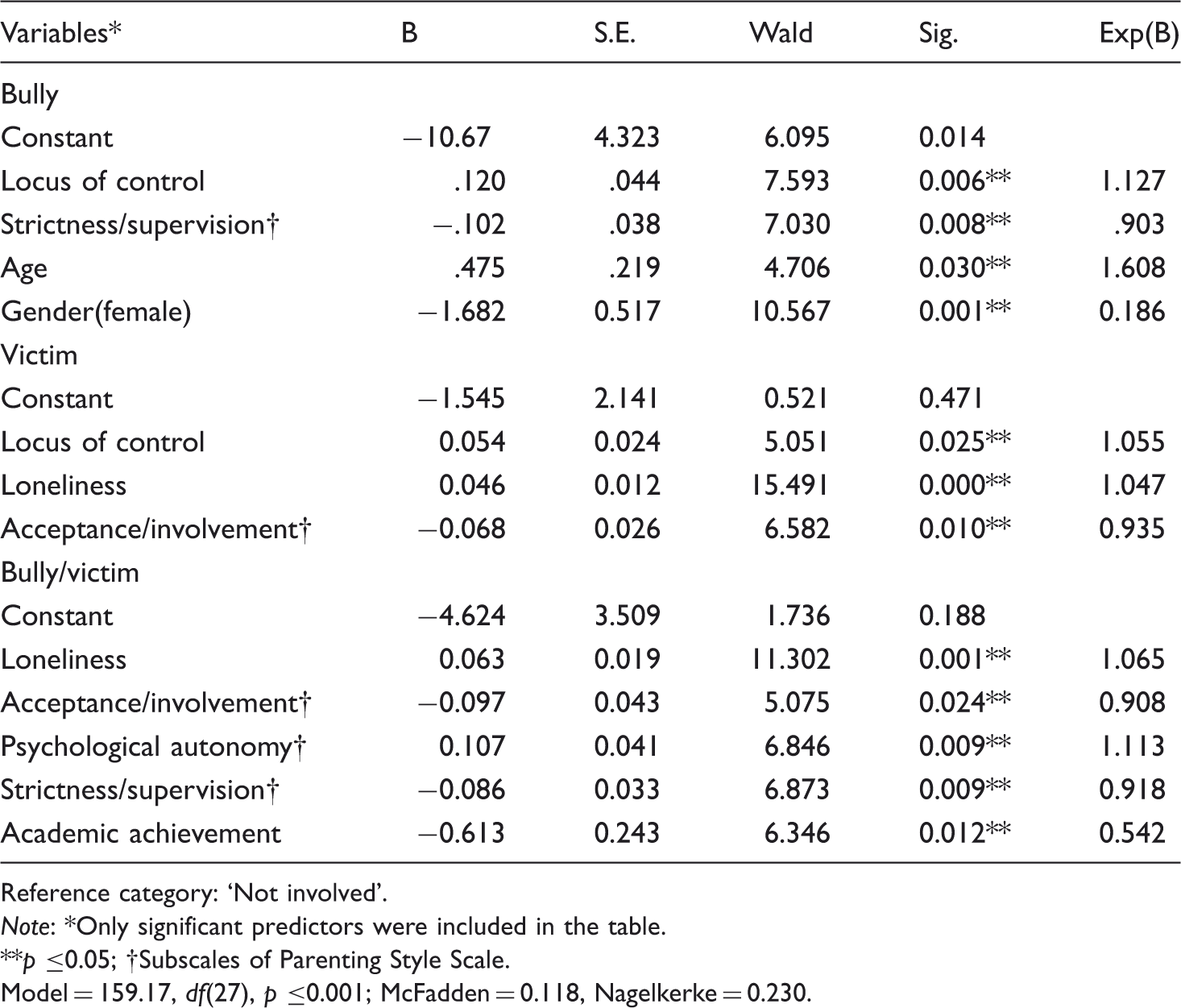
Reference category: ‘Not involved’.
Note: *Only significant predictors were included in the table.
p ≤0.05; †Subscales of Parenting Style Scale.
Model = 159.17, df(27), p ≤0.001; McFadden = 0.118, Nagelkerke = 0.230.
Wald statistics indicate that locus of control, loneliness, dimensions of parenting style, academic achievement, age, and gender are significant predictors of involvement in bullying. As Table 2 shows, a higher locus of control, lower strictness/supervision scores, increased age, and being male increase the likelihood of being a bully rather than not involved; higher locus of control, higher loneliness score, and a lower acceptance/involvement score increased the likelihood of being a victim rather than not involved; and higher loneliness and psychological autonomy scores and lower acceptance/involvement, strictness/supervision and academic achievement scores increased the likelihood of being a bully/victim rather than not involved.
Discussion and conclusions
This study provides information about the prevalence, types, and predictors of bullying and victimization among Turkish middle school students. Almost one-third (32.4%) of participants were found to be involved in bullying, most often as victims (21.3%), with relatively few students involved as bullies (4.6%), or as bully/victims (6.5%). These rates are similar to those reported by earlier studies conducted in Turkey. For instance, in a study with 721 students, Özer and Totan (2009) found 5.7% to be bullies, 20.7% victims, and 9.6% bully/victims. Piş kin (2010) found 6.2% of students to be bullies, 35.1% to be victims, and 30.2% to be bully/victims. Prevalence of bullying/victimization in other countries also supports this finding. For instance, a study by Analitis et al. (2009) carried out in 11 European countries among 16,210 children and adolescents aged 8–18 years found that almost 21% of children had been victimized by bullying. Von Marées and Petermann (2010) found 10% to be bullies, 17.4% victims, and 16.5% bully/victims in German primary schools. Nansel et al. (2001) investigated the prevalence of bullying among 15,686 students in US schools in grades 6–10 and found that approximately 30% of participants had been involved in bullying as either a bully (13%), a victim (10.6%), or both (6.3%).
The current study found verbal bullying and victimization to be the most prevalent type of bullying and victimization. This finding is consistent with previous research conducted in Turkey (Kartal, 2008; Piş kin, 2010) and in other countries (Chapell et al., 2006; Wang, Iannotti, & Nansel, 2009) that reported verbal bullying to be the most prevalent type among adolescents. The higher prevalence of verbal forms of bullying may be due to the difficulty of identifying these types of behaviours and their tendency to be tolerated by school officials (Bulach, Fulbright, & Williams, 2003).
Logistic regression analysis showed individual (locus of control, loneliness, gender, and age), parental (parenting style: strictness/supervision, acceptance/involvement, and psychological autonomy) and academic factors (academic achievement) to be significant predictors of involvement in bullying. Higher scores for external locus of control increased the likelihood of involvement as either a bully, or a victim. In other words, bullies and victims do not appear to establish causal relations between their behaviour and reinforcement, and as a result, they may not control their behaviour. This finding is in line with other research (Andreou, 2000; Haye, 2005) indicating children’s bullying behaviour to be negatively correlated with internal locus of control, and children who were involved in bullying have external locus of control.
The present study found higher loneliness scores to be a risk factor for being either a victim or a bully/victim. Research into the relationship between loneliness and bullying behaviour among children has shown that victimization is related to loneliness (Hawker & Boulton, 2000; Schwartz et al., 2002). This study supports the notion that lonely students are more likely to be involved in bullying as victims or bully/victims.
The current study also showed the likelihood of being a bully to be higher for males and for older students. Most previous research has found both bullying and victimization to be more prevalent among boys than girls (Kristensen & Smith, 2003; Natvig et al., 2001).
The role of self-esteem in relation to bullying is a controversial issue. Most studies emphasize that students who are victimized (victims or bully/victims) have poor self-esteem (Andreou, 2000; Olweus, 1993). Some studies have indicated that students who bully others suffer from poor self-esteem (Andreou, 2000; O’Moore & Kirkham, 2001), whereas other studies have shown bullies to have high levels of self-esteem (Olweus, 1993; Pearce & Thompson, 1998) and still others found no significant relationship between bullying and self-esteem (Seals & Young, 2003). Our findings are in line with the latter group of studies not indicating a significant relationship between self-esteem and involvement in bullying as either a bully, victim, or bully/victim. O’Moore and Kirkham (2001) have stated that the controversy regarding the relationship between self-esteem and bullying stems from how self-esteem and bullying are conceptualized and measured. In order to reach a better understanding of the role of self-esteem in bullying, further studies are needed.
Parenting styles (lower acceptance/involvement, higher psychological autonomy, lower strictness/supervision) were found to be significant factors in predicting involvement in bullying. These findings were expected and are in line with those of previous research (Akgün, 2005; Stevens et al., 2002). Students involved in bullying as victims or bully/victims appear to perceive their parents to be less loving, involved, and responsible. With regard to parenting styles, higher strictness/supervision scores decreased the likelihood of being a bully or a bully/victim. In other words, students with lower strictness/supervision scores perceived their parents less involved in monitoring and supervision. Consistent with this finding, Olweus (1980) remarked that ‘a young boy who gets too little love and interest from his mother and too much freedom and lack of clear limits with regard to aggressive behaviour is particularly likely to develop into an aggressive adolescent’ (p. 657).
The current study found that in terms of academic achievement, high academic achievement scores decreased the likelihood of involvement in bullying as a bully/victim. This is in line with prior findings that children who participate in bullying tend to have lower academic scores or suffer from lower academic performance than other children (Beran, et al., 2008; Beran & Lupart, 2009; Özer & Totan, 2009). Also, poor academic performance was found to be a risk factor for being a target of bullying (Schwartz et al., 2002).
In conclusion, the findings of the this study conducted with Turkish middle school students demonstrates similarities with previous international research findings in highlighting the combinational impact of individual, parental, and academic factors on bullying behaviour. The measures used in this study were developed in Western countries and adapted to Turkish. Thus similarities in the findings of the study to Western literature could be regarded as comparable.
The present study had some limitations. First, data were collected from four state schools in Ankara, and the findings cannot be generalized beyond these schools. Second, this study included some parental and individual factors. However, parallel to the current research (Larochette, Murphy, & Craig, 2010) that underlines the investigation of bullying from the ecological approach, many other parental, individual, and school factors could be included in the model. Third, data were obtained through student self-reporting only. Additional assessment procedures such as peer-teacher nominations and behavioural observation could also be included in the future research.
Implications
The findings of this study provide useful information to school psychologist and counsellors with regard to understanding bullying behaviour; the additional insights may help in planning appropriate preventive strategies for dealing with involved students. Given that verbal bullying is the most prevalent form of bullying, students may benefit from interventions such as problem solving, social skills and interpersonal skills in order to develop better ways of interacting.
The increased prevalence among male students suggests that prevention and intervention programs need to be gender sensitive. Moreover, social support which is considered to be a protective factor in resisting bullying and victimization should be provided by peers, parents, or teachers to academically underachieving or lonely students, since these students are often the targets of victimization. Similarly, such students should be encouraged to become involved in peer networks (Holt & Espelage, 2007). Finally, the findings of this study indicate that students involved in bullying perceived their parents to be less loving, involved, and responsive and providing less parental control, monitoring, and supervision. This suggests that parental efforts to provide a supportive, warm, and consistent home environment with adequate adult supervision and monitoring may help to reduce bullying behaviour.