



Abstract
This study examined the relationships between school belonging, academic emotions, and academic achievement in Macau adolescents. A survey of 406 junior high school students in Macau was used to collect information on the extent to which these students felt accepted and respected in their schools (school belonging), the emotions they experienced in learning (academic emotions), and their grade point averages. Path analysis indicated that academic emotions mediated the relation between school belonging and academic achievement. Students with a greater sense of school belonging experienced more positive emotions (both activating and deactivating) and less negative deactivating emotions, which in turn contributed to their academic success. A sense of being rejected in school can affect academic achievement negatively through facilitating negative deactivating emotions and inhibiting positive deactivating emotions.
The growing literature on academic achievement has focused on how social and environmental factors, including family, school, and peers, can enhance academic performance in school. Compared to the abundance of data on the impact of family and peers on student behavior and academic achievement, the impact of school factors has been relatively underexplored. A small number of studies have suggested that a sense of belonging to one’s school, the subjective sense of being accepted, respected, and supported by other members of the school community (Goodenow, 1993), may be a critical factor in school achievement (Anderman, 2003; Degelsmith, 2001; Goodenow, 1993; Pittman & Richmond, 2007). However, little research has been done on how and why school belonging is related to academic performance. Therefore, the purpose of this study was to investigate the underlying processes by which school belonging contributes to academic achievement.
Belonging at school and academic achievement
A sense of belonging may be derived from an inner need to develop connections with other people and a sense of group identity. Self-determination theory (Deci & Ryan, 2000) posits that satisfying students’ needs for relatedness and connections in the school context may help to maximize their motivation, engagement, and learning (Osterman, 2000). A series of studies have shown that school belonging may be of particular educational significance for middle-school adolescents (Osterman, 2000). Battistich, Solomon, Watson, and Schaps (1997) suggested that a sense of belonging was associated with a variety of positive outcomes for students in the United States, including better social skills, motivation, and achievement. More recent studies have also indicated that school belonging can be linked to academic achievement (Anderman, 2002, 2003; Degelsmith, 2001; Goodenow, 1993; Pittman & Richmond, 2007), academic attitudes and intrinsic motivation (Anderman, 2003; Freeman, Anderman, & Jensen, 2007), self-concepts and self-efficacy (Anderman, 2002; Pittman & Richmond, 2007), school adaptation and satisfaction (McMahon, Parnes, Keys, & Viola, 2008; Pittman & Richmond, 2007), and academic emotions (Anderman, 2002). In a longitudinal study of US adolescents, school belonging was also found to act as a protective factor against risk-taking behaviors and associated outcomes, such as suicidal ideation, teen pregnancy, and violence (Resnick et al., 1997). Adolescents who feel excluded in school and in their peer groups and have no sense of school belonging may be more likely to display maladaptive behaviors such as anxiety, depression, and withdrawal from school (Finn, 1989; Newman, Lohman, & Newman, 2007).
While findings have generally been consistent, a particularly strong association has been found between the sense of school belonging and academic performance (Anderman, 2003; Degelsmith, 2001; Pittman & Richmond, 2007). Conceptually, the association between school belonging and academic performance can be understood in terms of a social cognitive account of motivation. This theoretical framework posits that the characteristics of the social context help determine the extent to which an individual’s psychological needs are satisfied, which affects subsequent perceptions and behavior. Experiencing a sense of belonging is an important psychological process that boosts one’s inner resources. Adolescents in the US who feel a sense of belonging in school may feel more competent, supported, and accepted in school and enjoy school more (Osterman, 2000). They may also have more positive attitudes toward school, be more willing to participate in school activities, and invest more in the learning process. All of these factors may contribute to better academic performance.
However, there is still a lack of empirical research into the mechanisms by which a sense of belonging in one’s school promotes academic achievement. It is still unclear how a positive view of one’s school membership is related to academic performance. Lazarus (1993) suggested that emotions make individuals aware of important features of their environments and direct cognitive processes that result in adaptive behavior. According to cognitive-motivational relational theory (Lazarus, 1993), the emotions that direct actions and behaviors are derived from their relational meanings. An individual’s interpretation of the relational meaning of a specific encounter is based on an appraisal of the personal consequences (positive and negative) of that self-environment conjunction. It is possible that school belonging, which can be seen as a student’s appraisal of the positive and negative aspects of his or her school membership, may influence learning-related behavior through learning-related emotions.
The role of academic emotions
In a study of German students, academic emotions can be defined as emotions that are directly related to learning, classes, and academic achievement (Pekrun, Goetz, Titz, & Perry, 2002). The concept of academic emotions is relatively new but increasingly attracting attention in education and psychology research. However, a review of studies on emotions related to learning and achievement revealed an excessive focus on anxiety in this field of research (Pekrun et al., 2002). In a study using samples of undergraduate students from both Germany and Canada, Pekrun et al. (2002) also identified other academic emotions, including enjoyment, hopelessness, relief, pride, anger, anxiety, disappointment, shame, and boredom. The full range of emotions experienced by students at school needs to be explored further to understand the emotional diversity of academic settings.
Academic emotions can be associated with students’ thoughts, motivations, and actions (Pekrun et al., 2002). Different emotions can influence students’ learning and performance in different ways. According to Pekrun et al. (2002), emotions can be classified according to valence (positive or negative) and arousal (activating or deactivating). Four categories of academic emotion can be distinguished: Positive activating emotions (e.g. enjoyment of learning, hope of success, pride), positive deactivating emotions (e.g. relief, contentment, relaxation after success), negative activating emotions (e.g. anger, anxiety, shame), and negative deactivating emotions (e.g. boredom, hopelessness). There is empirical evidence that with the exception of relief, positive emotions such as enjoyment, hope, and pride have a positive correlation with academic achievement. The negative deactivating emotions of hopelessness and boredom have a more detrimental effect on academic achievement than did negative activating emotions such as anxiety, anger, and shame (Pekrun et al., 2002). Positive emotions enhance motivation and flexible learning and thus promote academic achievement. Negative deactivating emotions are generally harmful as they reduce motivation, distract students from learning, and reduce the depth of task-relevant information processing. However, negative activating emotions can be a double-edged sword. Reduced intrinsic motivation and increases in task-irrelevant thinking as a result of negative activating emotions may lead to low achievement. In contrast, extrinsic motivation triggered by negative activating emotions can improve academic performance, particularly when the learning task requires relatively little cognitive flexibility and students have positive expectations (Pekrun et al., 2002).
In line with the social cognitive perspective on human development, Pekrun et al. (2002) proposed that students’ cognitive appraisals of academic emotions are shaped by social and environmental factors. Empirical research into the social and environmental antecedents of academic emotion has indicated that classroom factors, including the quality of instruction and social affiliations in the class, and other social factors, including support from teachers, can affect students’ academic emotions (Hatfield, Cacioppo, & Rapson, 1994; Pekrun et al., 2002; Sutton & Wheatley, 2003; Turner, Meyer, Midgley, & Patrick, 2003). However, research into the environmental bases of academic emotions has mostly focused on test anxiety and been limited to the classroom context instead of considering the school context, that is, the broader environmental context. Furthermore, the theoretical framework of Pekrun et al. (2002) suggested that students’ appraisals of their social environment induce academic emotions, which in turn influence learning and achievement; in other words, Pekrun et al. (2002) proposed that academic emotions may mediate the impact of environmental factors on students’ learning and achievement.
Studies have shown that school belonging may be positively associated with positive academic emotions (e.g. pride, calmness, and interest) and negatively associated with negative academic emotions. In a study of American adolescents, Roeser, Midgley, and Urdan (1996) found that a strong sense of school belonging was related to greater positive school-related affect. The results of a longitudinal study conducted in United States also indicated students who have a greater sense of belonging to their school tend to be more optimistic and emotionally stable in examinations, while those with less sense of belonging are more depressed and anxious (Anderman, 2002). In sum, previous empirical studies have supported the existence of a chain of direct relations between school belonging, academic emotions, and academic achievement. However, little research has been done to empirically examine the process by which students’ appraisals of their social environment, such as their sense of school belonging, induce academic emotions, which in turn influence learning and achievement. It is thus of interest to explore how school belonging and academic emotions interact to influence academic achievement. Based on previous literature, the present study aimed to investigate the following research question: Do academic emotions work as a mediator in the relation between school belonging and academic achievement in adolescents? Students with a greater sense of school belongings were hypothesized to have more positive academic emotions and fewer negative academic emotions, which in turn contribute to their academic success. Furthermore, students with a greater sense of school rejection were hypothesized to have more negative academic emotions and fewer positive academic emotions, which in turn contribute to their academic success.
Method
Participants
The present study originally recruited 513 students from 15 junior high schools in Macau. The education system in Macau follows the 3–6–3–3–4 pattern, consisting of three years of kindergarten, six years of primary school, three years of junior high school, three year of senior high school, and four years of college education. Most schools in Macau are private or subsidized. Participants were recruited from all the main types of middle schools in Macau: Standard middle schools, girls’ middle schools, missionary schools, and non-missionary schools. The study utilized a convenience sample. A total of 443 students completed and returned the questionnaire. The response rate was approximately 85.69%. The majority of the participating students were selected because of the researchers’ contacts with school teachers in eight schools. In addition, a small number of students (about 11 students) from seven other schools participated in the study because of their personal relationships with the researchers. All 15 schools represented in the sample are middle-ranking or high-ranking schools in Macau. Most students in these schools come from middle-class families. There are no differences in average parental educational level or student age across schools. Three of the schools (home to 59 participating students) are girls’ schools.
Thirty-seven returned questionnaires were excluded as invalid (no response on GPA or the same response to every question), leaving 406 valid completed questionnaires. The sample consisted of 229 (56.4%) female students and 177 (43.6%) male students, with an overall mean age of 13.92 years (SD = 1.32 years). All participants signed a consent form before proceeding to complete a 15-minute self-report questionnaire, which was administered during a regular school class. Participation was voluntary, and participants’ anonymity was guaranteed. The research was reviewed by an institutional review board from the University of Macau prior to data gathering.
Measures
Background information
As background, the survey requested information on age, school, school year, gender, and maternal and paternal educational level.
Psychological sense of school membership
The study used the Chinese version of the Psychological Sense of School Membership (PSSM) scale to measure students’ subjective sense of belonging to their school community. PSSM was originally developed by Goodenow (1993) and translated into Chinese by Cheung and Hui (2003). The Chinese version of the PSSM scale has shown good validity in Hong Kong students (Cheung & Hui, 2003). The scale consists of 18 items rated on a five-point Likert scale (from 1 = strongly disagree to 5 = strongly agree). Thirteen items assess students’ sense of belonging to their school community; an example item is ‘I feel like a real part of this school’. High scores indicate a higher level of school belonging. The other five items assess students’ sense of being rejected by their school; an example item is ‘It is hard for people like me to be accepted’. High scores on these items indicate a higher level of school rejection. Cronbach’s alpha was 0.85 for sense of belonging and 0.65 for sense of rejection in this study. A factor analysis was conducted to further examine the validity of the Chinese version of the PSSM scale. A principle-components factor analysis of the 18 items, using varimax rotations was conducted, with the two factors explaining 52% of the variance. All items had primary loadings over 0.5.
Academic emotions
The Adolescent Academic Emotions Scale was used to measure students’ emotional experiences in academic situations. The Adolescent Academic Emotions Scale was developed in China by Dong and Yu (2007) and has shown good validity in Chinese students (Dong & Yu, 2007). The scale includes 72 items rated on a five-point Likert scale (from 1 = strongly disagree to 5 = strongly agree) and covering two dimensions: Arousal and valence. These two dimensions give four categories of academic emotion: Positive activating emotions (sample item: ‘I am proud of working faster than other students’), positive deactivating emotions (sample item: ‘My academic performance is relatively stable. I feel comfortable and relaxed’), negative activating emotions (sample item: ‘I feel anxious before examinations’), and negative deactivating emotions (sample item: ‘I feel helpless about study’). The scale covers 13 academic emotions: Pride, happiness, hope, satisfaction, calmness, relief, anxiety, shame, anger, boredom, hopelessness, depression, and fatigue. High scores indicate a higher level of emotion. Cronbach’s alphas for the four types of academic emotion examined in the present study ranged from 0.82 to 0.91.
Academic achievement
Students’ self-reported grade point averages (GPAs) were used as the index of academic achievement in junior high school. GPA values in junior high school in Macau range from 0–100 and are calculated by taking the sum of grade points for all the courses a student has completed and dividing it by the number of courses the student has completed. High scores indicate a higher level of academic achievement.
Data analysis
The relationships between school belonging, academic emotions, and academic achievement were examined using path analysis. Analysis was carried out using SPSS 16.0 and Amos 17.0 (Arbuckle, 2008). With a total of 84 parameters in the model, the subjects-to-parameter ratio was approximately 13:10. The path analysis was examined using maximum likelihood estimation. Measures of the model’s goodness of fit included χ2, NNFI, CFI, RMSEA, and SRMR. According to Bentler and colleagues (Bentler, 1990; Bentler & Bonett, 1980), CFI and NNFI values larger than 0.90 and RMSEA and SRMR values lower than 0.08 (Byrne, 2010; Hu & Bentler, 1999) indicate an acceptable fit between the model and the sample. All values were standardized before the models were evaluated.
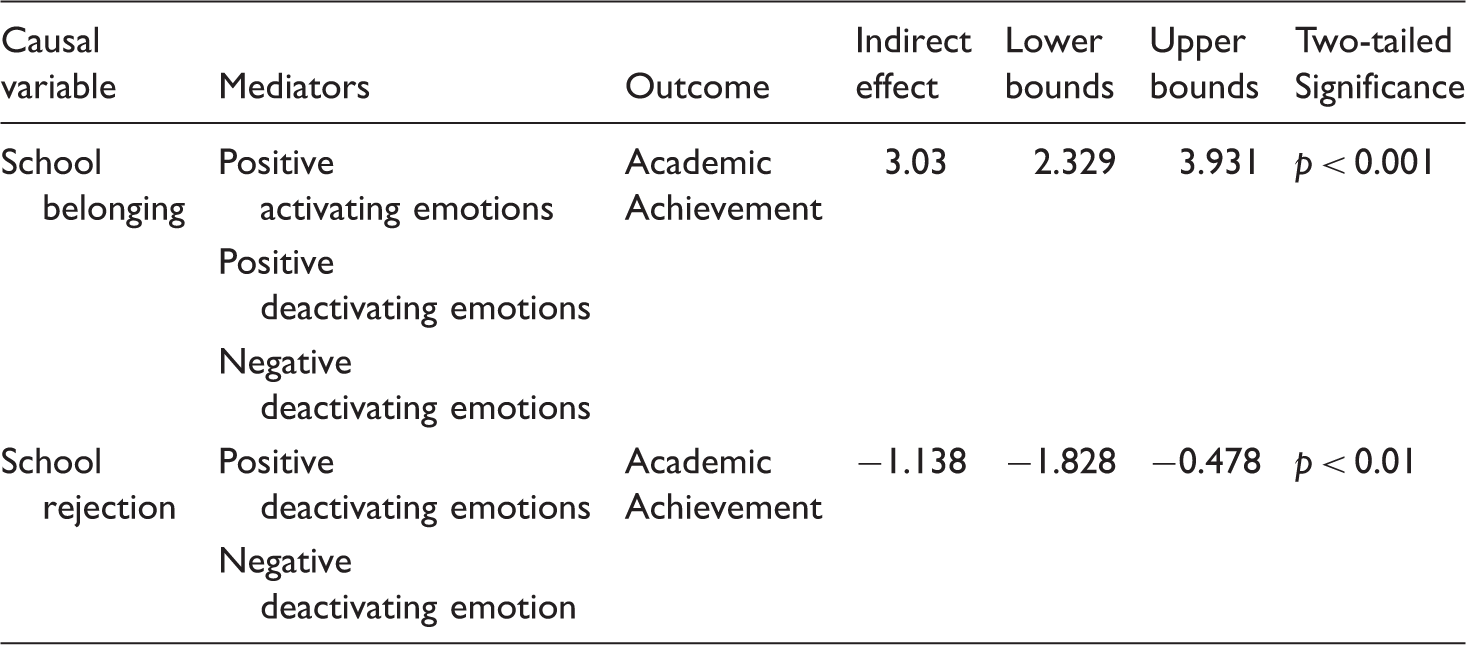
The bootstrapping method was utilized to examine the mediating effects in the present study. Compared to Baron and Kenny’s (1986) method, the bootstrapping method is more reliable in small samples and when the sample data are not normally distributed (Hayes & Preacher, 2010; Preacher & Hayes, 2004). The bootstrapping method is a non-parametric method using numerous resampling with replacement (e.g. 1000 times). From each resampling, the indirect effect can be computed and other statistics including a distribution, a confidence interval, or a p value can be obtained (Preacher & Hayes, 2004). Indirect effects using bootstrapping are significant if the 95% Confidence Interval (CI) does not include zero.
Results
Preliminary analyses
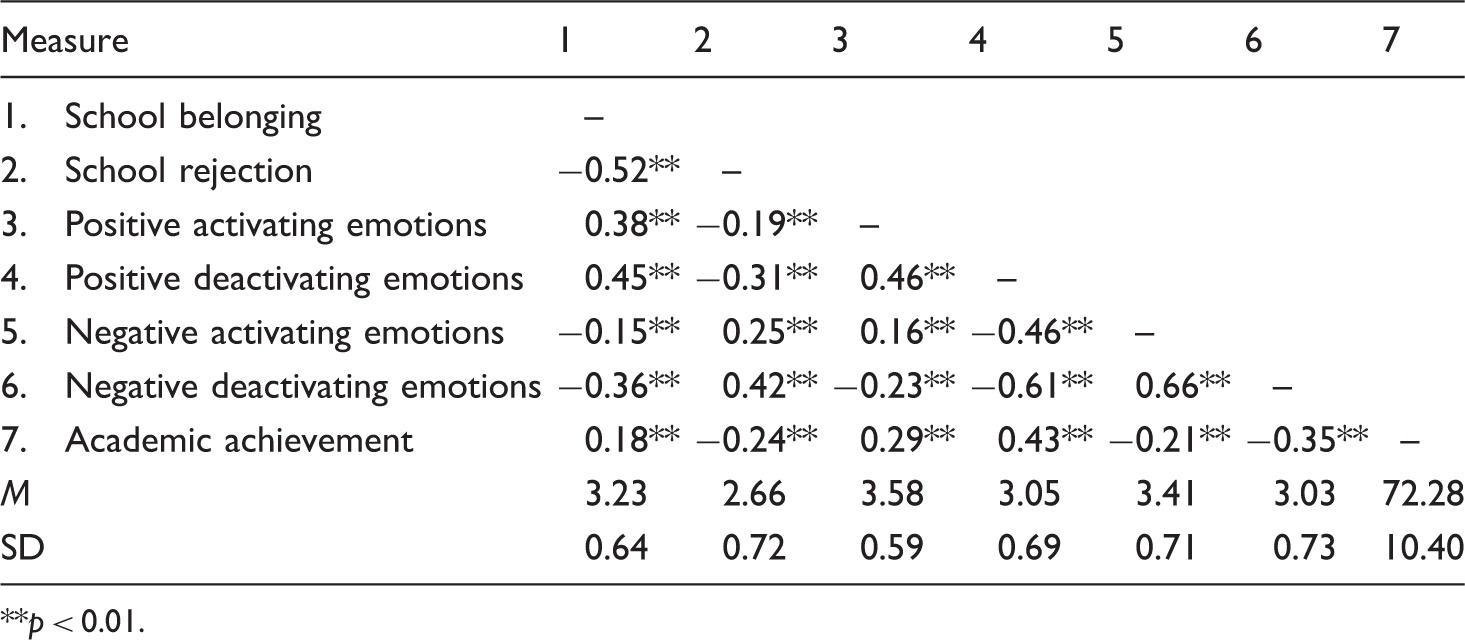
Means, Standard Deviations, and correlation matrix for variables.
p < 0.01.
The initial analyses examined the direct relationships among school belonging, academic emotions, and academic achievement (Table 1). The correlations between the main variables and potential mediators were consistent with the previous literature. School belonging was positively correlated with academic achievement (r = 0.18, p < 0.01), and a sense of rejection was negatively correlated with academic achievement (r = −0.24, p < 0.01). Positive activating and positive deactivating emotions were positively correlated with academic achievement (r = 0.28 and r = 0.43, respectively, both p < 0.01). Negative activating and negative deactivating emotions were negatively correlated with academic achievement (r = −0.21 and r = −0.35, respectively, both p < 0.01). School belonging was positively correlated with positive activating and deactivating emotions (r = 0.38 and r = 0.44, respectively, both p < 0.01) and negatively correlated with negative activating and deactivating emotions (r = −0.15 and r = −0.36, respectively, both p < 0.01). A sense of rejection was positively correlated with negative activating and deactivating emotions (r = 0.25 and r = 0.42, respectively, both p < 0.01) and negatively correlated with positive activating and deactivating emotions(r = −0.19 and r = −0.31, respectively, both p < 0.01).
Testing the mediating effect of academic emotions
Path analysis was performed to investigate the mediating effect of academic emotions on the relationship between school belonging and academic achievement. The result of the path analysis is presented in Figure 1. The model demonstrated acceptable fit: χ2 = 6.42; df = 2; CFI = 0.99; TLI = 0.95; NFI = 0.99; RMSEA = 0.074 (90% CI [0.013, 0.141]); GFI = 0.99; and SRMR = 0.014. School belonging was related to academic achievement through the mediators of positive activating emotions and negative deactivating emotions. School rejection was related to academic achievement through the mediators of negative deactivating emotions and positive deactivating emotions. School belonging was positively associated with positive activating emotions (β = 0.38, p < 0.001) and positive deactivating emotions (β = 0.39, p < 0.001) and negatively associated with negative deactivating emotions (β = −0.20, p < 0.001). School rejection was positively associated with negative activating emotions (β = 0.23, p < 0.001) and negative deactivating emotions (β = 0.32, p < 0.001) and negatively associated with positive deactivating emotions (β = −0.10, p < 0.05). Positive activating emotions (β = 0.13, p < 0.05) and positive deactivating emotions (β = .27, p < 0.001) were positively associated with academic achievement, whereas negative deactivating emotions were negatively associated with academic achievement (β = −0.17, p < 0.05). The structural model accounted for 21% of the variance in academic achievement.
Path analysis of the full mediation of the effects of school belonging and school rejection on academic achievement by academic emotions (all coefficients are the standardized solution).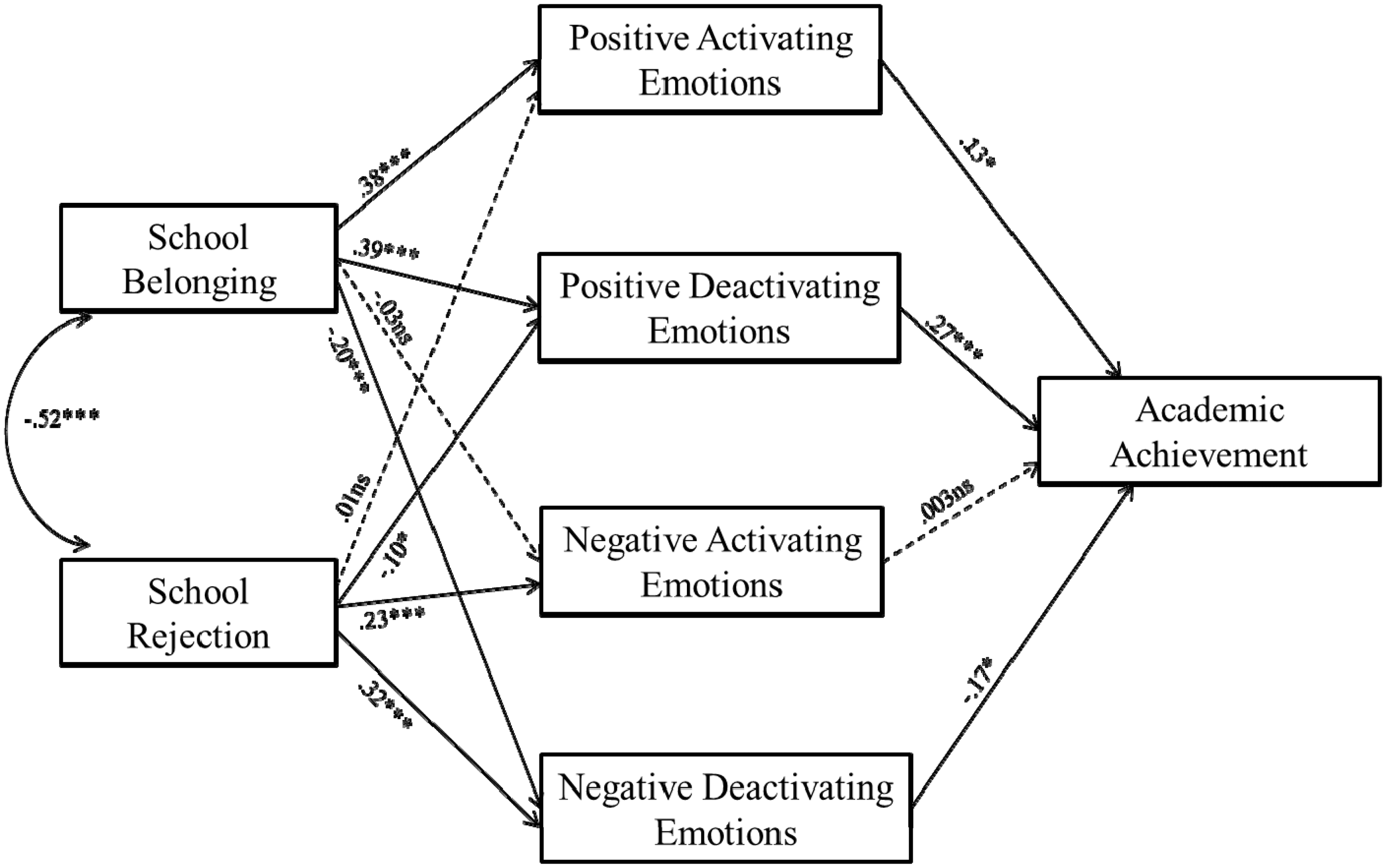
Indices in the Bootstrapping.
Discussion
The existing body of research has mostly focused on the chain of direct relationships between school belonging, academic emotions, and academic performance. No previous studies have investigated how school belonging and academic emotions interact to improve students’ academic performance or sought to identify potential mediating effects involving these three variables. This study has extended previous research by looking at school belonging together with the four types of academic emotions to explore how they contribute to academic success. Our findings fill a gap in the literature by examining the mediating effects of academic emotions in the relation between school belonging and academic achievement among junior high school students. The findings can be also situated within a self-determination framework and reveal how several socio-cognitive factors (e.g. self-efficacy, student engagement, need for psychological relatedness) can be linked to the variables of interest and contribute to students’ academic outcomes.
The results showed that the relationship between school belonging and academic achievement was mediated by academic emotions. According to Pekrun and Linnenbrink-Garcia (2012), academic emotions were found to profoundly influence academic engagement and performance in Germany. Academic emotions have been shown to impact academic achievement and various types of student engagement, including cognitive (attention and memory processes), motivational (intrinsic and extrinsic motivation), behavioral (effort and persistence), and cognitive-behavioral (strategy use and self-regulation) engagement (Pekrun & Linnenbrink-Garcia, 2012). The results of the present study further argue that school belongingness can be one of the important sources of students’ academic emotions, which subsequently exert influences on various types of academic engagement and performance.
Students with a greater sense of school belonging have more positive emotions (both activating and deactivating) and fewer negative deactivating emotions, which in turn contribute to their academic success. Research conducted by Roeser et al. (1996) in the United States is consistent with this result. Although they did not examine academic emotions empirically, they argued that greater school belonging may make students feel more positive about school life and give them greater emotional stability, such that they can relax and enjoy learning and thus improve their academic performance. As shown in the present study, students who feel more accepted and connected in school are more likely to experience positive academic emotions, including pride, happiness, hope, satisfaction, calmness, and relaxation. According to Pekrun, Elliot, and Maier (2009), positive learning-related emotions can stimulate deeper cognitive processing as well as creative thinking and motivate students to attempt difficult academic challenges, which in turn may enhance academic performance.
In addition, according to self-determination theory (Deci & Ryan, 2002), individuals can be self-motivated and initiate their behaviors without any external influence when three psychological needs are satisfied, including the need for competence, the need for autonomy, and the need for relatedness. The positive activating and deactivating emotions derived from a greater sense of school belonging can satisfy students’ needs for competence and boost individuals’ self-efficacy. Kavanagh and Bower (1985) examined the relation between mood and self-efficacy in Australia and found that those who are in a joyful mood are more likely to have a positive efficacy judgment about themselves in interpersonal and athletic domains. A greater sense of school belonging and positive academic emotions may work together to create a positive appraisal of their own learning abilities, which consequently contribute to student academic success. Future research may consider exploring how self-efficacy may interact with school belonging and emotions experienced in school and subsequently influence students’ academic and non-academic outcomes.
In addition, students who feel connected and accepted in school are also less likely to experience negative deactivating emotions, including helplessness, fatigue, boredom, and depression, the lack of which may also enhance their academic success. Goodenow and Grady (1993) showed that students’ sense of school belonging was correlated with both their friends’ academic values and their own academic motivation. Students who feel they belong in their schools may tend to be acquainted mostly with peers who support mainstream values related to motivation and achievement. Learning with peers who share the same sense of membership may not only make students less likely to experience negative deactivating emotions (e.g. it may shield them from feeling bored, helpless, or tired), but also reinforce positive attitudes toward learning, which subsequently lead to better academic achievement. In addition, the lower level of negative deactivating emotions derived from a greater sense of school belonging can also be linked to students’ need for relatedness in self-determination theory. The subjective sense of being accepted and supported by other members of the school community strengthens the membership students share with their peers and satisfies their need for relatedness. Similar to the mechanism of attachment theory, such feeling of connectedness in school may create an emotional bonding and subsequently leads to optimal functions and growth. The emotional bonding between students and their peers enables students to feel less helpless, bored, and depressed, which consequently motivates them to have greater academic engagement and have better academic achievement.
A sense of being rejected in school can contribute to academic achievement negatively through facilitating negative deactivating emotions and inhibiting positive deactivating emotions. In other words, students who feel rejected in school are more likely to feel tired, helpless, bored, and depressed and less likely to feel satisfied, calm, and relaxed while learning, tendencies that in turn may undermine their academic performance. Consistent with our findings, research has shown that students who feel rejected in school often feel depressed and helpless while learning because of social isolation (Buhs & Ladd, 2001; Buhs, Ladd, & Herald, 2006), and they tend to have low academic achievement (Bellmore, 2011; Coie, 1990; Hinshaw, 1992; Masten et al., 2005). In addition, according to Pekrun’s (2000, 2006) control-value theory of achievement emotions, individuals’ appraisals of the extent of their own control over achievement activities and their outcomes are critical for the arousal of academic emotions. Feeling rejected in school may undermine students’ cognitive appraisal of their control over learning-related tasks because of their perception of a lack of support from their peers and teachers in school, and this perceived lack of support may subsequently disturb the positive and stable emotional states (e.g. calm or satisfied) that are helpful for academic achievement.
From the perspective of self-determination theory (Deci & Ryan, 2002), such perceived lack of control and social isolation due to a greater sense of rejection in school implies the failure to satisfy the psychological needs for relatedness and for autonomy. Those who feel rejected in school fail to develop relatedness and connectedness with their peers and school members, and they tend to have low personal agency due to the lack of care and support they received in school. Failure to meet the needs for relatedness and autonomy can make students more likely to feel bored, depressed, and helpless, and less likely to feel calm and satisfied while learning, which in turn lead to lower engagement and academic performance. Future studies may consider investigating the level of relatedness and autonomy students perceived in school to further clarify the role of psychological needs in the relation between school belonging (and also school rejection), academic emotions, and academic achievement. It should be noted that although a sense of school rejection can also be linked to students’ negative deactivating emotions, including anxiety, shame, and anger, those emotions did not relate to their academic performance. This finding is consistent with the literature suggesting a mixed effect of negative activating emotions on students’ learning and academic achievement. Lack of belonging in school may make students feel anxious (Anderman, 2002). However, such negative activating emotions can sometimes trigger extrinsic motivation (e.g. to strive for progress with determination) and improve academic performance (Pekrun et al., 2002), as indicated by the weak but positive correlation between negative activating emotions and academic achievement in our results.
Limitations and implications
Several limitations of the present study should be noted. First, academic achievement was an important variable in this research, but there may be variation among schools. Although GPA is believed to be a good indicator of students’ overall academic performance compared with single-subject test scores (Fan & Chen, 2001), it nonetheless has its flaws. The operation of GPA may vary as a result of differences in educational policy or simply differences in evaluation standards. The assessment of our dependent variable was not standardized, which may lead to an inaccurate or invalid reflection of academic performance in this sample of Macau students. In addition, the self-reported nature of the data may be also subject to common method variance. Further studies should use more objective criteria, such as scores on standardized tests, as an index of academic achievement.
Second, the convenience sampling method was another weakness in the design of this study. Participants attended different schools, and the number of participants in each school varied. Unlike a study using random sampling, the present study did not capture a representative set of schools and students across different school backgrounds and socioeconomic statuses. This unrepresentative sampling method makes generalization of our findings problematic. For example, as a consequence of the characteristics of the sample, the findings may apply primarily to students from middle-class families who study in middle-ranking or high-ranking junior high schools. However, our study was grounded in the international literature, and we discussed our findings based on research across national boundaries. Therefore, we believe that the results derived from the present study can provide several important insights for educators and school psychologists internationally. It is also important to note that ours was a cross-sectional study, so the findings support no conclusions about causality. The results demonstrate only that the relationship between school belonging and academic achievement was mediated by academic emotions. Further research using a longitudinal design or more rigid statistical methods, such as structural equation modeling, is recommended to investigate the causal mechanism by which school belonging influences academic achievement through its association with academic emotions.
The findings of the present study suggest some practical implications. Teachers and school principals should try to create a school environment in which students feel supported, respected, and accepted by other members of the school community. A positive perception of their school environment may help students develop positive emotions (e.g. happiness, pride, satisfaction) and reduce negative emotions (e.g. helplessness, depression) while learning, which eventually contributes to their academic performance. By fostering a more positive atmosphere in the school and the learning environment, teachers may be able to help students experience more positive emotions while learning, which in turn supports their academic success. The relations between school belonging, academic emotions, and academic achievement found in the present study can also be situated in the self-determination framework. School belonging and academic emotions can work together to meet individuals’ three important psychological needs, including the need for competence, the need for relatedness, and the need for autonomy (Deci & Ryan, 2002). Satisfying these three innate psychological needs can motivate individuals to initiate behaviors voluntarily, and help to maximize their engagement and learning (Osterman, 2000). As a result, when students feel accepted and connected in school, they may experience more positive emotions while learning, and have greater engagement and achievement, because the sense of school belonging students perceived encourages them to engage into learning intrinsically and in a self-driven way. Future research may further pinpoint the specific type of academic emotions that may play a particularly important role in the relation between school belonging and academic achievement. Moreover, research should examine how school belonging and the emotions students experience in school work together to impact their non-academic domains, such as their peer relationships and psychological adjustment.