




Abstract
Drawing on data from a mixed-method longitudinal study of marginalized youth from New Zealand, most of whom did not complete high school, we explore the concept of a sense of belonging as it relates to the way these youth explain their experiences of school. We identify the centrality of this sense of belonging at school to an understanding of resilience for vulnerable youth. Based on youth accounts we identify five orientations to practice that made the most difference to youth capacity to stay at school. These orientations are able to be used by a wide range of school professionals, including school psychologists, to enable youth to successfully stay in mainstream educational settings and achieve to their abilities.
Keywords
The potential of schools to be ‘game changers’ in the lives of vulnerable children is widely recognized (Samel, Sondergeld, Fischer, & Patterson, 2011). Accordingly, there are extensive debates in the literature about how school professionals can promote the wellbeing of students and produce better outcomes, particularly for students who are at higher risk of early disengagement (Theron, Liebenberg, & Malindi, 2014). The work of Theron and colleagues (Theron & Donald, 2013; Theron et al., 2014) has demonstrated that school ecologies contain rich and numerous opportunities for resilience-building and resilience-enhancing interactions between school professionals and children who are vulnerable to poor outcomes. Outside of the private domain of the family, schools remain the developmental asset most consistently available to such youth (Frønes, 2010). It is, therefore, important to expand our understanding of the practices that school-based professionals can utilize to build resilience and to help these students to remain at school. Toland and Carrigan (2011) have suggested resilience is a useful concept for school-based professionals because its ecological characteristics provide a framework for responding to children’s needs in a systemic way. However, Toland and Carrigan (2011) also argue that this potential is not consistently realized by schools. Others have also commented on the relative silence in the educational literature regarding the role of resilience in creating relational spaces that foster positive development of vulnerable children (Ungar & Liebenberg, 2013b). It is important that this silence is addressed because it is now well established that resilience is not an inherent trait residing in individuals, but rather a cluster of processes that change over time and that can be intentionally enhanced by the actions of others (Masten, 2014). As discussed elsewhere in this special edition, resilience is of interest primarily because of its potential to offset, or compensate for, the impact that risks have upon children’s development. Schools can be a key resource here and indeed school-based professionals have a critical role in enhancing the resilience of vulnerable youth (Noltemeyer & Bush, 2013).
In addition to qualifications, schools provide access to numerous developmental opportunities (such as sports, cultural, and other endeavours as well practice in building relationships with peers and adults). This mix of educational and other developmental resources enables schools to build resilience (Frønes, 2010). However, not all students gain benefits from school and differences in levels of educational achievement are not consistently explained by student ability (Ungar & Liebenberg, 2013a). The question then becomes what practices can schools adopt to increase the likelihood that vulnerable children will gain resilience benefits from staying at school? There is evidence internationally that engagement practices such as careful relationship building and collaborative practices by teachers enhance the capacity of schools to function as resilience resources (Sharkey, You, & Schnoebelen, 2008). A limitation, however, of much of the research conducted to date is that it has been located within schools. This means that the understanding of disengagement has been shaped predominantly by the experiences of students who are actually attending school. This leaves questions about the experiences of youth who face high levels of adversity and who are likely to disengage early from school (Sanders, Munford, & Liebenberg, 2012; Ungar & Liebenberg, 2013a).
Educational disengagement as a risk
Premature disengagement from school is a significant concern internationally because it reduces life chances and good outcomes (Noltemeyer & Bush, 2013). Internationally, New Zealand performs relatively well in terms of overall educational achievement, however it also ranks below the OECD median in terms of the proportion of children who have access to the resources required to participate successfully in education (Human Rights Commission, 2010). These resources are not evenly distributed across the population and specific subgroups of children face significant challenges in completing their education. It has been estimated that around 30% of all school leavers in New Zealand exit school with no formal qualifications, creating what has been described as a ‘long tail’ of students who under-achieve in a system that is nonetheless characterized by the majority of students doing well (Jacobsen et al., 2002, p. 7). As is the case elsewhere, the children who are most likely to exit school prematurely in New Zealand are the same children who face heightened risks in their families and neighbourhoods. For instance, Māori and Pacific Island youth are more likely to exit early, and males tend to exit education earlier than females (Jacobsen et al., 2002). Also, youth from low socio-economic status households face greater risks of early disengagement or low educational attainment than youth from better resourced families, as do youth who have disabilities (Human Rights Commission, 2010; Jacobsen et al., 2002).
Many of the factors which influence the capacity of children to achieve at school are beyond the direct control of children themselves (Ungar & Liebenberg, 2013b); they rely heavily on the adults around them to make resources and opportunities available. In this regard, analyses that consider the risks present in neighbourhoods, families, and within schools focus our attention upon what adults around vulnerable youth can do to assist them to do well. As Goeke-Morey and colleagues (Goeke-Morey et al., 2013) report, community and family risks exert powerful impacts on educational outcomes. Rather than compensating for the disadvantages children bring with them to school, it often appears that schools, albeit unintentionally, either reinforce disparities apparent in society more generally or, at the very least, do not meaningfully disrupt broader patterns of risk and disadvantage (Frønes, 2010; Parffrey, 1994). When children exit early from school they lose access to the resilience-building resources these ecologies contain. This is particularly problematic for vulnerable youth who face greater risks in their neighbourhoods and families (Goeke-Morey et al., 2013).
Schools as sites for identity development
The current article draws on the experiences of a group of youth who were vulnerable to poor outcomes. Many of these youth had prematurely exited from mainstream schools. The article asks: What practices can schools adopt to increase the likelihood that vulnerable children will gain resilience benefits from staying at school? The educational experiences recounted by 107 youth are examined to identify practices that were and were not resilience-promoting. From these accounts we abstract a set of orientations to practice that school professionals can use to guide their interactions with such vulnerable youth. These practice orientations draw attention to the critical importance of schools embedding their pedagogies in a relational framework (Ruch, 2012). It is challenging to implement new models of practice in schools. New initiatives tend to fail not because of a lack of good evidence or goodwill by school staff, but rather because they often need to be added into an already pressured environment. If schools are to contribute to better outcomes for students at high risk of early disengagement, it is important to identify practices that can be easily adopted by a range of school personnel within their existing operations, rather than through the development of new programmes or the introduction of new professional groups (Ball, 1993). This argument is compelling and in the current study we sought to distil generic components of daily practice experienced by youth that made a difference to their capacity to stay at school. In this way, like Florian and Linklater (2010), we are able to speak to aspects of daily practice that can be used by a range of school professionals to assist youth at risk of early disengagement to remain at school.
The analysis presented in this article uses the reflexive project of the self as a conceptual lens through which to explore the ways school ecologies can promote resilience in vulnerable children. Giddens (1991, p. 54) explains the reflexive project of the self: A person’s identity is not to be found in behaviour, nor––important though this is––in the reactions of others, but in the capacity to keep a particular narrative going. The individual’s biography, if she is to maintain regular interaction with others in the day-to-day world, cannot be wholly fictive. It must continually integrate events which occur in the external world, and sort them into the ongoing ‘story’ about the self.
While not endlessly able to change, this reflexive project is dynamic and, crucially, it is shaped by social interaction. The ongoing narrative to which Giddens (1991) refers is a search for coherent answers to three key identity questions: Who should I be? What should I do? How should I do it?
The search for answers to these questions involves individuals shaping and reshaping the story of themselves through experiences and relationships. In the case of children, interactions with school professionals are particularly important. This is because children spend a large amount of time at school and because successful completion of school represents an important gateway into opportunities across the life-course. If the encounters children have with school-based professionals are understood as a part of the reflexive project of the self, then educational encounters become dynamic, active relational exchanges that are as much about youth finding answers to the three identity questions posed above, as they are about accumulating knowledge. The potential of school ecologies as resilience-building resources is located in relation to this larger reflexive, interactional project of self-creation.
The study
The data upon which this article is based comes from the Successful Youth Transitions Programme (SYT). The research was approved by the authors’ University Ethical Review Board prior to commencement. Protocols ensured that research processes were sensitive and respectful, that young people were well informed about the study and gave their own written consent to participate. Further details about ethical protocols and procedures adopted in the research can be found at http://www.youthsay.co.nz.
The SYT programme is a mixed-methods, longitudinal study of patterns of resilience, risk, and service use of 1366 young people, 506 of whom were followed for three years because their life histories indicated they were at risk of not graduating from high school or making a successful transition to adulthood. Based on published research, it was reasoned that these characteristics made the youth vulnerable to poor psychosocial outcomes (McLean, Wood, & Breen, 2013; Sanders, Munford, Liebenberg, & Ungar, 2013). These youth are referred to as the ‘vulnerable group’ in this article. The 506 youth completed a survey instrument at three annual intervals between 2009 and 2013. The retention rates for the survey were from Time 1 to Time 2: 89%, and from Time 2 to Time 3: 96%.
Annual qualitative interviews were then completed with a subsample of 107 youth for a further three years following the third survey. This article draws data from the first qualitative interview which occurred approximately four years into the study. This interview asked youth a range of questions regarding life experiences, experiences of family, education/school, community, services, informal supports, relationships, risks, and their views on what assisted them to do well. Interviews were digitally recorded, transcribed verbatim and coded using the Nvivo computer programme. For the current article, analysis involved a two-step procedure. First, an etic approach (Ryan & Bernard, 2003) was used to create an initial set of nodes derived from the major thematic areas contained in the interviews. This coding was done by research assistants. Education/school was one of these initial nodes. This generated approximately 1,000 pages of coded transcript. Second, the two authors independently coded this text identifying sub-nodes that form the basis for this article. In this way analysis included both a priori research questions and emergent concepts (Liamputtong, 2009). Checking of these sub-nodes in meetings where the two authors shared their independent coding and analysis along with reviews of disconfirming information were undertaken throughout this process to ensure emerging analysis was robust and to achieve credibility, authenticity, and trustworthiness (Lietz, Langer, & Furman, 2006). This iterative process moved between the large education/school node, emerging sub-nodes, literature and discussions between the two authors to resolve analytical and interpretive differences.
Demographic characteristics of the sample at completion of Time 3 survey interview.

Comparison of resilience and risk scores for qualitative subsample and remainder of Time 3 participants.
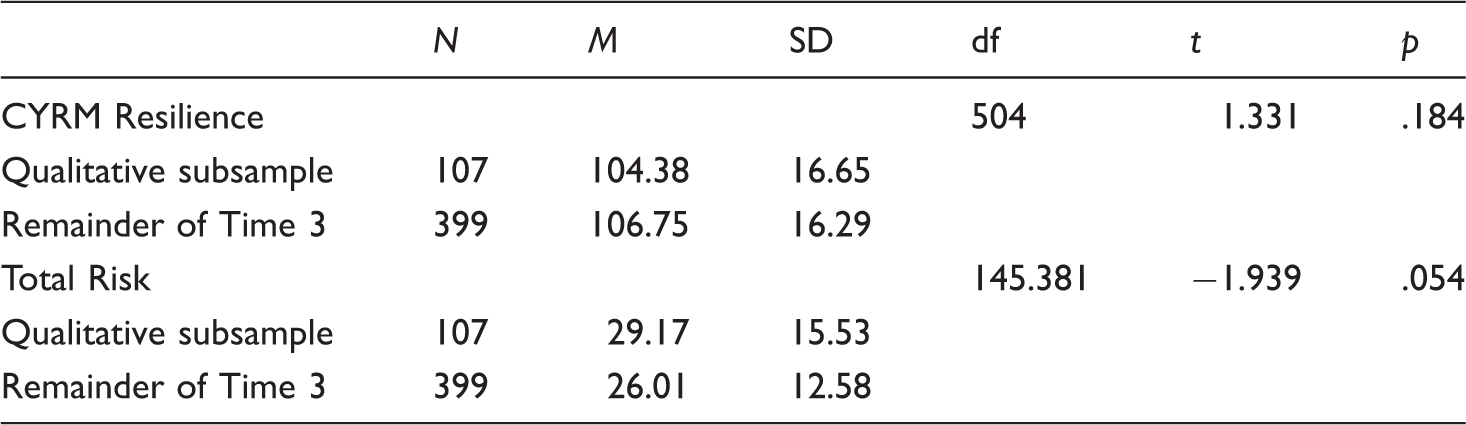
Of relevance to the current article are the fragmented and disrupted educational experiences of this group of youth; only 13% were still attending mainstream school and achieving at their age level at the time of their first interview. A majority of these youth had been suspended or expelled from mainstream school at least once (70%). Most were receiving educational supports outside of mainstream classroom settings at the time of their first interview (73%). Typically this was through a community-based education provider rather than a regular school. Most (82%) reported that factors beyond their control had stopped them attending school during the last year they had participated in a mainstream classroom. Further, 53% reported that they had skipped school more than a few times a week when they last attended a mainstream school. Despite these educational experiences approximately one-third (33%) were positive about their last or current mainstream school and 83% scored over the mean when asked if getting an education was important to them. It is interesting thus to note that even when youth experience challenges in participating in school most nonetheless still value getting an education.
Findings
Trying to fit in––struggling to weave the competent student narrative thread
The strongest narrative thread in the descriptions youth gave of their experiences of mainstream school was that they did not fit in; they talked of feeling that school was not ‘for them’, that they could never be ‘good enough’ or that they knew that they were different from other students; this made them feel uncomfortable and caused them emotional distress. Similar to the observations made by Theron and Donald (2013) this thread of difference appeared regardless of whether youth enjoyed or completed school. School was a place where they had to confront the message that they were not ‘like the other children’: You feel different, when you’re at school you see everyone else’s mums, dads, picking them up and you wish you were going with them. [Peter] Schools were real hard to be honest. I was always bullied. I used to have girls rip my clothes, pull my hair. Coz we were poor, I never had my own shoes; I went to school in the same clothes that I had worn for the past couple of days … I was different, everyone laughed at me. [Jessica] A place where I belonged (school)? No, not really. I don’t think I belonged. I didn’t feel like I fitted in. [Hone]
Rather than providing integrative answers to the three identity questions posed above, the school experience was a discordant element in their growing self-narratives and as such it generated a sense of alienation from school. The young people adopted a variety of strategies to manage this intense sense of difference. Some used humour, but this did not help with integrating a student identity into a positive self-narrative: Teachers had favourites, I wasn’t one of them, coz I’m not on the bright side so I was teased or ignored. So I got meself pinned as the class clown. Even when I tried to do the work, teachers would just not even bother with me so I was like, ‘Fuck it, whatever’. [Paul]
To stay at school youth had to be able to create and sustain a convincing image of themselves as sufficiently similar to the other students. Over time, rather than a self-image they were actively trying to embody, this student-self came to represent an idealized vision of self that they progressively came to believe they could never achieve. As a result they became increasingly unable to convince themselves and others that they were just the same as any other student. The challenges of mounting and sustaining a coherent student narrative could be most clearly seen in two key areas.
First, even those who successfully graduated from school talked of a strong feeling that no-one at school appreciated what one participant explained as their ‘back life’. This ‘back life’ was the complex mix of intense challenges and vulnerabilities they faced at home and in their neighbourhoods. While they could leave the corporeality of these risks outside school, the emotional and practical impact of these vulnerabilities could not be left there and accordingly this ‘back life’ came to school with them: Probably because of troubles I have at home, I’d carry that and I’d take it to school. But I couldn’t leave what I have at home, at home. You’re supposed to leave it … but really, how do you do that? [Nikki] I was going through a very hard time of being molested, so going to school was quite hard and actually keeping my emotions and stuff under control, people were bullying me and it wasn’t working. I’d be that one that would lose it, throw chairs, shout and scream and hit out at people. [Paula]
This ‘back life’ influenced all their interactions, increasing their felt sense of difference from other students. If not interrupted by the intentional behaviours of school professionals, the feeling of being different translated into a sense of not belonging. The multiple and complex challenges youth needed to juggle outside school swamped them, reducing their capacity to mimic an image of a student who fitted in. This swamping was most often seen in the appearance or escalation of behaviours such as displays of anger and frustration: Couldn’t hold that feeling in any more so decided to let it all out (anger). [Jonathon] They thought I was just a little brat, and I didn’t care about school. I did, it’s just the problems that were going on in my life; my dad was going through the courts, which was another load on my shoulders, cops would come to the school for me, it all spills over, hard to keep it in. [Anne]
The more often students experienced these instances of swamping the less likely it was that they would be able to continue to convince themselves that they were in fact able to be just like the other students. It also increased the disconfirming evidence peers and school professionals had of them as a student who fitted in. Young people often related that neither school professionals nor their peers understood the effort it took to keep this competent student narrative going. They felt judged and labelled by the times they slipped up, without any recognition of the times they successfully maintained the persona: High school didn’t want me. I had a bad record at intermediate and that followed me to high school. This teacher was always on my back; he finally caught me doing something stupid and finally got rid of me. He made me look that bad that I couldn’t go to any other school. [Jerry] Everyone hated me for who I was. I was never encouraged; all the good things that I did do in school, no one praised me. Only ever criticised for what I did wrong. So I would be like ‘Oh well, fuck you then’. [Tim]
The second area where challenges in enacting a coherent student image were seen was situations where youth with learning or cognitive impairments were not provided with the educational supports they needed to function successfully in mainstream classrooms. Without the promised support these children could never sustain a coherent student narrative. When the systems around them failed to deliver appropriate and meaningful support it was common for them to express frustration which then served to reinforce the negative labels: I just hated it. I was embarrassed coz I’ve got two learning disorders. They said they would get me special help. It never happened; nothing happened about it. I felt very unsuccessful, embarrassed, frustrated. Then when it gets too much I get blamed. So I just constantly kept wagging and fighting. [John]
Feelings of alienation from education and not fitting in at school were not always continuous throughout the school career. For example, some talked about enjoying primary school; others spoke of a teacher at high school who had understood them. However, in general terms as they moved through school, the sense of alienation grew: At the start (primary) I thought school was where I belong, but then I started thinking that school wasn’t for me … they didn’t understand my background and that. I‘d had a teacher, honestly, punch my face. I was only 11 years old, and then after that I didn’t really trust schools. [Brewer] It was probably the funnest time in my life (primary school). Two months at college I got kicked out. My family was going through so much at that time. My dad just got out of jail and he was coming round our house, beating my mum up. Too hard to keep it up, had to give it away (school). [Nicky]
When not interrupted, the sense of difference accumulated to a point where remaining at school became unsustainable in the evolving self-narrative. Young people talked of reaching a point where they could not continue to balance the tension between the imagined student and the daily reality of not fitting in. Then the school ecology came to represent a discordant element in the ongoing self-story. If Giddens (1991) is right––that the ongoing story of the self is an important activity, and that it cannot be completely fictive––then children who daily experience school as frightening, hostile, foreign, or unwelcoming are likely at some point to either remove themselves or precipitate circumstances where the school excludes them. Indeed, this was a common response recounted by three quarters of the vulnerable youth in the study. However, leaving school meant losing access to the resilience-building resources that their school ecologies contained.
The search for narrative coherence in dangerous places – authoring an alternative self-story
Experiences of exclusion from school were the second most common set of educational narratives. Irrespective of how youth came to be not attending school, the patterns in their stories about what happened next were remarkably similar. Echoing Giddens’ descriptions of ‘fractured selves’ (1991, p. 53), youth talked about loss of motivation, a weightless feeling of lost-ness that was difficult to live with: Everything fades and fades. The schooling fades, the support network fades. You think it’s gonna be easier, when you get out from school. But your friends fade, family fades and then you just feel depressed. [Nathan] I used to wake up and go floating, I dunno, strange-as feelings hard to describe, like I had disappeared or something, floated away during the night, the end of the chapter … it just all petered out after that … I was on my own. Downward spiral, drift away. [Judith]
To construct a coherent narrative thread youth needed to find somewhere else to fit. Paradoxically, however, removal from school did not remove the sense of being different; this transcended the place from which it originated. In the process it became a dangerous dimension of the ongoing story of self because if not a student, then who should they be, what should they do, and how should they do it? Youth most often built this new narrative with other similarly-displaced youth. Here they did not need to maintain the student narrative thread, and the others around them understood how their ‘back life’ impacted upon their behaviours. Together these youth wrote new bold, powerful and independent self-stories over painful school selves. This made it difficult to pick up the educational narrative thread again, reducing the chances that prosocial self-narratives could be authored: I was in so much trouble. I was like why do I bother going? Just let it go, be free. It’s not for me (school). They look at you differently … It got worse after I left every school, I got worse after I got kicked out, just emptiness … then you think ‘be that person they think you are, be the baddest, hardest-out person there is. Be that’. [Jarvis]
Fostering a sense of belonging––re-authoring the educational narrative thread
Achieving educationally and constructing a coherent, positive identity are key tasks in the adolescent identity project that are critical to successful transitions to adulthood (McLean et al., 2013). As noted above, being removed or removing themselves from school required that youth created new narrative identity threads that contained opportunities to see themselves as strong, capable and successful. It could appear that school had never really offered real identity possibilities for these vulnerable youth. Indeed, many talked of a growing realization that school had ‘never been for me’. However, the interviews also contained evidence of school-based professionals arresting, refocusing, and helping with re-authoring the educational stories of these children whose hold on a positive educational self was fragile. These reciprocal exchanges (Theron & Donald, 2013) were resilience-enhancing: At the end of the day you’ve got to have someone there, someone outside of your family; when there is all that shit going on in your family. School should be the one place where you can go to and just be yourself, doesn’t change who you are, but it’s a place you can go. [Amy] I got on really, really well with my Deans and the counsellor; they were kind of like stand-in parent figures. They knew what was going on for me. They looked out for me if I was sick, lent me money for the doctors, they were really, really good. I wouldn’t have made it through school without that help and knowing they were watching over me. [Jo]
Creating relational spaces to build resilience––PARTH practices
The relationships some school professionals formed with the youth allowed them to re-author their educational narratives so that rather than a place of risk, characterized by feelings of alienation and exclusion, school became a powerful resilience resource and a place that fostered a sense of belonging despite feelings of difference. While these youth may still have carried a powerful sense of being different, by demonstrating caring, by providing social and material resources, and investing effort in making school a safe haven, school professionals created a sense of belonging and attachment to the school ecology. In this way, these relationships came to comprise a resilience resource. Belonging made school a meaningful source of identity material for youth who otherwise were at risk of early disengagement. Five orientations to practice were identified from recurring themes in youth interviews that fostered this sense of belonging. These orientations to practice are summarized as PARTH and what is particularly interesting about these orientations is that they transcend professional boundaries; they were equally represented in the practices of teachers, counsellors, school social workers, psychologists, and school administrators who made a difference to the capacity of vulnerable youth to stay at school. The PARTH orientations are:
Perseverance Adaptability Relationships Time Honesty
Perseverance was illustrated in enduring commitment to the young person. In lives where adult commitment was in short supply this was highly valued by youth and it contributed to a sense of belonging at school, building resilience in the process. Others (Theron et al., 2014) have noted the benefits children gain from reciprocal collaborations with school professionals. Perseverance was a tangible manifestation of such relational transactions. Perseverance also contributed to a sense of safety at school; mistakes youth made could be understood and forgiven, and they might be given a chance to try again. In contrast to Tim (above) who explained that no-one ever recognized him for the good things he did, or Nicky and Anne who found that no-one understood the way that the pressures at home spilled over into their behaviours and performance at school, Murray and Jo (below) experienced the commitment of a school professional to them at a personal level. As a result school became a place where even when they made mistakes they were given opportunities to try again: Every time I was bad he [counsellor] used to just take me into his office, let me sit on his computer, give me some food. Even when I got kicked out of class, he was kind. [Murray] She was a real good teacher. She came to my (family member’s) funeral. She’d stay with you until you understand what you’re doing. Believe that you could be that person (student). [Jo]
Adaptability and flexibility are valued by children because they demonstrate commitment (Hlatshwayo & Vally, 2014). These orientations indicate that school professionals might ‘bend the rules’ in recognition of the pressures and challenges the student faced. Below, Simon explains how the psychologist used his role in the school to create safe spaces for Simon when the pressure to contain his emotions in the classroom became overwhelming. This experience stands in contrast to that recounted by Paula (above), who found herself at school having to cope alone with the emotional impact of sexual abuse. Simon had a school professional he could rely on to ‘bend the rules’ so that he did not have to stay in the classroom when his emotions were running high: The psychologist was a big support for me at college. He could read me like a book. If he seen I was having a bad day he would come and get me out of class, get the pressure off. [Simon]
It was very important to the young people in this research that their circumstances were taken into consideration by school professionals and this is something that has been noted elsewhere (Noltemeyer & Bush, 2013) as central to building resilience.
Relationships that were enduring, positive, encouraging, warm, and empathic were valued highly by the young people. The ongoing self-story is interactional and fluid and particularly influenced by interactions that demonstrate that an aspect of the narrative is not correct (Giddens, 1991). It was disturbing to hear that Jerry (above) felt that he was not wanted at school and it was difficult to imagine what it might be like to be a child who daily confronts this feeling of rejection. The sense of feeling trapped and then inevitably caught by a teacher who was just waiting for Jerry to make a mistake can be contrasted with Louise’s experiences (below). Here school professionals constructed positive relationships with Louise and in the process they counteracted narrative elements that contradicted the positive student thread. In the process they enhanced Louise’s capacity to thrive (Noltemeyer & Bush, 2013): My science teacher understood the troubles I was going through. She never judged me for it all; I just knew that she knew. I was glad for it. She made sure I was alright. [Louise]
Time was very important to the young people. As noted above (see: The search for narrative coherence in dangerous places), time was a resource that could help when attending school. However when not at school, time became risk-laden. Time manifested itself as school professionals recognizing and responding to the teachable or critical moment; that point in time when change became possible. When school professionals made time to listen and communicated that the relationship was sufficiently important to endure beyond the class, the semester, or the year, the coherent student narrative thread was strengthened. In the process the chances that the youth would experience school as a welcoming place increased: I was living with my counsellor. I couldn’t have finished school otherwise. I still keep in contact with her; she still makes the time for me. It is incredible. [Maggie]
Because these young people confront atypical challenges in navigating a safe pathway to adulthood sometimes atypical responses are required. While having a student board with a counsellor may be an atypical response, in making her home available Maggie’s counsellor demonstrated that she knew that without a stable living environment Maggie would not be able to complete school. The longevity of this relationship, extending as it did beyond Maggie’s school years, further enhanced her sense of stability and capacity to cope as she moved into young adulthood. Of course, counsellors cannot take all the troubled students they see home with them. The significance of this action lies in the fact that the counsellor responded to the challenges Maggie faced at home and the impact that these had upon her capacity to do well at school. The key issue here was that the counsellor responded to Maggie’s reality by doing something concrete and meaningful. In other situations there may well be other resources that school personnel can draw upon to assist a young person to stay at school. In this case, however, the counsellor understood that Maggie did not have other options available to her. By giving of her own time, the counsellor created the possibility that Maggie would be able to complete her education.
Honesty was fundamental to fostering a sense of belonging and building resilience. Young people often talked of being let down by the professionals involved in their lives, of being promised services and supports that did not eventuate. John’s experience (above) of being promised services that never eventuated was not unusual. The consequence of broken promises for many youth was that they lost faith in the willingness or ability of professionals to make a difference in their lives. They appreciated school professionals who honestly told them what support they could and could not offer, and who kept their word and did not break confidences. Honesty made relationships reliable and this made school a safe place to be as Nick identifies: I have utmost respect for that man (teacher). He understood, like he’d talk to ya, like a person; you would tell him what’s happening. He treated me like a human being which was hard to come-by back then. He would keep his word, and if he couldn’t do something he would tell me straight up. [Nick]
In summary, when school professionals adopted PARTH practices, re-authoring of the student narrative thread became possible. These practices embodied subtle, warm, responsive, and practical behaviours that demonstrated commitment. They also created opportunities for students to negotiate actively with school professionals over how support and resources would be made available. This ensured that supports were meaningful and relevant and this increased the likelihood that youth would benefit from these interventions.
Conclusion
The use of a PARTH orientation to practice transformed schools into relational spaces that bolstered resilience of vulnerable youth. Professionals such as school psychologists are in an ideal position to model these kinds of interactions to other school personnel and to support them to adopt PARTH practices. They are ideally placed to create PARTH-based relationships with vulnerable students so that schools feel more safe and welcoming. These orientations to practice increase the capacity of school professionals to respond to youth in culturally and contextually relevant ways, focussing attention upon the ways that students’ lives outside of school influence their behaviours at school. The belonging these orientations create transcend the sense of not fitting in that vulnerable youth experience at school, and this transforms school from a place that reinforces difference to one that creates possibilities for change. These caring relationships do not change the sense of being different. However, they reduce the power the sense of difference has to undermine the coherence of youth self-stories, and education, as part of youth self-narratives, remains a possibility.
Footnotes
Acknowledgements
The researchers thank all the young people who made a commitment to this study and who generously shared the details of their lives with us. We acknowledge the contribution of The Donald Beasley Institute, Child Youth and Family, Youthline Auckland, Kapiti Youth Support and all the other researchers who helped out with the research. In particular we thank Bianca Prujean for initial coding of the education node.
Declaration of Conflicting Interests
The author(s) declared no potential conflicts of interest with respect to the research, authorship, and/or publication of this article.
Funding
The author(s) disclosed receipt of the following financial support for the research, authorship, and/or publication of this article: We thank The Ministry of Business, Innovation and Employment (MBIE); who fund this long-term research programme.