



Abstract
The current study first examined the applicability of the ClassMaps Survey (CMS)—a measurement of resilience in classroom/school settings developed in the US with Chinese middle school students and then compared the group differences on student perceptions of the resilience factors in the CMS across the two cultures. The findings suggest that the CMS and all its seven subscales have good to acceptable scalar measurement equivalence. The current study supports the use of the CMS and its seven subscales with Chinese middle school students as a measurement of resilience in classroom context. Furthermore, the study found that Chinese students scored significantly higher on academic self-determination, behavior self-control, teacher-student relationship, home-school relationship, and peer conflict but significantly lower on academic self-efficacy than American students. There was no significant difference in peer friendships between the two groups. Implications for resilience promotion in school settings were discussed in cultural context.
Researchers have recently begun advocating for an ecological approach to school psychological services, in which the needs of individual students are addressed in their social context and the interaction process between the individual and the environment (Ysseldyke et al., 2006). Research on resilience is informative for this ecological approach, as resilience is the product of the interaction between individual characteristics and the conditions of one’s ecology (Doll, 2013; Doll & Lyon, 1998; Masten & Coatsworth, 1998). The current study aims to understand students’ perceptions of resilience promoting factors in an urban school context in China in comparison to that in the United States.
Social ecological conceptualization of resilience
There are multiple definitions of resilience that reflect different perspectives, including individual traits, adaptation process, and ecological dynamics (Windle, 2010). Although the majority of resilience research is conducted in developmental psychology, reviews of how resilience is examined in multi-disciplinary studies (Fletcher & Sarkar, 2013; Windle, 2010) suggest the following themes in our current understanding of resilience that are relevant to the current study. First, despite various definitions of resilience from different research perspectives, there are two core concepts: adversity and positive adaptation. While some researchers consider significant negative life experience (e.g., major disaster) as adversity (e.g., Luthar & Cicchetti, 2000), others view adversity as ongoing common daily stressors (Davis, Luecken & Lemery-Chalfant, 2009; Sameroff & Rosenblum, 2006). In the current study, considering the roles of school psychologists in prevention and intervention in schools, we view adversity as daily stressors for middle school students and resilience as the ability to thrive academically despite adverse circumstances (Kitano & Lewis, 2005). Second, more researchers are adopting a socio-ecological approach to resilience instead of viewing resilience as fixed personal traits. For example, in developmental psychology, Masten (2014) defined resilience as ‘the capacity of a dynamic system to adapt successfully to disturbances that threaten system function, viability, or development’ (p. 10). In research on children’s resilience, the dynamic system is the individual child; the individual child’s capacity to adapt to disturbances is rooted in the individual, his or her ecology, and the interactions between the two. Third, decades of research about resilience in youth has identified a set of individual and environmental resilience promoting factors within the individual, the family, and the community, such as school (Doll & Lyon, 1998). Sameroff, Gutman, and Peck (2003) proposed a risk dimension with one end being risk factors and the other end being promotive factors rather than protective factors. In this dimension, the effect of the protective factors is minimal and only meaningful to high-risk populations; however, promotive factors are the positive end of the risk dimension and have positive effects for all populations. Their Philadelphia research has evidenced that the more promotive factors, the better the outcome. Therefore, for prevention and intervention purposes, it is more beneficial to address any and/or all factors (Vanderbilt-Adriance & Shaw, 2008).
Recent research on resilience has been exploring the cultural and contextual variations of resilience process because of the importance of ecology and the fact that the bulk of current resilience research is conducted in Western cultures and mostly in the US. Ungar (2011) proposed a social ecological conceptualization of resilience that emphasized the need to decentralize the individual and focus more on the ecology that facilitates positive outcomes or resilience. Whether a factor is an accepted and meaningful resource to a child depends on the context and culture. In addition, whether a child is resilient or not is determined in his or her context and culture.
Empirical research that examines the cultural variation of resilience-promoting factors has found a set of similar characteristics of individuals and their environment across different cultures, e.g., self-determination, aspiration, positive peer relationships, family support, community/school support, and educational engagement (Hue, 2011; Li, Martin, Armstrong & Walker, 2011; Theron, Theron, & Malindi, 2013; Ungar et al., 2007; Zhang, Li, Gong & Ungar, 2013). It appears that the cultural differences are mainly in how these resilience factors are played out in the context and how the individual interacts with these environmental factors. In other words, there seems to be a set of similar helpful factors for individuals across many cultures even though how these factors work or the mechanism of resilience largely depends on the context and culture (Ungar, 2011). For example, Theron et al. (2013) investigated the resilience factors of South African youth and identified a list of similar, though occasionally differently named, resilience factors, including resilient personality, dreamer (self-determination), educational progress (school engagement), acceptance (of the reality with difficulties), value driven (positive values as defined by the local culture), and active support systems (immediate and extended families, peers, social support services, and school and community). These resilience characteristics are overall consistent with those reported in prior research conducted mostly in the Western cultures (Doll & Lyon, 1998; Masten & Coatsworth, 1998). However, it is important to point out that the ways in which these factors were expressed were different. For instance, there was no identification of a specific significant adult mentor or a positive relationship with the nuclear family in South African youth resilience; instead, supportive systems including the networks among family, school, and community were prominent. The authors argued that this was consistent to the African collectivist cultural values that emphasize the experiences of a family-community rather than individual supportive person or the nuclear family. In summary, we view resilience in schools as students thriving academically despite adverse circumstances. We adopt the socio-ecological perspective of resilience. This perspective takes the role of culture and context into consideration when acknowledging common resilience factors across cultures.
ClassMaps Survey: A measure of resilience factors in schools
In most countries, children spend the majority of their weekdays in schools; classroom and/or school conditions play an important role in their learning and development. Academic, social, and emotional success in the school contributes considerably to students’ overall development. Resilience research, especially the research about resilience promoting variables in school settings, provides us with the foundation for prevention and intervention practices. The need for translating resilience research findings to practice in school systems led to the development of the ClassMaps Survey (CMS; Doll, Spies, LeClair, Kurien, & Foley, 2010a). The CMS assesses students’ perceptions of eight important resilience promoting factors describing the aspects of a classroom/school environment in eight subscales (See Supplemental Materials; Doll et al., 2010a). Oriented toward prevention and intervention, the CMS can also serve as a data-driven problem-solving tool to enhance students’ academic and overall resilience in school settings through a consultation process using class meetings called micro-studies of classrooms (Doll, 2013). Studies conducted in the US have demonstrated that the CMS is easy to use and has robust psychometric properties (Doll et al., 2010a; Doll et al., 2010b). However, it is unclear whether the resilience constructs measured in the CMS stay equivalent across different cultural groups. As the CMS was developed in the US, before any cross-cultural comparisons on resilience factors can be conducted, empirical studies should be conducted to determine if it yields the same resilience factors in different cultures.
The current study has dual purposes. First, it aims to examine whether the CMS developed in the US has measurement equivalence when used with Chinese middle school students. A positive answer to this question would have important practical implications to Chinese schools. Second, it compares American and Chinese students’ perceptions of resilience factors in their classrooms, given that the CMS has measurement equivalence across the two cultural groups. Cross-cultural research on resilience with Chinese and American students has been scarce. Chinese schools, like their American counterparts, are facing increasing challenges in students’ social and emotional development (Chen, Chen, Kaspar, & Noh, 2000). If the CMS has measurement equivalence between the Chinese and American students, it can serve as a practical tool for prevention and intervention in Chinese middle schools. In addition, a comparison between Chinese and American students’ perceptions of resilient factors in their classroom environment will add new knowledge to cross-cultural research on resilience in school settings.
Resilience of Chinese students
Resilience in Chinese culture
Few studies have explored the interpretation of resilience in Chinese culture. Most of the resilience research on Chinese youth has adopted the Western conceptualization of resilience (e.g., Hu & Gan, 2008; Lee, Shek, & Kwong, 2007; Tian & Wang, 2015; Wong, 2008). Research, however, indicates that Chinese interpretation of the two key components of resilience, adversity and adaptation, is influenced by traditional Chinese philosophies. First, Chinese seem to adopt a holistic view of adversity and adaptation. For example, Hu and Gan (2008) stated that in Chinese culture, adversities are not necessarily viewed as negative but as opportunities for positive changes and adaptation. In her qualitative research on resilience, Hue (2011) found Hong Kong Chinese teachers emphasized viewing challenges or disturbances in students’ lives as opportunities for them to develop social competence. This viewpoint seems to align with Taoist rule of dualism, implying the cyclical swing between extremes (e.g., adversity and success) (Young, Tseng, & Zhou, 2005). This holistic view may help individuals take a dialectic and positive approach toward the adversities in their lives.
Second, an ecological approach is utilized in resilience promotion by researchers and educators in China. Research in this area emphasizes the role of environmental variables, such as peer relationships and nuclear and extended family support (Lee et al., 2007; Tian & Wang, 2015; Wong, 2008). This is consistent with the understanding of children’s learning difficulties in Chinese educational research that highlights risk factors in students’ ecology and recommends prevention and intervention from an ecological perspective (e.g., Li, 2010; Ni, 2006; Wu, 2006; Zhao & Su, 2010).
Chinese perspectives in resilience and well-being also emphasize the importance of individual traits, especially innate strengths. Yan (2005) stated that in Confucianism, it is important to cultivate one’s personality and develop coping skills for better well-being. For example, self-control and moderate (instead of extreme) opinions are the golden means to social harmony and individual well-being. Hue (2011) found that, when asked about resilience promotion, Hong Kong Chinese teachers emphasized students’ inner strengths of self-determination, self-control, and self-reflection.
Although limited, the current empirical research on resilience factors among Chinese students appears to concur with cultural research on youth resilience. A similar set of environmental and individual factors is believed to promote Chinese youth’s resilience. For example, Hu and Gan (2008) identified five factors of resilience for Chinese adolescents (goal determination, social support, family support, positive cognition, and self-control of emotions) and developed the Resilience Scale of Chinese Adolescents. This scale, however, does not target resilience factors in school settings; for example, the items for social support have little context information. Consequently, the data from this scale do not provide much information for school interventions. In contrast, the CMS is designed for assessing resilience factors within school settings for prevention and intervention purposes. Therefore, we chose to examine if the CMS is applicable with Chinese students in school settings.
For the resilience factors in individuals’ environment, research in China has similar findings as in the Western countries. Studies in China consistently find that peer relationships generally enhance Chinese students’ resilience (Hu & Gan, 2008; Li et al., 2011; Zhang et al., 2013). The majority of research supports the positive roles of teacher-student and parent-child relationships in resilience promotion (e.g., Cheng, 1998; Wang et al., 2016; Yang et al., 2013). Research, however, has also found that teacher caring relationships do not always predict a lower level of depression (Zhang et al., 2013). Furthermore, poor parental supervision and family conflict are not consistently linked to Chinese adolescents’ poor academic outcomes (Li et al., 2011). Research has attributed these different findings to the over-emphasis on academic achievement in Chinese schools and families. As there is already sufficient educational support in schools for Chinese adolescents, parental and teacher supervision and care might not appear as influential as in other cultures. Parents’ over-involvement can also contribute to more internalized problems in Chinese students (Liu, 2003). Thus, the over-emphasis on academics in China may mitigate the roles of teacher-student and parent-student relationships as resilience promoting factors for Chinese students.
There are few studies on individual factors of resilience in Chinese youth. Zhang et al. (2013) found that individual students’ meaningful participation, their goals and aspirations, problem-solving, and self-efficacy were negatively related to their levels of depression. Hue (2011) reported Hong Kong teachers emphasized students’ ‘inner power’ such as self-determination, self-control, and self-reflection in resilience. Hu and Gan (2008) identified three individual factors (goal determination, positive cognition, and self-control of emotions) in Chinese adolescents’ resilience. Among these individual factors, the emphasis on self-determination and self-control appears to be consistent with research findings about Chinese students’ family-oriented high achievement motivation (Yu & Yang, 1994) and the socialization theme of behavioral and emotional self-control in Chinese culture (Chen, 2010). Although these resilience promoting individual factors are similar to the ones found in Western cultures, one caution is that these concepts are influenced by different cultural values and practices in the collectivist context in China and the individualistic context in the U.S. However, the behavioral expression (e.g., following classroom rules) of the individual factors, such as self-determination and self-control, might be very similar in American and Chinese schools.
In contrast, current research (Hau & Ho, 2010) does not consistently support the importance of self-efficacy in academic achievement for Chinese students. Despite their high academic achievement and motivation, Chinese students consistently reported lower self-efficacy than their Western counterparts (Hau & Ho, 2010). This might be attributed to several social and cultural factors. First, the highly competitive examination system in Chinese schools produce many failure experiences, which do not enhance self-efficacy for Chinese students. Second, high parental educational and career expectations and emphasis on effort frequently make a Chinese student feel that s/he is never good enough (Chao, 1996; Lu, 2011). Third, self-efficacy (which essentially means feeling good about oneself) contradicts traditional Chinese cultural virtue of modesty (Li, 2002). Chinese students are expected to remain humble and modest amidst success. In addition, Chinese individuals typically hold the view that being conceited negatively affects an individual’s further progress (suggested by numerous negative idioms in traditional Chinese culture about being conceited).
Overall, current research suggests that Chinese tend to adopt a holistic and ecological view of adversity and adaptation. Chinese research on resilience generally adopts the conceptualization of resilience in the Western cultures; however, there are unique cultural interpretations of resilience and its two components—adversity and adaptation. The limited research on resilience factors among Chinese students indicates that there is a set of similar resilience factors as found in Western research, although their cultural contexts are different. There are different findings regarding the roles of student-teacher and student-parent relationships in student success in the US and China. Academic self-efficacy might not be a significant indicator of classroom resilience due to the Chinese cultural value of modesty.
Current study
When a measurement instrument developed in one culture is used in another, the establishment of measurement equivalence (ME) means it measures the same constructs and results can be interpreted similarly across the cultural groups. For the current study, we first examined the configural, metric, and scalar levels of ME of the CMS and its subscales between Chinese and American students. Then, we compared the latent group mean differences of the subscales across the Chinese and American groups to add new knowledge to cross-cultural research in resilience in classroom/school settings when the CMS demonstrated the scalar equivalence. We asked the following research questions: a) Is there a similar factor structure for CMS across the Chinese and American middle school students? b) Are the factor loadings and intercept of similar items the same across these two cultural groups? c) If the answers to the first two questions suggest measurement equivalence, what are the similarities and differences in students’ perceptions of resilience factors across the two cultural groups?
Method
Participants
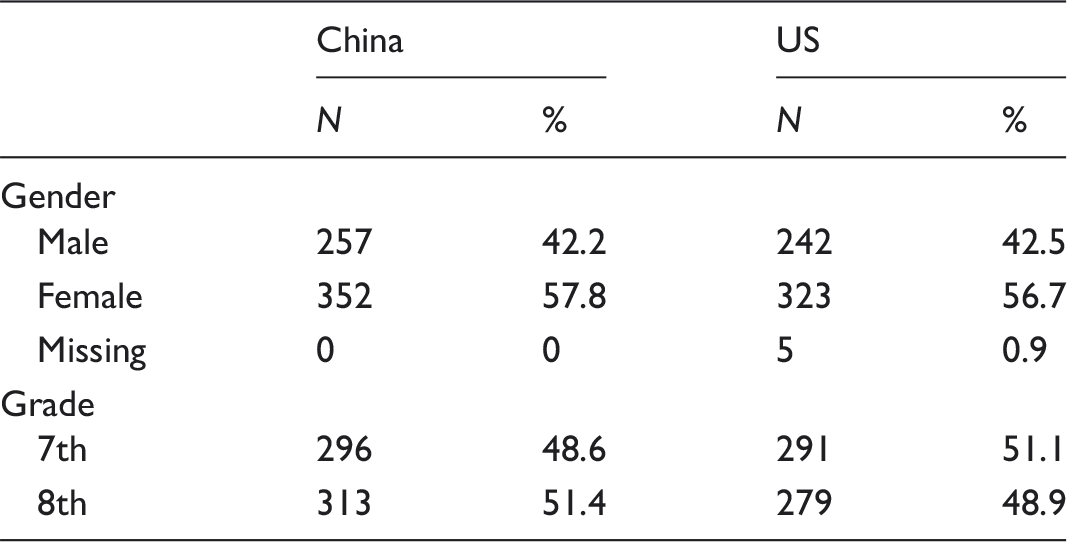
Participants of this study were 609 7th and 8th grade students from a middle school in Eastern China. The participant school and students were selected for convenience purposes to complete the Chinese version of the CMS anonymously in their classrooms in 2014. The participant school is located in Nanjing, the capital of Jiangsu Province. The 2010 China population census (Office for the Population Census of Jiangsu Province, 2012) suggests that the average annual income of urban residents in Najing was about RMB 28,312 (roughly $4,310) compared to RMB 19,104 (roughly $2,910) of national urban residents. Thus, all the Chinese student participants were from urban background and the majority of them were likely from middle-class families. The current study used a companion sample of 570 7th and 8th grade American students from the study of Doll et al. (2010b). Data about the participant schools (demographics from public-schools.startclass.com) in the study of Doll et al. (2010b) suggest roughly 28% of the student populations were eligible for free or reduced lunch. About half the student participants in the companion data were from schools in urban areas while the other half were from rural areas in a Midwest state in the US.
Demographics of the ClassMaps Survey (CMS) participants.
Measures
The ClassMaps Survey (CMS)
The CMS was developed based on the empirical findings in developmental resilience and educational research (Doll, Brehm, & Zucker, 2014; Doll et al., 2010a). It originally operationalized seven classroom factors that promote student overall psychological well-being in school settings. Later, a factor of peer aggression was added. The final CMS has 55 items with eight subscales, five of which describe social relational aspects of the classroom: teacher-student relationships (My Teacher, seven items), peer friendships (My Classmates, six items), peer conflict (Kids in This Class, five items), peer aggression (I worry That, eight items), home-school relationships (Talking With My Parents, seven items). An additional three subscales describe student self-regulatory characteristics: Academic self-efficacy (Believing in Me, eight items), self-determination (Taking Charge, eight items), and behavioral self-control (Following Class Rules, six items). Doll et al. (2010a) described the theoretical background and development process of the CMS and conducted an exploratory factor analysis with elementary school students. The results indicated the CMS is a fairly robust measure of the intended eight scales and is consistent with its eight factor conceptual framework. Their results also suggested that the eight subscales can be used separately due to strong internal consistency. Doll et al. (2010b) conducted a confirmatory factor analysis to examine the technical properties of the CMS with students in grade 5–8 using the original seven subscales (47 items). Results suggested that the survey items loaded on the seven factors as predicted (CFI = 0.92; RMSEA = 0.048; SRMR = 0.04); all reliability coefficients were strong, ranging from 0.87–0.91. In addition, all CMS subscales correlated significantly with student engagement in science and efficacy for science inquiry. All these findings indicate that the CMS is a reliable and valid measurement of the resilience factors in both elementary and middle school classrooms. In the current study, we used the seven subscales because the US companion data were based on seven subscales.
The ClassMaps Survey, Chinese Version (C-CMS)
The Chinese version of the CMS was primarily created by translating the CMS into Chinese. First, the first author translated the CMS to a Chinese version and included all items in the original CMS. Then, three bilingual researchers translated the Chinese version of the CMS to English independently and blindly. The three bilinguals all received higher education in China and the US in education-related fields. Thus, they are familiar with the education background of the CMS, as well as American and Chinese cultures. According to Doll et al. (2010a), the readability level of the CMS is 3rd grade. We, therefore, assumed there would be few errors in translation caused by content difficulty and cultural unfamiliarity. The three versions of Chinese CMS were then compared and discussed among the three bilinguals and the authors to reach an agreed-upon version of the Chinese CMS. Next, this agreed-upon Chinese CMS was brought to a Chinese monolingual panel of two university professors of education, two middle school principals, six middle school teachers, and three middle school students. Based on their feedback, a final version of Chinese CMS had two important changes. First, all items were changed to a question format because, according to the Chinese panel, question format would be more student friendly than rating statements. In fact, Chinese students are typically more accustomed to answering questions. Second, teachers in the CMS subscales were worded as homeroom teachers in the Chinese version because in typical Chinese schools, students are assigned to a homeroom teacher, who teaches one subject and is in charge of students’ daily learning in the school. Teachers of other subjects typically come to teach students in their homeroom. This was different compared to American students from the companion US sample, who rated their science teacher in a science class.
Analysis procedures
In the current study, multigroup confirmatory factor analysis (MCFA) was conducted using Amos 21. Multiple fit indices were used to determine the model fit, including comparative fit index (CFI), the root mean square error of approximation (RMSEA), the Tucker-Lewis Index (TLI), and the standardized root mean square residual (SRMR). Generally, the model fit is considered good if CFI >0.95, RMSEA <0.05, TLI>0.95, and SRMR<0.05; the model fit is considered acceptable if CFI>0.90, RMSEA<0.08, TLI>0.90, and SRMR <0.10 (e.g., Bentler, 1990; Cheung & Rensvold, 2002). We proceeded to test the measurement invariance between the US and Chinese groups if the model fit was acceptable. We used the typical MCFA procedures that involve establishing cross-group constraints and evaluating models with increasingly restricted parameters (specifically, configural, metric, and scalar invariance). Because the performance of the chi-square difference test is affected by non-normality and large sample size, we followed the recommendation by Cheung and Rensvold (2002) and considered a difference of larger than 0.01 in the change of CFI as an indication of a meaningful change in model fit for testing measurement invariance. After the measurement invariance across the two groups was supported, we proceeded to examine latent mean differences between two groups using Mplus. The US group was chosen as a reference group, and its latent mean was set to zero. Throughout the paper, we used p < 0.05 as the cut-off for the significance tests. In the correlation analysis, we used one-tailed test of significance because we hypothesized the relationships between the subscales to be positive.
Results
Pre-MCFA results
Correlations among CMS subscales for US and Chinese participants.
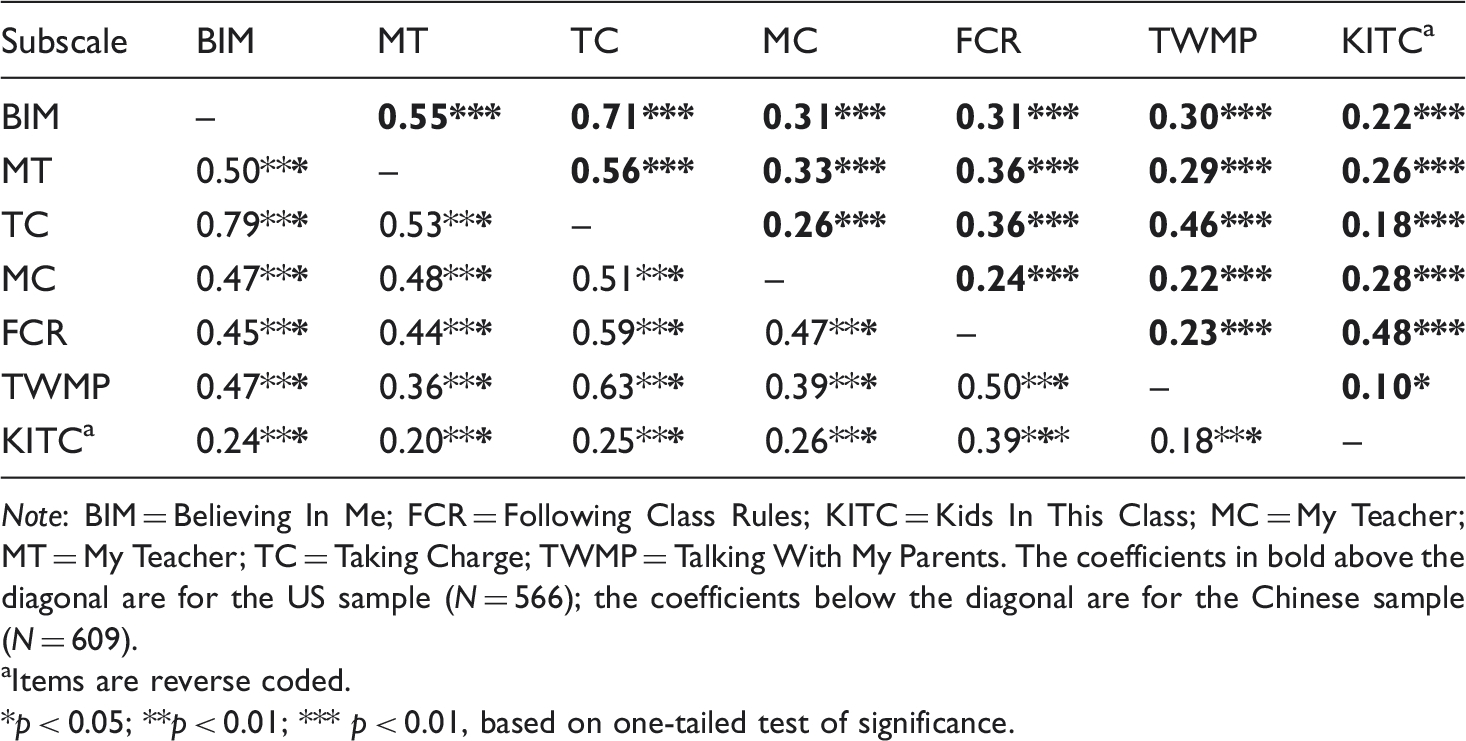
Note: BIM = Believing In Me; FCR = Following Class Rules; KITC = Kids In This Class; MC = My Teacher; MT = My Teacher; TC = Taking Charge; TWMP = Talking With My Parents. The coefficients in bold above the diagonal are for the US sample (N = 566); the coefficients below the diagonal are for the Chinese sample (N = 609).
Items are reverse coded.
p < 0.05; **p < 0.01; *** p < 0.01, based on one-tailed test of significance.
Cronbach’s Alphas for the CMS subscales.
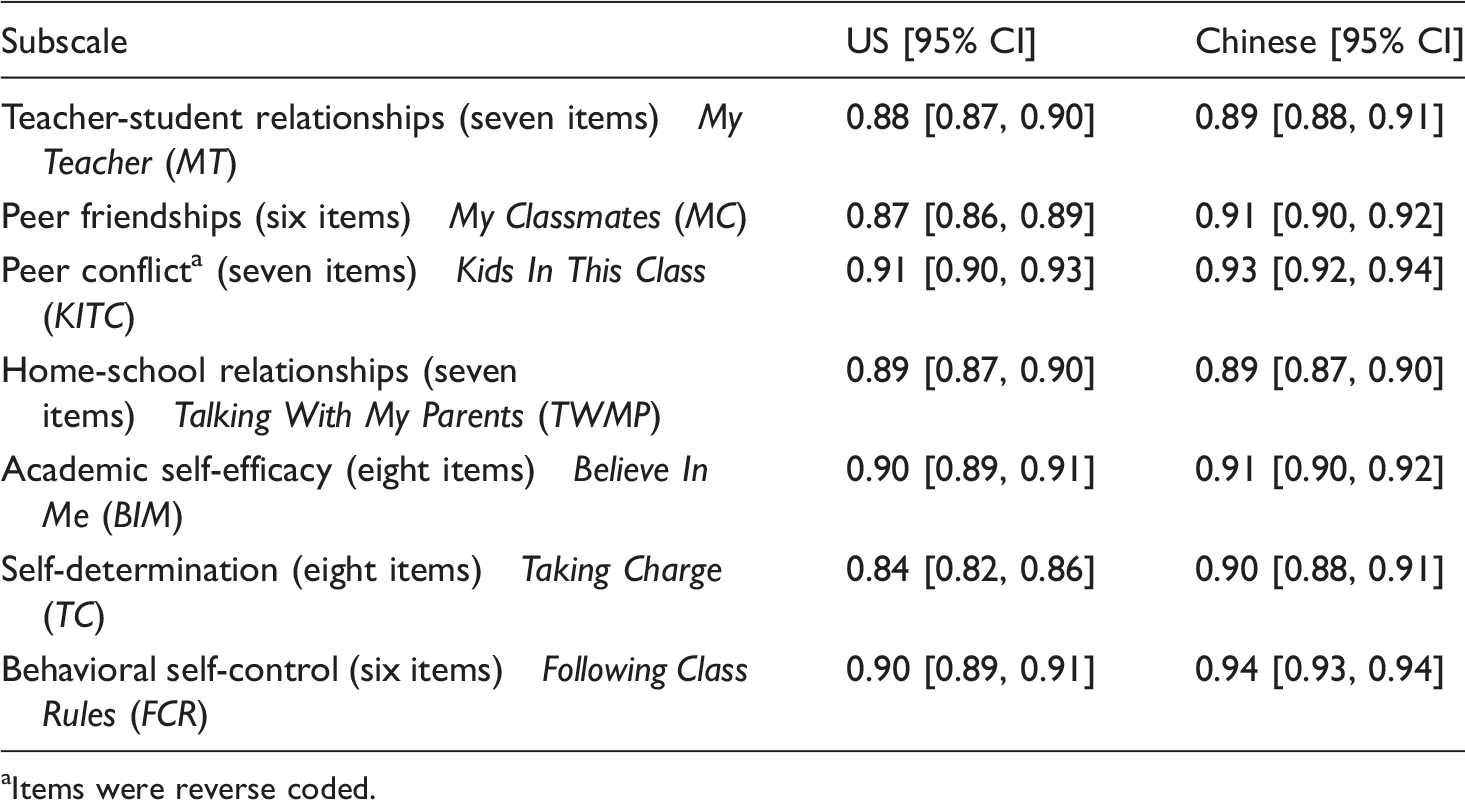
Items were reverse coded.
Multigroup confirmatory factor analysis
Goodness-of-fit statistics for tests of invariance: Seven-factor model.
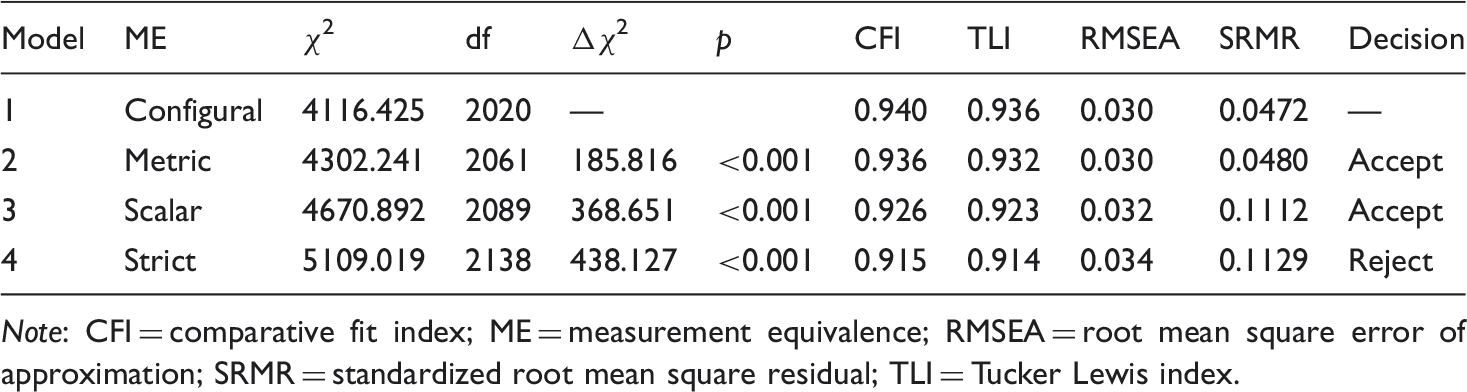
Note: CFI = comparative fit index; ME = measurement equivalence; RMSEA = root mean square error of approximation; SRMR = standardized root mean square residual; TLI = Tucker Lewis index.
Goodness-of-fit statistics for tests of invariance: Individual subscales.
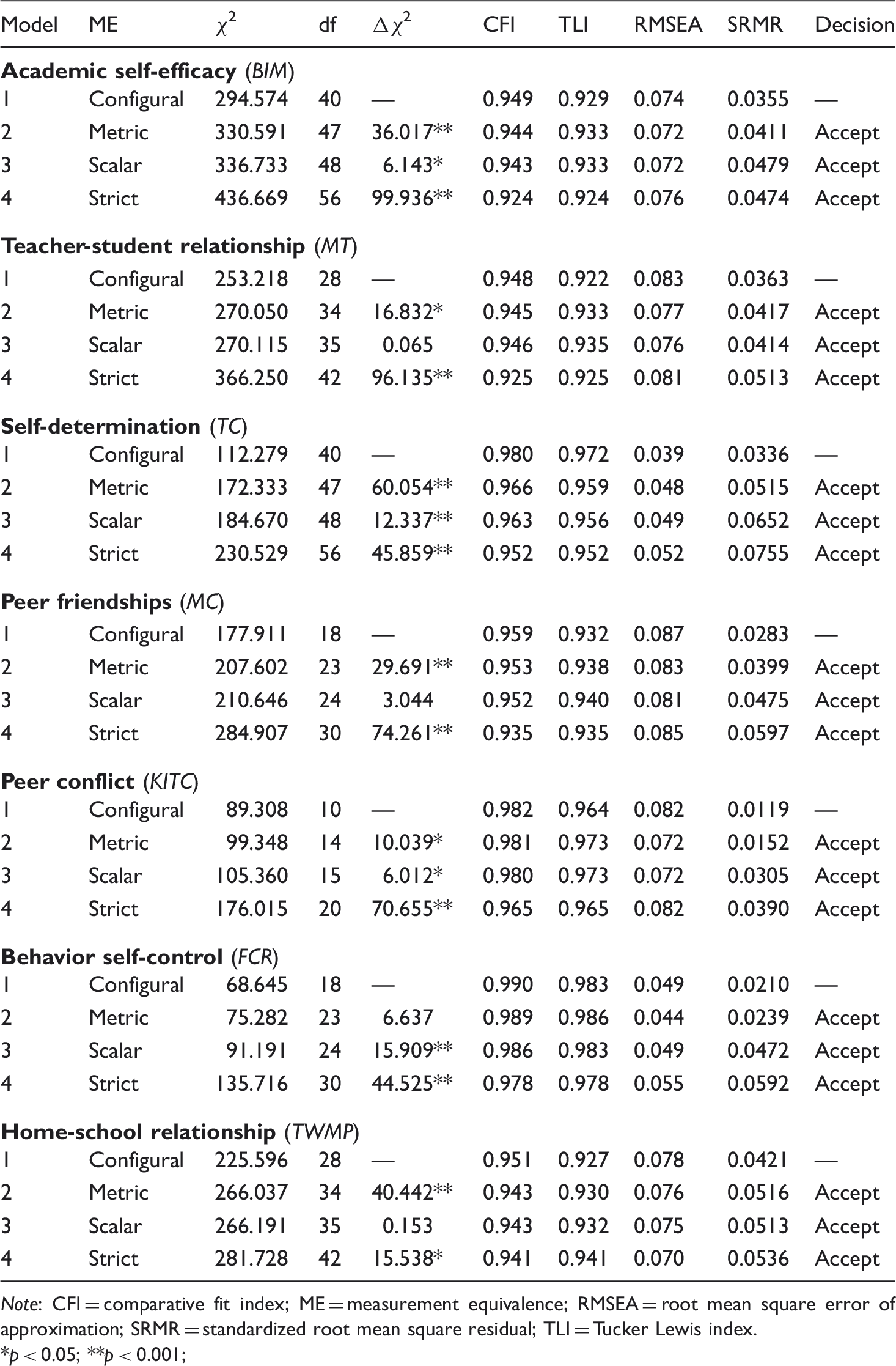
Note: CFI = comparative fit index; ME = measurement equivalence; RMSEA = root mean square error of approximation; SRMR = standardized root mean square residual; TLI = Tucker Lewis index.
p < 0.05; **p < 0.001;
Latent group mean comparison
Mean differences on the subscales between the US and Chinese samples.
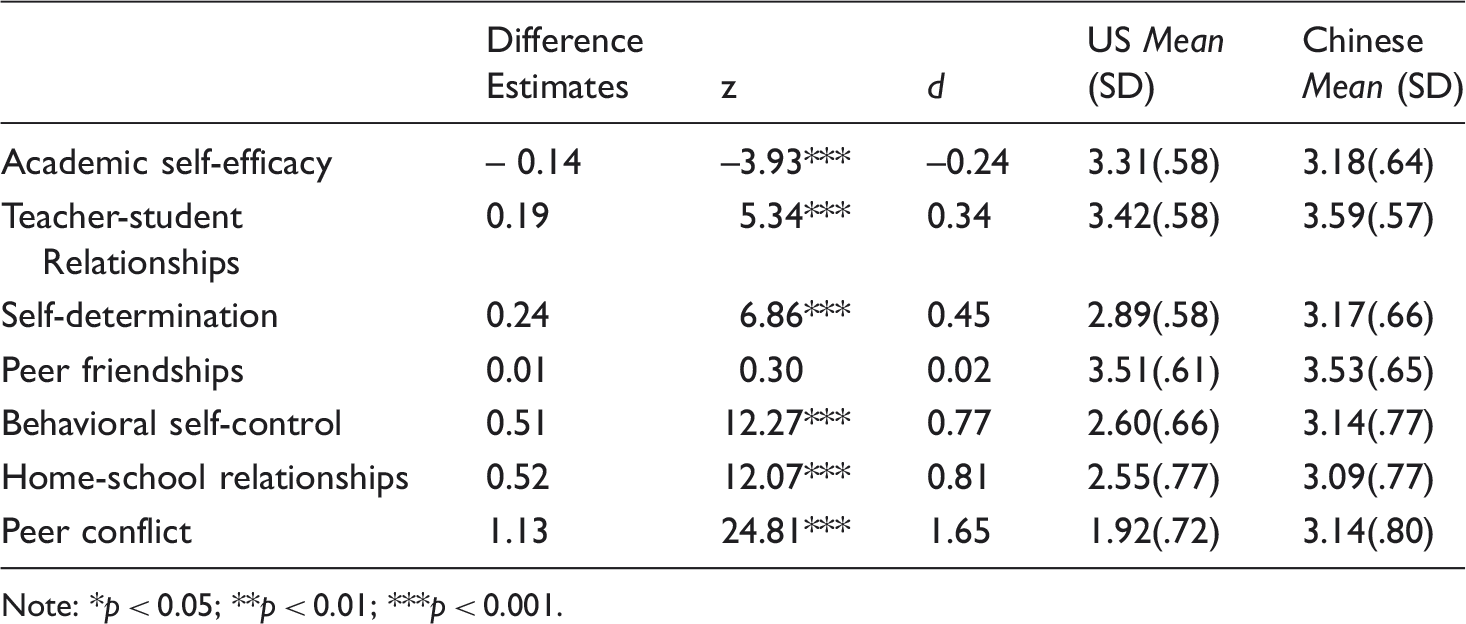
Note: *p < 0.05; **p < 0.01; ***p < 0.001.
Discussion
The present study examined: (a) whether the CMS has measurement equivalence between Chinese and American students, and (b) whether the students in China and the United States perceive the same level of resilience promoting factors in their classrooms. Findings from the current study indicate that the C-CMS has a similar factor structure, factor loadings, and intercepts of like items with the Chinese middle school students as the CMS with the American middle school students. This is consistent with previous research on resilience, which has found that resilience factors are similar across cultures (e.g., Theron et al., 2013; Ungar et al., 2007; Zhang et al., 2013). The current study added new data to the literature with seven specific resilience factors in classroom settings (e.g., self-determination, behavioral self-control, positive relationships with peers, teachers and parents, and between home and school) that are similar across the American and Chinese samples. However, it is important to note that this does not mean these factors work the same way across the two cultural contexts. The mechanism of how these factors function in each cultural context should be explored in future research. Overall, the current study supports the use of the C-CMS in Chinese urban middle schools.
The fact that the C-CMS can be used in Chinese urban middle schools has important practical implications. Using the C-CMS or its subscales as a screening tool can produce data on how strong these important resilience promoting factors are in the school as perceived by students. More importantly, as mentioned previously, the CMS also provides a data-driven problem-solving/consultation tool to guide prevention and intervention development in classrooms. One critical tool used in this consultation strategy is class meetings that involve students in analyzing their own classroom data facilitated by the homeroom teacher and/or the school psychologist (Doll, 2013). Fortunately, class meetings are common in Chinese elementary, middle, and high schools since 1949, typically held by the homeroom teacher once a week or as needed to address class issues (Li & Liang, 2015). Therefore, there are existing structures and resources in Chinese middle schools for utilizing class meetings for prevention and intervention based on the C-CMS data. This means the class-meeting strategy informed by the C-CMS data is applicable in Chinese middle schools. Being able to use the seven subscales independently further allows the administration of the C-CMS to be tailored to the needs of classroom settings where addressing all the seven factors is not feasible.
The current study also compared the group means across the US and Chinese samples on the subscales. A visual scanning of the numbers in the seven factors shows that, in both cultures, students gave the highest ratings on Teacher-Student Relationships and Peer Friendships, suggesting strong relationship resources for resilience promotion in the two participant schools. Statistically, Chinese middle school students scored significantly higher on five subscales (Teacher-student Relationships, Peer Conflict, Home-school Relationships, Self-determination, and Behavior Self-control) and significantly lower on Academic Self-efficacy than American students. There was no cross-cultural difference in Peer Friendships. These results are consistent with the findings of previous research. As discussed earlier, the strong emphasis on self-determination and self-control is consistent with Chinese cultural values in education and childhood socialization. Chinese students’ higher scores on self-control are also consistent with the collectivistic orientation that encourages conformity instead of expression of individual difference (Yang et al., 2013). The finding of Chinese students’ higher scores on self-determination may be related to the high value of education and over-emphasis on academic achievement that encourages academic goal determination (Chen, Chen, Li, & Wang, 2009). Unsurprisingly, Chinese middle school students scored higher on behavior self-control and self-determination than American students.
The findings of Chinese middle school students’ significantly higher score on teacher-student and home-school relationships indicate that there is a relatively strong relationship across teachers, students, and parents in the Chinese sample. One important fact to note is the difference in urbanity between the two samples. The American sample was half urban and half rural, from a Midwestern state while the Chinese sample was all urban from the capital city of Jiangsu Province. Research (Montgomery, 2010) about the challenges of rural schools in that particularly Midwestern state found that family support such as parental involvement and support at home for student learning was relatively low, likely due to more single parent homes and/or lower income. This might explain the comparatively American students’ lower scores in the home-school relationships found in the current study. For the Chinese students, the strong relationships in teacher-student and home-school relationships could enhance student school resilience in the face of stress, including high academic pressure. However, as noted in previous research, the over-emphasis on academics and parents’ over-involvement could also diminish the supportive roles of teacher- and parent-student relationships (Cheng, 1998; Liu, 2003). Therefore, future research may further examine how over-emphasis on academics and parents’ over-involvement affect teachers’ and parental supportive roles in resilience among Chinese middle school students.
The results on academic self-efficacy also concur with the findings from prior research, which suggests that Chinese students tend to have lower academic self-efficacy in comparison to students in Western countries (Hau & Ho, 2010). Although the results show that the CMS and its subscales have scalar measurement equivalence, due to this consistent finding on academic self-efficacy and its conflict with Chinese cultural value of modesty, we should be cautious when developing interventions on Chinese students’ academic self-efficacy. Further research is needed to examine the role of academic self-efficacy in resilience enhancement with Chinese students.
The current study found no difference in Peer Friendships between the two groups; however, Chinese students scored significantly higher on Peer Conflict than their American counterparts. It might suggest that Chinese students have a similar level of peer support but significantly higher level of perceived peer disruption, which is inconsistent with previous research findings that Chinese adolescents perceive better peer relationships than American students (Jia et al., 2009). One possible explanation might be that previous research examined only the overall peer relationships, while the current study specified peer friendships and peer conflict. The different findings on peer friendships and peer conflict suggest the importance of specificity in describing peer relationships. Currently, little research exists on Chinese adolescent peer conflict in school settings. Research about bullying in Chinese schools, however, indicates that peer conflict is an important factor that is associated with students’ subjective well-being and educational success (Cui, Cheng, Xu, Chen, & Wang, 2010), which may partially explain our finding.
There are several implications of the findings from the comparison of the CMS scores between the Chinese and American students for school-based psychological service providers in the international community. First, when promoting resilience in a school environment, psychologists/educators could gauge students’ perceptions regarding the important resilience promoting factors using a measure such as the CSM to inform prevention and intervention development priorities. For example, in the two participant middle schools in this study, teacher-student relationship and peer friendships can be considered as strengths of the schools. These relationships are crucial for a student to bounce back from adversities in the school environment. School psychologists/educators could build resilience promoting environment through nurturing teacher-student relationship, peer friendships, and home-school collaboration. Second, it is better to examine peer relationship in more specificity as students can have different perceptions of peer friendships and peer conflict, which would result in separate prevention and intervention practices. Third, for cultivating characteristics of resilience in individuals, nurturing self-determination and behavior self-control is likely to enhance resilience in students in both collectivistic culture like China and individualistic culture like the United States. Nurturing academic self-efficacy is likely to enhance resilience of students in an individualistic culture, but it is not as straight forward in a collectivistic culture such as China as in the US. Psychologists should consider the cultural value and practice of modesty (Li, 2002), as well as the social context of high parental expectations of academic performance (Hesketh et al., 2010) coupled with highly demanding school tasks and exams (Zhao, Selman, & Haste, 2015), when interpreting measures of self-efficacy or helping students develop self-efficacy in collectivistic cultures that share common values with Chinese culture such as the East Asian cultures. Lastly, when applying the knowledge generated from research to practice, psychologists and educators should keep in mind that, although there may be a set of similar resilience factors across cultures, how these factors work largely depends on the context and culture (Ungar, 2011).
Limitations and directions for future research
There are several limitations of the current study. First, the Chinese sample came from one urban middle school in Eastern China and only 7th and 8th graders participated in this study. The findings should not be generalized to students in other grades or with different demographics. Both samples lack student demographic information. We only know that about 28% of the companion American students were eligible for free or reduced lunch, and that roughly half of them were from urban areas and half from rural areas. Thus, it was difficult to compare the socio-economic status of the two samples precisely. Future studies should include more specific demographic information of the sample. Second, we did not collect outcome data to test concurrent validity of the ClassMaps Survey-Chinese Version (C-CMS) at the time of the study. Future studies can expand the generalizability of the current study by using a sample from other regions of China and rural schools and test concurrent validity of the C-CMS with outcome data, such as academic achievement, student engagement, and psychological stress. Third, the current study tested only the seven-factor model of the CMS, excluding the subscale of peer aggression. Future research should use all eight subscales of the CMS, including peer aggression, to replicate this study on a larger sample size. The scarcity of research on peer conflict among Chinese students calls for more studies in this area. Possible foci include cross-validation of the findings of the current study, investigation of effects of the high level of peer conflicts, and possible variables contributing to this phenomenon.
Conclusion
The current study examined the measurement equivalence of the ClassMaps Survey (CMS) and compared the latent group means across the Chinese and American samples. We found that the CMS has acceptable to good cross-cultural measurement equivalence and is a structurally valid measure of resilience factors in the Chinese middle school context. The study supports the use of either the full C-CMS or its seven subscales independently in Chinese urban middle schools that are similar to the participant school. Consistent with prior research, the study found that Chinese students had significantly higher scores of behavior self-control, self-determination, teacher-student relationships, home-school relationships, and peer friendships but significantly lower scores of academic self-efficacy than American students. Chinese students, however, perceived more peer conflicts than American students. The findings add new knowledge to our understanding of adolescent resilience in both cultures by 1) confirming that the Western culture-based seven factor of resilience measurement in school setting also appears to be applicable in the participant Chinese middle school and 2) revealing the similarities and differences of Chinese and American student perceptions of the seven resilience factors, both of which would provide guidance in prevention and intervention development for resilience enhancement in schools.
Footnotes
Declaration of Conflicting Interests
The author(s) declared no potential conflicts of interest with respect to the research, authorship, and/or publication of this article.
Funding
The author(s) received no financial support for the research, authorship, and/or publication of this article.
Note
We would like to thank Dr. Beth Doll for her longtime support to this study and the companion data used in the current study, Professor Shanqin Chen for his help with the data collection in China, and Margaret Beneville and Angela Cai for their assistance with manuscript preparation.
Author biographies
References
Supplementary Material
Please find the following supplemental material available below.
For Open Access articles published under a Creative Commons License, all supplemental material carries the same license as the article it is associated with.
For non-Open Access articles published, all supplemental material carries a non-exclusive license, and permission requests for re-use of supplemental material or any part of supplemental material shall be sent directly to the copyright owner as specified in the copyright notice associated with the article.
