




Abstract
The current study investigated the capacity of a new test assessing phonological awareness to detect differences between Italian children with and without developmental dyslexia. Specifically, the task involves blending of a list of pseudo-words, and excludes lexical knowledge as a source of task performance. Fifty-four third to fifith Italian graders were presented a battery of tests assessing phonological awareness, reading, writing, and verbal short-term memory abilities. A multivariate analysis of covariance, with age as a covariate, revealed that proficient readers outperformed students with developmental dyslexia in all cognitive measures considered, except verbal short-term memory. Moreover, high concordance was found between the new pseudo-word blending task, and well-known word blending, writing, and reading tests, respectively. In conclusion, the new phonological awareness task seems to be a useful tool for the detection of poor blending abilities of Italian children and thus it could be used to screen phonological awareness in primary schools. Implications for school psychology research and practice, including across linguistic contexts, are emphasized; for example, the new blending task could aid discrimination of proficient and dyslexic readers speaking other languages characterized by a transparent orthography, such as Greek, Spanish, Turkish.
Phonological awareness refers to a specific and conscious component of metalinguistic ability, that may be defined as the ability to reflect on and process the sounds (i.e. phoneme) of speech (e.g., Tunmer & Rohl, 1991; for a review see also Melby-Lervåg, Lyster, & Hulme, 2012). According to Goswami (2010) phonological awareness is ‘the child's ability to detect and manipulate the component sounds that comprise words, at different grain sizes’ (p. 23). Moreover, Anthony and Francis (2005) claimed that phonological awareness is a unified metalinguistic construct incorporating a variety of skills, such as segmenting, blending, and phoneme isolation of initial sounds.
Unlike speaking skills requiring automatic processes, metalinguistic skills develop during early and middle childhood; that is, children become increasingly able to perform metacognitive operations invoking control processes, such as deleting the initial, middle, or final sound contained in spoken words, matching words that rhyme like further ones, counting the number of phonemes contained in spoken words (Flavell, 1985). In this regard, Adams (1990) argues that the development of phonological awareness is articulated in at least three stages: Firstly, children learn to rhyme words or recognize rhymes. Then, they learn to separate phonemic units (e.g., isolating the initial sound of man, /m/, from the remainder, -an). Finally, at the most developed stage, children are able to segment a spoken word into its sounds and to manipulate and recombine those phonemic units in order to form different words (e.g., lago and gola). As pointed out by Goswami (2010), the visual form of words (i.e., orthography) is related to their spoken sounds (i.e., phonology) by reading process.
For more than three decades, one of the most interesting issues facing researchers is the nature of the relationship between the development of reading abilities and phonological awareness in children with typical and atypical development (i.e., students with developmental dyslexia). This interest prompted many researchers to compare performances of proficient readers and peers with developmental dyslexia in a wide range of tasks assessing reading and phonological skills.
Developmental dyslexia refers to a persistent neurodevelopmental condition associated with a phonological deficit, which in turn negatively impacts the processing of phonemes in words and therefore the ability to connect written letters with their corresponding sounds. Despite normal intelligence and the absence of socio-cultural disadvantage, the most direct consequences of dyslexia are phonological awareness deficits, spelling problems, reduced reading fluency and lower reading accuracy which, in turn, can be associated with word writing difficulties and problems with word recognition (Snowling, 2013; VandenBos & APA, 2015).
Several authors have conjectured that phonological awareness is necessary for learning to read. For instance, Goswami (2010, 2015) assumes that phonological awareness is a part of language acquisition that is naturally developed before the development of reading skills. In this regard, Ziegler and Goswami (2005) claim that during a reading task, phonological awareness is essential to allow phonological recoding, that is, the process of learning and carrying out phonological unit-orthographic symbols mappings to access spoken lexical information stored in long-term memory. In line with this, Hulme et al. (2015) stressed the causal role of preschool phoneme awareness and grapheme-phoneme knowledge in supporting the development of word-level literacy in 5–6 years old reading beginners. Furthermore, from the atypical developmental perspective, there is evidence that children who are poor readers at first grade tend to remain poor readers at the end of the fourth grade, acquiring word recognition skills only very slowly (e.g., Juel, 1988; see also Melby-Lervåg et al., 2012). Additional support for this view was provided by Ehri et al. (2001), according to which poor readers benefit from specific interventions based on the use of explicit instructions and gain experience empowering the recognition of letters and sound-letter mapping.
A different theoretical perspective assumes that the development of several phonological awareness skills is the direct consequence of reading achievement. For instance, Wagner and Torgesen (1987) postulate that segmentation skills and specifically phoneme-deletion ability are the direct consequence of learning to read.
Finally, according to a further approach, there is a mutual relationship between learning to read and the development of phonological awareness across a variety of languages (e.g., Perfetti, Beck, Bell & Hughes, 1987; Wagner, Torgesen, & Rashotte, 1994; Duncan et al., 2013). For instance, in a longitudinal study Perfetti et al. (1987) documented that first graders who were more fluent in reading also showed better performances in blending (i.e., using a series of spoken sounds to form a word), phoneme counting (i.e., the segmentation of a word into sounds and the successive representation of each phoneme with a tap or counter) and phoneme deletion (i.e., taking away a phoneme from a spoken word, in order to form another utterance). Consistent with this, Duncan et al (2013) observed mutual influence between the development of phonological awareness and reading skills acquisition in a sample of first graders across six European alphabetic orthographies (Greek, English, French, Portuguese, Icelandic, and Spanish). Accordingly, it has been speculated that a universal developmental trajectory can be traced across different written languages: Children initially acquire the awareness of the large grains composing the words (i.e., syllables and rhymes) and, later on when they acquire the awareness about smaller grains (i.e., phonemes and individual letters sounds), reading becomes more fluent and accurate (e.g., Anthony & Frencis, 2005; Goswami, 2010, 2015). Moreover, it has been documented that specific interventions promoting phonological awareness in beginning readers also promote the development of reading achievements, which, in turn, has beneficial effects on the development of the metalinguistic ability to manipulate phonemes (e.g., Hogan, Catts, & Little, 2005). Concerning this, Ehri et al. (2001) found that the efficacy of interventions based on the use of instructions supporting phonological awareness in children with poor reading skills is more evident in English native speakers than in Italian and Spanish ones. This was attributed to the complex (i.e., opaque) orthographic structure of English, that is, its sound-written symbol mapping is less regular than in languages like Italian and Spanish. Indeed, in English the same sound can be represented by different combinations of letters or a single letter, whereas in a language like Italian, — that is based on a transparent orthographic system characterized by an almost one-to-one mapping between sounds and letters — there is a greater grapheme-phoneme correspondence (e.g., Conrad & Jacobs, 2004). Therefore, Ehri et al. (2001) concluded that considering the nature of the graphophonemic system, explicit instructions about phonological awareness contribute more to the development of reading skills in English, because children need to be more supported for figuring out the English phonemic characteristics and their graphemic equivalence. Consistent with these findings, it has been documented that children who speak Greek, Turkish, and Italian develop syllable awareness faster than French or English native speakers. It has been speculated that this difference can be because Greek, Turkish, and Italian are transparent-orthography languages being also characterized by simple syllable structure (i.e., occurrence of few consonant clusters, that is, groups or sequences of consonants appearing together in a single syllable without any intervening vowel, such as
In short, it can be concluded that, as reported in the meta-analytic review by Melby-Lervåg et al. (2012), the relationship between the development of phonological awareness and reading skills is well-established across many languages (i.e., based on opaque and transparent orthographic systems) and that phonemic awareness (e.g., phoneme segmentation, phoneme blending, phoneme deletion) is the most crucial predictor of children's word reading skills, when the effect of verbal short-term memory and rime awareness are controlled for.
Relative to the Italian context, which is the focus of this paper, syllable awareness is already present in pre-readers 4- to 5-years-old, that is, prior to the development of literacy, and is perfected during the second and third grades (i.e., at the age of 7- to 8-years-old). Moreover, phoneme awareness, which is influenced by the transparency (i.e., spelling-sound correspondences) of orthographies and the syllable structure of the languages, is more developed in Italian pre-schoolers 5-years-olds than in 4-years-olds (Cossu, Shankweiler, Liberman, Katz, & Tola, 1988). Finally, Italian first graders achieve accurate levels of almost one-to-one grapheme-phoneme recoding several months after they start learning to read (Cossu, Gugliotta, & Marshall, 1995). The high accuracy (i.e., more than 90 percent) of grapheme-phoneme recoding strategies of the novice Italian readers has been documented both for familiar words than for non-words (Seymour, Aro, & Erskine, 2003). Moreover, there is also evidence that Italians read words better than pseudo-words (i.e., lexicality effect). In short, this suggests that a few months after the development of early literacy, Italian first graders use both lexical knowledge about familiar words and decoding strategies (e.g., Pagliuca, Arduino, Barca, & Burani, 2008). Later on, proficient readers rely on more efficient lexical strategies; therefore, a word recognition system develops and reading becomes faster and more accurate (e.g., Zoccolotti et al., 2009).
Conversely, for what concerns the atypical reading development, Barbiero et al. (2012) documented that in Italy the prevalence of dyslexia is uncertain and underestimated. Indeed, despite the current availability of univocal diagnostic criteria, according to the authors this reading disorder is not recognized in approximately two out of three third to fifth Italian graders (i.e., children 8- to 10-years-old).
Unlike English, in Italian, a language characterized by grapheme-phoneme regularity, dyslexia is mainly determined by reduced reading speed, whereas accuracy seems to be less crucial (e.g., Paulesu et al., 2001). Indeed, thanks to compensatory mechanisms and the application of grapheme-to-phoneme conversion rules, dyslexic Italian children and adults tend to make less mistakes but are slower in decoding written texts (e.g., Spinelli et al., 2005; Zoccolotti et al., 2005).
Further studies conducted with Italian children (i.e., 6- to 11-years-old; Di Filippo et al., 2005) and young adults (i.e., 19- to 27-years-old; Cancer & Antonietti, 2018) with dyslexia suggest that phonological awareness and serial rapid automatized naming (RAN) deficits are the strongest factors accounting for reading performance ─ an effect being found across many languages (for a review see Norton & Wolf, 2012) ─ since they ‘predict different portions of variance in reading tasks’ (Di Filippo et al., 2005, p. 350). Overall, in RAN tasks phonological skills are engaged automatically (i.e., implicit phonological processing, see Melby-Lervåg et al., 2012), since participants access phonological codes without any awareness, in order to name (i.e., retrieve from a lexical knowledge system) rapidly sequences of visually presented stimuli (e.g., objects, colors). According to Georgiou et al. (2013), RAN and reading performances are related because serial processing and active name production is required by both the tasks. Relative to the Italian language, RAN deficits are reported by dyslexics with and without a history of language development delay, whereas phonological deficits are exhibited mainly by Italian dyslexic children with previous language delay (Brizzolara et al., 2006). Overall, Italian children with developmental dyslexia present an evident word length effect both for familiar words and pseudo-words, as well as a tendency to read high-frequency words faster and more accurately than low-frequency ones (De Luca, Borrelli, Judica, Spinelli, & Zoccolotti, 2002; Zoccolotti et al., 2005; Paizi, Zoccolotti, Burani, 2010). Embracing the dual-route cascaded model by Coltheart, Rastle, Perry, Langdon, and Ziegler (2001), Paizi et al. (2010) report that the lexicality effect, both in Italian proficient readers and children with dyslexia, indicates that both groups are more likely to use the lexical route (i.e., word pronunciation is driven by direct access to lexical storage of known words) than the non-lexical one (i.e., non-word and low-frequency words pronunciation is driven by the grapheme-phoneme conversion rules) in reading aloud. This effect is more marked when Italian expert readers and those with dyslexia are asked to read aloud high-frequency words. Nonetheless, when both skilled and poor readers are presented lists composed of words and pseudo-words, both groups mainly use non-lexical processing (i.e., grapheme-phoneme correspondences). Overall, Paizi et al. (2010) state that compared to typically developing readers, Italians with developmental dyslexia are slow and less accurate than proficient readers, especially when they are presented with low-frequency long words. More recently, Zoccolotti et al. (2013) stressed that impaired reading in Italian dyslexics reflects not only a problem in developing efficient lexical strategies for processing the whole words, but also a deficit in the simultaneous processing of single words presented as multiple arrays, especially when the targets to decode are long (i.e., 7-letter words). In summary, at least three different conclusions are suggested by the existing studies involving Italian native speakers: 1) unlike proficient young readers who present only a word frequency effect, children with developmental dyslexia show both word length and word frequency effects; 2) low-frequency words containing context-dependent ambiguous letters (i.e., in Italian c and g) are more likely to be read aloud by the non-lexical route by both proficient readers and those with developmental dyslexia; 3) the impairment of lexical access in dyslexic readers is consistent with a deficit in serial information processing required in the RAN serial tasks (for a review, see Norton & Wolf, 2012; Paizi et al., 2010).
From an educational viewpoint, it has to be highlighted that early detection of children with developmental dyslexia and poor phonological awareness is crucial (see Hulme, Nash, Gooch, Lervåg, & Snowling, 2015; Snowling, 2013). This ensures both the implementation of specific psychoeducational programs to remediate deficient reading/phonological awareness processes and ensure adequate scholastic achievement. In view of this, the development of tools to screen the development of reading skills in schools, in particular those detecting atypical trends of development in children, is essential. Highlighting this, Barbiero et al. (2012) and Snowling (2000; 2013) estimate that reading difficulties negatively impact the educational potential of approximately 3 to 10 percent (i.e., range depends on the adopted diagnostic criteria and tests) of the school-aged population across languages, and prevents the attainment of high educational results.
The available literature shows that a variety of demanding tasks have been developed to assess phonological awareness in childhood, such as segmentation, blending, phoneme counting, phoneme reversal (for a review, see Anthony & Francis, 2005). However, for the aims of the current study, attention will be focused on the assessment of blending skills in Italian primary school.
So far, the tasks used in clinical settings for the assessment of phonological awareness in the Italian context are mainly based on the manipulation of phonemic units contained in Italian words. Clinical practice suggests that when stimuli to be blended or segmented are words, Italians often guess the answer, storing only the order of presentation of the first phonemes and use lexical knowledge to carry out the task (e.g., ‘t-e-l-e’… ‘televisione’). Instead, for the aim of the current investigation, the phonological awareness of Italian children, with and without a diagnosis of dyslexia, was tested using a new test in which lexical knowledge is irrelevant. This approach ensured that awareness about the phonological constituents of pseudo-words, with similar sounding structure to Italian words, was assessed.
The main goal of this investigation was to provide evidence of the validity of a new phonological awareness task developed for Italian children attending the third to fifth grades of primary school. Specifically, the main goal of the current study was to demonstrate the discriminative validity of a new task assessing synthesis (blending) skills in typically developing and dyslexic children, by the presentation of spoken pseudo-words. Indeed, the new task requires blending of phonemic sequences in order to utter pseudo-words sounding as Italian words. It was hypothesized that proficient young Italian readers attending the third-fifth grades would outperform children with developmental dyslexia matched for age and gender in the new phonological awareness task and in further measures of blending, segmentation, writing, and reading tasks. To our knowledge, this is the first study presenting a task assessing phonological awareness of Italian children, using nonsense word stimuli.
Method
Participants
Fifty-four children, aged 8- to 10-years-old (mean age = 9.6 years, SD = 9.6 months) attending Italian primary schools voluntarily took part in the study. Participants were recruited using direct appeals to several schools located in Sardinia, an Italian isle in the Mediterranean Sea. To participate in the study, the parents of each child had to sign the informed consent for a screening project about the efficiency of verbal abilities that was promoted in several Sardinian villages.
The final sample consisted of 27 dyslexic children who were age-and-gender matched with 27 young skilled readers attending the same primary schools. Gender was counterbalanced between the groups (χ2 = 0, df = 1, p = 1). Moreover, no age differences were found between the groups of typically developing and dyslexic children (t(52) = −0.04, p = 0.99).
Based on the current Italian law concerning the diagnosis of specific learning disabilities (Italian Law n° 170, 8 October 2010), in order to be selected, dyslexic children had to be diagnosed and then certified for dyslexia at a local centre for the assessment of specific learning disabilities by using a wide battery of tests validated in Italian. Furthermore, typically developing children had to show no signs of dyslexia during the screening activities, that is, their performances had to be within the normal range according to the Italian normative data relative to each test. In line with the current Italian law and the Consensus Conference defining the guidelines for the diagnosis and treatment of specific learning disabilities (Istituto Superiore di Sanità, 2011), our participants were recruited from the age of 8-years-old, because in Italy the diagnosis of dyslexia cannot be conducted before the end of the second grade. Moreover, as suggested by Barbiero et al. (2012), the 8- to 10-years-old age range was employed because in this developmental phase most temporary learning delays are spontaneously overcome and because the selection of a restricted age range allowed us to limit the number developmental factors that had to be controlled for.
Socio-demographic characteristics of the sample.
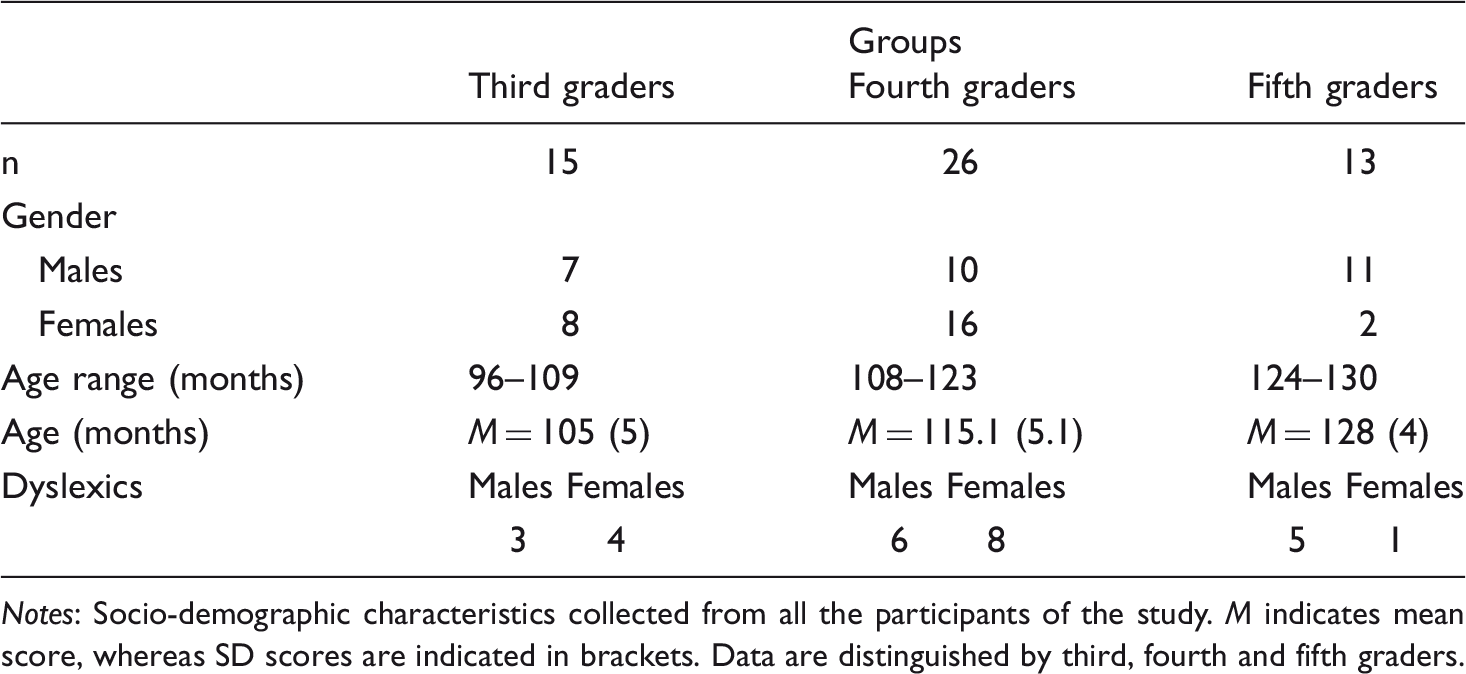
Notes: Socio-demographic characteristics collected from all the participants of the study. M indicates mean score, whereas SD scores are indicated in brackets. Data are distinguished by third, fourth and fifth graders.
Materials and procedure
Each participant was presented the following tests:
1) The Verbal Meaning test is part of the Primary Mental Abilities battery (Thurstone & Thurstone, 1962), and therefore a measure of verbal intelligence. This test was presented to exclude possible cases of border-line general intellectual efficiency or mild intellectual disability. The test is composed of two tasks — each consisting of 30 items — assessing semantic knowledge. In one condition, participants are asked to match each target word with a synonym, whereas in the second task matching between each target word and a figure is required. In both conditions, the child selects from four possible alternatives. The internal consistency of this Primary Mental Abilities test, as measured by Spearman and Brown's procedure, is reported to be 0.93 (Thurstone & Thurstone, 1962). 2) The MT Reading test (Cornoldi & Colpo, 1998) is a standard Italian narrative passage reading test. The child is presented with a reading task text which he/she must read aloud within four minutes. Two parameters are calculated; accuracy is assessed in terms of the total number of errors made, whereas the speed is calculated in terms of number of syllables read per second. Reading skills are considered inefficient if either speed or accuracy is two or more standard deviations below the normative mean levels. The internal consistency of this reading test is expressed by a test-retest coefficient of r = 0.97 for speed and r = 0.86 for accuracy (Cornoldi & Colpo, 1998). 3) The Word Reading test is a widely used, standardized task that assesses the capacity to read aloud 112 disyllabic and trisyllabic single Italian words, as quickly and accurately as possible. The test is contained in the DDE-2 battery (Sartori, Job, & Tressoldi, 2007) and includes four lists of common nouns, among which the level of imageability (i.e., high versus low) and frequency of occurrence (i.e., high versus low) in the Italian language are counterbalanced. In order to decode the stimuli, the child could be driven by his/her lexical knowledge. Reading skills are assessed in terms of accuracy (i.e., number of stimuli incorrectly read aloud) and speed (i.e., total time expressed in seconds used to read aloud the set of stimuli). The normative data provided by the authors include the general test–retest reliability indexes for accuracy and speed in reading respectively. That is, the indexes have been computed combining the results relative to the performance in word and pseudo-word reading tasks. Overall, Sartori et al. (2007) report that the general test–retest reliability coefficients are 0.77 for speed and 0.56 for accuracy in reading. 4) The Pseudo-word Reading test is part of the DDE-2 battery (Sartori et al., 2007), and assesses the capacity to utter 48 non-words divided into three lists, as quickly and accurately as possible. In order to carry out this task, the child cannot use lexical knowledge, since the stimuli do not exist in the Italian vocabulary, despite sounding like Italian words. Reading ability is assessed in terms of accuracy and speed, just as for the Words Reading test (Sartori et al., 2007). The test–retest reliability is expressed by a Pearson's r of 0.77 for speed and 0.56 for accuracy (Sartori et al., 2007). 5) The Writing Sentences task is also a component of the DDE-2 battery (Sartori et al., 2007) which, in this case assesses the writing ability. Children are presented with 12 sentences containing homophonic but not homographic Italian words (e.g., luna vs. l'una), and asked to write them one after the other. Performance is assessed in terms of the number of target words spelt incorrectly. The maximum total score is 18. The internal consistency of this tool was assessed in terms of test–retest reliability, which is expressed by a Pearson's r ranging from 0.19 (i.e., for second graders) and 0.68 (i.e., for sixth graders) (Sartori et al., 2007). 6) The Non-word repetition task (Bisiacchi, Cendron, Gugliotta, Tressoldi, & Vio, 2005) is a verbal short-term memory test requiring the immediate retrieval of 15 di-syllabic and tri-syllabic pseudo-words orally presented by the examiner and sounding like actual Italian words. The child's score is calculated as the number of items correctly repeated and, therefore, the maximum total score is 15. The reliability of this task was assessed in terms of test–retest reliability, which is expressed by a Pearson's r of 0.23 (Bisiacchi et al., 2005). 7) The Word Blending test (Marotta, Ronchetti, Trasciani, & Vicari, 2004) is a phonological awareness task requiring blending of a series of sounds, orally presented, to speak a word. The test includes 15 di-syllabic and tri-syllabic Italian words. One point is given for each item correctly spoken, thus, the maximum total score is 15. This test is reliable, as documented by Spearman's rho of 0.97. 8) The Non-Word Blending test, the new task under assessment for discriminant validity, assesses the capacity to blend sequences of sounds, orally presented in sequence, to form pseudo-words. The test has been originally developed by Cardis and Fastame and then tested on a sample of 503 pupils by Fastame et al. (2014). The task is composed of 16 invented items (i.e., disyllabic, trisyllabic and quadrisyllabic stimuli) sounding like Italian words, each containing four to eight phonemes. Each child was presented a series of individual phonemes (approximately one phonemic unit per second) and asked to speak the corresponding pseudo-word (e.g., ‘What word is this ‘d-u-r-t-a’?’). In order to avoid any facilitation effect related to lip reading, the examiner used an auditory registration of the stimuli. In the current study two different scores were computed: 1) the total number of pseudo-words correctly blended, assigning 1 score for each correct answer and 0 for each uncorrected response (maximum total score = 16); 2) the total number of phonemic units correctly blended (as suggested by Fastame et al., 2014). In this case, 1 point was given for each phonemic unit correctly blended with another one (e.g., if correctly uttered, ‘durta’ includes four blended phonemic units, that is, ‘du’, ‘ur’, ‘rt’ and ‘ta’) and 0 for each incorrectly response. If a child responded with letter names instead of uttering the corresponding pseudo-word, the response was scored as incorrect. The procedure required participants to complete all items. The maximum total score for this measure is 72. Fastame et al. (2014) reported that the test is reliable, as indicated by Cronbach's alpha 0.83 and an adjusted half-test reliability of 0.84 using the Spearman-Brown formula. Furthermore, the test–retest reliability, controlling for age, is good (r = 0.81). In the current sample the internal consistency was expressed by a Cronbach's alpha of 0.85 relative to the number of pseudo-words correctly blended, and α = 0.95 relatively to the total number of phonemic units correctly blended.
Apart from the Verbal Meaning and Sentence Writing tests, which were collectively presented, remaining tools were administered individually during two separate sessions. The presentation order of the individual tasks was counterbalanced according to the Latin Square procedure. Overall, the assessment sessions lasted approximately 90 minutes.
Results
A Multivariate Analysis of Covariance (MANCOVA) was performed to investigate group (i.e., proficient young readers versus children with dyslexia) differences in reading, writing, short-term memory and phonological awareness tasks, controlling for the effect of age.
The Multivariate tests highlighted a significant main effect of age [F (11,41) = 2.33, p = 0.02, Pillai's trace = 0.38] and group [F (11,41) = 3.77, p = 0.001, Pillai's trace = 0.50] on the combined dependent measures.
There was the main effect of age in the Writing Sentences [F(1,51) = 4.5, p = 0.04,
As expected, proficient readers outperformed children with developmental dyslexia in each of the abovementioned measures.
Mean scores of the participants in the tests administered.
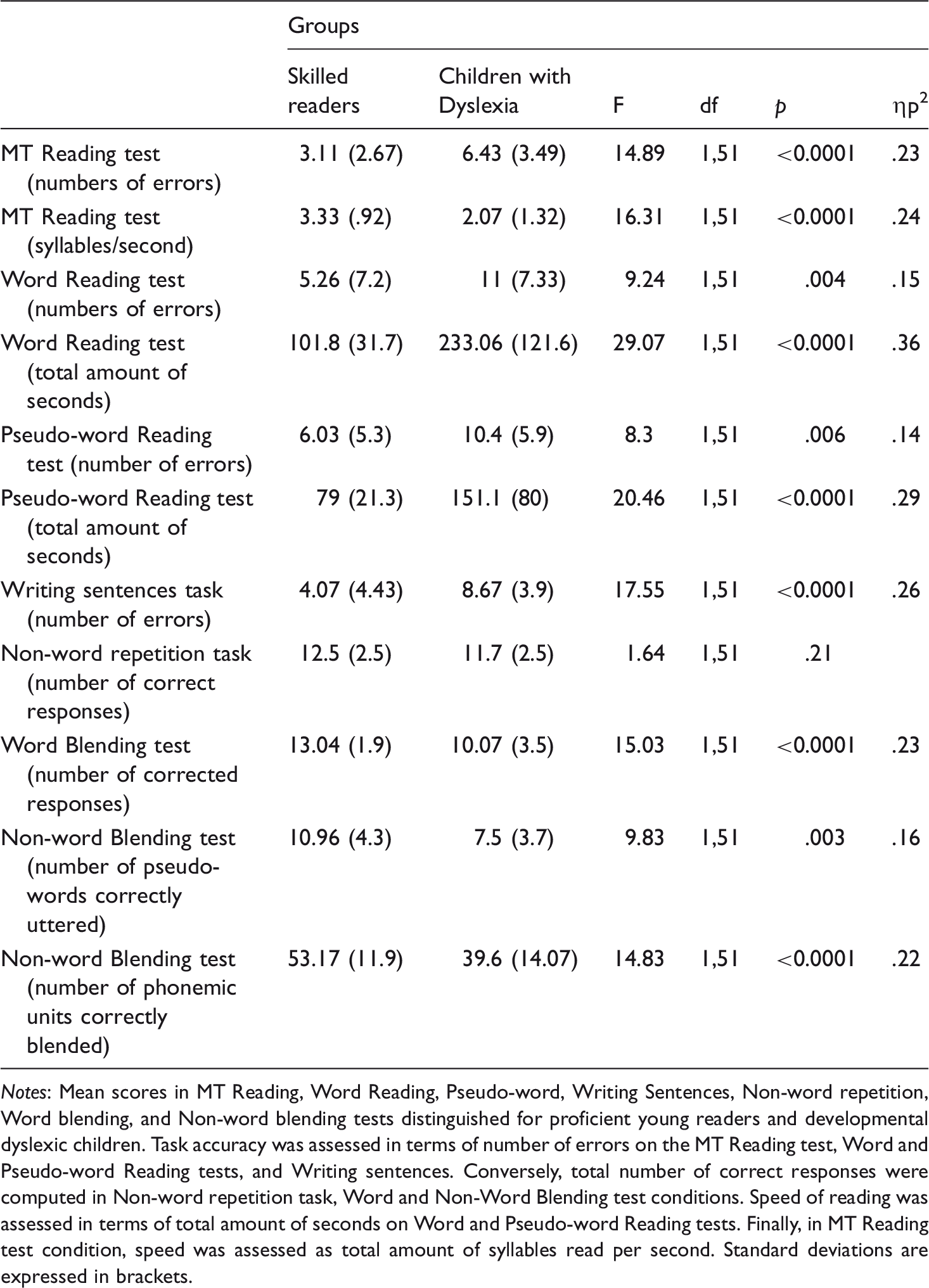
Notes: Mean scores in MT Reading, Word Reading, Pseudo-word, Writing Sentences, Non-word repetition, Word blending, and Non-word blending tests distinguished for proficient young readers and developmental dyslexic children. Task accuracy was assessed in terms of number of errors on the MT Reading test, Word and Pseudo-word Reading tests, and Writing sentences. Conversely, total number of correct responses were computed in Non-word repetition task, Word and Non-Word Blending test conditions. Speed of reading was assessed in terms of total amount of seconds on Word and Pseudo-word Reading tests. Finally, in MT Reading test condition, speed was assessed as total amount of syllables read per second. Standard deviations are expressed in brackets.
Finally, a series of high product-moment Pearson correlations were computed to test the relationship between the new Pseudo-word Blending Test measures and the Word Blending, the Non-word repetition, the Writing Sentences, the Word and pseudo-word Reading, the MT Reading and Verbal Meaning tests, respectively. Significant correlations were found between the Pseudo-word Blending and Word Blending (for the pseudo-words correctly uttered: r = 0.66, p < 0 .0001; for the phonemic units correctly blended: r = 0.68, p < 0.0001), Writing Sentences (for the pseudo-words correctly uttered: r = −0.42, p = 0.002; for the phonemic units correctly blended: r = −0.45, p = 0.001), accuracy (for the pseudo-words correctly uttered: r = −0.40, p = 0.003; for the phonemic units correctly blended: r = −0.41, p = 0.002) and speed (for the pseudo-words correctly uttered: r = −0.44, p = 0.001; for the phonemic units correctly blended: r = −0.49, p < 0.0001) in Word Reading condition. Similarly, statistically significant relationships were found between performance in the new Pseudo-word Blending task and accuracy (for the pseudo-words correctly uttered: r = −0.30, p = 0.03; for the phonemic units correctly blended: r = −0.28, p = 0.04) and speed (for the pseudo-words correctly uttered: r = −0.32, p = 0.02; for the phonemic units correctly blended: r = −0.37, p = 0.005) in the Pseudo-word Reading condition, respectively. The same pattern of results was found when Pearson coefficients were computed between the new Pseudo-word Blending task measures and accuracy (for the pseudo-words correctly uttered: r = −0.34, p = 0.01; for the phonemic units correctly blended: r = −0.37, p = 0.005) and speed (for the pseudo-words correctly uttered: r = 0.52, p < 0.0001; for the phonemic units correctly blended: r = 0.54, p < 0 .0001) in the MT Reading condition. Finally, no statistically significant relationships were found between the new Pseudo-word Blending and the Non-word repetition measures (for the pseudo-words correctly uttered: r = 0.05, p = 0.70; for the phonemic units correctly blended: r = 0.07, p = 0.63).
Discussion
Phonological awareness has been defined as the ability to manipulate the component sounds of language independently of its meaning (Goswami, 2010). This is a basic but fundamental skill underlying successful academic achievement, that, in turn, can become a vulnerability for dyslexic students.
The main goal of the current study was to explore whether a new tool developed to assess phonological awareness skills could discriminate between the performances of 8- to 10-years-old children with and without dyslexia similarly to a battery of well-known tasks widely used in the Italian context for the diagnosis of reading disorder (for a review see the Consensus Conference edited by Istituto Superiore di Sanità, 2011), such as the Word Blending test (Marotta et al., 2004), the Non-word repetition and Word repetition subtests of the DDE-2 battery (Sartori et al., 2007). For the aims of the current investigation, the assessment of phonological awareness was focused on the analysis of the efficiency of blending skills, because considering the age of the sample (i.e., 8- to 10-years-old), it was assumed that in this developmental phase those processes would have already been developed (e.g., Adams, 1990; Melby-Lervåg et al., 2012). In this regard, the originality of the current study was to explore the validity of a new test discriminating proficient readers and children with developmental dyslexia in terms of blending capacity for pseudo-words structured as the Italian words. The difficulty of this new phonological awareness task is to be noted, since readers could not employ lexical knowledge to carry out the task, and the children could only use grapheme–phoneme correspondences. Therefore, despite that empirical evidence suggesting that the development of reading skills in the Italian context is usually driven by lexical knowledge (Zoccolotti et al., 2005; Paizi et al., 2010), we hypothesized that the new Non-word Blending test had to be sensitive in detecting differences between the typically and atypically developing groups.
As expected, typical developing children outperformed the group with dyslexia in all the measures of writing, reading, and phonological awareness, excepted for the verbal short term memory task (i.e., Non-word Repetition test, Bisiacchi et al., 2005). Current outcomes suggest at least four conclusions. First, the new tool discriminated proficient young readers and children with developmental dyslexia in terms of a specific metalinguistic aspect: The ability to manipulate abstract phonemic units to blend the sounds without supporting lexical knowledge. Second, we replicated the outcomes pointed out by Fastame et al. (2014) in a sample of five hundred typically developing children attending primary school. That is, robust and significant medium-to-large (Cohen, 1988) correlation indexes were found between the new Pseudo-words Blending Test measures and the Word Blending (Marotta et al., 2004), writing (Sartori et al., 2007), narrative passage decoding (Cornoldi & Colpo, 1998), word (Sartori et al., 2007) and pseudo-word reading skills (Sartori et al., 2007), respectively. Overall, these outcomes confirm the concurrent validity of the new tool for the assessment of the phonological awareness in Italian children with and without dyslexia. Third, the differences between typically developing children and dyslexic peers emerging by the administration of the new Pseudo-word Blending test replicated the pattern of results concerning the assessment of reading, writing, and phonological awareness skills by the administration of a battery of tests widely used in the Italian educational and clinical context, such as the aforementioned writing, word and pseudo-word reading tests developed by Sartori et al. (2007), the Word Blending task developed by Marotta et al. (2004), the MT Reading test by Cornoldi and Colpo (1998).
Thus, in our opinion, the new test is a valid tool that could be used to screen phonological awareness skills in primary school, because it allows investigation of a specific aspect of blending skills, that is not related to the lexical knowledge. Indeed, to our knowledge, the tests administered in the Italian context usually require the blending of words, such as that proposed by Marotta et al. (2004). Therefore, considering its discriminant properties, the new task seems to be a useful tool that can be easily administered to detect differences in blending skills among 8- to 10-years-old children with and without dyslexia. This is crucial, because as pointed out by Barbiero et al. (2012), in the Italian context, dyslexia and its cognitive correlates, are underestimated in two out of three children aged 8- to 10-years-old.
However, one obvious limit of this preliminary study is the paucity of the sample. Indeed, although the socio-demographic characteristics (i.e., age, sex, area of origin) of the proficient readers were matched with those of the participants with dyslexia, the groups were small. Therefore, one has to be cautious in generalizing these results and further research is necessary.
Moreover, the participants were recruited in the third to fifth grades of primary schools, therefore no information can be provided about the validity of the new test for the assessment of phonological awareness of older dyslexic readers. Similarly, no information has been provided about the predictive validity of the new blending task in detecting children that will be diagnosed with phonological deficits and dyslexia. This suggests that future research should replicate the current study, and test the discriminative and predictive validity of the Non-word Blending Test in wider samples of differently aged skilled readers and those with developmental dyslexia.
If future studies confirm the predictive properties of the new tool in detecting future dyslexic readers, this evidence could extend that by Bigozzi et al. (2016), according to which several aspects of phonological awareness (e.g., rhyme detection, phonemic segmentation) in combination with conceptual knowledge of writing system contribute in predicting dyslexia in Italian readers.
Moreover, future research should investigate the capacity of the new blending task in discriminating proficient and dyslexic readers speaking other languages characterized by a transparent orthography (e.g., Spanish). If the current outcomes can be extended to different linguistic contexts, the new Non-word Blending task could be proposed as cross-cultural tool for the early detection of poor blending skills in children attending third to fifth grades that would allow cross-linguistic comparisons about the efficiency of blending skills.
Moreover, from an applied perspective, the use of the new Non-word Blending task in the future could facilitate identification of children needing a specific phonological awareness intervention and the following allocation of resources to promote the development of that metalinguistic skill at school. This is very pertinent, since the promotion of successful achievement of atypically developing children is increasingly recognized as a fundamental goal of schools across different languages (e.g., Snowling, 2000, 2013).
Moreover, if phonological awareness is at the core of developmental dyslexia across a variety of opaque and transparent writing systems, as some studies suggest (e.g., Boets et al., 2010; Ziegler & Goswami, 2005), the applicability of a new cross-cultural blending test with predictive properties could help resolve the lack of consensus about the criteria for the diagnosis of reading disorder across different linguistic contexts.
In conclusion, assuming an educational perspective, if future research provides further confirmation of the validity of the Non-word Blending Test, this new task could be employed for the early screening of an important dimension of phonological awareness in children attending 3rd-5th grades.
Footnotes
Declaration of Conflicting Interests
The author(s) declared no potential conflicts of interest with respect to the research, authorship, and/or publication of this article.
Funding
The author(s) received no financial support for the research, authorship, and/or publication of this article.