



Abstract
Although school climate has been identified as a protective factor for youth development in the United States, few longitudinal studies have examined the relationship between school climate and student outcomes in China. This study explored the relationship between school climate, victimization, covitality, internalizing symptoms, and academic achievement, and whether school climate moderated the relationship between victimization and mental health outcomes using longitudinal data. Survey data were collected from 1150 Chinese 3rd to 6th grade students (Mage = 10.27 years, SD = 1.03 years, 55% boys) from five elementary schools at two time points. Regression results showed that school climate factors, including student-teacher relationships, clear expectations, respect for diversity and fairness of rules, predicted victimization, mental health (both internalizing symptoms and covitality), and academic grades six months later. School climate did not moderate the relationship between victimization and mental health. Our results suggest that it is important to foster positive school climate in order to prevent bullying and promote positive youth development among elementary students in China.
School climate ‘reflects the norms, goals, values, interpersonal relationships, teaching and learning practices, and organizational structures at a school’ (National School Climate Council, 2007, para. 3) and provides a context for students to be engaged in their learning. A positive school climate allows students to feel safe, respected, cared for, and fosters positive youth development. Positive school climate is a protective factor against the most common form of school violence, bullying (Wang, Berry, & Swearer, 2013). However, the role of school climate on bullying victimization and mental health outcomes in Eastern countries, such as China, is less understood. Bullying is a growing concern in Chinese schools, with about 22% to 26% of students reporting being bullied, a rate similar to American students (Cheng et al., 2010; Xie, Xie, Yang, Bear, & Ling, 2016). However, most Chinese studies have thus far focused on middle and high school students, and few examined bullying among elementary school students where victimization is believed to be more prevalent (Han, Zhang, & Zhang, 2017). This longitudinal study fills in this gap by examining the relationship between school climate, victimization, both positive (i.e., covitality) and negative mental health outcomes (i.e., internalizing symptoms), and academic achievement among elementary school students in China. This study also explores whether school climate moderates the relationship between victimization and mental health outcomes.
Theories on school climate, victimization, and youth outcomes
Several theories explain the relationship between school climate, victimization, and student mental health and academic outcomes. Social control theory suggests that youth are more likely to engage in delinquent behavior such as bullying when ‘an individual’s bond to society is weak or broken’ (Hirschi, 1969, p. 16). Perceived positive school climate is an indicator of student’s bond to school and society. On the other hand, negative school climate suggests that youth have weakened bonds with schools and teachers, which contributes to higher rates of victimization at school (Wang et al., 2013). In addition, Bronfenbrenner’s ecological systems theory (1977) posits that individual (e.g., victimization) and contextual factors (e.g., school climate) mutually influence each other to predict youth mental health outcomes (e.g., internalizing symptoms). Positive school climate is as an indicator of the broader supportive environment at school, such as caring teachers and supportive peers, which contributes to positive mental health outcomes for students. Researchers have proposed that school climate factors may serve as a moderator because ‘the presence, nature, and severity of adjustment difficulties evidenced by victims of bullying vary depending on factors related to … the classroom and school contexts’ (Yang, Sharkey, Reed, Chen, & Dowdy, 2018, p. 55). Positive school climate may buffer the deleterious effects of peer victimization on youth mental health by providing additional support within the school microsystem. Even when students experience victimization, those students who view their school as a safe place and feel they are supported by teachers and peers are more likely to function better due to these additional supports compared with students who view their schools as less supportive.
The importance of school climate in China
Chinese students report better school climate, such as feeling safer in school, perceiving higher levels of teacher support, student-student support, school liking, and fairness of school rules compared to their American peers (Gong, 2016; Jia et al., 2009; Yang, Bear,Chen, Zhang, Blank, & Huang, 2013). Yang and colleagues (2013) attributed these differences to cultural differences between China and Western countries. Specifically, Chinese culture (e.g. macrosystem) places greater emphasis on respect for authority (e.g., teachers), commitment to educational excellence, social harmony, and behavior regulation. For Chinese students, learning is seen as a means to perfect oneself morally and socially, to achieve mastery of the material, and to contribute to society (Li, 2005) in accordance with Confucian ideals about learning (see Lee, 1996). Teachers are held in high esteem in China (Li, Xie, & Wang, 1998), and teaching is the most respected profession in Confucian tradition (Hofstede, 1986). These cultural values play a role in socialization goals and practices at school (Yang et al., 2013) and contribute to more positive school climate and lower rates of bullying and victimization. Understanding the relationship between school climate, victimization and child outcomes in China can inform the development of bullying prevention and intervention programs in China and other cultural contexts.
In addition to the cultural value of education, the learning environment is structured in such a way that promotes positive school climate in China. Character or moral education is explicitly woven into Chinese education through three major channels: Moral/ideological education class, other school subjects, and extracurricular activities that promote moral goals (Zhao, 2005). Classroom lessons focus on the development of sound character, civilized behavior, patriotism, personal integrity, and mastery of basic knowledge and culture. In addition, in Chinese elementary schools, students remain with the same group of peers throughout the day with teachers traveling to their students’ homerooms for scheduled classes. This allows for greater opportunities for teacher-student and student-student bonding and also fosters stronger norms and peer pressure for promoting social harmony (Yang et. al., 2013). Chinese teachers often do not tolerate aggression and immediately address maladaptive behaviors that threaten group harmony, such as bullying (Li, Coplan, Archbell, Bullock, & Chen, 2016). However, in recent decades, China has experienced dramatic political, social, and economic changes resulting in the socialization of traditionally individualistic traits such as assertiveness, independence, and competitiveness in children (Chen & Chen, 2010). These societal changes have corresponded with increasing rates of bullying (Cheng et al., 2010) with implications for youth mental health.
Relationship between school climate, victimization, and mental health
Consistent with social control theory and Bronfenbrenner’s ecological systems theory, several studies have found that positive school climate is related to positive youth outcomes, such as better academic achievement (Wang et al., 2014; Yu & Ge, 2010), less mental health difficulties (Leadbeater, Sukhawathanakul, Thompson, & Holfeld, 2015), and less peer victimization (Espelage, Polanin, & Low, 2014; Gendron, Williams, & Guerra, 2011; Konishi, Miyazaki, Hymel, & Waterhouse, 2017; Lee & Song, 2012; Waasdorp, Pas, O’Brennan, & Bradshaw, 2011). Using longitudinal data, researchers have also found that student perceptions of school climate predicted the decrease in victimization over time in Western countries, such as Canada and Australia (Leadbeater et al., 2015; Turner, Reynolds, Lee, Subasic, & Bromhead (2014). Student perceptions of school climate also predicted later declines in internalizing symptoms in Western countries (Leadbeater et al., 2015; Way et al., 2007). However, less is known about these relationships among Chinese students. Two cross-sectional studies found that general school climate (Wang et al., 2014) and positive student-student relationships (Cheng, 2010) were concurrently related to peer victimization in China. Jia and colleagues (2009) found that positive school climate is negatively associated with depressive symptoms for Chinese students. Additionally, Liu and Lu (2012) found that Chinese high school students’ perceptions of student-teacher relationships were negatively associated with depressive symptoms. However, to our knowledge, no longitudinal study has examined these relationships among Chinese students.
Relationship between school climate, victimization, and covitality
Most studies on school climate and mental health outcomes focus on negative outcomes, such as internalizing symptoms (e.g. anxiety, depression). However, the World Health Organization (WHO, 2004) has suggested that mental health contains dual factors: The absence of psychopathology and the abundance of well-being, and it is important to study both. To address this limitation in the literature, this present study used both covitality and internalizing symptoms as indicators for mental health. Covitality is frequently regarded as the antithesis to comorbidity and is the ‘synergistic effect of positive mental health resulting from the interplay among multiple positive psychological building blocks’ (Renshaw et al., 2014, p. 14). Furlong, You, Renshaw, O’Malley, and Rebelez (2013) developed the Social Emotional Health Survey to assess covitality. For elementary-aged children, covitality as a latent trait, has been measured by four lower order constructs: Gratitude, zest, optimism, and persistence (Furlong et al., 2013). Covitality relates to less victimization among elementary school students in China (Wang, Yang, Jiang, & Furlong, 2018) and with adolescents in the US (Fullchange & Furlong, 2016). Researchers also noted that covitality, or the number of psychological assets an individual holds, was correlated with less depressive symptoms and substance use (Lenzi, Dougherty, Furlong, Sharkey, & Dowdy, 2015). However, none of the above-mentioned studies on covitality and victimization utilized a longitudinal design, making it hard to ascertain the directionality of these relationships. Only one longitudinal study found that victimization predicted decreased optimism (one component of covitality) over time (Smokowski, Evans, & Cotter, 2014), suggesting victimization may predict changes in covitality.
There is a dearth of studies that explore how school climate factors may promote covitality. Research indicates that student perception of school safety, an important aspect of school climate, is correlated with covitality (Furlong et al., 2013). On the other hand, school climate factors are related to other measures of positive psychosocial development, such as well-being, resilience, and life satisfaction (Aldridge et al., 2016). Furthermore, one study with Chinese middle school students showed that positive relationships with peers and school satisfaction predicted the positive psychological construct of ‘flourishing’ (Skrzypiec et al., 2018), suggesting school climate might predict positive psychological traits (e.g., covitality) in China.
School climate as a moderator
Victimization has been linked to mental health difficulties, such as more internalizing symptoms (e.g., Gini, Card, & Pozzoli, 2017; Wu, Zhang, Su, & Hu, 2015) and fewer positive psychology traits (e.g., covitality) although the latter is less studied (Wang et al., 2018). Although fewer studies have focused on Chinese children, this relationship has been documented (Xie, Lv, Bear et al., 2016). Since eliminating victimization is a common goal among schools, it is important to identify moderators that may buffer its negative impact on youth mental health. School climate has been suggested as such a variable that may mitigate these effects (Konishi et al., 2017; Wang, La Salle, Wu, Do, & Sullivan, 2018). Consistent with Bronfenbrenner’s ecological systems theory (1977), school climate has been found to buffer the detrimental relationship between victimization and suicidal thoughts and behavior among Asian American middle school students (Wang et al., 2018). Low and Ryzin (2014) also found that school climate moderated the effect of the Steps to Respect bullying intervention on student-reported victimization. However, one study among fifth-graders in Canada did not find school climate to moderate the relationship between victimization and academic achievement (Wang et al., 2014), suggesting results are not conclusive and further research is needed. Using a sample of Chinese high school students, Liu and Lu (2012) found that school climate moderated the relationship between academic stress and depressive symptoms. Although Liu and Lu (2012) did not study victimization specifically, their results suggest that positive school climate may serve as a protective factor, buffering the effects of stress (e.g., victimization is one type of life stress) on later depressive symptoms among Chinese students.
Current study
This present study examined the following research questions:
Does positive school climate at T1 predict lower victimization, better mental health (covitality and internalizing symptoms) and better grades at T2? Does school climate at T1 moderate the relationship between victimization at T1 and internalizing symptoms at T2? Does school climate at T1 moderate the relationship between victimization at T1 and covitality at T2?
It was hypothesized that positive school climate would predict less victimization, better mental health (less internalizing symptoms, more covitality), and improved grades six months later (hypothesis #1). In addition, school climate would moderate the relationship between victimization and internalizing symptoms (hypothesis #2), and vicitmziaiton and covitality (hypothesis #3) by serving as a buffer.
Methods
Participants
Survey data were collected from 1150 Chinese 3rd to 6th grade students from five elementary schools (Mage = 10.27 years, SD = 1.03 years, range from 7-years-old to 13-years-old, 55% (N = 605) boys) at Time 1 (T1, November 2016), and 1148 students at Time 2 (T2, May 2017). Based on students’ reports, fathers’ highest level of education varied (7.1% elementary or below, 17.4% middle school education, 24.3% high school education, 35.9% college graduates, and 14% with advanced degrees). Mothers’ highest level of education also varied (5.1% elementary or below, 17.4% middle school education, 23.4% high school education, 33.4% college graduates, and 14.4% with advanced degrees). Most fathers (91.7%) and mothers (76.9%) were employed.
Procedures
This project was approved by the Institutional Review Board from the University of California, Riverside. Principals from five schools in two provinces (Zhejiang and Sichuan) agreed to participate. Parents of children in Grades 3–6 in these five schools were notified about this study and were given the option to withdraw their children from participating in this study. No rejections from parents were received. Students completed a 20–30 minute online survey in the school’s computer lab. School personnel used a script prepared by the first author to explain to students that the information they provided in the survey was confidential and they could exit the survey at any time without penalty. School staff also explained to students that there were no right or wrong answers in the survey, and encouraged students to respond to questions truthfully. Students indicated their willingness to participate in the project by signing the electronic assent form. Students were reminded to complete survey questions automatically by the online survey software in order to reduce missing data.
Measures
Students responded to demographic questions (age, gender, grade level, parents’ highest level of education, parents’ employment status) and estimated their current school grades for three subjects (Chinese, English, and math) on a five-point scale: 1 = very bad, 2 = below average, 3 = average, 4 = above average, and 5 = very good. These three estimates were then averaged to be an indicator of their grades. Students also completed the following measures in Chinese:
School climate
The Delaware School Climate Survey-Student-Chinese version (Bear, Gaskins, Blank, & Chen, 2011; Xie et al., 2016a) was used to measure students’ perceptions of school climate at T1. Specifically, six subscales were used to assess different aspects of school climate: Teacher–Student Relationships (e.g. ‘I like my teachers’, four items), Fairness of Rules (e.g. ‘School rules are fair’, four items), Respect for Diversity (e.g., ‘Students respect others who are different’, three items), Clarity of Expectations (e.g. ‘Students know what the rules are’, four items), School-wide Engagement (e.g. ‘Most students try their best’, three items), and School Safety (‘I feel safe in this school’, three items). Students responded to items on a four-point Likert scale (1 = strongly disagree, 2 = disagree, 3 = agree, and 4 = strongly agree). The Chinese version has shown high reliability (0.80) and validity (Xie et al., 2016a). In the current study, internal consistency Cronbach’s α ranged from 0.73 to 0.84 for subscales. Confirmative Factor Analysis (CFA) using Mplus showed that the model fit the data well, χ2 = 531.275, df = 194, CFI = 0.97, RMSEA = 0.04, and all items had standardized factor loadings higher than 0.50.
Bullying victimization
The Delaware Bullying Victimization Scale-Student-Chinese version (DBVS-S; Bear et al., 2016; Xie et al., 2016b) was used to assess students’ perceived bullying victimization at T1 and T2. Three subscales with four items in each were taken to measure verbal bullying (e.g., ‘A student said mean things to me’), physical bullying (e.g., ‘I was pushed or shoved on purpose’), and social/relational bullying (e.g., ‘A student told/ got others to not like me’). Students responded on a six-point Likert scale by indicating the frequency to which s/he had been a victim of the bullying behavior during the current school year. Responses ranged from 1 (never), 2 (less than once a month), 3 (once a month or more), 4 (once a week), 5 (several times a week), to 6 (every day). The Chinese version demonstrated high internal consistency (0.70 to 0.82) and validity (Xie et al., 2016b). The internal consistency was 0.93 at T1 and 0.95 at T2 in this study. CFA showed that the model fit the data well, χ2 = 216.57, df = 51, CFI = 0.98, RMSEA = 0.05, and all items had standardized factor loadings higher than 0.50.
Covitality
The Social Emotional Health Survey- Primary-Chinese version (SEHS-P; Furlong et al., 2013; Wang et al., 2018) was used to measure covitality at T2. Covitality consists of four lower-order positive psychology traits, gratitude, optimism, zest, and persistence. In this study, we used an updated version of SEHS-P-Chinese (21 items), which has also been validated in China with internal consistency α ranging from 0.83 to 0.94 for subscales (Xie et al, 2018). Sample items include ‘Do you feel thankful to go to your school?’ (gratitude), ‘Do you believe that you can make new friends at school?’ (optimism), ‘Do you get really excited about your schoolwork?’ (zest), and ‘Do you keep working until you get your schoolwork correct?’ (persistence). Students responded to each item on a six-point Likert scale, ranging from 1 (no, never) to 6 (yes, always). SEHS-P showed high internal consistency of 0.94. CFA showed the model fit the data well, χ2 = 935.21, df = 185, CFI = 0.95, RMSEA = 0.06, and all items had standardized factor loadings higher than 0.50.
Internanalizing symptoms
The Me and My School Questionnaire (Deighton et al., 2013), is a 16-item self-report scale including a ten-item emotional difficulties/internalizing symptoms subscale (e.g., ‘I feel lonely’) and a six-item behavioral difficulties subscale (e.g., ‘I do things to hurt people’). It was used to measure internalizing symptoms at T2. This measure was translated into Chinese and back-translated into English by two bilingual school psychologists independently. Then the measure was sent to one Chinese psychologist to review for readability and clarity. The three of them then discussed the disagreement in translation and paid special attention to preserve the equivalence of the translated items. Students responded to the questions by indicating the response ‘Always’, ‘Sometimes’, or ‘Never’ (Patalay, Deighton, Fonagy, Vostanis, & Wolpert, 2014). The subscale for emotional difficulties was used in this study, and had high internal consistency ranging from 0.77 to 0.84 (Patalay et al., 2014; Deighton et al., 2013). The internal consistency in the present study was 0.89. CFA fit the data well, χ2 = 309.171, df = 35, CFI = 0.95, RMSEA = 0.03, and all items had standardized factor loadings higher than 0.50.
Data analysis
We ran four separate regression analyses in SPSS using covitality T2, victimization T2, internalizing symptoms T2, and grades T2 as dependent variables, and all six subscales of school climate T1 as independent variables (respect, fairness of rules, relationship, clear expectations, engagement, and school safety). Mean scores of all scales/subscales were used in the analyses. Gender (male was the referent group) and grade level were treated as control variables because prior research suggested that they might be related to the dependent variables (e.g., Cole et al., 2002; Cook, Williams, Guerra, Kim, & Sadek, 2010; Furlong et al., 2013). To test for moderation, because the six school climate factors were highly correlated with each other, all items were averaged into one total school climate score. To reduce the problem of collinearity, victimization T1 and school climate T1 were mean centered before creating the interaction term. Separate moderation analyses were then conducted for internalizing symptoms T2 and covitality T2. In regression analysis, list wise deletion was used for missing data since we had few missing data (including one case missing for victimization, one for grades, and two missing for internalizing symptoms).
Results
Descriptive statistics
Correlation matrix.

Note: ***p < 0.001.
Climate = School Climate; Engage. = School-Wide Engagement; Expectations = Clarity of Expectations; Fairness = Fairness of Rules; Intern. = Internalizing Symptoms; Relation. = Teacher-Student Relationships; Respect = Respect for Diversity; Safety = School Safety; Victim. = Victimization.
Multiple linear regression
School climate factors predicting victimization, mental health, and grades.

Note: *p < 0.05; **p < 0.01; ***p < 0.001.
Engage. = School-Wide Engagement; Expectations = Clarity of Expectations; Fairness = Fairness of Rules; Internalizing = Internalizing Symptoms; Relation. = Teacher-Student Relationships; Respect = Respect for Diversity; Safety = School Safety.
Moderation analyses
Regression analyses.
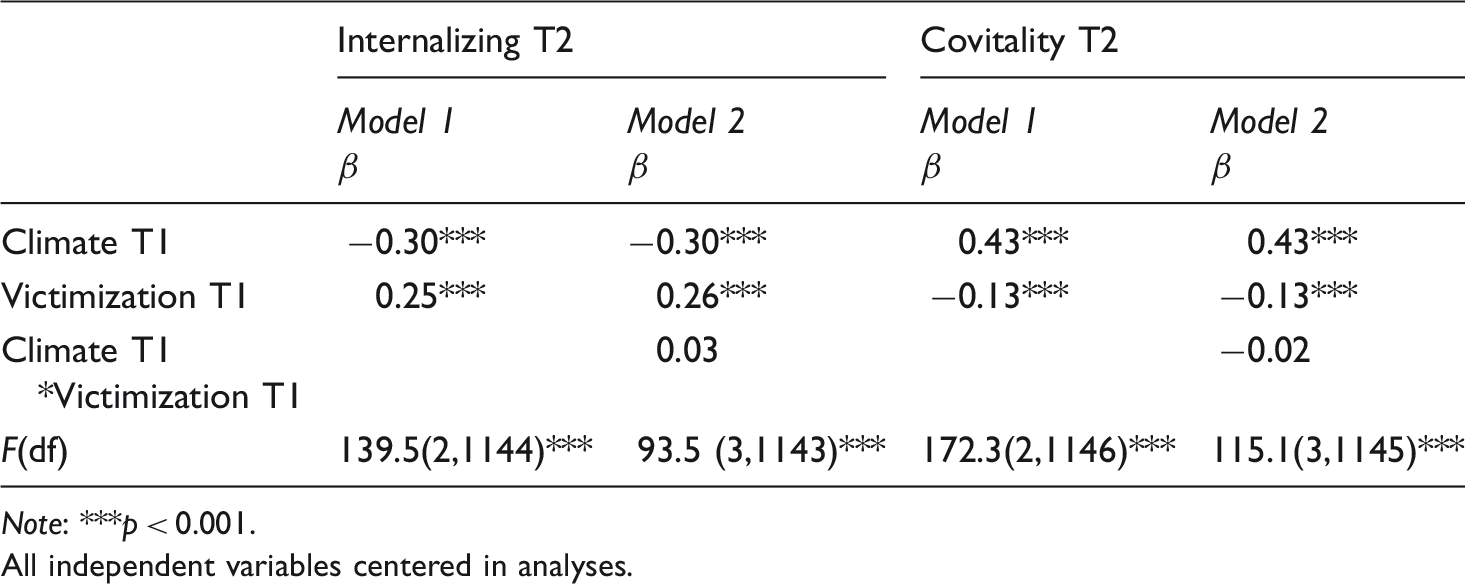
Note: ***p < 0.001.
All independent variables centered in analyses.
Discussion
Chinese culture values education and social harmony (Li, 2005), and holds high respect towards teachers (Li et al., 1998), which tends to foster a positive school climate and discourages bullying/victimization (Yang et al., 2013). All of these factors make Chinese school an interesting context to study school climate, victimization, and child mental health outcomes. To our knowledge, this is the first longitudinal study on school climate, victimization, and mental health among Chinese elementary school student. Consistent with our hypothesis #1 (the main effect model), our findings replicated prior research on Chinese students (e.g., Han et al., 2017, Jia et al., 2009; Yu & Ge, 2010) and extended it by using longitudinal data to highlight the essential role of school climate on important youth outcomes, including less victimization, fewer internalizing symptoms, more covitality and better grades over time.
When different school climate factors were examined together, the more salient factors for youth outcomes were student-teacher relationships, clear expectations, respect for diversity and fairness of rules. Because teachers are well respected in the Chinese culture and are viewed as authority figures (Le et al., 1998), when students have secure bonds with their teachers and feel their teachers care about them, students are more likely to identify with and behave according to school rules. They also feel more positively about themselves, which contributes to better mental health outcomes. Teachers and school psychologists should strive to have positive relationships with each student, and help all students feel welcomed at school. On the other hand, consistent with Social Control theory, as well as findings in the US (e.g., Wang, Wang, Zheng, & Atwal, 2016) and Canada (Konishi et al., 2017), clear expectations about rules at school and respect for diversity appear to be more important in reducing bullying at school. When expectations are unclear and diversity is not respected in school, students are less likely to feel a strong bond to the school, and are more likely to be victimized. In recent decades, China has experienced dramatic social and economic changes resulting in increased divorce rates, larger income gaps, and more migrant children attending schools in cities. Children from these diverse and disadvantaged backgrounds (e.g., lower income, divorced families) may be marginalized at school and perceived as different (Wang, Ni, Ding, & Yi, 2015). School psychologists and teachers should hold class meetings to discuss how to accept and appreciate individual differences among peers in order to promote respect towards diversity and reduce bullying. Interestingly, fairness of rules is the only significant predictor for better grades over and above other school climate dimensions. School psychologists and teachers need to make sure the rules are fair at school and avoid differential treatment towards certain students in order to help every student feel like they belong.
Consistent with prior research (Gini et al., 2018; Wu et al., 2015), victimization contributes to more negative mental health outcomes over time. However, contrary to the moderation hypothesis (#2 and #3), school climate did not moderate the relationship between victimization and mental health outcomes over time. This is similar to other research that did not find such moderation effect (Wang et al., 2014). Other individual-level characteristics, such as temperament, social support, or coping strategies, or family-level factors, such as parental involvement, may serve as potential moderators instead of school climate. Future studies should examine these potential moderators.
Limitation and future studies
Several limitations need to be considered when interpreting the results. First of all, all data were collected from student self-reports, and the shared method of variance is a concern. Future studies should collect data from other informants, such as parents and teachers. Secondly, data were collected from five schools in two provinces. China is a very diverse country, and our finding may not be generalizable to schools with different demographics. In addition, we did not use multilevel modeling to control for the nested nature of the data due to the small number of schools in the sample. Prior researchers have suggested that when using multilevel modeling with a small sample size at level two (a sample of 50 or less), it ‘leads to biased estimates of the second-level standard errors’ (Maas & Hox, 2005, p. 86). Future studies should collect data from more schools and use multilevel modeling to analyze data. Third, data on academic achievement were based on student self-reports. Future studies should collect this data from school records or teacher reports. Fourth, data were only collected at two time points. Future studies should collect data over a longer period of time.
Implications
China and many other Asian countries share similar cultural values of collectivism, social harmony, education, and commonalities in their school systems. Our findings suggest that in a collectivistic context like China, fostering positive school climate, specifically, fostering positive student-teacher relationships, setting clear expectations about student conduct, creating fair rules, and creating an atmosphere that respects and values individual differences may be beneficial in reducing bullying and promoting student mental health and educational outcomes. Because the relationship between different school climate factors and youth outcomes may vary, it is important for schools to conduct school climate assessments, and identify specific areas for improvement to foster positive youth development (Konishi et al., 2017). Teachers frequently underestimate bullying behavior at their school (Bradshaw, Sawyer, O’Brennan, 2007; Waasdorp et al., 2011), and some students are hesitant to report bullying to teachers. In order to help victimized students, teachers need to create a positive environment that encourages students to seek help. Educators need to take student reports of bullying seriously and ensure students that teachers will effectively intervene on their behalf (Cortes & Kochenderfer-Ladd, 2014). School staff should also foster positive psychology traits among students, such as gratitude and optimism, in addition to preventing mental illness. Because many Chinese school psychological service providers teach mental health classes, they should incorporate school climate interventions and positive psychology interventions into those classes (Wang et al., 2015). They can engage students in class meetings to identify the best way to foster positive school climate and discuss difficult topics related to bullying, such as dominance and popularity (Wang et al., 2013).
Footnotes
Declaration of Conflicting Interests
The author(s) declared no potential conflicts of interest with respect to the research, authorship, and/or publication of this article.
Funding
The author(s) received no financial support for the research, authorship, and/or publication of this article.