



Abstract
The problem behaviors exhibited by left-behind children occur within multiple contexts, and are influenced by cumulative risk, including family, peer, and school characteristics; however, little is known about the mediating and moderating mechanisms underlying the relationship between such problem behaviors and cumulative risk. A total of 1,313 Chinese left-behind children were recruited to complete anonymous questionnaires measuring cumulative risk, deviant peer affiliation, effortful control, and delinquent behavior. After controlling demographic covariates, cumulative risk is positively associated with problem behaviors. Furthermore, deviant peer affiliation was found to partially mediate the association between cumulative risk and problem behaviors. Both the direct association between cumulative risk and delinquent behaviors and the indirect effect of deviant peer affiliation were moderated by effortful control, specifically; the effects were stronger for left-behind children with low levels of effortful control. These results highlight the significance of the cumulative ecological model for understanding and developing intervention programs to reduce left-behind children's problem behaviors.
Keywords
China has exhibited one of the largest rural-to-urban migrations in human history. During this mass migration, tens of millions of left-behind children in rural areas have become part a unique disadvantaged group – rural left-behind children. Left-behind children are generally younger than 17 years; have, as one or both parents have migrated, been left in the care of the remaining parent, grand-parents, other relatives, or even on their own; and remain in their rural area for at least six months. According to recent estimates, currently there are approximately 61.03 million left-behind children in China, accounting for 21.88% of the country's child population (All-China Women's Federation, 2013).
Parental absence as a result of long-term rural-to-urban migration causes great disruption to the family structure, families' emotional functions, and parental supervision of children's behaviors (Shen, Liu, Zhao, & Shi, 2015; Wen & Lin, 2012; Wang & Mesman, 2015). There is accumulating evidence that the incidence rates of problem behaviors in left-behind children are much higher than those in non-left-behind children, and that the former are also more prone to developing delinquent behaviors, such as fighting, smoking, and alcohol abuse (Zhao, Liu, & Zhang, 2013a; Zhao, Li, Wen, Hou, & Wang, 2017).
However, not all left-behind children develop problem behaviors. There are individual differences regarding the psychological and social adaptation of left-behind children; some individuals from this group adjust well to their situation and show resilience characteristics, despite exposure to multiple risk contexts (Shen et al., 2015; Zhao et al., 2013a). According to the ecological model (Bronfenbrenner, 1986), multiple ecological subsystems, such as family, school, and peers, interact with each other and contribute to child-development outcomes. However, previous related studies have mainly focused on single or a small number of risk factors (Jin, Liu, & Chen, 2012; Shen et al., 2015). To our knowledge, the impact and underlying mechanisms of cumulative multiple ecological risks regarding left-behind children's acquiring of delinquent behaviors have not been empirically examined in detail.
Cumulative ecological risks and left-behind children's problem behaviors
The ecological systems theory suggests that individuals' development is influenced by their interaction with micro systems, such as family, school, and peers. Inspired by this theory, researchers have extensively examined how the ecological contexts of key life domains for left-behind children, including family (Chen, Fan, Cheng, & Wang, 2014; Zhao, Liu, & Li, 2013b), school (Liu, Li, Chen, & Qu, 2015; Wen & Lin, 2012), and peers (Zhao et al., 2013a), are linked to delinquent behaviors. Specifically, long-term parental migration may lead to changes in family structure, and seriously diminishes basic family affection and connections. For example, parent-child cohesion reduces the risk that rural left-behind children adopting problematic behaviors such as smoking and drinking (Shen et al., 2015; Zhao et al., 2013b). In addition, school contexts are one of the most salient social domains in terms of the development of left-behind children, because such children tend to spend a large amount of time with teachers and classmates. A recent study found that a good teacher-student relationship is negatively correlated with delinquent behaviors among left-behind children (Liu et al., 2015). What's more, peer contexts are also crucial determinants of the emergence of problem behaviors. As a result of the absence of their parents, the time left-behind children spend with their families is greatly reduced, and they typically spend a larger proportion of their time with peers (Zhao et al., 2013a). For example, low-quality peer relationships and poor connections with peers may cause left-behind children to develop delinquent and other problem behaviors (Jin et al., 2012; Zhao et al., 2013a).
Notably, these risk factors do not work independently, but have strong co-occurrence (Masten & Wright, 1998). Cumulative ecological risk can have a detrimental effect on adolescents' behaviors (Gerard & Buehler, 2004). The basic assumption is that an individual's development outcome is not caused by a single risk factor, but by a synergy of multiple interrelated risk factors (Evans, Li, & Whipple, 2013). A growing body of studies has shown that cumulative ecological risk can significantly predict tobacco, alcohol use, and aggressive behaviors among youths (Ostaszewski & Zimmerman, 2006; Stoddard et al., 2013). Thus, cumulative ecological risk constitutes a new perspective for advancing our understanding of problem behaviors among Chinese left-behind children. Several researchers (Jin et al., 2012; Shen et al., 2015) have noted that the problem behaviors of left-behind children are shaped by the overlapping of multiple risk factors, rather than by a single risk factor. Nevertheless, as mentioned, current empirical research on the cumulative ecological risk of left-behind children remains lacking.
The mediating role of deviant peer affiliation
Deviant peer affiliation refers to the association with peers who engage in delinquent behaviors, such as smoking, drinking, and violence. According to the theory of social learning, such delinquent behavior is continuously strengthened, causing left-behind children to move farther away from a normal development track (Snyder, Reid, & Patterson, 2003). Further, children from the same peer groups are similar because they seek group confirmation and consequently adopt their groups' attitudes and codes of conduct (Harris, 1995). Previous studies have found that adolescents who affiliate with deviant peers are prone to exhibiting delinquent behaviors such as using tobacco, alcohol, and fighting (Fergusson, Vi taro, Wanner, & Brendgen, 2007; Westling, Andrews, Hampson, & Peterson, 2008). Left-behind children, as a result of the long-term absence of their parents, are likely to rely on their peers for support and identification when encountering various risk factors. Based on the social development model (Hawkins & Weis, 1985), it can be determined that multiple cumulative risks have the potential to influence the likelihood that left-behind children engage in deviant peer affiliation, which may further negatively impact their development of problem behaviors. Children's attitudes, beliefs, and behaviors are shaped by the correlated social unit (family, peers, school) (Hsieh et al., 2016). Accordingly, risk factors relating to these social units may hinder left-behind children's fulfillment of their basic psychological needs, such as autonomy, competence, and relatedness. Thus, experiencing such difficulties may increase left-behind children's likelihood of being abandoned, discriminated against, rejected, or isolated, and they may consequently resort to associating with deviant peers in the hope of obtaining acceptance and identification. There is growing evidence that deviant peer affiliation plays a mediating role in the relationship between some risk ecological factors and adolescent delinquent behaviors, such as parental control (Song, Chen, Hou, & Zhang, 2017), perceived school climate (Bao, Li, Zhang, & Wang, 2015), and/or peer victimization (Rudolph et al., 2014). Similarly, one recent longitudinal study also confirmed that deviant peer affiliation played a mediator role between peer victimization and children's problem behavior (Zhu et al., 2016). However, to our knowledge, no existing research has examined the mediating role deviant peer affiliation plays in the relationship between cumulative risk and problem behaviors in Chinese left-behind children.
The moderating role of effortful control
Left-behind children are exposed to multiple risk factors; however, the influence of these factors can differ between individuals, and not all children exhibit problem behaviors (Jin, Liu, & Chen, 2012; Wen & Lin, 2012; Zhao et al, 2013a). This heterogeneity of outcomes may be contingent upon some left-behind children possessing individual characteristics, such as effortful control, that attenuate the negative effects of cumulative risk on problem behaviors.
Effortful control refers to the ability to inhibit dominant responses in favor of subdominant responses, such as autonomous control of attention processes and behaviors and appropriate regulation and expression of emotional experiences (Rothbart & Bates, 2006). In general, individuals with high levels of effortful control show better emotion regulation, moral development, and adjustment (Eisenberg, Smith, & Spinrad, 2011). Considering this, effortful control may buffer the impact of multiple environmental risk factors on left-behind children's problem behaviors. Specifically, individuals with high levels of effortful control have more self-control regarding emotions and behaviors than individuals with low levels of effortful control, and show strong resistance to delinquent behaviors when exposed to multiple ecological risks (Bao et al., 2015; Lengua, Bush, Long, Kovacs, & Trancik, 2008), indicating they exhibit good social adaptability (Luthar, Grossman, & Small, 2015). In addition, several studies also have found that effortful control can mitigate the negative impact of deviant peer interaction on adolescent problem behaviors (Baker, 2010; Bao et al., 2015; Loukas et al., 2010; Yi, Ye, & Liu, 2016). Thus, effortful control, as an important protective factor, may moderate the negative effects of cumulative risk on left-behind children's problem behaviors.
The present study
Based on ecological systems theory (Bronfenbrenner, 1986), the social development model (SDM, Catalano & Hawkins, 1996), and resiliency theory (Luthar et al., 2015), the present study proposes a moderated mediation model (Figure 1). We hypothesized that cumulative risk is positively associated with delinquent behaviors in left-behind children (Hypothesis 1). Furthermore, we hypothesized that deviant peer affiliation plays a mediating role in the association between cumulative risk factors and delinquent behaviors (Hypothesis 2). In addition, we also posited that effortful control would moderate the direct and/or indirect path of cumulative risk on delinquent behaviors through deviant peer affiliation (Hypothesis 3).
Proposed moderated mediation model.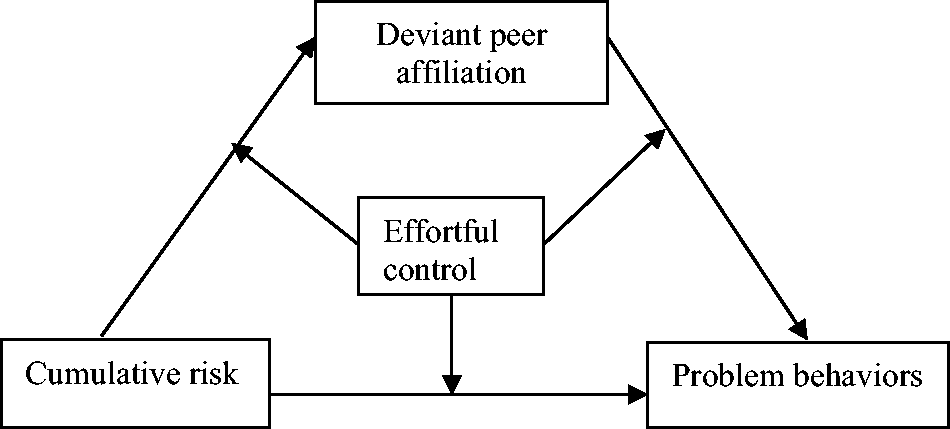
Methods
Participants
A total of 1,373 rural left-behind children were identified by self-report from 11 primary schools and six middle schools located in rural areas of the Shanxi, Guizhou, and Sichuan provinces of China, which have large populations of migrating laborers. Of the collected questionnaires, 39 featuring invalid responses were excluded from the analyses due to missing more than one-third of the questionnaire. Meanwhile, 11 questionnaires were returned incomplete; missing data were imputed using predicted values determined through multiple regression analysis that included a set of sociodemographic variables, with regression coefficients estimated via bootstrapping. Ultimately, 1,313 valid questionnaires were obtained. The sample included 649 boys (49.4%) and 666 girls (50.6%), all aged 10- to 17-years-old (M = 13.13, SD = 1.77). In terms of parents' educational level, 23.3% of the fathers had an educational level of elementary school or below, 53.3% junior middle school, 18.6% high school, 2.6% junior college, and 2.2% bachelor degree or above; 30.8% of the mothers had an educational level of elementary school or below, 52.0% junior middle school, 12.1% high school, 3.1% junior college, and 2.0% bachelor degree or above. The amount of family financial resources range from 0–5 (M = 3.02, SD = 1.36). Based on parental migration status, these children were divided into three groups: Father-only migration (N = 787, 59.9%), mother-only migration (N = 122, 9.3%), and both-parent migration (N = 404, 30.8%).
All of the participants signed a consent form approved by the institutional review board of Southwest University. Prior to initiation of the study, all children and their parents or guardians were informed that they had the right to cease participation at any time and that an ethics committee had approved the procedure. Data were collected by class, with the questionnaires administered in participants' classrooms at prearranged times. Participants completed the questionnaires individually and anonymously. The entire experiment lasted approximately 40 minutes, and participants received a small gift upon completion of the questionnaire.
Measures
Cumulative risk
Individual measures for cumulative risk.
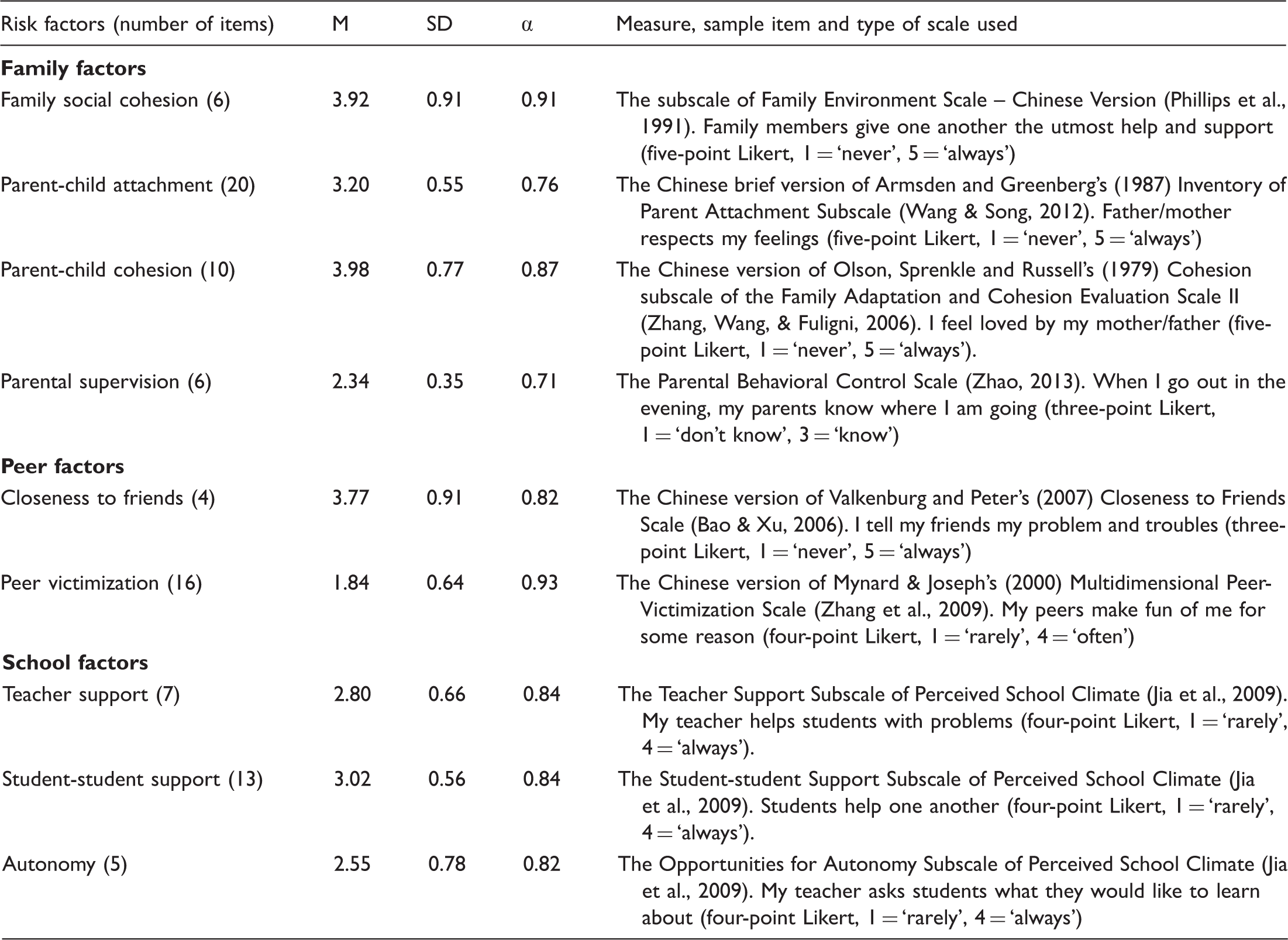
Using procedures similar to those used by previous research (Evans et al., 2013), we identified the lower 25% or upper 75% of the distribution of each of the variables as risk factors. The cut-off points were assigned as close to the lower 25% or upper 75% threshold. Each student will be given a score of 1 if the original score was below or above the cut-off point, otherwise, a 0 will be given. Cumulative indices were computed by summing all of the risk factors for each individual; the range of the cumulative promotive factors was 0–9 (M = 2.39, SD = 2.13).
Deviant peer affiliation
We used the Deviant Peer Affiliation Scale (Li et al., 2013) to assess how many of the participants’ friends had engaged in deviant behaviors during the preceding year. This scale consists of eight items adapted from a previously published Deviant Peer Affiliations Scale (Fergusson & Horwood, 1999); an example item is: ‘how many of your friends got drunk in the last year?’. Participants were asked to rate, using a five-point Likert scale, the proportion of their friends who engaged in specific deviant behaviors (1 = ‘none’; 5 = ‘all’). Higher scores indicated more deviant peer affiliations. In this study, Cronbach's α was 0.79 for this scale.
Effortful control
We used the Effortful Control Scale (Li, Zhang, Li, Zhen, & Wang, 2010) to assess the participants’ effortful control. This scale comprises 16 items and three dimensions; namely, attention control, activation control, and inhibitory control. Participants were required to indicate the degree to which the items described themselves, using a five-point Likert scale (ranging from 1 = ‘almost always untrue of you’ to 5 = ‘almost always true of you’); an example item is: ‘the more I want to stop doing things I should not, the more I cannot stop doing them’. Higher scores indicate higher effortful control. For this study, Cronbach's α was 0.70.
Delinquent behavior
We used the Child Problem Behavior Scale (Shen, 2009) to assess how often the participants had engaged in various problem behaviors during the preceding year. This scale includes 12 items adapted from a previously published scale named The Children Behavior Checklist (Achenbach & Edelbrock, 1987; Fang, Li, & Dong, 1996), with examples being ‘escape from class’ and ‘stealing’. Participants were required to indicate their agreement with the items using a four-point scale (ranging from 1 = ‘never’ to 4 = ‘frequently’). Higher scores represent greater delinquency. Cronbach's α was 0.82 in this study.
Covariates
According to previous studies (Gao et al., 2010; Wen & Lin, 2012), demographic covariates were gender (coded as ‘0’ for male and ‘1’ for female), age, socioeconomic status (SES), and parental migration status (both-parent migration was used as a reference). SES was comprised of a single index derived from principal component analysis of multiple indicators, including parental education and family financial resources (Bao et al., 2015). Higher scores indicate higher SES.
Results
Preliminary analysis
Means, standard deviations, and correlation matrix (N = 1313).
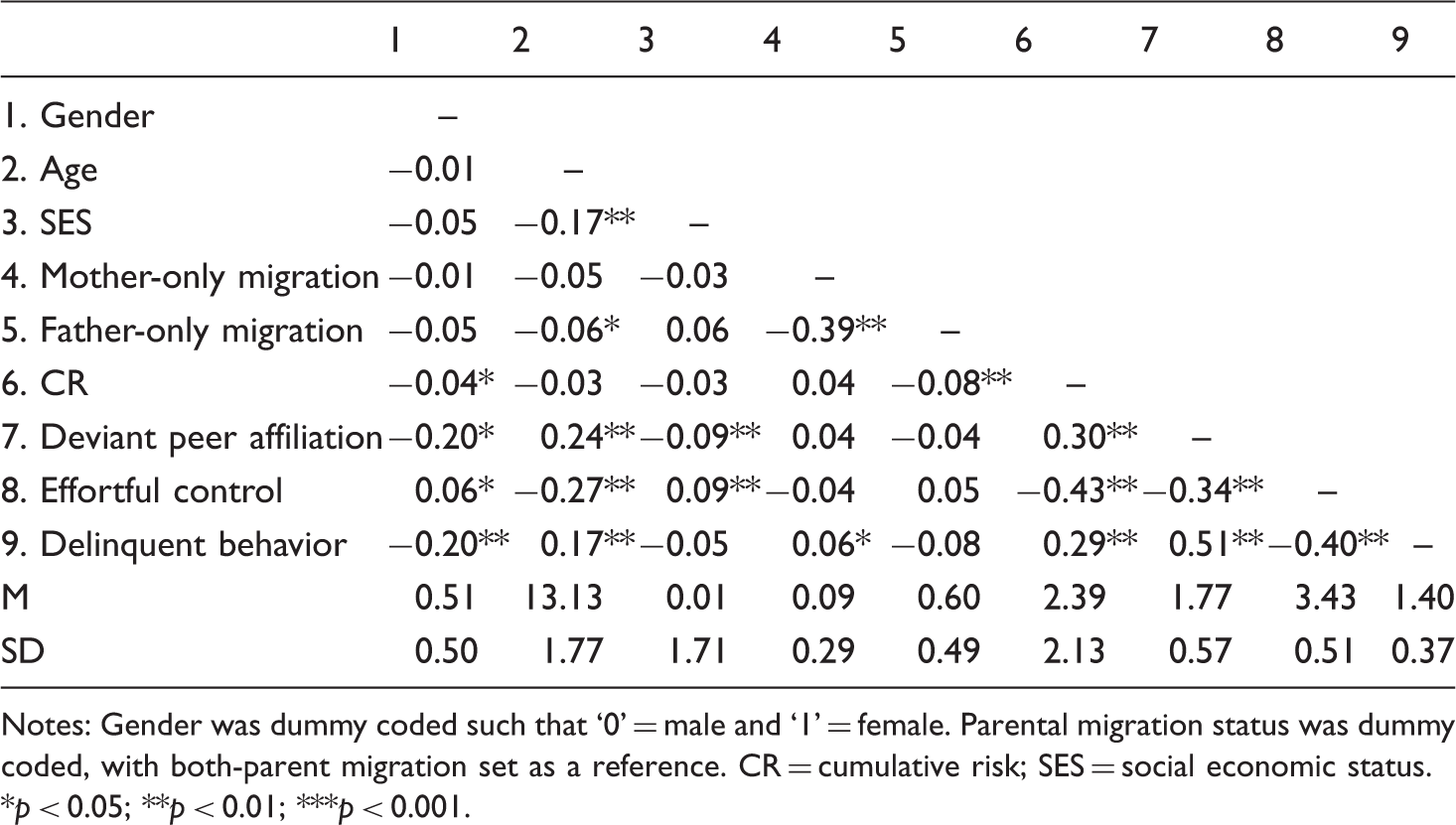
Notes: Gender was dummy coded such that ‘0’ = male and ‘1’ = female. Parental migration status was dummy coded, with both-parent migration set as a reference. CR = cumulative risk; SES = social economic status.
*p < 0.05; **p < 0.01; ***p < 0.001.
Testing for mediation effect
The Hayes' (2013) PROCESS macro was used to examine the mediating role deviant peer affiliation plays in the relationship between cumulative risk and delinquent behaviors. The bias-corrected bootstrap method showed that the indirect effect of deviant peer affiliation was significant, with the index of the mediation effect being 0.16 (95% CI = [0.12, 0.21]) for delinquent behaviors. The mediation effect accounted for 47.1% of the total effect of delinquent behaviors. In addition, the direct effect of cumulative risk on problem behaviors was also significant (βdelinquent behaviour = 0.05, t = 1.53, 95% CI = [-0.01, 0.11], p < 0.01). Therefore, the relationship between cumulative risk and problem behaviors was partially mediated by deviant peer affiliation, supporting Hypothesis 2.
Testing for moderated mediation: Delinquent behavior
The main results of moderated mediation analysis by Hayes' (2013) PROCESS macro (Model 59) are presented in Table 3, after controlling for gender, age, SES, and parental migration status. As can be seen from Table 3, in Model 1, there was a significant effect of cumulative risk on delinquent behaviors (β = 0.13, t = 4.86, 95% CI = [0.08, 0.18], p < 0.001), and this effect was moderated by effortful control (β = -0.03, t = −3.56, 95% CI = [−0.04, −0.01], p < 0.001). To better understand the moderating effect of effortful control, the plot of the association between cumulative risk and delinquent behaviors is different at two levels of effortful control (i.e., 1 SD above the mean and 1 SD below the mean); the results are presented in Figure 2. Simple slope tests indicated that for left-behind children with lower effortful control, cumulative risk was positively associated with delinquent behaviors (βsimple = 0.33, t = 3.91, p < 0.001), as this association was still significant but much weaker for left-behind children with higher effortful control (βsimple = 0.17, t = 2.30, p < 0.001).
Effortful control moderating cumulative risk and delinquent behaviors. The moderated mediating effect of deviant peer affiliation on delinquent behaviors. Notes: CR = cumulative risk; DPA = deviant peer affiliation; EC = effortful control. *p < 0.05; **p < 0.01; ***p < 0.001.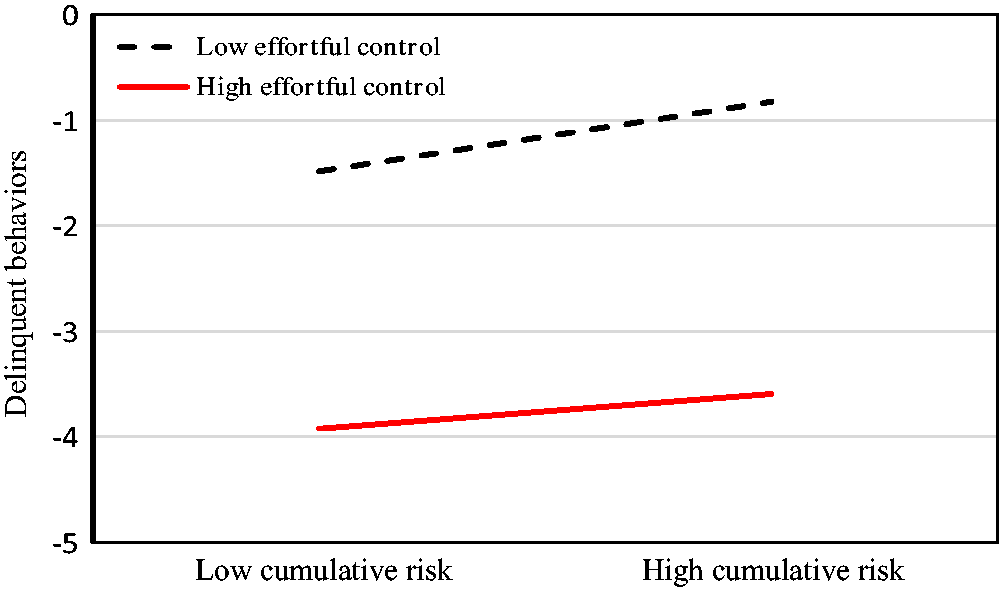
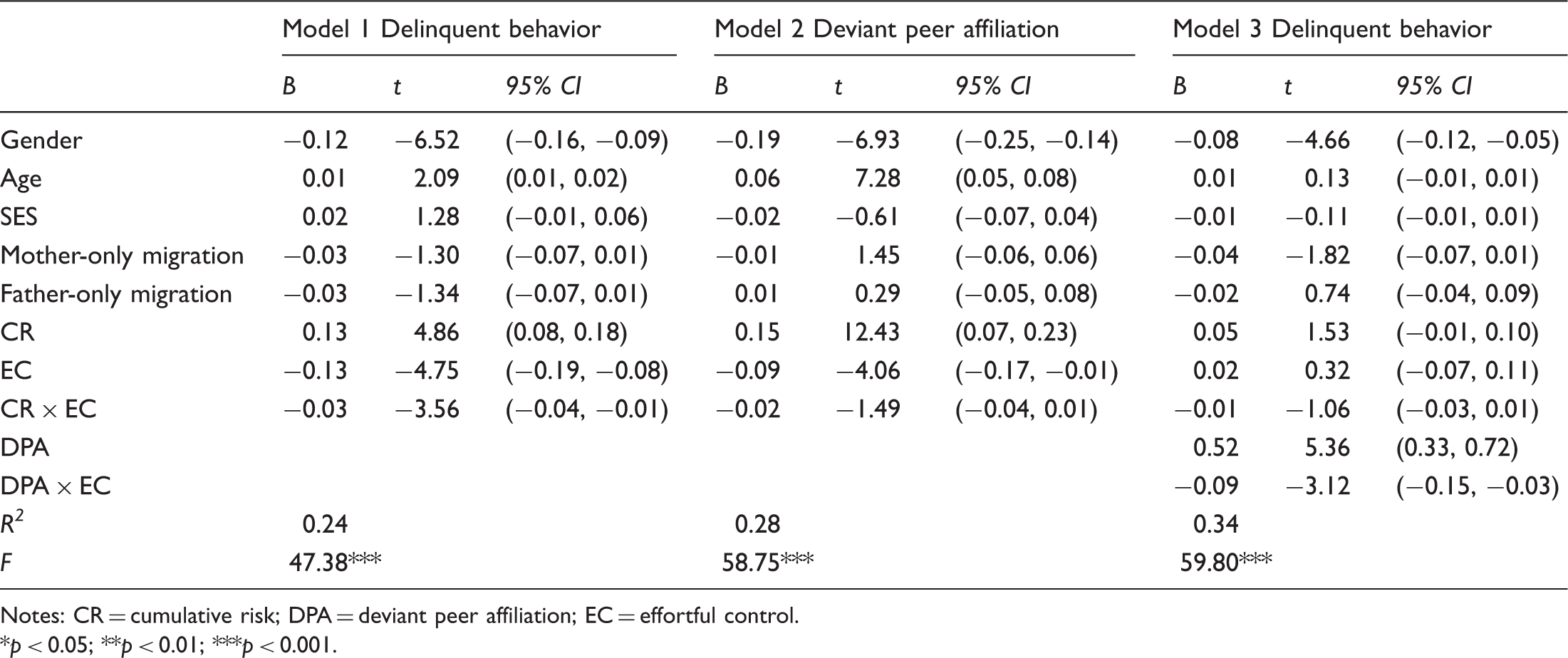
As Table 3 illustrates, in Model 2, there was a significant main effect of cumulative risk on deviant peer affiliation (β = 0.15, t = 3.79, 95% CI = [0.07, 0.23], p < 0.001) and this effect was not moderated by effortful control (β = −0.02, t = −1.50, 95% CI = [-0.04, 0.01], p > 0.05). Model 3 showed that the effect of deviant peer affiliation on delinquent behaviors was significant (β = 0.52, t = 5.36, 95% CI = [0.33, 0.72], p < 0.001), and more importantly, the effect was moderated by effortful control (β = −0.09, t = −3.12, 95% CI = [−0.15, −0.03], p < 0.01). For descriptive purposes, we plotted the predicted deviant peer affiliation against delinquent behaviors separately for low and high levels of effortful control (i.e., 1 SD above the mean and 1 SD below the mean); the results are presented in Figure 3. Simple slope tests also showed that for the left-behind children with higher effortful control, deviant peer affiliation was positively associated with delinquent behaviors (βsimple = 0.34, t = 6.09, p < 0.001); however, for the left-behind children with lower effortful control, the effect of deviant peer affiliation on delinquent behaviors was much weaker (βsimple = 0.59, t = 9.14, p < 0.001). Thus, Hypothesis 3 was supported.
Effortful control moderating deviant peer affiliation and delinquent behaviors.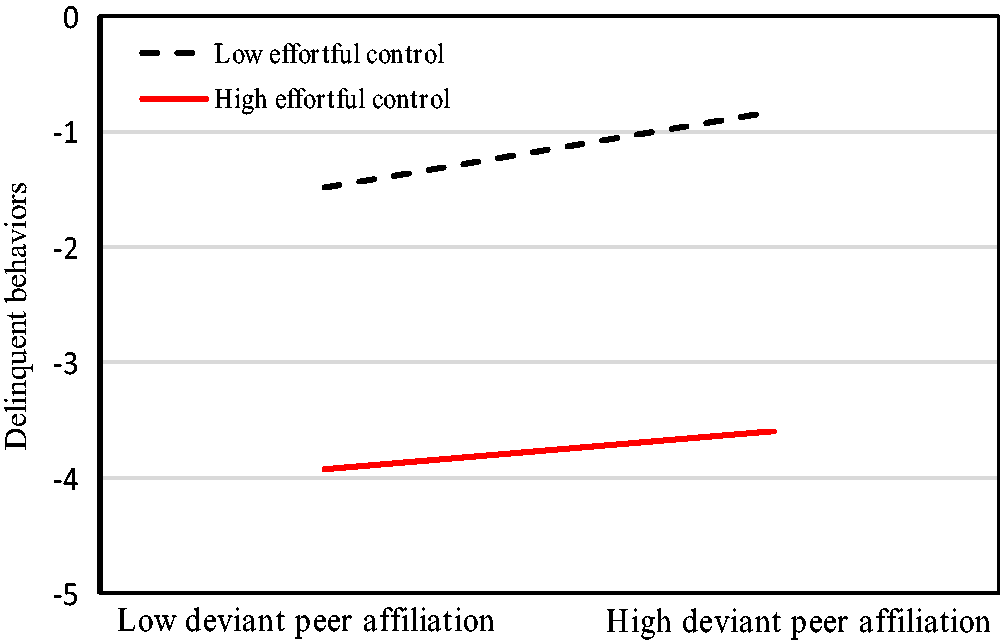
Discussion
This is the first study to examine the influence of cumulative risk on the problem behaviors exhibited by Chinese left-behind children. Our results showed that left-behind children who are exposed to multiple risk factors are much more likely to develop problem behaviors, and our findings extend existing research by providing a clearer description of the development outcomes of Chinese left-behind children, because they often contend with constellations of risk rather than isolated instances of adverse contexts. Moreover, our findings may add to existing literature by providing a more accurate overview by examining the mediating role of deviant peer affiliation and the moderating role of effortful control in the relationship between cumulative ecological risk and left-behind children's problem behaviors.
This study revealed that left-behind children exposed to multiple ecological risks are more likely to exhibit delinquent behaviors. Our finding is consistent with the ecological systems theory (Bronfenbrenner, 1986), which posits that the social contexts within which children interact are crucial determinants in shaping problem behaviors. One possible explanation for this relationship is that the cumulative risk factors essentially reflect the lack of supportive resources available to left-behind children. Family, peers, and school are all indispensable contexts in left-behind children's development. If there are many disadvantages in these domains (e.g., insecure parental attachment, poor parental supervision, low teacher support, low closeness to friendship, and high levels of peer victimization), left-behind children may, as a result of a lack of effective social support, be more likely to engage in various socially disapproved behaviors in attempts to attract others' attention.
Our study found that cumulative risk is significantly positively associated with deviant peer affiliation which, in turn, may increase the risk of deviant behavior in left-behind children. This finding is consistent with a prior theoretical assumption (Evans et al., 2013) and there are several potential explanations for deviant peer affiliation's role as an underlying mechanism in this regard: First, the social development model (Hawkins & Weis, 1985) posits that family, school, and peers influence adolescents’ behaviors successively, and when adolescents are firmly bonded to these social units (which support conformity to the rules of society), they are less likely to engage in various problem behaviors. In contrast, if left-behind children believe that they are abandoned, neglected, or discriminated against by their parents, teachers, or peers, such negative social connections may create a greater risk of the children affiliating with deviant peers in an attempt to gain a sense of belonging and social reinforcement. Second, according to social learning theory, children can learn certain behaviors by imitating others. When left-behind children affiliate with deviant peers, they are easily influenced by such peers’ behaviors. The underlying process in this regard may involve peer norms, social modeling, peer pressure, and various types of reinforcement; for example, left-behind children may learn certain behaviors by observing the ‘example behaviors’ of the deviant peers they affiliate with, including smoking and truancy (Dishion & Tipsord, 2011).
Importantly, we found that both the direct association between cumulative risk and delinquent behaviors and the indirect effect of deviant peer affiliation were moderated by effortful control, indicating the protective effect of effortful control. Our result is consistent with the results of previous studies (Baker, 2010; Bao et al., 2015; Yi et al., 2016), and suggests that effortful control is a protective factor for left-behind children's deviant behavior. According to the individual-environment interaction model (Lerner, Lerner, Almerig, & Theokas, 2006), the influence of deviant peer affiliation on individuals’ behaviors differs between individuals. Those with higher levels of effortful control can control their own cognition, emotions, and behaviors when exposed to the influence of deviant peers and cumulative risk factors. To reduce the negative impact of cumulative risk factors and deviant peer affiliation, on one hand, left-behind children with high effortful control are capable of adjusting their attention in a timely manner, focusing more on themselves, and insulating themselves from the negative effects associated with deviant peer affiliation and negative cumulative risk environment, thereby reducing the risk of developing negative behaviors. On the other hand, other left-behind children with high levels of effortful control may adopt some positive coping strategies to negotiate the negative impact of additive risk factors and deviant peers, avoiding the ‘temptation’ of deviant peer affiliation. In addition, left-behind children with high effortful control are eager to maintain good interpersonal relationships, so they restrain themselves from engaging in impulsive behaviors that do not meet family expectations, thus indirectly avoiding the formation of delinquent behaviors (Bao et al., 2015).
Several limitations should be considered when evaluating the findings presented in this research. First, cross-sectional design may limit our ability to establish causal inferences. Further studies should employ a longitudinal design in order to better pinpoint the mechanisms of the theoretical model. Second, the study featured limited measures of ecological risk factors, and it will be necessary to consider more contextual risk factors as well as promotive factors in future research in order to predict the development of problem behaviors among Chinese left-behind children. Third, future studies should also pay more attention to other variables that may impact the outcomes, such as the age of the children when their parents migrate, the duration of the parent-children separation and the frequency of parent-children contact), for previous studies indicating that these two variables may influence the developmental outcomes of left-behind children (Liu, Li, & Ge, 2009; Ling, Fu, & Zhang, 2015). Besides, all measures in this study were based on children self-report, which may lead to inaccuracy and unreliability for the results. It will be of great value to use multiple methods of data collection in further study. Finally, the representativeness of the sample may restrict the generalizability of our findings, since the participants in this study were recruited from a group of Chinese left-behind children, focused on internal migration. Future research is needed to determine whether the types of risks and the mechanism of delinquent behavior found in this study is applicable to diverse samples, such as left-behind children whose parents migrated internationally.
Despite these limitations, the present study may provide important insights into the mechanisms underlying the relationship between cumulative risks and problem behaviors in Chinese left-behind children, which may have practical significance in terms of the development of prevention and intervention strategies regarding left-behind children's problem behaviors. First, our findings highlight the importance of the cumulative ecological model for understanding and developing intervention programs for reducing left-behind children's problem behaviors. For example, school practitioners can help left-behind children to modify their exposure to multiple risk contexts, such as improving the parent-children interaction or friend companionship. Second, these findings also revealed that deviant peer affiliation may serve as a potential mechanism that mediates the association between cumulative risks and problem behaviors, implying that reducing the opportunities to affiliate with deviant peers is helpful for decreasing left-behind children's problem behaviors. School psychologists should pay close attention to children's peer interactions and provide targeted guidance to alleviate some of the detrimental influence of cumulative risks on left-behind children's problems behaviors. In addition, our study also demonstrated that effortful control can protect left-behind children from adopting problem behaviors through the cumulative risk factors and deviant-peer context; enhancing effortful control may be a promising way for left-behind children who are exposed to cumulative risk context or deviant peers to reduce the risk of engaging in deviant behaviors. For example, targeted intervention, aimed at enhancing left-behind children's effortful control, may be more helpful in protecting them from risk of delinquent behaviors, suggesting a possible venue for interventions.
Footnotes
Author Contributions
Huijie Lei: Analysis or interpretation of data; Qinghua Zhang: Conception or design; Xiying Li: Drafting the article; Hang Yang and Weiping Du: Collection of data; Jingjin Shao: Revising the article. Huijie Lei and Qinghua Zhang contributed equally to this paper.
Declaration of conflicting interests
The author(s) declared no potential conflicts of interest with respect to the research, authorship, and/or publication of this article.
Funding
The author(s) disclosed receipt of the following financial support for the research, authorship, and/or publication of this article: This work was supported by Humanity and Social Science Youth foundation of Ministry of Education of China (17YJC880128), and the Key Humanity Social Science Research Institute in Chongqing (16SKB027).