




Abstract
The purpose of the current study was to explore the nature of the underlying relationship between creativity fostering teacher behavior and student creative achievement in science activities. In doing so, we examined the mediating effect of intrinsic motivation on the relationship between creativity fostering teacher behavior and student creative achievement in science activities, and the moderating effect of openness to experience. We conducted a two-wave survey study in three high schools in China and obtained data from 1035 students. Results from ordinary least squares regression analysis showed that creativity fostering teacher behavior was positively related to student creative achievement in science activities. We found that students' intrinsic motivation mediated the relationship between creativity fostering teacher behavior and student creative achievement. When a student had a high level of openness to experience, the relationship between intrinsic motivation and creative achievement was stronger. In addition, we discussed the implications and limitations of our study, as well as suggestions for future research.
Keywords
Scholars argue that the period of school education is an optimal time for children and adolescents to develop creative potential (Lee & Kemple, 2014; Runco, 2003; Starko, 2018). In many countries, fostering student creativity is an integral part of pre-tertiary education (Lee & Seo, 2006; Peng, Cherng, & Chen, 2013; Runco, 2014). Building on the view that creativity exists in a broad range of students (Weisberg, 1986), researchers have emphasized the role of teachers, given their ability to elicit, guide, and support students' creativity development (Besançon & Lubart, 2008; Diakidoy & Kanari, 1999).
In the current study, we attempt to understand teacher practices that foster student creativity from a human development view and a motivational perspective. Specifically, we offer an integrated framework that draws on the strengths of the bioecological theory (Bronfenbrenner, 1979) and self-determination theory (SDT) (Deci & Ryan, 2012) to address how teacher behavior affects student creativity and the role of student personality.
Student creative achievement and creativity fostering teacher behavior
Creativity is commonly defined as the ability to generate novel and potentially useful ideas or solutions to a problem, given the knowledge and skills of the individual (Amabile, 1996). In the educational setting, creative thinking skills are viewed as something that can be taught (Runco, 2014). For most students, creativity is desirable since it allows students to deliver more cumulative creative products or outcomes (Kaufman, Plucker, & Baer, 2008; Lee & Kemple, 2014). Student creativity is often captured by students' achievement in science activities, which is the aggregate of creative ideas or solutions to problems they generate while pursuing such activities (Carson, Peterson, & Higgins, 2005). These activities include exploring unconventional ways to solve a science problem, designing a natural science experiment, reporting a scientific study, conceiving a prototype of product, and so on (Amabile, 1983; Barron, 1955; Carson et al., 2005). Students at all ability levels can benefit from participating in these challenging activities to develop their creative potential (Lee & Seo, 2006; Sternberg & Lubart, 1996).
In the school context, classrooms are significant socializing contexts that influence students' creative pursuits. Therefore, Bronfenbrenner's (1979) bioecological systems model of human development is appropriate for guiding our understanding of the role of teachers in developing student creativity. According to Bronfenbrenner, the development of children is jointly determined by a primary context where they observe and engage in activities under the guidance of another person, and a secondary context where resources, opportunities, and encouragement to perform activities are provided to them. Bronfenbrenner suggested that teacher practices are an important contextual factor in the development of children (Bronfenbrenner & Ceci, 1994; Bronfenbrenner & Morris, 2006). Extending this bioecological view, we argue that student creativity development is primarily shaped by teacher practices in classrooms because students are able to routinely observe and engage in activities under the guidance of their teachers, who subsequently give students the opportunity, resources, and encouragement to explore the unknown. Thus, the guidance and support by teachers comprise the primary and secondary developmental contexts for students, respectively. In the present study, we focus on teacher behavior since it has a significant impact on students' creativity development (Marin & Halpern, 2011). In particular, creativity fostering behavior reflects a teacher's continued efforts to promote independent and flexible thinking, to equip students with a variety of knowledge and materials for divergent thinking, to encourage novel ways of solving problems and to help students cope with obstacles and failures (Cropley, 1997). We propose that creativity fostering teacher behavior (CFTB) experienced by a student can strengthen his or her belief in accomplishing creative tasks. This is because when there is ambient teacher support for student creativity, students will have more opportunities to internalize positive attitudes toward creative thinking and to develop relevant skills (Soh, 2017). Moreover, those who receive assistance and encouragement for pursuit of science activities will be more likely to persist in their creative efforts and in turn generate more innovative ideas and solutions (Scott & Bruce, 1994). Teacher support for creativity also signals that students' creative endeavors are valued and protected, which positively affects their later creative achievement. Hypothesis 1: CFTB will be positively related to student creative achievement in science activities.
The motivational perspective on student creative achievement
The bioecological model suggests a strong developmental potential of teacher practices. What, then, are the root causes of individual creative behavior? We approach this question from a motivational perspective by drawing on the SDT (Deci & Ryan, 2012; Ryan & Deci, 2000b). At a meta-theoretical level, SDT assumes that people inherently want to grow, develop, and explore, and defines such experiences as high-quality, intrinsic motivation (Deci & Ryan, 2012). Intrinsic motivation refers to the extent to which a person is inner directed, is genuinely interested in a task, and pursues it for the sake of the task itself (Utman, 1997). In the education context, intrinsic motivation is viewed as an essential ingredient to the manifestation of individual creativity (Amabile, 1983). However, intrinsic motivation can be influenced by contextual factors around individuals (Deci & Ryan, 2012; Ryan & Deci, 2000b). In this regard, we argue that SDT complements the bioecological model by linking students' development of creative potential to their social context.
SDT highlights the fact that contexts may facilitate or undermine intrinsic motivation. Social–contextual factors that prompt feelings of autonomy and competence can enhance intrinsic motivation, whereas factors that abate these feelings undermine intrinsic motivation (Gagné & Deci, 2005). We contend that in classrooms, the nature of creativity fostering teacher practices is to remove constraints and barriers to creative thinking processes and build up confidence for students to engage in creative tasks. To help students have freedom to explore an idea or solution to a problem, a teacher changes his or her role from “instructing” to “facilitating” (Schamel & Ayres, 1992). For example, a teacher can facilitate student pursuit of creative activities through praise and encouragement. This kind of teacher support will convince students that it is worthwhile to invest effort in challenging creative tasks and that they are free to experiment. Consequently, students will have higher intrinsic motivation to engage in those activities (Ryan & Deci, 2000b). Hypothesis 2: CFTB will be positively related to students' intrinsic motivation. Hypothesis 3: Intrinsic motivation will be positively related to student creative achievement in science activities. Hypothesis 4: The relationship between CFTB and student creative achievement in science activities will be mediated by students' intrinsic motivation.
The moderating effect of openness to experience
While teachers may induce creative behavior by elevating students' intrinsic motivation, the effect of creativity fostering teacher practices on each student's creative achievement may differ. Hence, we take into consideration individual differences within the classroom. Building from research on the Five-Factor Model (Costa & McCrae, 1992), we examine openness to experience, which has been found to be mostly closely linked to creative achievement in scientists and artists (Feist, 1998). Openness to experience is defined as the extent to which an individual is broad-minded, curious, imaginative, and original (Costa & McCrae, 1992). According to McCrae and Costa (1997), individuals high on openness are highly motivated to actively seek out new experiences and novel techniques. Individuals who are low on openness are more conservative and tend to favor ideas that are conventional rather than unique (George & Zhou, 2001). In schools, students with high openness to experience are more likely to embrace new experiences and explore unfamiliar situations given teacher support. By comparison, those low on openness tend to stay in their comfort zone. Consequently, students high on openness to experience can be attracted to difficult tasks that demand more creativity. These students are more likely to fulfill their aspiration in science activities through creative thinking processes. In addition, students high on openness to experience are deemed to have a more vivid imagination, as well as a broader range and depth of experience, both of which facilitate creative thinking (McCrae, 1987; Silvia, Nusbaum, Berg, Martin, & O'Connor, 2009). Therefore, openness to experience will strengthen the positive relationship between student intrinsic motivation and creative achievement. Hypothesis 5: Student openness to experience will moderate the relationship between CFTB and student creative achievement in science activities. Hypothesis 6: Student openness to experience will moderate the relationship between students' intrinsic motivation and student creative achievement in science activities.
Method
Sample and procedures
The research was conducted in three public high schools in Beijing, China, with permission granted by the officials at each school. One of the three schools was a prestigious government-designated “key” school, but all schools claimed that developing their students' full potential was a major goal of their education policy. Students in four grades (7th, 8th, 10th, and 11th) from these schools participated in our study. Students from grade 9 and grade 12 were not included in our study because we did not obtain consent to conduct a survey in these two grades. The final sample used in this study consisted of 1035 students. The average age of the participating students was 15 years and 58% of the students were girls.
The time 1 data (i.e., measures of CFTB, intrinsic motivation, and openness to experience) were collected two months before the time 2 data (i.e., measures of student creative achievement). The temporal separation between the predictor and outcomes could mitigate the potential common method biases as a result of using self-report data (Podsakoff, MacKenzie, Lee, & Podsakoff, 2003). We dispatched one researcher to administer the survey in the class each time. To ensure anonymity, we assigned a unique code number to each student and assured every participant of strict confidentiality.
Measures
CFTB
We employed nine items from a short version of the CFTI (Lee & Kemple, 2014) to measure CFTB. Developed by Cropley (1997) and validated by Soh (2000), this index is widely used to measure creativity fostering behavior in practice. In our study, we asked students to evaluate if teachers in their school engaged in creativity fostering teaching behavior in class. Prior research has shown that students' evaluation of teaching has high reliability (Richardson, 2005). The items were slightly modified to reflect the student's perspective on a scale that ranged from 1 (rarely) to 5 (very often). A sample item was “My teacher provides opportunities for me to share ideas and views in class.” “My teacher” in each item refers to all teachers who have taught a student respondent before. This emphasis on general perception of teachers was highlighted in the introduction part of the questionnaire. In this study, the results of confirmatory factory analysis (CFA) suggested a good fit for this scale (χ2 = 97.56, df = 27, root mean square error of approximation [RMSEA] = .052, comparative fit index (CFI) = .97, Tucker-Lewis index (TLI) = .94) and Cronbach's alpha coefficient for the modified CFTI was .90.
Students' openness to experience
We used 11 items from the openness subscale of NEO Five-Factor Inventory (Costa & McCrae, 1992) to capture students' personality. We used the Chinese version of Five-Factor subscale that has been validated in a prior study (Zhou, Niu, & Zou, 2000). The items were rated from 1 (strongly disagree) to 5 (strongly agree). A sample item was “I have a vivid imagination.” The CFA results showed a good model fit (χ2 = 725.32, df = 44, RMSEA = .04, CFI = .90, TLI = .90). Cronbach's alpha coefficient for this scale was .89.
Students' intrinsic motivation
Five items from the Work Preference Inventory (WPI; Amabile et al., 1994) were used to measure student intrinsic motivation. The items were rated by each student from 1 (disagree) to 3 (agree). A sample item was “I enjoy tackling problems that are completely new to me.” The results of CFA suggested a good fit for this scale (χ2 = 79.48, df = 5, RMSEA = .04, CFI = .96, TLI = .94) and Cronbach's alpha coefficient for this scale was .70.
Creative achievement in science
We measured student creative achievement by combining four items from the science-domain subscale of the Creative Achievement Questionnaire (CAQ; Carson et al., 2005) with two additional items, which were developed and validated in a prior study that fit Chinese high school students (Cheng, 2012). We rank-ordered these six items by assigning each one a weighted score from 1 (low achievement) to 6 (high achievement) based on ratings by five experts (senior teachers experienced in creativity education). Expert ranking has been shown to be a valid and practical method for creativity assessment (Hennessey & Amabile, 1988; Kaufman, Baer, Cole, & Sexton, 2008). A sample item was “solve scientific problems by using different approaches.” Students rated the frequency of each item from 0 (never) to 4 (very often). We calculated every respondent's creative achievement score through a two-step process. First, we computed an item-specific score by multiplying the frequency score and the corresponding weighted score. For example, if a student chose “never” (0) on the item “publish a scientific study in a journal,” which had an assigned weighted score of 5, his or her score on this item would be zero (0 × 5). In the second step, we aggregated the student's scores on each of the six items to form a composite score for analysis. The CFA results showed a reasonable model fit (χ2 = 326.33, df = 9, RMSEA = .07, CFI = .87, TLI = .88). Cronbach's alpha coefficient for the combined six-item scale was .89.
Control variables
As prestigious “key” schools are more likely to retain bright and academically apt students, we controlled for school prestige by using a dummy variable called school type (key school = 0; non-key school = 1). Prior studies showed that students' mathematical ability and their parents' educational attainment also influence creative achievement (Lee & Bowen, 2006; Runco, 1999). Therefore, we considered students' performance on math (0–100) in the preceding semester and the education level of their parent(s) (middle school or below = 1; vocational school = 2; university = 3; graduate school = 4). We also controlled for student gender (male = 0; female = 1), age (in number of years), and grade (7th, 8th, 10th, and 11th).
Translation of items
The back-translation technique (Brislin, 1970) was used. The English items were first translated into Chinese by a professional translator. Then, we employed another bilingual professional to translate the Chinese items back to English. Finally, a third expert checked the translations to ensure consistency.
Results
Descriptive statistics and correlations.

N = 1035. Alphas in parentheses. School type: Non-key school = 1; Key school = 0. Gender: Female = 1; Male = 0. *p < .05; **p < .01.
Means of students' responses by grade level and gender.

Grade difference. There were significant differences across grade in terms of students' perceived CFTB (F(3, 1015) = 5.27, p < .01), openness to experience (F(3, 1015) = 4.34, p < .01), intrinsic motivation (F(3, 1015) = 2.78, p < .05), and creative achievement in science (F(3, 1010) = 20.75, p < .001). As a general pattern, students' responses on all four scales decreased by grade. We employed Tukey's HSD test to examine the significance of the differences between each pair of means. The results indicated that students in seventh grade perceived more creativity fostering teacher practices than students in eighth grade. Students in 10th grade perceived more CFTB than students in 11th grade. A similar difference pattern was found with respect to student creative achievement in science. Grade 7 students scored highest on creative achievement, and grade 10 students' scores were higher than those of 11th graders. Moreover, 11th graders had the lowest ratings for both intrinsic motivation and openness to experience among all grades.
Gender difference. We found that girls rated higher levels of creativity fostering teaching practices than boys (F(1, 1015) = 4.81, p < .01). Boys scored higher on openness to experience (F(1, 1015) = 4.34, p < .05) and on creative achievement (F(1, 1010) = 135.42, p < .001).
Ordinary least squares (OLS) regression analyses.

*p < .05; **p < .01; ***p < .001.
Hypotheses 1 and 2 were both supported (see Table 3, Models 2 and 4) because the coefficients of CFTB in predicting student creative achievement (B = .14, p < .001) and intrinsic motivation (B = .24, p < .001) were significant. The results met Baron and Kenny's (1986) first and second requirements for mediation.
In Model 5, intrinsic motivation was positively related to student creative achievement (B = .25, p < .001), thus supporting Hypothesis 3. Moreover, the coefficient of CFTB (B = .08, p < .05) significantly decreased after entering intrinsic motivation into the model, thereby fulfilling the third and fourth requirements for mediation. We used the bootstrapping method to test the indirect effect. The results showed that the 95% confidence interval of mediation effect was [.04, .09]. Hence, intrinsic motivation mediated the relationship between CFTB and student creative achievement in science activities, thus lending support for Hypothesis 4.
As shown in Model 6, the interaction between openness and CFTB (B = −.01, ns) was not significant. Hypothesis 5 was not supported. The interaction between openness and intrinsic motivation was significant (B = .06, p < .05), supporting Hypothesis 6. The examination of this relationship at high and low levels of openness (±1 SD above and below the mean; Aiken & West, 1991) suggested that when student openness to experience was high, there was a positive relationship between intrinsic motivation and creative achievement (B = .12, p < .05). When student openness to experience was low, intrinsic motivation had no effect on student creative achievement (B = .01, ns). We plotted this interaction pattern in Figure 2. Since the moderating effect was significant, we followed Preacher, Rucker, and Hayes (2007) recommendation to assess the conditional indirect effect of CFTB on student creative achievement via intrinsic motivation across high and low levels of openness to experience. When student openness to experience was high, the 95% confidence interval of mediation was [.01, .04]. When student openness to experience was low, the 95% confidence interval was [−.02, .01], which indicated a nonsignificant mediating effect.
The hypothesized model. The moderating effect of students' openness to experience.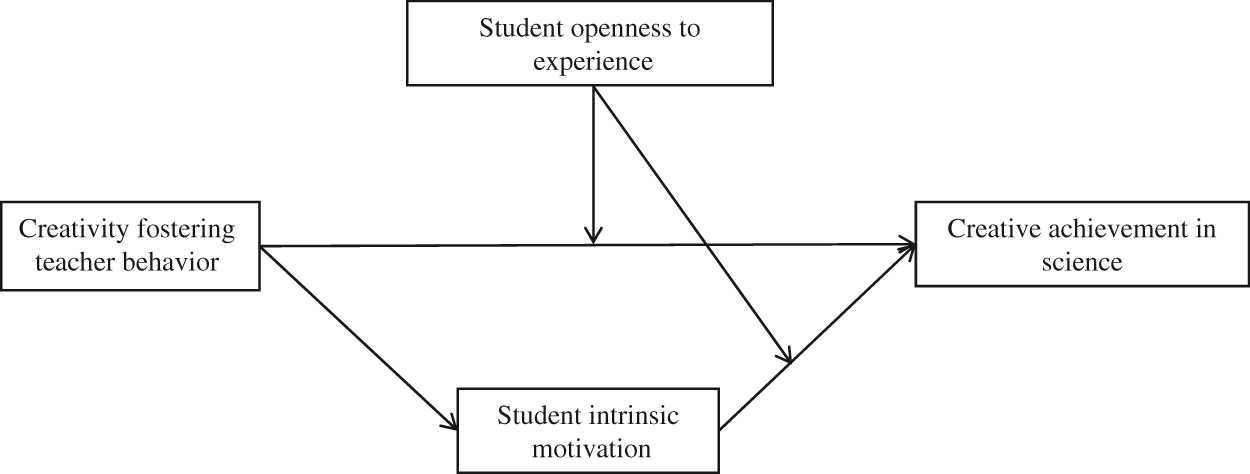

Discussion
The present investigation aimed to understand how teacher behavior affects student creativity. Our findings provide evidence about the joint influence of CFTB and students' intrinsic motivation and openness to experience on student creative achievement in science activities. We therefore contribute to the growing literature considering the positive effects of teacher practices in classrooms (Chan & Yuen, 2014; Lee & Kemple, 2014; McLellan & Nicholl, 2013; Niu & Liu, 2009).
Our integrated framework, which draws on the strengths of the bioecological theory and SDT, could shed new light on understanding the effect of teacher behavior on student creativity. On the one hand, the bioecological theory (Bronfenbrenner, 1979; Bronfenbrenner & Morris, 2006) posits that teacher behavior constitutes a major contextual factor in the micro system of human development. We extended the central tenet of this theory by arguing that teacher behavior is a source of guidance and support for developing student creativity. On the other hand, SDT identifies intrinsic motivation as the mechanism that links contextual factors to creativity (Gagné & Deci, 2005; Ryan & Deci, 2000b). This theory assumes that feelings of autonomy and competence lead to increased intrinsic motivation. Combining these two theories, we theorized that CFTB could enhance student intrinsic motivation by removing hurdles to creative thinking processes while building up autonomy and competence to undertake these tasks (Richardson & Mishra, 2018; Soh, 2017).
Furthermore, the results of the present study hold practical implications. In creativity education, teachers might adopt motivation-enhancing practices that relate to students' self-efficacy. For example, teachers could set the right expectations for completing creative tasks. Prior research showed that setting proper expectations for students is an effective way to upgrade academic performance (Rubie-Davies, 2006, 2010). Students are able to capture a teacher's perpetuation of their capabilities and prospects, which influence their self-beliefs and later achievements (Rubie-Davies & Peterson, 2016). As a result, teachers should design tasks that provide students with opportunities to be successful while challenging their minds at the same time. Meanwhile, providing students timely feedback is also vital in enhancing students' self-efficacy (Pintrich, 2003).
In addition to the main effect, openness to experience was found to explain why some students benefit more from creativity fostering teacher practices. By exploring this moderating effect, we answered the call for more personalized considerations in creativity development (Soh, 2017). Specifically, we argued that student individuality should be recognized and that high school teachers are well positioned to develop adolescent students' openness to experience. For instance, teachers can direct students to think out of the box in the classroom. Outside of class, teachers can lead field trips to a variety of sites that broaden the scope of the curriculum.
Limitations and future directions
There are several limitations of our study. First, we did not specify the teaching subjects across which teacher practices may vary. This subject-specific variation might influence the results of our study. To account for this influence, we recommend future research to focus on teachers whose subjects are closely related to the domain of creative achievement in science. Second, we cannot draw causal conclusions from our study because of our two-wave time-lagged design. Third, students could have observed different kinds of teacher behavior due to variations in attentiveness and time spent with the teacher. To address these concerns, we recommend that researchers collect data from different sources and consider how teachers from different disciplines interact with students (Liebenberg et al., 2016). Fourth, the fit indices of the CFA results on our modified CAQ measure were slightly below .9, which might be attributed to the slightly low correlations among measurement items. Future research could use multi-methods to measure student creativity.
Conclusion
In our study, we found that intrinsic motivation mediated the positive relationship between CFTB and student creative achievement in science activities. Openness to experience moderated this mediated relationship such that the mediating effect of intrinsic motivation was significant only for students with high openness to experience.
Footnotes
Declaration of conflicting interests
The author(s) declared no potential conflicts of interest with respect to the research, authorship, and/or publication of this article.
Funding
The author(s) received no financial support for the research, authorship, and/or publication of this article.