



Abstract
This article focuses on school-leavers who enter employment with a temporary contract in the European context, and examines their probabilities to shift to standard employment or unemployment, and their chances of occupational mobility afterwards. The authors argue that two institutional dimensions of insider–outsider segmentation drive the career progression after a flexible entry: the gap between the regulation of permanent and temporary contracts and the degree of unionization. The analyses show that a disproportionate protection of permanent compared to temporary contracts increases the probability of remaining on a fixed-term contract, whereas the degree of unionization slightly decreases the chance of moving to jobs with higher or lower socio-economic status. Finally, a shift to permanent employment after a fixed-term entry is more often associated with occupational upward mobility in strongly rather than weakly unionized labour markets.
Keywords
Introduction
A consolidated stream of research argues that temporary (or fixed-term) employment – as a specific instrument to cope with structural changes in the globalized economy – is the new source of social inequality in European labour markets (e.g. Barbieri, 2009; DiPrete, 2005; Maurin and Postel-Vinay, 2005). In fact, while some commentators argue that fixed-term contracts (hereafter: FTCs) facilitate firms’ response to labour demand fluctuations, they are often overrepresented among low-paid and low-skilled jobs (Booth et al., 2002; Kalleberg et al., 2000). Moreover, the importance of employment flexibility in structuring inequality in Europe is even exacerbated in some national contexts, where standard and uninterrupted employment careers are the only connection to welfare entitlements, such as unemployment benefits or pension schemes (e.g. in Italy, see Barbieri and Scherer, 2009).
The rising demand for employment flexibility in the European context is reflected in the expansion of FTCs among the youth labour force, allegedly the most common target for flexibilization practices (Barbieri, 2009; Blossfeld et al., 2008). In 2013, about 51% of young employees had a temporary contract in the Southern European countries, whereas this figure is slightly lower in continental Europe (40%), and lower again in Northern (35%) and Eastern (34%) Europe (see Figure 1). However – despite these cross-regional differences – in the last two decades the incidence of temporary employment among the youth has increased steadily in all European countries. Considering the EU averages, the percentage of temporary workers among the youth showed a significant increase from 27% in 1990 up to 43% in 2013.
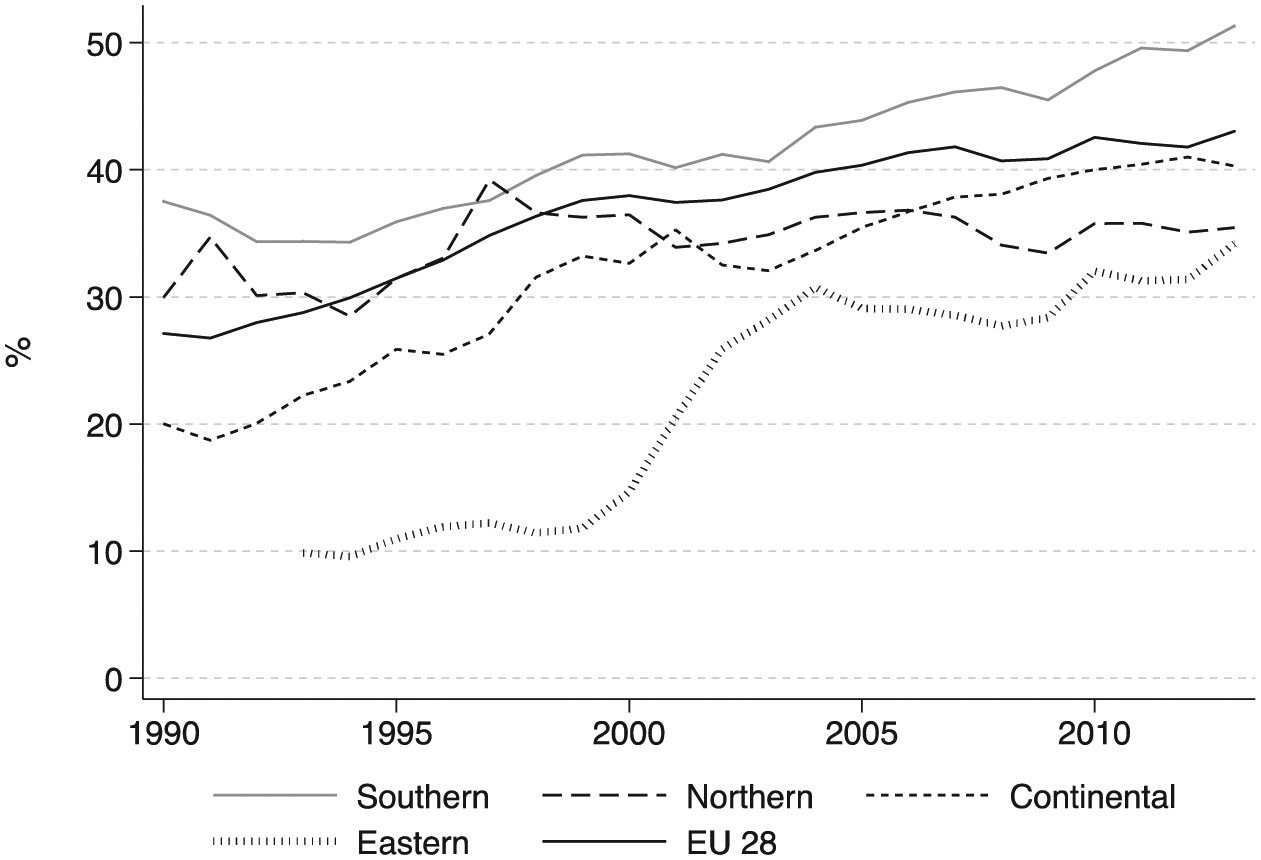
Youth temporary employment rates (% of total employees) in the EU-28 and in different country clusters in the period 1990–2013.
These figures confirm that temporary jobs are part of the early phases of the employment career for many young Europeans. Therefore, it becomes relevant to examine the career progression of the youngsters who experienced employment flexibility at labour market entry. In fact, while being uncertain per se, fixed-term jobs at the start of the career could undermine future occupational development via low skill-accumulation and bad signalling, thus representing a trap for labour market entrants (de Lange et al., 2013; Gash and McGinnity, 2006; Gebel, 2010; Giesecke and Groß, 2003; McGinnity et al., 2005; Scherer, 2004). Moreover – and crucially – previous studies suggest explicitly that the extent to which this entrapment scenario is likely to apply depends on the institutional context (Gash and McGinnity, 2006; Gebel, 2010; McGinnity et al., 2005; Scherer, 2004).
Against this background, we focus on a pool of school-leavers who entered their first ‘real’ job (the first non-casual job lasting at least three months) with a FTC, and examine their probabilities to enter standard employment or unemployment/inactivity (versus remaining in temporary employment), and their chances of occupational mobility in a variety of institutional contexts. Specifically, we question whether institutionally driven segmentation into the labour market leads to worse early career developments for school-leavers who entered the first employment on FTCs.
Our potential contribution to the debate about the diffusion of temporary employment among young people is threefold. First, we contribute to the stepping-stone versus trap debate, which considers, alternatively, FTCs at labour market entry as entry-port to standard employment or as trap into the bad segment of the labour market. In fact, this literature has often found mixed results, depending on the specific countries and periods analysed, but the reasons behind these variations are not well explored. Second, contrary to existing studies that considered institutional configurations only at a theoretical level by focusing on one or a few countries at most, we compare a large number of countries (17) and a relatively broad time-span (1995–2009), in order to parametrize micro-level outcomes on the basis of macro-level determinants. Third, we focus on the role of two interconnected institutional dimensions of labour market segmentation: the gap between the regulation of standard and temporary contracts and the strength of unions.
The entrapment argument
A good starting point to elucidate the entrapment argument is the core–periphery model developed by Atkinson (1984). Although somewhat dated, this model still offers useful insights for understanding the societal consequences of firms’ distinction between permanent and temporary workers. In a nutshell, the model depicts the structure of the modern, flexible firm that organizes its workforce in a core segment – an internalized, highly skilled, well-paid and secure group of workers – and a periphery segment – typically a less-skilled group of workers hired on a temporary basis from the external labour market, and used to buffer demand fluctuations. In this way, firms pursue both functional and numerical flexibility. Functional flexibility is guaranteed by the high-skill profile of core workers with permanent contracts, whereas numerical flexibility is guaranteed by the availability of temporary workers. Nowadays, the distinction between permanent and temporary contracts may have become more blurred and uncertain than in the 1980s when Atkinson developed his model, thus making possible that functional flexibility is also achieved via highly skilled workers hired on a temporary basis (Reilly, 1998). However, it is still more common that the core workers are offered permanent contracts in order to ensure long-lasting employment relationships and avoid poaching, especially when firms’ initial investment in training is conspicuous (Busemeyer, 2009).
At the aggregate level, this firm-level organizational structure mirrors the creation of a two-tier labour market, where a well-protected and rewarded group of workers in the primary segment is neatly separated from a lower paid and less protected group of workers in the secondary segment (Doeringer and Piore, 1985; Kalleberg, 2003). In this perspective, temporary workers in the secondary segment are outsiders compared to permanent workers – the insiders – in the primary segment (Lindbeck and Snower, 1989). One constitutive feature of this segmentation is its persistence over the lifecourse, since in- and outflows from the two segments are scarce.
Starting from this scenario, the entrapment hypothesis predicts that entering the labour market on FTCs, i.e. as outsiders, hinders future career development by means of two basic micro-level mechanisms that operate mainly on the external labour market. First – from a human capital perspective (Becker, 1962) – temporary jobs in the secondary segment may hinder skill-accumulation via poor working conditions and little or no formalized (possibilities for) training on-the-job (Cutuli and Guetto, 2013), thus making fixed-term entrants less attractive for future employers. Second – from a signalling perspective (Spence, 1973) – a flexible entry could represent a bad signal for prospective employers: ‘why was the candidate not worthy of a permanent position?’ It can be argued that flexible entries can be negative signals irrespective of the actual quality of the job: it suffices that temporary jobs are considered inferior compared to permanent jobs.
Therefore, the preconditions of the entrapment argument are that jobs on FTCs are – or are believed to be – part of the secondary segment, i.e. inferior jobs compared to standard employment. As a matter of fact, these two conditions are more likely to be satisfied if there is actual segmentation in the labour market between insiders’ and outsiders’ jobs, with temporary employment being part of the latter. Previous research is well aware of this issue, and it is usually claimed that the extent to which the entrapment hypothesis is likely to apply depends on the actual level of insider–outsider segmentation within a labour market (McGinnity et al., 2005; Scherer, 2004). We empirically test this specific contention.
In what follows, we focus on two interconnected institutional dimensions of labour market segmentation, and we elaborate hypotheses on the role of these dimensions in shaping the career progression after a flexible labour market entry in terms of contractual and occupational mobility. Contractual mobility is defined by shifts into labour market positions that are marked by a different contractual/employment status (permanent employment, unemployment, inactivity) compared to temporary employment (the origin state). Occupational mobility is defined by moves into job positions marked by higher or lower occupational status compared to the first job entered after leaving education.
Institutional dimensions of labour market segmentation: Theory and expectations
The gap between the regulation of standard and temporary contracts
The employment protection legislation (hereafter: EPL) summarizes a series of institutional measures that regulate hiring and firing practices within national contexts (Boeri and van Ours, 2008). More precisely, the EPL for standard employment regulates hiring and firing practices of permanent workers, whereas the EPL for temporary employment sets down specifically the procedures to hire workers on a temporary basis. However, while ‘firing’ is a different process compared to ‘hiring’, we argue that both measures can be read in terms of turnover costs: the stricter the regulation, the higher the turnover costs for employers. In fact – from the employer perspective – excessive hiring costs for temporary workers increase financial loss in case of lay-offs, thus also representing firing restrictions.
The deregulation of employment relationships is one of the main instruments by which EU labour markets have implemented flexibility in response to globalization pressure. In fact, deregulation of the EPL facilitates hiring and dismissal of workers, thus making it easier for employers to adjust the workforce according to demand fluctuations (Bertola and Rogerson, 1997). While boosting productivity growth (e.g. Autor et al., 2007), it has been questioned whether the increased flexibility is reflected in lower job satisfaction and well-being for workers exposed to high levels of uncertainty about their future (Böckerman et al., 2011; Salvatori, 2010).
However – in practice – the ways EU labour markets implemented deregulation in employment relationships differ considerably among national contexts. In some countries, deregulation became the basic principle of labour market policies, whereas in other cases, it was introduced as a controlled experiment and directed towards specific marginal groups (Regini, 2000). These processes of deregulation at the margins usually facilitated the volatility of temporary employment, while leaving the protection of standard employment largely unchanged (Barbieri, 2009; Cahuc and Postel-Vinay, 2002). Therefore, in many countries, this process of partial and targeted deregulation resulted in a disproportionate protection of permanent compared to temporary contracts.
The gap in the protection of permanent and temporary employment (hereafter: EPL gap) is nowadays recognized as one of the main institutional factors driving the insider–outsider segmentation in the labour market (Barbieri and Cutuli, 2015; Polavieja, 2003; Scarpetta et al., 2010). This is because when permanents contracts are disproportionally protected compared to FTCs, employers will tend to use FTCs as buffers from short-term fluctuations in the demand for basic tasks, due to their lower turnover costs compared to standard employment. It follows that, when the EPL gap is high, jobs on FTCs are more likely to be in the secondary segment of the labour market (Centeno and Novo, 2012). As discussed in the previous section, in this insider–outsider setting, FTCs at labour market entry could hamper future career upgrading via low human capital accumulation and bad signalling. 1 However, a fixed-term entry is often considered better than unemployment, which offers the worst opportunity for human capital accumulation and represents the worst signal for future employers (Steijn et al., 2006).
In conclusion, high EPL gaps are likely to increase barriers between labour market segments and, in this way, ‘freeze’ the early career stages of fixed-term entrants. Compared to the situation where EPL is more balanced, fixed-term entrants in the context of a high EPL gap should be less likely to move into the primary segment – that is the prerogative of permanent workers already part of the core workforce – but they should also be less likely to move to unemployment – that is the prerogative of the even ‘more’ outsider labour force who have never entered employment.
The role of unions
Another institutional dimension related to labour market segmentation is the strength of trade unions within a national context (Polavieja, 2003). According to insider–outsider theory, unions protect the interest of the unionized core workforce in the primary segment, whereas the interests of non-unionized people out of the labour market or in peripheral positions have no priority (Lindbeck and Snower, 1989). By contracting wages above the efficiency level and favouring institutional measures to protect the core workforce, unions maximize the interests of insiders, which has the side effect of transferring market risks to outsiders. 2 In this process, unions bargain wages in a way that allows insiders to receive the highest possible wage without eroding their employment positions and their welfare benefits.
While in its early formulation the insider–outsider theory considered employed workers as insiders and unemployed workers as outsiders, recent contributions argue that temporary workers can also be considered part of the outsider group, with no or with a very limited role in the bargaining process (Eichhorst and Marx, 2012; Rueda, 2005).
We argue that – to some extent – fixed-term labour market entrants in contexts of strong unionism are even ‘more’ outsiders compared to fixed-term entrants in contexts where unions have less market power. However, unions could also help youth integration into the labour market by favouring coordination among economic actors (Hall and Soskice, 2001), thus fostering also the partial integration of those who started to work in fixed-term employment. In this sense, unions seem to exert an ambivalent role for the career prospects of fixed-term entrants: they could hinder opportunities of upgrading to better-off jobs and to permanent contracts – but at the same time – they might also protect them from the risk of occupational downgrading and unemployment.
In fact, in contexts where unionism is weak, young people who entered employment on FTCs have the chance to move on the occupational ladder, since there are comparatively few restrictions to occupational and contractual mobility – this could occur in either direction, however. Conversely, in contexts where unionism is strong, young people who entered employment on FTCs have fewer mobility chances. On the one hand, strong unions control the access to core jobs, and therefore impede occupational and contractual upgrading after a fixed-term entry. On the other hand, unions are likely to protect the interests of all workers (Hyman, 2001) – at least to some extent – and therefore fixed-term entrants will be less likely to move to unemployment in contexts of strong unionism compared to contexts of weak unionism. Moreover, strong unionism might enlarge differences among fixed-term entrants by attaching them specific degrees of ‘outsiderness’ on the basis of the quality of the first job they entered. More precisely, in contexts of strong unionism, fixed-term entrants can be considered outsiders compared to their counterparts who entered employment with higher occupational status, and insiders compared to their counterparts who entered employment with lower occupational status. In such scenario, school-leavers who entered employment on FTCs might be more protected from occupational downgrading in contexts of strong unionism than in contexts of weak unionism.
All in all, strong unionism is likely to generate or at least to reinforce the segmentation of the labour market, thus reducing contractual and occupational mobility (in all directions) after a flexible labour market entry.
Hypotheses
We discussed how both a high EPL gap and strong unions – although by means of different mechanisms – generate barriers across labour market segments, thus hindering mobility between the primary and secondary segment, but also between the secondary segment and unemployment. Therefore, we expect both institutional dimensions of labour market dualism to affect similarly the subsequent contractual/employment status of fixed-term entrants. With respect to the EPL gap, we expect fixed-term entrants to be more likely to remain in temporary employment in the early career in contexts where there is a strong EPL gap compared to fixed-term entrants in contexts where EPL is more balanced (hypothesis 1). In a similar fashion, we expect fixed-term entrants to be more likely to remain in temporary employment in the early career in contexts of strong unionism compared to fixed-term entrants in contexts where unions are comparatively weaker (hypothesis 2).
However, the theoretical discussion leads to slightly different predictions of the effects of the two institutional dimensions on the probability of occupational mobility. Regarding the EPL gap, low human capital accumulation and bad signalling might prevent fixed-term entrants from making their way up on the occupational ladder in contexts where permanent employment is disproportionally protected compared to temporary employment. Therefore, we expect fixed-term entrants to be less likely to upgrade on the occupational ladder in contexts where there is a strong EPL gap compared to fixed-term entrants in contexts where EPL is more balanced (hypothesis 3). Nevertheless, the effects of the EPL gap on the probability of downward occupational mobility are largely unpredictable – at least on the basis of our theoretical discussion.
Regarding the role of trade unions on the probability of occupational mobility after a fixed-term entry, predictions are more in line with the idea of ‘frozen’ early careers when unions have strong market power. Indeed, strong unions are likely to protect the access to insider jobs, but, at the same time, unions are likely to attach different degrees of ‘outsiderness’ to fixed-term entrants, thus preventing them from downgrading to even worse occupational positions later in life. For these reasons, we expect fixed-term entrants to be less likely to both up- and downgrade on the occupational ladder in contexts of strong unionism compared to contexts where unions are comparatively weaker (hypothesis 4).
Our last hypotheses try to relate the two labour market outcomes considered: contractual and occupational mobility after a fixed-term entry. Contract type and occupational status are two important characteristics for the evaluation of the overall quality of a job. However, some individuals might have a preference for job stability, whereas others might strive for their socio-economic status. Nevertheless, individual preferences and choices are shaped and constrained by structural, cyclical and institutional factors. For example, individuals may have fewer opportunities to choose between type of contract and occupational status when high unemployment rates reduce the vacancies available on the labour market, or when – given the occupational structure – high-status jobs require long-lasting employment relationships. 3
In this respect, we argue that the institutional dimensions of insider–outsider segmentation that we have considered are two of the main factors constraining individual preferences and choices. Indeed, when labour market segmentation is weak, FTCs are not necessarily bad jobs in the secondary segment, and therefore, fixed-term entrants with a specific preference for temporary employment can upgrade on the occupational ladder without necessarily upgrading to a permanent position. In this context, a weak positive or even no association between contract type and occupational upgrading can be expected.
Conversely, when the insider–outsider segmentation is strong, FTCs are often overrepresented among low-status occupations in the secondary segment, whereas permanent contracts are often attached to high-status jobs in the primary segment. In this context, a contractual upgrading after a fixed-term entry is more likely to come along also with an upgrading in terms of occupational status, and vice versa. Therefore, we expect a stronger positive association between contractual and occupational upgrading after a fixed-term entry in contexts with a strong EPL gap compared to contexts where EPL is more balanced (hypothesis 5). In the same fashion, we expect a stronger positive association between contractual and occupational upgrading after a fixed-term entry in contexts of strong unionism compared to contexts where unions are comparatively weaker (hypothesis 6).
Research design
Data and analytical sample
This article uses data from the Eurostat 2009 Labour Force Survey’s ad hoc module ‘Entry of Young People into the Labour Market’. This module – combined with the standard LFS 2009 – provides specific retrospective information on both the first relevant job obtained after leaving formal education and the current occupational position (in 2009) of people aged 15–34 in 31 European countries. 4 We analyse only the 17 European countries for which comparable macro-indicators and reliable micro-data were available. 5
We restricted the overall sample to young people who entered the labour market for the first time in temporary employment, in order to focus on contextual differences in the early occupational careers of flexible labour market entrants. We defined the early career as the first 14 years after leaving education maximum, and therefore the empirical analysis is restricted to respondents whose last exit from formal education is between 1995 and 2009.
Unfortunately, the ad hoc module collected information on the contract of the first job exclusively for those who changed the first employer, i.e. for those who moved on the external labour market. 6 However, in our case, this selection should not be problematic, since the micro-level mechanisms behind the entrapment argument (low skill-accumulation and bad signalling) operate mainly with respect to new potential employers rather than to the same employer. Therefore – given the focus of the article on the role of institutions via these specific mechanisms – the external labour market is the most appropriate circumstance to study contextual variations in the entrapment dynamics.
After these selections and list wise deletion of missing values, the overall sample includes a maximum of 20,050 cases for which we have data both on individual and contextual characteristics.
Variables and methods
The first dependent variable is the contractual mobility between the first significant job and the employment situation at the moment of the interview (in 2009). We measure the current employment status by distinguishing four categories: temporary employment, permanent employment, unemployment and inactivity. 7
The second dependent variable is the occupational mobility between the first significant job and the current job in terms of occupational status. Occupational status is measured by means of the International Socio-Economic Index (ISEI) (Ganzeboom et al., 1992) on the basis of information from the ISCO-88 classification. Compared to most previous research, we use a lower threshold to define upward and downward mobility, which counts as moves of at least six percentage points on the ISEI scale. We consider even small movements on the scale, since the focus here is on the early career stages (seven years on average), and we cannot expect strong career progression in this limited time-span. The final variable includes three categories: upward mobility, downward mobility and stability.
The main independent variables refer to two different institutional dimensions of labour market segmentation: the EPL gap and union strength. Both variables are measured at the country-year level and matched to individuals according to their year of exit from the first job, allegedly the moment when they restarted the job search. 8
The EPL gap is measured as the difference between the employment protection for standard and temporary employment in a given country and year. Positive values on the index indicate insider–outsider segmentation, whereas the value of 0 indicates that permanent and temporary jobs are equally protected, i.e. no segmentation. 9 Figures for the EPL strictness for regular and temporary contracts are taken from the relative time-series released by the OECD in 2013. We use the difference instead of the ratio, since the EPL gap argument is essentially about differences in turnover costs between temporary and permanent workers, which are by definition very low in both cases when both indices approximate the value of 0, even in the presence of strong positive values of the ratio.
Union strength is approximated by the OECD ‘union density index’, which measures the percentage of wage and salary earners that are members of a trade union over the total amount of wage/salary earners in a given country and year. Although union density may be an imperfect and incomplete measure of strength, it still represents a critical resource for unions’ power (Piazza, 2005; Sullivan, 2009; Visser, 1992). Unfortunately, an alternative measure of union strength, such as the coverage of collective wage agreements, is simply not available longitudinally for many of the countries considered.
Both independent institutional variables are normalized to vary between 0 and 10, which represents the overall theoretical range of variation.
In the last part of the empirical analysis, the focus is on the contextual heterogeneity in the relation between contractual and occupational mobility. Here, the main independent variable is the shift to a permanent job, which measures whether fixed-term entrants are integrated in standard employment at the moment of the interview (1 = yes).
A series of individual-level characteristics that are likely to affect the probability of contractual and occupational mobility after a fixed-term entry are controlled for. More precisely, we include in all models the variables sex, age, parental education (high, medium, low), level of education (primary or lower secondary, upper secondary, tertiary), field of study of the highest level of education attained (general, social sciences and humanities, natural sciences and technical disciplines, health and welfare) and a cardinal variable measuring the time since the last exit from the education system (until the year of the interview).
Unfortunately, some relevant characteristics concerning the first job are not available, such as the sector of employment, and – in this respect – field of study represents only a weak proxy. We exclude from the models the ISEI score of the first job, since the low quality of temporary jobs in segmented labour markets is cause and part of the mechanism (the human capital mechanism) that could explain the reduced contractual and occupational mobility patterns in those contexts. 10
In addition to individual-level variables, a large set of macro-level factors are considered in order to control for contextual differences that are possibly correlated with both the institutional dimensions of segmentation and the outcomes of interest. As for the institutional variables, these variables are also matched to individual data according to the national context and the year of exit from the first job.
The total unemployment rate and the GDP per capita (US$ – divided by 5000) are used to control for cyclical and structural economic factors, respectively. Figures for these measures are taken from the World Bank. The total share of temporary workers over the overall amount of employees, as measured by OECD data, is used to account for the diffusion of temporary employment in different countries and years, which may itself explain the higher or lower propensities of having FTCs later in life. The inclusion of this variable is particularly important, since a relevant number of studies found a positive association between our institutional dimensions of segmentation and the diffusion of temporary employment, particularly for young people (see Hipp et al. [2015] for a review).
The difference between the youth and total unemployment rate is used as a measure of age divide in the distribution of labour market risks. In fact, there are good reasons to believe that the two institutional dimensions of segmentation are positively related to the relative disadvantage of all the young workers compared to the more experienced labour force (e.g. Barbieri, 2009). Therefore, we include the age divide variable in order to ensure that the effect of the institutional dimensions of interest hold for fixed-term entrants in particular, and not for all young people in general. The higher the value of the index, the more young people are disadvantaged compared to more experienced workers. Descriptive statistics for all variables used are reported in Table 1.
Description of the variables (N = 20,050 − unless specified otherwise).
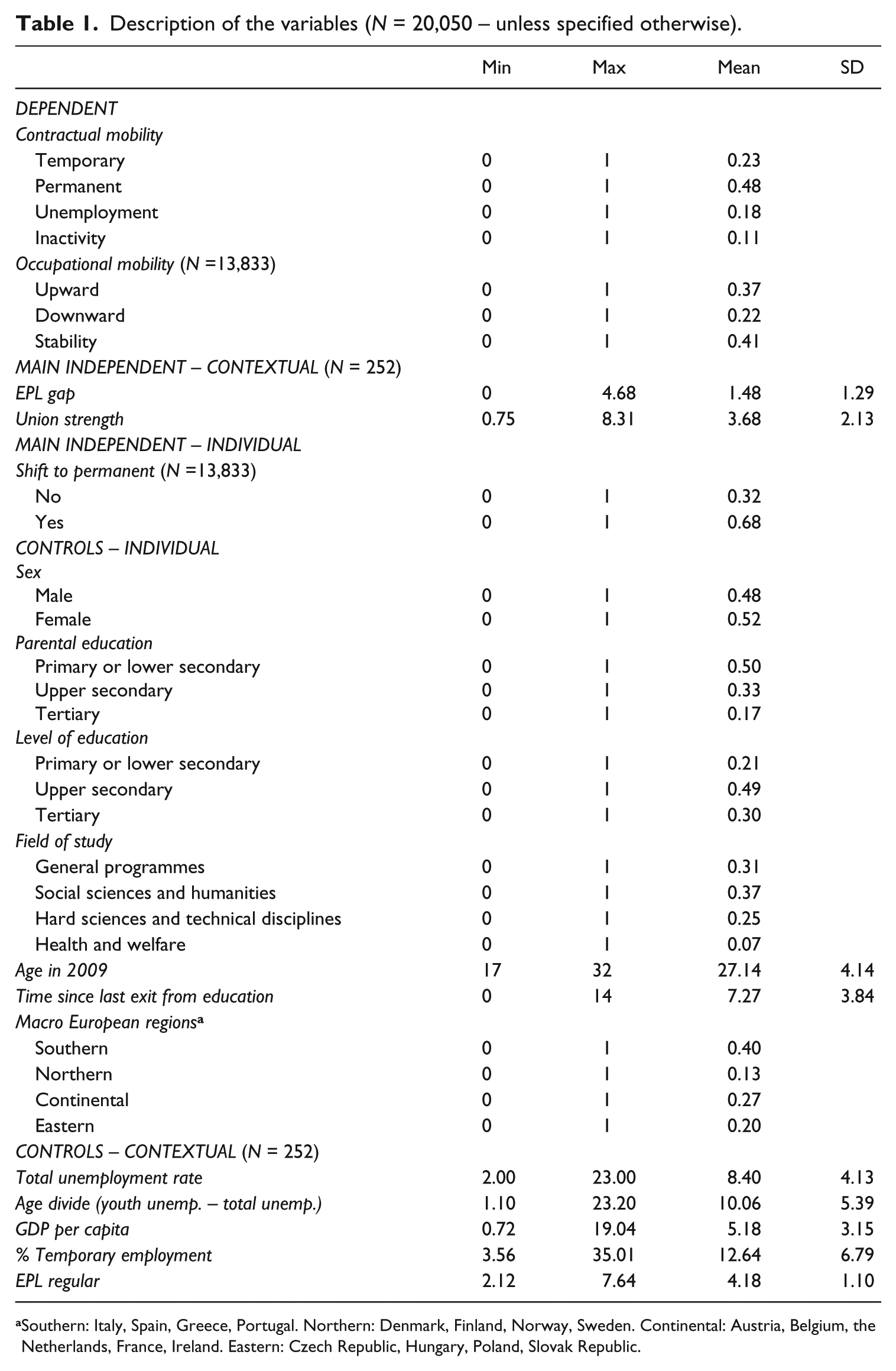
Southern: Italy, Spain, Greece, Portugal. Northern: Denmark, Finland, Norway, Sweden. Continental: Austria, Belgium, the Netherlands, France, Ireland. Eastern: Czech Republic, Hungary, Poland, Slovak Republic.
Given the categorical nature of our dependent variables, multinomial logistic regression models with macro-area fixed effects (Southern, Northern, Continental and Eastern European countries) and clustered standard errors at the country level are estimated. In this setting, the identification of the partial associations of interest relies on cross-country and longitudinal variations occurring within each specific macro-area, i.e. in a context of relative ‘similarity’ among countries. In this way, we rule out the possible confounding effects of time-constant factors at the macro-area level for which we are unable to include specific macro-indicators at the country-year level (such as the generosity of welfare provisions). 11
Findings
Contractual mobility
Table 2 reports the empirical results from the multinomial logistic regression models analysing the log odds of entering standard employment (left panel) and unemployment (right panel) versus remaining in temporary employment after a flexible entry. 12
Multinomial logistic models to analyse contractual mobility after a fixed-term entry: Permanent employment and unemployment vs temporary employment.
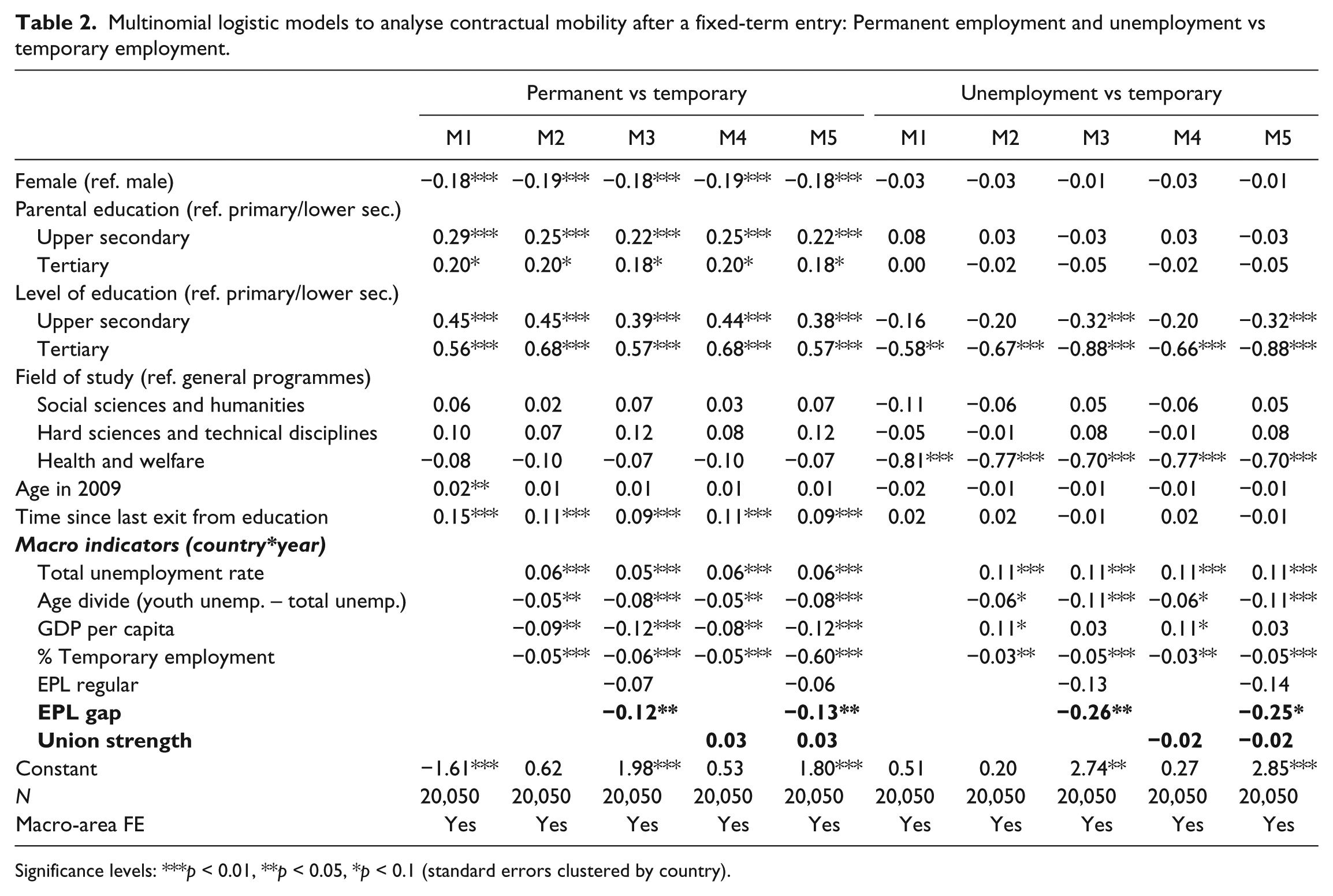
Significance levels: ***p < 0.01, **p < 0.05, *p < 0.1 (standard errors clustered by country).
Model 1 is a baseline model that shows the impact of a series of individual-level covariates once overall differences across European macro-regions are controlled for. For the sake of brevity, we will not thoroughly discuss each single coefficient. This model clearly shows that women who entered the market in flexible employment are less likely to move to permanent jobs than remain in FTCs compared to their male counterparts (b = −0.18). Moreover, this propensity increases both with parental education and especially the level of education of school-leavers. Yet, the time between school-leaving and the year of interview – which can be interpreted roughly as labour market experience – is positively associated with the likelihood of obtaining a permanent contract rather than remaining in a temporary position (b = 0.15). However, looking at the log odds of being unemployed rather than in temporary employment, we generally found neither statistical nor substantial significant associations. A noteworthy exception is the level of schooling: indeed, tertiary education seems to significantly prevent fixed-term entrants from entering unemployment rather than remaining in a temporary position later in life.
In Model 2 – in addition to individual variables and macro-area fixed-effects – we include several macro-level confounders: the total unemployment rate, the GDP per capita, the percentage of temporary workers in the labour force, and a variable measuring the age divide in the labour market. This specification allows us to explore the role of the abovementioned macro-level variables, even if one should bear in mind that it is not specifically designed to systematically evaluate the role of these contextual characteristics. First, the higher the unemployment rate, the higher the propensity of moving out of fixed-term contracts, and especially of moving to unemployment. Second, the higher the GDP per capita, the lower the likelihood of moving to permanent employment rather than remaining in FTCs. This finding may sound counterintuitive, but it might be the result of a lower preference for permanent contracts in wealthier national systems, where the future might be perceived overall less uncertain. Third, the higher the overall share of temporary workers in the labour force, the higher the propensity of remaining in temporary employment rather than moving to permanent jobs or to unemployment. Fourth, the higher the age divide on the labour market, the higher the likelihood of remaining in temporary employment after a flexible entry.
In Models 3 and 4, we add to the previous specification all macro-level confounders and the two institutional variables of interest considered separately. These models allow us to examine the role of the specific institutions when individual and other macro-level confounders are controlled for. Model 3 examines the role of the EPL gap, and therefore it includes also the EPL index for regular contracts to avoid estimates being completely driven by the overall level of employment protection. This model shows that a disproportionate protection of permanent compared to temporary contracts – independently of the overall level of protection – comes along with a lower propensity of moving out of temporary employment after a fixed-term entry. In fact, both the likelihood of having permanent jobs (b = −0.12) and being unemployed (b = −0.26), rather than having FTCs, decrease significantly as the EPL gap increases. In other words – consistent with hypothesis 1 – institutionally driven segmentation in terms of EPL gap comes with higher contractual immobility for fixed-term entrants.
Model 4 examines the role of union strength on the probability of moving out of temporary employment towards permanent employment or unemployment versus remaining in temporary employment. Contrary to hypothesis 2, the model shows no statistically significant effects of union strength. Therefore, we can conclude that the strength of unions does not affect the likelihood of moving either to permanent employment or to unemployment after a flexible labour market entry.
Finally, Model 5 jointly tests the role of the two institutional dimensions of segmentation when controlling for all other covariates. This model provides a further test of our hypotheses, and establishes whether the two institutional dimensions of segmentation exert separate effects on the outcome of interest. This model fully confirms the results from previous specifications: higher EPL gaps are accompanied with higher contractual immobility after a flexible entry independently of union strength (both towards permanent employment and towards unemployment), whereas unions seem not to exert a relevant role in this regard.
Occupational mobility
Table 3 presents the empirical results from the multinomial logistic regression models analysing the log odds of moving upward (left panel) and downward (right panel) versus remaining stable on the occupational scale after a flexible entry. The analytical sample is limited to people who are employed at the moment of the interview.
Multinomial logistic models to analyse occupational mobility after a fixed-term entry: Upward and downward mobility vs stability.

Significance levels: ***p < 0.01, **p < 0.05, *p < 0.1 (standard errors clustered by country).
Model 1, once again, starts with the inclusion of individual-level variables and the macro-area dummies. This model shows that the propensity of moving upward is higher for men compared to women, whereas the propensity of moving downward seems not to differ across gender. Interestingly, the log odds of moving upward (b = 0.03) or downward (b = 0.03) rather than remaining stable increase as an individual’s potential labour market experience increases, thus suggesting that labour markets tend to adjust initial skill–job mismatches during the first stages of the occupational career. Finally, level of education seems generally to protect from downgrading risks, but is not associated with the log odds of upgrading further on the occupational scale. This result is consistent with better educated school-leavers having better skill–job matches and higher socio-economic positions at labour market entry, also among fixed-term entrants.
In Model 2, the effects of the individual-level variables are jointly estimated with contextual characteristics such as cyclical and structural economic factors, the overall share of temporary workers, and a variable measuring the age divide in the labour market. Although not specifically intended to detect systematically the role of the abovementioned contextual features, it is worth taking a closer look at the results.
First, school-leavers who entered the labour market on FTCs seem more likely both to upgrade and to downgrade on the occupational scale in times of bad economic circumstances than in times of low unemployment. This result clearly indicates polarization in the mid-term occupational outcomes of fixed-term entrants in times of economic downturns. However, structural factors – such as the GDP pro capita – are positively associated with occupational ‘immobility’ after a fixed-term entry. Finally, the overall share of temporary workers in the labour market seems not to be associated with the propensity of moving on the occupational ladder afterwards.
In Models 3 and 4 we test our hypotheses 3 and 4 by adding separately the two indicators for the institutional dimensions of labour market segmentation. As for contractual mobility, Model 3 examines the role of the EPL gap, and therefore includes also a variable indicating the EPL strictness of regular contracts to avoid estimates being completely driven by the overall level of employment protection. This specification clearly shows that a disproportionate protection of permanent contracts compared to FTCs does not affect the propensity of moving upward or downward on the occupational scale after a fixed-term entry. Therefore, hypothesis 3 cannot be supported.
In Model 4, we test hypothesis 4 against the data by including the union strength indicator. Interestingly, net of other individual and macro-level confounders and comparing similar countries, we find a negative association between the degree of unionization and the likelihood of moving downward (b = −0.09) on the occupational ladder, and a negative (b = −0.05), but not statistically significant association with the likelihood of moving upward. This result provides only partial support for hypothesis 4, which predicted less occupational mobility in contexts of strong unionism compared to contexts of relatively weak unions.
Finally, Model 5 provides a further test for our research hypotheses by estimating simultaneously the effects of the EPL gap and union strength. On the one hand, even controlling for the role of unions, disproportions in the protection of regular and temporary employment are not associated with the propensity of moving on the occupational ladder. On the other hand, the hypothesis about the role of unionism finds more robust corroboration when the legislative arrangement in terms of protection of permanent and temporary contracts is taken into account: the higher the union strength, the higher the occupational immobility after a fixed-term entry.
Are contractual and occupational upward mobility systematically related?
Table 4 once again reports the results from the multinomial logistic regression models analysing the log odds of moving upward (left panel) and downward (right panel) versus remaining stable on the occupational scale, but the focus now is on the relation between contractual and occupational mobility. Also in this case, the analytical sample is limited to people who are employed at the moment of the interview.
Multinomial logistic models to analyse the relation between contractual and occupational mobility after a fixed-term entry: Upward and downward mobility vs stability.

Significance levels: ***p < 0.01, **p < 0.05, *p < 0.1 (standard errors clustered by country).
Model 1 includes only a key variable detecting whether respondents shifted to a permanent job or not, and the individual-level variables and macro-area fixed effects as controls. This model shows that the likelihood of being upward mobile rather than immobile is higher for fixed-term entrants who shifted to a permanent contract compared to fixed-term entrants who remained in a temporary position (b = 0.22) – net of relevant individual-level characteristics and overall contextual differences among European macro-regions. In the same vein, a shift to a permanent contract is negatively associated with the propensity of moving downward rather than remaining stable (b = −0.20). Therefore, generally speaking, contractual and occupational upward mobility after a fixed-term entry seem to be strictly related. This scenario is fully confirmed once heterogeneities within macro-regions in terms of cyclical, structural and institutional factors are controlled for (see Model 2).
In Models 3 and 4 we specifically test hypotheses 5 and 6 by adding an interaction term for the variable indicating a shift to permanent employment and the indicators for the EPL gap and union strength, respectively. 13 Since the substantive interest is the association between contractual upgrading and the likelihood of moving upward, results regarding the likelihood of moving downward are not discussed. The results are as follows. On the one hand (see Model 3), the main effect of the variables detecting a shift to a permanent job is positive and significant (b = 0.20), while its interaction coefficient with the EPL gap is nearly 0. Therefore, contrary to hypothesis 5, a shift to permanent employment seems to come along with a higher propensity of upward mobility in all contexts, and not specifically in contexts where the insider–outsider segmentation in terms of the EPL gap is stronger. On the other hand (see Model 4), the coefficient of the interaction term with union strength is positive and significant (b = 0.04), and the main effect of this variable is positive, but not statistically significant. This suggests that, in line with hypothesis 6, contractual and occupational upgrading are more likely to come together in more segmented rather than less segmented labour markets, at least when insider–outsider segmentation in terms of union strength is considered.
Finally, Model 5 confirms previous findings by estimating the two interaction terms simultaneously: upward mobility and contractual upgrading come together irrespective of the EPL gap, but their positive association is stronger in more segmented markets in terms of union strength.
Discussion and conclusions
In this article, we examined the early career stages of flexible labour market entrants in a context of institutional variety. In particular, we focused on two institutional dimensions of labour market segmentation – the EPL gap and union strength – as determinants of contractual and occupational mobility after a fixed-term entry. The topic has received great attention in the last two decades, as the share of fixed-term employment has generally increased among young people, and the occupational trajectories of those who enter the labour market in a flexible position are not well explored in comparative perspective.
Our empirical findings provide some insights on the entrapment hypothesis. More precisely, we demonstrated that, once having entered the labour market on FTCs, the probabilities of moving to different contractual and occupational positions on the external labour market largely depend on the actual level of insider–outsider segmentation. The higher this segmentation, the larger the likelihood of being ‘entrapped’ in the contractual and occupational position obtained immediately after school-leaving. Previous studies provide some theoretical support for this claim (e.g. McGinnity et al., 2005; Scherer, 2004), but they are lacking in systematic empirical evidence (for an exception, see Barbieri and Cutuli, 2015).
We have shown how a disproportionate protection of permanent contracts compared to FTCs ‘freezes’ the early occupational careers after a fixed-term entry. In fact, in the context of a strong EPL gap, fixed-term entrants are more likely to remain in a fixed-term position rather than moving to permanent employment or to unemployment compared to a context where the EPL gap is low. In substantive terms, the probabilities of remaining in a fixed-term position increase by approximately 14 percentage points moving from contexts with no EPL gap (0) to contexts where the EPL gap has the maximum value (4.68) observed in the data (see Figure 2). However, the gap in the protection of permanent and temporary employment does not account for any influence on the likelihood of upgrading or downgrading in terms of socio-economic status. Conversely, the strength of unions does not impact on the probability of contractual mobility, while slightly influencing the chance of obtaining a job with a different socio-economic status compared to the first one. More precisely, moving from the minimum (0.75) to the maximum (8.31) observed value of union strength, the probabilities of moving upward and downward on the occupational scale decrease by approximately 6.5 and 9 percentage points, respectively (see Figure 3).
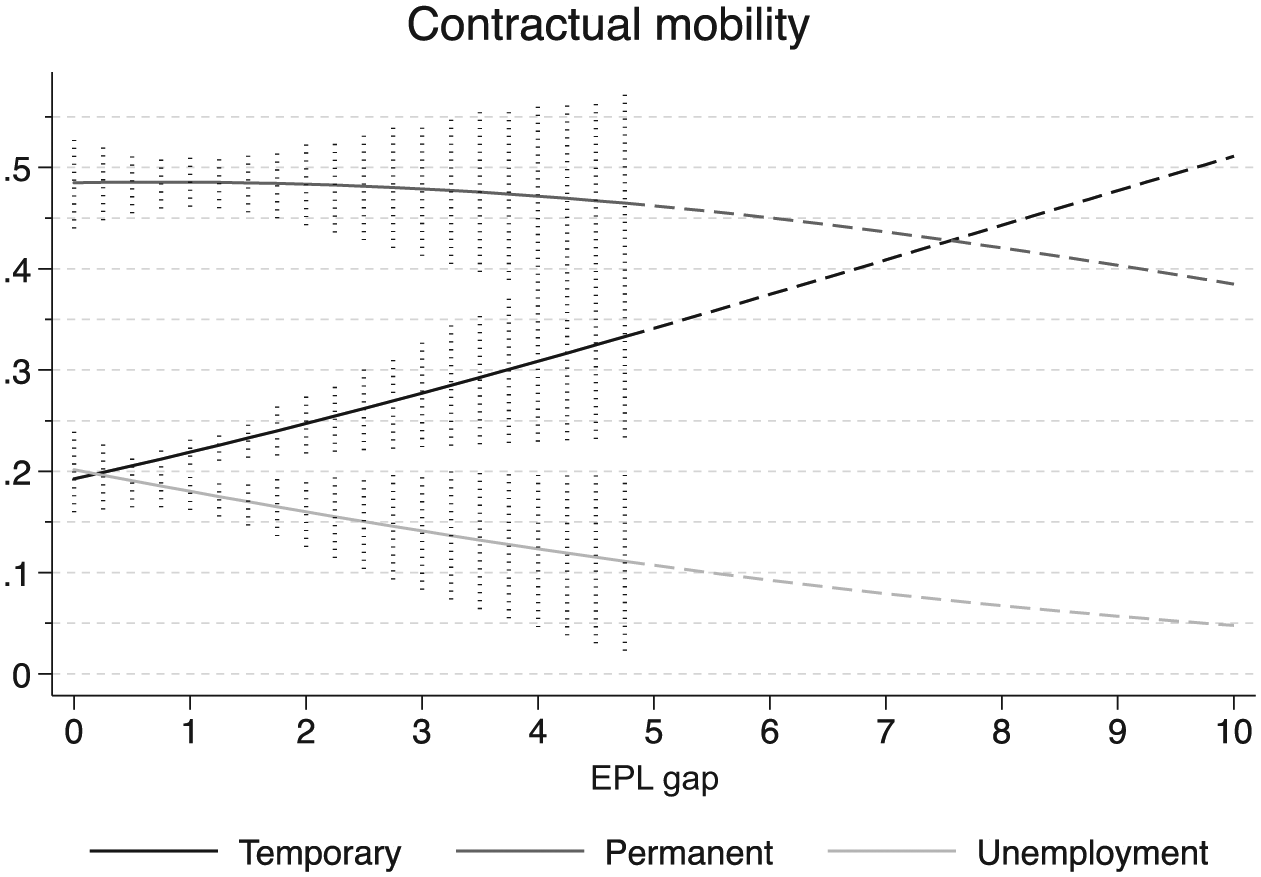
Predicted probabilities and 95% confidence intervals (Table 2, Model 5) of being in temporary contract, permanent contract, or unemployment after a flexible entry for different levels of EPL gap (dashed parts indicate extrapolation).
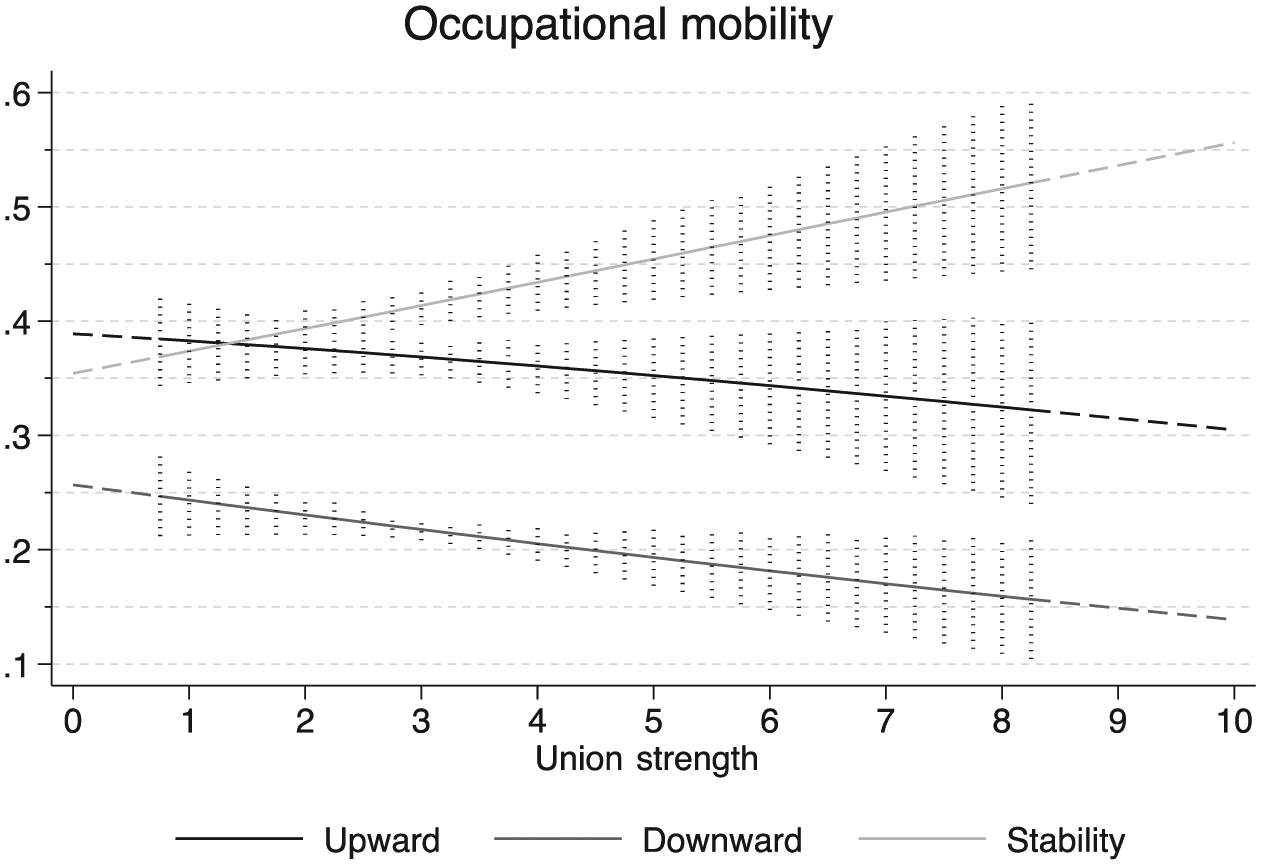
Predicted probabilities and 95% confidence intervals (Table 3, Model 5) of moving upward, downward, or remaining stable on the occupational scale for different levels of union strength (dashed parts indicate extrapolation).
Moreover, we tried to relate the process of contractual and occupational mobility in a single framework. We provided evidence that contractual and occupational upgrading after a flexible entry is likely to come together. However, a shift to permanent employment after a fixed-term entry more often leads to upward mobility in segmented rather than non-segmented labour markets, at least when segmentation in terms of union strength is concerned. As Figure 4 shows, in contexts where union strength is at the minimum observed value (0.75), shifting to a permanent contract after a fixed-term entry increases the probability of upward mobility by 5 percentage points approximately, whereas in contexts where union strength is at the maximum observed value (8.31), this increase is up to 10 percentage points. This is understandable, since in contexts where strong unionism increases barriers across labour market segments permanent contracts are often overrepresented among high-status jobs.

Predicted probabilities and 95% confidence intervals (Table 4, Model 5) of moving upward on the occupational scale comparing subjects who shifted to permanent contracts and subjects who remained on temporary contracts for different levels of union strength (dashed parts indicate extrapolation).
All in all, these results underscore the importance of distinguishing different aspects of the insider–outsider segmentation on the labour market, both theoretically and empirically. Indeed, when focusing on two institutional dimensions of the segmentation by type of contract – the EPL gap and union strength – we found evidence that the two dimensions do not equally impact on the outcomes considered, and that they exert separate, specific and independent effects. This result, although in contrast with our hypotheses, is understandable if we consider that the mechanisms by which we predicted similar effects differ considerably between the two institutional dimensions of segmentation.
The obtained results may have a wider relevance for scholars and policy makers. On the first point, we contributed to the long-lasting debate about the possible detrimental occupational consequences of flexible employment in the beginning of the career. In fact, we demonstrated in this article that the extent to which fixed-term contracts at labour market entry influence future career advancement on the external labour market depends on the actual level of institutionally driven segmentation. More specifically, this finding could contribute to explain why previous studies analysing the consequences of temporary employment at labour market entry found mixed results when focusing on different countries and periods, often marked by very different institutional arrangements.
The relevance for policy makers lies in the chance to modify the current institutional settings in order to boost the efficiency of labour markets. In fact, a more balanced protection of permanent and temporary contracts and less union strength seem to increase the mobility across labour market segments (both in terms of contract type and occupation), and – in this way – could improve the efficiency of the job-allocation process in the early career. However, while more balanced employment protection legislation could represent a viable policy leverage to boost efficiency, the degree of unionization cannot be considered as a specific target for public policy. Indeed, union membership often reflects the democratic nature of the bargaining structures in Western countries. Therefore – as far as efficiency is the primary goal of policy makers – our results suggest that in strongly unionized contexts an adequate combination of policies and institutional arrangements should promote adequate initial skill–job matches, since in these contexts any initial mismatch seems hardly adjustable afterwards.
Finally, it is important to discuss four possible limitations of our article and suggestions for future research. First of all – although offering some insights on the contextual determinants of entrapment dynamics – our research design does not allow us to draw any specific conclusions about the integrative potential of FTCs on the internal labour market. In fact, data limitations prevented us from examining contextual variations in the functioning of FTCs as extended probation periods, possibly followed by permanent contracts with the same employer. Conditionally on the availability of better cross-country data at the individual level, future research would benefit from examining jointly the contextual determinants of the stepping-stone and the entrapment scenarios.
A second point concerns the cross-sectional nature of the data used in this article, which prevented us from analysing multiple moves after the first, flexible labour market entry. Compared to earlier generations, occupational trajectories after the first labour market entry are currently more complex, and are often constituted by a mixed sequence of events that includes education, training, temporary employment, permanent employment and unemployment spells. Unfortunately – given the focus on the role of contextual characteristics – these issues are hardly manageable due to unavailability of comparable full employment-history data for a wide set of countries.
Third, future research would benefit from considering possible heterogeneities in the effects of institutionally driven segmentation for the career progression of fixed-term entrants. For example, women could be particularly affected by strong unionism, since they are traditionally underrepresented in work councils compared to men. Yet, strong unionism and unbalanced employment protection legislation could impact more strongly in sectors of employment where unions are more active and labour legislation more effective.
Fourth, the article analysed the role of unions at the national level. However, the degree of unions’ centralization is likely to differ cross-nationally. Cross-country variation in the extent to which unions bargain at the national, industry, or workplace level could have significant implications for the relation between union strength and the career progression after a flexible entry. While some degree of simplification in measuring concepts is unavoidable in empirical research, taking into account the cross-country variation in the levels at which unions bargain seems a promising area for future research on the topic.
Footnotes
Appendix
Multinomial logistic models: Inactivity vs temporary employment.

| M1 | M2 | M3 | M4 | M5 | |
|---|---|---|---|---|---|
| Female (ref. male) | 1.21*** | 1.21*** | 1.23*** | 1.20*** | 1.23*** |
| Parental education (ref. prim./lower sec.) | |||||
| Upper secondary | 0.13 | 0.08 | 0.04 | 0.08 | 0.04 |
| Tertiary | −0.01 | −0.03 | −0.04 | −0.03 | −0.04 |
| Level of education (ref. prim./lower sec.) | |||||
| Upper secondary | −0.07 | −0.12 | −0.29** | −0.14 | −0.29** |
| Tertiary | −0.57** | −0.61*** | −0.90*** | −0.64*** | −0.90*** |
| Field of study (ref. general programmes) | |||||
| Social sciences and humanities | −0.22 | −0.20 | −0.05 | −0.18 | −0.05 |
| Hard sci. and tech. disc. | −0.27 | −0.27 | −0.13 | −0.25 | −0.13 |
| Health and welfare | −0.53** | −0.50** | −0.39** | −0.48** | −0.39** |
| Age in 2009 | −0.02 | −0.01 | −0.01 | −0.01 | −0.01 |
| Time since last exit from education | 0.12*** | 0.12*** | 0.09*** | 0.12*** | 0.09*** |
|
|
|||||
| Total unemployment rate | 0.09** | 0.07*** | 0.09** | 0.07*** | |
| Age divide (youth unemp. – total unemp.) | −0.03 | −0.07*** | −0.03 | −0.07*** | |
| GDP per capita | 0.11* | 0.02 | 0.11* | 0.03 | |
| % Temporary employment | −0.03** | −0.04*** | −0.02* | −0.04*** | |
| EPL regular | −0.28*** | −0.26** | |||
|
|
|
|
|||
|
|
|
|
|||
| Constant | −1.70*** | −1.97** | 1.04 | −2.31** | 0.75 |
| N | 20,050 | 20,050 | 20,050 | 20,050 | 20,050 |
| Macro-area FE | Yes | Yes | Yes | Yes | Yes |
Significance levels: ***p < 0.01, **p < 0.05, *p < 0.1 (standard errors clustered by country).
Declaration of Conflicting Interests
The author(s) declared no potential conflicts of interest with respect to the research, authorship, and/or publication of this article.
Funding
The author(s) received no financial support for the research, authorship, and/or publication of this article.