




Abstract

In 2009, with the support of a university grant, an online multimedia tutorial system was developed to teach the Malay language braille code to learners who are sighted in Malaysia (Lee, 2011). eKodBraille became the first fully automated open-access e-learning course on Malay braille code instruction. This system, which is available online at http://ekodbraille.ses.usm.my, continues the endeavor to use distance education as a pathway for braille instruction in the last two decades (Herzberg et al., 2016). The primary purpose of eKodBraille is to teach the Malay braille code and its rules to preservice special educators at Universiti Sains Malaysia (USM), Penang, Malaysia, through the massive open online courses (MOOCs) platform. MOOCs are defined as free online courses that allow for unlimited participation, enabling students to learn independently at their own pace without the constraints of a specific schedule (Kaplan & Haenlein, 2016). In addition, the full eKodBraille course is offered online to the general public for free as a social responsibility project of the university to increase braille awareness, especially among stakeholders in the Malaysian community (The Star, 2011). Therefore, eKodBraille is open to everyone without entry qualifications and can be accessed for free by anyone anywhere (MOOCs, as defined by OpenupEd, 2015).
The features of eKodBraille that enable learners to learn independently at their own pace include content that is structured systematically into five levels, 10 units, and 21 lessons. Figure 1 captures the overall menu in the eKodBraille tutorial system. Figure 2 captures a lesson in Unit 5.

eKodBraille menu.

A lesson in unit 5.
The systematic grouping of content allows for information to be delivered in a way that is perceived by students as not being overly burdensome, a best practice guideline on MOOC creation (Northwestern University’s Coordinated Services Center, n.d.). The use of direct instruction and mastery teaching approaches supported by pedagogical features such as practice exercises with feedback, worked examples, animations, and progress reports enable self-paced learning (Lee et al., 2015). Figure 3 are screen captures of a practice exercise with corrective feedbacks (when correct and when wrong). The incorrect braille sign is highlighted for correction. Features in the eKodBraille system that are designed to promote engagement include online awards of certificates at each level of completion, braille games, and virtual tutors. The online award reward feature was rated the highest among other features in eKodBraille by the 77 preservice special educators surveyed during the design and development phase (Lee et al., 2015).

Practice exercise with corrective feedback (when correct and when wrong).
Progressive evaluation of student performance is measured within the automated eKodBraille system through formative tests at the end of each lesson and summative tests at the end of each unit. In total, there are 21 formative tests and 10 summative tests. The summative tests are cumulative in nature, which means that the final summative test (the 10th summative test in the system) measures the whole course content. All performance measures in the system are set at 100% mastery criterion, which means that the students are required to obtain correct scores in all of the practice exercises and formative and summative tests before the system allows them to advance to the next knowledge unit. All performance measures comprise of two types of tasks, which are braille writing (print to braille) and braille transcribing (braille to print).
The eKodBraille MOOC system is custom-designed and coded using Python language programming. A braille simulator was custom-built, so that braille codes can be digitally written using a set of keys on the computer keyboard. Keys F, D, S represent braille dots 1, 2, 3, and keys J, K, L represent braille dots 4, 5, 6. Figure 4 shows screen captures of animations teaching learners how to write braille using the braille simulator. The braille simulator enables practice exercises to be interactive (see Figure 3) and allows braille writing and transcribing tests to be fully automated online. A detailed description of the design, development, and evaluation of the eKodBraille system is reported in Lee et al. (2015).
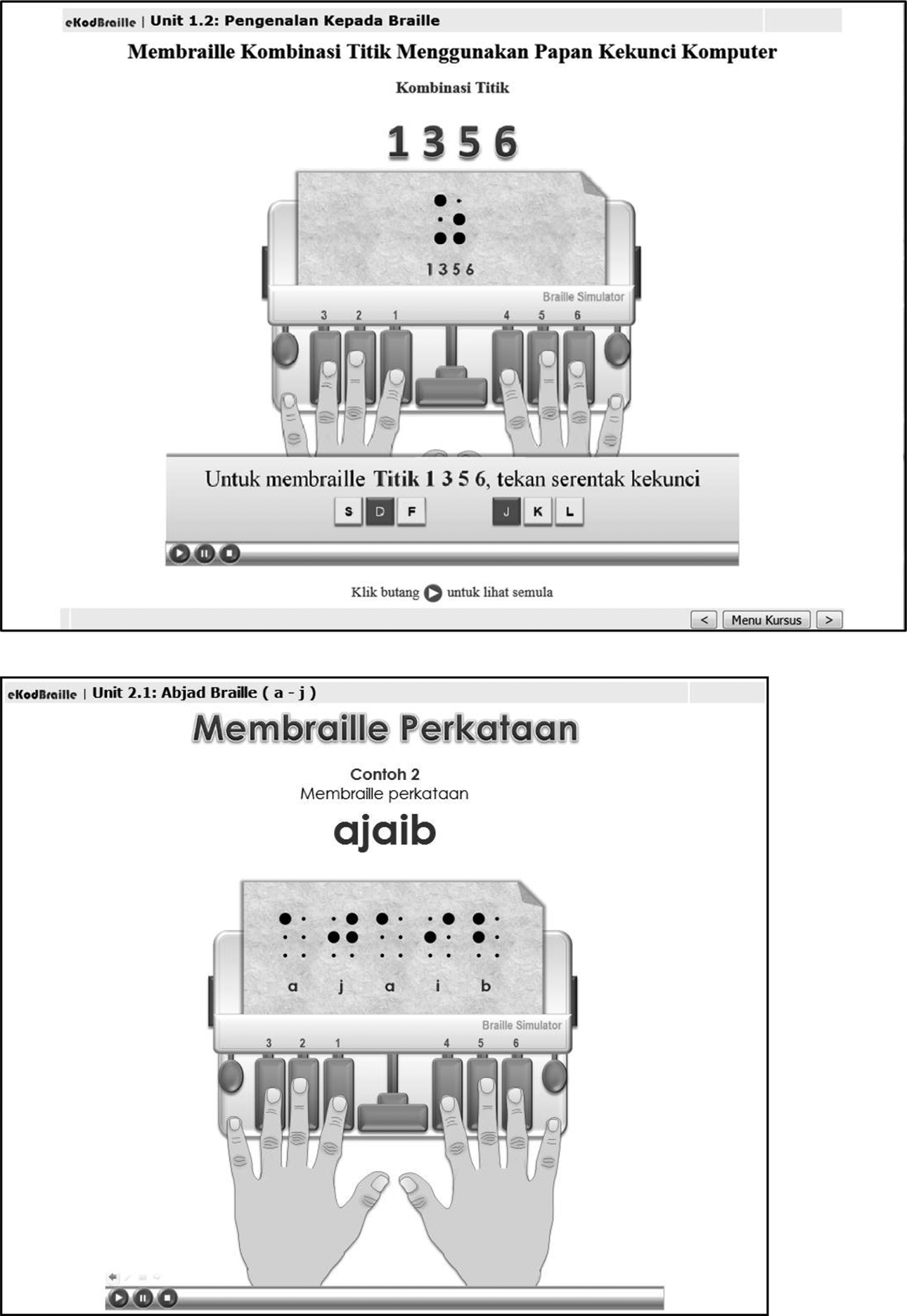
Writing braille using the braille simulator.
This article examines the indicators of success typically measured through learner assessment on the MOOC platform (Kaplan & Haenlein, 2016), learner completion rates (Jordan, 2015), and learner perceptions on course quality (Hew et al., 2020).
Method
In order to assess whether the eKodBraille system has been successful in teaching the preservice special educators at USM, a braille test was administered to a cohort of 69 student teachers upon their completion of the eKodBraille course through independent study. The braille test consisted of braille writing and braille transcribing tasks. The items include words, mathematical symbols, and connected texts. The cut-off test score was set at 80%. Furthermore, a learner perception scale (Lee et al., 2015) that measured six subconstructs (quality of the system, flexibility of learning, perceived usefulness, ease of use, learner satisfaction, and learner confidence) were administered. Each item rated according to a 4-point Likert-type scale (1 = strongly disagree; 2 = disagree; 3 = agree; and 4 = strongly agree).
To evaluate whether the secondary purpose, to increase braille awareness among the community, was achieved, the completion rate of all course registrants from the past 8 years (from March 2011 through March 2019) was calculated. The data for completion rates were extracted automatically from the eKodBraille internal data tracking system; it was then analyzed in Microsoft Excel. The completion rate is defined as the percentage of enrolled learners who achieved the mastery criterion score of 100% in the final summative test.
Results
Braille test scores
The braille test scores of the 69 samples are summarized and presented in Table 1. Referring to Table 1, 85.5% (33.3 + 52.2) of the student teachers scored above the cut-off score of 80%. Only one sample scored below 50%.
Braille test scores.

Learner perceptions
The descriptive statistics of the six subconstructs in the learner perception scale are presented in Table 2. The average mean scores of the subconstructs ranged from 3.62 to 3.94 (agree or strongly agree), which indicated positive perceptions toward eKodBraille. The highest rated subconstruct was “perceived usefulness” followed by “learner satisfaction.” Flexibility of learning using the eKodBraille system was also rated highly.
Descriptive statistics of learner perception subconstructs.

Completion rates
The total number of course registrants was 848 (see Table 3). The course is compulsory for the student teachers at USM, the hosting institution (53.54% of course registrants). The rest of the course registrants (46.46%) registered independently on their own online. This group comprised special education teachers, general education teachers, social workers, parents, and students from other universities (non-USM students). Referring to Table 3, the completion rate of the overall learners was at 48.82%. As expected, the highest completion rate (83.04%) was among the student teachers at USM, for whom the course is compulsory. Even though all of the student teachers at USM completed the course, the scores of those who did not achieve the mastery criterion score in the final summative test were not counted into the completion rate. As for the other stakeholders in the Malaysian community, the course completion rate ranged from 0% to 16.18%. Among the other stakeholders’ group, the social workers in nongovernment organizations (NGOs) providing services to people with visual impairment in the Malaysian community had the highest completion rate of 12.18%.
Course completion rate by job role.

Note: USM is the hosting university. NGO = nongovernment organization; USM = Universiti Sains Malaysia.
Discussion
The braille test scores indicated that 85.5% of the student teachers scored above the cut-off score. The learner perceptions scores also indicated positive perceptions toward eKodBraille. These findings suggest that the primary purpose of eKodBraille, to teach the Malay braille code to preservice special educators at USM through the MOOC platform, has been at least 85.5% achieved. However, the secondary purpose of promoting braille awareness among other stakeholders in the community needs further attention: Even though these stakeholders were motivated enough to register for the online course on their own, they did not fully complete the all five levels of the course. A low completion rate is a common problem among open-access online courses. Based on a study by Jordan (2015), the completion rates for 221 MOOCs varied from 0.7% to 52.1%, with a median value of 12.6%. The USM student teachers’ completion rate (over the past 8 years) beats this average, whereas the completion rates of most of the other stakeholders fell within the range cited by Jordan (2015). As virtually anyone can register for open courses, many students can enroll in the course without ever participating, and students continue to drop out at virtually every point during the course (Balakrishnan & Coetzee, 2013). Hew et al. (2020) proposed that the extent of learner satisfaction with the course rather than learner completion rate should define the success of MOOCs, since completion rates fail to account for the diverse goals and needs of MOOC learners. The cohort of student teachers tested in this study gave a high rating for learner satisfaction. Nevertheless, as with other open online courses, the completion rate of the eKodBraille tutorial system still needs to be improved.
Despite the lower completion rate, the return on investment for the MOOC-based braille code instruction system is still viable, since any individual can learn the Malay braille code anytime and anywhere ad infinitum, without the need for braille machines. Finally, the eKodBraille experience contributes toward the ongoing evolution of braille literacy and communication media (Wittenstein, 2006) from the perspective of a language other than English.
Implications for practice
The first implication for practice is that a fully automated braille tutorial system is viable and sustainable for the long term. Therefore, the development of systems for online braille code instruction in a language other than English throughout the world is encouraged and promoted. The appeal for the community serving people who are blind lies in the accessibility of standardized braille code instruction from any geographical location, an answer to the significant lack of trained braille instructors.
The second implication for practice is the need to identify factors that can further motivate and engage learners to fully complete an open online braille code instruction course. Apart from the organization of braille code content into incremental systematic units, the provision of practice with immediate feedback and extrinsic motivation in terms of reward and recognition contributes toward engagement in online braille code learning (Herzberg et al., 2016; Lee, 2011; Lee et al., 2015). Other factors related to the promotion of engagement to achieve course completion need further investigation.
Conclusion
Overall, the study results contribute to the growing body of knowledge about the potential of MOOCs for the field of visual impairment. The potential of MOOCs to promote braille awareness outside of the blind community to the wider general public is promising and should be further explored.
Footnotes
Declaration of conflicting interests
The author(s) declared no potential conflicts of interest with respect to the research, authorship, and/or publication of this article.
Funding
The author(s) disclosed receipt of the following financial support for the research and/or authorship of this article: This study received funding from Universiti Sains Malaysia Research University (Grant ID 1001/PGURU/816129).