



Abstract
Keywords
Children, aged birth through 3 years, with visual impairments (i.e., blindness or low vision) have unique needs. The challenges faced by families and guardians of these young children are alleviated by the partnership formed with specialized professionals. These professionals help families learn about their child's visual impairment, as well as the effect of the visual impairment on the child's development (Anthony, 2014). Teachers of students with visual impairments, certified orientation and mobility specialists, and other professionals provide support to families in order to promote the best possible future outcomes for their children.
Young children with visual impairments require specialized knowledge and services from all members of their educational team. These professionals not only need to be well versed in early childhood development, they also need to have a firm grasp on how a visual impairment affects development and learning. Vision professionals assist families in helping their children meet developmental milestones (Anthony, 2014). Development for a child with visual impairment can be delayed, and children with additional disabilities are more likely to experience lags in one or more areas of development (Hatton et al., 1997; Kesiktas, 2009). Thus, early intervention is essential for these children.
The first early intervention services for young children with visual impairments in the United States began when a nursery was opened in Hartford, Connecticut, in 1893 for neglected blind babies (Koestler, 1976). Similarly, the Boston Nursery opened its doors on January 1, 1901, to two babies who were blind (Boston Nursery for Blind Babies, 1901). It was established to provide services and experiences to those children who were too young to enter kindergarten in their neighboring schools. Early intervention services became more available on a national level for young children in the United States in the 1930s (Ferrell et al., 2014). The service delivery model also changed across time. For example, by the mid-1930s, the Hartford nursery had been replaced with a “mother's counselor” to serve infants in their home environment (Koestler, 1976). Early intervention services continue today to provide a foundation that will affect the growth and the development of children with visual impairments the rest of their lives (Anthony, 2017).
Although there is limited research about what types of programs meet the needs of children who are visually impaired, the services needed by these children have been well documented. Services should address the priorities of the families, and professionals should provide emotional support to families and facilitate the child's development (Hatton et al., 2002). Similarly, services should support young children in building their orientation and mobility skills and encourage supportive parent–child interactions (Kesiktas, 2009). Professionals should model how to promote turn-taking and how to respond to a child's communicative attempts in different situations (Kesiktas, 2009). Supportive interactions were supported by Chen (1999), when she detailed the benefits of center-based services for early intervention for infants, toddlers, and preschool-age students with visual impairments. Working with infants and toddlers in their natural environments which include homes, day care centers, homes with supportive family members or guardians, and preschools is a foundational tenet of Part C services for children under the age of 3 years (Individuals with Disabilities Education Act, 2004).
In the early spring of 2020, governments were beginning to react to the news of a global pandemic being caused by COVID-19. In order to reduce the spread of the disease, lockdown mandates were issued that included closing schools and making a shift to online learning. In some instances, that shift happened over a weekend. Ultimately, 48 US states closed schools for the rest of the 2019 to 2020 academic year, affecting more than 50 million students across the United States (Decker et al., 2020).
By May 2020, remote instruction was common, and hundreds of educators had died from COVID-19 (Decker et al., 2020). Similarly, most schools in provinces across Canada had transitioned to remote instruction for the rest of the academic year, since their school buildings were closed (Aurini & Davies, 2021). The authors heard multiple anecdotal comments from teachers of students with visual impairments and other service providers, including professionals serving infants and toddlers, who were scrambling to provide virtual educational services to their students while parents and caregivers were left to manage the needs of their children while often trying to work from home or take care of other children in the home or both. There was really no documented guidance as to how to go about this type of service delivery for children with visual impairments who required early intervention services. The only other pandemic situation in which educational services were affected occurred during the influenza pandemic of 1918. Although there was some documentation regarding how services were provided to students with visual impairments during that time, early intervention services had not yet begun, thus, there was no guidance to be found for how to go about teaching these young children during the COVID-19 pandemic. As a result of this lack of documentation, a team of researchers came together to capture what was happening during this current pandemic so that they might document its impact on education and services to families. This article specifically addresses the effect on early intervention services for children with visual impairments from birth to 3 year of age, as reported by their family members or guardians.
Purpose
The purpose of this study was to examine the qualitative data collected as part of the larger survey about the experiences of young children with visual impairments and their families to answer the following research questions:
1. What was the impact of the COVID-19 pandemic on students with visual impairments age birth to 3 years and their families?
2. How did changes in early intervention services impact the families and guardians of these children?
Methods
Instrument
Less than 3 weeks into the shutdown, an online survey was created to investigate the effect of the COVID-19 pandemic on the education of children and youth with visual impairments, including those with additional disabilities. The survey also explored the experiences of family members, teachers of students with visual impairments, and orientation and mobility specialists during the initial shutdown. This survey was reviewed for readability, but it was not assessed for validity and reliability, due to the urgent need to collect the data during the initial pandemic-related lockdown. The online survey was divided into eight sections. The sets of questions are available from the first author upon request.
Three sections of the survey were designed for family members of children with visual impairments aged birth to 21 years, and three sections were developed for teachers of students with visual impairments and orientation and mobility specialists. There were also two demographic sections: one for participants from Canada and the other for participants from the United States. Each demographic section contained 21 parallel questions, including demographic questions about the participant, their employment status, their access to technology and the Internet, and the size of their family. Participants were allowed to choose which questions to answer, take a break and return to the survey, or opt out of answering most questions. “Skip logic” was then used to direct family members or guardians to the demographic section for their country of residence.
This article addresses those survey participants who indicated that they were family members or guardians of a young child (aged birth through 3 years) with a visual impairment who were directed to the appropriate survey designed for their group. That set of questions contained 19 multiple-choice and open-ended questions. This article specifically addresses the results of the answers to the open-ended questions about the experiences of family members with young children with visual impairments. Examples include:
Because of COVID-19, how, if at all, has the plan changed to transition your child to preschool? Describe how the changes in early intervention services, as a result of the COVID-19 pandemic, have impacted your child and family. How have you balanced the need to work from home and provide for your child’s educational needs? Please share any additional challenges, successes, and concerns you have related to your child’s education as a result of the COVID-19 pandemic.
Recruitment
Before recruitment began, a website was built to share information about the survey and the link to the survey. Beginning on April 22, information about the survey was widely advertised on electronic discussion groups and Facebook pages that were frequented by parents of young children with visual impairments. Collaborating US and Canadian organizations and companies such as the National Braille Press and Council for Schools and Services for the Blind also shared information about the survey with their consumers. In addition, information about the survey was posted on the American Printing House for the Blind and the American Foundation for the Blind websites.
The study was open to families of children and youths with visual impairments, including those with multiple disabilities and deafblindness. Each parent provided informed consent before completing the survey. Families with more than one child with a visual impairment were invited to provide information about all of their children, if desired. All methods used in this study were reviewed and approved by each researchers’ university or organizational Institutional Review Board.
Participants
The larger research study contained a total of 1,432 participants, who represented parents of children with visual impairments, teachers of students with visual impairments, and certified orientation and mobility specialists that completed the survey from April 22 to May 13, 2020 (Rosenblum et al., 2020).
Of those who completed the survey, 441 were parents and guardians (hereafter, referred to as parents), and they shared information about 455 children. Of those parents, 62 reported that they had a child aged birth to 3 years. The responses given by these participants form the basis for the information contained in the current article. All 62 participants reported the age of their child. Forty percent (n = 25) of the children ranged in age from birth to 2 years, and 60% (n = 37) were aged between 2 and 3 years old. Approximately two-thirds of the participants answered the demographic questions. The majority of participants who reported their demographic information were female (n = 39) and White (n = 30). See Table 1 for additional demographic and background information of the participants.
Background Data of the Participants.
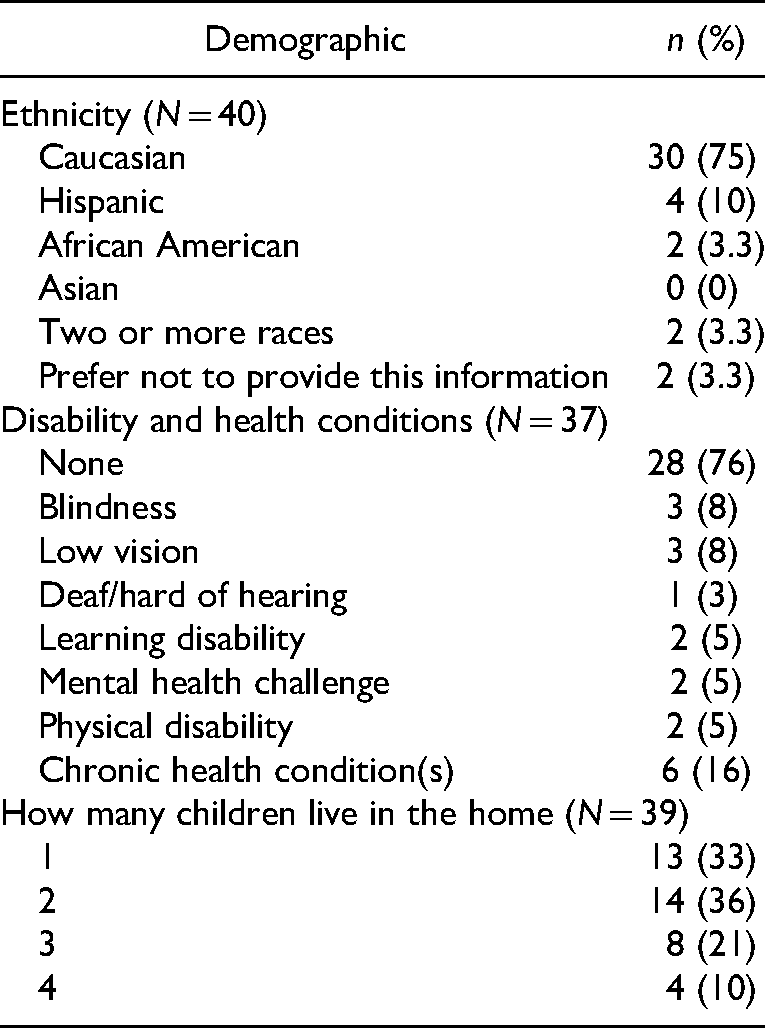
Participants were also asked about their current employment status and their Internet access at home. Of those responding to the question, six (14.3%) reported they were an “essential worker,” and 17 (40.5%) reported that they were working remotely from home. Of the 18 parents who were not working, 6 (14.3%) were furloughed and 3 (7.1%) had lost their job since the beginning of the pandemic. Two also shared that they had applied for a job recently. Additionally, 41 (97.6%) shared that they currently had Internet access at home.
Thirty-one out of 62 families reported they continued to receive services during the shutdown. Of those families, 21 families reported using online meeting spaces such as Zoom or Google Hangouts, 19 received recommendation for online resources, 15 received emails with activities to implement in the home, 19 received materials or toys via the postal service or delivery made by an educational team member, and seven received telephone calls (Rosenblum, et al., 2020). Fifteen family members reported a decrease in services while 14 family members reported no change in services.
Data Analysis
The first two authors examined the qualitative data. It was analyzed by coding and examining themes within each question, as well as overall themes within the data. Glasser's method of constant comparative analysis was utilized (Glasser, 1965). This method allowed researchers to explore and describe a phenomenon. Researchers coded responses together and separately once preliminary codes were established. Overall, when coding the data separately, the researchers had a 51% consistency rate. Discussion of differences with the coding resulted in changes, which reflected 100% agreement.
Responses to open-ended questions could contain one or more codes. For instance, when parents were asked, “Describe how the changes in early intervention services, as a result of the COVID-19 pandemic, have impacted your child and family.” several responses were long and contained multiple pieces of information that were individually coded. See the following example of the coding process: My child can no longer go to school or to his private therapy appointments. [code: lack of services] I feel like I have to be a million different things to try and keep him progressing. It is very stressful! [code: parental stress]. Therefore, when coded responses are reported, the number of reported responses could exceed the total number of participants.
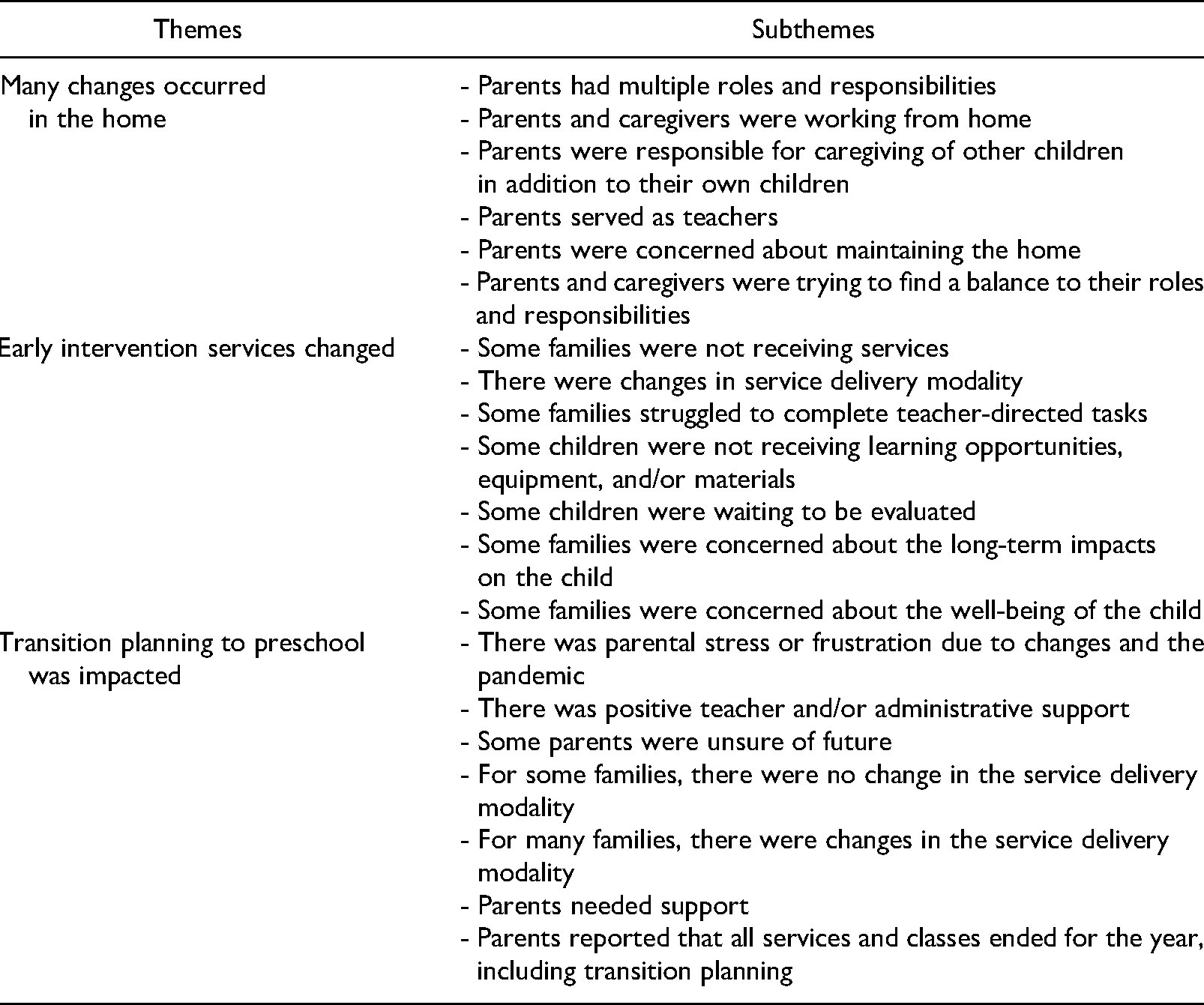
Each qualitative response contained between one and four codes. In addition, multiple questions could contain answers across the same theme. In addition, not all families answered all questions; it was not required for participation in the survey. The researchers did not look at answers provided by each individual parent across the questions, but rather analyzed these data as a collective group of answers provided by parents to each question. Data presented by question were generated by any of the 62 parents who participated in the survey, and response rate varied by question. A table of generated themes and subthemes is presented in Table 2.
Themes and Subthemes.
Results
Results are presented as major themes of the data when analyzed as described. Those responses about a single topic that did not support major themes are not reported below.
Changes at Home
Parents reported that they were trying to work from home while caring for and teaching their young children, all while trying to maintain the household. When asked to share about how they balanced their need to work from home and provide for their child's educational needs, 14 of the 37 coded responses focusing on this theme reflected on multiple roles and responsibilities, and 10 were about the stress of trying to balance roles at home. One parent wrote, “Trying to take care of our son while also trying to work means that he doesn’t get as quality of care as he gets with a full time caregiver.” Parents were trying to balance different roles at different times of the day. Another parent said, “It’s a work in progress. My husband takes care of the kids while I am working or in class (I’m a full time PhD student as well as working from home). Work gets done during nap times and bedtime.” All of these changes led to many comments about parental stress, feeling overwhelmed, and concerns for the children. One parent said, “My child can no longer go to school or to his private therapy appointments. I feel like I have to be a million different things to try and keep him progressing. It is very stressful!”
Changes in Early Intervention Services
The participants with young children with visual impairments reported concerns related to the shutdown when answering the questions in the survey. This theme emerged over multiple questions, not a single question posed on the survey. Data indicated that there were concerns about their child's education and lack of services compared to before the shutdown, change in service delivery modality, and the inability to complete teacher-directed tasks. This finding was supported by comments about a lack of learning opportunities, inability for evaluations to be completed, concerns about long-term implications related to the change in services, their child's well-being, and lack of equipment or resources, which could accompany parental stress and frustration. One parent stated, I’m frustrated though that our district and our state EI [early intervention] had 0 [no] plan for doing remote instruction for VI [visually impaired] Kids. It feels like they are guessing at what to do. Plus no one considered the needs of blind parents at all. Basically none of the apps and websites that are out there that our district has shared with families work with screen readers. As for accessible learning apps/websites, [specific examples given used in the district], I've had to tell the public school TVI about them, not the other way around.
However, there were bright spots. Parental comments included the ways in which their teachers continued to support their families and children, allowing service delivery to remain uninterrupted. One parent stated, “We have appreciated the efforts made by our TVIs to continue providing at-home suggestions and opportunities to connect with teachers and other families.” Others commented on the positive aspects of the change to the service delivery. One parent felt that services delivered at home were helping her child to positively improve her health and well-being. “Scheduling is much easier, because we are always home with my child. She is also significantly healthier because she has not been around other people, and has been making astounding strides in development.”
Impacts on Transition Planning
When asked about the impact on transition, 12 families responded to the question. Seven families indicated that they were unsure how COVID-19 and the shutdown would impact their child's transition to preschool. One parent stated “I’m just not sure when my son will be able to attend school, since the schools are closed…” While answering the questions, four family members indicated that no change would happen while one family described changes to service delivery, need for support, and programs ending. Another parent shared, He is still transitioned to preschool for his TVI and O&M services but they will be electronically provided through video and consultation. We haven’t had our first meeting but I’m concerned about how successful this will be as other tele health services haven’t been engaging for him.
The uncertainty was evident in the responses received as many parents were waiting to see what would happen with continued closures and planning for the upcoming year.
Limitations
The survey instrument was not tested for validity or reliability. Due to the nature of the work, the researchers developed the questions quickly in order to respond to the shutdown due to the early outbreak of the COVID-19 pandemic. The researchers wanted to quickly gather this data at a historical time in our world. Thus, survey questions were vetted for readability only. In addition, due to a problem with the survey logic, 21 participants in this study were not given the opportunity to answer demographic questions about themselves.
The parents who completed surveys most likely had computers or smartphones and answered their questions online. No option to participate by telephone was offered. Thus, parents who participated may represent a more advantaged group than parents who did not have the resources to complete the survey. It is possible that parents with limited resources experienced a greater impact from the pandemic.
The survey did not require participants to answer all questions. In addition, comments varied in the amount and depth of response. Results are reported as overall themes and not by responses to each individual question or by participants’ collective responses across the survey by demographics or experiences discussed in the data. The results represent a holistic view of the data provided by all respondents.
Given these limitations, the results of this research are not generalizable. They are limited to the opinions of those that took the survey, the specific questions, and depth of responses to each question they answered. However, the participants’ responses do offer insights into the experiences of parents with infants and toddlers with visual impairments during the initial shutdown in spring 2020.
Discussion
Overall, the changes in education due to the pandemic and initial shutdown resulted in much parental stress. Parents reported that they were stressed and sometimes overwhelmed by the sudden and dramatic changes in their daily lives and how best to help their children in continuing to learn and develop their skills while simultaneously working from home, being caregivers to the other children in the family, and serving as educators and sometimes informal therapists to their children. These changes were particularly stressful for parents with young children, especially when multiple children were in the home and the youngest learner had a visual impairment.
Only 31 of the 62 families reported that their children were continuing to receive services (Rosenblum et al., 2020). Open-ended responses provided concrete illustrations about how the lack of services and changes in service delivery were difficult for many parents and children. For example, one parent shared, “We are not receiving necessary services. We have not been provided with services promised before the pandemic. I am being expected to provide 4 therapies [each] day on top of everything else.” For other families, services moved to an online format and were provided remotely. It can be especially difficult to keep a child's attention directed at a screen for an extended amount of time at this age. Another parent stated, “It’s tricky for a toddler to learn anything beneficial from video chat. She likes her instructors, but only interacts in very short stretches w/ a person on a screen. She engages more in person.” Other families reported that services were limited to emails and telephone calls.
Further compounding the problem was that some parents did not know what to do to help their child or know what resources were needed. Becoming the service provider went beyond the typical role expected of parents. They needed access to resources, supplies, and information on how best to provide educational opportunities for their children. A parent of two young children with visual impairments shared, The agency's group sessions don't fit with our parent work schedule. [Plus] I never seem to have the materials needed to do the OT projects with my daughter outside of class time. Our TVI drops off materials occasionally, and that helps. She also brailles books for us if I buy them in print and leave [them] for her. In general, though, the video sessions don't seem helpful for my daughter. The TVI and OT try to talk to us parents during the sessions, but I have kids running around…. So we're all doing our best.
Many parents were unsure of the impact the changes would have on their child's development and future plans for transition. Screenings, testing, and educational planning meetings were all interrupted by the sudden closing of schools and centers. This uncertainty was another source of stress for parents. However, some parents were loving the chance to spend additional time with their young child and experience first-hand the positive impact of therapies and intervention were having on their child—something they could not typically witness when services were being provided while they were at work or the child was in a controlled environment like a daycare. Additionally, some parents were very understanding and appreciative of all the service providers were trying to do.
Implications and Future Research
This research provides some context about the struggles parents and their children were facing during the pandemic-related lockdown. The theme of changes at homes can provide insight into the home life of young children with visual impairments, especially for service providers. This research documents the struggle some parents were facing during the initial shutdown due to the pandemic. Furthermore, it documents the changes in service delivery and transition services that were experienced by the participating families. Research such as this can serve as a historical marker for future researchers examining the impact of the COVID-19 pandemic and be used to better prepare service providers in case of a future global pandemic.
The results have implications for the field of visual impairment. Service providers should continue to provide services to families and children who have been impacted by the COVID-19 pandemic and resulting shutdown. It is critically important that these young children are provided consistent opportunities to learn and develop. Service providers should also take into account that sudden shifts in service delivery can be very difficult for families. As one parent shared, My child doesn't do well with the [Z]oom meetings with her providers. It usually ends with me chasing her around the house while they are on the call. I don't think she is doing as well as when we have face-to-face interactions with her team. I'm ready to be done with all meetings via [Z]oom, as they are more stressful than helpful.
In addition, service providers should provide flexibility for scheduling visits at times that work best for the family. One parent shared, “I schedule all the virtual lesson during my lunch hour or after I get off work. I’ve been amazed that the team is OK meeting at 5 sometimes.”
Some parents became more aware of their child's learning and developmental needs. They commented that it was powerful to witness the interactions with service providers’ first-hand and see their children making progress. Some parents also reported more communication with service providers. One parent reported, “I’m in constant communication with all of his teachers. Whereas, before COVID-19 I would get an update about 1–2 times a month.” Parents should be encouraged to become active participants in their child's services, as well as empowered to advocate for the needs of their child.
Service providers and families should monitor their children's development and learning both now and in the future. If children experience delays or do not have educational opportunities due to another shutdown, additional support should be provided in order to minimize the long-term effects. Evaluations, meetings, and transition planning must continue in spite of the pandemic. The field of visual impairment should consider long-term planning for future emergency or crisis situations in order to ensure continuity of services.
As identified in the larger study, professionals should facilitate families connecting with each other so that they can support one another, share resources, and problem-solving stressful situations (Rosenblum et al., 2020). These relationships may mitigate feelings of isolation and help families continue to be resilient during a very challenging time period. Hopefully these connections will become lifelong supports as their children grow.
In the near future, research should focus on the immediate and long-term impact of the pandemic on families with young children with visual impairments, assessing both developmental and academic growth. Future research should explore exactly how the transition from early childhood to preschool was affected for students who turned 3 years of age during the pandemic. Additionally, future research should reach out to a broader range of participants to reflect the diversity of students with visual impairments and families served in the United States and Canada. Future research should also evaluate the effectiveness of remote service delivery for infants and toddlers. In addition, strategies for expanding parental involvement in early intervention services should be explored.
Footnotes
Declaration of Conflicting Interests
The author(s) declared no potential conflicts of interest with respect to the research, authorship, and/or publication of this article.
Funding
The author(s) received no financial support for the research, authorship, and/or publication of this article.