



Abstract
Keywords
In 2000, the National Plan to Train Personnel investigated the number of teachers of students with visual impairments (TVIs) in the United States. Mason and Davidson's analysis estimated 7,300 TVIs were currently employed, approximately 400 new TVIs were entering the field annually, and a shortage of 5,000 TVIs to meet the contemporary needs of students with visual impairments (Mason & Davidson, 2000). During the 2020–2021 school year, the number of TVIs was relatively unchanged from 2000 (Savaiano et al., 2022). The federal count of students with visual impairments and deafblindness also remained relatively unchanged during this time period (Mason & Davidson, 2000; U.S. Department of Education, 2020), suggesting the need for TVIs has remained the same. Importantly, these data only account for students with a primary disability of visual impairment or deafblindness; accurate, total population data for these students are not available in many states (Schles, 2021). According to Shore (2020), data in Texas documents a 30% growth in the population of students with visual impairments or deafblindness in the last 10 years (2010: 8,475 students; 2020: 11,125 students) while the number of direct service providers (TVIs and orientation and mobility specialists) has only grown about 9% (834 vs. 908 providers). Nearly 10 years prior, similar shortages were predicted (Davis, 2011). This shortage of TVIs is a systemic issue with multiple causes, including a lack of qualified individuals to hire, along with administrators and district-level decision makers not posting vacancies for positions they believe cannot be filled (Mason & Davidson, 2000). Given the perpetual, and potentially escalating, shortage of TVIs, teacher preparation programs, and broader educational systems need to consider how to increase recruitment efforts to end the TVI shortage.
Systemic Shortage of Teachers
Skilled teachers delivering high-quality instruction are critical to ensuring students with disabilities find success during and after their school years. Schools in the United States face critical teacher shortages, coupled with high levels of teacher turnover (Carver-Thomas & Darling-Hammond, 2019). Teacher turnover impacts the effectiveness of schools, as well as the morale of teachers and students; leads to increasing monetary costs for schools and districts; and results in inconsistent educational services for students (Carver-Thomas & Darling-Hammond, 2019). Teacher shortages are a systemic, chronic issue (Dewey et al., 2017) that exists across teaching domains (Eren & Tezel, 2010). Students with disabilities do not receive appropriate services when teacher shortages are not addressed (Bremer, 2012). Decreasing enrollment in teacher preparation programs hinders the ability of the field of visual impairment to adequately address the teacher shortage (Vanderslice, 2012). Furthermore, high levels of teacher turnover compound the effect of teacher shortages (Ronfeldt et al., 2013).
One strategy to address the shortage of teachers is targeted recruitment of teacher candidates. The limited research on the recruitment of teachers includes the demographics of teacher candidates (Brookhart & Freeman, 1992), their motivations for entering the field (Eren & Tezel, 2010), and the influence of early teaching experiences (Brookhart & Freeman, 1992; Richardson & Watt, 2007). Motivations for entering the field frequently relate to altruistic or service-oriented goals, wanting to “make a difference,” a desire to work with young people (Watt et al., 2012), and beliefs that their own individual characteristics would make them good teachers (Malderez et al., 2007). Research suggests that the motivations of special and general education teachers for entering the field are similar (Bremer, 2012).
Shortages of Teachers of Students With Visual Impairments
The national shortage of TVIs is well documented (e.g., Ajuwon & Craig, 2008; Mason & Davidson, 2000), and teacher preparation programs face the same recruitment issues as schools (U.S. Department of Education, 2016). Due to the low prevalence of students with visual impairments, prospective teacher candidates and current teachers likely lack previous experience with individuals with visual impairments and are unaware of the field of visual impairment. The shortage and retention problems are particularly prevalent within rural communities (Ajuwon & Craig, 2008).
Several attempts have been made to address shortages of TVIs over the last few decades. Preparation programs have focused recruitment efforts in high-need areas, allowed teachers to continue working during their education, partnered with school districts, and adjusted tuition (Garcia & Harley, 1991). TVI preparation programs were early to adapt to online education and to include a distance education component (Ambrose-Zaken & Bozeman, 2010). Increasingly, TVI programs are developing online, hybrid models, and regional consortium models to specifically navigate the geographic barriers to the limited number of programs (Ajuwon & Craig, 2008). Targeted recruitment of highly motivated teachers who will remain in the field long-term may be one way to further address the teacher shortage (Heinz, 2015).
Understanding who chooses to become a TVI is an important step in creating plans for recruitment. However, little research exists exploring the motivations of these individuals, or what guides their selection of preparation programs. Hong et al. (2000) looked at how vision professionals learned about the field and why they decided to enter it. Many learned about the field through a professional contact and entered the field because of a desire to do good. Once in the field, TVIs have reported feeling prepared by their programs and believe that they made the correct decision to become a TVI (Davis, 2011).
To continue investigating their motivations for entering the field of visual impairment, the current study surveyed graduates from a preparation program in the Southeastern United States. The authors sought to answer four questions:
What were the demographic characteristics of the individuals who entered the program? What influenced these graduates to pursue licensure to become a TVI? What factors played a role in the professional's selection of a preparation program? What experiences do TVIs value from their teacher training?
Method
Participant Recruitment
Participants from a university-based TVI preparation program in the Southeastern United States were recruited for the study. The program is an R1 institution (i.e., a university with very high research activity that offers doctoral programs) that provides in-person instruction and requires all students to complete more than 200 hours of practicum experience under the mentorship of an experienced TVI, plus an additional semester for those seeking initial licensure. The program also offers students the opportunity to work with faculty and community leaders on research or community-related service projects. Eligible participants were those who had graduated from the program with a bachelor’s or master's degree in Visual Disabilities Special Education between 2000 and 2020. Using program records, contact information for 90 graduates was located, and this group was contacted via email. Potential participants were encouraged to share the survey with their program cohorts. The survey was open for 5.5 weeks in January and February 2021; it was available electronically via REDCap. The Institutional Review Board (IRB) at a Southeastern University in the United States approved the study and all participants completed a survey agreement before answering survey questions.
Survey Instrument
The survey consisted of 17 questions across four themes:
demographics and background, the decision to become a TVI, the selection of a preparation program, and student and alumni experiences.
The demographics and background section included six multiple-choice questions. The second section included two optional, open-ended questions on how and why participants decided to become a TVI. The third section included four multiple-choice questions regarding how they heard about the program and what factors influenced their decision to attend, with optional write-in responses. The last section included three open-ended questions about their experiences as students in the program, a question that asked for ideas about how to recruit new teachers to the program, and a question about their interest in volunteering in program recruitment. A copy of the survey is available on request from the first author.
Validity and Reliability
Three experts reviewed the survey prior to its release for reliability and validity. Each were TVIs who were current or retired coordinator of personnel preparation programs. The experts suggested minor edits to improve clarity and added two open-ended questions in which participants could report their own personal experiences.
Data Analysis
To address the quantitative research question (RQ1), data cleaning and preparation involved summarizing write-in short responses (e.g., undergraduate degree major, prior teaching license held). Write-in responses were organized to include a code for the geographic region of the undergraduate schools the participants attended and prior teaching license categories. Descriptive statistics were calculated for all numeric and closed-ended multiple-choice questions.
The open-ended survey questions were separately coded by the authors based on a combination of a priori goals and inductive exploration (Saldaña, 2015; RQ2, RQ3, RQ4). The responses to open-ended questions were coded in two rounds. The first round involved open coding or identifying individual thoughts or ideas within each response. Next, codes were reviewed for similarities to develop the final list of codes. Codebooks were developed for each survey question. Lastly, the researchers identified conceptual themes which ran across two or more open-ended survey questions.
Credibility and Reliability
The authors maintained research journals for coding decisions and analytic observations about the dataset for the credibility of the data cleaning and qualitative coding. Reliability for data cleaning and preparation was addressed by having the secondary coder check all recoded and new variables created by the primary coder. Across the 16 variables and new categories created, nine had 100% agreement between the coders. Six variables had 97.9% and one had 95.7% agreement. The primary and secondary coders came to an agreement on differences before finalizing the dataset. For credibility within the qualitative data analysis, the secondary coder independently reviewed all survey responses within each question using the codebook created by the primary coder, making notes of any disagreements or suggestions for revising the codebook. The two coders then reviewed any differences and determined the final codebook and coding scheme.
Results
Educational Demographics
From the 90 eligible graduates contacted; 47 unique responses were obtained for analysis. The majority (n = 28, 59.6%) of participants attended the program as full-time graduate students, 34% (n = 16), as part-time graduate students, and 4.3% (n = 2) as undergraduate students. One respondent participated in the program as an undergraduate and then a full-time graduate student. Over half of the participants entered the program either immediately upon graduating from their undergraduate program (n = 12, 35.5%) or within 1 to 3 years following graduation (n = 14, 29.8%). Most respondents held at least one teaching license (n = 32, 68.1%) before entering the program. The most common teaching licenses were in elementary and/or special education. Of those participants who did not hold a prior teaching license (n = 14), half majored in a social science area for their bachelor's degree. See Table 1 for additional educational demographics.
Demographics of the Participants.
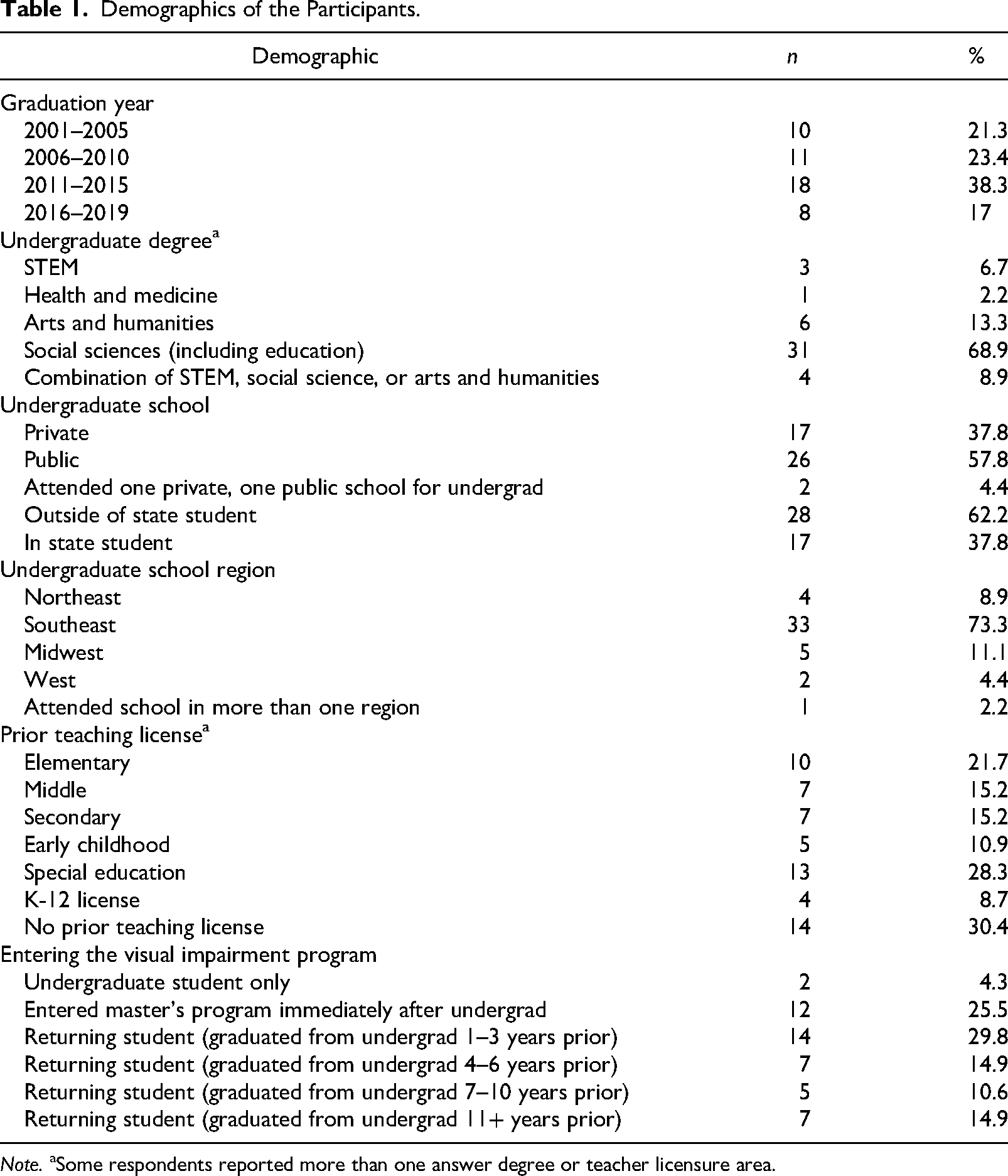
Note. aSome respondents reported more than one answer degree or teacher licensure area.
Deciding to Become a TVI
Forty-two participants responded to the question, “When did you first learn about teaching students with visual impairments and being a TVI as a career/teaching option?” One-third (n = 14, 29.8%) of the respondents indicated that they had an experience with a student with a visual impairment that drew them to the field. About 20% had a friend or family member with a visual impairment (n = 4) or had a visual impairment themselves (n = 4). The largest group of participants (n = 20, 47.6%) indicated “other” and wrote in their responses. Several learned about the field through a TVI while working in schools. Others described experiences as educators or at camps or elaborated on their experiences of growing up with family members or peers with visual impairments. Over half (n = 12) indicated they had learned about the role of a TVI after college.
Participants were asked why they decided to pursue TVI licensure. Two were hired as TVIs and were required to earn TVI licensure. About one-third (n = 17) wanted to become TVIs after working with a student with a visual impairment. More than half (57.4%, n = 27) wrote in their responses. The most common theme in the write-in responses had to do with previous experiences with students or individuals with visual impairments that motivated them to pursue licensure or made them aware that they needed more training. Several described the prospect of becoming a TVI as “interesting,” including one who stated, “I had no experience with students with visual impairments, but I found the prospect interesting and exciting.”
Themes of wanting to make a difference or to meet an observed need arose. One noted “[I] did not want another student to deal with” the negative education they witnessed a peer experiencing. Another stated, “It was monumental for me to see how meaningful accommodations are to students with vision loss.” Yet another explained, I felt it was the ethical thing to do. The state I was in didn't have a TVI prep program, and the Department of Education told me I could be a TVI if I simply passed the certification test. Based on my experiences in the classroom, I knew this was inappropriate and unethical, and I sought proper preparation.
Overall, many responses reflected a desire to improve services for students.
Selecting a Teacher Preparation Program
Participants were asked how they learned about the program they attended. About one-third (n = 15) reported they sought information on the Internet. Eight respondents learned about the program from alumni. Several (n = 12) learned about the program through word-of-mouth (e.g., “chats with coworkers” and “from other teachers in the school district that I was working in”) or directly from program faculty (n = 4). Participants (n = 8) also reported print advertisements and recruitment emails helped them learn about the program.
Participants rated the extent to which six factors influenced their decision to attend the program. The response scale ranged from 1 (“strong negative influence”) to 5 (“strong positive influence”). The two factors holding the strongest positive influence were grant funding or tuition assistance (M = 4.8, SD = .74) and the program's reputation (M = 4.6, SD = .80). Next, the location of the program (M = 4.4, SD = .88), in-person (not online) training (M = 4.3, SD = .90), and the availability of jobs upon graduation (M = 4.2, SD = .91) all had some positive to a strong positive impact. The opportunity to become a TVI while also learning about research held a small positive impact (M = 3.7, SD = 1.00). Ten participants wrote in additional influences captured in three themes: schedule considerations (classes that took place after school on weekdays) (n = 4, M = 5.00, SD = 0.0), the reputation of the faculty (n = 4, M = 5.00, SD = 0.0), and opportunities for professional growth (n = 2, M = 3.50, SD = .71).
Student and Alumni Experiences
The remaining survey questions focused on the student and alumni experiences of the participants. Specifically, the questions referred to the aspects of the program participants believed to be the most impactful when looking back on their training. Clear themes emerged including hands-on and practical experiences, collaboration and relationships, and specific course content.
Hands-on and Practical Experiences
Numerous references were made to hands-on, practical experiences in the community. One participant stated the program was “extremely hands-on and I think this was the most valuable part of the program. We worked with actual students in real-world settings almost from the very start.” Participants emphasized the value and practicality of community and coursework experiences. One participant reported, “learning to juggle tasks and assignments [as students] helped since we [now] juggle many different tasks in our jobs.” The diversity of the experiences was noted by several respondents, with one commenting that the “positive teacher practicum experience in itinerant, resource room, and school for the blind” was particularly valuable.
Mentorship and Collaboration
The value and strength of interpersonal relationships were a strong theme across survey responses. Experiences with professors and mentors were referenced as critical to participants’ training. One stated: I learned from some of the most well-respected leaders in our field. I learned from their first-hand accounts as both practitioners and researchers. The mentor teachers at [a local district] are incredible and a wealth of knowledge. The program was never hesitant to bring in guest speakers that represented the best of the best.
These connections led to continued professional ties following the program's conclusion. When reflecting on their time in the program, one individual said that “our professors connected me with many surrounding counties and colleagues which opened up other doors and experience.” Participants (n = 9) described how the close-knit nature of the program allowed them to develop professional relationships and close friendships with fellow cohorts. Another said, I really enjoyed being able to collaborate with my small cohort in class and on assignments. I value having colleagues that I can frequently and openly bounce ideas off of, which is what I had with my two cohort members. I felt each of us had different experiences and therefore different perspectives to share which added greatly to our education.
It was clear across respondents, the leadership from faculty and community mentors as well as collaboration among cohort members was critical to their teacher preparation.
Program Content
Participants reflected upon important aspects of the preparation program. References were made to instruction in the braille code, eye anatomy, and the expanded core curriculum. The range of knowledge needed to support all students with visual impairments was a common theme. One stated, “I believe that students with additional disabilities and cortical visual impairment should be central to teacher of students with visual impairments’ training program.” Another noted, “Giving real attention to low vision was very valuable (and deserved) as the largest and most diverse part of the visual impairment population.” Some participants also described areas in which they wished they had received more training such as braille and assistive technology. Participants appreciated receiving their pre-service TVI training at the same time as they were learning how to conduct research. One noted, The research experience was meaningful to me. Even though I do not necessarily do research as a practitioner, I can think critically about how to evaluate better because of my experience doing research in school.
Participants’ classes, research, and practicum experiences worked together to provide a comprehensive preparation experience.
Discussion
This study attempted to answer four research questions:
What were the demographic characteristics of individuals who entered the program? What influenced individuals to pursue licensure to become a TVI? What factors played a role in professionals' selection of a preparation program? What experiences do TVIs value from their time in the preparation program?
Participants varied in their undergraduate training and at what point in their career they entered the field of visual impairment, though most decided to enter the program after working with a student or meeting a TVI. Many already had an interest in education, were already teachers, or held initial teacher licensure. Participants were drawn to the program particularly because of the availability of grant funding and the reputation of the program and faculty. Lastly, hands-on and practical experiences were described as very impactful. Because many had teaching backgrounds, they appreciated the authentic experiences that helped to prepare them to enter the field as TVIs.
Recruitment and Retention
Survey results demonstrated that the motivations of TVIs overlapped with the motivations of teachers in other teaching professions. Prior research established that early teaching experiences can be pivotal in an individual's desire to become a teacher (Hobson et al., 2007). Richardson and Watt (2008) also found that teachers who were highly engaged and resilient were often drawn to the education field due to intrinsic motivations, a desire to do good, and a belief that the field would be interesting and fulfilling. Like those entering the field of general education (Eren & Tezel, 2010; Richardson & Watt, 2007), TVIs in the current study described wanting to make a difference and meet a perceived need in their schools. Furthermore, many seeking TVI training were already teachers; therefore, they were already intrinsically motivated to join the profession. Teacher preparation programs should consider recruitment strategies for individuals who have the intrinsic motivations that are necessary for a lasting career in education.
Designing Programs to Appeal to Individuals in High-Needs Areas
The shortage of TVIs across the United States is particularly acute in rural communities (Ajuwon & Craig, 2008; Garcia & Harley, 1991). This shortage coincides with the fact that students in rural areas are more likely to be diagnosed with a disability, but that they are less likely to receive adequate services (Zablotsky & Black, 2020). It is noteworthy that most participants in the study entered the field after having an experience with a student with a visual impairment or after meeting a TVI. Current teachers in high-needs areas should be provided with opportunities to meet TVIs or work with students with visual impairments to see if they may be interested in a career as a TVI. Other areas of education have established community-university partnerships to address teacher shortage problems (e.g., Flynn et al., 2014) by recruiting professionals who are currently teaching in a district to earn additional teaching endorsements.
Meaningful Program Characteristics
Personnel preparation programs vary by geographic location, type of degrees offered, instructional model (in-person, online, or hybrid), practicum experiences, financial support, and faculty (Ambrose-Zaken & Bozeman, 2010). It is important to know what factors draw candidates to a particular program, since fewer than 30 TVI programs are currently active in the United States. A notable percentage of participants found the field of visual impairment later in their careers, and their reasons for entering the profession were thoughtful and intentional. Tangible factors like the availability of funding and grants had a large influence on drawing respondents to the program. Given the fact many teachers are underpaid, providing affordable options for quality training is critical (Allegretto & Mishel, 2020). Personnel preparation grant funding has a long track record of addressing special education teacher shortages (Burke et al., 2013).
Preparation programs must evaluate how to best equip students for their future roles as TVIs to benefit students in the short term and avoid teacher attrition. Respondents from this survey felt prepared for their current roles through the authentic experiences with students and the opportunities to collaborate with professionals in the field. In a survey of orientation and mobility specialists, hands-on experiences and time spent with current professionals were found to be valuable (Jones, 1993). According to Everling et al. (2015), hands-on experiences in the community prepared teacher candidates for roles in special education and made them more likely to enter the field.
Participants spoke about the importance of including practical information and assignments in the classwork that they would use later as professionals. Malderez et al. (2007) found that graduate students (including those with prior professional or teaching experiences) in teacher training programs were more likely to value information presented in classes, were better able to connect theory to practice, and recognized the implications of classwork in the field better than undergraduate students. Survey respondents demonstrated similar characteristics, by identifying class content that was valuable later in their careers such as in the areas of conducting assessments, teaching the expanded core curriculum, and utilizing assistive technology.
Limitation
The limitations of the study should be considered alongside the findings. This is the first study that explored specifically why individuals become TVIs and how they select a preparation program. As such, this study should be considered a preliminary investigation. Results reflect the experiences of graduates from a single TVI training program at an in-person, R1 institution. The experiences of individuals attending online or hybrid training programs may be different than those of this study's respondents. The study was conducted during the COVID-19 pandemic, which likely affected the availability of potential participants. Lastly, there was no triangulation of the qualitative analysis through member checking with participants to help verify responses were accurately interpreted.
Future Directions and Implications
The results of the current study highlight several next steps for research and recruitment of TVIs. A national version of this survey should be conducted will all TVIs, regardless of where they were prepared, which would provide a broader understanding of how people enter the field of visual impairment. This information could inform recruitment and teacher preparation practices across the United States and provide a baseline measure for understanding issues related to the diversity of TVIs.
Implications for Practitioners and Administrators
Two key practical implications can be taken from this survey to help recruit future TVIs and reduce the teacher shortage. First, administrators should encourage interested personnel to shadow TVIs to learn more about the job. Incentives developed by local or state education agencies or preparation programs could improve the recruitment of current teachers who are interested in the TVI role. Second, many survey respondents decided to become TVIs after engaging with someone related to the profession. Therefore, practicing TVIs can spread awareness of the field and encourage interested school personnel to connect with preparation programs. Both approaches would increase awareness of the profession and focus recruitment on individuals more likely to become TVIs.
Implications for Teacher Preparation Programs
Practical suggestions for teacher preparation programs emerge from the findings of this study. Respondents found active relationships with school districts and mentorships with TVIs in the community to be most impactful in their training. In addition to mentor-practicum placement experiences, local TVIs can be invited as guest speakers or to serve on community advisory boards for the TVI program. Actively pursuing multifaceted relationships with local TVIs can lead to stronger partnerships. Many survey respondents already held licensure as educators. It may be beneficial for preparation programs to specifically recruit licensed educators who are to expand their experiences and skills. Lastly, many participants learned of the TVI profession and program from other professionals. Preparation programs can engage with teachers in their communities to build awareness of the programs and the field of visual impairment.
Footnotes
Declaration of Conflicting Interests
The author(s) declared no potential conflicts of interest with respect to the research, authorship, and/or publication of this article.
Funding
The author(s) received no financial support for the research, authorship, and/or publication of this article.
