



Abstract
Specialized vision rehabilitation professionals help individuals who are visually impaired (ie, those who are blind or have low vision) gain increased function, well-being, personally satisfying levels of independence, and improved quality of life (Academy for Certification of Vision Rehabilitation & Education Professionals, ACVREP, 2022; Duffy, 2021). The umbrella of Vision Rehabilitation Professionals includes Vision Rehabilitation Therapists (VRTs), Orientation and Mobility Specialists (OMSs), Low Vision Therapists (LVTs) and Assistive Technology Instructional Specialists (ATISs; ACVREP, 2022; Duffy, 2021).
The field of vision rehabilitation therapy (VRT) has evolved from its early roots as a church charity model of teaching individuals who are blind how to read their Bibles (McMahon & Ponchillia, 2020; Jones, 2021), to an established profession with university master's degree programs, a body of knowledge, ethical guidelines, and a process for certification (ACVREP, n.d.). As the profession of VRT has evolved over time, the roles and job tasks typically performed by service providers have grown and expanded as well (Connors et al., 2020; Connors & Lee, 2020; Leja, 1990). The most current job task inventory identified four job roles for vision rehabilitation therapists (VRTs), including teaching activities, case management, technology, and low vision assessment (Connors & Lee, 2020).
☑Earn CEs Online
by answering questions on this article.
For more information, visit:
A recent investigation by the National Academies of Sciences, Engineering, and Medicine (NASEM, 2016) identified barriers in the United States to developing a national high-quality and accessible vision rehabilitation system to meet the growing need of persons with vision loss. The first identified barrier is a general lack of awareness and knowledge of vision rehabilitation services, including VRTs (NASEM, 2016). This lack of visibility for vision rehabilitation in general, is found in knowledge gaps among health care providers, patients, and public health officials.
Other identified barriers include low capacity for personnel preparation (NASEM, 2016). There are only five university programs in the United States producing VRTs and one in Canada. Although there is a shortage of VRTs, and recent graduates quickly find employment, the number of new professionals cannot keep pace with the growing need of clients and the number of older VRTs who are retiring. In addition, universities often have difficulty recruiting students, especially considering the invisibility of the profession. The U.S Department of Education Rehabilitation Services Administration helps to address the need for vision professionals, by providing tuition support for university students, in exchange for their working in the field after graduation. In the past five years, the number of CVRTs has ranged from a low of 647 to a high of 675 and currently stands at 673 (ACVREP, K. Zeider, personal communication, May 26, 2022). In the past 20 years, there has been a net increase of 65 CVRTs. This increase, is in part, the result of the number of retirements offsetting the number of newly certified professionals.
A third identified barrier for a functional vision rehabilitation system, recognized by the NASEM (2016) report, is that Medicare policies do not recognize some members within the vision rehabilitation team, including COMSs, CLVTs and CVRTs. The lack of recognition of these professionals contributes to the lack of awareness of their roles in addressing vision loss (NASEM, 2016). A further complication is that other professionals, such as physical therapists or occupational therapists (OTs), who are less highly trained in vision impairment, provide services since they are recognized by Medicare and are able to bill for services.
Although the NASEM (2016) report has identified challenges to the field of blind rehabilitation, little is known about the perceptions of the state of the field of VRT that are held by service providers within the field. In this study, VRT service providers are asked about their perceptions of the field's strengths, weaknesses, threats, and opportunities.
Methods
Survey Development
The authors began the development of an initial document stating potential strengths, weaknesses, opportunities, and threats (SWOT) of the VRT profession. The initial document then underwent examination by stakeholders in the field, using the Delphi method (Hsu & Sandford, 2007). The Delphi method is a practice of group decision making, using the judgments and consensus of experts within a field. Fourteen stakeholders were invited to an online meeting to review and modify the SWOT document, including the clarification of the wording, and the adding and subtracting of specific items. In order to more fully represent the wide variety of service providers in the field, the 14 stakeholders represented professionals from various aspects of the VRT field, including faculty members from university personnel preparation programs, practitioners and administrators in federal, state, and private agencies, and leaders of professional groups (the Association of Vision Rehabilitation Therapists, AVRT, and the Association for Education and Rehabilitation of the Blind and Visually Impaired, AER).
Ten participants attended the meeting including the four researchers. The online meeting was audio-recorded to ensure all comments were captured. As a result, 13 of the SWOT statements were modified in wording to increase clarity or scope or both, and 8 new statements were added, with consensus of the four researchers. The final version of the SWOT document was used for the survey questions.
Survey Recruitment
This research project was reviewed and approved, by the Institutional Review Board through Western Michigan University. The survey was conducted online, using Qualtrics Survey software, from March 1 to March 25, 2022. To reach potential survey responders, a wide variety of agencies and stakeholders in the field of VRT were contacted and snowball sampling was encouraged. Potential survey participants were contacted through direct email invitations and social media. A link to access the survey was sent to individuals, federal agencies located in U.S. and Canadian states and provinces, private agencies serving persons with vision impairments, university instructors in VRT programs, vocational rehabilitation agencies, Vision Serve Alliance members (a consortium of nonprofit agencies providing vision rehabilitation services), the National Blindness Professional Certification Board, and professional online discussion groups. Email messages were also sent from the following organizations:
ACVREP messaged all currently certified VRTs AVRT messaged its members, and AER messaged the members of its VRT division.
Effort was made to email potential participants directly if contact information was available online, otherwise, agencies were contacted with the request that the email be forwarded to appropriate employees.
Inclusion criteria included individuals who were currently employed or had recently retired (5 or less years) as VRTs in agencies serving persons with blindness, including direct-service agencies, organizations directly or indirectly serving individuals with visual impairments, and university personnel preparation programs. Exclusion criteria included rehabilitation teachers or VRTs who had been retired for 6 or more years, as well as persons who served as volunteers in blind rehabilitation agencies.
After clicking on the survey link, potential participants were directed to a page informing them of the survey and required the clicking of a “consent” box, to continue to the survey questions. The anonymous survey consisted of 11 demographic questions and asked participants for their level of agreement on 29 specific SWOT statements. There were 5 possible choices to indicate level of agreement: strongly disagree, disagree, neutral, agree, and strongly agree. Participants were also asked to rank the top 3 statements they considered most important or impactful, within the 4 SWOT categories.
Analysis
Qualtrics Survey Software was used to implement the survey and collect data. SPSS Version 28 was used to calculate percentages. For each SWOT statement, the number and percentage of participants indicating “agreement” or “strong agreement” were calculated. The ranking of the most important or impactful statements within each section (SWOT) was calculated and reported in two manners: the number and percentage of participants who chose the specific statement as their top choice, and the number and percentage of participants who chose the specific statement as one of their top three statements.
Results
Of the 302 individuals who clicked on the survey link, 300 consented to take the survey. Forty-five participants were removed for not providing information in each of the SWOT categories, resulting in a sample size (n) of 255.
The survey population was 85.5% female, and 85.1% white. Three-quarters of the survey participants held a master's degree, and 62% had obtained a master's degree in rehabilitation teaching or VRT, followed by 15.7% with master's degrees in other disciplines. Thirty-three percent of participants identified themselves as having a vision impairment. The sample population was overwhelmingly certified, with nearly 79% certified through ACVREP. See Table 1 for more information characterizing the sample population.
Characterization of the Sample Population.
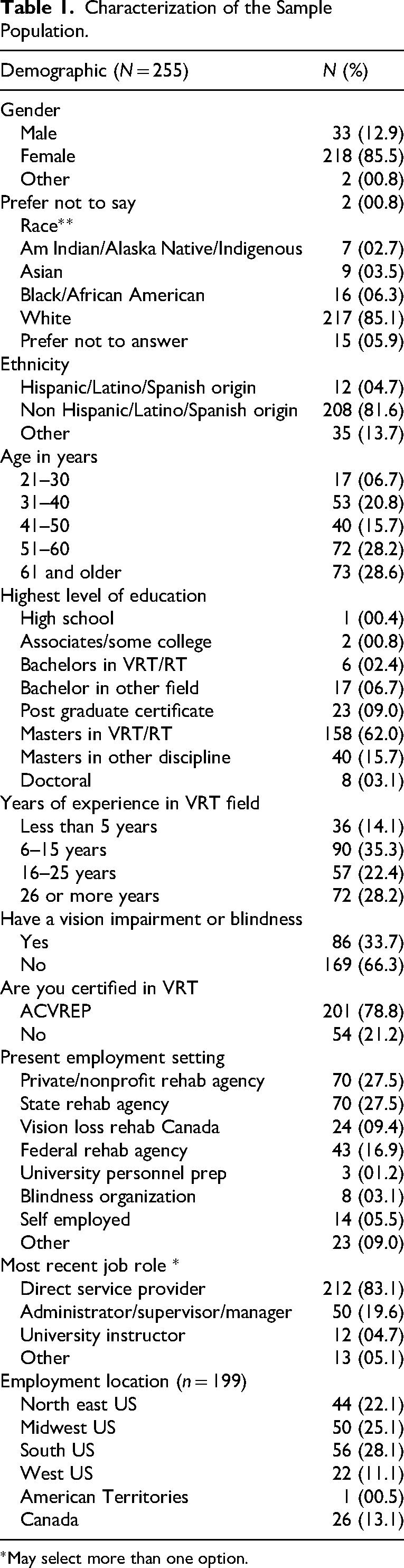
*May select more than one option.
Table 2 lists each SWOT statement and provides the number and percentage of participants who “agreed” or “strongly agreed” with each statement. The actual n for each statement ranged between 251 and 255. Three specific weakness statements, one threat statement and one opportunity statement were more applicable to the United States landscape. Canadian participants were able to opt out of ranking their agreement with these statements if they did not have an opinion. For these five statements, the actual n ranged between 230 and 232.
Number and Percentage of Agreement on Statements and Level of Statement Importance or Impact.
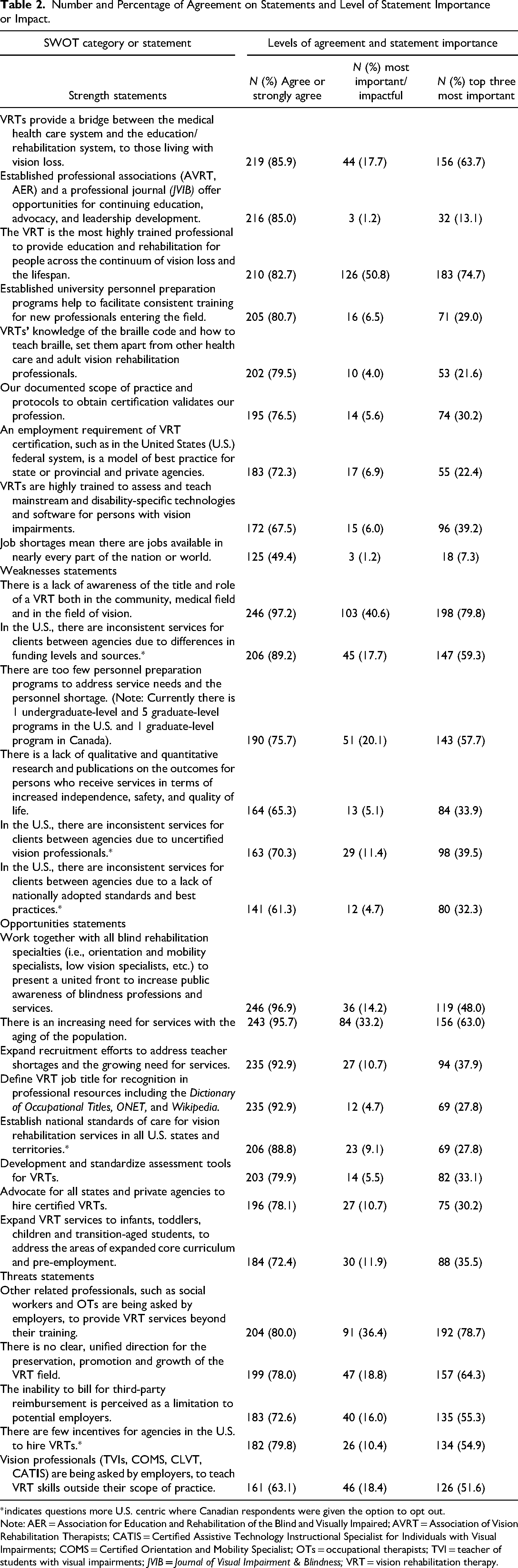
*indicates questions more U.S. centric where Canadian respondents were given the option to opt out.
Note: AER = Association for Education and Rehabilitation of the Blind and Visually Impaired; AVRT = Association of Vision Rehabilitation Therapists; CATIS = Certified Assistive Technology Instructional Specialist for Individuals with Visual Impairments; COMS = Certified Orientation and Mobility Specialist; OTs = occupational therapists; TVI = teacher of students with visual impairments; JVIB = Journal of Visual Impairment & Blindness; VRT = vision rehabilitation therapy.
The category with the highest average level of agreement (87.2%) across its statements was the opportunities category. The level of agreement across the eight opportunities statements ranged between a low of 72.4% for the statement, “Expand VRT services to infants, toddlers, children and transition aged students, to address the areas of expanded core curriculum and pre-employment”; and a high of 96.9% for the statement, “Work together with all blind rehabilitation specialties (i.e., O&M, LVT, etc.) to present a united front to increase public awareness of blindness professions and services.”
The other three categories, strengths, weaknesses and threats averaged around 75% agreement across their specific statements. When examining the statements within the strengths category, the level of agreement ranged between a low of 49.4% for the statement, “Job shortages mean there are jobs available in nearly every part of the nation/world”; and a high of 85.9% for the statement, “VRTs provide a bridge between the medical health care system and the education/rehabilitation system.” The level of agreement across the six weakness statements ranged between a low of 61.3% for the statement, “In the US, there are inconsistent services for clients between agencies due to a lack of nationally adopted standards and best practices”; and a high of 97.2% for the statement, “There is a lack of awareness of the title and role of a VRT both in the community, medical field and in the field of vision.” In the threats category, the level of agreement across the five statements ranged between a low of 63.1% and a high of 80.0%. The low-rated statement is: Vision professionals such as Teachers for the Visually Impaired (TVI), Certified Orientation and Mobility Specialists (COMS), Certified Low Vision Therapists (CLVT) and Certified Assistive Technology Instructional Specialists (CATIS), are being asked by employers, to teach VRT skills outside their scope of practice
And the high-rated statement is, “Other related professionals such as Social Workers & OTs are being asked by employers, to provide VRT services beyond their training.” See Table 2 for more information.
By categories, participants were asked to rate the three statements they felt had the most impact or significance. When examining the strength category, 50% of survey participants believe that the discipline's most important or impactful strength is: “The VRT is the most highly trained professional to provide education and rehabilitation for people across the continuum of vision loss and the lifespan.” That strength was selected by 74.7% of participants as one of their top three most important or impactful strengths. The second most frequently chosen strength statement was, “VRTs provide a bridge between the medical health care system and the education/rehabilitation system, to those living with vision loss,” with 63.7% of the respondents selecting it in their top three choices.
When examining the weaknesses category, the greatest agreement from survey participants was with the statement, “There is a lack of awareness of the title and role of a VRT both in the community, medical field and in the field of vision,” with 40.6% choosing the statement as their top weakness and 79.8% choosing it within their top three. Two other weakness statements had over 55% of respondents including it as one of their top three weaknesses, “There are too few personnel preparation programs to address service needs and the personnel shortage” and “In the US, there are inconsistent services for clients between agencies due to differences in funding levels and sources.”
Within the opportunities category, few statements gained widespread agreement on clear opportunities for the field. One third of participants (33.2%) choose “There is an increasing need for services with the aging of the population,” as their top opportunity, with 63% choosing it in their top three. Nearly half of participants (48%) believe the statement, “Work together with all blind rehabilitation specialties to present a united front to increase public awareness of blindness professions and services” to be one of their top three opportunities for the field.
Within the threats category, note that there were only five statements to choose from, thereby potentially increasing the level of agreement due to fewer choices. The statement with the highest agreement as a threat is, “Other related professionals such as Social Workers & OTs are being asked by employers, to provide VRT services beyond their training,” with 36.4% choosing this statement as their first choice and 78.7% including it in their top three.
Discussion
The premise of this project was to canvas VRTs for their understanding and perceptions on the state of the VRT discipline. VRTs who participated in the survey indicated agreement with the three barriers identified in the NASEM (2016) report, to developing a strong national vision rehabilitation system in the US. Nearly all VRT respondents (97.2%) agreed that there was a lack of awareness of VRTs among the community and the medical field. The other two barriers identified by the NASEM (2016) report, low capacity for personnel preparation (weakness) and inability to bill for third-party reimbursement (threat) garnered 75.7% and 72.6% agreement, respectively, by participants. This level of agreement indicates that survey respondents recognized from their perspective/experience, the barriers identified at a national level to the development of an effective vision rehabilitation system.
Overall there was strong consensus among participants on the SWOT statements, with half of the statements (14 out of 29) receiving a minimum of 80% agreement or strong agreement, indicating a fairly unified perspective on the field. When examining the 26 participants identified as working in Canada, except in the questions that tended to be U.S.-centric, Canadian responses and American responses were similar.
The statement chosen most often by participants, as one of the top three most important or impactful statements, was in the strengths category. Three-quarters of participants choose the statement, “Our greatest strengths lie in VRTs being the most highly trained professional to provide education and rehabilitation for people across the continuum of vision loss and the lifespan,” as being the most important or impactful to the field. This selection was followed by the statement that the field bridges the medical health system and the education or rehabilitation system for persons with vision loss.
Unfortunately, those strengths are not well understood or known, among the general public or within the medical field. This lack of awareness to the profession, the top concern chosen by survey participants and identified as a barrier in the NASEM (2016) report, has long-reaching consequences. Consequences such as difficulties in the recruitment of students and new professionals to the field, referrals for services, and third party reimbursement. The most detrimental impact however, is that individuals with visual impairments may not receive services in a timely manner, or at all.
The second weakness identified by participants as being most impactful or important, is that in the United States, there are inconsistent services for clients between agencies due to differences in funding levels and sources. For a U.S. citizen experiencing vision loss, the services they receive vary greatly depending on factors such as the state in which they reside, if they have an employment goal, and if they are a veteran. This situation is in contrast to that in Canada, where there is a national standard of care for vision rehabilitation services that all Canadians receive.
The top opportunity identified by participants as being the most important or impactful included the increasing need for VRT services due to the aging of the population. A current initiative working to address this opportunity is being coordinated by Vision Serve Alliance, an association of organizations and individuals throughout the United States and Canada (Vision Serve Alliance, 2022a). The Aging and Vision Loss National Coalition (Vision Serve Alliance, 2022b) has committees addressing public policy and funding, data and research, public awareness, and access to quality services, with the goal of advocating for equal access and quality of life for older Americans with vision loss. Presently, the vast majority of those participating in the effort come from other vision professions and the management of vision service agencies. At the time of this report, few VRTs are participating.
The second opportunity identified as most important or impactful is the need for all the vision impairment specialists (CVRTs, COMSs, CLVTs, and CATISs) to work together to present a united front to increase public awareness of blindness professionals and services. Although this opportunity speaks directly to the goal of increasing the visibility of the field of blind rehabilitation, there are likely many other reasons for vision impairment specialists to work together. One of these reasons may be in addressing shared threats across visual impairment disciplines.
The threat identified as most important or impactful is that other related professionals such as social workers and occupational therapists (ie, those who lack vision credentials) are being asked by employers to provide VRT services beyond their training and scope of practice. The primary implication of this threat is that clients do not receive appropriate services that are designed specifically for their vision needs. A secondary implication is the ethics of professionals practicing outside their scope of training. It is likely that the lack of recognition of the VRT profession by Medicare contributes to this threat of professionals who are less highly trained in vision providing services, as they are able to bill for services (NASEM, 2016).
The second most important or impactful threat identified by respondents is that there is no clear unified direction for the preservation, promotion, and growth of the VRT field. Many VRTs work in remote, itinerant situations, or they may be one of the few VRTs on staff at a center-based facility. If their employer does not support their participation in an organization like AER or AVRT, they may be very disconnected from not only continuing education, but opportunities to participate in presenting skills and techniques or findings they have developed professionally. Their separation from the field as a whole, reduces their awareness of the strengths, weaknesses, opportunities, and threats facing the field. This disconnection presents a challenge in developing a unified grassroots effort to grow, strengthen and promote the field. Active steps will need to be taken to involve the estimated more than 70% of the field that did not provide feedback. Their participation is necessary to unify and develop a strategic plan to leverage the strengths and opportunities and mitigate the weaknesses and threats facing VRT as a profession.
As a more unified direction for the promotion and growth of the field is forged, effort should be made to recruit persons from under represented ethnic and race backgrounds. Although it is not known how accurate the sample of survey respondents here, represent the whole field of practicing VRTs, the sample suggests that the VRT discipline is overwhelmingly White and non-Hispanic. In order to best serve the diverse needs of VRT clients, recruitment that encourages wider representation of all backgrounds is needed.
The field of VRT has significant strengths and opportunities upon which it can build. In addition, there are significant threats and weaknesses that need to be addressed. There is a place for all VRTs to play a part in increasing the visibility of the field, recruiting new professionals, and advocating for policy changes that allow persons with visual impairment to access the services they need and gain the quality of life they choose. These findings may be used as a starting place for unifying the voice of VRTs and can be used by professionals in the field for coordinating grassroots initiatives.
Limitations
The perspectives of the VRTs surveyed here cannot be extended to the whole population of VRTs. The sample we studied represents approximately 30% of certified VRTs, but it is difficult to estimate the total number of VRTs more broadly. Also, like most survey projects, the data collected here are self-reported, with limited understanding of how the statements were interpreted by the survey respondents.
Implications for Practitioners
Within the field of VRT, there is strong agreement that VRTs are the most highly trained professionals to provide education and rehabilitation services to persons with vision loss across the lifespan. However, there are not enough service providers to meet the growing needs of persons who qualify for services.
Addressing this growing need requires that the field build upon it strengths and opportunities while mitigating its weaknesses and threats. One of the identified threats to the field includes a lack of a unified direction for the preservation, promotion, and growth of the field of VRT. The findings from this study identify shared understandings and perceptions of VRTs concerning the state of the field. These findings of shared understanding may serve as a foundation for unifying the voice of VRTs, coordinating a more uniform direction forward and aid in strategic planning within the field to strengthen its position to provide high quality services for all. There is opportunity for all VRTs to contribute to the growth and strengthening of the VRT discipline.
Footnotes

Declaration of Conflicting Interests
The author(s) declared no potential conflicts of interest with respect to the research, authorship, and/or publication of this article.
Funding
The author(s) received no financial support for the research, authorship, and/or publication of this article.