



Abstract
This article aims to examine the book of Jonah using the narrative criticism method. The book is divided into pericopes, viz. narrative units, based on specific criteria. For each pericope, the author attempts to demarcate the initial situation, complication, transforming action, resolution, and final situation. Light is shed on the complication part of each pericope, and it is argued that the complication of the first pericope, i.e. sending Jonah to Nineveh to convert its people, is the main complication of the book and is the one that leads to all the other complications.
Much has been written about the book of Jonah, using different critical approaches (Allen; Christensen; Eynikel; Gunn; Jonker & Lawrie; Kim; Person; Trible; Walton). However, little, if any, has been written about this book using the narrative criticism method. This article aims to analyze the book of Jonah using this method. Narrative criticism, according to Marguerat and Bourquin, is concerned with how the author communicates his/her message to the reader. More specifically, it studies the “effects of the meanings brought about by the arrangement of the narrative” (Marguerat & Bourquin: 8).
Ska states that one of the first tasks of narrative criticism is the demarcation of the narrative units (Ska: 1–3). To do so, he proposes using what he calls “dramatic criteria,” which include change of place, change of time, change of characters, and change of action. Marguerat and Bourquin mention the same criteria, though, instead of the change of action, they talk about change in theme (Marguerat & Bourquin: 32). Stylistic criteria—such as repetitions, inclusions, and shift in vocabulary—are also useful, according to Ska, though they are less important than their dramatic counterparts.
A comment is in order regarding each of the dramatic criteria mentioned above. The place criterion refers to a modification in space. The time criterion refers to a change in chronology. The character criterion refers to who enters and leaves the narrative scene. The theme criterion refers to a change in the topic being talked about in the story (Marguerat & Bourquin: 32). The action criterion refers to a change in what one or more of the characters do. In this article, I use the dramatic criteria mentioned above to demarcate the narrative units (also called “pericopes”).
Speaking of a narrative would not make sense unless there is a story. The structure of this story is termed plot. Ska defines the term plot as the ordered arrangement of the events (Ska: 17). The classical plot, according to Marguerat and Bourquin, consists of five stages, which are the initial situation, complication, transforming action, resolution, and final situation. The initial situation provides the reader with the necessary information to understand what comes next in the story. This information usually includes who the actors in a particular scene are, what they are doing, and how they are doing it. The complication presents the problem. The transforming action shows what is being done in order to remove the problem. The resolution indicates the result of the transforming action, and the final situation shows the reaction or the new situation arising from the previous four stages (Marguerat & Bourquin: 19–30).
How can we decide when a new plot or pericope ends and another starts? Marguerat and Bourqin propose identifying change based on at least two of the dramatic criteria discussed above (Marguerat and Bourquin: 32). In my analysis, I will follow in the footsteps of Marguerat and Bourqin and propose a new pericope whenever I can apply two or more of the dramatic criteria to the text.
Out of the five stages, I will focus on the complication. According to Watts, the main theme of book of Jonah is “the conversion of the heathen to the worship of God and the prophet's attitude toward this” (Watts 1975: 73; see also Hahn: 467; Nowell: 828;). In this article, I will demonstrate that this is also the main complication of the story and the one that brings about all the other complications.
Narrative-critical Exegesis
Pericope 1: Jonah 1:1–3
This pericope serves as an introduction to the whole story. The first two verses constitute the initial situation. Verse 1 introduces two of the three main characters of this story, namely God and Jonah (the third is a collective character—the Ninevites—introduced in v 2). We are told that God speaks to Jonah and that Jonah is the son of Amittai. Nothing more is told about Jonah. We know neither in which city he is residing, nor during the time of which ruler, nor his age, his job, why God chose him, and the like. It is worth noting that the second book of Kings mentions a prophet with the name Jonah son of Amittai (2 Kgs 14:25). There, we are told that Jonah is a prophet from Gath-hepher, which is present-day Mashhad, a Galilean town near Nazareth. Is the Jonah of the second book of Kings the same as Jonah of the Book of Jonah? The answer remains indefinite (Mitchell, Smith, & Bewer). Notwithstanding, not mentioning such information does not seem to be unusual in the OT, as we find a similar pattern in the books of Joel, Obadiah, Nahum, Habakkuk, and Malachi.
The phrasing of v 1 indicates that Jonah must have been a prophet or was chosen to be so at that moment. The Hebrew equivalent of the English phrase “the word of the Lord came to” is typical of prophetic call narratives (see, e.g., Is 38:4; Jer 18:5; Ezek 1:3; Hos 1:1; Hg 1:3; Zec 6:9).
Verse 2 presents God's message to Jonah. God orders Jonah to go to Nineveh and cry against it. Verse 2 presents the complication. Nineveh is described as a big city, and its people are so wicked that their evil came up before God. This, as can be inferred from the next verse, constitutes a problem for Jonah. The first complication in the story can be regarded as the mother of all the complications that follow.
This complication creates a multi-faceted conflict. The first conflict is an inner one; it is between Jonah and himself. It appears that Jonah cannot accept the idea of preaching repentance to the goyim, “gentiles.” The Ninevites, as one can easily conclude, were not Hebrews (note that I use the term “Hebrews” rather than “Jews” following Jonah's definition of his ethnic identity in 1:9). To Jonah, they were foreigners, and why should he care for their spiritual life? One could also argue that Jonah might have even rejected the idea of being or becoming a prophet altogether. Based on the text, it is not easy to pinpoint the motivation behind Jonah's rejection of going to Nineveh.
The second conflict that this complication brings about is a divine-human one. Jonah, as will be discussed below, chooses to disobey God. God wants him to go somewhere, whereas he opts for another place.
A third possible conflict is an inter-personal one. If it is true that Jonah did not want to go to Nineveh because he did not want to preach repentance to non-Hebrews, then one could also talk about a conflict between Jonah and the Ninevites. Note that this would be a one-sided conflict. It is Jonah, so the argument can go, that has a problem with the Ninevites, while the reverse is not true, as will be demonstrated later.
After God delivers his message to Jonah, the latter, as v 3 tells us, chooses to disobey the former by deciding to escape toward Tarshish. This can be seen as the transforming action. His going to Jaffa can be seen as the resolution, and his paying the fare and going into the ship can be seen as the final situation.
Note that Tarshish is identified by many as Tartessus, an old Phoenician colony in southwest Spain (Senior & Collins: 1200). God ordered Jonah to go to Nineveh. Archeologists point out that Nineveh is modern-day Mosul, Iraq (Watts: 76). Since Jonah was in present-day Israel, as one can conclude from his going to the Jaffa port, since God ordered him to go to Nineveh, which was to the east of Jaffa, and since Jonah chose to go to Tarshish, which was to the west of Jaffa, this means that Jonah was going in a direction completely opposite to the one God showed him.
Thus Jonah tries to solve the problem by escaping. This highlights Jonah's disobedience. In all the OT, this is the only time that a prophet is said to have disobeyed God. Collins remarks that one of the unique characteristics of the book of Jonah is that Jonah is depicted as an anti-prophet, which contributes to the humor of the story (Collins: 357; Jenson: 43).
Verse 3 adds humor to the story in two ways. First, the reader unexpectedly witnesses a disobedient prophet. Second, Jonah seems to think that, by escaping to a faraway place, he will be able to escape from God. This second idea might have been presented for one or more of the following reasons. First, it could be argued that Jonah was not willing to take the task (compare with Moses in Exodus 4:13) or might have thought that God should have approached someone else. Second, it could be that Jonah thought about God anthropomorphically, that is, he attributed to God human characteristics; although God was viewed as a powerful or the most powerful being, his power was considered limited. Third, it could be that the author wants his readers to reflect on how they react to God's vocation. Do they try to escape from it? Do they think that they can escape from God? Do they think that God can forget (about) his message if they busy themselves with other matters?
Jonah's escape toward Tarshish is a little striking, because, akin to Nineveh, Tarshish was a pagan city. If Jonah refused to go to Nineveh because its inhabitants were gentiles, the people of Tarshish were not in a better position; they, too, were gentiles. This might support the notion that Jonah did not have a problem with pagans but rather with either being a prophet in general, being sent as a prophet to non-Hebrews, or being sent as a prophet to Nineveh itself.
Also, Jonah's escape can cast doubt on his prophetic status. A prophet in the OT is looked upon as a mediator between God and people and as a person faithful to God's message. Jonah, on the contrary, received God's message and disregarded it.
Table 1 summarizes the results:
The First Pericope
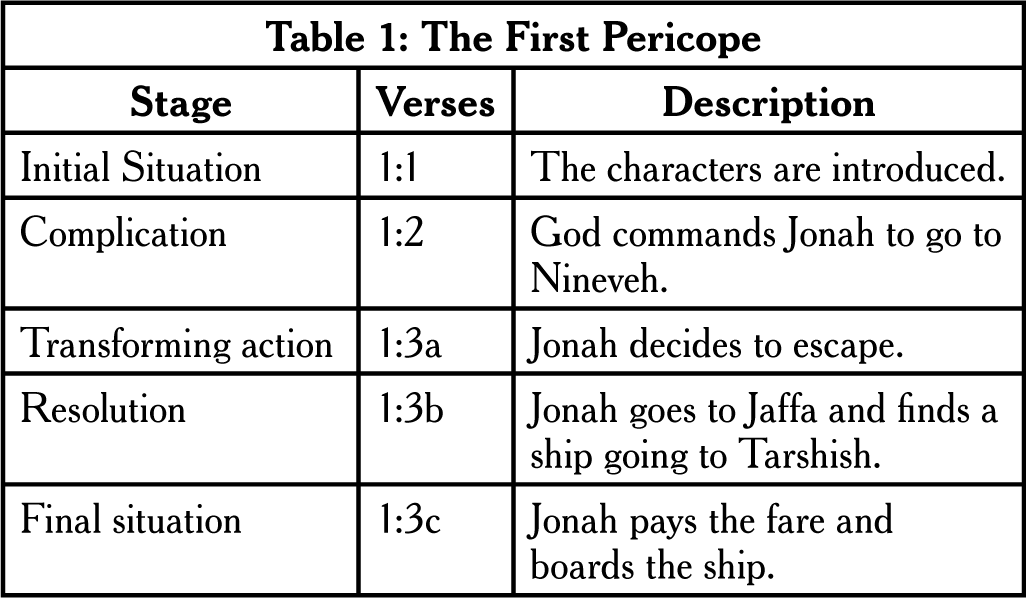
Note that it can be argued that v 3a, in which Jonah decides to escape, represents the complication of the story. While this may be true from the reader's perspective; it is not necessarily true from Jonah's perspective.
Pericope 2: Jonah 1:4–16
After Jonah boards the ship, God sends a great wind on the sea, a violent storm arises, and the ship is about to break up. It seems that, from the final situation of the first pericope, we immediately jump into the complication of the second pericope. There does not seem to be any initial situation here. Two indications that a new pericope starts here are the change in place and change in time. It is obvious that the ship has departed from the port and is in the sea now; as the place changes, time necessarily changes.
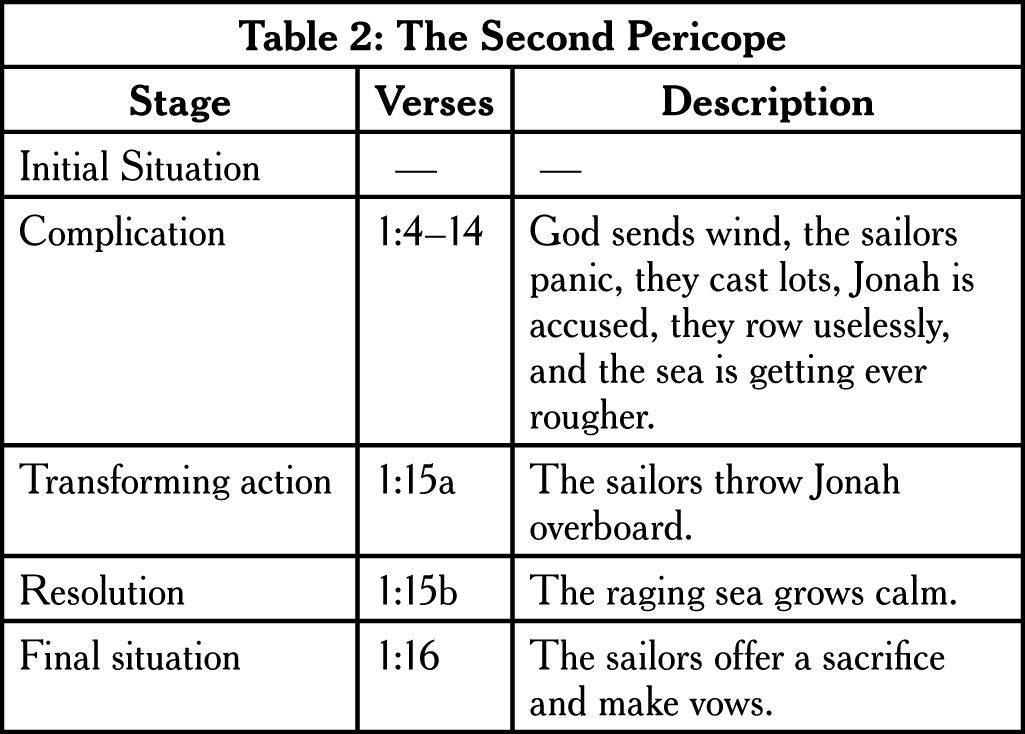
The complication here arises from the first complication, i.e. God's asking Jonah to convert the Ninevites. This complication can be looked at as a series of sub-complications. The first of these sub-complications is the storm (v 4). The second sub-complication is the fear of the sailors and their throwing the cargo into the sea to lighten the ship (v 5). The third sub-complication occurs when the captain asks Jonah to pray to his god, and how can Jonah do that if he escaped from him? (v 6). The fourth sub-complication is casting lots and finding that the storm was because of Jonah (v 7). The fifth sub-complication is the fear that struck the sailors when they knew that Jonah was escaping from God (vv 8–10). The sixth sub-complication is the difficult solution that Jonah proposes to the sailors, i.e. throwing him into the sea (vv 11–12). The seventh sub-complication is when the sailors avoid throwing Jonah, and, in lieu of that, they try to row back to land, but the storm grows rougher and rougher (vv 13–14).
As the storm is getting ever rougher, the sailors decide to throw Jonah into the sea (v 15). This can be viewed as the transforming action of the pericope. Their action brings about the resolution of the complication, as the sea grows calm. The final situation shows that the sailors are offering a sacrifice to God and making vows to him. Thus the complication discussed above brought about the conversion of the sailors. It is difficult to prove from the text whether the sailors believed in God or not. Verse 5 may suggest that they were not Hebrews, as each of them is said to have prayed to his god (‘ělōhāw) and not to God (
The results from the second pericope are presented in Table 2:
The Second Pericope
Pericope 3: Jonah 1:17–2:11
With v 17, a new pericope starts, as there is a change of place, time, and characters. The sailors and the ship disappear from the scene, and a sea creature appears in their place.
Like the second pericope, the third pericope does not appear to have an initial situation. It immediately starts with the complication depicted in v 17. In this verse, we read about how God sends a big fish to swallow Jonah, after the sailors have thrown him overboard. It seems that God is still insisting on his project, viz. the conversion of the Ninevites through Jonah. Thus this complication arises from the complication of the first pericope. It is worth noting that 1:17 may be looked at as the initial situation and that the complication is the act of swallowing Jonah. However, since the text does not describe how the fish swallowed Jonah, I prefer to look upon v 17 as the complication.
Jonah is now in the belly of the fish. Southwell makes an interesting observation as he notes the depicted constant succession of descents that Jonah goes through (Southwell: 593). Jonah descends to Jaffa, then to the heart of the ship, and afterward he is thrown down into the sea, where he descends into the belly of the fish. Southwell explains this descent as being indicative of God's power over the lives of those who disobey him. Instead of putting the emphasis on God's power, I would put it on the human being's disobedience. Going against God does not lead anyone to any place of comfort; disobeying God can mean one thing: a constant succession of spiritual descents, which can have an effect on other aspects of the life of that person.
As Jonah is in the belly of the fish, he prays (2:1–11a). His praying can be seen as the transforming action of this pericope. It is worth noting that this is the first time that Jonah is said to have prayed (wayyiṯpallêl) to God. Jonah's prayer may remind the reader of the psalms. Verse 5 is reminiscent of Psalm 31:22; compare:

“I said, ‘I have been banished from your sight …”’ (Jon 2:5)

“In my alarm I said, ‘I am cut off from your sight!’” (Ps 31:22) Also compare v 6 to Psalm 69:2:

“The engulfing waters threatened me” (Jon 2:6)

“for the waters have come up to my neck.” (Ps 69:2)
Many other parallels can be found between Jonah's prayer and the Psalms. Consider the following: Jonah 2:7 vs. Psalm 22:14; Jonah 2:8 vs. Psalm 31:6; and Jonah 2:9 vs. Psalm 116:17–18.
Jonah's prayer appears to indicate an inner conversion. This prompts God to command the fish to throw up Jonah. Thus it can be argued that Jonah's prayer and God's command to the fish can be seen as two transforming actions that bring about the resolution of the complication, i.e. Jonah's coming out of the fish. The pericope does not seem to have a final situation.
Table 3 below presents the stages of the third pericope:
The Third Pericope

Note that, as will be demonstrated later, this inner conversion seems to come into conflict with Jonah's attitude in chapter 4. So, how should this conversion be viewed? It can be argued that this conversion is superficial and that Jonah goes through it only because his life is threatened. Once the danger is removed and Jonah completes his task, he would return to his previous attitude.
Pericope 4: Jonah 3:1–3b
Now that Jonah has apparently undergone an inner conversion and is seemingly attuned to God's word, God speaks to him for the second time. Note that the change in the place, time, and characters is indicative of the starting of a new pericope; v 1 can be viewed as the initial situation of this pericope.
When God speaks to Jonah, God orders him to go to Nineveh a second time. God has not abandoned his project of converting the Ninevites. It is worth noting here, that, unlike the first time when God spoke to Jonah, this time, God does not mention why he wants Jonah to go to Nineveh. One might argue that this piece of information is not mentioned because it has already been mentioned at the very beginning of the chapter. Nevertheless, the last verse in the book of Jonah (4:11) states that the Ninevites did not know their left from their right; if this is so, how can they be wicked? It can be argued that God wanted Jonah to go to Nineveh to convert its people, in the sense that they would know God and his law. But it can also be argued that God wanted Jonah to go to Nineveh in order to convert him, so that Jonah would come to understand that God's mercy is not limited to the Hebrews but can encompass everyone. Yet another argument can be that God wanted to “kill two birds in one stone” by converting both the Ninevites and Jonah.
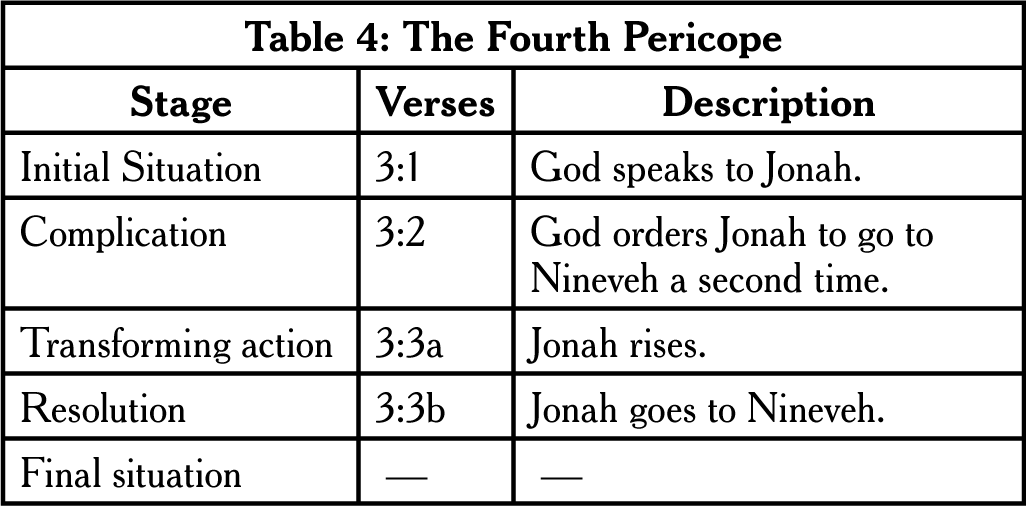
At first reading, and while bearing in mind Jonah's prayer, one might not be inclined to think that there would arise any problem with Jonah's obedience to God this time. However, as will be shown later, Jonah still feels that it is not right to convert the Ninevites. This being so, v 2 can be regarded as the complication of the fourth pericope.
Jonah seems to have learned his lesson; he cannot escape from the face of God. Consequently, he has no other choice but to rise and go to Nineveh. Jonah's decision to go to Nineveh (3:3a) can represent the transforming action. This transforming action might not solve the complication for Jonah, but it might prevent another complication (another storm, etc.).
Jonah's going to Nineveh can be regarded as the resolution. From the outset, God wanted Jonah to go to Nineveh, and here Jonah makes his way into that city. The resolution, as the reader will discover, is superficial. Jonah's rejection of God's giving the Ninevites the opportunity to convert has not faded away.
Table 4 sketches the different stages of the fourth pericope:
The Fourth Pericope
Pericope 5: Jonah 3:3c–10b
As Jonah arrives in Nineveh, there is a change in place, time, and characters (the Ninevites enter the scene); thus it can be argued that Jonah 3:3c starts a new pericope. Jonah 3:3c depicts Nineveh as an exceedingly big city; this verse can be taken as the initial situation.
Verse 4 introduces the complication of the pericope. Jonah goes around for one day informing people of God's plan to destroy the city if they do not repent. This is, in point of fact, the major complication in the story; this is what God is after, i.e., the conversion of the Ninevites.
Verses 5 through 9 introduce the transforming action. The transforming action can be looked at as a series of sub-actions. The first three sub-actions are the Ninevites’ believing in God, their fasting, and their putting on sackcloth. The next three sub-actions are done by the king, who takes off his royal clothes, covers himself with sackcloth, and sits down in the dust. The seventh sub-action is the king's issuing a decree stating that both people and animals have to fast, as well as put on sackcloth, and that people have to pray fervently to God, return from their evil, and give up their violence.
It is noteworthy that, according to vv 3 and 5, although Nineveh was so big that one needed three days to cross it, it was enough for Jonah to wander in it for one day for the Ninevites to convert. The book of Jonah draws a striking contrast between the Ninevites and Jonah. It took the Ninevites, who probably did not know or believe in God, only one day to repent and convert, whereas it took Jonah, who knew and believed in God, several days only to accept going to Nineveh and declare God's word to its people.
As God sees the conversion of the Ninevites, he himself converts, i.e. changes his opinion, as v 10 describes him. God is said to have relented. Clearly, this is an anthropomorphic way of describing God. From a theological viewpoint, God does not change. However, it is not unusual in the OT to depict God along these lines; consider, e.g., 1 Chronicles 21:15, Jeremiah 18:8, Joel 2:12, and Amos 7:3–6. God's conversion comes as a positive response to the Ninevites’ conversion. Thus v 10a, which tells us that God saw the Ninevites’ repentance, can be viewed as the resolution, and v 10b, which tells us that God relented, can be seen as the final situation.
Table 5, above, summarizes the results.
The Fifth Pericope

Pericope 6: Jonah 4:1–6
As chapter 4 begins, the Ninevites disappear from the scene and time passes, indicating the beginning of a new pericope. This sixth pericope lacks an initial situation. The reader is immediately confronted with a new complication, Jonah's anger (4:1). Jonah is said to have viewed the Ninevites’ conversion and God's forgiveness as being very wrong. The reader, who was led to believe that Jonah underwent conversion in chapter 2, is struck by Jonah's reaction.
What can be even more striking is Jonah's prayer (4:2–4), which contributes to the complication. Jonah turns to God and claims that he (i.e. Jonah) knew that God would forgive the Ninevites and, therefore, he wanted to go to Tarshish. The striking thing is that Jonah seems to be lying. It is true that, in chapter 1, we are not told why Jonah tried to escape to Tarshish, but, as has been argued above, he must have done so because he looked upon the Ninevites as foreigners, who, in his view, did not deserve God's mercy. One indication that corroborates this argument is the fact that Jonah asks God to take his life because, as Jonah says, it is better for him to die than to live. The reader cannot but wonder why Jonah wanted to die if something very good happened, namely the conversion of the Ninevites, and the answer seems to lie in the notion that Jonah wanted the destruction of Nineveh.
Another indication that Jonah wanted the destruction of Nineveh is his leaving the city and sitting on the east side of it till he sees what will become of the city (4:5), which can be seen as the resolution of the pericope. It appears that Jonah still believed that God would ultimately punish the Ninevites.
Thus one can see that Jonah was lying. He did not try to escape to Tarshish because he knew that God would forgive the Ninevites. Rather, he did that because he did not want to go to Nineveh and help its people to convert and repent. This, in turn, corroborates the idea that Jonah is seen as more of an anti-prophet. Not only does he escape from his mission, he also does not tell the truth.
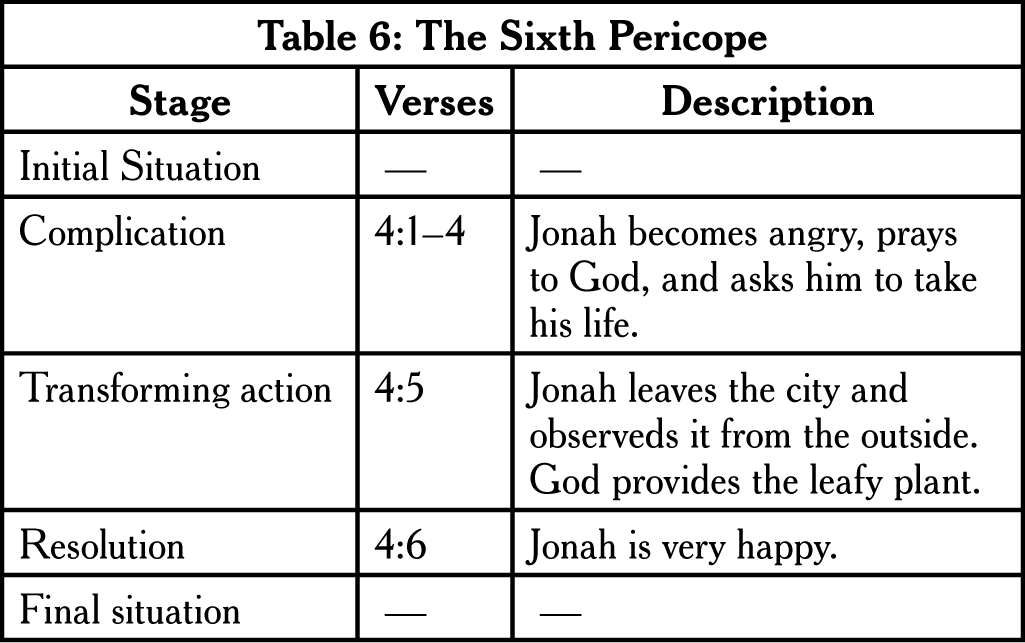
Jonah's leaving the city, sitting at a place east of it, and observing what might happen to it can be seen as the beginning of the transforming action. The action is completed by God, who, according to v 6, provides a leafy plant and makes it grow up over Jonah so that it would both give shade for his head and ease his discomfort. This verse highlights God's loving kindness and mercy. God is concerned about Jonah's physical and psychological health; so, he provides him with the necessary shade. The result is that Jonah feels very happy.
As with the fourth and fifth pericopes, no final situation seems to be provided in the sixth pericope. The different stages of this pericope appear in Table 6 below:
The Sixth Pericope
Pericope 7: Jonah 4:7–9
Verse 7 starts the seventh and last pericope in the book of Jonah. Like some of the previous pericopes, this pericope starts with the complication. At dawn, God sends a worm that chews the leafy plant so that it withers. To make things worse, when the sun rises, God sends a scorching east wind, the sun blazes on Jonah's head, and Jonah grows faint. Again, Jonah wishes for death.
As has been discussed above, God provided the leafy plant in order to help Jonah physically and psychologically. Now, God removes the plant in order to help Jonah spiritually. In the end, the soul is more important than the body, and conversion is more important than physical and psychological health (cf. Matt 10:28; 1 Cor 5:5).
Jonah's wish to die prompts a dialogue between him and God (Jon 4:9). From God's perspective, this dialogue aims to change Jonah's perspective. As Ceresko puts it, this part of the story can be seen as “God's attempt to convert Jonah” (Ceresko: 583); thus v 9 can be regarded as the transforming action of the pericope. Here, God questions Jonah's anger. Jonah tells God that he is very angry to the extent that he prefers to die. In vv 10 and 11, God responds by telling Jonah that he (viz. Jonah) showed concern for a plant which he had not tended or made grow, while he does not expect God to show concern for a whole city.
The story ends without showing us the result of this dialogue; thus there is no resolution or final situation. The story has an open ending, where the reader is left to wonder what would happen.
The results of this pericope are presented in Table 7 below:
The Seventh Pericope

Discussion
In this article, I have attempted to analyze the book of Jonah based on the narrative-criticism method. As has been demonstrated, the book can be divided into seven pericopes. For each pericope, I tried to demarcate the different stages of the plot, i.e. initial situation, complication, transforming action, resolution, and final situation. Not all the pericopes had all five stages.
Of the five stages that I identified in each pericope, I focused on the complication. I have argued that the complication of the first pericope was the main complication in the book of Jonah, and that it led to all the other complications. In the first pericope, the complication arose because God commanded Jonah to go to Nineveh and preach conversion. In the second pericope, the complication arose because of a storm that God sent owing to Jonah's refusal to go to Nineveh. In the third pericope, the complication stems from the fact that Jonah was overthrown into the sea and a great fish swallowed him. Here, it appears that God wanted to save Jonah from drowning, but, at the same time, he wanted him to spend some time pondering God's mission to him. The complication of the fourth pericope emerges as God commands Jonah to go to Nineveh a second time. This is the same complication as that of the first pericope. In the fifth pericope, the complication arises because Jonah warns the Ninevites that their city would be destroyed unless the repented and converted. The complication of the sixth pericope emerges because Jonah did not accept God's acceptance of the Ninevites’ conversion. As for the last complication, appearing in the seventh pericope, it arises because of Jonah's insistence on not accepting the Ninevites’ conversion.
God's aim at converting the Ninevites has definitely been achieved, but is this conversion the only conversion with which the book of Jonah is concerned? The answer is probably “no.” The author of the book of Jonah sheds light on the conversion of different characters. The first characters to convert are the sailors; their conversion might have been out of fear, but, nevertheless, it was immediate. This conversion is followed by Jonah's partial, if not superficial, conversion. In chapter 2, Jonah, while being in the belly of the fish, says a prayer that reflects some kind of inner conversion, though this conversion seems to evaporate in chapter 4.
There is also the conversion of the Ninevites, as they get to know God's vocation to them and accept it immediately and wholeheartedly. One can even talk about God's conversion; as the book of Jonah shows, God relents and “changes” his mind as the Ninevites convert. Another conversion that can be talked about is the “hopeful” conversion of the reader or listener. Allen points out that the compound name
Conclusion
In this article, I have explored the book of Jonah using the narrative criticism approach. One may wonder how the results obtained by using this approach differ from the results obtained by other approaches. I would reply that each approach examines the biblical text from a different angle and gives us unique insights into the text. Consider, as an example, Trible's Rhetorical Criticism: Context, Method, and the Book of Jonah. In this book, Trible divides the book of Jonah into two main sections, each having two episodes. In each episode, Trible investigates the language that is used in the book of Jonah, be it the words, the figures of speech, the rhythm, and so on. The present article divides the book of Jonah into seven pericopes, but, instead of focusing on the linguistic and non-linguistic devices employed in the book, it focuses on the events that take place in the narrative, while being alert to the rhetorical devices that deepen the nuances of the text. As Merenlahti and Hakola put it, narrative critics focus on the text “as a whole and try to come up with an integrated interpretation of all the elements of the narrative” (Merenlahti & Hakola: 15). Thus while both rhetorical criticism and narrative criticism pay attention to the structure of the text, each focuses on different aspects.
Like any other method, narrative criticism has its strong and weak points. One major advantage of this method is that it explores a narrative text using a method that concerns itself with the story being narrated and that focuses on the story as a whole, and this is exactly what the present article does. As Resseguie remarks, “Narrative criticism focuses on how biblical literature works as literature. The ‘what’ of a text (its content) and the ‘how’ of a text (its rhetoric and structure) are analyzed as a complete tapestry, an organic whole” (Resseguie: 18–19).
Another advantage is the ease with which one can grasp the results of the critical narrative exegesis. This ease stems from the fact that many people are familiar with a similar kind of analysis owing to the literature classes they had at school. This makes the present article accessible to the ordinary person and not only to the expert.
Narrative criticism, however, is not a method without limitations. One of its limitations is that it does not delve into the historical and social backgrounds, as its primary focus is the narrative qua narrative. This can create some difficulties in the interpretation of the target text. To illustrate, consider the conversion that Jonah goes through while being in the belly of the great fish. This conversion, as has been discussed, comes into conflict with Jonah's attitude as seen in chapter 4. However, if the reader knows that Jonah's prayer is a later addition (see, e.g., Collins: 357), this conflict may not arise. But, since narrative criticism does not concern itself with identifying the original text and the later additions, the narrative critic will treat the whole text as being the original story and analyze it accordingly.
Another limitation is that there is not always only one way of dividing the text into pericopes and each pericope into clear-cut stages. As has been discussed above, Jonah 1:3a, where we see Jonah escaping from God, can be regarded as either the complication or the transforming action. This may cast doubt on the objectivity of the analysis and may lead some to believe that the structuring of the pericopes and their respective stages is influenced by the researcher's own interpretation of the biblical text. Whether this is right or not requires further research.
To conclude, no one approach to the study of biblical texts is sufficient to explore all the aspects of these texts. Each approach helps us to see more and more of these aspects. In applying narrative criticism to the book of Jonah, we could examine the story that is narrated and see how its different plots shed light on the concept of conversion.
Footnotes
Acknowledgements
The author is grateful to the Rev. Dr. Eric John Wyckoff, SDB, for the many discussions of issues dealt with in this article. He also wishes to thank the anonymous BTB reviewers for their invaluable input.