



Abstract
The poetic telling of stories—especially stories of ancestral failings and ongoing relationship to those failings—is a key aspect of how the book of Psalms moves audiences from trauma to healing and resilience. Trauma blocks the ability of survivors to narrate a coherent story of their experiences. Learning to tell traumatic stories—and integrate them into life moving forward—is a significant factor in healing from past traumas and building the resilience necessary to survive and sustain well-being through future ones. The “twin” Psalms 105 and 106 are an example of how the book of Psalms equips audiences for this work of processing trauma, moving toward healing, and building resilience through its poetic language, narrative structures, and community context. In particular, these psalms narrate a shared history, acknowledge the good and the bad within that history, and demand participation and response.
In February 2022, in the midst of the nation’s “Black History Month” tributes, the Florida legislature put forward a bill permitting parents to sue schools that taught their children history in ways that caused them to feel “discomfort, guilt or anguish.” Debates over this bill quickly revealed that questions of longstanding systemic racism, and the degree to which white Americans alive today are responsible for the violent and oppressive acts of their ancestors, were an undercurrent driving the proposed legislation (Brockwell, 2022). Why should innocent (white) children sitting in twenty-first century integrated classrooms be made to carry the sins of their parents, grandparents, great-grandparents, and, ultimately, their race as a whole? Won’t teaching children these kinds of stories about race and racism only traumatize and re-traumatize new generations? In answering this question in his book How to Fight Racism, Jemar Tisby (2021, p.95) astutely, boldly, and rightly observes that argumentation along these lines “fails based on what the Bible teaches about confession.” I would like to add to Tisby’s observation that this argument fails also in its understanding of trauma, healing, and the path to resilience.
Though its educational context in some ways could not be more different than the state of Florida in 2022, the book of Psalms has likewise served a pedagogical and formational function within the faith community for over two thousand years. Its opening psalm sets the stage for receiving the following collection of songs and prayers as a form of instruction, a mode of reception that its structural echoing of the five-book Torah that begins the Judeo-Christian canons of Scripture reinforces (LeMon, 2011, p. 95; McCann, 2014, p. 350). The psalms—both individually and as a collection of collections—teach about the character and great acts of God, about the persistent presence of enemies in the world, about the efficacy of petition, and about the communal history of Israel. Furthermore, through example, the psalms provide templates for worship, plea, confession, reconciliation, and imprecation. Weaving throughout all these lessons, the book of Psalms reflects the effects of trauma and offers pathways to healing and to the building of resilience.
The telling of stories—especially stories of our ancestors’ failings and our relationship to those failings—is a key aspect of how the book of Psalms moves audiences from trauma to healing and resilience. In what follows, I will outline the role of narrative and storytelling in trauma, trauma-healing, and resilience-building. The “twin” Pss 105 and 106 will serve as case studies for how the Psalter equips audiences for this work. Notably, the use of these psalms in the construction of the postexilic thanksgiving psalm in 1 Chr 16 provides evidence that these psalms were actually functioning along these lines for the ancient faith community (Fulton, 2022; Ko, 2013; Van Grol, 2011; Berlin, 2007). Just as these psalms charted paths that invited their ancient readers to move from trauma to resilience, they likewise have the capacity to invite and shape rich theological reflection in contemporary communities that long to move from trauma to a resilience born of hope. The challenge, of course, is that this process requires serious engagement with the narratives of the past—even those that inspire feelings of “discomfort, guilt or anguish”—because these narratives are what mark the way forward.
The Science of Storytelling
Human beings are narratively oriented animals who can construct stories from the most minimal building blocks. Like our prehistoric ancestors, our pre-literate children draw connections around static images, immo-bile dolls, unidentified noises, recurring weather patterns, and geological formations in ways that produce the most fantastic tales (Boyd, 2009, p. 9; Gottschall, 2012, p. xiii, 6–7; Maggio, 2014). Such stories—mythological, nightmarish, political, etc.—drive human experience of and engagement with the world in profound yet sometimes subtle ways.
On a technical level, genuine narratives must actually narrate something happening. A story comprises a sequence of events related chronologically and causally. Artistic license allows for alteration of these basic elements (e.g., stories told out of order or modern novels in which nothing actually happens), but, for at least 2,500 years, the generally-accepted definition of “story” involves some kind of plot: the setting of the stage, the complicating factor and its navigation, and the resolution of the complication (Poe Hays, 2021, p. 13–16).
The rhetorical, emotional, and psychological power of stories and storytelling comes from the ways stories engage with the brain. Reading or hearing stories—particularly stories that have a good dramatic arc—affects our emotions, releases oxytocin, and ultimately changes our beliefs and behaviors in various ways (Zak, 2015). In the realm of modern healthcare, the interaction between story and brain is increasingly recognized as having a profound impact on physical body:
Illness, treatment, and/or death challenge those who are affected to construct meanings that create a tolerable narrative for what appears to be inexplicable; in such a context, storytelling is viewed as a form of communication that can help people to successfully cope with and reframe illness and, thereby, create the paradoxical possibility of being “successfully ill” (Sunwolf, 2005, p. 2; see also Greenhalgh & Hurwitz, 1999; Kamill, 2003).
Psycholinguists (Gerrig, 1993, p. 1–25; Emmott, 2003) describe this all-encompassing human engagement with story in ways that produce change as being “transported to,” “immersed in,” or “enthralled by” the narrative world.
Trauma: The Absence of Story
Trauma prevents survivors from being able to construct a story about their experiences. They might have “snapshots” of moments, feelings, smells, tastes, sounds, but they are unable to put them together into a logical-chronological sequence that would explain what happened to them and why (Herman, 2015, p. 175; Van der Kolk, 2014, p. 43–44). This phenomenon is one reason the courts and news media have traditionally struggled to respond well to survivors of sexual violence who fail to provide on demand a coherent, consistent report of their assault. It is also why specific sounds or smells or physical postures often trigger trauma survivors to panic and shut down: their senses have been de-coupled from a context—from a narrative—and the person therefore loses control (Levine, 2010, p. 39–72).
One of the most fundamental steps in healing from trauma is learning how to tell the story of what happened. With a trusted companion, the survivor recalls and narrates life before the trauma, the trauma itself, and all the corresponding emotions and responses. They piece their snapshots together into a coherent plot. In doing so, the survivor questions, recognizes, and creates meaning for the trauma that is part of her narrative (Herman, 2015, p. 176–81).
Significantly, learning how to narrate the story of one’s past trauma is not enough for healing. Survivors must also learn how to tell the story in such a way that it integrates into their present existence and allows them to move forward—to craft a new, ongoing story that marches on into a healthy future (Herman, 2015, p. 196–97). This work of integration is a key factor not only in trauma healing but also in resilience building.
Resilience: The Adoption of Story
Resilience has become a popular subject for discussion in recent decades, often in conjunction with the observation that younger generations seem increasingly to lack it. Definitions of resilience abound, but they all involve three major components: the experience of a crisis, the deployment of resources to survive the crisis, and what we might—in the context of a paper on narrative power and movement—call a “happy ending” (White & Cook, 2020, p. 2–3). More than the ability simply to “bounce back” from crises, resilience is the previously-mentioned capacity to “create the paradoxical possibility of being ‘successfully ill’” or of finding ways to thrive in the midst of those crises (Sunwolf, 2005, p. 2). As noted above, the creative work of storytelling lies at the heart of this capacity, and the tripart composition of resilience is itself reminiscent of the necessary elements of a story (a beginning, middle, and end). Storytelling thus becomes more than a merely human tendency, and even more than a pathway to healing from trauma; storytelling becomes a key element in the building of resilience that will equip communities and individuals to survive and sustain well-being through future traumas (Sedmak, 2017, p. 56–58).
Scholars (Janzen, 2012; Boase & Frechette, 2016; Cook & White, 2020) are increasingly cognizant of the ways that the biblical texts intersect with these dynamics of trauma response, healing, and resilience building. David Carr (2014) has demonstrated compellingly how the very formation of the Judeo-Christian Scriptures is a testimony to this process of survival through centuries of trauma and crisis. Nancy deClaissé-Walford (1997, 2004) has made a similar argument about the book of Psalms as a whole. She credits these prayer-poems and the ways the retell the story of ancient Israel in integrative ways with the survival of that faith community. Others have likewise noted the relevance of trauma and resilience for understanding the composition and reception of the Psalms (Strawn, 2014; Poe Hays, 2016; Móricz, 2021). What remains of this article will explore this dynamic in relation to two psalms and the stories they contain.
Storytelling in Psalms 105–106
Psalms 105 and 106 are both generally accepted as two of the “historical” psalms that take up and curate earlier traditions—not just as a recounting of the past, but as a way to shape the present and future of the community (Brueggemann, 1991; Gärtner, 2015; Klein, 2015). Much could be (and has been) said about how Pss 105–106 narrate Israel’s history and the implications for the composition history of the Hebrew Bible, group identity formation, and theology (DeClaissé-Walford, 1997, p. 88–91; Hossfeld, 2004; Tucker, 2005; Passaro, 2006; Gärtner, 2012). Their placement together at the conclusion of the Psalter’s Book IV has suggested to scholars (Gärtner, 2015, p. 376–77; Anderson, 2017, p. 187) interested in the editorial shaping of the book of Psalms that their content and placement are deliberate responses to the crisis of exile and the identity crisis of return from exile. Even apart from these specific historical contexts, these psalms resonate with the faith communities who utilize them because they narrate a shared history, acknowledge the good and the bad within that history, and demand participation and response (Brueggemann, 1991, p. 21–25). In other words, this pair of psalms provides a template for trauma-healing and resilience-building.
Note that, while male authorship of these psalms is certainly the likely historical reality, I will use feminine pronouns in reference to the psalmists because I am trying to draw out how the psalm texts engage and shape readers—both ancient and modern—and I myself am reading the text as a woman.
The Healing Work of Narrative Construction
Constructing a narrative of one’s trauma begins by remembering what was before the trauma (Herman, 2015, p. 176). Both Ps 105 and 106 begin with celebration of Yhwh’s character and relationship to the people. The common emphasis in their opening lines, though the language differs somewhat, is on the rightly-ordered divine-human relationship, which involves understanding God’s identity and invariable faithfulness as seen in the chart laid out below.
John Anderson builds on Judith Gärtner’s observations about the structural and thematic place of covenant in Pss 105–106 to argue that the idea of promise and covenant form an inclusio around both psalms (Anderson, 2017, p. 188; Gärtner, 2010, p. 479–88). This “cocooning” of the two historical recitations within the theological stability of covenant relationship is significant as it provides the “safe” environment necessary for a constructive revisiting of the past. Sensitive topics, tender emotions, and psychological wounds are best approached gradually and with extreme care—in the context of secure relationship (Herman, 2015, p. 162–72; see also Poe Hays, 2016, p. 183–204).
The two narratives that emerge from within this “covenantal cocoon” of secure relationship are at once the same and strikingly different. Psalm 105 is a community hymn that praises Yhwh on the basis of God’s saving actions on behalf of Abraham and his descendants throughout their history. The psalm celebrates the covenant promise that Abraham’s children would possess the land of Canaan (v. 11), and it tracks how God worked to keep that promise even through the traumas of famine (v. 16), immigration (vv. 12–15, 17), enslavement (vv. 17–25), exodus (vv. 26–38), and wilderness wanderings (vv. 39–45). Though the history recounted involves moments of deep darkness, the people of God—as the psalmist-storyteller of Ps 105 depicts them—remained consistently trusting and joyful throughout their history.

In contrast to the relatively straightforward praise of its twin, Ps 106 is a jumble of genres—hymn, petition, confession, historical recitation, lament—and reflects a jumbled, dark history. Psalm 106 recounts many of the same events as 105, but whereas the psalmist of Ps 105 is unfailingly positive in her remembrance of her ancestors’ story, the Ps 106 psalmist repeatedly admits her ancestors’ sin and—significantly—connects her present community’s guilt with that of their ancestors (v. 6): “We have sinned with our fathers! We have done iniquity, we have committed wickedness!”
Both of these psalmic narratives provide paths to healing. Judith Herman (2015, p. 177) says that the therapeutic work of narrating one’s trauma starts simply as “a recitation of fact.” Admit that bad things happened and that you were impacted; you add the emotions, responses, and causes in later. Different responses to the same trauma are possible, and the same survivor can construct different meanings from the same event at different stages of their healing process (Yehuda & Flory, 2007, p. 435). Accordingly, all those involved in working through the process of trauma healing:
must develop tolerance for some degree of uncertainty, even regarding the basic facts of the story. In the course of reconstruction, the story may change as missing pieces are recovered…. [B] oth patient and therapist must accept the fact that they do not have complete knowledge, and they must learn to live with ambiguity while exploring at a tolerable pace (Herman, 2015, p. 179–180).
Both psalms refuse to shy away from traumatic events in their weaving-together of their narratives, even though the details of their accounts differ. Psalm 105 and 106 both name the traumas of enslavement in Egypt (105:17–38; 106:7–13, 21) and starvation in the wilderness (105:40–41; 106:13–15, 32–33); while the psalmist of 105 focuses on Yhwh’s acts of deliverance from these traumas, the psalmist of 106 adds to the narrative her ancestors’ own failings and culpability.
A primary goal of trauma healing is acquiring the capacity to “transform the traumatic memory, so that it can be integrated into the survivor’s life story” (Herman, 2015, p. 175; see also Van der Kolk, 2014, p. 53). Accordingly, neither psalmist attempts to mask the presence of slavery, oppression, and victimization in her history—even in the context of communal worship (see the plural calls to praise and give thanks throughout both psalms). These memories are part of their story, they are part of the community’s identity, and they are critical for shaping how the worshippers will move forward in life. The psalmist-storyteller of Ps 105 shapes the memory of trauma into a sung parable of obedience to Yhwh as the path to wellbeing. The storytelling in Ps 106 serves not so much to highlight obedience as the path to wellbeing as it does to justify and intensify ongoing petitions to God for help in present crises (Brueggemann, 1991, p. 16). Both “survival narratives” call for responses that demand connection and reconnection with life.
Every (good) psychologist and counselor will tell you that no trauma healing is ever perfect or final, and the life with which survivors attempt to reconnect continues to produce new traumas (Herman, 2015). Trauma is obviously ongoing in Ps 106:4–5, 47, where the psalm-ist calls for help now. The final historical narration of 105:44–45 (culminating in the comment “so that they would keep his statutes and his instructions” in v. 45) implies ongoing trauma because worshippers would know that God’s people did not keep God’s statutes and observe God’s instruction. In the face of ongoing adversity, more than trauma-healing is required.
The Resilient Power of Embracing a (Challenging) Narrative
Resilience is the capacity to survive and sustain well-being through the traumas of life—and the challenging work of recovering from them. As stated above, resilience involves three factors that give it the beginning, middle, and end characteristic of narratives: a crisis, the deployment of resources to cope with that crisis, and a positive outcome. This narrative dimension of resilience comes to the fore in explanations (White & Cook, 2020, p. 3; Yehuda & Flory, 2007, p. 435–38; Panter-Brick, 2014, p. 439) that describe resilience as “a rejection of the necessarily causal relationship between adversity and a negative outcome” and “a counter-narrative to discourses of vulnerability and social suffering.” In both Ps 105 and Ps 106, the psalmists produce these kinds of counter-narratives, though they do so in different ways.
Psalm 105 narrates resilience with a “glass half full” mentality, employing a pedagogical style that utilizes positive examples and commands rather than negative ones (Panter-Brick, 2014, p. 438). As noted above, the psalmist does not hesitate to recount the points of crisis in the collective memory. Her focus, however, is on the factors that allowed for survival and transformation. The opening call to give thanks to Yhwh (v. 1) lays the foundation for this focus by directing attention to the biblical “coping resource” par excellence (i.e., Yhwh). Verse 4, in particular, highlights the underlying strategy for survival—and thriving—present in throughout the rest of the psalm: “Seek Yhwh and his might! Strive to be in his presence continually!” Together with the psalm’s prevailing emphasis on covenant, obedience, and God’s mighty acts in history, these plural imperatives direct worship-pers to strengthen the divine-human relationship, which is a significant predictor of resilience (Westgate, 1996, p. 30–31; Pargament & Cummings, 2010, 201–203; Cook & White, 2018, 513–520; Poe Hays, 2020, 34–35). The concluding call to obedience provides further guidance for how to go about strengthening and accessing this relationship (v. 45). Psalm 105 is a story that celebrates survival, and the community’s embrace of this narrative provides them with an additional resource for their own coping needs: Our ancestors survived significant crises by being in right relationship with God and lived to praise about it—we can, too!
Psalm 106 also narrates the survival of significant crises, it also begins by directing attention to the might acts of Yhwh (v. 2), and it also serves as a reminder that survival is possible for worshippers facing new crises. Its “glass half empty” narration, however, draws attention to the negative responses and attitudes of God’s people throughout their history. The psalmist’s ancestors—with whom she identifies (v. 6)—committed wicked acts that include the failure to understand and remember God’s character-driven acts (vv. 7, 13, 21), testing God (v. 14), jealousy (v. 16), idolatry (vv. 19–20, 28–29, 35–39), and failing to trust and therefore rejecting God’s plans (vv. 24–25, 32–34, 43). In a summary statement near the end of the psalm, the psalmist concludes:

In constructing the narrative of her past trauma, therefore, the psalmist-storyteller of Ps 106 lays the blame for her people’s distresses squarely on their own shoulders. She has determined causality. As essayist Frank Bures (2020, p. 183, emphasis added) argues,
… the utility of storytelling has to do with causality, the ability to determine what causes what. Causality is the thing that helps you plan. Causality helps you decide what must be done to get what you need, or want, or want to avoid. You might know how the world is, but if you want to know how it got that way, you have to understand causality. If you want to know how to change it in order to effect your goals, or if you want to know what to expect in the future, you have to understand causality. When you tell a story, you’re trying to bring … “causal coherence” to events that are ordered in time.
While extreme caution must be exercised in assigning culpability in cases of traumatic events—whether ancient or modern—the psalmist’s strategy here in Ps 106 is ultimately one of empowerment rather than blaming. Whereas her people were at one time denied agency by God and the enemy nations (vv. 41–42), the psalmist restores agency to her people by providing them with an implied choice on how to proceed with their lives (Poe Hays, 2020, p. 37). Frank-Lothar Hossfeld (Hossfeld and Zenger, 2011, p. 92, emphasis added) notes,
The unusual expression “brought down by their iniquity” (v. 43b) has a twofold function here: it indicates the climax of the involvement in sin and, in accord with its parallels in Ezek 4:17; 24:23; 33:10; Lev 26:39, it connotes the possibility of a shift—either through repentance on the part of Israel or through divine rescue.
The “counter-narrative to discourses of vulnerability” that the psalmist proclaims here is one that calls the people of God to reject their iniquity, which will allow them to rise triumphant in praise (v. 47) rather than fall in defeat before enemies.
Even more powerfully, the psalmist recounts a narrative of hope in which Yhwh actively responds with solidarity and help to the trauma of God’s people whether they choose obedience or not:

In language deliberately reminiscent of the exodus story—in which Yhwh “sees” and “hears” the trauma of the “covenant” people and “remembers” that relationship (e.g., Exod 2:24, 3:7–9, 6:5)—the psalmist concludes her historical recital by highlighting the “divine social support” that has always been and always will be available to the worshipping community. With this narrative of survival in place, the psalmist invites worship-pers to join their voices with hers as they stand together in the face of new crises:
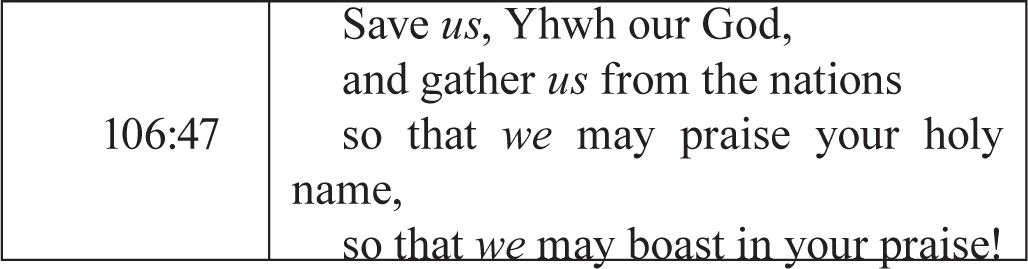
The embrace of these different-yet-similar narratives in Pss 105 and 106 shapes the identity of the worshipping community, provides meaning for their past experiences, and offers purpose and direction as they continue life in the world. These sung stories identify worshippers as a people who has experienced significant adversity repeatedly and over a long period of time; furthermore, they are a people who continues to face adversity. Through this adversity, they have endured. This kind of identity formation that embraces and so transforms stories of horror into stories of hope is a powerful resource for resilience (Peres et al., 2007, p. 346–48; Duckworth et al., 2007, p. 1087–88; Seery, 2011, p. 390–94).
Conclusion
Story and storytelling are a necessary aspect of a healthy individual and community. The Psalms show us how our communal narratives can hold together love, respect, and gratitude for those who came before us while also acknowledging their very real failings and our own ongoing culpability for the brokenness those failings created. The psalmist of Ps 106 recognizes that she shares the guilt of her ancestors; whether this shared guilt is due to her own repetition of their sinful acts or to her participation in the systems and structures their sinful actions instated remains open. Likely the answer is “both.”
Catherine Meeks (Meeks & Foley, 2022), the Executive Director of the Absalom Jones Center for Racial Healing, has observed that, in line with the biblical warning that the choices of one generation shape those of future generations (e.g., Exod 20:5, Num 14:18, Jer 32:17–18), the men who murdered George Floyd would not have been able to do so had their ancestors not been able to lynch Floyd’s ancestors. Precedents, systems, and habits from the past have a bearing on the future. Healing from trauma is never possible without acknowledgment of the horrors all around, and any recital of history will expose the wounds that will hurt.
Psalms 105–106 model how narratives can help us process trauma, move toward healing, and build resilience. These two psalms with their “twinned” retelling of history appear together, and the more challenging, lament-laden psalm comes second in the sequence. This canonical reality (i.e., we have both psalms) and arrangement (i.e., Ps 105 and then Ps 106) testifies to the fact that the work of trauma healing is neither simple nor unidirectional. Furthermore, the location of these psalms within the “prayerbook of Israel” suggests that this work is best done in relationship with others and with the God who sees, hears, remembers, and acts to save.