



Abstract
Heterosexual couples (N = 57) discussed features about each other they wanted to change. During a review of their recorded discussions, for each 30 s of interaction, perceivers provided judgments of their partner’s regard, and partners reported their actual regard for the perceiver. The authors simultaneously assessed the extent to which perceivers’ over- or underestimated their partner’s regard (mean-level bias) and tracked their partner’s changing regard across the discussion (tracking accuracy). Perceivers on average tended to underestimate their partner’s regard (negative mean-level bias) but exhibited substantial tracking accuracy. Bias and accuracy were related; perceivers that were more negatively biased more accurately tracked changes in their partner’s regard. Women who were more insecure about their partner’s continued regard demonstrated more negative mean-level bias and greater tracking accuracy, whereas more secure women demonstrated more positive bias and lower accuracy. The results indicate that bias and accuracy are shaped by context-relevant goals and motives.
Recent reviews focusing on the veracity of judgments in romantic relationships have revealed a puzzling bifurcation in the findings and interpretations (see Fletcher & Boyes, 2008; Fletcher & Kerr, 2010; Gagné & Lydon, 2004). An array of findings reveals the biased, rose-colored way in which intimates judge their partners and relationships. For example, intimates typically see their partner’s attributes more positively than their partner views himself or herself (e.g., Murray, Holmes, & Griffin, 1996). These “illusions” are widely interpreted as serving to keep doubt and pessimism at bay in the task of maintaining relationships. However, these same reviews also document the way in which people’s relationship judgments are tied to reality, typically revealing quite high levels of accuracy. Despite being positively biased, for example, perceptions of the partner also tend to correlate with the partner’s corresponding self-perceptions (e.g., Murray et al., 1996).
How can people be both biased and accurate? One suggestion advanced for solving this apparent paradox is that the overarching accuracy of social judgments can be defined and assessed in two independent ways, what Fletcher and Kerr (2010) have termed mean-level bias versus tracking accuracy. These authors are not the first to raise this possibility (e.g., Cronbach, 1955; Funder & Colvin, 1997; Kenny & Albright, 1987), and a range of technical terms has been advanced to capture the distinction. Conceptually, they all reflect the difference between (a) over- or undershooting some benchmark, such as ratings provided by the partner or the individual’s own ratings provided at earlier time points (mean-level bias) versus (b) the correlation between a set of judgments, such as ratings across several attributes or across time, and the corresponding benchmark (tracking accuracy).
Mean-level bias and tracking accuracy can be independent. For example, Karney and Frye (2002) gathered relationship satisfaction ratings eight times across a 4-year period and then at the 4-year mark asked participants to retrospectively judge their satisfaction at each earlier time point. Individuals recalled their relationship satisfaction had recently improved more than revealed by their prior self-reports (a positive mean-level bias), but their judgments regarding the trajectory of their satisfaction across time were also relatively close to the actual changes in their relationship satisfaction (tracking accuracy; also see Sprecher, 1999). Thus, it seems possible to cling to relationship illusions and track relationship reality simultaneously.
A recent meta-analysis by Fletcher and Kerr (2010) of judgments in romantic relationships suggests this pattern is not unusual, revealing robust overall effect sizes for tracking accuracy (98 studies, r = .47) and positive mean-level bias (48 studies, r = .09). The studies reviewed by Fletcher and Kerr (2010), however, either examined mean-level bias or tracking accuracy or used different measures and benchmarks to assess bias and accuracy. In addition, we know little about the links between bias and accuracy because prior work has computed mean-level bias and tracking accuracy in separate analyses. A recent statistical innovation by West and Kenny (2011) as part of their truth and bias model, however, allows mean-level bias and tracking accuracy to be assessed in a single analysis using the same measures and benchmarks and the association between bias and accuracy calculated.
Applying the novel procedures developed by West and Kenny (2011), in the current study we addressed prior limitations by assessing judgments of the partner’s regard multiple times across couple’s conflict discussions. Using the partner’s actual regard as the benchmark, we simultaneously assessed mean-level bias (the degree to which judgments over- or underestimated the partner’s actual regard) and tracking accuracy (the degree to which judgments tracked the partner’s changing regard across the discussion) for both partners and examined the degree to which bias and accuracy were related.
Perceptions of the Partner’s Regard During Conflict Discussions
We focused on perceptions of the partner’s regard because research has increasingly established that judgments concerning whether partners understand and care for the self are pivotal determinants of relationship satisfaction and success (Murray & Holmes, 2009; Reis, Clark, & Holmes, 2004). The important and unique role of these judgments was illustrated in Fletcher and Kerr’s (2010) meta-analysis. The 16 studies assessing judgments of individual-level partner attributes, such as attractiveness or personality traits, revealed the prototypical positive mean-level bias. That is, participants generally rated their partners as more attractive and viewed their personality more positively than their partners’ self-perceptions of the corresponding attributes. In contrast, the 17 studies examining judgments of the partner’s beliefs and behaviors toward the self, like the partner’s support, forgiveness, and regard, revealed overall levels of negative mean-level bias. Across these samples, participants tended to underestimate their partner’s positivity toward the self.
Fletcher and Kerr (2010) explained this pattern in terms of error management theory (Haselton & Buss, 2000); namely, the costs of overestimating the partner’s regard may offset the default adoption of positive bias. If intimates overestimate the degree to which the partner cares for and regards the self, this could lead to complacency, lack of effort in building and maintaining relationship satisfaction, resulting increases in the partner’s disappointment and negative regard, and unexpected rejection. For example, when individuals neither recognize nor attempt to alter self-attributes that their partner regards negatively, their partner becomes increasingly dissatisfied and resentful (Overall, Fletcher, & Simpson, 2006).
In the current research, we examined judgments of the partner’s regard during conflict-related discussions when one partner was targeting the other for change. This context contains a salient risk of rejection, particularly for the person who is being targeted for change. According to the risk regulation model (Murray & Holmes, 2009; Murray, Holmes, & Collins, 2006), the heightened risk of rejection should automatically trigger assessment of the partner’s regard. For this reason, we examined the degree to which perceptions of the partner’s regard by the target of change (the perceiver) were biased or accurate. The costs of overestimating the partner’s regard in this context, such as intensifying the partner’s dissatisfaction and potential rejection, should increase the degree to which perceivers are cautious in their judgments. Thus, we predicted that perceivers would generally underestimate how positively their partner was regarding the self—an overall negative mean-level bias.
The risk of rejection and diagnostic nature of the partner’s behavior during conflict also amplifies the importance that assessments of the partner’s regard be accurate. In general, therefore, we expected that perceivers would be strongly motivated to accurately understand their partner’s regard and show high levels of tracking accuracy (Fletcher & Kerr, 2010; Gagné & Lydon, 2004). Prior research does show that intimates demonstrate good levels of accuracy when judging their partners’ thoughts, feelings, and intentions during conflict (known as empathic accuracy). The typical paradigm involves intimates reviewing their problem-solving discussions and at specific points in the interaction describing what they think their partner was thinking or feeling at that time (e.g., Thomas, Fletcher, & Lange, 1997). Independent observers then rate how accurately these descriptions capture the thoughts and feelings recorded by the partner at equivalent time points. The 14 studies using this type of approach in Fletcher and Kerr’s (2010) meta-analysis revealed very high levels of empathic accuracy (r = .58).
We used a modified approach in this study because the empathic accuracy paradigm does not provide separate indices of mean-level bias and tracking accuracy or provide a way of testing how mean-level bias and tracking accuracy are related. Participants reviewed their recorded discussions, and for every 30 s of interaction perceivers rated how they thought their partner regarded them, whereas their partners rated the regard they felt for the perceiver. This procedure allowed us to test the degree to which perceivers’ judgments of their partner’s regard were, on average, lower or higher than the regard actually reported by their partner (mean-level bias) as well as the degree to which perceivers tracked the ups and downs of their partner’s changing regard across each 30-s segment of the discussion (tracking accuracy). This is a good way of assessing tracking accuracy because it indexes the extent to which perceivers recognize shifts in their partner’s regard throughout the discussion.
Using West and Kenny’s (2011) novel techniques, we also examined whether bias and accuracy were related. That is, when perceivers are more accurate, do they show more or less mean-level bias? In their meta-analysis, Fletcher and Kerr (2010) reported there was no correlation between the effect sizes of mean-level bias and tracking accuracy (N = 38 studies that used the same variables and samples to calculate separate indexes of bias and accuracy). The question remains, however, whether mean-level bias covaries with tracking accuracy within the individuals making those judgments and in what direction. Our reasoning above suggests that the risks that produce cautious underestimation of the partner’s regard should also motivate perceivers to accurately assess that regard, in particular identifying if and when their partner’s regard is diminishing. Accordingly, we predicted that perceivers who were more negatively biased would also demonstrate greater tracking accuracy.
The Moderating Role of Security in the Partner’s Regard
Murray and colleagues (Murray et al., 2006; Murray & Holmes, 2009) have also shown that the risk regulation system motivating assessment of the partner’s regard in rejection-risk situations is sensitive to the general, cross-situational context of the relationship as indexed by perceptions of how the partner generally values the self. In their model, general security in the partner’s continued regard acts as a barometer of the overall risk of rejection. For those who chronically feel less valued by a specific partner, the possibility and consequences of rejection are more acute and so motivate more sensitive detection of rejection and vigilant monitoring of the partner’s current acceptance. As a result, during conflict discussions, intimates who are more insecure in their partner’s continued regard should be more likely to underestimate their partner’s current regard but also track changes in their partner’s regard more accurately.
Research supports the proposition that insecurity in the partner’s regard is associated with adopting a more cautious approach in assessing the partner’s acceptance. Intimates who are less confident about their partner’s regard feel more rejected on days following relationship conflict (Murray, Bellavia, Rose, & Griffin, 2003). Dispositions that capture expectations of rejection, such as attachment anxiety, are also associated with feeling less valued than the actual regard shown by the partner (e.g., Collins & Feeney, 2004). Consistent with these findings, we predicted that intimates who were more insecure in their partner’s regard would exhibit greater negative mean-level bias when judging their partner’s current regard within conflict discussions.
The greater perceived risk of rejection during relationship-threatening interactions should also result in insecure intimates more vigilantly monitoring or tracking their partner’s regard. Although prior research has not specifically examined how general perceptions of the partner’s regard influences tracking accuracy, a recent investigation of the links between attachment and empathic accuracy offers support for this prediction. Using the empathic accuracy paradigm described above, Simpson and colleagues (2011) found that individuals higher in attachment anxiety, who are chronically anxious about acceptance, were more accurate in judging their partners’ thoughts and feelings (as rated by observers) during relationship-threatening discussions. Their procedure, however, could not examine whether anxious individuals were also negatively biased in these judgments, or the degree to which bias and accuracy were related.
Although dispositional measures of security, such as attachment anxiety, are likely to shape bias and accuracy in the manner proposed, the risk regulation model (Murray et al., 2006; Murray & Holmes, 2009) emphasizes the unique role of partner-specific expectations. For example, attachment security varies across specific relationships (e.g., Overall, Fletcher, & Friesen, 2003) and is powerfully shaped by perceptions of the partner’s caring (e.g., La Guardia, Ryan, Couchman, & Deci, 2000). Security in a specific partner’s regard is also associated with important outcomes, such as reactions to conflict, above and beyond attachment security (see Murray et al., 2006; Murray & Holmes, 2009). Moreover, security in the partner’s continued regard can override dispositional insecurities when coping with relationship stressors (e.g., Rholes, Simpson, Campbell, & Grich, 2001). Thus, guided by the risk regulation model (Murray et al., 2006; Murray & Holmes, 2009), in the current research we focused on how partner-specific security—beliefs about how much the partner generally values and regards the self—moderated mean-level bias and tracking accuracy.
Current Research
To summarize, we asked heterosexual couples to engage in two discussions about ways in which one partner wanted the other to change. Because the heightened rejection risk for the target of change should trigger assessment of the partner’s regard, we examined the degree to which perceptions of the partner’s regard by the target of change (the perceiver) were biased or accurate using the partner’s actual regard as the benchmark. To do this, after the discussions, participants reviewed each of their recorded discussions. For each 30-s interval, perceivers reported judgments of their partner’s regard and partners rated the regard they actually felt for the perceiver.
Using procedures outlined by West and Kenny (2011), we simultaneously assessed mean-level bias (the degree to which perceivers over- or underestimated their partner’s regard across the discussion) and tracking accuracy (the degree to which perceivers tracked their partner’s changing regard across the discussion). We predicted that perceivers would simultaneously demonstrate both negative mean-level bias and high levels of tracking accuracy. We also explored whether mean-level bias and tracking accuracy were associated, predicting that perceivers who displayed more negative mean-level bias would also show greater tracking accuracy. Finally, we assessed whether the perceiver’s relationship-specific security in the partner’s regard moderated bias and accuracy, hypothesizing that both negative mean-level bias and tracking accuracy would be highest for perceivers who were chronically more insecure about their partner’s continued regard and acceptance.
Method
Participants
A total of 57 heterosexual couples responded to paper and electronic announcements posted across a New Zealand university inviting couples to participate in research investigating relationship communication. All notices informed that couples would be recorded discussing aspects of their relationship they would like to change, and detailed information on the study procedures was provided on initial contact. Participants ranged from 18 to 37 years of age (M = 21.0, SD = 3.1). Of couples 46% were cohabiting or married, and 83% of the remainder classified their relationship as serious. Relationship length ranged from 1 to 6.5 years (M = 2.5, SD = 1.5). Couples were paid NZ$70 for a 3-hr session.
Procedure
Participants completed the questionnaires described below and then identified and ranked in order of importance three aspects of their partner that they wanted improved that they understood would be discussed with their partner. The most important ranked feature was selected for discussion. After a short warm-up discussion, each couple had two discussions that were unobtrusively recorded. One discussion involved the feature the women wanted to change about their male partner; in the other discussion, the woman was targeted for change. Order of discussions was counterbalanced across couples.
After both discussions, partners were directed to separate rooms where they reviewed their discussions and reported on their thoughts and feelings during the discussion. Review procedures assess people’s subjective understanding during their discussions (see Welsh & Dickson, 2005) and enabled us to compare perceivers’ judgments of their partner’s regard with their partner’s actual regard across the discussion. Participants reviewed their discussions in the order they occurred. For each discussion, participants stopped the recording 14 times (every 30 s) and rated a series of items according to how they remembered thinking and feeling during the discussion, not how they thought and felt when reviewing the recording. For perceivers (targets of change), items assessed beliefs about their partner’s feelings of regard toward them and their own negative affect during that 30-s segment of interaction. For partners (agents of change), these items assessed the degree to which they felt regard for the perceiver and their own negative affect within each segment.
Measures
Own regard for partner
Prior research has shown that intimates evaluate their partner by comparing partner perceptions to chronically accessible ideal standards, the most critical being warmth and trustworthiness qualities, such as understanding, supportive, and sensitive (e.g., Fletcher, Simpson, Thomas, & Giles, 1999). Using the items generated by Fletcher et al. (1999), we assessed participants’ general regard for their partner by asking them to rate the degree to which their partner matched their warmth or trustworthiness ideals (1 = does not match my ideals at all, 7 = completely matches my ideals). This measure reveals unique and more robust associations with relationship evaluations and behaviors than the simple positive or negative perceptions often used to assess partner regard (see Overall et al., 2006).
Security in the partner’s regard
We used the same approach to assess security in the partner’s regard. Murray and colleagues (Murray et al., 2006; Murray & Holmes, 2009) argue that the common diagnostic that affords security in the partner’s continued regard is the perception that a partner values the qualities they bring into the relationship. Accordingly, in their research program, general perceptions of the partner’s continued regard is often assessed by asking participants to rate how positively their partner views them on important interpersonal qualities, such as “kind and affectionate” and “patient” (e.g., Murray et al., 2003; Murray, Holmes, Griffin, Bellavia, & Rose, 2001). Based on our research that has shown that partner evaluations involve a comparison between perceptions and ideal standards (see above), we asked participants to rate the degree to which they believed they matched their partner’s ideals across the relationship-relevant attributes that people identify as most important in a romantic partner (e.g., understanding, supportive, sensitive; 1 = do not match my partner’s ideals at all, 7 = completely match my partner’s ideals; Overall et al., 2006; Overall & Fletcher, 2010). Prior research using this scale has shown, consistent with the risk regulation model, that greater insecurity in meeting the partner’s expectations undermines relationship quality and reduces self-evaluations across time, whereas more positive inferences that the partner regards these self-attributes positively leads to greater relationship quality and more stable, positive self-perceptions (e.g., Overall et al., 2006; Overall & Fletcher, 2010). 1
Relationship satisfaction
Participants rated five items describing their levels of satisfaction with their relationship using the measure developed by Rusbult, Martz, and Agnew (1998) (e.g., “I feel satisfied with our relationship,” “My relationship makes me very happy”; 1 = strongly disagree, 7 = strongly agree).
Self-esteem
The 10-item Rosenberg (1965) Self-Esteem Scale was used to measure global feelings of self-worth (e.g., “On the whole, I am satisfied with myself”; 1 = strongly disagree, 7 = strongly agree).
Assessing perceived regard and actual regard during the discussion
The items participants rated during the review procedure were designed to assess (a) the target’s judgments of their partner’s regard and (b) the partner’s actual regard toward the target. When watching discussions in which they were the target of change, participants were asked to consider how they thought their partner was thinking and feeling during the discussion. Thus, across analyses, targets of change are the perceivers of their partner’s regard. To assess perceivers’ judgments of their partner’s regard, for each 30-s segment, participants rated the degree to which their partner “cared for me,” “understood me,” “accepted me,” “valued me,” and felt “close” and “intimate” (1 = not at all, 7 = extremely; average α = .94). Perceivers also rated their own negative affect, including how much they felt “angry,” “frustrated,” “hurt,” and “sad” (average α = .90).
When reviewing discussions in which they were the agent of change, for each 30-s segment of the discussion participants rated their regard for the targeted partner (i.e., the perceiver) during that part of the discussion, including “cared for my partner,” “understood my partner,” “accepted my partner,” “valued my partner,” “close,” and “intimate” (1 = not at all, 7 = extremely). These ratings were combined to index the partner’s actual regard of the perceiver within each segment of the discussion (average α = .92). Partners also rated the degree to which they felt “angry,” “frustrated,” “hurt,” and “sad,” which were combined to index their negative affect (average α = .88).
Discussed features
For descriptive purposes, we categorized the features targeted in the discussions. Approximately two thirds composed interpersonal qualities and behaviors, such as commitment, trust, and intimacy (36%) and reactions during times of stress or conflict (28%). Less relationship-oriented dispositions such as self-esteem and social confidence (16%) and motivation and ambition (9%) were also commonly targeted. The remaining issues included bad habits and health behaviors (3%), desires for independence (5%), family relationships (2%), and religion (1%).
Results
Table 1 presents descriptive statistics and correlations across the questionnaire measures. Examining the across-discussion aggregates of the repeated measures variables, partners typically reported moderate to high levels of regard (M = 4.98, SD = 1.44) and low levels of negative affect (M = 1.97, SD = 1.31). Perceivers judged similar levels of the partner’s regard (M = 4.93, SD = 1.46) and also reported low negative affect across the discussion (M = 1.92, SD = 1.26). However, assessing whether perceivers were biased or accurate requires comparing the perceivers’ judgments of the partners’ regard with the partners’ actual regard within each couple across each discussion.
Descriptive Statistics and Correlations Across Questionnaire Measures
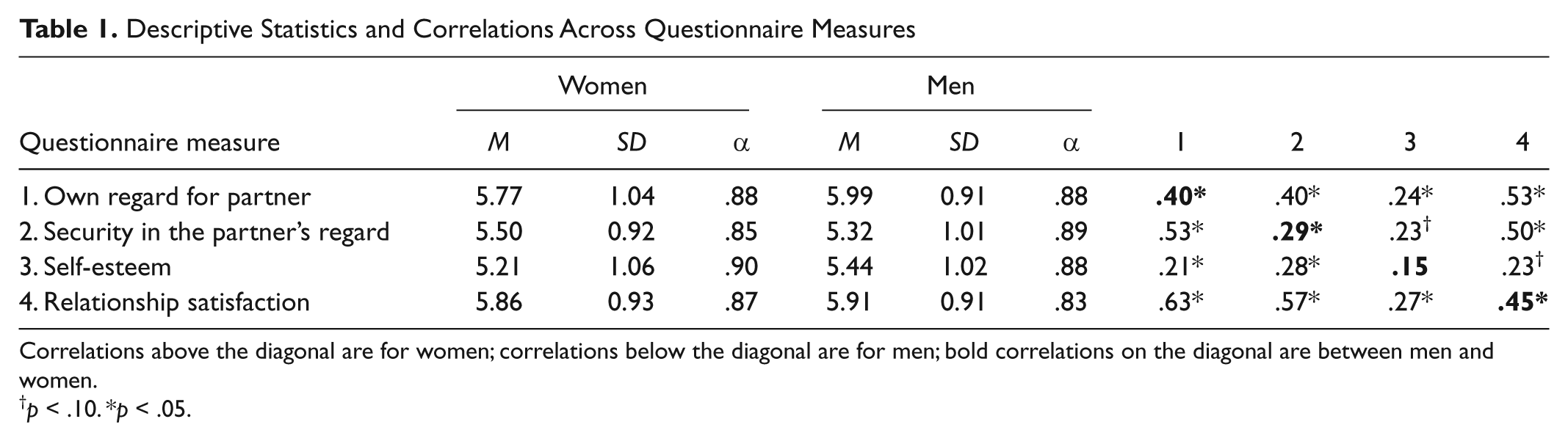
Correlations above the diagonal are for women; correlations below the diagonal are for men; bold correlations on the diagonal are between men and women.
p < .10. *p < .05.
Are Judgments of the Partner’s Regard Biased, Accurate, or Both?
We used West and Kenny’s (2011) truth and bias model to conceptualize and test empirically the degree to which judgments of the partner’s regard during couples’ discussions were biased and accurate. In the truth and bias model, mean-level bias and accuracy are modeled simultaneously and, because we had repeated assessments across discussions, the model allowed us to examine whether accuracy and bias were related.
Our data have a nested structure, with perceivers and partners multiple ratings of regard across the 14 discussion time points (Level 1) nested within dyad (Level 2). Accordingly, we used multilevel modeling methods for analyzing repeated measures data within dyads (Kenny, Kashy, & Cook, 2006). Following the procedures outlined in West and Kenny’s (2011) truth and bias model, we first modeled the associations across the perceivers’ judgments of their partner’s regard and the partners’ actual reported regard (the Level 1 repeated measures variables) to test the degree to which judgments of the partner’s regard were biased and accurate.
The basic model is as follows:

In this equation, the judgment of perceiver j of his or her partner’s regard (J) at a particular point in the discussion (i) is a function of perceiver’s j intercept or b0, the effect of the partner’s actual partner regard (b1) for that point in the discussion, and an error term (eij) representing random error and all other unmeasured biases that influence the perceivers’ judgments. We note that the model is estimated separately for the man and the woman and that the intercept and the effect of partner regard are averaged across perceivers (Kenny et al., 2006; also see below).
As specified in West and Kenny’s (2011) truth and bias model, the perceivers’ judgments of the partners’ regard (the outcome variable) were centered on the partners’ actual regard by subtracting the grand mean of all the partners’ regard (i.e., mean across dyads) from the perceivers’ judgment at each time point. This centering strategy is directly comparable to mean-level bias (West & Kenny, 2011) because the intercept represents the difference between the mean of the partners’ actual regard and the mean of the perceivers’ judgments of that regard. Thus, the average of this coefficient across perceivers tests whether perceivers’ judgments differed from the partners’ actual ratings across the discussion and specified the direction of that bias; thus, West and Kenny (2011) call this directional bias. A negative intercept would indicate that perceivers were generally underestimating the partners’ regard (i.e., negative mean-level bias). Alternatively, a positive average intercept would indicate that perceivers were generally overestimating the partners’ regard (i.e., positive mean-level bias).
The predictor variable (partner’s actual regard) was grand-mean centered across dyads and time points, and its coefficient assesses accuracy—the degree to which perceivers’ judgments were influenced by the partners’ actual regard. A positive coefficient would indicate that perceivers were accurately tracking the degree to which the partners’ regard varied across the discussion.
All analyses were conducted using the MIXED procedure in SPSS 18. The SPSS syntax is provided in the appendix, which specifies a multilevel model in which dyad is at Level 2 and ratings of perceived and actual regard across the discussion are at Level 1. Accounting for the dependence in the data across dyad members, the model estimated the parameters from Equation 1 twice, once for the men and once for the women (using a no-intercept model; see Kenny et al., 2006, and the appendix). The model allowed the error variances to differ for men and women and allowed errors for a given time to be correlated (see the last line of syntax in the appendix). The model allowed mean-level bias (b0j) and accuracy (b1j) to vary by male and female perceivers for each dyad (i.e., be random variables), and we estimated the correlation between these effects.
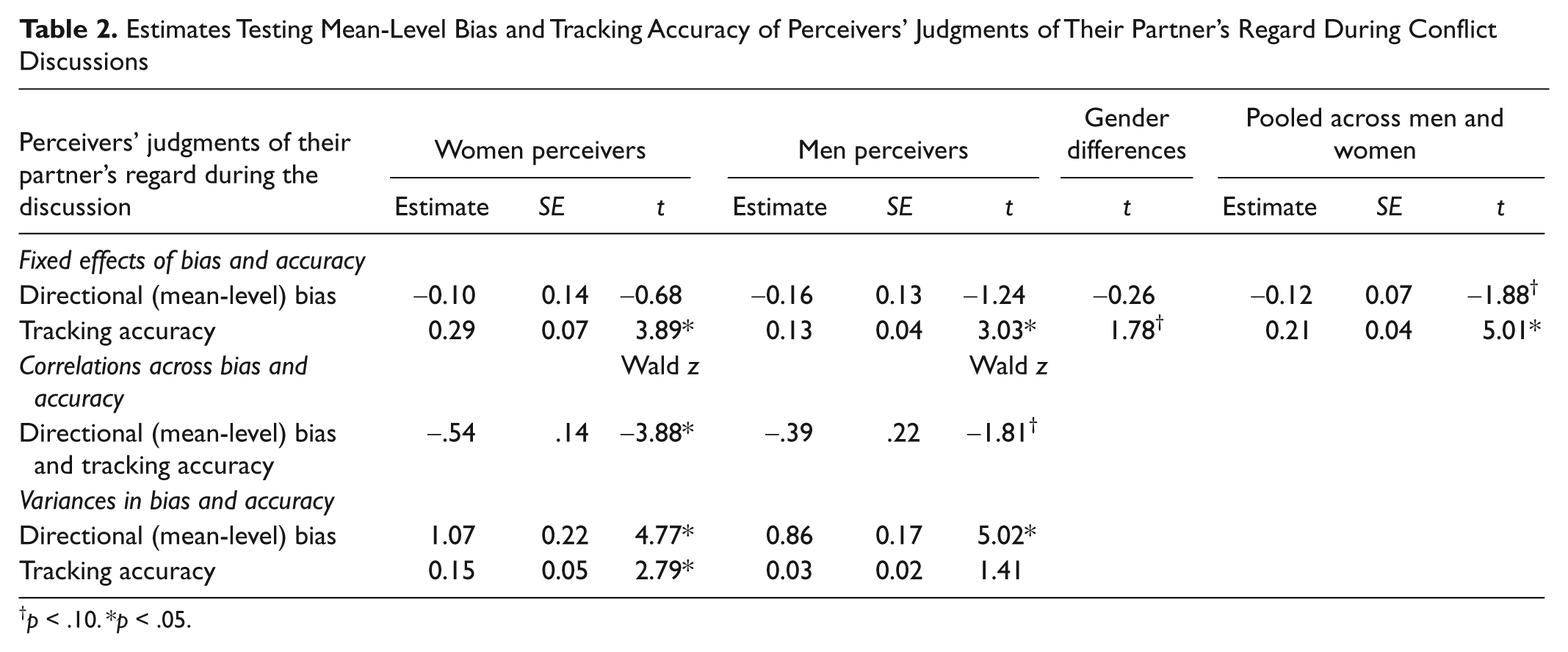
We report the results for men and women in Table 2. However, the reader should attend to the fixed effects pooled across men and women (shown in the final column of Table 2) when there were no statistically significant gender differences (see Kenny et al., 2006, for how to estimate effects across men and women). Examining the fixed effects of bias and accuracy (see first rows of Table 2), the average intercept for both men and women was negative and did not significantly differ across men and women, and pooled across men and women was marginally significant (p = .07). The statistically significant coefficients testing accuracy also indicated, as predicted, that both men and women perceivers accurately tracked their partner’s regard across the discussion. A marginally significant (p = .08) gender difference indicated that women demonstrated slightly greater accuracy.
Estimates Testing Mean-Level Bias and Tracking Accuracy of Perceivers’ Judgments of Their Partner’s Regard During Conflict Discussions
p < .10. *p < .05.
The middle half of Table 2 displays the correlations across mean-level bias and tracking accuracy, as well as tests of whether bias and accuracy varied significantly across perceivers. Examining whether accuracy and bias were related (see correlations between estimates of bias and accuracy in Table 2), the negative associations for both men and women suggest that perceivers who more strongly underestimated their partner’s regard more accurately tracked their partner’s regard across the discussion.
Examining the variances in bias and accuracy (see the bottom half of Table 2), the variance in directional (or mean-level) bias was significantly different from zero for both men and women revealing that some perceivers are positively biased and others negatively biased. Assuming a normal distribution, about 46% of women and 47% of men were positively biased and 53% and 54% were negatively biased (see West & Kenny, 2011, for formulas). Similarly, some perceivers were more accurate than others, although the variance for accuracy was not statistically significant for men. We note that, assuming normality, more than 75% of both men and women have positive accuracy coefficients.
In sum, as predicted, perceivers tended to be negatively biased in their judgments of the partner’s regard but nevertheless accurately tracked changes in their partner’s regard across the discussion. Mean-level bias and tracking accuracy were also negatively associated, indicating that perceivers who more strongly underestimated their partner’s regard across the discussion more accurately tracked changes in their partner’s regard. Finally, bias and (for women) accuracy significantly varied across individuals. This is important because it indicates individual differences, such as security in the partner’s continued regard, might predict the degree to which perceivers are biased and accurate.
Does Security in the Partner’s Regard Predict Bias and Accuracy?
To test whether the perceiver’s general security in the partner’s regard predicted bias and accuracy, security in the partner’s regard was entered as a predictor of the between-person variability in mean-level bias and tracking accuracy (each parameter estimated by Equation 1). In these analyses, the Level 1 intercept (modeling mean-level bias) and slope (modeling tracking accuracy) were treated as dependent variables predicted by individual differences in security in the partner’s regard modeled at Level 2. The Level 2 equations are as follows:


Equation 2 examines the effect of security in the partner’s regard (grand-mean centered) on mean-level bias (b0 j ), where γ00 represents the Level 2 intercept reflecting average levels of mean-level bias across perceivers, γ01 is a coefficient testing whether perceivers’ security in the partner’s regard is associated with mean-level bias, and u0j represents individual differences in bias. We predicted that lower security in the partner’s regard would be associated with greater negative mean-level bias.
We simultaneously assessed whether tracking accuracy varied according to levels of security in the partner’s regard. Equation 3 gives the cross-level interaction between accuracy and perceivers’ partner-specific security. In this equation, the outcome is the person’s slope coefficient b1 j or tracking accuracy, which is modeled as a function of the main effect of accuracy (γ10), the moderating effect of security in the partner’s regard on accuracy (γ11), and an error term allowing for variation in slopes across perceivers (u1 j ). These analyses tested whether security in the partner’s regard moderated the degree to which perceivers accurately tracked their partner’s regard across the discussion. We predicted that perceivers who were less secure would exhibit greater tracking accuracy.
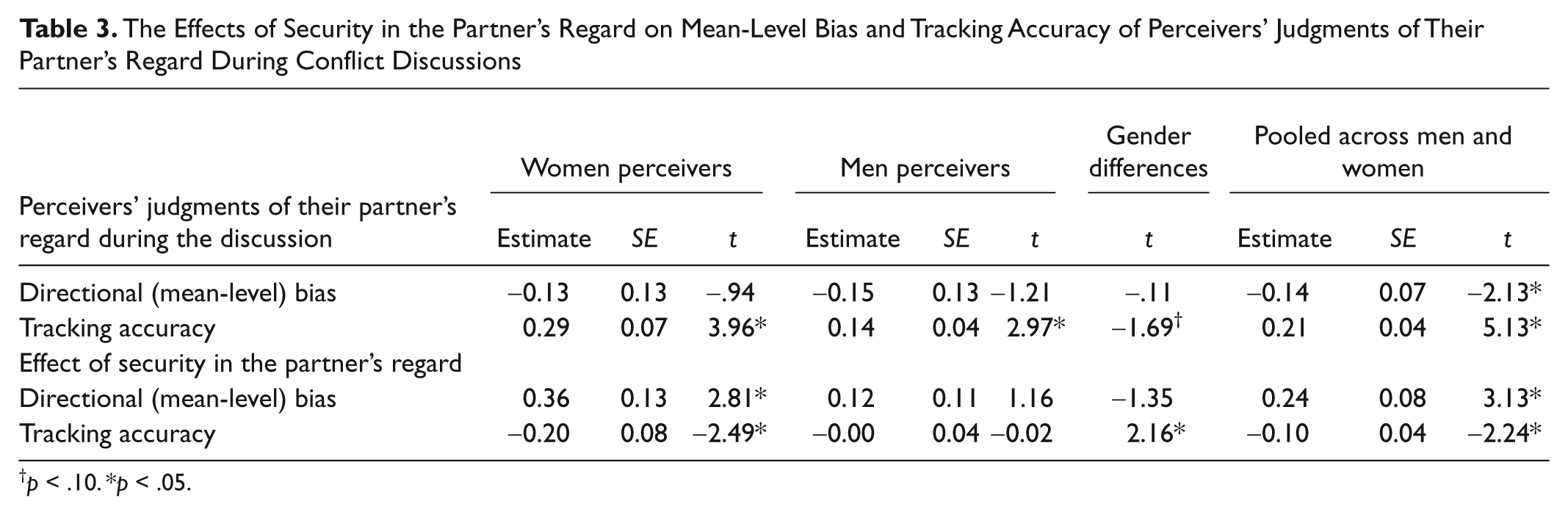
As before, each equation was estimated twice, once for women and once for men, but we also present the effects pooled across men and women and associated tests of gender differences. The resulting coefficients are shown in Table 3. Adding perceivers’ partner-specific security into the model did not substantially alter mean-level bias and tracking accuracy. On average, both men and women exhibited negative mean-level bias, and pooled across men and women this bias was statistically significant. Thus, controlling for general security in the partner’s regard, perceivers generally underestimated their partner’s regard during the discussion. The statistically significant effects for accuracy also remained, showing that both men and women also accurately tracked changes in their partner’s regard across the discussion.
The Effects of Security in the Partner’s Regard on Mean-Level Bias and Tracking Accuracy of Perceivers’ Judgments of Their Partner’s Regard During Conflict Discussions
p < .10. *p < .05.
The effects of security in the partner’s regard on mean-level bias were positive (i.e., the main effect of perceiver’s security) and did not significantly differ across men and women (see bottom half of Table 3), revealing that perceivers who were generally more insecure in their partner’s regard judged their partner’s regard during the discussion to be more negative. The significant cross-level interaction (last row of Table 3) indicated that security in the partner’s regard also predicted (i.e., moderated) the degree to which perceivers were accurately tracking changes in their partner’s regard across the discussion, although this effect significantly differed across men and women. Women, but not men, who were more insecure in their partner’s continued regard tracked the partner’s within-discussion regard more accurately.
This interaction is shown in Figure 1, where we plot the predicted values of perceiver’s judgments of the partner’s regard during the discussion at low (–1 SD) and high (+1 SD) levels of the partner’s actual regard during the discussion (the predictor testing accuracy) for women who were less (–1 SD) and more (+1 SD) secure in their partner’s continued regard. Recall that the perceiver’s judgments of the partner’s regard (on the y axis) are centered on the partners’ actual regard, so zero represents no mean-level bias, positive values indicate positive mean-level bias, and negative values indicate negative mean-level bias. The slopes across low versus high levels of the partner’s actual regard (on the x axis) demonstrate levels of tracking accuracy for women high (top slope in Figure 1) versus low (bottom slope in Figure 1) in security.
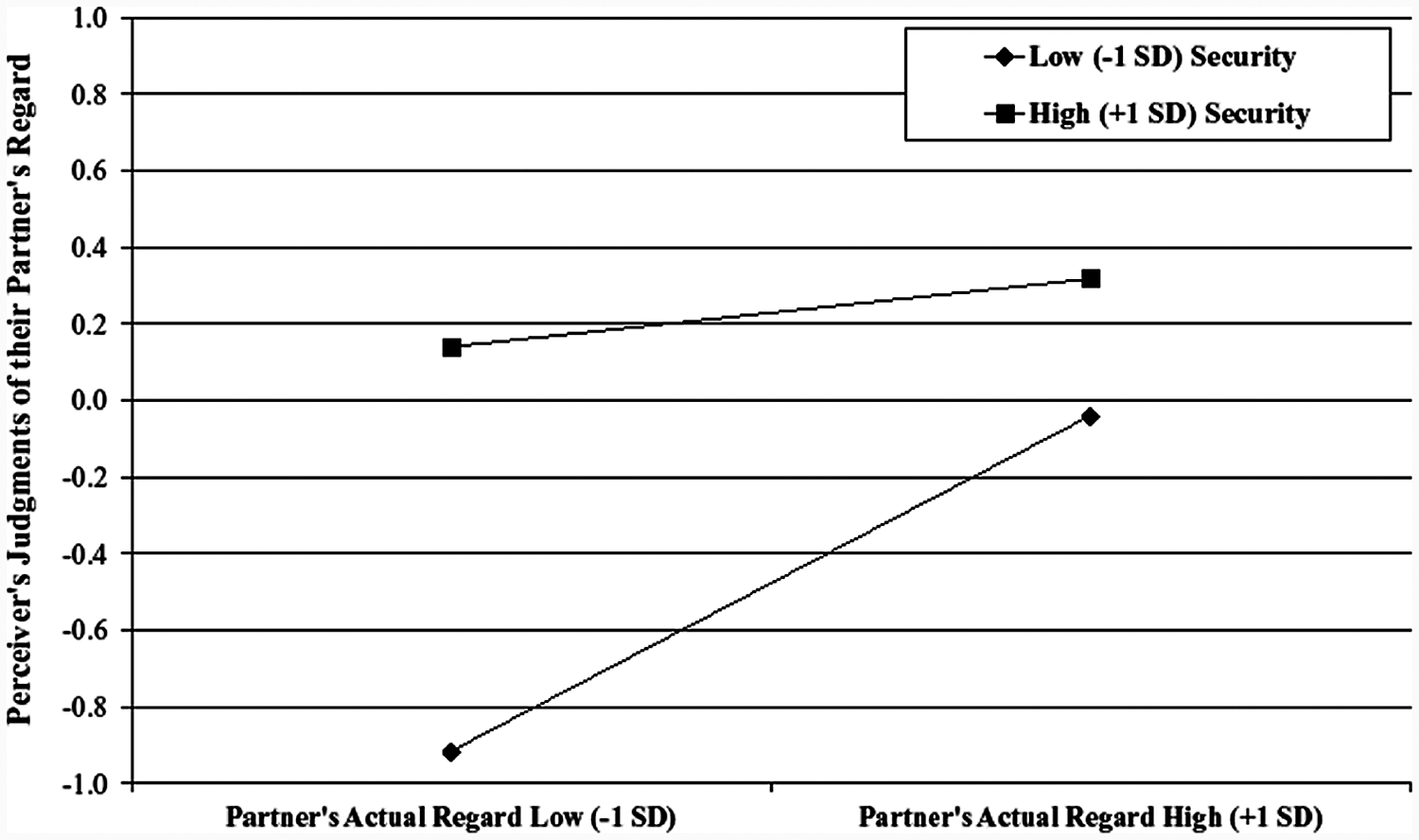
The effect of women perceiver’s general security in their partner’s regard on judgments of their partner’s regard during conflict discussions
Women who were generally insecure (low security) distinguished across moments during the discussion when their partner was regarding them negatively and moments when their partner was regarding them more positively—that is, insecure women demonstrated significant tracking accuracy (simple slope = 0.48, SE = 0.11, t = 4.55, p < .001). Women who were more secure, in contrast, retained positively biased judgments (i.e., above zero) even when the partner’s actual regard for them became negative during the discussion—that is, they did not exhibit significant tracking accuracy (slope = 0.10, SE = 0.11, t = 0.91, p = .37).
Figure 1 also highlights that the key difference occurs when the partner’s actual regard became more negative during the discussion. Examining the differences across low versus high security when the partner’s actual regard was low (left side of Figure 1), women who were more secure did not perceive a drop in perceived regard when their partner’s regard reduced during the discussion, whereas women who were insecure in their partner’s regard were especially sensitive to these drops (slope = 0.55, SE = 0.18, t = 3.10, p < .01). In contrast, when partners were evaluating perceivers more positively during the discussion (right side of Figure 1), there were no differences in the judgments of women high versus low in security (slope = 0.19, SE = 0.12, t = 1.61, p = .11). This pattern indicates that more insecure women demonstrated greater tracking accuracy specifically because they accurately detected when their partner’s regard diminished during the discussion.
The role of assumed similarity
Perceptions of the partner’s regard might also be shaped by assumed similarity, such that perceivers assume the partner regards the self in the same way that perceivers regard their partner (Kenny & Acitelli, 2001). Indeed, as shown in Table 1, own regard for partner and security in the partner’s regard were strongly correlated. Analyses examining perceivers’ own partner regard as a predictor of mean-level bias and tracking accuracy revealed that women who more negatively regarded their partner demonstrated more negative bias in their judgments of their partner’s regard (b = 0.29, t = 2.53, p = .01), but men did not (b = −0.09, t = −0.74), and perceivers’ own partner regard did not reduce or enhance accuracy for women or men (bs = −0.01 and 0.04, p > .42). Importantly, controlling for perceivers’ own regard for their partner did not alter the effects of women’s security on mean-level bias (b = 0.32, t = 2.26, p = .03) or tracking accuracy (b = −0.21, t = −2.55, p = .01) or the parallel nonsignificant effects for men (b = 0.18 and –0.02, ns). 2
Alternative moderator variables
We also wanted to ensure that the results were not a product of global self or relationship evaluations. Women who were less satisfied were also more accurate in their judgments of their partner’s regard (b = −0.14, t = −1.88, p = .07) and relationship satisfaction and security in the partner’s regard were strongly correlated (see Table 1). Nevertheless, controlling for relationship satisfaction only slightly reduced the effects of women’s security on accuracy (b = −0.17, t = −1.83, p = .07), whereas the effects of relationship satisfaction were eliminated (b = −0.07, t = −0.77, p = .45). Despite being correlated with security in the partner’s regard and own regard for partner (see Table 1), self-esteem did not predict bias and accuracy or alter the effects shown in Table 3 and Figure 1. The partners’ relationship satisfaction and self-esteem also did not influence perceivers’ mean-level bias or accuracy.
We also thought that judgments of the partner’s regard might be driven by perceivers’ or partners’ hurt feelings during the discussion. The more perceivers experienced negative affect during the discussion, the more they underestimated their partner’s regard (b = −0.26, p < .001), but controlling for levels of negative affect did not alter the effect of women’s security on bias (b = 0.28, t = 2.31, p = .03) or accuracy (b = −0.17, t = −2.58, p = .01). Similarly, the more partners experienced negative affect during the discussion, the more both dyad members demonstrated negative mean-level bias (b = −0.14, p < .001), but controlling for the partners’ negative affect did not reduce perceivers’ tracking accuracy (bs = −0.27 and -0.13, ps < .01) or alter the effect of women’s security on bias (b = 0.38, t = 3.10, p < .01) or accuracy (b = −0.21, t = −2.78, p < .01).
Discussion
To simultaneously assess mean-level bias and tracking accuracy, we recorded couples having discussions about ways in which one partner wanted the other to change. During a review of their discussion, dyad members who were targeted for change (perceivers) reported their perceptions of their partner’s regard, and their partners reported the regard they actually felt for the perceiver. Judgments of the partner’s regard are crucial because they signal how likely partners will continue to be committed and invested in the relationship versus dissatisfied and rejecting (Murray & Holmes, 2009; Reis et al., 2004). Thus, intimates should be strongly motivated to accurately track changes in their partner’s regard and, given the costs associated with overestimating the partner’s love and acceptance, be relatively cautious in their judgments (Haselton & Buss, 2000). Consistently, we found that perceivers tended to underestimate their partner’s regard across the discussion (negative mean-level bias) but exhibited substantial accuracy in tracking how the partner’s regard changed across the discussion (tracking accuracy).
These findings are consistent with prior findings but extend prior research by examining online judgments during important relationship-threatening interactions, when judgments of the partner’s regard are critical. Our innovative design, and the novel statistical procedures outlined by West and Kenny (2011), also allowed us to test the degree to which bias and accuracy were related—a critical gap in the existing literature. Perceivers who more strongly underestimated their partner’s regard tracked their partner’s regard more accurately across the discussion. By distinguishing two elements of accuracy (mean-level bias and tracking accuracy), and charting their association, this pattern highlights that bias and inaccuracy are not synonymous. When estimating others’ regard for the self, a vigilant approach that produces both negative bias and tracking accuracy may be adaptive because it should avoid the costs of overestimating acceptance and deliver superior detection of likely rejection (Tooby & Cosmides, 1996). We think it likely that this pattern will extend to judgments of regard, and likelihood of inclusion versus rejection, across other types of social interactions (Leary & Baumeister, 2000).
Furthermore, those whose general or relationship-specific histories amplify expectations of rejection should be most alert to how they are valued (Leary & Baumeister, 2000; Murray et al., 2006). Guided by the risk regulation model (Murray et al., 2006; Murray & Holmes, 2009), we argued that people who chronically perceive low regard from their partners should be especially cautious in their judgments of their partner’s regard and particularly vigilant about signs that their partner’s current levels of acceptance and regard are waning. Consistent with this prediction, women perceivers who were more insecure in their partner’s continued regard were more negatively biased. Women who were more insecure also more accurately tracked changes in their partner’s regard, specifically detecting when their partner’s regard became more negative during the discussion. Prior work has argued that insecure intimates read “too much” into common relationship difficulties, incorrectly interpreting these as signs of fading regard, and, thus, generate inaccurate estimates of the partner’s sentiments (e.g., Murray et al., 2001; Murray et al., 2003). Our results for women suggest a more nuanced process; insecure intimates more accurately identify when their partner’s regard is weakening and then exaggerate the detected drops in their partner’s regard.
What implications might this mix of greater tracking accuracy and more negative mean-level bias have for relationships? We have argued above that both negative mean-level bias and tracking accuracy should be adaptive by minimizing the costs associated with missing cues of possible rejection. However, excessive vigilance concerning the partner’s regard might incur costs. Ickes and Simpson (2001) propose that greater accuracy is not always beneficial for relationships. Providing support, Simpson, Oriña, and Ickes (2003) found that more accurate inferences of the partner’s negative and threatening thoughts reduced relationship closeness. These potentially damaging effects should be even more pronounced for people who are relatively insecure in their partner’s regard. Indeed, our results indicated that insecure women not only accurately detect declines in their partner’s regard but also inflate those drops. And, once rejection is perceived, intimates who are insecure in their partner’s regard typically respond with greater hurt and hostility (see Murray et al., 2006; Murray & Holmes, 2009).
Thus, in relationship-threatening situations, inaccuracy might be beneficial for relationships (also see Ickes & Simpson, 2001). Steadfastly holding onto positive perceptions of regard, for example, could help intimates traverse difficult relationship interactions and maintain relationships by containing the impact of (what will often be) short-term dips in acceptance. Even satisfied partners are likely to experience momentary dips in regard during conflict but, nevertheless, retain positive, loving attitudes once the difficulty has passed. The degree to which perceivers can ignore these dips, however, should depend on the extent to which the partner’s regard is likely to recover. In this study, women who had stronger faith in their partner’s continued regard retained positive evaluations of that regard across conflict discussions, missing or ignoring times when the partner’s regard became more negative.
This process may constitute a primary mechanism explaining why high levels of relationship security confer relationship protective benefits. Trusting that the partner will continue to regard the self positively, despite within-interaction negativity, should allow intimates to bypass feelings of hurt and rejection by drawing on more global knowledge of the partner’s typical love and support. By reducing reactivity within threatening situations, like conflict, couples should be able to more effectively resolve disputes and restore positivity. Nevertheless, these benefits may apply only when the danger of permanent drops in partner regard is low. Accordingly, people who cannot trust in their partner’s positive regard once the difficult interaction is over should be more alert to any warnings that their partner’s love and acceptance is under strain. Moreover, even when relationship security is warranted, blithely ignoring partner dissatisfaction may lead to the partner feeling undervalued and ignored and, thus, put the relationship at risk (e.g., McNulty & Russell, 2010; Overall, Sibley, & Travaglia, 2010).
In this study, we did not test whether negative mean-level bias and tracking accuracy produced different relationship outcomes, so we are unable to tell whether the patterns of bias and accuracy we found were more or less successful in maintaining relationships. Drawing on prior research, our discussion above suggests that different combinations of bias and accuracy may be successful in maintaining healthy relationships in different contexts. Positive mean-level bias and low tracking accuracy should be more successful in maintaining relationships when the risk of rejection and dissatisfaction are low, whereas negative mean-level bias and vigilant tracking of changes in regard should be more successful in contexts when the risk of rejection is high. Future research is needed, however, to test the postdiscussion and long-term outcomes of these patterns.
The moderating role of security in the partner’s regard in the current research is consistent with our general contention that bias and accuracy in relationship judgments depends on the relationship context. However, the impact of partner-specific insecurity on accuracy was shown only for women. Men demonstrated the same amount of tracking accuracy regardless of how secure they were in their partner’s regard. In their meta-analysis of prior research, Fletcher and Kerr (2010) found that women were more positively biased when judging partner attributes, such as attractiveness and intelligence, but more negatively biased about the partner’s views of the self. Fletcher and Kerr explained these findings by arguing that women are more invested in sexual relationships and, therefore, are more likely to engage in cognitive strategies to maintain relationships (including bolstering partner evaluations) and protect relationship quality (including avoiding overstating partner regard). Viewing the current findings in such motivational terms, women may be more likely to protect the relationship by overlooking potentially transitory drops in the partner’s regard when they perceive their relationship to be strong and secure but be more strongly motivated to track and respond to negative regard when they are insecure about their partner’s future love and commitment.
Strengths, Caveats, and Future Directions
This study had several strengths. We gathered multiple judgments of regard and associated benchmarks across couples’ conflict-related discussions and, thus, examined bias and accuracy within a behavioral context in which judgments of the partner’s regard really matter. Following West and Kenny’s (2011) truth and bias model, we simultaneously examined mean-level bias and tracking accuracy, using the same variables and in the same statistical model, and demonstrated how bias and accuracy can be related. Our analysis also extended understanding of how partner-specific insecurity can both produce bias and motivate accuracy and demonstrated that these effects were not the result of a variety of potential artifacts, such as relationship satisfaction or negative affect during the discussion.
As argued above, we think the different patterns of bias and accuracy we found indicate that levels of accuracy and bias are shaped by context-relevant goals and motives. However, future research needs to be conducted to test whether positive mean-level bias and low tracking accuracy can help stable relationships weather short-term conflict and assess whether negative bias and accurate detection of drops in partner regard can help intimates avert relationship deterioration or unnecessarily amplify relationship difficulties.
We also did not take into account the different ways perceivers may gather information concerning partner regard. When partners are negative and direct in their communication, perceivers are more likely to recognize their partner’s dissatisfaction. On the other hand, positive and accommodating communications might reduce the perceivers’ ability to detect negative shifts in their partner’s thoughts and feelings (Overall, Fletcher, Simpson, & Sibley, 2009). Furthermore, couples who are more secure and satisfied might use more positive, subtle forms of communication and be more adept at disguising negativity, producing more positive mean-level bias and lower tracking accuracy. Although the partner’s satisfaction, evaluations, and negative affect did not change our results, the partner’s behavior might magnify or attenuate the effects of perceivers’ insecurity. People who are less secure in their partner’s regard might exhibit greater negative mean-level bias when their partner is behaving more negatively but reveal lower bias and more inaccuracy when they are comforted by loving and reassuring partner behavior.
It is an open question the extent to which the current findings will generalize to other samples and contexts. Individuals in this research were relatively young, satisfied couples involved in serious relationships that were on average 2.5 years in length. Controlling for age, relationship status, and satisfaction did not change our results. Nevertheless, older married couples, who possess more knowledge of each other, might show greater accuracy and also be more motivated to protect the relationship, increasing the effects we found here. The moderating role of security in the partner’s regard occurred only for women. Consistent with prior findings, we speculated that this pattern was a function of women typically being more invested and motivated to maintain their relationships, and thus women’s perceptions of their partner’s regard were more likely to be influenced by the relationship context. When highly committed to their relationships, men’s bias and accuracy might also be sensitive to their relationship perceptions and motivations.
The association between bias and accuracy we found is also likely to be restricted to judgments about the partner’s evaluations of the self. When assessing the partner’s values and opinions external to the relationship, positive mean-level bias and other types of bias, such as assuming similarity, might enhance accuracy (Kenny & Acitelli, 2001; Lemay, Pruchno, & Field, 2006). In addition, we assessed judgments of the partner’s regard during a rejection-risk context that should trigger assessments of the partner’s regard (Murray et al., 2006), activate relationship securities (Simpson et al., 2011), and produce more cautious, accurate perceptions. The vigilant combination of negative mean-level bias and greater tracking accuracy we found, therefore, may be most or only evident within relationship-threatening interactions, even for those who are insecure in their partner’s regard. On the other hand, insecure intimates are more sensitive to fluctuations in their partner’s daily mood (e.g., Butner, Diamond, & Hick, 2007), and so might also attentively monitor their partner’s feelings more generally. The current design and procedures developed by West and Kenny (2011) demonstrate how future research can simultaneously explore and compare mean-level bias and tracking accuracy across different relational contexts and judgments.
The statistical design, and our underlying concepts, may also help to reconcile other arguments outside the relationship arena. A longstanding debate, for example, is whether depression produces negatively biased thinking (Beck, 1967) or more realistic and accurate judgments (Alloy & Abramson, 1979), with evidence supporting both positions (see Andrews & Thomson, 2009, for a review). Like the impact of insecurity in romantic contexts, depressed affect might exert a double-barreled effect, producing negative mean-level bias in self-relevant and social judgments but nevertheless enhancing tracking accuracy in those same judgments. This pattern is consistent with the view that depressed affect adaptively triggers sensitivity to costs and sustained problem analysis, which aids resolution of depression-inducing (social) dilemmas (Andrews & Thomson, 2009). Thus, the approach illustrated here paves the way for future research to answer critical questions concerning the relationship between, and predictors of, bias and accuracy.
Conclusions
Feeling regarded and valued by the partner is the cornerstone of building a secure and lasting relationship (Murray et al., 2006; Reis et al., 2004), yet exaggerating the partner’s regard and ignoring signs that the partner’s regard is weakening pose substantial risks. In this research, intimates tended to cautiously underestimate their partner’s regard during relationship-threatening conflict discussions but accurately tracked changes in their partner’s regard. Moreover, this pattern was most pronounced for women perceivers whose insecurity in their partner’s continued regard offered good reason to be vigilant. In contrast, women who were secure in their partner’s future regard weathered the threat by maintaining high levels of positive bias and forgoing accurate tracking of partner regard.
Prior research and theorizing in intimate relationships has often contrasted individuals as being either blinded by love or driven by the search for truth (Fletcher & Kerr, 2010). The results of this study support a more nuanced approach in which individuals in romantic relationships adjust the bias and accuracy of their partner judgments in light of their goals, the state of their relationship, and the costs and benefits associated with exaggerating or underplaying how their partners see them.
Footnotes
Appendix
Acknowledgements
We would like to thank Rosabel Tan, Lucy Travaglia, Jan Trayes, and David Pirie for their help with recruitment and data collection.
The author(s) declared no potential conflicts of interest with respect to the research, authorship, and/or publication of this article.
The author(s) received the following financial support for the research, authorship, and/or publication of this article: This research was supported by a Royal Society of New Zealand Marsden Fund grant (UOA0811) to Nickola Overall.