



Abstract
Individual-based and group-based forms of relative deprivation (IRD and GRD, respectively) are linked with individual- and group-based responses to inequality, respectively. System justification theory, however, argues that we are motivated to believe that people’s outcomes are equitably determined. As such, endorsement of system-justifying beliefs should dampen people’s reactions to outcomes perceived to be unequal and ultimately undermine support for political mobilization. We examined these hypotheses in a national probability sample of New Zealanders (N = 6,886). As expected, IRD predicted individual-based responses to inequality (i.e., satisfaction with one’s standard of living and psychological distress) better than GRD. Conversely, GRD predicted group-based responses to inequality (i.e., perceived discrimination against one’s group and support for political mobilization) better than IRD. Each of these relationships was, however, notably weaker among participants who were high, relative to low, on system justification. These results demonstrate that system-justifying beliefs have a palliative effect on people’s experiences with inequality.
Keywords
And we indeed are suffering justly, for we are receiving what we deserve for our deeds . . .
On any given day, a brief glance at the local newspaper is likely to uncover stories about the rising rates of unemployment, homelessness, and abject poverty. Unfortunately, these are more than just sensationalized headlines designed to capture the attention of a fickle readership. The past 40 years have seen a steady increase in the levels of inequality found within nations (Atkinson, Piketty, & Saez, 2011). Although some might suspect that the global economic collapse of 2008 would have halted this trend, recent reports indicate that postrecession levels of inequality continue to rise throughout the world. Indeed, data from the United States (DeNavas-Walt, Proctor, & Smith, 2012) and New Zealand (Sibley, Harré, Hoverd, & Houkamau, 2011)—the country in which the current study takes place—show that the gap between the wealthy and the poor has grown since the onset of the latest financial crisis. Thus, it appears that the wealthiest continue to increase their already sizable share of the economy while the rest are left to slide down the proverbial rungs of the socioeconomic ladder.
What is perhaps most surprising about this trend is not its occurrence, but rather, people’s (lack of) response to rising rates of inequality. With the exception of the Occupy Wall Street movement in 2011, the public in most Western democracies has been relatively silent in light of the growing disparities between the wealthy and the poor. It should be noted, however, that the public’s apparent apathy cannot be explained by inattentiveness to this trend—nearly three quarters of a nationally representative sample of adults living in the United States agree that the income gap between the rich and the poor has grown over the past two decades (Bartels, 2005). The “missing piece” of the puzzle, then, lies in people’s responses to inequality. Specifically, one is left to wonder why the public fails to generate a (sustained) response to objective instances of group-based inequality (for a related discussion, see Kluegel & Smith, 1986).
This article seeks to answer this question by presenting a theoretical integration of the literatures on relative deprivation and system justification. We start by providing an overview of these two previously disparate traditions. Afterward, we propose a theoretical integration of this research by arguing that endorsement of system-justifying beliefs dampens people’s responses to felt deprivation. We then test our model among a nationally representative sample of New Zealanders and show that deprivation experienced at the individual (but not group) level predicts individual responses to inequality, whereas deprivation experienced at the group (but not individual) level predicts collective responses to inequality. Both of these patterns, however, are attenuated among people who believe that society is just. As such, we identify a previously unknown qualification to the relationship between relative deprivation and responses to inequality, thereby increasing our understanding of why objective deprivation seldom leads to collective action.
Relative Deprivation Theory
Although increasing levels of objective inequality are undoubtedly a cause for concern (see Wilkinson & Pickett, 2010), people’s subjective interpretation of their lot in life must be considered when predicting their responses to inequality. In the initial discovery of this finding, Stouffer, Suchman, DeVinney, Star, and Williams (1949) interviewed members of the United States armed forces about their wartime experiences. To their surprise, the authors found that, although air corps soldiers were promoted at a quicker rate than military police, the former soldiers were more frustrated than the latter soldiers over the promotion process. Stouffer and colleagues reasoned that air corps soldiers’ frustration resided in their awareness that other air corps soldiers were also being quickly promoted—a comparison that was absent for military police. Thus, soldiers’ relative (rather than absolute) status vis-à-vis their compatriots was posited to underlie their frustration.
Since this initial discovery, scholars have produced important insights into the impact that subjective (as opposed to objective) social status has on numerous outcomes. Feeling relatively deprived is inversely associated with psychological well-being (Abrams & Grant, 2012; Osborne, Smith, & Huo, 2012; Tougas, Lagacé, Laplante, & Bellehumeur, 2008; Walker, 1999), but positively associated with group-level responses such as intergroup bias (Guimond & Dambrun, 2002; Halevy, Chou, Cohen, & Bornstein, 2010) and support for collective action (Osborne et al., 2012; Smith & Ortiz, 2002; van Zomeren, Postmes, & Spears, 2008). Some studies even show that relative deprivation is negatively correlated with objective measures of physical health (Adler, Epel, Castellazzo, & Ickovics, 2000; Cohen et al., 2008).
While it is clear that subjective social status matters, it is important to distinguish between the types of comparisons that give rise to feeling relatively deprived. To these ends, Runciman (1966) differentiated between (a) egoistic (i.e., individual-based deprivation [IRD]) and (b) fraternal (i.e., group-based) deprivation (IRD and GRD, respectively). IRD involves interpersonal comparisons whereby people believe that they are personally deprived relative to others. In contrast, GRD entails intergroup comparisons whereby people believe that their ingroup is deprived relative to another group. Importantly, these different comparisons produce distinct outcomes—whereas IRD predicts individual-based outcomes such as levels of stress and mental health (Abrams & Grant, 2012; Osborne et al., 2012; Tougas et al., 2008; Walker, 1999; Walker & Mann, 1987), GRD is a reliable predictor of group-based responses like support for social change and collective action (Abrams & Grant, 2012; Olson, Roese, Meen, & Robertson, 1995; Smith & Walker, 2008; Walker & Mann, 1987). Thus, scholars must distinguish between IRD and GRD to accurately predict how someone will respond to their (perceived) disadvantaged status (for a review, see Mark & Folger, 1984).
A meta-analysis by Smith, Pettigrew, Pippin, and Bialosiewicz (2012) demonstrates the importance of ensuring that the type of relative deprivation experienced and the ensuing response(s) are measured at the same level of analysis. Specifically, Smith and colleagues coded 500 separate analyses based on whether the measures of deprivation and the given outcome were “matched” (i.e., either IRD was used to predict individual-based responses or GRD was used to predict group-based responses) or “mismatched” (i.e., either IRD was used to predict group-based responses or GRD was used to predict individual-based responses). As predicted, the authors found that studies using “matched” measures produced notably larger effect sizes than studies using “mismatched” measures.
As informative as these results may be, a number of scholars have noted inconsistencies in the relative deprivation literature (Abrams & Grant, 2012; Smith et al., 2012; Smith & Ortiz, 2002; Walker & Mann, 1987). Some studies show that relative deprivation is consistently linked with various responses to felt inequalities (Abrams & Grant, 2012; Leach, Iyer, & Pedersen, 2007), whereas others have commented on the notable absence of the said relationship (Birt & Dion, 1987; Macleod, Davey Smith, Metcalfe, & Hart, 2005; Schmitt, Maes, & Widaman, 2010). These inconsistencies emerge even when scholars take into account the different types of relative deprivation experienced—Birt and Dion (1987) and Schmitt and colleagues (2010) failed to find a relationship between GRD and support for collective action, whereas Olson and colleagues (1995) noted that feeling personally deprived was unassociated with individual-based responses to inequality. This implies that the effects of relative deprivation on various outcomes only emerge under some circumstances. Until now, however, research has largely neglected the boundary conditions of relative deprivation theory.
System Justification Theory
One possible explanation for these noted inconsistencies is that beliefs about the legitimacy of the social system could affect how people react to feeling relatively deprived. People who believe that they “are suffering justly” (Luke 23:41) may view their relatively deprived position in a more complacent light than those who do not endorse such beliefs. This alternative framework for viewing one’s feelings of relative deprivation would, in turn, result in a muted (or altogether absent) response to inequality. Indeed, believing that an outcome is unfair is thought to be a necessary prerequisite for the experience of relative deprivation (Crosby, 1976; Runciman, 1966; Smith et al., 2012). As such, studies that fail to account for individual differences in the perceived legitimacy of the social system may find weak (or nonexistent) relationships between relative deprivation and responses to inequality due to chance fluctuations in this unmeasured variable.
Accordingly, system justification theory argues that people are motivated to justify the status quo (Jost, Banaji, & Nosek, 2004). Ironically, the need to view society as fair often leads those who are most disadvantaged to endorse policies that ultimately undermine their self-interest (Jost & Hunyady, 2005; Jost, Pelham, Sheldon, & Sullivan, 2003). This occurs because, in the absence of direct challenges to the social system, the ensuing experience of cognitive dissonance motivates people to change their beliefs about the fairness of society (Jost et al., 2003). As such, endorsement of system-justifying beliefs may lessen people’s feelings of relative deprivation, thereby weakening their responses to conditions perceived to be unfair (Wakslak, Jost, Tyler, & Chen, 2007). This would have the paradoxical effect of protecting people from the harmful psychological and physiological effects of IRD, while undermining their support for collective responses to GRD.
Although never tested, the argument that endorsement of system-justifying beliefs may moderate the relationship between relative deprivation and responses to perceived inequality receives indirect support from past research. Belief in a Just World (BJW), a type of system-justifying belief (see Jost & Hunyady, 2005), (a) lessens discontent in the workplace (Hafer & Olson, 1993), (b) dampens resentment following unfavorable outcomes (Hafer & Olson, 1989), and (c) increases the extent to which people engage in victim blaming (Appelbaum, 2002). Related ideologies, such as conservatism and Social Dominance Orientation (SDO), have similar effects on attitudes toward inequality (Jost & Thompson, 2000; Lambert & Raichle, 2000; Pratto, Stallworth, & Conway-Lanz, 1998). Together, these studies suggest that endorsement of system-justifying beliefs will increase people’s acceptance of unequal outcomes.
Recently, Jost and colleagues (2012) examined the impact of system-justifying beliefs on people’s willingness to pursue collective action. Across three studies, the authors showed that students (Study 1) and political activists (Studies 2 and 3) were less likely to support protest activities the more they endorsed system-justifying beliefs. Moreover, the negative relationship between endorsement of system-justifying beliefs and support for collective action was mediated by decreases in anger. That is, believing that the system was just decreased participants’ anger, which, in turn, weakened their support for protest activities. Given these placating effects, it is likely that endorsement of system-justifying beliefs constitutes a previously unrecognized moderator of the relationship between relative deprivation (both IRD and GRD) and various responses to inequality.
Research on social identity theory also supports our thesis that beliefs about the legitimacy of the social system shape how people respond to inequality. Specifically, Mummendey, Kessler, Klink, and Mielke (1999) showed that East Germans’ levels of relative deprivation and their beliefs about the legitimacy of the status difference between East and West Germans had opposing relationships with support for social competition (i.e., a collective response to inequality)—whereas the former was positively correlated with support for competing against West Germans, the latter predicted decreased support for social competition. Ellemers, Wilke, and van Knippenberg (1993) have also shown that illegitimate status differences are particularly likely to result in collective responses to inequality when these differences are perceived to be unstable. In other words, aspects of the sociostructural environment (i.e., the legitimacy and stability of status differences, as well as beliefs about the permeability of group boundaries) can shape the types of strategies people pursue following an unfavorable social comparison.
It is important to note that system-justifying beliefs differ from these previously mentioned variables in a number of ways. First, aspects of the sociostructural environment are more context-specific than system-justifying beliefs—whereas the former variables focus on specific aspects of a given intergroup context (e.g., the legitimacy of differences between Groups X and Y), system-justifying beliefs capture people’s general beliefs about society. Second, while system-justifying beliefs overlap with ideologies such as BJW and SDO, people’s motivation to believe that the system is just explains unique variance in their beliefs about society (Kay & Jost, 2003). Thus, though there is indirect support for our hypotheses, research has yet to directly examine the impact that system-justifying beliefs have on the relationship between feeling relatively deprived and various responses to inequality.
Overview of the Current Study
This study aims to explain why collective action is so rare despite apparent—and widely known (see Bartels, 2005; Kluegel & Smith, 1986)—levels of inequality. In examining this question, we provide a theoretical integration of the literatures on relative deprivation and system justification theory. We also examine both individual-based and group-based responses to perceived inequalities, arguing that endorsement of system-justifying beliefs moderates the relationship between relative deprivation and these various responses to inequality. In doing so, we seek to understand why people rarely engage in efforts aimed at redressing inequality.
Because IRD occurs after an unfavorable interpersonal comparison (Olson et al., 1995; Smith & Ortiz, 2002; Smith & Walker, 2008), we predict that IRD (but not GRD) will be inversely associated with satisfaction with one’s standard of living, but positively associated with psychological distress. In contrast, GRD is elicited following an unfavorable intergroup comparison (Olson et al., 1995; Smith & Ortiz, 2002; Smith & Walker, 2008). As such, GRD (but not IRD) should be negatively correlated with (a) perceiving discrimination directed toward one’s ingroup and (b) supporting the political mobilization of one’s ingroup. Finally, given the placating effects system-justifying beliefs have on responses to inequality (e.g., Jost et al., 2012; Wakslak et al., 2007), we expect that each of these hypothesized relationships will be weaker among those who are high, relative to low, on system justification.
In pursuing these hypotheses, we aim to expand the literature on relative deprivation and system justification theory in three important ways. First, we provide a critical test of the discriminant validity of IRD and GRD after partialing out the effects of objective levels of inequality. This is particularly important, as actual levels of inequality negatively correlate with physical health (Wilkinson, 1992) and mental well-being (Wilkinson & Pickett, 2010). Research on relative deprivation, however, rarely accounts for objective levels of inequality when predicting responses to IRD and GRD. Thus, our study has the potential of showing that IRD and GRD predict distinct outcomes even after accounting for the effects of objective deprivation.
Second, we seek to resolve an inconsistency in the literature on relative deprivation. Specifically, some studies show that feeling relatively deprived correlates with a number of individual-based (Abrams & Grant, 2012; Schmitt et al., 2010; Walker & Mann, 1987) and group-based (Grant & Brown, 1995; Guimond & Dambrun, 2002; Walker & Mann, 1987) responses to inequality. In other studies, however, these relationships are notably absent (e.g., Birt & Dion, 1987; Macleod et al., 2005). In noting this inconsistency, we argue that scholars have overlooked an important moderator (namely, endorsement of system-justifying beliefs) of the relationship between relative deprivation and the resultant response. Thus, we aim to identify a boundary condition to the relationship between relative deprivation and various responses to inequality. This will help resolve an inconsistency in the literature on relative deprivation theory.
Finally, this study will examine the impact that feeling relatively deprived has on multiple responses to perceived inequality using a large national probability sample of New Zealanders. This is particularly noteworthy, as research on relative deprivation theory often relies on relatively narrow (and/or unique) sample populations. As such, relative deprivation theory’s utility in explaining how most people respond to perceived inequalities is unknown. Indeed, scholars have long-noted the perils of relying on a narrow database when explaining general phenomena (Henry, 2008; Sears, 1986). Therefore, our use of a national probability sample represents an important contribution to the literature. In sum, our research broadens the theoretical focus of prior work, while also providing a nuanced integration of the literatures on relative deprivation and system justification theory.
Method
Sampling Procedure
This study is based on data from Wave III of the New Zealand Attitudes and Values Study (NZAVS)—a national longitudinal study that began in 2009. Sampling for Wave III of the NZAVS took place on two occasions. The first occasion, which occurred in 2009, was based on a random sample of New Zealanders from the electoral roll (i.e., a national registry of registered voters). This resulted in a sample of 6,518, which, after adjusting for the accuracy of the electoral roll (and including anonymous responses), represents a response rate of 16.6%. By 2011, 3,927 participants remained in the sample (a 60% retention rate). To compensate for sample attrition, a nonrandom booster sample was recruited through the website of a major New Zealand newspaper in 2011. This second sampling occasion resulted in the inclusion of an additional 2,959 participants. Thus, Wave III of the NZAVS included 6,886 participants.
Participants
Of the 6,886 people who participated in Wave III of the NZAVS, 62.5% were women. As such, we used a sample weight to approximate the actual proportion of men and women in the population. 1 After applying this sample weight, participants’ mean age was 51.22 years (SD = 15.98). Most participants identified as either New Zealand European (69.1%) or Māori (10.8%). A small portion of the sample identified as Asian (3.4%) or Pacific Islander (2.1%). The rest of the sample (14.6%) either identified with another ethnic group or failed to indicate their ethnicity.
Measures
Wave III of the NZAVS included the following measures relevant to this study: (a) IRD and GRD, (b) system justification, (c) individual- and group-based responses to inequality, and (d) demographic covariates. Unless noted, items were rated on a 7-point scale (1 = strongly disagree, 7 = strongly agree). Higher scores reflect greater levels of the given variable. Table 1 displays the descriptive statistics and bivariate correlations for the variables included in this study.
Descriptive Statistics and Bivariate Correlations Between the Variables Included in Our Analyses.
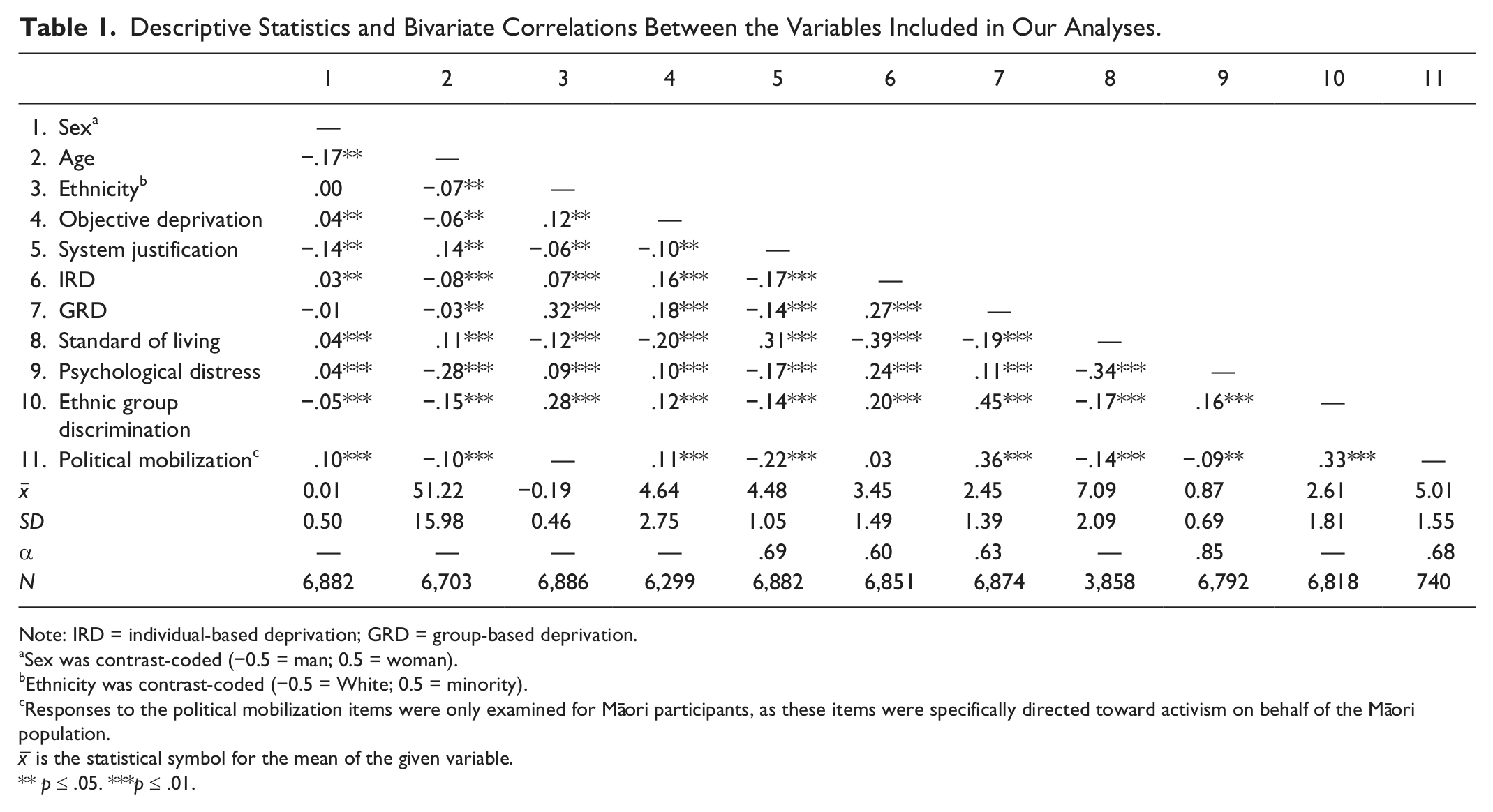
Note: IRD = individual-based deprivation; GRD = group-based deprivation.
Sex was contrast-coded (−0.5 = man; 0.5 = woman).
Ethnicity was contrast-coded (−0.5 = White; 0.5 = minority).
Responses to the political mobilization items were only examined for Māori participants, as these items were specifically directed toward activism on behalf of the Māori population.
p ≤ .05. ***p ≤ .01.
Predictors
System Justification
The following four items adapted from Kay and Jost (2003) were used to assess endorsement of system-justifying beliefs: (a) “Everyone has a fair shot at wealth and happiness in New Zealand”; (b) “in general, I find New Zealand society to be fair”; (c) “most of New Zealand’s policies serve the greater good”; and (d) “in general, the New Zealand political system operates as it should.” These items were averaged to assess endorsement of system-justifying beliefs (α = .69).
Individual-based deprivation
The following two items adapted from Abrams and Grant (2012) were used to assess IRD: (a) “I’m frustrated by what I earn relative to other people in New Zealand” and (b) “I generally earn less than other people in New Zealand.” These two items were averaged to assess IRD, r(6,696) = .43, p < .001.
Group-based deprivation
The following two items adapted from Abrams and Grant (2012) were used to assess GRD: (a) “I’m frustrated by what my ethnic group earns relative to other groups in New Zealand” and (b) “people from my ethnic group generally earn less than other groups in New Zealand.” These items were averaged to assess GRD, r(6,690) = .46, p < .001.
Individual-based Responses
Standard of Living
One item was used to assess people’s satisfaction with their standard of living. This item had participants indicate their level of satisfaction with their “standard of living” on an 11-point scale (0 = completely dissatisfied, 10 = completely satisfied).
Psychological Distress
Kessler and colleagues’ (2002) six-item Kessler-6 was used to assess psychological distress. These items had participants indicate how often “during the past 30 days” they felt (a) “hopeless,” (b) “so depressed that nothing could cheer you up,” (c) “restless or fidgety,” (d) “that everything was an effort,” (e) “worthless,” and (f) “nervous” on a 5-point scale (0 = none of the time, 4 = all of the time). These items were averaged to assess psychological distress (α = .85).
Group-based Responses
Perceived Ethnic Group Discrimination
One item was used to assess perceived levels of discrimination directed toward one’s ethnic group. This item had participants indicate whether they thought people from their “ethnic group are discriminated against in New Zealand” on a 7-point scale (1 = definitely no; 7 = definitely yes).
Political Mobilization
Two items were used to assess support for political mobilization. One of these items had participants indicate their level of support for “protest marches and public demonstrations supporting the rights of Māori” on a 7-point scale (1 = strongly oppose, 7 = strongly support). The other item had participants use a separate 7-point scale (1 = strongly disagree, 7 = strongly agree) to indicate the extent to which they agreed that “Māori have too much political power and influence in decisions affecting New Zealand” (reverse-coded). These items were averaged to assess support for political mobilization, r(728) = .51, p < .001. 2
Demographic Covariates
Objective Deprivation
Objective deprivation was assessed by matching participants’ addresses with a measure of neighborhood-level deprivation calculated by the Ministry of Health (see White, Gunston, Salmond, Atkinson, & Crampton, 2008). This measure provides a ranked decile score (1 = least deprived, 10 = most deprived) to each neighborhood in New Zealand. Each decile score is derived via a principal components analysis of household income and the proportion of people living within the given neighborhood who (a) receive financial assistance, (b) rent their home, (c) are single parents, (d) are unemployed, (e) lack qualifications, (f) live in crowded housing, (g) lack telephone access, and (h) lack access to a car. Higher scores on this measure reflect greater levels of objective deprivation.
Age, Sex, and Ethnicity
Age, sex, and ethnicity were used as demographic covariates. Age and ethnicity were assessed via open-ended items. Sex (−0.5 = man; 0.5 = woman) and ethnicity (−0.5 = White; 0.5 = non-White) were contrast-coded.
Results
We expected that IRD and GRD would have distinct relationships with individual- and group-based responses to perceived inequality. Specifically, IRD should be a better predictor of the former, whereas GRD should be a better predictor of the latter, reaction to frustrated living conditions. In addition, because system-justifying beliefs serve a palliative function for people who are exposed to inequality (Jost et al., 2003; Jost et al., 2004; Jost et al., 2012; Jost & Hunyady, 2005), we predicted that believing that the system is just would buffer people from the effects of the respective forms of deprivation. That is, endorsement of system-justifying beliefs should “dampen the blow” of inequality, regardless of whether people feel deprived at the individual or group level.
To test these hypotheses, we conducted four separate multiple regression analyses. Each of our regression models contained two blocks of predictors. The first block of each model contained our mean-centered (a) IRD and GRD measures, (b) system justification measure, and (c) demographic covariates (which were either mean-centered or contrast-coded). The second block of each model contained the mean-centered (a) IRD × System Justification and (b) GRD × System Justification interaction terms. The given response to inequality was then regressed onto the full model.
Individual-based Responses
Standard of Living
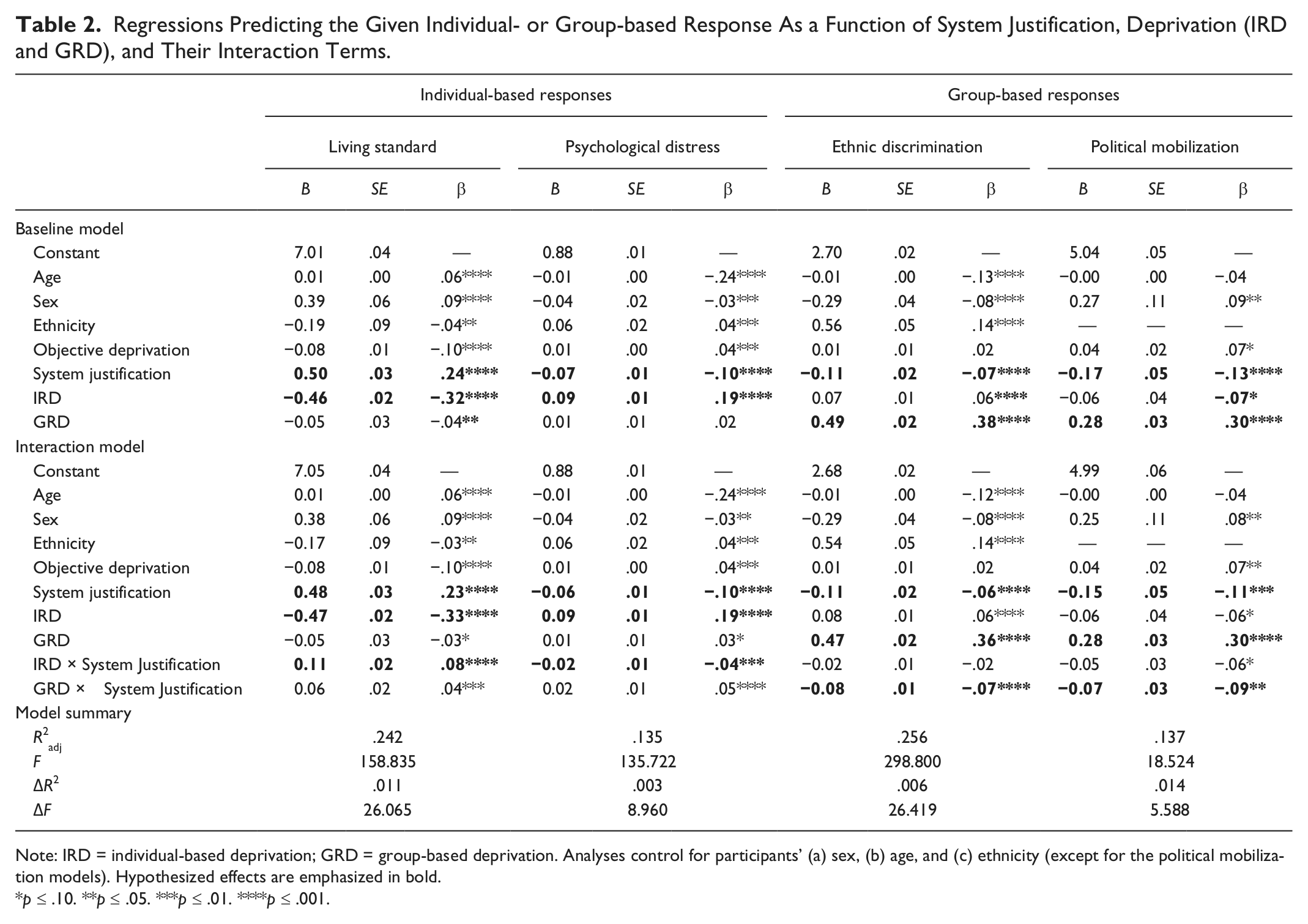
One way that relative deprivation could affect individual-based outcomes is by influencing people’s satisfaction with their standard of living. Accordingly, Table 2 displays the results of our regression predicting this outcome. As our baseline model shows, age (β = .06, p < .001) and being a woman (β = .09, p < .001) were positively, whereas being an ethnic minority (β = -.04, p = .031) and objective deprivation (β = -.10, p < .001) were negatively, associated with being satisfied with one’s standard of living. Moreover, endorsement of system-justifying beliefs had an independent positive relationship with people’s satisfaction with their standard of living (β = .24, p < .001). After partialing out these effects, IRD was negatively associated with participants’ satisfaction with their living conditions (β = −.32, p < .001). GRD, in contrast, was only weakly associated with this individual-based outcome (β = −.04, p = .038). Thus, the belief that one is personally deprived is particularly relevant when assessing one’s contentment with life.
Regressions Predicting the Given Individual- or Group-based Response As a Function of System Justification, Deprivation (IRD and GRD), and Their Interaction Terms.
Note: IRD = individual-based deprivation; GRD = group-based deprivation. Analyses control for participants’ (a) sex, (b) age, and (c) ethnicity (except for the political mobilization models). Hypothesized effects are emphasized in bold.
p ≤ .10. **p ≤ .05. ***p ≤ .01. ****p ≤ .001.
Although IRD predicted people’s satisfaction with their living conditions, system justification theory posits that system-justifying beliefs palliate people’s experience with inequality. As such, believing that the system is fair should “soften the blow” of relative deprivation. Consistent with this thesis, Table 2 also shows that endorsement of system-justifying beliefs moderated the relationship between IRD and satisfaction with one’s living conditions (β = .08, p < .001). To examine this interaction, we plotted the simple slopes for participants who were ±1 SD from the mean of system justification (see Aiken & West, 1991). As shown in Figure 1a, endorsement of system-justifying beliefs lessened the impact of IRD on people’s satisfaction with their living conditions. Specifically, the negative relationship between IRD and contentment was weaker among participants who were high, relative to low, on system justification (β = −.25, p < .001 vs. β = −.40, p < .001, respectively).
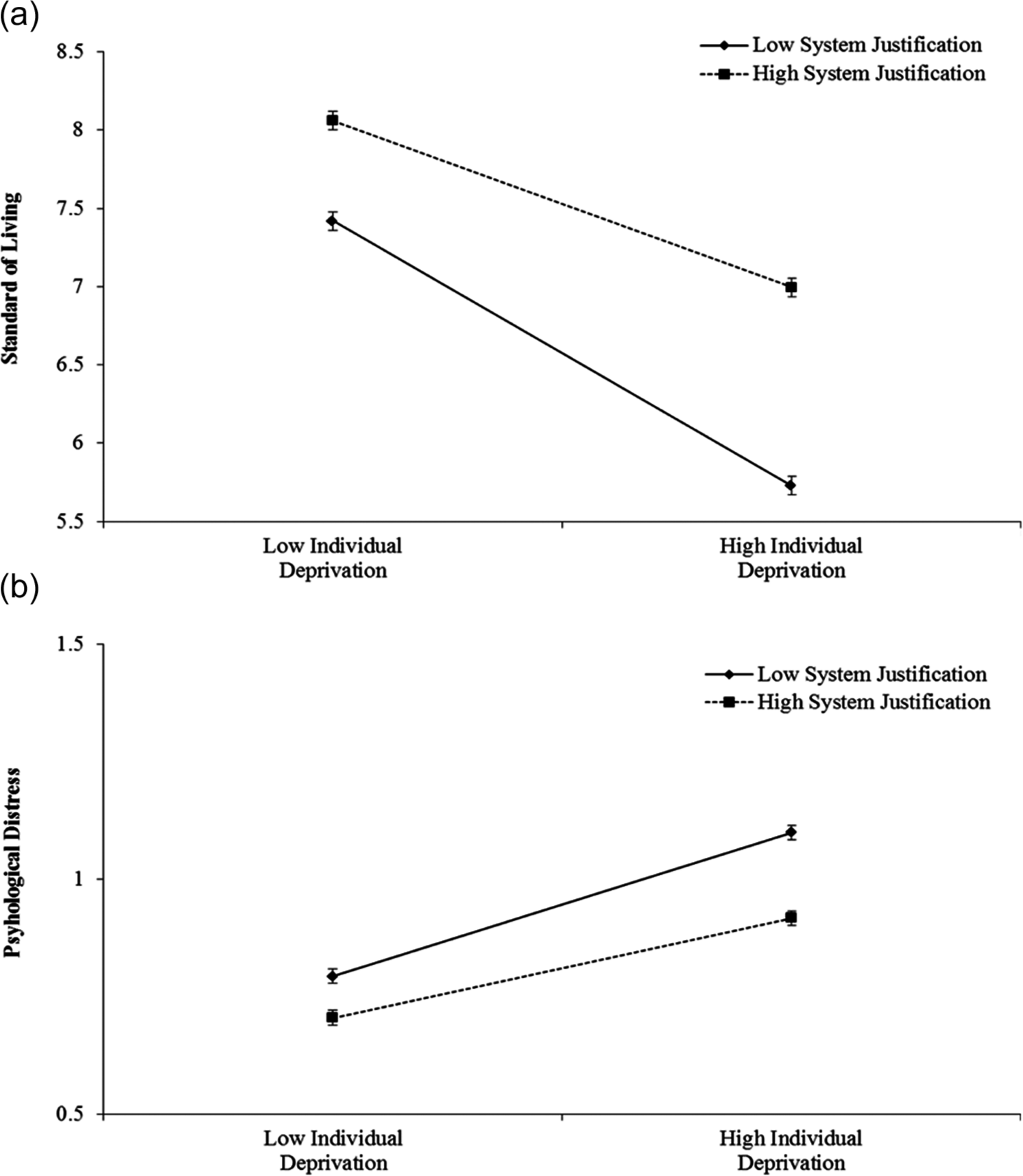
Participants’ (a) perceptions of their standard of living and (b) level of psychological distress as a function of IRD and endorsement of system-justifying beliefs.
Psychological Distress
Psychological distress is another individual-based response people can have to relative deprivation (see Adler et al., 2000). As such, Table 2 displays the results of our regression predicting participants’ self-reported levels of psychological distress. As shown here, psychological distress was negatively correlated with age (β = −.24, p < .001) and being female (β = −.03, p = .008). Conversely, being a member of a minority group (β = .04, p < .003) and objective deprivation (β = .04, p = .002) were positively associated with psychological distress. Moreover, believing that the system is just was independently associated with a decrease in self-reported psychological distress (β = −.10, p < .001). After accounting for these effects, we see that IRD—but not GRD—predicted participants’ level of psychological distress (β = .19, p < .001 vs. β = .02, p = .20, respectively).
Given the hypothesized palliative effects of system-justifying beliefs, the positive relationship between IRD and psychological distress may vary by people’s tendency to justify the system. Indeed, Table 2 shows that there was a significant IRD × System Justification interaction on psychological distress (β = −.04, p = .002). To examine this interaction, we plotted the simple slopes for participants who were ±1 SD from the mean of system justification (see Aiken & West, 1991). As shown in Figure 1b, there was a significant positive relationship between IRD and psychological distress for participants who were low on system justification (β = .22, p < .001). The corresponding relationship for participants who were high on system justification, however, was slightly weaker (β = .15, p < .001). Thus, endorsement of system-justifying beliefs cushioned the impact of IRD on participants’ mental well-being.
Group-based Responses
Perceived Ethnic Group Discrimination
Although IRD often predicts individual-based responses to inequality, GRD is the better of the two predictors of group-based outcomes (Abrams & Grant, 2012; Olson et al., 1995; Smith et al., 2012). The third column of Table 2 tests this hypothesis. As shown here, age (β = −.13, p < .001) and being a woman (β = −.08, p < .001) were negatively, whereas being an ethnic minority (β = .14, p < .001) was positively, associated with believing that one’s ethnic group encounters discrimination. In addition, endorsement of system-justifying beliefs was associated with a decreased tendency to believe that discrimination was directed toward one’s ethnic group (β = −.07 p < .001). After partialing out these effects, we see that GRD had a notably stronger relationship with the perception that one’s ethnic group is the target of discrimination relative to IRD (β = .38, p < .001 vs. β = .06, p < .001, respectively).
Although GRD was by far the strongest predictor of believing that discrimination is directed toward one’s ethnic group, we posited that this relationship should be attenuated for those who believe that society is fair. In accordance with this argument, Table 2 also indicates that there was a significant interaction between GRD and system justification on perceived ethnic group discrimination (β = −.07, p < .001). As per Aiken and West (1991), we examined this interaction by plotting the simple slopes for participants who were ±1 SD from the mean of system justification. As predicted, Figure 2a shows that the relationship between GRD and perceptions of ethnic group discrimination was weaker for participants who were high, relative to low, on system justification (β = .30, p < .001 vs. β = .43, p < .001, respectively).

Participants’ (a) perceptions of the amount of discrimination directed toward their ethnic group and (b) support for the political mobilization of Māori as a function of GRD and endorsement of system-justifying beliefs.
Political Mobilization
As a final test of our hypotheses, we examined participants support for collective action. Because the only relevant measure in the NZAVS that assessed attitudes toward collective action focused specifically on Māori rights, we restricted our analyses to participants who identified as Māori (n = 741). Notably, Māori constitute the largest ethnic minority group in New Zealand; they are also disproportionately represented in the nation’s most deprived neighborhoods (White et al., 2008). As such, examining Māori participants’ support for collective action provides an ideal test of the hypothesized differential effects of IRD and GRD on a practical group-based response to inequality.
To these ends, Table 2 shows the results of our regression model predicting support for political mobilization among Māori participants. As shown here, support for political mobilization was positively correlated with being female (β = .09, p < .016) and objective deprivation (β = .07, p = .054). In contrast, endorsement of system-justifying beliefs was associated with opposition to the mobilization of participants’ ingroup (β = −.13, p = .001). After accounting for these effects, we see the predicted positive relationship between GRD and support for political mobilization (β = .30, p < .001). In contrast, IRD was weakly (albeit marginally) associated with opposition to political mobilization (β = −.07, p = .079). That is, after partialing out the effects of the other variables in our regression, the more personally deprived Māori participants felt, the less supportive they were of political movements aimed at benefiting their group.
If system-justifying beliefs soothe people’s experiences with inequality, then the relationship between GRD and support for political mobilization should be moderated by system justification. Consistent with this hypothesis, Table 2 shows that the GRD × System Justification interaction term was significant (β = −.09, p = .021). As expected, simple slope analyses for participants who were ±1 SD from the mean of system justification (see Aiken & West, 1991) shows that there was a positive relationship between GRD and support for political mobilization among participants who were low on system justification (β = .38, p < .001; see Figure 2b). This relationship was, however, noticeably attenuated among participants who were high on system justification (β = .22, p < .001). Thus, system-justifying beliefs lessened the impact of GRD on Māori participants’ support for mobilizing their ingroup.
Discussion
This study examined the relationships between two forms of relative deprivation (i.e., IRD and GRD) and two types of responses to inequality (i.e., individual- and group-based). Because the experience of IRD occurs following an unfavorable interpersonal (rather than an intergroup) comparison (Olson et al., 1995; Walker, 1999), we expected that feeling personally deprived would predict individual-based responses to inequality better than GRD. In contrast, feeling that one’s group is deprived results from an intergroup (as opposed to an interpersonal) comparison in which one’s ingroup fares worse than another group (Olson et al., 1995; Walker, 1999). As such, GRD should predict group-based responses to inequality better than IRD.
As expected, our results showed that feeling personally deprived was (a) inversely associated with being satisfied with one’s standard of living, but (b) positively associated with self-reported psychological distress. In contrast, GRD was weakly (if at all) associated with these two individual-based responses to inequality. On the other hand, feeling relatively deprived at the group level was positively associated with (a) believing that one’s ingroup is discriminated against and (b) supporting political activism on behalf of one’s ingroup. The relationships between IRD and these two group-based outcomes were, however, either weak (in the former case) or, in the latter case, in a direction that was theoretically implausible (i.e., feeling personally deprived was negatively associated with participants’ support for political activism). Thus, our results corroborate prior work by showing that different types of deprivation predict distinct outcomes (for a review, see Smith et al., 2012).
Although demonstrating the discriminant validity of IRD and GRD is important in its own right, a major aim of this study was to examine the boundary conditions of the relationship between relative deprivation and responses to inequality. Because system-justifying beliefs have a palliative effect on people’s reactions to perceived injustices (Harding & Sibley, in press; Jost et al., 2004; Jost et al., 2012; Jost & Hunyady, 2005), we predicted that the abovementioned relationships would be weaker among participants who were high, relative to low, on system justification. This pattern of results would support our thesis that, although there are personal rewards for endorsing system-justifying beliefs (e.g., it lessens one’s psychological distress), believing that the system is just ultimately undermines people’s motivation to redress group-based inequalities (also see Jackman, 1994).
Consistent with these expectations, our results indicated that system justification mitigated the effects of relative deprivation on a range of responses to inequality. In each relationship examined, the association between feeling relatively deprived and the ensuing response was notably weaker among participants who were high, relative to low, on system justification. In some cases, the moderating effects of system justification were particularly pronounced. Indeed, the relationship between GRD and support for political mobilization on behalf of one’s ingroup was nearly cut in half among those who strongly believed that the system was just (relative to those who weakly endorsed system-justifying beliefs). This speaks to the powerful impact that system-justifying beliefs have on the maintenance of system-wide inequalities.
We would like to highlight that system justification selectively moderated the relationship between relative deprivation and these various responses to inequality. Whereas endorsing system-justifying beliefs attenuated the relationship between GRD and group-based responses to inequality, the IRD × System Justification interaction terms were nonsignificant. Likewise, the size of the GRD × System Justification interaction term on perceptions of one’s standard of living, though reliable, was half the size of the corresponding IRD × System Justification interaction term. Finally, though system justification moderated the relationships between both types of deprivation and psychological distress, the GRD × System Justification interaction term was in the opposite direction than one might expect. That is, endorsement of system-justifying beliefs strengthened the relationship between GRD and psychological distress. These findings further support the distinction made between IRD and GRD, while also demonstrating the insidious effects of system justification.
Although we have shown that system-justifying beliefs moderate the relationship between relative deprivation and various outcomes, one must keep in mind that other variables also shape people’s responses to inequality. For example, collective action often requires a strong sense of identification with the deprived group (Ellemers, 2002; van Zomeren et al., 2008) and a belief in the efficacy of the actions taken on its behalf (Klandermans, 1989; van Zomeren et al., 2008; van Zomeren, Leach, & Spears, 2010). Likewise, characteristics of the sociostructural environment (i.e., the stability and legitimacy of status differences, as well as the permeability of group boundaries) play a critical role in shaping how people respond to unfavorable outcomes (Ellemers et al., 1993; Mummendey et al., 1999). Indeed, behaviors as complex as collective action are undoubtedly multiply determined. Thus, it is important to note that we have shed light on just one of many possible pathways to collective action.
With this caveat in mind, our results have important implications for the literature on relative deprivation and system justification theory. In regard to the former theory, the present study helps identify a critical boundary condition for the relationship between relative deprivation and responses to individual- and group-based inequality. Specifically, our results show that believing that the system is just attenuates the relationships between relative deprivation and multiple types of responses to inequality. This helps explain why, despite being aware of the rising rates of inequality (e.g., Bartels, 2005), group-based responses to unequal outcomes are so rare. Indeed, endorsement of system-justifying beliefs appears to placate people’s experiences with injustices (also see Jost et al., 2012).
We also elucidate the powerful effects of system justification by showing that endorsement of system-justifying beliefs has countervailing effects on people’s self-interest. In terms of individual-based responses, believing that the system is just provides a protective barrier against the ill effects of inequality on people’s (a) assessment of their standard of living and (b) levels of psychological distress. This helps explain why people are attracted to system-justifying beliefs in the first place. When looking at group-based responses, however, endorsement of system-justifying beliefs (a) obscures people’s perceptions that their group is the target of discrimination and (b) undermines their support for collective action on behalf of their ingroup. As such, system-justifying beliefs are an insidious form of social control that reward people at the individual level, yet simultaneously undermine support for changing the system responsible for their distress.
Strengths, Limitations, and Future Directions
One of the strengths of this study was our ability to partial out the effects of objective levels of deprivation when predicting participants’ responses to feeling relatively deprived. Numerous studies have shown that increases in actual levels of inequality correspond to declines in physical (Macleod et al., 2005; Wilkinson & Pickett, 2010) and mental (Boydell, van Os, McKenzie, & Murray, 2004; Burns & Esterhuizen, 2008) health. Indeed, our results showed that objective deprivation was inversely associated with participants’ assessment of their standard of living, but positively associated with their levels of psychological distress. Nevertheless, IRD—a measure of perceived relative status—was the strongest predictor of both types of individual-based responses to inequality. This speaks to the strength of relative deprivation theory and highlights the need to consider objective and subjective aspects of deprivation when attempting to remedy the harmful effects of inequality.
Another strength of this study is our use of a psychometrically sound measure of psychological distress. Specifically, the Kessler-6 was developed to identify people with clinical levels of generalized psychological distress (Kessler et al., 2002). Indeed, this scale is excellent at discriminating between those who suffer from clinical and nonclinical levels of psychological distress in the United States (Kessler et al., 2002) and internationally (Kessler et al., 2010). Recent work also shows that the Kessler-6 has desirable item-response properties in New Zealand (Krynen, Osborne, Duck, & Sibley, in press), the country in which this study is based. To the best of our knowledge, however, we are the first to use IRD to predict scores on the Kessler-6. As such, our research demonstrates (a) the predictive validity of relative deprivation using a validated measure of mental health and (b) the responsiveness of the Kessler-6 to variations in people’s perceived (rather than actual) social status.
It is interesting to note that objective deprivation was only modestly correlated with IRD and GRD (i.e., rs = .16 and .18). This indicates that more than just objective experiences with inequality contribute to feeling relatively deprived. Indeed, Crosby’s (1976) analysis of relative deprivation theory posited that the immediate environment (a factor that closely corresponds to our measure of objective deprivation) is only 1 of 5 factors that affect people’s feelings of relative deprivation—The remaining factors identified by Crosby were (a) personality, (b) biological needs, (c) social norms, and (d) past experience with the deprived object. Our study contributes to this literature by showing that objective aspects of the immediate social context appear to only have a modest impact on perceiving that one (or one’s group) is relatively deprived. Future work should continue to examine the consequences and antecedents of relative deprivation.
Although our results are consistent with prior work, it is important to recognize that our measures of IRD and GRD assessed participants’ frustration (rather than anger) in response to their relative status. As such, differences in the phenomenology of these emotions may motivate distinct behaviors (see Osborne et al., 2012). That said, frustration and anger elicit similar outwardly focused action tendencies aimed at overcoming an obstacle or injustice (Roseman, Wiest, & Swartz, 1994). Accordingly, Smith and colleagues (2012) argued that emotions such as frustration “capture the notion of deservingness and entitlement that are at the core of relative deprivation” (p. 207). Thus, though we asked our participants about their frustration rather than anger, we are confident that our measures of IRD and GRD accurately assess their respective constructs.
We should also note that the correlational nature of our data prevents us from making strong claims about the causal direction of our results. For example, participation in social movements may increase people’s feelings of GRD. Alternatively, rather than being concurrent predictors of discrete outcomes, IRD may lead to GRD (see Pettigrew, 2002). That said, the causal order of our model is firmly rooted in more than 60 years of research (for a review, see Smith et al., 2012). Moreover, many studies have shown that experimentally induced feelings of relative deprivation cause various individual-based (Walker, 1999) and group-based (Grant & Brown, 1995; Guimond & Dambrun, 2002; Halevy et al., 2010) responses to inequality. Schmitt and colleagues (2010) also showed a cross-lagged effect of relative deprivation on decrements to participants’ life satisfaction and mental health. These studies paint a compelling portrait suggesting that relative deprivation leads to (rather than is preceded by) various psychological and group-oriented outcomes. Still, because our data are derived from survey responses collected at a single point in time, one must be cautious when interpreting the causal direction of our results.
Conclusion
In closing, we would like to preempt a possible misinterpretation of our data. Based on our readings of the literature (and on our own research), we do not believe that system-justifying beliefs are beneficial to society. Rather, our results indicate that people’s endorsement of system-justifying beliefs play an insidious role in the maintenance of social inequalities by providing a psychological incentive for those who experience inequality at the individual level. That is, believing that society is just (a) increases people’s satisfaction with their standard of living and (b) buffers them from the psychological distress associated with IRD. At the same time, such beliefs (a) decrease people’s ability to detect discrimination and (b) undermine their support for actions aimed at redressing inequality. Thus, system-justifying beliefs ultimately contribute to the stability of the status quo by ensuring that group-based responses to inequality rarely materialize.
Footnotes
Declaration of Conflicting Interests
The author(s) declared no potential conflicts of interest with respect to the research, authorship, and/or publication of this article.
Funding
The author(s) disclosed receipt of the following financial support for the research, authorship, and/or publication of this article: Data collection for the New Zealand Attitudes and Values Study (NZAVS) was supported by University of Auckland FRDF (3624435/9853) and ECREA (3626075) grants awarded to Chris G. Sibley, a University of Auckland FRDF (3700683/9853) grant awarded to Danny Osborne, and Performance Based Research Funds jointly awarded to Danny Osborne and Chris G. Sibley.