



Abstract
We proposed that (a) processing interest for affective over cognitive information is captured by meta-bases (i.e., the extent to which people subjectively perceive themselves to rely on affect or cognition in their attitudes) and (b) processing efficiency for affective over cognitive information is captured by structural bases (i.e., the extent to which attitudes are more evaluatively congruent with affect or cognition). Because processing speed can disentangle interest from efficiency by being manifest as longer or shorter reading times, we hypothesized and found that more affective meta-bases predicted longer affective than cognitive reading time when processing efficiency was held constant (Study 1). In contrast, more affective structural bases predicted shorter affective than cognitive reading time when participants were constrained in their ability to allocate resources deliberatively (Study 2). When deliberation was neither encouraged nor constrained, effects for meta-bases and structural bases emerged (Study 3). Implications for affective–cognitive processing and other attitudes-relevant constructs are discussed.
In social psychology, it has long been recognized that perhaps the most pervasive dimension by which people judge objects, issues, and other individuals is the evaluative one (i.e., judgments along a dimension ranging from positive to negative; Osgood, Suci, & Tannenbaum, 1957). These evaluations are often referred to as attitudes. Although knowing people’s attitude toward an issue can provide insights into how they perceive and process information about that issue (e.g., Fazio, 1995), it is also important to know the bases of people’s attitudes—the type of information people have relied on to arrive at their evaluations. Most commonly, researchers have distinguished between the affective and cognitive bases of attitudes (for reviews, see Petty, Fabrigar, & Wegener, 2003; Zanna & Rempel, 1988). Within this literature, affect refers to the positive and negative emotions associated with an object. Cognition refers to beliefs about positive and negative attributes of an object. The affect–cognition distinction has been central to many theories of attitudes (e.g., Insko & Schopler, 1967; Katz & Stotland, 1959; Rosenberg & Hovland, 1960; Smith, 1947), and has received much empirical support (e.g., Breckler, 1984; Kothandapani, 1971; Ostrom, 1969). Furthermore, variations in affective–cognitive attitudinal bases have been found to affect the type of behaviors influenced by attitudes (e.g., Millar & Tesser, 1986, 1989) and the susceptibility of attitudes to emotions-focused versus attributes-focused persuasion (e.g., Edwards, 1990; Fabrigar & Petty, 1999; Millar & Millar, 1990).
Of most relevance to the current article, recent research has demonstrated that the affect–cognition distinction is more multifaceted than originally thought (See, Petty, & Fabrigar, 2008). This research distinguished between affective–cognitive structural bases and affective–cognitive meta-bases.
Within the attitudes literature, researchers have typically conceptualized the bases of attitudes in terms of the structural basis of the attitude (e.g., see Chaiken, Pomerantz, & Giner-Sorolla, 1995). That is, affective bases and cognitive bases represent relationships among the overall attitude, emotions, and beliefs, all of which are stored representations in one’s memory. Accordingly, attitudes are considered to be primarily affective if emotions appear to be driving the overall evaluation more than beliefs. That is, affective attitudes are evidenced by higher evaluative consistency between emotions and attitudes than between beliefs and attitudes. The reverse is true for attitudes with a primarily cognitive basis. Although this approach presumes that people can reflect on whether an object induces certain feelings or has certain attributes, no assumptions are made about people’s subjective impressions of the extent to which their affect or cognition contributes to their overall attitudes. Rather, covariations of affective and cognitive judgments with global attitudes are determined empirically without reference to people’s awareness of such covariations.
In contrast to this traditional approach, meta-cognitive measures do not attempt to gauge the affective–cognitive nature of people’s attitude structure but only their subjective impressions of whether their various attitudes are more in line with their affective or cognitive bases. Such perceptions have been referred to as meta-cognitive bases or meta-bases for short (See et al., 2008). Meta-bases have been measured by obtaining participants’ responses to a question asking them for the extent to which they think their attitudes toward a target object are driven by emotions and a parallel question for beliefs. The emotions question and the beliefs question were then repeated across various objects and combined for an omnibus measure.
To investigate the utility of the meta-structural distinction, recent research measured individual differences in affective–cognitive structural bases and meta-bases, and compared effects of the two constructs on persuasion and choice (See et al., 2008). Several key findings emerged from this research. First, the two constructs were largely independent of one another. That is, people’s perceptions of the extent to which they relied on affect versus cognition in their attitudes was virtually unrelated to actual differences in the extent to which attitudes were evaluatively consistent with affect versus cognition. The lack of correlation between the two constructs in all three studies is noteworthy considering that there were many methodological similarities between the two measures. For instance, the meta-bases index and the structural-bases index used the same metric (i.e., scale ratings), are computed as relative scores, referred to the same attitude objects, and allowed participants to provide responses at their own pace (see also Hofmann, Gawronski, Gschwendner, Le, & Schmitt, 2005; Payne, Burkley, & Stokes, 2008).
Second, meta-bases and structural-bases measures appeared to capture meaningful variations in the underlying nature of attitudes in that both predicted information-processing effects. For example, both accounted for persuasion-matching effects in response to affective versus cognitive messages (See et al., 2008; Study 2). That is, people who had predominantly affective meta-bases or predominantly affective structural bases were more receptive to an emotions-focused appeal than an attributes-focused appeal. In contrast, there was a tendency for the attributes-focused appeal to be more successful than the emotions-focused appeal when people had predominantly cognitive meta-bases or cognitive structural bases for their attitudes. Interestingly, the effects of meta-bases and structural bases were completely independent of one another. Both effects remained when statistically controlling for the other. This suggests that meta-bases and structural bases produced a similar outcome, but presumably through distinct psychological mechanisms.
Finally, meta-bases and structural bases predicted people’s reliance on externally provided affective versus cognitive information in their choices, but the predictive strength of the two constructs differed as a function of the extent of deliberativeness (See et al., 2008; Study 3). That is, when participants were instructed to be thoughtful in their decisions, structural bases did not have any predictive utility, but meta-bases predicted the extent to which preferences for video clips were based on affective and cognitive ratings that were ostensibly provided by other participants. In contrast, when people were more spontaneous in their decision making, structural bases but not meta-bases were predictive of people’s reliance on affective versus cognitive information. Thus, the finding that both types of measures influenced the same outcome but did so under different contexts provided further support for the notion that these measures captured distinct psychological constructs.
Unresolved Issues and Current Research Objectives
Although research indicates that affective–cognitive meta-bases and structural bases are separate constructs and exert their impact depending on deliberativeness, to date very little is known regarding the underlying mechanisms through which the two constructs influence persuasion and choice. It is important to understand why these two constructs work in the way they do. For instance, it is difficult to fully specify when one construct or the other would be consequential without some understanding of the processes underlying how the constructs work as they do. Moreover, a clearer understanding of the underlying processes induced by each construct would also facilitate predictions for additional consequences of holding a particular type of attitude basis and predictions for the factors that lead people to have a particular structural or meta-basis.
Interest Versus Efficiency in Processing Affective and Cognitive Information
Our central premise is that meta-bases and structural bases differ from one another in that the meta-bases reflect variations in the interest people have in processing affective versus cognition information, whereas structural bases capture variations in the efficiency with which people can process affective versus cognitive information. There are several reasons to believe that the interest–efficiency distinction might explain meta-bases and structural-bases effects.
First, the face validity of these measures is consistent with such an interpretation. Affective–cognitive meta-bases are more likely to capture processing interest because the measure directly asks participants to report their affective and cognitive reliance, so participants know that their attitudinal bases are being examined (see also Payne, 2009). Therefore, meta-bases measures are likely to capture what people think they prioritize in their judgments, what they personally want to rely on in their judgments, and/or what they think they should rely on. Consistent with the processing interest account, in a study in which all participants were told that the study’s purpose was to examine how people make decisions, those with more affective meta-bases spent more time reading an emotions-focused rather than a belief-focused appeal (See et al., 2008; Study 1). In the same study, variables such as Need for Cognition (Cacioppo & Petty, 1982) and Need for Affect (Maio & Esses, 2001) did not predict such selective interest, thus suggesting that people who enjoy mental challenges might be interested in processing affective and cognitive information as long as they are doing so in a mentally effortful fashion (Petty, Schumann, Richman, & Strathman, 1993), and that people who seek out emotionally arousing events might approach such events for the sake of the emotional experience itself but not necessarily for the explicit purpose of making decisions. Of most importance, as we explain below, structural bases did not predict selective interest in processing affective or cognitive information.
Structural-bases measures do not require people to judge the relationships between attitudinal bases and global evaluations. Thus, these measures are much less likely to be directly tied to people’s lay theories regarding affective and cognitive information or their intentional strategies for any selective processing. Indeed, because structural measures make no assumption about awareness of covariation between bases and attitudes, structural-bases measures could reflect processes for which people have little introspective awareness. One such process is efficiency. Unless specifically prompted to do so, it is unlikely that people often compare the efficiency with which they process affective versus cognitive information. Moreover, without clear objective or normative standards against which they could assess their processing efficiency, it is not likely that people could make meaningful judgments even if prompted to do so. Thus, processing efficiency might influence covariation among bases and global attitudes without affecting subjective beliefs regarding reliance on attitude bases. Consistent with the efficiency notion, affective–cognitive structural bases have been found to be associated with the accessibility of emotions versus attributes for various attitude objects (Giner-Sorolla, 2004). Such selective accessibility might in turn increase the efficiency with which one can process new affective or cognitive information.
In addition, the interest–efficiency distinction is also conceptually consistent with the finding that meta-bases are more influential under deliberative conditions and structural bases under spontaneous conditions (See et al., 2008). When people are being deliberative, they could compensate for any deficits in efficiency by expending more intentional effort. In other words, behaviors under deliberative processing conditions would be more affected by the interest in expending effort rather than the efficiency in doing so. In contrast, when people are being spontaneous, it is less likely that any extra effort could compensate for any deficit in efficiency. This means that existing levels of efficiency would be more consequential than processing interest under spontaneous information-processing conditions.
These arguments notwithstanding, the existing evidence is at best only suggestive of the interest–efficiency distinction. As mentioned earlier, affective meta-bases predicted relatively longer emotions-focused reading time when everybody was told that the study’s purpose was to examine how people made decisions (See et al., 2008). Due to these instructions, all participants were presumed to be deliberative and thus to allocate their time based on processing interest. However, there was no manipulation of any moderator in that study to provide conclusive evidence for a processing interest account. Furthermore, no effects of structural bases were observed in that study. Notably, only one study thus far has directly compared the effects of these two measures under deliberative versus spontaneous conditions. Although such studies are suggestive of an interest–efficiency distinction, more definitive evidence would demonstrate effects using new moderators and new processing outcomes that would also be expected to emerge as a function of interest versus efficiency.
Current Research
To distinguish between interest and efficiency for affective versus cognitive information, we sought to demonstrate effects of meta- and structural bases on the same outcome variable—speed of processing. Processing speed is an ideal dependent variable to test our framework because it can disentangle interest and efficiency from each other by being manifest in opposite directions. On the one hand, greater processing interest could be manifest in slower processing speed as people who are more interested in processing a particular type of information take a longer time to read that information. Indeed, reading time has often been conceptualized as a measure that captures motivated interest in the information (e.g., Celsi & Olson, 1988; Pomerantz, Chaiken, & Tordesillas, 1995; Smith, Fabrigar, Powell, & Estrada, 2007). One possible reason is that the more people are interested or involved in the information, the more they reflect on what they read or elaborate, and the more issue-relevant thoughts they generate, all of which takes time (e.g., Barden & Petty, 2008; Petty & Cacioppo, 1979). In fact, people who spent a longer time reading a particular type of information generated a greater number of counterarguments (Edwards & Smith, 1996), were more affected by argument quality in their post-message attitudes (Clark & Wegener, 2009), and were more influenced by the information in their likeability for a person whom they depended on to win some money (Neuberg & Fiske, 1987). To summarize, longer reading times have been conceptualized in many literatures as reflecting greater processing interest.
On the other hand, greater processing efficiency could be manifest in faster processing speed as people who are efficient at processing a particular type of information take a shorter time to read that information. For instance, in a self-paced reading paradigm, faster readers—those with shorter reading times—performed better at comprehension and recall tasks for the passages relative to slower readers (e.g., Graesser, Hoffman, & Clark, 1980; Jackson & McClelland, 1979; Palmer, MacLeod, Hunt, & Davidson, 1985). Furthermore, faster readers also tended to have better general verbal abilities (Jackson & McClelland, 1979; Rudell & Hua, 1997). Finally, people who spent less time reading stereotype-consistent information rather than stereotype-inconsistent information when under cognitive load were presumed to do so because stereotype-consistent information places relatively little demand on one’s mental resources (e.g., Sherman, Lee, Bessenoff, & Frost, 1998). In summary, in a variety of contexts, shorter reading times have been conceptualized as reflecting greater processing efficiency such as when the information fits preexisting knowledge or schemas.
Therefore, we hypothesized that more affective meta-bases would predict longer reading times for affective over cognitive information, thus suggesting that meta-bases capture processing interest. However, we also hypothesized that more affective structural bases would predict shorter reading times for affective over cognitive information, thus suggesting that structural bases capture processing efficiency. To test our hypotheses, we sought to
establish information framing as a new moderator for the positive influence of meta-bases on reading time (Study 1),
demonstrate negative effects of structural bases on reading time by minimizing the tendency for participants to allocate attention deliberatively (Study 2), and
demonstrate opposite effects for structural bases and meta-bases in a context where deliberativeness was neither encouraged nor constrained (Study 3).
Study 1
In this study, we wanted to demonstrate the effects of meta-bases on processing interest. We highlighted whether the information was affective or cognitive to participants so that it would be easy for them to act based on their interest. In other words, we varied only the affective versus cognitive framing of the information (see also Mayer & Tormala, 2010). At the same time, we minimized the role of processing efficiency by keeping the actual contents of the information identical for all participants. In the absence of any content differences, the same demands are placed on participants’ mental resources across different frames (e.g., See, Petty, & Evans, 2009). Thus, efficiency is unlikely to affect processing behavior. Accordingly, we did not expect structural bases to predict reading time in this study. Instead, reading time that varies across frames of identical information should be due to people’s intentional allocation of their resources such that if information is framed to be of the type that they are interested in processing, they would spend more time reading that information. We predicted that meta-bases would interact with frame such that cognitive meta-bases individuals would spend more time on information that they believed was mostly cognitive rather than affective. Those with affective meta-bases were expected to do the opposite.
Method
Participants and design
Fifty-six introductory psychology students completed the study in exchange for partial course credit. Participants were randomly assigned to receive either the cognitive frame or the affective frame. Thus, the study was a Frame (cognitive vs. affective) × Meta-Bases (continuous) × Structural Bases (continuous) between-subjects design. The dependent measure was total reading time.
Procedure
Participants were told that they would be reading seven paragraphs of information about lemphurs. They were then given framing instructions for the paragraphs. All participants received the same paragraphs, which were presented over seven computer screens. Each paragraph contained between three to five sentences that consisted of neutral, attributes-focused, and emotions-focused information that was positive about lemphurs. 1 This means that in its entirety, the information was ambiguous in its actual affective–cognitive nature and could be construed as primarily affective or cognitive based on the framing instructions. In an ostensibly separate study, participants reported their structural bases and meta-bases toward various attitude objects. All participants were debriefed and thanked at the end of the session.
Predictor variables
Frame
In the cognitive frame condition, participants were told “Now, you will be reading a passage about the characteristics of lemphurs.” In the affective frame condition, participants were told “Now, you will be reading a passage about the emotions that an individual experiences when interacting with lemphurs.” All participants were also instructed that the upcoming passage contained seven paragraphs.
Regardless of the frame condition, everybody proceeded to read neutral, attributes-related, and emotions-focused information about lemphurs. The contents on each computer screen contained a mix of the different types of information. An example of neutral information is “Lemphurs can be found in the ocean waters as far north as Alaska and as far south as Antarctica.” An example of attributes-related information is “Ernestine is an extremely intelligent creature.” An example of emotions-focused information is “The delicateness of the motion amazed me.” A piece of information was considered to emphasize attributes or emotions depending on whether it came from a passage that was validated in past research to be affective or cognitive (Crites, Fabrigar, & Petty, 1994).
Structural bases
To assess individual differences in affective–cognitive structural bases, we used a measure from prior research (e.g., Huskinson & Haddock, 2004; See et al., 2008). Participants completed affective, cognitive, and attitudinal items using bipolar semantic-differential scales that were originally developed and validated in prior research (see Crites et al., 1994). For the affective items, participants reported the extent to which they had positive emotions toward the object on eight scales (e.g., sad–delighted). For the cognitive items, participants indicated the valence of their beliefs about the same attitude object on seven scales (e.g., useless–useful). Finally, they reported their overall attitudes, on four scales (e.g., negative–positive). After reporting their affective, cognitive, and attitudinal responses as well as meta-bases (see below for meta-bases assessment) for one attitude object, participants then repeated the procedure for another attitude object. The mean Cronbach’s α for feelings across the attitude objects was .94, for beliefs it was .90, and for attitudes it was .93.
The order in which participants reported their feelings and beliefs was random across the objects for each participant. Responses were aggregated across attitude objects to form a structural-bases index. The attitude objects were birth control, blood donation, the death penalty and George Bush, and were selected such that they were diverse in eliciting affective and cognitive structural and meta-bases.
To create an individual differences measure of structural bases, two correlations were computed for each participant. One correlation measured the relationship between the participant’s affect and attitude for the attitude objects. The other measured the relationship between the participant’s cognition and attitude for these objects. These correlations were then converted to Fisher’s z values. Finally, participants’ cognition–attitude correlations were subtracted from their affect–attitude correlations such that the higher a participant’s final score, the more the participant’s attitude structure across the diverse attitude objects was dominated by affect rather than cognition (see Haddock & Zanna, 1994, and See et al., 2008).
Meta-bases
After the structural bases items for each of the attitude objects, participants reported their meta-bases for the same object by responding to the following questions: (a) “To what extent do you think your attitudes toward (insert attitude object) are driven by your emotions?” and (b) “To what extent do you think your attitudes toward (insert attitude object) are driven by your beliefs?” Participants responded to these questions on 7-point scales (1 = not at all; 7 = totally). We computed an index for participants’ meta-bases by first averaging participants’ responses to the belief questions across the attitude objects (Cronbach’s α = .63). The same was done for their responses to the emotion questions (Cronbach’s α = .51). Affective meta-basis and cognitive meta-basis items were positively correlated, r(54) = .52, p < .001. To make the meta-bases measure comparable with the structural-bases measure, standardized values for each participant’s averaged responses to the belief questions were subtracted from standardized values for the participant’s averaged responses to emotion questions. Therefore, larger positive scores reflected more affective meta-bases (see See et al., 2008).
Dependent variable: Reading time
The computer recorded the amount of time participants spent on each paragraph. Reading time was computed by summing the time the participant spent on the seven paragraphs. To control for individual reading speed, the amount of time participants spent on reading the framing instructions was also measured.
Results and Discussion
As in prior research, structural bases and meta-bases did not correlate with each other, r(54) = −.002, p = .99.
A regression analysis was conducted with the following predictor variables in the first step: the amount of time participants spent on reading the framing instructions, participants’ centered meta-bases and structural bases, and the frame (0 = cognitive; 1 = affective). Two-way interactions were entered as predictors in the second step, and the three-way interaction in the third step.
Reading time for the framing instructions predicted reading time for the lemphur information, β = .50, t(51) = 3.92, p < .001, rpartial = .48. Of more importance, a Meta-Bases × Frame interaction was observed, β = .38, t(48) = 2.30, p = .03, rpartial = .32, in a pattern that supported our hypothesis (see Figure 1). Among cognitive frame participants, more cognitive meta-bases predicted longer reading times, β = −.35, t(23) = −2.22, p = .04, rpartial = −.42. Among affective frame participants, the difference between affective and cognitive meta-bases participants did not reach statistical significance although the trend was in the predicted direction: more affective meta-bases tended to predict longer reading times, β= .32, t(25) = 1.72, p = .10, rpartial = .32.
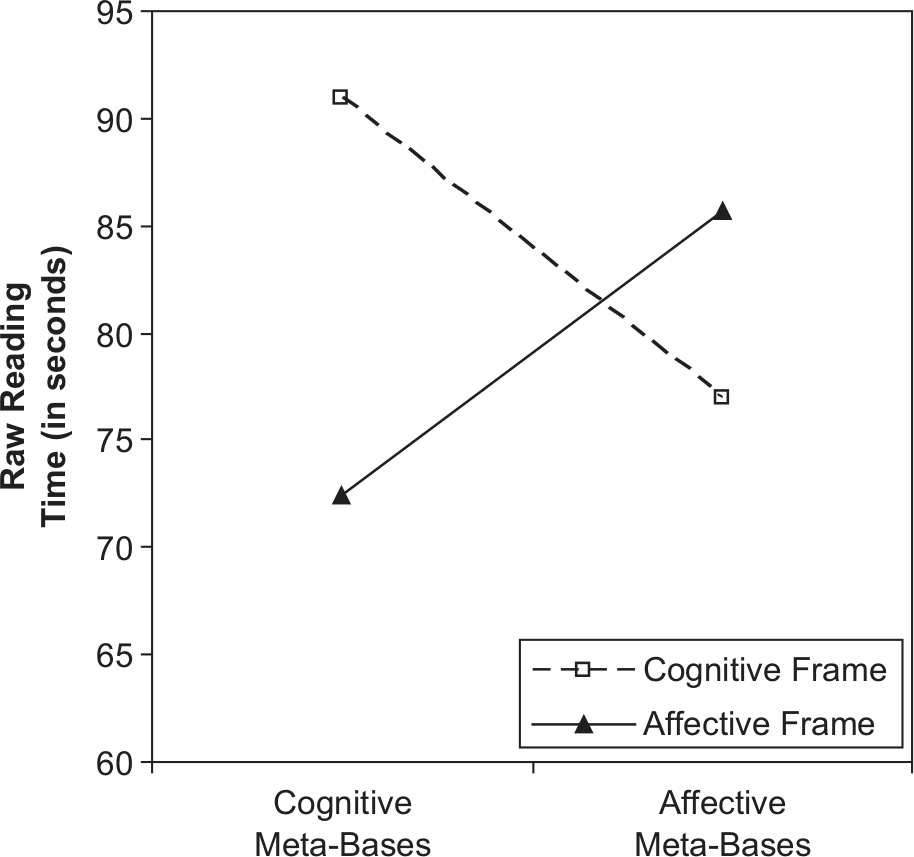
Time spent on reading lemphur passage as a function of Frame and Meta-Bases in Study 1.
In contrast, structural bases did not interact with frame to influence reading time, p = .91. Thus, when processing efficiency could not influence reading time (because all participants read identical information) but processing interest could (because the information was clearly labeled as affective or cognitive in nature), structural bases did not predict reading time but meta-bases interacted with framing to influence reading time. No other main effect or interaction was statistically significant.
Study 2
In this study, we sought to create a situation that was opposite to that of Study 1. Because our aim was to demonstrate the effects of structural bases on processing efficiency, we presented participants with affective and cognitive sentences on separate computer screens so that it was possible to record the time each participant spent on reading actual affective versus cognitive content. The dependent measure was the proportion of reading time for affective sentences compared with cognitive sentences. We also minimized the possibility that reading time would reflect processing interest in two ways. First, we did not label the information in any way so it would be difficult for participants to allocate their attention deliberatively. Second, we presented affective and cognitive sentences in a mixed order among neutral sentences, so that it would be hard for participants to anticipate whether the upcoming sentence would be affective or cognitive.
Our main hypothesis was that more affective structural bases would predict faster reading of the affective content, as reflected by a lower proportion of time spent on the affective rather than cognitive sentences. We also measured participants’ recall of the sentences to test the alternative hypothesis that the faster reading time for affective sentences among affective structural-bases participants was due to lack of interest (rather than greater efficiency), such that they would have poorer memory for the affective sentences. That is, because we assumed that reading time reflects efficiency in this study, we expected that affective structural-bases participants would remember at least an equal number of affective sentences as their cognitive counterparts even if they spent a shorter time reading those sentences.
Method
Participants and design
Sixty introductory psychology students (35 females, 25 males; Mage = 22.15; SDage = 1.86) completed the study in exchange for fast food vouchers (worth about US$4). 2 To test whether our predictions would hold regardless of the valence of the information, participants were randomly assigned to read either positive cognitive and negative affective information or positive affective information and negative cognitive information (see van den Berg, Manstead, van der Pligt, & Wigboldus, 2006, for a similar procedure). Thus, the study was a Valence (positive cognitive and negative affective vs. positive affective and negative cognitive) × Structural Bases (continuous) × Meta-Bases (continuous) between-subjects design. The dependent measures were (a) proportion of time spent on affective information relative to the total time spent on affective and cognitive information and (b) recall for affective sentences relative to cognitive sentences.
Procedure and materials
Participants first reported their structural bases and meta-bases toward various attitude objects. In an ostensibly separate study, they were told that they would be reading a series of sentences about a mammal named Garuda-banabilus venivitalus. They were presented with 10 sentences, 1 sentence per computer screen. Regardless of the Valence condition, the type of sentence was presented in the following order: neutral, affective, cognitive, neutral, affective, neutral, neutral, cognitive, affective, and cognitive. Descriptions of the animal were taken from past research that had been pilot tested to be affective (e.g., has a playful character) or cognitive (e.g., helps reduce tree diseases; van den Berg et al., 2006). To increase the sample of stimuli, two new sentences—one affective and one cognitive—were also adapted from prior research (Crites et al., 1994), and added for each Valence condition. After reading the sentences, participants recalled as many of the 10 sentences as they could. Participants were then debriefed and thanked for completing the study.
Predictor variables
Structural bases
Participants’ structural bases were assessed in the same way as before. The attitude objects were birth control, snakes, spiders, blood donation, and chocolates. The mean Cronbach’s α for feelings across the attitude objects was .91, for beliefs it was .87, and for attitudes it was .92.
Meta-bases
Participants’ meta-bases were also assessed in the same way as before using the same attitude objects that comprised the structural-bases measure. The Cronbach’s α for the affective and cognitive meta-basis items were .55 and .65, respectively. Affective meta-basis and cognitive meta-basis items were positively correlated, r(58) = .45, p <.001.
Dependent variables
Reading time
The proportion of time participants took to read the three affective sentences relative to the total time they took to read the affective and cognitive sentences was computed as an index of reading time. Using a proportion index (rather than a difference score) allowed for individual differences in reading speed to be controlled. Higher values reflect greater proportions of affective reading time.
Memory
The number of cognitive sentences that participants recalled was deducted from the number of affective sentences so the minimum possible value is −3 and the maximum possible value is 3. Using a difference score (rather than a proportion) allowed us to include participants whose memory for affective and cognitive sentences was zero. 3 Higher values reflect better memory for affective sentences compared with cognitive sentences.
Results and Discussion
As before, structural bases and meta-bases did not correlate with each other, r(58) = .01, p = .95.
Reading time
The proportion of affective reading time was subject to a one-way (valence: positive cognitive and negative affective information vs. positive affective and negative cognitive information) ANOVA. Valence did not influence the proportion of affective reading time, p = .59. 4 Therefore, we conducted a simultaneous regression analysis with only meta-bases and structural bases as the predictor variables. As hypothesized, more affective structural bases predicted shorter reading time for affective than cognitive information, β = −.26, t(57) = −2.05, p = .045, rpartial = −.26. Also, as expected, meta-bases did not predict affective reading time, β = .11, t(57) = .84, p = .405, rpartial =.11.
Memory
We also ran another simultaneous regression analysis but with memory as the dependent measure. Structural bases did not predict selective memory, p = .98. This means that the faster affective reading speed among affective structural-bases participants, relative to their cognitive counterparts, did not occur at the expense of memory for the affective sentences. In other words, affective structural-bases participants were not just faster readers but faster and equally effective readers, compared with their cognitive counterparts. Meta-bases also did not predict selective memory, p = .58.
Study 3
In Study 3, we examined whether the effects of meta-bases in Study 1 and the effects of structural bases in Study 2 could be replicated within the same study. All participants received affective and cognitive information. To allow reading time to reflect processing interest and processing efficiency, we adapted the procedures in Studies 1 and 2.
In the present study (Study 3), the information was labeled according to its affective–cognitive nature and its negative–positive nature. In addition, the affective and cognitive information was presented as distinct summaries rather than intermingled affective and cognitive sentences. Hence, unlike Study 2’s participants who did not receive any affective–cognitive label and who were presented with intermingled affective and cognitive information, Study 3’s participants should be able to allocate their time to read the upcoming affective and cognitive summary based on their interest. Therefore, our first hypothesis was that more affective meta-bases would predict a greater proportion of time spent on reading affective rather than cognitive information, an effect found in Study 1.
At the same time, unlike Study 1’s participants who received information that was not clearly affective or cognitive in its actual content, Study 3’s participants received sets of information that were clearly affective or cognitive in nature. Therefore, reading time could also be influenced by differences in processing efficiency for particular types of information. Because affective and cognitive summaries were presented on separate computer screens in Study 3, it was possible to record the time each participant spent on reading actual affective versus cognitive material. Therefore, our second hypothesis was that structural bases would predict efficiency in processing affective versus cognitive information, and produce the opposite pattern as meta-bases; that is, more affective structural bases would predict a smaller proportion of time spent on reading affective information rather than cognitive information.
Method
Participants and design
Fifty-six introductory psychology students (44 females, 12 males) completed the study in exchange for partial course credit. To test whether our predictions would hold across positive and negative information, and across different orders of presentation, participants were randomly assigned to a 2 (valence: positive cognitive and negative affective information vs. positive affective and negative cognitive information) × 2 (information order: cognitive information first vs. affective information first) design. The dependent measure was the proportion of reading time for affective summaries compared with cognitive summaries.
Procedure
Participants were told that they would be completing various studies in the session. First, participants reported their structural bases and meta-bases toward different attitude objects, one object at a time. Participants then completed a supposedly separate study in which they read two summaries about the lemphur. The lemphur information was taken from prior research (e.g., Crites et al., 1994).
Participants were first told that they would be presented with two excerpts about lemphurs. Importantly, they were told that “To be fair, we will present both positive and negative information. The information has been taken from transcripts for two different documentaries about the lemphur.” They then received the affective–cognitive labels for the upcoming information. For the affective label, participants were told to “focus on how [they] would feel if [they] encountered a lemphur.” For the cognitive label, participants were told to “focus on learning as much as [they] can about lemphurs.” The information in each summary was presented over a series of two computer screens. This means that each participant read a series of four computer screens in total. Finally, participants were debriefed and thanked for their participation.
Predictor variables
Structural bases
Participants’ structural bases were assessed in the same way as before. Responses were aggregated across attitude objects to form a structural-bases index. The attitude objects used were birth control, snakes, spiders, blood donation, and chocolates. The mean Cronbach’s α for feelings across the attitude objects was .90, for beliefs it was .89, and for attitudes it was .90.
Meta-bases
Participants’ meta-bases were also assessed in the same way as before using the same attitude objects that comprised the structural-bases measure. The Cronbach’s α for the affective and cognitive meta-basis items were .53 and .57, respectively. Affective meta-basis and cognitive meta-basis items were positively correlated, r(54) = .44, p =.001.
Dependent variable: Reading time
After reporting their structural and meta-bases, participants were given two summaries—one cognitive and the other affective. For half of the participants, the cognitive information was presented before the affective information whereas for the other half, the order was reversed. In addition, among participants who received cognitive information first, half read about negative attributes of the lemphur (e.g., they contain relatively high levels of cholesterol) while the other half read about positive attributes (e.g., they are extremely capable of being trained). Similarly, among those who read affective information first, half read information designed to elicit pleasant emotions (e.g., a lemphur was smiling at an individual and made the individual happy), whereas the other half read information designed to elicit unpleasant emotions (e.g., a swimmer experienced pain and panic during a lemphur attack; see Crites et al., 1994, for validation of these materials). In summary, participants either received positive cognitive information and negative affective information or positive affective information and negative cognitive information, with the order of the information counterbalanced across participants.
The proportion of time participants took to read the affective summary (i.e., the two computer screens that contained affective information) relative to the total time they took to read the affective and cognitive passages (i.e., all four computer screens) was computed as an index of selective reading of affective rather than cognitive information.
Results and Discussion
As before, structural bases and meta-bases did not correlate with each other, r(54) = .14, p = .31.
The proportion of time spent reading affective information was subject to a 2 (valence: positive cognitive and negative affective information vs. positive affective and negative cognitive information) × 2 (information order: cognitive information first vs. affective information first) ANOVA. Only a significant main effect for Information Valence emerged, F(1, 55) = 17.20, p < .001. This effect was due to participants spending a greater proportion of time reading the negative affective information (M = .58, SD = .05) than the positive affective information (M = .49, SD = .05).
Given the main effect of information valence on proportion of affective reading time, we controlled for information valence in a regression analysis where information valence (0 = positive cognitive and negative affective; 1 = positive affective and negative cognitive), meta-bases (centered), structural bases (centered), as well as their interaction terms were added as predictors. As hypothesized, meta-bases and structural bases predicted the proportion of time spent reading affective information in opposite ways. More affective meta-bases predicted a greater proportion of time spent on affective than cognitive information, β = .26, t(52) = 2.31, p = .03, rpartial =.31. In contrast, more affective structural bases predicted a smaller proportion of time spent on affective than cognitive information, β = −.23, t(52) = −1.97, p = .05, rpartial = −.26 (see Figure 2).
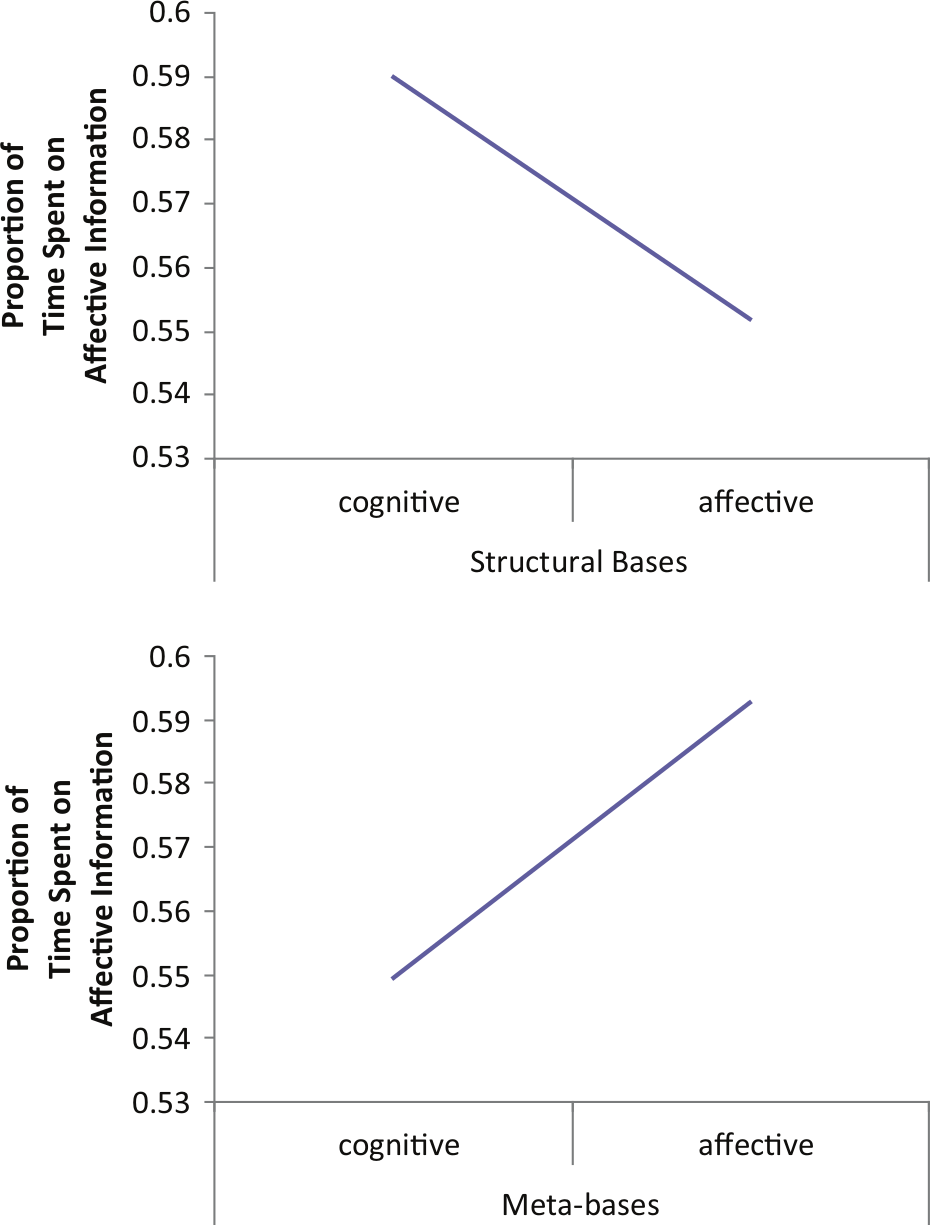
Effects of structural bases (top panel) and meta-bases (bottom panel) on proportion of time spent on reading affective information in Study 3.
Neither Information Valence nor Information Order interacted with meta-bases or structural bases to influence selective reading time, ps > .59. This suggests that the relationships between meta-bases and reading time as well as structural bases and reading time held regardless of whether the affective (or cognitive) information was negative or positive.
General Discussion
Summary of Findings
We reported several findings supporting our key premise that structural bases mainly capture processing efficiency for affective versus cognitive information whereas meta-bases mainly capture selective processing interest. By examining an outcome variable that allowed us to distinguish between interest and efficiency, we found opposite effects for meta-bases and structural bases. In Study 1, when the information was explicitly labeled as affective or cognitive (thus allowing for intentional time allocation), only meta-bases predicted reading time such that given the cognitive frame, cognitive meta-bases individuals spent a longer time reading the information than affective meta-bases individuals. When given the affective frame, affective meta-bases individuals tended to spend a longer time than cognitive meta-bases individuals. In contrast, in Study 2, when influence from processing interest was minimized by presenting unlabeled affective and cognitive sentences in a mixed order, only structural bases predicted reading time. More affective structural bases predicted shorter reading times for affective than cognitive information. In Study 3, when interest and efficiency were neither encouraged nor minimized, meta-bases and structural bases predicted reading time. More affective meta-bases predicted longer reading times for affective than cognitive information but the opposite was true for structural bases.
Although we believe our interest–efficiency interpretation is the most plausible account for the results of each individual study, we think this account is even more compelling when considering that it provides a consistent and parsimonious explanation for the distinct effects of meta-bases and structural bases across all three studies (i.e., the opposite effects of the two types of bases as well as the manifestation of their effects in differing contexts). Any plausible alternative explanation offered should not only be able to account for the effects of meta-bases and structural bases in a single study, but rather account for the effects across all studies. Indeed, it is difficult to arrive at an alternative explanation that can parsimoniously account for the full set of effects demonstrated in these studies.
For example, it seems difficult to argue the reverse interpretation for our findings (i.e., meta-bases reflect efficiency and structural bases reflect interest). If one wanted to propose that structural bases reflect processing interest, this might be tenable in the context of Study 2 where perhaps one could make a case that people who are more interested might expend more effort, and this effort would be manifest as faster processing speed. However, this alternative account for the effects of structural bases in Study 2 is difficult to sustain in Study 1. If structural bases reflect interest, why did this interest fail to interact with the framing of information in Study 1? Similar problems arise if one attempts to interpret meta-bases as reflecting processing efficiency.
Implications for Affective–Cognitive Processes
Consistent with prior research exploring the meta-structural distinction (See et al., 2008), the present studies indicated that individual differences in meta-bases and structural bases were typically uncorrelated with one another. However, at the empirical level, the present studies go beyond past research by providing evidence for a new outcome of meta-bases and structural bases: processing speed of affective versus cognitive information. Moreover, the present studies are also the first evidence for a new moderator of meta-bases effects: information framing. Furthermore, the present findings provide insight into the underlying mechanisms that distinguish between affective–cognitive meta-bases and structural bases: interest versus efficiency in processing a particular type of information.
The interest–efficiency account could shed light on previous findings on affective–cognitive persuasion. For example, the interest–efficiency distinction could explain how meta-bases and structural bases had identical effects on susceptibility to affective versus cognitive persuasion yet these effects were independent of one another (See et al., 2008). In the case of meta-bases, people might be more influenced by a persuasive message matched to their predominant basis because they are more interested to extensively process the matched message than the mismatched message. In the case of structural bases, people are also more persuaded by a matched message than a mismatched message, but this differential persuasion could be due to the greater efficiency in processing one type of information than another. Importantly, the interest–efficiency account suggests that when matched persuasion is predicted by structural bases, such an effect might be less likely to be disrupted by factors that diminish one’s capacity to process information (e.g., distraction; Petty, Wells, & Brock, 1976). However, when matched persuasion is predicted by meta-bases, such an effect might be less likely to be enhanced by factors that increase one’s intentional expenditure of mental effort (e.g., increased message relevance; Petty & Cacioppo, 1979).
The interest–efficiency account could also provide insight on how the origins of meta-bases and structural bases differ. For instance, people might be more interested in allocating their resources toward one type of information over the other because they want to debunk that information to protect their attitudes (e.g., Edwards & Smith, 1996) or rely on that information to make an accurate decision (e.g., Tetlock, 1992). However, as mentioned before, selective efficiency could be related to greater accessibility of one particular type of information over another (e.g., Giner-Sorolla, 2004), which might have developed from greater frequency of exposure to a particular type of information (e.g., Bargh, Bond, Lombardi, & Tota, 1986; Higgins, 1996). At the same time, interest and efficiency could be driven by what appears to be the same variable but actually reflect different constructs. For instance, pleasure from processing one type of information could lead to selective interest and selective efficiency but in the case of interest, one is aware of the experience of pleasure and deriving the pleasure from relatively external incentives whereas in the case of efficiency, one is not fully aware of the pleasure, which is inherent in the processing activity (see McClelland, Koestner, & Weinberger, 1989; Schultheiss, 2001).
Implications for Other Constructs
The interest–efficiency distinction could be generalized to other processing-relevant constructs. Attitudes researchers have long been interested in various properties of attitudes (e.g., ambivalence and amount of attitude-relevant knowledge) that govern the extent to which attitudes are susceptible to change and are likely to influence behavior and judgments (see Fabrigar, MacDonald, & Wegener, 2005; Fabrigar, Wegener, & MacDonald, 2010; Petty & Krosnick, 1995). Interestingly, these properties of attitudes have sometimes been assessed using subjective self-perception measures and other times using objective measures. For example, ambivalence has been assessed by asking people how conflicted they are or computed objectively as an index from the number and extremity of positive versus negative reactions (Thompson, Zanna, & Griffin, 1995). Similarly, knowledge has been measured by asking a person how knowledgeable they consider themselves on a topic or by having a person list all the things they know about a topic (Wood, Rholes, & Biek, 1995). The most common practice has been to view these measures as indices of the same construct (see Wegener, Downing, Krosnick, & Petty, 1995, for a review). Other researchers have suggested that structural measures had more predictive strength than meta-cognitive measures (e.g., Bassili, 1996).
However, the present studies suggest that we should not necessarily expect subjective measures to correlate highly with their structural counterparts. Moreover, such a lack of correlation need not imply flaws in either measure, but instead could imply that different types of measures reflect distinct but equally useful constructs. In the case of knowledge, for instance, the relationship between knowledge and attitude–behavior consistency that was observed for subjective and objective knowledge measures (e.g., Davidson, Yantis, Norwood, & Montano, 1985) could be explained by two different mechanisms. Notably, the interest–efficiency account suggests specific predictions for how subjective and structural factors affect attitude–behavior consistency. For example, subjective knowledge might moderate attitude–behavior consistency by influencing one’s interest in seeking out attitude-related information whereas objective knowledge might also moderate attitude–behavior consistency but by influencing efficiency in retrieving attitude-relevant information. Similarly, subjective ambivalence might increase the motivation to process information to minimize the experience of conflict whereas objective ambivalence might increase the efficiency with which one processes information because positive and negative reactions are available.
Future Directions
The present findings also raise several questions for new research. Within the context of the affect–cognition literature, one fruitful direction would be to compare the effects of meta-bases and structural bases on additional outcomes. Some research has suggested that attitudes with different bases might influence instrumental versus consummatory behavior (Millar & Tesser, 1986, 1989). It would be interesting to see if meta-bases and/or structural bases moderate such attitude–behavior consistency effects and whether such effects are driven by different psychological mechanisms. Meta-bases and structural bases might also influence various stages of information processing (e.g., exposure, attention, elaboration, or retrieval). For instance, especially when the matched information is lacking in one’s environment, the interest in allocating resources for such information might be more important than processing efficiency, and thus, meta-bases but not structural bases would predict the tendency to seek out additional information that matches one’s interest (see also See & Khoo, 2011). In contrast, especially when there is an abundance of the matched information in one’s environment, processing efficiency might matter more such that structural bases but not meta-bases would predict the tendency to remember the abundant information.
Another question prompted by the present findings concerns how past experimental manipulations and measures of affective and cognitive bases of attitudes should be interpreted. In many cases, researchers have attempted to either measure or manipulate differences in the bases of attitudes but the precise type of basis that was manipulated is unclear. For example, manipulations have sometimes asked people to introspect on their beliefs or emotions as a means of altering the bases of attitudes (e.g., Millar & Millar, 1990; Millar & Tesser, 1986, 1989). Others have used personality measures such as the need for affect and need for cognition (Haddock, Maio, Arnold, & Huskinson, 2008). Although such manipulations and measures have clearly had effects, an interesting future direction would be to explore whether such effects are driven by structural bases (efficiency factors), meta-bases (interest factors), or both, with implications for when and how such effects are more likely to occur.
Conclusion
The present research provides some clarity regarding the nature of the meta-structural distinction that has been applied to affective and cognitive bases of attitudes. We hope these findings will lead to advances in research that enriches our understanding of affective–cognitive processing and generate new questions about the meta-structural distinction for other attitudes-relevant constructs.
Footnotes
Declaration of Conflicting Interests
The author(s) declared no potential conflicts of interest with respect to the research, authorship, and/or publication of this article.
Funding
The author(s) disclosed receipt of the following financial support for the research, authorship, and/or publication of this article: This research was supported in part by Singapore’s National Research Foundation NRF2008IDM-IDM001-028 and Ministry of Education (MOE) Academic Research Fund R581-000-079-112.