



Abstract
For some people, religion strongly influences their worldviews. We propose that religious outgroups threaten the foundational beliefs of people with strong religious worldviews (RWVs) by endorsing alternative belief systems and that this threat contributes to religious prejudice. To examine these ideas, we developed a measure of RWV strength and assessed the role of RWV threat in religious prejudice. Across five studies, strength of RWV was related to religious prejudice, including derogation and denial of alternative religious viewpoints, as well as support for suppressing, avoiding, and even aggressing against religious outgroups. These responses were strongest toward religious outgroups whose worldviews were the most different, and therefore most threatening. Mediational analyses revealed that strong RWV people expressed heightened prejudice because of the worldview threat posed by religious outgroup members. These findings indicate that the avoidance and subjugation of religious outgroups can serve as a worldview protection strategy for some people.
Now I urge you, brethren, note those who cause divisions and offenses, contrary to the doctrine which you have learned, and avoid them. For those who are such do not serve our Lord Jesus Christ, but their own belly, and by smooth words and flattering speech deceive the hearts of the simple.
Since ancient times, humans across the globe have cherished the ability to enhance their experiences of the world by perceiving it through a religious lens (Smart, 1989). However, a clearly defined and unified religious worldview that all people share remains elusive. Intergroup conflict and religious strife also persist as tenacious elements of religion’s pervasive presence. Although the Christian Crusades of the 11th to 13th centuries are long over, many of the most contentious conflicts today involve religion. For example, tensions between Christians and Muslims remain high, along with tensions between Protestants and Catholics in Northern Ireland, Jews and Muslims in the Middle East, Hindus and Muslims in India and Pakistan, and Islamic sects all over the world. We argue that religious prejudice is an enduring correlate of religious differences because people are motivated to protect their religious worldviews from threats posed by religious outgroups. By contradicting one’s religious worldview through the endorsement of an alternative worldview, religious outgroup members can threaten a person’s foundational approach to the world. The present work tests the idea that people whose worldviews are strongly shaped by their religion derogate and avoid religious outgroup members (i.e., respond with religious prejudice) because religious differences threaten their religious worldviews. By demonstrating the important role of worldview threat in religious prejudice, the present approach can contribute to a better understanding of both worldview defense and religious prejudice.
Worldviews
Throughout our lives, we put a considerable amount of effort into navigating extremely complicated physical and social worlds. Our decisions and interpretations of our experiences are heavily influenced by our worldviews. A worldview is an individual’s subjective beliefs and assumptions about reality and his or her existence within that reality (Koltko-Rivera, 2004). A person’s worldview directly affects his or her cognition, motivation, behavior, and relationships with the world and other people (see Koltko-Rivera, 2004, for a review). Worldviews serve important psychological functions by imbuing the world with meaning and order to create feelings of predictability, certainty, and self-worth (e.g., Greenberg, Solomon, & Pyszczynski, 1997; Janoff-Bulman, 1989; Major, Kaiser, O’Brien, & McCoy, 2007; McGregor, Zanna, Holmes, & Spencer, 2001).
Due to the reliance people have on their worldviews, experiencing disconfirmation of worldviews can be life-transforming or even catastrophic (Koltko-Rivera, 2004). People are therefore motivated to maintain and protect their worldviews. People experience a worldview threat when they encounter information that contradicts their core subjective beliefs about the way the world works, and people actively engage in cognitive processes and behaviors to combat such threats (Hardin & Higgins, 1996; Hart, Shaver, & Goldenberg, 2005; Lerner, 1980). For example, people avoid others who do not share their worldview (e.g., Hardin & Higgins, 1996; Kruglanski, Pierro, Mannetti, & De Grada, 2006) and respond with prejudice or discrimination to worldview violators when in need of bolstering their worldviews (Greenberg et al., 1990; Major et al., 2007; Solomon, Greenberg, & Pyszczynski, 2000). In extreme cases, people will even support violence against worldview violators when they feel their worldview is being threatened (Lieberman, Arndt, Personius, & Cook, 2001). Thus, people are motivated to maintain their worldviews and will avoid, derogate, and even aggress against others to do so.
Religious Worldviews
For many people, religion functions as an important set of beliefs about the world through which they interpret their reality and make meaning of their lives (Baumeister, 1991; Durkheim, 1912/1954; James, 1902/1982; Park, 2007; Silberman, 2005). By providing answers to many of life’s deepest questions, a religious worldview (RWV) affects a myriad of psychological processes in addition to simple self and world beliefs, including contingencies, expectations, goals, motivations, and emotions (see Silberman, 2005, for a review).
For example, many religious belief systems provide people with a sense of certainty about the important existential question of what happens to us after we die (Vail et al., 2010). People who are more religious exhibit less of a tendency to defend their psyches against fears of death (Friedman & Rholes, 2008; Jonas & Fischer, 2006; Norenzayan, Dar-Nimrod, Hansen, & Proulx, 2009). In addition, religion provides more general but similarly beneficial feelings of certainty and control about day to day experiences (Hogg, Adelman, & Blagg, 2010; Inzlicht & Tullet, 2010; Kay, Gaucher, McGregor, & Nash, 2010). Religiosity also benefits people by connecting them to other people (Graham & Haidt, 2010; Kinnvall, 2004), connecting them to caring and attentive supernatural beings (Epley, Akalis, Waytz, & Cacioppo, 2008; Granqvist, Mikulincer, & Shaver, 2010; Kirkpatrick, 1998), and providing them with an avenue through which they can feel good about themselves (Crocker, Luhtanen, Cooper, & Bouvrette, 2003; Sedikides & Gebauer, 2010). Thus, RWVs serve important psychological functions.
These benefits of a RWV may be threatened by others who endorse alternative worldviews, resulting in interfaith tension. For an individual with a strong RWV, simply understanding that other people believe something very different is threatening because it suggests on some level that one’s beliefs might be wrong (Hardin & Higgins, 1996). Furthermore, the more inconsistent an outgroup’s worldview is with one’s own, the greater the threat posed by that outgroup. There are several strategies that people with a strong RWV might use to maintain their RWV when faced with religious outgroups. They may avoid religious outgroups altogether and thereby avoid confronting the alternative worldviews. They may derogate religious outgroups and thereby derogate the alternative worldviews. They may double down on their certainty in their own RWV, taking a fundamentalist approach to religion and dismissing other worldviews as evil. They may even aggress against religious outgroups in an attempt to repress or even annihilate the alternative worldviews. All of these RWV protection strategies also constitute religious prejudice. Thus, if a person’s religious beliefs are a core part of his or her foundational approach to the world, religious prejudice may result from the need to defend that worldview from competing worldviews. The role of worldview threat in religious prejudice is the focus of this article.
Religious Prejudice
Basic intergroup processes, whereby people prefer their ingroup over outgroups, contribute to religious prejudice as they do to all forms of prejudice (Jackson & Hunsberger, 1999; Tajfel & Turner, 1979). However, recent work suggests that prejudice can also originate from specific perceived threats posed by specific outgroups (Cottrell & Neuberg, 2005; Fiske, Cuddy, Glick, & Xu, 2002). We posit that worldview threats are an important cause of negative attitudes and responses toward religious outgroups. If worldview threats are an important driver of religious prejudice, then people will be particularly likely to be prejudiced against religious outgroups when their worldviews are strongly shaped by their religion. This theorizing fits with past research demonstrating a link between level of religiosity and religious prejudice such that more religious people tend to report greater religious prejudice (Hunsberger & Jackson, 2005; Jackson & Hunsberger, 1999). Jackson and Hunsberger (1999) further suggested that religious groups compete for the promotion of their values over the values of alternative belief systems. Competition and conflict may serve the religion as an entity per se, but may also benefit the individuals who comprise that religion because religious prejudice allows one to manage the worldview threats posed by those who endorse alternative belief systems.
The Present Work
The central premise of the present work is that religious worldview differences are threatening and lead to religious prejudice. Specifically, we predict that RWV differences will result in avoidance, suppression, and derogation of, and even support for aggression toward religious outgroup members. These responses should theoretically be most pronounced among people whose religion strongly influences their worldviews and against religious outgroups who pose the greatest worldview threat (i.e., those with the most divergent worldviews). We investigate the role of RWV threats in religious prejudice by measuring strength of RWV and assessing responses to religious outgroups who endorse different worldviews. Across a series of studies, we explore the idea that worldview threats are an important cause of religious prejudice.
Study 1A
The purpose of Study 1A was to examine whether strength of RWV is related to intensity of religious prejudice. We first developed an assessment of the degree to which religion influences a person’s worldview. Although we predicted that people who express stronger religiosity would, on average, be more likely to endorse a RWV, we wanted to create a measure that directly and exclusively assesses the impact of religion on people’s worldviews. We predicted that people with a strong RWV would express heightened prejudice against religious outgroups but not racial outgroups. In addition, we predicted that the degree of prejudice expressed against a particular group would be based on the degree to which that group’s worldview differed from, and therefore was the most potentially threatening to, the RWV of the participant. Specifically, strong RWV Christians were expected to report more prejudice against outgroups with highly different worldviews (e.g., Atheists, who do not believe in a god) than outgroups with more similar worldviews (e.g., Jews, who share the Old Testament and many religious teachings).
Method
Participants
Eighty-five undergraduate psychology students participated in exchange for partial course credit. The participants were 55% female, 71% White, 9% Black, 8% Hispanic, 7% Asian, and 5% other or mixed race. They self-identified as 75% Christian, 15% Atheist/Agnostic, 8% Jewish, and 1% Islamic.
Materials
We created 20 items tapping into three key aspects of RWVs—knowledge, morality, and purpose in life. Religion can influence people’s worldviews by providing them with knowledge about how the world was created and operates. Religion can also influence people’s moral worldviews by defining what is morally right or wrong. Finally, religion can have an important impact on a person’s purpose in life because religion can help imbue one’s life with meaning and a sense of purpose. A reliability analysis indicated that one item reduced the interitem reliability of the measure, and it was removed from the scale and not used in future examinations. The resulting 19-item scale was highly reliable (α = .97; see the appendix for the RWV scale). We examined the factor structure of the RWV scale in a large sample of undergraduate psychology students (n = 1,147, 65% female) using an exploratory factor analysis with an Oblimin rotation. The scree analysis indicated that there was one strong factor (eigenvalue = 13.01) which accounted for 68.5% of the variance in responses.
Prejudice against each social group was assessed with 7 items rated on a 1 (strongly disagree) to 7 (strongly agree) scale (sample items: “I would never vote for a Hindu for president” and “Hindus and non-Hindus are inherently equal”—reverse-scored). The religious groups included Atheists 1 (α = .88), Jews (α = .81), and Hindus (α = .83). For the racial outgroup, non-Black participants answered questions about Black people and Black participants answered questions about White people (α = .80).
Procedure
Participants completed the questionnaires in group settings with the order of the measures counterbalanced. At the end, all participants reported their demographics including religious group membership.
Results and Discussion
As was predicted, RWV was correlated with prejudice against all of the religious outgroups (see Table 1 for all Ms and r values) such that a stronger RWV was associated with more religious prejudice. RWV was unrelated to prejudice against a racial outgroup, suggesting that RWV differences relate to religious prejudice but not racial prejudice.
Means, Standard Deviations, and Correlations With RWV of Prejudice Measures.
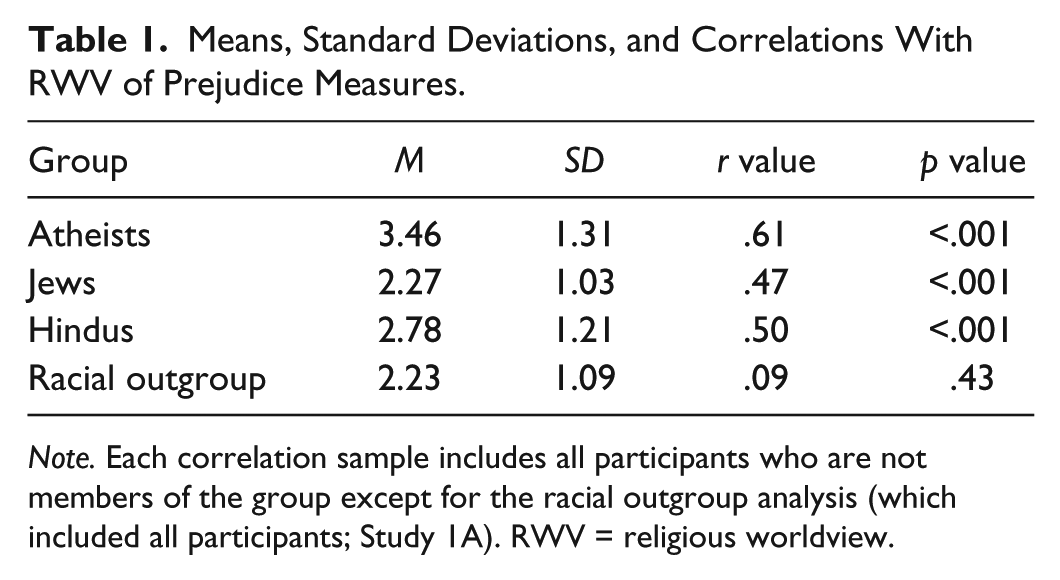
Note. Each correlation sample includes all participants who are not members of the group except for the racial outgroup analysis (which included all participants; Study 1A). RWV = religious worldview.
Mixed-design general linear models tested the hypothesis that people with a strong RWV would differentiate between religious outgroups more than people with a weak RWV (see Figure 1). We selected the Christian participants and tested the role of RWV in differences of prejudice against the three religious outgroups, with prejudice against each religious group (Jews, Hindus, and Atheists) as the within-subjects variable and RWV as the between-subjects continuous variable. Main effects of group, F(2, 61) = 38.05, p < .001, and RWV, F(1, 62) = 21.22, p < .001, on prejudice were qualified by the predicted interaction between group and RWV, F(2, 61) = 4.97, p = .01, partial η2 = .14; 95% confidence interval (CI) = [.01, .29].
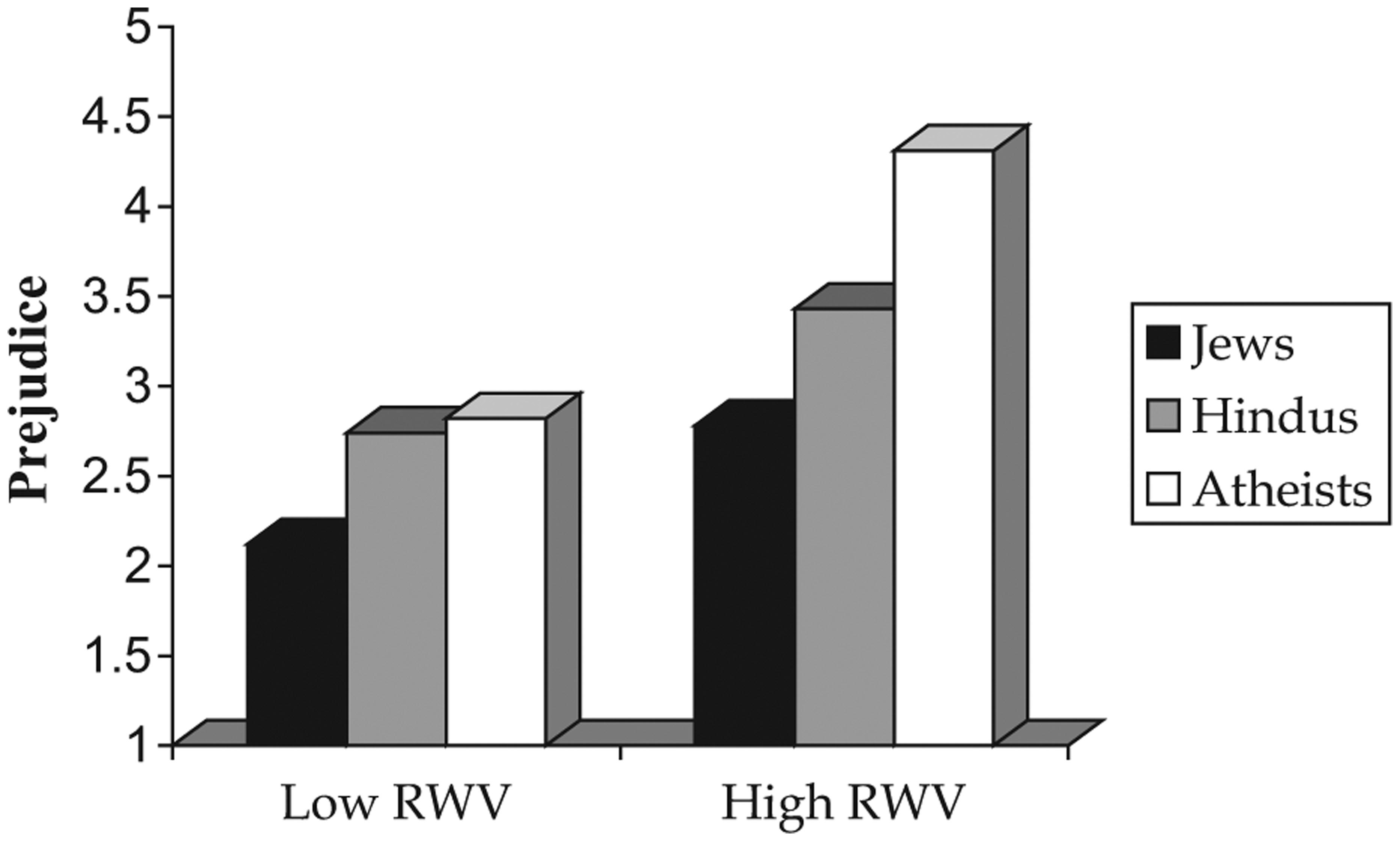
Prejudice against different religious outgroups among Christians as a function of RWV (Study 1A).
To understand this interaction, we assessed the simple effects of group at strong (1 SD above M) and weak (1 SD below M) levels of RWV. People with strong RWVs clearly differentiated between their prejudice against Jews, Hindus, and Atheists, F(2, 61) = 31.71, p < .001, partial η2 = .51; 95% CI = [.32, .62]. Consistent with our theorizing, people with strong RWVs reported the least prejudice against Jews and the most prejudice against Atheists with prejudice against Hindus falling in between. Contrast effects demonstrated that people with strong RWVs were less prejudiced against Jews than Hindus, F(1, 62) = 20.42, p < .001, partial η2 = .25, and less prejudiced against Hindus than Atheists F(1, 62) = 20.44, p < .001, partial η2 = .25.
For people with weak RWVs, group also predicted prejudice, F(2, 61) = 11.06, p < .001, partial η2 = .27; 95% CI = [.08, .41], but did so much more weakly than at strong levels of RWV. People with weak RWVs reported the same level of prejudice against Atheists and Hindus, F(1, 62) = .19, p = .67, partial η2 < .01, but reported more prejudice against Atheists than Jews, F(1, 62) = 12.65, p = .001, partial η2 = .17, and more prejudice against Hindus than Jews, F(1, 62) = 17.95, p < .001, partial η2 = .23.
In Study 1A, RWV was related to prejudice against all religious outgroups with the most prejudice being reported against people with the most different RWVs. RWV was unrelated to racial prejudice, however, demonstrating discriminate validity of the RWV construct.
Study 1B
The purpose of Study 1B was to assess how RWV relates to three additional, potential RWV protection strategies. We suspected strong RWV people would favor suppressing alternative beliefs. We therefore predicted that people with a strong RWV would support suppression of religious outgroups and would be unsupportive of science. Many RWVs entail a description of a world that contradicts what the scientific study of our world indicates (e.g., the evolution vs. creationism debate). Thus, to the extent that scientific findings contradict people’s RWV, people with a strong RWV likely perceive science as a worldview threat and would therefore be less interested in promoting scientific research than people with a weak RWV. In addition, we predicted that RWV would be related to support for aggression against religious outgroups because aggression is a potentially effective strategy to suppress or even eradicate worldview threats. However, we suspected that people would be hesitant to condone outgroup aggression (i.e., people are unlikely to agree with statements that members of a religious outgroup should be harmed simply because of their group membership). Therefore, we assessed support for aggression against Muslims suspected of terrorism to provide an alternative “justification” for the aggressive response besides religion.
Method
Participants
Forty-nine undergraduate psychology students participated in Study 1B in exchange for partial course credit. The participants were 39% female, 78% White, 10% Black, 6% Hispanic, 2% Asian, and 4% other or mixed race, and had an average age of 19. They self-identified as 88% Christian, 6% Atheistic/Agnostic/Spiritual, 4% Jewish, and 2% Taoist.
Materials and procedure
Participants completed the study in groups. They first completed a series of items tapping into the three RWV protection strategies on a 1 (strongly disagree) to 9 (strongly agree) scale. Eight items assessed suppression of religious outgroups/religious intolerance (sample item: “This is a Christian nation and people just need to deal with it,” α = .73). Five items assessed support for science (sample item: “Too much emphasis is placed on science in our society” [reverse-coded], α = .56). Six items assessed support for aggression against Muslims connected to terrorism (sample item: “When interrogating Islamic fundamentalists, it is sometimes okay to use practices that some may consider torture,” α = .78). Participants then completed the RWV scale (α = .97) and answered demographic questions including their religious group membership.
Results and Discussion
All participants were included in the analyses to assess support for science and support for aggression against Muslims. When assessing religious intolerance, all non-Christians were excluded. As was predicted, RWV was positively correlated with religious intolerance and support for aggression against Muslims and negatively correlated with support for science (see Table 2). These results provide further support for the idea that people with strong RWVs are motivated to protect their worldviews and may do so by suppressing other religions, being less supportive of science, and being more supportive of aggression against a religious outgroup.
Means, Standard Deviations, and Correlations with RWV of RWV Protection Strategies.
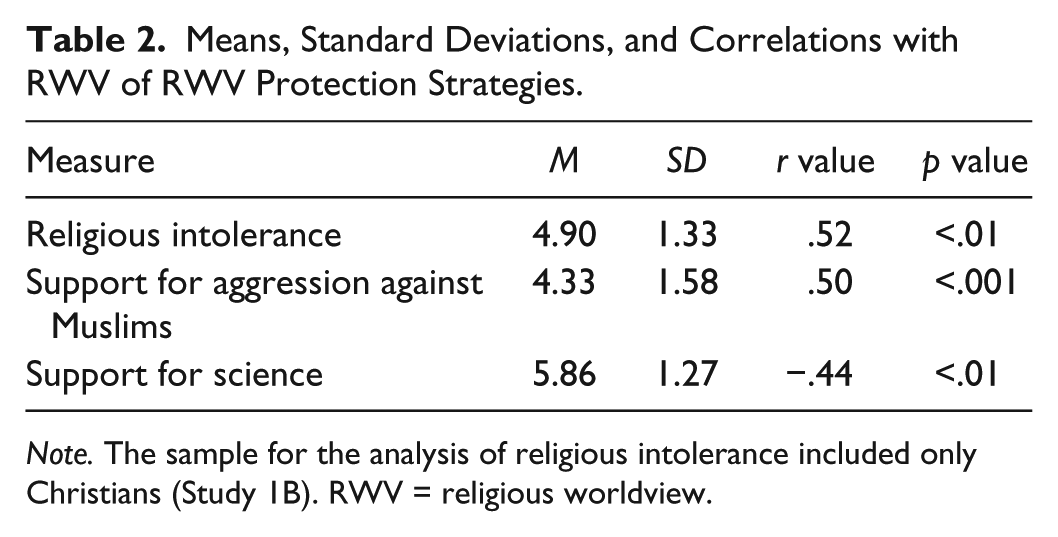
Note. The sample for the analysis of religious intolerance included only Christians (Study 1B). RWV = religious worldview.
Study 2
Central to our theory is the premise that RWV differences contribute to religious prejudice because religious outgroups threaten strong RWV people’s worldview. We therefore wanted to demonstrate that perception of worldview threat contributes to the relationship between RWV and religious prejudice. In Study 2, we assessed participants’ RWVs and then asked them to imagine they had a new roommate who was either a Christian or an Atheist. Participants were asked about the degree of threat posed by their roommate across different threats (i.e., worldview, societal, and economic), perceptions of dissimilarity between themselves and the roommate, and their attitudes about (prejudice against) their roommate. We predicted an interaction between RWV and roommate condition on both worldview threat and prejudice such that people with a strong RWV would perceive a greater worldview threat and would report more negative attitudes toward the Atheist than Christian roommate. To clearly demonstrate that religious prejudice results from perceived worldview threat posed by religious outgroups, we also predicted that worldview threat would mediate the effect of condition on prejudice for people with a strong RWV.
We also examined whether the roommate was perceived as posing an economic threat and a societal threat. We did not expect that the Atheist roommate would be perceived as more economically threatening than the Christian roommate, because we do not theorize that religious outgroups are perceived as more threatening than religious ingroups in all ways. We did, however, anticipate that the Atheist roommate would be perceived as posing a societal threat and that this threat would be perceived most strongly by those with a strong RWV. Past research suggests that religious majority group members perceive religious minorities as posing a societal threat by threatening the coordination, freedoms, and culture of the mainstream religious group of a society (Cottrell & Neuberg, 2005; Gervais & Norenzayan, 2012.) We predicted that societal threat may also contribute to religious prejudice, particularly for those with a strong RWV, because strong RWV people are more likely to view their (mainstream) religion as a force that holds their society together. Therefore, although we predicted that societal threat would also mediate the effect of condition on prejudice for strong RWV people, we expected that worldview threat plays a role in religious prejudice that is distinct from societal threat.
We also assessed perceived dissimilarity to disentangle the role of dissimilarity on negative attitudes toward religious outgroups. Past work has demonstrated that people exhibit a preference for similar others over dissimilar others (Byrne, 1961; Byrne et al., 1971; see Montoya & Horton, 2013, for a recent review). We predicted that our participants would perceive the Atheist as more dissimilar, especially participants with strong RWVs, and that this may also contribute to increased negativity toward the Atheist compared with the Christian. However, we wanted to assess the role of worldview threat in religious prejudice while accounting for these perceptions of dissimilarity to demonstrate that religious prejudice stems from more than perceived dissimilarity. Thus, we predicted that RWV threat would continue to be a significant mediator in our model for strong RWV people even after controlling for the mediational effects of societal threat and perceived dissimilarity.
Method
Participants and design
Sixty-five undergraduate psychology students who self-identified as Christian or Agnostic 2 participated in exchange for partial course credit. Five participants failed an attention check that asked them to respond with a 1 to a specific item, and they were excluded from the analyses. The remaining 60 participants were 90% female with an average age of 20. The design was a continuous (RWV of participant) × 2 (Religious Group of Roommate: Christian vs. Atheist) between-subjects design.
Materials and procedure
Participants came into the lab and were told they would be participating in a study about how people think about other people. RWV (α = .97) was measured, and then participants were asked to imagine moving in with a same-sex roommate whom they did not know prior to the assigned living situation, and whom they soon found out was either an Atheist or a Christian. To more fully engage the participants in the manipulation, they were asked to spend 5 to 10 min writing about what it would be like to live with this person.
Participants then indicated the extent to which they anticipated they would feel dissimilar to and various types of threat from this roommate on a 1 (I would NOT feel this way at all) to 9 (I would feel this way strongly) scale. These items included 6 items to assess perceived dissimilarity (sample item: “My roommate would differ from me in his/her beliefs about the world,” α = .86), 3 items to assess economic threat (sample item: “worried that my roommate will be more successful than me,” α = .72), 3 items to assess societal threat (sample item: “concerned that my roommate threatens to corrupt American culture,” α = .63), and 10 items to assess worldview threat (sample item: “My roommate would threaten my fundamental approach to the world,” α = .83). Participants completed these items in random order and then completed 7 items to assess negativity toward their imagined roommate (sample item: “I don’t think I would like my roommate very much,” α = .84) on a 1 (strongly disagree) to 9 (strongly agree) scale. Finally, participants completed a demographics questionnaire.
Results and Discussion
We first tested our prediction that people with a strong RWV would be more prejudiced against Atheists than Christians. We regressed negativity toward the roommate onto RWV, condition, and the RWV × Condition interaction. The results yielded a main effect of condition, β = −.35, p = .002, pr = −.40, which was qualified by the predicted RWV × Condition interaction, β = −.43, p < .001, pr = −.46; 95% CI = [−.65, −.21]. Follow-up analyses of the interactive effect revealed that people with a weak RWV did not differ in their attitudes toward the Atheist and Christian roommate, p = .62. People with a strong RWV, however, expressed more negativity toward the Atheist roommate than the Christian roommate, β = −.79, p < .001, pr = −.56; 95% CI = [−1.10, −.48].
We next tested the hypothesis that RWV would similarly interact with condition to predict the perceived worldview threat posed by the roommate. We regressed worldview threat onto RWV, condition, and the RWV × Condition interaction. Results revealed only the predicted interaction between RWV and condition, β = −.28, p = .03, pr = −.28; 95% CI = [−.53, −.02]. People with a weak RWV did not differ in their perceptions of worldview threat posed by the Atheist and Christian roommate, p = .54. People with a strong RWV, however, perceived higher levels of worldview threat from the Atheist roommate than the Christian roommate, β = −.45, p = .02, pr = −.32; 95% CI = [−.80, −.09].
Mediation analyses
An important goal of Study 2 was to assess whether worldview threat statistically mediated the effect of roommate condition on prejudice for people with a strong RWV (i.e., whether strong [but not weak] RWV people reported more negativity toward Atheists than Christians because they viewed Atheists as more threatening to their worldview than Christians). We found that perceptions of worldview threat predicted roommate negativity, β = .76, p < .001. A bootstrapping analysis of the model above conducted with Model 8 of Hayes’ PROCESS model script (2013; see also Preacher & Hayes, 2008) provided CIs for the estimated indirect effects of roommate condition on negativity through perceived worldview threat for people with strong and weak RWVs. Consistent with predictions, worldview threat significantly mediated the effect of condition on negativity for people with strong RWVs, 95% CI = [−1.6756, −.1637]. In contrast, for people with weak RWVs, the indirect effect of condition on prejudice through worldview threat was not significant, 95% CI = [−.3079, 1.0424]. These results suggest that for our participants whose worldviews were strongly shaped by their religion, the roommate who did not share their religious beliefs was perceived as a RWV threat, and this perception of threat led to more negative attitudes toward the Atheist roommate compared with the Christian roommate.
Other threats
We next conducted parallel analyses on the other threats. For economic threat, we found only a main effect of condition such that the Atheist roommate was perceived as less economically threatening than the Christian roommate, β = .36, p = .005, pr = .36. As predicted, RWV did interact with condition to predict perceptions of societal threat, β = −.33, p = .01, pr = −.36, and societal threat did predict negativity toward the roommate, β = .78, p < .001. Initial examination revealed a mediating effect of societal threat similar to that of worldview threat such that perceived societal threat significantly mediated the effect of condition on negativity for people with a strong RWV, 95% CI = [−.1.9178, −.2359], but not for people with a weak RWV, 95% CI = [−.1622, −.7869].
Dissimilarity
We also conducted parallel analyses on dissimilarity and found a main effect of condition on perceptions of dissimilarity, β = −.46, p < .001, pr = −.57, and an interactive effect of RWV and condition on perceived dissimilarity, β = −.59, p < .001, pr = −.66. Perceived dissimilarity also predicted prejudice, β = .72, p < .001. Mediation analyses indicated that dissimilarity also mediated the effect of condition on negativity for people with a strong RWV, 95% CI = [−3.3148, −1.1027], but not for people with a weak RWV, 95% CI = [−.1948, .9581].
Combined model
Given that our initial analyses indicated that worldview threat, societal threat, and dissimilarity all mediated the effect of condition on negativity for people with strong RWVs, we wanted to clearly distinguish between these three constructs in their independent contributions to religious prejudice. To do this, we conducted a bootstrapping mediational analysis that included worldview threat, societal threat, and perceived dissimilarity as parallel mediators in the same model. This analysis allowed us to assess the mediational effect of perceived worldview threat in our model while controlling for the mediational effect of perceived societal threat and perceived dissimilarity. In this model and for people with a strong RWV, both worldview threat, 95% CI = [−1.1617, −.0896], and societal threat, 95% CI = [−1.2231, −.0923], were significant mediators of the effect of condition on negativity, but perceived dissimilarity was not, 95% CI = [−1.2139, .2705] (see Figure 2). Consistent with the individual analyses of the possible mediators, none of them were significant mediators at low levels of RWV. This analysis indicates that both worldview threat and societal threat play a significant and independent role in religious prejudice. In addition, although worldview differences create perceptions of dissimilarity, which, when assessed alone, contribute to negative attitudes toward dissimilar others, this effect was accounted for by the worldview and societal threat in our combined model.
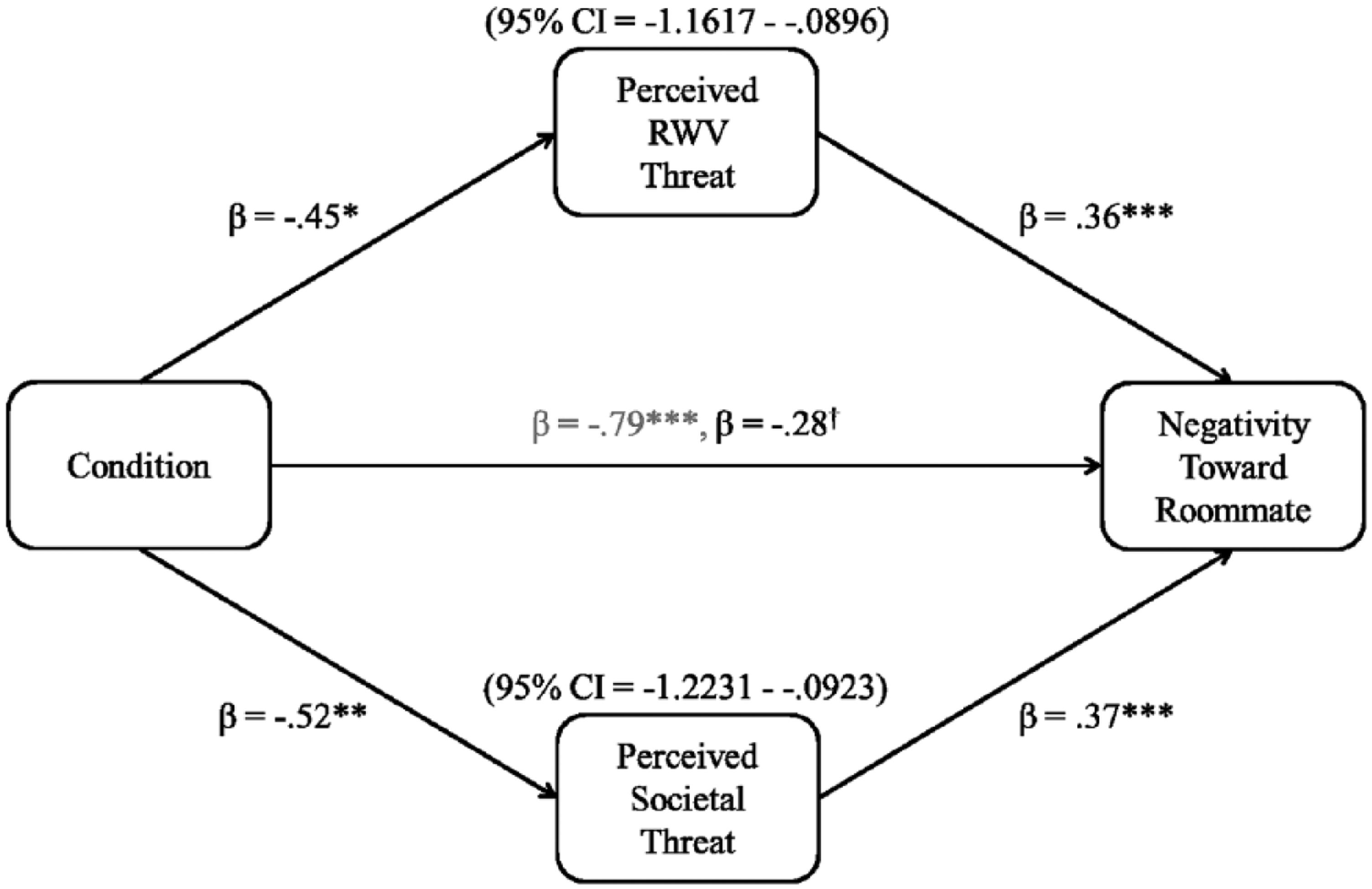
Direct and indirect effects of condition on negativity via perceptions of RWV threat and societal threat for people with strong RWVs (Study 2).
It is worth noting that the Study 2 sample was predominantly women. Some caution should be taken in generalizing these effects to men although we have no reason to expect that a larger proportion of men in the sample would have significantly changed the results. Even considering this possible limitation, Study 2 provides strong support for our theory that religious prejudice results from perceived threats to a person’s RWV.
Study 3
Although Study 2 found that perceived worldview threat was more relevant to religious prejudice than perceived dissimilarity, it is still possible that our effects could have been partially driven by strong RWV people using their religion-related attitudes more than weak RWV people when reacting to religious ingroup versus outgroup members. In Study 3, we sought to rule out this alternative explanation by including a third condition—someone whose religious group membership was unknown. This allowed us to compare whether strong RWV people preferred an ingroup member over a religion-unknown other. If strong RWV Christians do not differ in their reactions to another Christian and a religion-unknown other and instead target their negativity to the Atheist, this would support our findings from Study 2 that our effects are indeed driven by worldview threat.
To test these ideas, we examined the role of RWV in responses to an upcoming interpersonal interaction. An expeditious approach to dealing with an interpersonal RWV threat would be to avoid the threatening person altogether. To test avoidance of religious outgroups among strong RWV people, participants were led to believe they were going to interact with another person (who was actually a confederate). Worldview differences were manipulated (through the mention of the confederate as being either an Atheist, a Christian, or who made no mention of religion) and measured (through the strength of the participants’ RWVs with our RWV scale). Of interest were participants’ desires to avoid the upcoming interaction. We predicted that among our Christian participants, RWV would be related to an increased desire to avoid interacting with the Atheist, but would be unrelated to desire to avoid the interaction in either of the other two conditions (Christian or religion-unknown control). This pattern would suggest that it is not merely a preference for similar others driving our effect (Byrne, 1961; Byrne et al., 1971) because strong RWV Christians would not be differentiating between the Christian and religion-unknown other. Instead, this pattern would reinforce our findings from Study 2 that religious prejudice among strong RWV people stems from the worldview threat experienced when confronting people with a different perception of reality. We also assessed participants’ general level of religiosity to examine whether RWV, and not just level of religiosity, was more relevant to predicting avoidance of religious outgroup members.
Method
Participants and design
Sixty-nine undergraduate psychology students who self-identified as Christian participated in exchange for partial course credit. One participant was excluded because he or she indicated that he or she personally knew the confederate in the study.
The remaining 68 participants were 72% female, 72% White, 10% Black, 10% Hispanic, 2% Asian, and 6% mixed race, and had an average age of 19 years. The design of the study was a continuous (RWV) × 3 (Religious Group Membership of Confederate: Christian, Atheist, or Religion-unknown) quasi-experimental design.
Materials and procedure
Participants were told they would be having an interaction with another student, but that they would first view a video of this person introducing himself or herself. All participants were shown a prerecorded video of a same-sex White confederate.
Religious group membership was manipulated through the video of the confederate. In all of the conditions, the confederates gave the exact same general description of themselves (e.g., grew up in Orlando, played intramural soccer, enjoyed listening to music and hanging out with friends). However, three quarters of the way through the video, the confederates stated that they belonged to a student organization which was either an Atheist organization (religious outgroup condition), Christian organization (religious ingroup condition), or scuba diving club (control condition).
After viewing the video, participants then indicated the extent to which they agreed with statements about the upcoming interaction on a 1 (strongly disagree) to 9 (strongly agree) scale. Eight items assessed the participant’s desire to avoid the interaction (sample items: “I wish I could avoid having this interaction,” and “I am looking forward to this interaction” [reverse-coded], α = .76).
Finally, participants completed the RWV scale (α = .96) and a demographics questionnaire. To assess participants’ general level of religiosity, participants completed a four-item measure which asked about the strength and importance of the participants’ religious beliefs and the frequency with which they attend religious services and pray (α = .82). An open-ended manipulation check was also included in the demographics questionnaire that asked participants about the student organization to which the confederate belonged.
Results and Discussion
All participants correctly answered the manipulation check question except two participants in the control condition who answered “soccer” instead of “scuba diving.” Because these participants were in the control condition and the confederate did mention playing intramural soccer, they were included in the analyses.
We created two orthogonal contrasts—one compared the Atheist condition with the control and Christian condition (2, −1, −1 respectively), and the other compared the Christian condition with the control condition (0, −1, 1). These two contrasts, RWV, and their interactions were entered into a regression equation to predict desire to avoid the interaction. The analysis revealed that RWV interacted with the contrast that compared the Atheist condition with the two other conditions, β = .29, p = .034, pr = .27; 95% CI = [.02, .55]. No other predictors were significant, including the interaction between RWV and the contrast comparing the Christian condition with the control condition, p = .96.
Probing this interaction revealed that among participants with a weak RWV, condition did not affect the desire to avoid interacting with the person in the video, β = −.23, p = .29, pr = −.14 (see Figure 3). In contrast, participants with a strong RWV reported a greater desire to avoid the interaction if their partner was an Atheist (
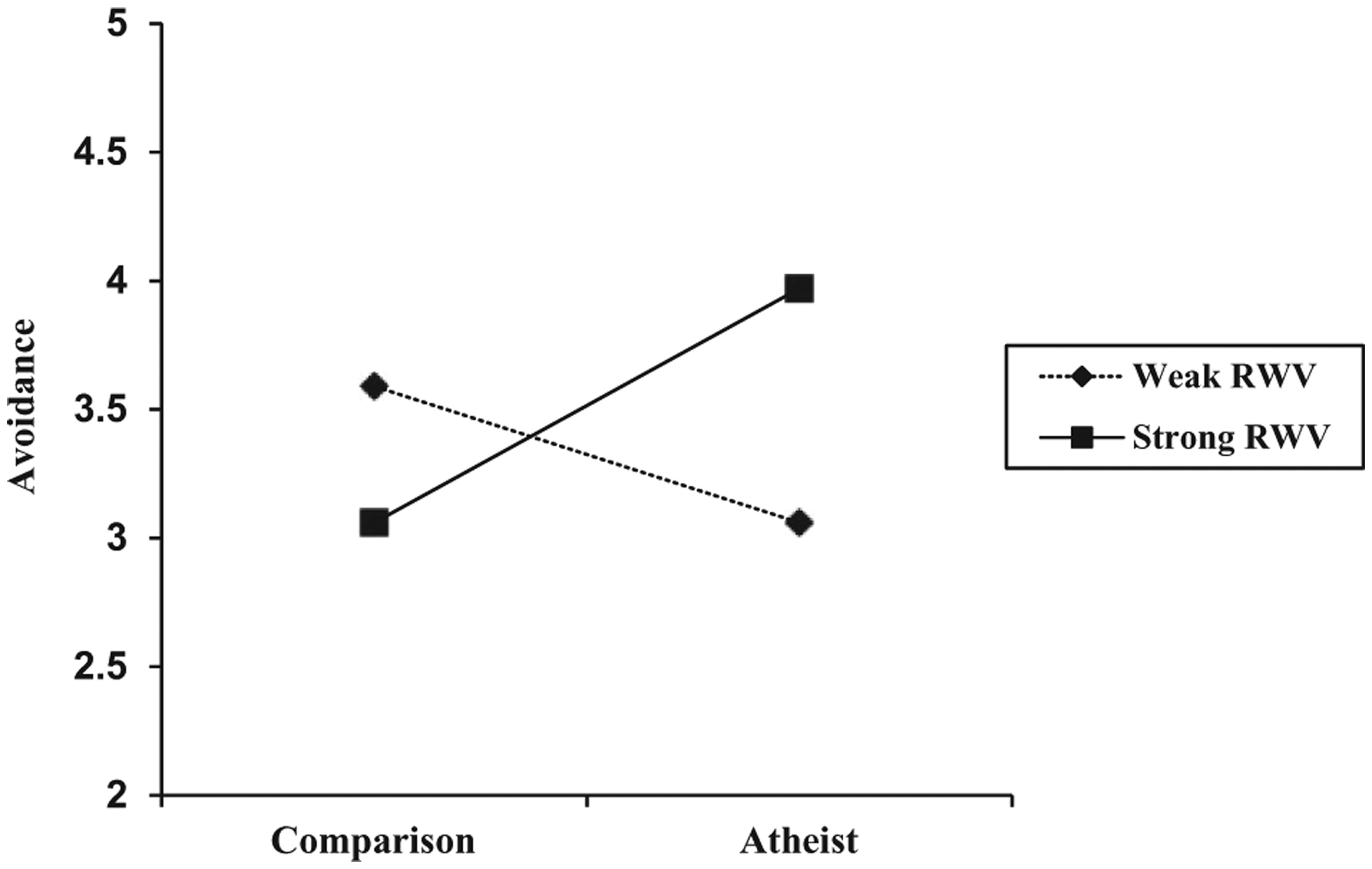
Avoidance in Atheist versus the comparison conditions (Christian and religion-unknown) as a function of RWV (Study 3).
If we repeated the above analysis replacing RWV with general religiosity, none of the effects were significant, including the parallel effect of general religiosity and the contrast variable comparing the Atheist with the other conditions, p = .14. Thus, the desire to avoid a religious outgroup member was specific to strength of RWV and was not simply due to degree of general religiosity. 3
Study 4
We created the RWV scale because we did not believe that existing measures of religiosity cleanly captured our individual difference of interest (the extent to which a person’s religion shapes his or her view of the world). Although general religiosity did not predict religious prejudice in Study 3 to the extent that RWV did, we thought it was important to more broadly assess RWV’s relations to several other measures of religiosity and to explore the role that a RWV plays in religious prejudice when also considering these other forms of religiosity. By using a larger sample, Study 4 also allowed us to follow up on Study 3 with a more stringent test of whether RWV predicts religious outgroup prejudice above and beyond other measures of religiosity. To do this, we assessed RWV, general religiosity, intrinsic religiosity, extrinsic religiosity, religious fundamentalism, and religious prejudice in an online community sample.
At the conceptual level, RWV most closely maps onto intrinsic religiosity. Intrinsic religiosity is characterized as the extent to which people live their religion by using their religious teachings to seek value and meaning from life. However, many of the items from the scale do not exactly capture RWV as we have defined it. For example, people may strongly agree with the Intrinsic Religiosity Scale item, “I enjoy reading about my religion,” (Gorsuch & McPherson, 1989) but not necessarily apply their religious readings to their worldviews. We therefore predicted that RWV and intrinsic religiosity would be highly correlated, but that RWV would play a stronger or unique role in predicting religious prejudice compared with intrinsic religiosity. Similarly, we predicted that general religiosity would be correlated with RWV, but that RWV would more strongly predict religious prejudice than general religiosity.
Extrinsic religiosity is characterized as the extent to which people use their religion as a source of belonging or solace. We predicted a weak or no correlation between extrinsic religiosity and RWV because occasionally using one’s religion is conceptually very different from one’s religion influencing a person’s entire perspective of the world. We therefore predicted that extrinsic religiosity would not account for the variance in prejudice due to RWV. Religious fundamentalism is characterized by a belief that, among the many RWVs, there is one and only one religious teaching that is absolutely or fundamentally true (Altemeyer & Hunsberger, 2004). It therefore represents a focus on RWV differences combined with the affirmation that one’s own RWV is absolutely correct and in this way, may operate as a RWV protection strategy. Fundamentalism is also a conservative approach to one’s RWV, and conservative ideologies can be used as motivated cognition to manage uncertainty and threat (Jost et al., 2007). Brandt and Reyna (2010) proposed that fundamentalism provides people with a sense of consistency and closure and found that closed-mindedness mediated the relationship between fundamentalism and prejudice against value violators. Fundamentalism may therefore be motivated by the need to manage RWV threats, such that the more people feel their worldview is threatened by competing worldviews, the more they embrace fundamentalism and the certainty it provides. If so, considering people’s strength of RWV may help to identify who is likely to be threatened by religious outgroups and, therefore, who is likely to embrace a fundamentalist approach to religion.
In addition, a central tenant of fundamentalism is the belief that the one true religion is threatened by evil that must be “vigorously fought” (Altemeyer & Hunsberger, 1992, p. 118). This means that religious outgroup prejudice is essentially a part of religious fundamentalism as typically measured (e.g., fundamentalism item: “When you get right down to it, there are basically only two kinds of people in the world: the Righteous, who will be rewarded by God; and the rest, who will not,” [Altemeyer & Hunsberger, 2004]). Fundamentalism can therefore be used to justify negative attitudes toward people who threaten one’s RWV by derogating religious outgroups as evil.
Thus, we considered the possibility that fundamentalism may act as a RWV protection strategy for people with strong RWVs. By clinging fervently to the belief in the absolute truth of one’s religion and closing one’s mind to alternative belief systems, a person with a strong RWV could work toward diffusing the RWV threat posed by religious outgroups. We therefore predicted a strong relationship between RWV and fundamentalism. Furthermore, codifying all competing belief systems as evil essentially amounts to the derogation of those competing belief systems. Because fundamentalism insinuates religious prejudice within the construct, we predicted that fundamentalism would more strongly predict religious prejudice compared with RWV. If fundamentalism acts as a RWV protection strategy for people with a strong RWV and this strategy leads to prejudice, then fundamentalism would mediate the relationship between RWV and prejudice. We tested this possibility in our final study.
Method
Participants
One hundred-sixty Mechanical Turk workers who were either Christian or Agnostics with Christian leanings were paid $.25 to participate in the study. Eight of these participants were excluded from the analyses because they identified their religious beliefs as something other than our target group. The remaining 152 participants were 52% female, 77% White, 12.5% Black/African American, 5.3% Hispanic, 3.3% East Asian/Pacific Islander, and 2% mixed race. Their ages ranged from 18 to 74 with an average age of 37.
Materials and procedure
Participants first completed all measures of religiosity in random order. Our RWV scale was administered on a 1 (strongly disagree) to 9 (strongly agree) scale (α = .97). Intrinsic and Extrinsic religiosity was assessed with Gorsuch and McPherson’s (1989) Intrinsic/Extrinsic Religiosity–Revised Scales on 1 (strongly disagree) to 5 (strongly agree) scales. Intrinsic religiosity was assessed with eight items (sample item: “It is important to me to spend time in private thought and prayer,” α = .89). Extrinsic religiosity was assessed with six items (sample item: “I go to church mostly to spend time with my friends,” α = .62). The Revised Religious Fundamentalism Scale (Altemeyer & Hunsberger, 2004) assessed fundamentalism with 12 items on a 1 (very strongly disagree) to 9 (very strongly agree) scale (sample item: “To lead the best, most meaningful life, one must belong to the one, fundamentally true religion,” α = .95). To assess participants’ general level of religiosity, rather than a specific kind of religiosity, we included the four-item measure from Study 3 (α = .88). Finally, participants completed the same seven-item measure of prejudice against Atheists used in Study 1A (α = .90) and demographics.
Results and Discussion
RWV was correlated with all measures of religiosity except for extrinsic religiosity which was also the only religiosity measure that did not correlate with prejudice (see Table 3 for all correlations). RWV was strongly correlated with intrinsic religiosity suggesting a close connection between the constructs. RWV was also strongly correlated with fundamentalism, which supports our idea that strong RWV people are more likely to embrace a fundamentalist approach to their religion as a method of RWV protection. Because extrinsic religiosity is largely based on religion as a means to meet social needs, the lack of a correlation with prejudice indicates that religious prejudice is less about basic group membership and more about what a person’s religion means to him or her on an existential level.
Bivariate Correlations Between RWV, Religious Prejudice, and Other Measures of Religiosity (n = 152).
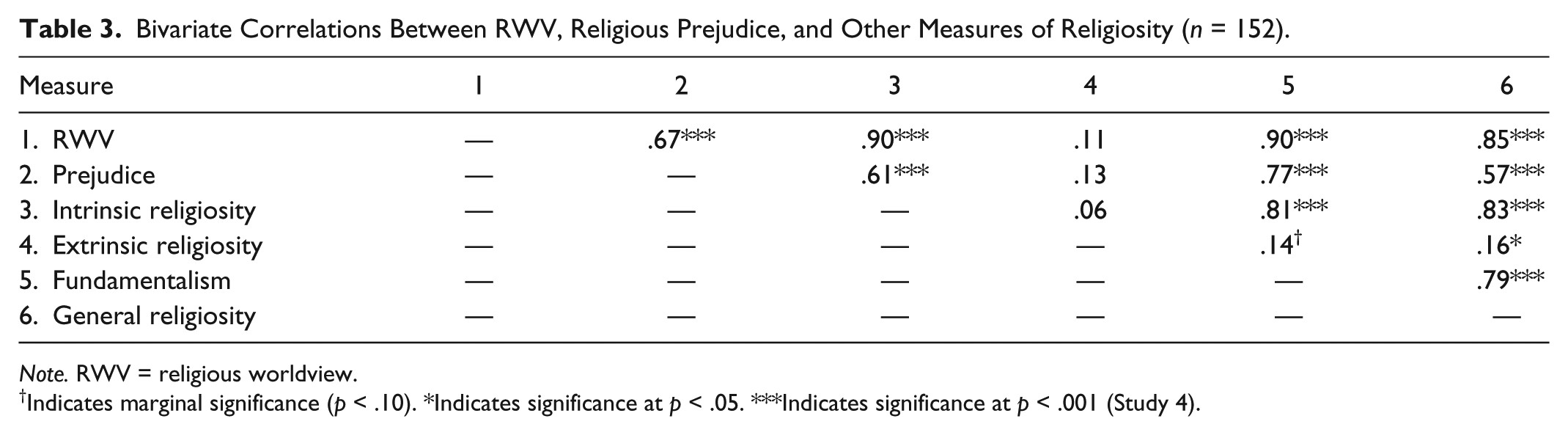
Note. RWV = religious worldview.
Indicates marginal significance (p < .10). *Indicates significance at p < .05. ***Indicates significance at p < .001 (Study 4).
To test our prediction that RWV would predict prejudice above and beyond the other measures of religiosity (with the exception of fundamentalism, which we consider below), we included RWV, intrinsic, extrinsic, and general religiosity in a multiple regression analysis predicting prejudice against Atheists. When considered simultaneously with the other measures of religiosity, RWV significantly predicted prejudice, β = .63, p < .001, pr = .33; 95% CI = [.34, .92], and the other measures did not, all ps > .30. Our results therefore indicate that, although intrinsic religiosity is quite similar to RWV conceptually and general religiosity predicts prejudice on its own, religious prejudice is better predicted by measuring a person’ RWV rather than their level of intrinsic orientation toward their religion or their general level of religiosity.
We next examined which of the measures of religiosity best predicted fundamentalism to assess whether RWV is the strongest contributor to a fundamentalist (and thereby prejudiced) approach to one’s religion. As predicted, RWV significantly predicted fundamentalism when including all of the religiosity measures as predictor variables, β = .83, p < .001, pr = .62; 95% CI = [.66, 1.00], and the other religiosity measures did not, all other ps > .32. This is consistent with the idea that strong RWV people may close their minds to other belief systems and justify their religious prejudice by adopting a fundamentalist approach to religion to ultimately manage the RWV threats posed by religious outgroups. In addition, if we included all of the religiosity variables as predictors in a regression analysis with prejudice as the outcome variable, fundamentalism predicted prejudice, β = .87, p < .001, pr = .50; 95% CI = [.63, 1.11], and all other measures did not (RWV p = .60, all other ps > .25). This pattern of results suggests that RWV and fundamentalism are the key players in contributing to prejudice but that fundamentalism may mediate the effect of RWV on prejudice. A bootstrapping analysis confirmed that fundamentalism mediated the relationship between RWV and prejudice, CI = [.6301, 1.0488], with strong RWV people (compared with weak RWV people) being more likely to endorse a fundamentalist approach to their religion, which is associated with religious prejudice. These findings provide insight into the people most likely to embrace a fundamentalist (and prejudice laden) approach to religion (i.e., those with a strong RWV) and (in combination with our findings from previous studies) why they take on this approach.
General Discussion
The present work tested the theory that worldview threat is an important component of religious prejudice. For those who base their worldviews on their religion, religious outgroup members’ endorsement of alternative worldviews is threatening and leads to prejudiced responses to religious outgroups. Across five studies, strength of RWV was related to religious prejudice, including derogation and denial of alternative religious viewpoints, support for suppressing and avoiding religious outgroup members, and even support for aggression against religious outgroups. Furthermore, this prejudice was strongest when RWVs diverged the most (i.e., when people with a strong RWV reported on groups with the most different worldview). Perhaps most importantly, RWV differences were associated with religious prejudice because religious outgroups were perceived as threatening to strong RWV people’s worldviews.
Study 1A developed a highly reliable and direct measure of the degree to which a person’s religion shapes his or her worldview. This measure strongly predicted religious prejudice but not racial prejudice and the stronger the person’s RWV, the more they discriminated between the religious outgroups. Importantly, the more different the worldview of the religious outgroup, the more prejudice was reported against the outgroup by people with strong RWVs. Study 1B demonstrated associations between RWV and RWV protection strategies such as increased religious intolerance, decreased support for science, and increased support for aggression against Muslims among non-Muslims. Study 2 provided support for our theory by demonstrating the mediational role of perceived worldview threat in the relationship between RWV differences and religious prejudice. In Study 3, Christians with strong RWVs wanted to avoid interacting with an Atheist, although they did not differ in their responses to another Christian compared with a person of unknown religious group membership. Christians with weak RWVs, however, were unaffected by religious group membership of their partner in their desire to have an interaction with that person. Study 4 examined the relationship between RWV and other measures of religiosity. RWV was a stronger predictor of religious prejudice than intrinsic, extrinsic, and general religiosity. In addition, Study 4 revealed that people with a strong RWV close their minds to and derogate other, threatening RWVs by adopting a fundamentalist approach to their religion. This heightened fundamentalism mediated the relationship between RWV and prejudice. Although the samples in some of our studies were relatively small (e.g., Study 3, n = 68), the consistency of the results across studies and the multiple replications of the relationship between RWV and religious prejudice leave us confident in the findings. Taken together, these studies suggest that people with strong RWVs derogate, avoid, suppress, and even aggress against people with differing RWVs in response to the worldview threat posed by these people. That is, when religion influences a person’s worldview, religious prejudice may be used as a religious worldview protection strategy.
These findings have important implications for interfaith interactions and prejudice. People with strong RWVs who avoid religious outgroup members as a means to protect their RWV may perpetuate prejudice and interfaith tension. Intergroup contact is one of the most effective routes to prejudice reduction (Pettigrew & Tropp, 2006), and avoiding such contact eliminates this opportunity. Furthermore, avoided and derogated outgroups are at a real disadvantage in society. For example, non-Christians who are routinely avoided and/or derogated in a predominantly Christian culture may not only experience feelings of discomfort and rejection but may also be deprived of important social and even professional opportunities. Aggression stemming from religious prejudice inflames interfaith tensions and has the potential to develop into large-scale conflict.
These findings do have some promising implications, however, in that they suggest that the quality of interfaith interactions may be improved if people focus on similarities in their RWVs. Most people share many of the same values (e.g., refraining from harming others), and many religions have similar tenets and overarching philosophies. Focusing on how religious outgroups share important aspects of their worldviews (essentially moving away from a fundamentalist approach) may make strong RWV people less inclined to avoid interfaith interactions, and these interactions may go more smoothly. In addition, if strong RWV people are able to bolster their RWV before or during an interfaith interaction, it may reduce the pursuit of RWV protection strategies and the concomitant prejudice against religious outgroups.
The present findings also pose some interesting questions for future research. For example, although we certainly believe that all types of worldviews are susceptible to worldview threats posed by people who endorse alternative worldviews (which can contribute to negativity toward worldview violators), it is possible that these processes may be stronger when RWVs are at stake. RWVs not only include sacred elements and transcendental experiences that are unmatched in depth or breadth by other worldviews (Pargament, Magyar, & Murray-Swank, 2005), they are also, by definition, based on faith rather than experience. A lack of direct evidence for RWVs can already lead their endorsers to struggle to preserve their belief systems (Exline, 2002). These unique characteristics may make RWVs particularly worth protecting while being particularly vulnerable to worldview threats. Jackson and Hunsberger (1999) found slightly negative attitudes toward religious people among non-religious people, demonstrating that prejudice used to maintain a non-RWV is also possible. A direct comparison between the strength of religious and non-religious worldview protection strategies is an interesting future research direction.
In addition, subsequent work should explore the effects of the specific beliefs and values that make up different RWVs. Christian participants made up the majority of all samples in this research program. Future research should test the effects among other religions and also examine distinctions in RWV within the same religious group. Some RWVs may include a strong tolerance for alternative belief systems, whereas other religions may specifically teach hatred of religious outgroups (Ellens, 2007; Silberman, Higgins, & Dweck, 2005). Furthermore, Study 4 indicated that a fundamentalist approach to religion may stem from the need to protect a strong RWV and may do so by closing one’s mind to alternative ideas and justifying prejudice against outgroups. The influences of specific religions, religious beliefs, and approaches to religion are important to explore in future work.
There are many other factors that likely contribute to religious prejudice, and we in no way suggest that these studies provide a comprehensive assessment of religious prejudice. For example, particularly in the post-9/11 United States, Muslims are perceived as posing a physical threat to many Americans and are responded to in ways consistent with a physical threat (Unkelbach, Forgas, & Denson, 2008). For many White Christian Americans, Hindus are often perceived as both a racial and/or national outgroup in addition to a religious outgroup. Throughout the world, religious groups compete over economic resources. The present work did not control for these potential other factors, and future work should explore these other sources of prejudice in conjunction with worldview protection processes.
Despite these limitations, the present work provides valuable insight into the role of worldview threat in religious prejudice. Because all forms of prejudice are not identical, it is important to understand the specific processes and outcomes associated with each type of prejudice. Our work suggests that people’s religions can strongly shape the way they view the world and that religious outgroups pose a worldview threat to such people. This RWV threat results in derogation, avoidance, and suppression of, and possibly even aggression toward people with differing RWVs. Integrating individual differences in strength of RWV and perceptions of RWV threat into the examination of religious prejudice contributes to a better understanding of the causes and consequences of this problematic form of intergroup prejudice.
Footnotes
Appendix
Declaration of Conflicting Interests
The author(s) declared no potential conflicts of interest with respect to the research, authorship, and/or publication of this article.
Funding
The author(s) received no financial support for the research, authorship, and/or publication of this article.

Notes
References
Supplementary Material
Please find the following supplemental material available below.
For Open Access articles published under a Creative Commons License, all supplemental material carries the same license as the article it is associated with.
For non-Open Access articles published, all supplemental material carries a non-exclusive license, and permission requests for re-use of supplemental material or any part of supplemental material shall be sent directly to the copyright owner as specified in the copyright notice associated with the article.
