



Abstract
Gift-giving is a common form of social exchange but little research has examined how different gift types affect the psychological distance between giver and recipient. We examined how two types of gifts influence recipients’ perceived psychological distance to the giver. Specifically, we compared desirable gifts focused on the quality of the gift with feasible gifts focused on the gift’s practicality or ease of use. We found that feasible (vs. desirable) gifts led recipients to feel psychologically closer to givers (Studies 1-4). Further clarifying the process by which receiving a desirable versus feasible gift affects perceived distance, when recipients were told that the giver focused on the gift’s practicality or ease of use (vs. the gift’s overall quality), while holding the specific features of the gifts constant, they felt closer to the gift-giver (Study 5). These results shed light on how different gifts can influence interpersonal relationships.
For both special and ordinary occasions, people choose and give gifts to close and distant others. Despite the central role of gifts in social life, research on this topic has been fairly limited in psychology. Much of the recent empirical work on gifting behavior has focused on specific gift characteristics and their effects on recipients’ downstream evaluation of the gift, such as how much recipients like and appreciate gifts. For example, givers believe that a gift that is explicitly requested or unrequested would be equally appreciated but recipients actually appreciate gifts that they had requested more (Gino & Flynn, 2011). In particular, close (vs. distant) givers are less likely to choose gifts from a registry even though registry items would better match the recipient’s preferences (Ward & Broniarczyk, 2016). Givers also incorrectly believe that a recipient would appreciate an expensive gift more than an inexpensive gift when recipients actually appreciate such gifts equally (Flynn & Adams, 2009). Finally, although givers predict that a recipient will appreciate a gift with symbolic meaning, recipients actually care more about the gift’s practical value (Cavanaugh, Gino, & Fitzsimons, 2015).
Although it is important to understand the consequences of certain gift types on recipients’ appreciation and liking of the gift as well as givers’ assumptions about what gift types would be appreciated and liked, gift-giving is critical for fostering interpersonal relationships (Chan & Mogilner, 2017; Malinowski, 1922; Mauss, 1925; Sherry, 1983). Indeed, there is a small but growing literature investigating how different types of gifts affect relational closeness from both the giver’s perspective (Aknin & Human, 2015; Zhang & Epley, 2012) and the recipient’s perspective (Chan & Mogilner, 2017; Dunn, Huntsinger, Lun, & Sinclair, 2008). It is important to understand the recipient’s perspective in particular because gifts remain with the recipient, presumably having more long-lasting effects on the recipient than the giver. As gifts serve as relational signals (Cheal, 1987; Ward & Broniarczyk, 2016), it is important to understand when and how some gift types might lead recipients to feel psychologically closer to the giver.
In the present research, we examine the effect of desirable gifts (i.e., high quality but lower in convenience and ease of use) versus feasible gifts (i.e., highly convenient and easy to use but lower in quality) on recipients’ perceived psychological distance to the giver (i.e., interpersonal distance). 1 Imagine that a friend gave you a gift certificate to a highly rated Italian restaurant that is a long drive away from you on your birthday. How does this gift affect how close you feel to your friend? Now imagine that another friend gave you a gift certificate to an ordinary Italian restaurant located just a few minutes away. Assuming you have known both friends for the same amount of time and you like both to the same extent, which friend would you feel closer to? We predict that you would feel closer to the friend who gave you the highly convenient but lower quality gift than the friend who gave you the high quality but less convenient gift.
Theoretical Framework
Of the many ways in which gifts can be classified, one is in terms of their desirability versus feasibility. A desirable gift is focused on the gift’s overall quality (high-level construal, ends-focused), and a feasible gift is focused on the practicality or convenience of using the gift (low-level construal, means-focused). In the example above, a gift certificate to a restaurant that is highly rated but inconveniently located is highly desirable (but not as feasible); a gift certificate to a poorer quality restaurant that is conveniently located is highly feasible (but not as desirable). Desirability is considered a high-level feature because it refers to the quality of the gift’s end state, which is central to defining the gift. On the contrary, feasibility is considered a low-level feature because it refers to the ease of attaining that end state (i.e., the means), which is relatively more peripheral to defining the gift (Liberman & Trope, 1998). 2
According to construal level theory (CLT; Trope & Liberman, 2010), increasing psychological distance from an object or event leads people to construe that object or event more in terms of its central and defining features and less in terms of features that are considered more peripheral. In particular, people weight desirability concerns more heavily than feasibility concerns when making decisions for psychologically distant (vs. proximal) events (e.g., Fujita, Henderson, Eng, Trope, & Liberman, 2006; Liberman & Trope, 1998; Wakslak, Trope, Liberman, & Alony, 2006). For example, when students considered attending a guest lecture in the distant versus near future, they gave more weight to desirability concerns (i.e., whether the topic was interesting and relevant to their work) versus feasibility concerns (i.e., whether the lecture was at a convenient time; Liberman & Trope, 1998).
Relevant to the context of gift-giving, research has shown that givers, who tend to take a more distal perspective on the gift (as gifts are intended for physical transfer to the recipient), prefer to give desirable (vs. feasible) gifts, whereas recipients, who take a more proximal perspective, like both types of gifts equally (Baskin, Wakslak, Trope, & Novemsky, 2014). This is in line with CLT that posits a link between distance and a focus on high-level, central considerations (e.g., overall quality) and between proximity and a focus on low-level, peripheral considerations (e.g., practicality and convenience).
The relationship between psychological distance and level of construal is bidirectional (e.g., Liberman, Trope, McCrea, & Sherman, 2007; Rim, Hansen, & Trope, 2013). That is, not only are high-level versus low-level considerations weighted more in distal versus proximal decisions but also a focus on high-level considerations leads to greater psychological distancing than a focus on low-level considerations. Accordingly, when receiving a feasible gift, we propose that the recipient infers that the giver focused on a low-level aspect of the gift for them, a focus that is associatively linked to a sense of psychological proximity to the recipient. 3 Thus, the recipient feels psychologically closer to the giver in this situation than in one where a high-level focus is inferred. The conceptual logic of this argument is as follows: In the case of receiving a feasible gift, I (the recipient) understand that you (the giver) considered feasibility (over desirability) in giving me this gift. This focus on a low-level concern is reserved for close others (based on CLT), and therefore, I feel close to you.
Our conceptual dependent variable of psychological distance includes social and spatial distance. 4 We measured social distance both in terms of feelings of closeness and connectedness, more traditional measures of closeness, and in terms of perceptions of similarity, consistent with other CLT work. Physical spatial distance was also important to examine, not only for generalization and theory-testing purposes because it is considered a form of psychological distance but also because propinquity is positively associated with liking and attraction (e.g., Byrne, 1961a; Nahemow & Lawton, 1975).
The present research is a contribution to the growing literature on CLT because most CLT work to date has examined psychological distance as a predictor variable rather than as an outcome (see Trope & Liberman, 2010). Of the studies examining distance as an outcome (e.g., Liberman et al., 2007; Rim et al., 2013), the focus has primarily been on perceived distance to actions or events, and not on the interpersonal distance between individuals (for an exception, see Stephan, Liberman, & Trope, 2010, which examined distance preference, or how close or far participants preferred to be from a target person). In our studies, we examine how construal influences individuals’ perceptions of spatial distance and social distance to other people. Of note, we are the first to explore the effect of construal on perceptions of interpersonal similarity, a form of social distance.
Most importantly, our work is the first to show that psychological distance to a target person is affected by an object that is exchanged between the self and target. We propose that this is due to the recipient’s inference regarding the giver’s focus when choosing the gift. To our knowledge, we are the first to examine the effect of construal level on psychological distance within a social exchange context.
The Present Research
In six studies, we test our prediction that receiving a gift that is attractive on a low-level dimension (low-level gift) leads to perceptions of reduced psychological distance to the giver, compared with one that is attractive on a high-level dimension (high-level gift). We operationalized a high-level gift as one that is highly desirable but relatively less feasible versus a low-level gift as one that is highly feasible but relatively less desirable. We demonstrate this effect across measures of social distance (Studies 1a and 1b) and spatial distance (Studies 2-5), providing convergent support for our psychological distance account. Furthermore, we tested, both correlationally and experimentally, whether the recipient’s inference about the giver’s focus on quality (high-level feature) or ease of using the gift (low-level feature) affects psychological distance (Studies 3 and 5) to provide evidence for the process. Finally, we ruled out potential alternative explanations, such as differential perceived cost and liking of the gifts (Studies 1-4), participants’ natural preference for the gifts when choosing for themselves (Study 3), and participants’ perception of match between the giver’s choice of gift and their own preference (Study 4). See figure 1 for an overview of the studies.
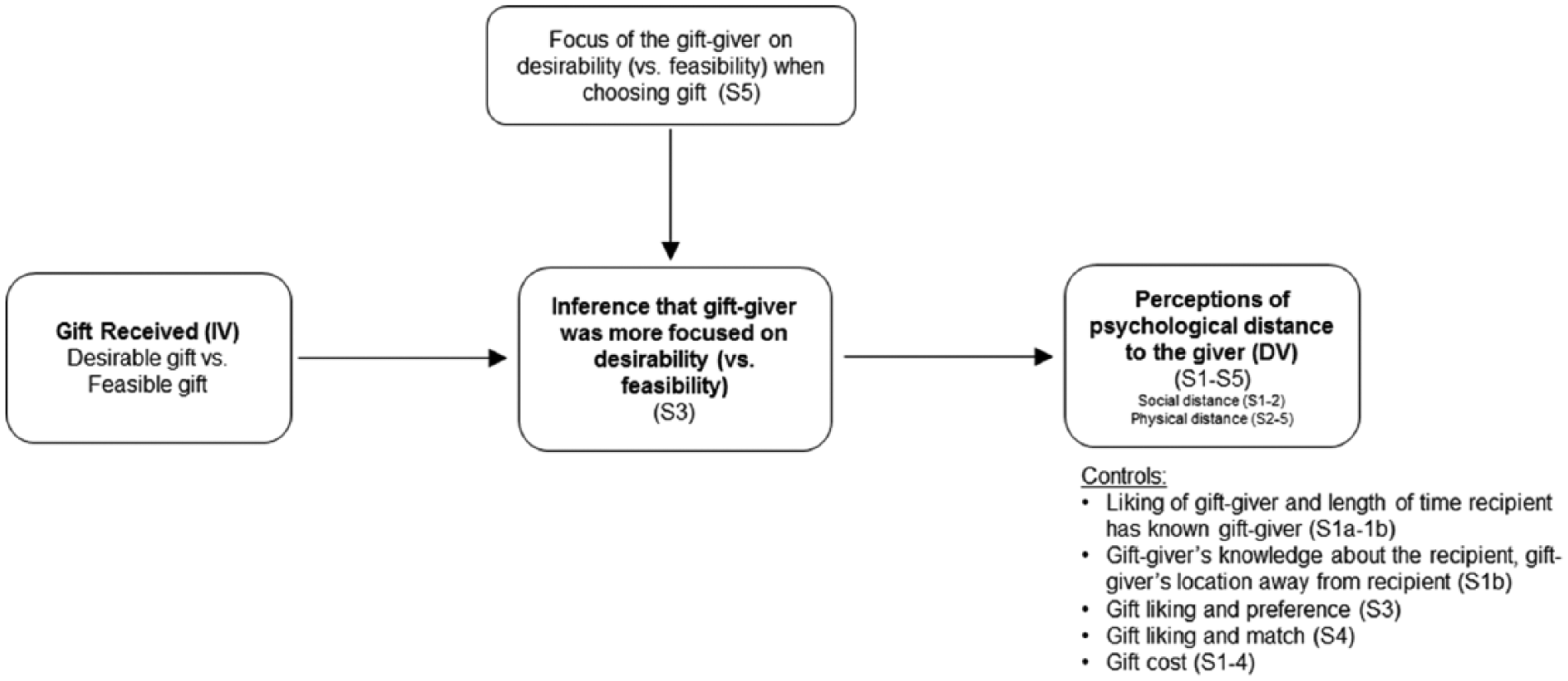
A conceptual diagram of the studies.
Studies 1a and 1b: Perceived Similarity to the Gift-Giver
In Studies 1a and 1b, we tested our prediction that receiving a low-level (vs. high-level) gift would lead to perceptions of reduced social distance to the giver. We operationalized social distance as used perceived similarity (Stephan, Liberman, & Trope, 2011). In Study 1b, we additionally measured perceptions of closeness and connectedness. All sample sizes were determined in advance of data analysis. 5 Data were analyzed upon termination of data collection. For all studies, no other independent variables or manipulations were used besides those reported, and a university institutional review board approved all research reported. 6
Method
Participants
In Study 1a, 142 participants were recruited from Amazon Mechanical Turk (MTurk). After removing participants who failed instructional manipulation checks (IMC; Oppenheimer, Meyvis, & Davidenko, 2009) and attention checks (details in “Procedure” section), 117 participants (53% female; Mage = 32.59) were left for analyses. In Study 1b, 80 participants were recruited from MTurk. After removing participants who failed the attention checks, 73 participants (64.4% female; Mage = 35.47) were left for analyses. 7
Procedure
Participants imagined receiving two gifts, one desirable and one feasible, from two different people (Person A and Person B).
In Study 1a, participants imagined receiving one desirable pen (state of the art and fancy but not very portable due to its weightiness) and one feasible pen (practical and easily portable but mediocre in aesthetics; Baskin et al., 2014) which cost the same amount. They were told to assume that they have known both gift-givers for the same amount of time, and that they like both gift-givers to the same extent. A posttest (N = 65) confirmed that the state of the art but weighty pen is perceived as more desirable (M = 4.91, SD = 1.65) than the practical but portable pen (M = 3.39, SD = 1.56), F(1, 63) = 7.38, p = .008; the practical pen was perceived to be easier to use (M = 6.16, SD = 0.88) than the state of the art pen (M = 3.91, SD = 1.30), F(1, 63) = 76.49, p < .001.
In Study 1b, participants imagined receiving one desirable restaurant gift certificate (upscale Italian restaurant, with a 30/30 Zagat rating, located a 1-hr drive away) and one feasible restaurant gift certificate (an ordinary Italian restaurant, with a 20/30 Zagat rating, located a 5-min drive away; Baskin et al., 2014 8 ). We also told participants to assume that both givers know them to the same extent and that they live the same distance away from them (in addition to controlling for length of time recipient has known gift-giver and liking of gift-giver). We wanted to address the potential alternative explanation that someone who gives a gift certificate to a restaurant that is 5 min away from the recipient knows the recipient better and perhaps lives closer to the recipient, thereby making them more similar. 9
In both studies, we measured social distance through similarity, a form of social distance (Liviatan, Trope, & Liberman, 2008), by asking participants to indicate which gift-giver (Person A or B) is more similar to themselves, in general, in terms of background, in terms of attitudes, and in terms of personal dispositions (1 = Person A, 7 = Person B or 1 = Person B, 7 = Person A; adapted from Stephan et al., 2011). These four items were averaged to form a similarity index (Study 1a: Cronbach’s α = .94; Study 1b: Cronbach’s α = .96).
In Study 1b, we also examined feelings of closeness and connectedness. Specifically, participants indicated which gift-giver they felt closer and more connected to (1 = Person A, 7 = Person B or 1 = Person B, 7 = Person A). To ensure that liking of the gift did not differ across conditions, thus driving our predicted effect, they rated liking of each gift.
Finally, participants provided demographic information, completed the IMC (Study 1a) and attention check questions (Studies 1a and 1b). The IMC question asked participants to demonstrate that they were paying attention to the instructions by not clicking on any of the answer options and instead entering a provided keyword on the next page. The attention check asked participants to indicate correctly which gift each person gave. Participants who failed the IMC (nStudy 1a = 27), or attention check (nStudy 1a = 10; nStudy 1b = 7) questions, or both questions (nStudy 1a = 12) were excluded from all analyses.
Results 10
We first recoded one of the two order presentations so that for all participants 1 = greater similarity to the desirable gift-giver and 7 = greater similarity to the feasible gift-giver. A one-sample t test indicated that receiving a feasible (vs. desirable) gift led to greater feelings of similarity to the gift-giver. In Study 1a, the similarity composite mean was 4.80 (SD = 1.43), significantly greater than the midpoint of 4, t(116) = 6.07, p < .001, 95% confidence interval (CI) for the mean difference = [0.54, 1.06], Cohen’s d = .56. 11 In Study 1b, the similarity composite mean was 4.62 (SD = 1.63), also significantly greater than the midpoint of 4, t(72) = 3.27, p = .002, 95% CI = [0.24, 1.00], Cohen’s d = .38.
In Study 1b, we also asked participants with which gift-giver they felt greater closeness and connectedness. We recoded one of the two order presentations so that for all participants 1 = greater closeness (connectedness) to the desirable gift-giver and 7 = greater closeness (connectedness) to the feasible gift-giver. The mean for closeness was 4.62 (SD = 1.66), significantly greater than the midpoint of 4, t(72) = 3.18, p = .002, 95% CI = [0.23, 1.00], Cohen’s d = .37, and the mean for connectedness was 4.48 (SD = 1.68), significantly greater than the midpoint of 4, t(72) = 2.43, p = .017, 95% CI = [0.09, 0.87], Cohen’s d = .28. Thus, participants felt greater closeness and connectedness to the feasible gift-giver than the desirable gift-giver. As expected, liking of the two gifts did not significantly differ (Mdesirable = 4.08, SDdesirable = 2.09; Mfeasible = 4.23, SDfeasible = 2.03), t(72) = –.725, p = .47.
Study 2: Field Experiment
In Study 2, we investigated another dimension of psychological distance: perceived spatial distance to the gift-giver, and manipulated the type of gift, high-level versus low-level, between subjects. Importantly, we tested our prediction in the context of actual relationships. Passersby walking in pairs on a college campus were approached and then separated by two research assistants. They were separately told that their friend would choose one of two pen gifts for them. Subsequently, they completed two measures of perceived spatial distance. We predicted that participants would estimate their friend to be closer in physical space when they received a low-level, feasible (vs. high-level, desirable) gift.
Method
Participants
Sixty-eight individuals (70.3% female, n = 4 did not report gender; Mage = 23.37) walking in pairs inside a university store completed this study. They were given a snack and a pen for their participation.
Procedure
Participant pairs were separated by two research assistants and taken to opposite ends of the store. At each end, a research assistant told the participant that they would either be assigned to be the gift-giver or the gift-recipient within their pair. In actuality, all participants were assigned to be the recipient and read descriptions of two pens that cost the same amount that their friend was ostensibly choosing between as a gift for them (see Study 1a for pen descriptions). Both research assistants then checked a text message on their phone that told them which pen the giver presumably had chosen for the recipient. Participants were told that they would actually receive the chosen pen.
Perceived spatial distance was assessed by asking participants (a) to rate how physically close or far they felt from their friend (1 = very close, 7 = very far) and (b) to estimate how far away they were in number of feet. Following prior research measuring spatial distance estimates, participants in this study (and Studies 3-5) were told that there was no correct answer and that we were simply interested in their intuitive judgments (e.g., Rim et al., 2013; Wakslak, 2012). Participants also indicated their similarity to the friend, in general, in terms of background, in terms of attitudes, and in terms of personal dispositions (1 = not at all, 7 = very much). Finally, participants answered demographic questions, and were given a snack and the pen gift as compensation.
Results
As predicted, an independent-samples t test (equal variances not assumed) on participants’ subjective ratings showed that they felt physically closer to their friend when they received the feasible pen (M = 2.81, SD = 1.52) rather than the desirable pen (M = 4.30, SD = 1.91), t(61) = 3.54, p = .001, 95% CI = [0.65, 2.33], Cohen’s d = .86.
We also asked participants to estimate physical distance as an open-ended measure. Consistent with prior research (e.g., Liberman et al., 2007; Rim et al., 2013), responses were log-transformed prior to statistical analysis to address positive skew. 12 For clarity of interpretation, we report both the log-transformed means upon which the statistical analysis is based as well as the raw nontransformed means for this study (and Studies 3-5). An independent-samples t test showed that participants estimated their friend to be physically closer in number of feet when they received the feasible pen, Mlog(feet) = 1.41, SD = 0.35; Mfeet = 34.43, versus desirable pen, Mlog(feet) = 1.94, SD = 0.50; Mfeet = 186.21, t(66) = 5.02, p < .001, 95% CI = [0.31, 0.74], Cohen’s d = 1.23.
We also examined the effect of gift type on similarity (averaged composite; Cronbach’s α = .87) using an ANCOVA with the friend’s gender and race (same or different) as covariates because past research has shown that common category membership affects perceived similarity (e.g., Allen & Wilder, 1975; Billig & Tajfel, 1973; Tajfel, Billig, Bundy, & Flament, 1971). Although in the predicted direction, the effect of gift type on perceived similarity was not significant (Mfeasible = 4.70, SDfeasible = 1.24; Mdesirable = 4.41, SDdesirable = 1.48), F(1, 66) = 1.64, p = .205. In actual relationships, unlike in hypothetical controlled scenarios, perceived similarity may be a noisier measure affected by numerous factors, in addition to similarity in gender and race, which we did not control for. For instance, factors such as similarity in occupation, college major, and socioeconomic status are likely to affect interpersonal similarity. In contrast, perceived physical distance is unlikely to be affected by such social factors.
Study 3: Perceived Spatial Distance and Gift-Giver Focus
In Study 3, we aimed to replicate the spatial distance effect and examine the process more closely. Participants imagined receiving either a desirable or a feasible pen, costing the same amount, from someone for their birthday. They were subsequently asked to estimate the gift-giver’s physical distance away from them. Participants were also asked to infer the gift-giver’s focus on desirability (i.e., overall quality) versus feasibility (i.e., ease of use) of the pen.
First, we predicted that receiving a feasible (vs. desirable) pen would lead to closer estimates of the giver’s physical distance, consistent with Study 2. Second, we predicted that receiving a feasible (vs. desirable) pen would lead to a greater tendency to infer that the giver focused on the gift’s ease of use (vs. overall quality), thereby demonstrating that the specific features of the pen indeed correspond well to low- versus high-level construal (manipulation check). Finally, we expected that the more participants inferred that the giver focused on the gift’s ease of use (vs. the overall quality) of the gift, the shorter the distance estimate to the giver. Consistent with the approach used by Luttrell, Petty, Briñol, and Wagner (2016), this last correlational prediction was intended to further clarify the process by which high-level, desirability versus low-level, feasibility of the gift affects psychological distance. 13
In addition, we controlled for the possibility that people might feel closer to someone who gives them a gift they would have been more likely to get for themselves. We asked participants to indicate the likelihood that they would choose the pen (either desirable or feasible, depending on condition) to buy for themselves, and predicted that their likelihood of choosing the pen would not affect perceived spatial distance to a gift-giver.
Method
Participants
Students (N = 65; 60% female; Mage = 21.68) completed this as an online study for course credit. After removing one participant who provided an impossible value for the spatial distance estimation (i.e., 200,000 miles), 64 were left for analyses.
Procedure
Participants were randomly assigned to imagine receiving either a desirable pen that is state of the art and fancy but not very portable due to its weightiness or a feasible pen that is practical and easily portable but mediocre in aesthetics, both costing US$6.85. We then measured spatial distance by asking participants to indicate how far away they felt the gift-giver was from them in physical distance (in number of miles). They also indicated how much they liked the gift (1 = very little, 7 = very much).
To examine the process more closely, we asked participants to indicate the extent to which the giver focused on desirability or feasibility of the pen (1 = mostly focused on feasibility, 7 = mostly focused on desirability). 14 After presenting them with the appropriate pen description again, we asked how likely they would be to gift this pen to themselves for their own birthday (1 = not at all likely, 7 = highly likely) and how expensive the pen seems to them (1 = not at all, 7 = very much). Finally, participants provided demographic information.
Results
Main hypotheses
As hypothesized, participants who imagined receiving a feasible gift thought that the gift-giver was significantly closer, Mlog(miles + 1) = 1.16, SD = 1.10; Mmiles = 270.69, than those who imagined receiving a desirable gift, Mlog(miles + 1) = 1.75, SD = 1.07; Mmiles = 396.27; t(62) = 2.16, p = .034, 95% CI = [0.04, 1.13], Cohen’s d = .54.
Participants who imagined receiving a practical but aesthetically less pleasing pen thought that the giver focused more on the feasibility of the gift (M = 2.27, SD = 1.46), and those who imagined receiving a state of the art but weighty pen thought that the giver focused more on the desirability of the gift (M = 4.90, SD = 1.83), t(62) = 6.37, p < .001, 95% CI = [1.80, 3.46], Cohen’s d = 1.59. Participants’ inferred focus of the giver in turn predicted spatial distance to the giver, B = .18, SE = .06, β = .335, t = 2.80, p = .007; the more recipients inferred that the giver focused on feasibility, the closer they felt to the giver. This finding provides some support for our predicted process.
Alternative accounts: Liking, perceived cost, preference
Participants did not significantly differ in how much they liked the feasible (M = 3.58, SD = 1.66) versus desirable gifts (M = 3.59, SD = 1.60), t(63) = .04, p = .97. Perceived cost of the pen gift did not significantly differ between desirable (M = 3.69, SD = 1.94) and feasible gifts (M = 3.70, SD = 1.86), t(63) = .02, p = .98. Finally, although there was a marginally significant difference in participants’ natural preference for the feasible gift (M = 2.97, SD = 2.01) compared with the desirable gift (M = 2.19, SD = 1.62), t(63) = 1.73, p = .089, it did not predict spatial distance to the giver, B = .06, SE = .08, β = .090, t = .72, p = .48, nor did it mediate the effect of gift type on spatial distance (95% CI = [–0.19, 0.09]).
Study 4: Preference Match as an Alternative Explanation
In Study 3, we ruled out various alternative explanations, including gift-recipients’ preference for the feasible versus desirable pen. However, it is possible that participants perceive the low-level gift as reflecting a better match between what they want and what the gift-giver chose, thereby leading to greater feelings of psychological closeness. Feelings of match may tap into a sense of being understood by the gift-giver, which may be different from general feelings of liking or preference. Thus, we wanted to rule out the possibility that gift-recipients consider the feasible gift to be a better match to their own preference.
In addition, we generalized to another gift scenario. Participants imagined receiving either a desirable versus feasible mini-tablet, costing the same amount (US$60-$70), from someone for their birthday. Then they estimated the gift-giver’s physical distance away from them. We predicted that participants who imagined receiving a feasible (vs. desirable) mini-tablet would estimate the giver to be closer. We also predicted that there would be no effect of gift type on perceptions of preference match. We also measured perceived liking and cost as in Study 3.
Method
Participants
Students (N = 178; 52% female; Mage = 19.89) completed this study in the laboratory for course credit. After removing participants who failed the attention check (n = 1) and did not follow experiment instructions during the lab session (e.g., did not complete the gift manipulation essay, did not enter a numerical value for the miles dependent variable; n = 11), 166 participants (52% female; Mage = 19.87) were left for analyses.
Procedure
Participants were run in large groups and completed the study individually. They were randomly assigned to imagine receiving either a desirable mini-tablet that is state of the art with highly rated design and capabilities (e.g., excellent graphics) but not very portable due to its weightiness or a feasible mini-tablet that is light and easily portable but with medium-rated capabilities (e.g., moderate graphics), both costing US$60 to $70. We asked participants to estimate subjective spatial distance from the gift-giver in miles and also to rate their liking of the gift (1 = very little, 7 = very much). Participants also indicated how much the gift-giver’s choice of gift matched what they might get for themselves (1 = poor match, 7 = excellent match) and how expensive the mini-tablet seemed to them (1 = not at all, 7 = very much).
Results
As hypothesized, participants who imagined receiving a feasible gift thought that the gift-giver was closer, Mlog(miles + 1) = 1.42, SD = 0.94; Mmiles = 142.81, than participants who imagined receiving a desirable gift, Mlog(miles + 1) = 1.72, SD = 0.94; Mmiles = 336.86; an independent-samples t test on log-transformed distance revealed that this effect of gift type was significant, t(164) = 2.07, p = .04, 95% CI = [0.013, 0.59], Cohen’s d = .32.
As predicted, perceived match between the gift-giver’s choice and what they might get for themselves did not significantly differ between the desirable gift (M = 3.13, SD = 1.56) and feasible gift (M = 3.17, SD = 1.50), t(164) = .19, p = .85. We found no differences in liking, t(164) = .70, p = .48, or perceived cost, t(151.12) = 1.52, p = .13, across the two conditions.
Study 5: Manipulating the Giver’s Focus
In Study 5, our aim was to provide further evidence for the process by which desirability versus feasibility affects psychological distance by manipulating the giver’s focus, rather than measuring it as we did in Study 3 (Spencer, Zanna, & Fong, 2005). Specifically, if beliefs about the gift-giver’s focus drive the effect of different gift types on perceived distance, then holding the gift constant and manipulating the gift-giver’s focus directly ought to lead to the same effect as varying gift type does. Thus, all participants imagined receiving the same gift—a restaurant gift certificate—and we only manipulated the purported focus of the gift-giver by indicating that the giver focused more on the logistics of using the gift (i.e., a low-level feature) or more on the value and quality of the gift (i.e., a high-level feature). We predicted that recipients would perceive the gift-giver to be subjectively closer if they believed the giver focused on the logistics of using the gift versus the value and quality of the gift. Any difference in perceived distance of the giver should be attributed to differences in the giver’s purported focus as everyone imagined the same gift. Thus, this study provides converging evidence for the proposed process and also demonstrates greater generalizability of the effect of gift construal on psychological distance beyond the specific features of the gifts used in our studies.
Method
Participants
We recruited 303 participants from MTurk; 283 (38.5% female; Mage = 31.76) remained for analyses after removing participants who failed the IMC and manipulation check questions (details in “Procedure” section).
Pretest
We conducted a separate pretest on MTurk (N = 301; N = 288 passed IMC and attention check questions) to show that gift type affects recipients’ inferences about a gift-giver’s focus. The pretest had a 2 (between-subjects: feasible gift, desirable gift) × 2 (within-subjects: focus on logistics of using the gift, focus on value and quality of the gift) mixed design. There was a significant interaction, F(1, 286) = 306.06, p < .001, such that participants who imagined receiving a feasible gift certificate inferred that the gift-giver was focused more on the logistics of using the gift (M = 5.49, SD = 1.23) than the value and quality of the gift (M = 4.43, SD = 1.15), F(1, 286) = 50.43, p < .001; participants who imagined receiving a desirable gift certificate inferred that the gift-giver was focused more on the value and quality of the gift (M = 5.73, SD = 1.17) than on the logistics of using the gift (M = 3.10, SD = 1.56), F(1, 286) = 312.46, p < .001. 15 Based on this pretest, we told participants in the main study that the gift-giver focused either on “the value and quality of the gift, and what you would get out of it” (high-level) or on “the logistics of using the gift” (low-level).
Procedure
All participants imagined receiving a birthday gift that was high on both desirability and feasibility, specifically, a gift certificate to an upscale Italian restaurant (30/30 rating in Zagat’s restaurant guide) that is about a 5-min drive away.
In the high-level focus condition, participants were told that the gift-giver was mostly focused on the value and quality of the gift, and what they, the recipient, would get out of it, and not as focused on the logistics of using the gift. In the low-level focus condition, participants were told that the gift-giver was mostly focused on the logistics of using the gift, and not as focused on the value and quality of the gift.
Then we asked participants to estimate how far away in physical distance (in number of miles) the giver is from them. Finally, participants provided demographic information and completed IMC (same as Study 1a) and manipulation check questions that asked them to indicate what the giver had in mind by selecting one of two descriptions (either the quality, value of the gift, or logistics of how to use the gift). Participants who failed the IMC (n = 12), manipulation check (n = 9) questions, or both questions (n = 1) were excluded from all analyses.
Results
An independent-samples t test (not assuming equal variances) on log-transformed physical distance was marginally significant, t(268) = 1.94, p = .054, 90% CI = [0.02, 0.22], 16 Cohen’s d = .23. Participants estimated that the gift-giver was closer if the gift-giver focused on a low-level feature, the logistics of use, Mlog(low-level + 1) = 1.11, SD = 0.46; Mmiles = 27.33, than if the gift-giver focused on a high-level feature, the value and quality, Mlog(high-level + 1) = 1.23, SD = 0.58; Mmiles = 70.48.
Thus, Study 5 provides experimental evidence that given the same gift with identical features, recipients who thought that the gift-giver focused on the logistics of using the gift (low-level feature) versus the value and quality of the gift (high-level feature) estimated the gift-giver to be physically closer. Studies 3 and 5 provide converging evidence that the type of gift affects perceived psychological distance to the giver specifically by affecting the recipient’s inference about the gift-giver’s focus on either a high-level or a low-level feature of the gift. 17
General Discussion
The present research draws on CLT (Trope & Liberman, 2010) to examine whether the type of gift received affects the psychological distance one feels to a gift-giver. According to this theory, there is a bidirectional relationship between level of construal and psychological distance. CLT proposes that high-level (vs. low-level) considerations are associated with psychological distancing (Trope & Liberman, 2010). We theorize that when a feasible gift is received, the recipient infers that the giver engaged in low-level considerations in choosing the gift, a construal process which is linked to a sense of psychological proximity according to CLT. This inference leads the recipient to feel closer to the giver than if they infer that the giver had a high-level focus.
Across six studies, we demonstrate that receiving feasible but relatively less desirable gifts led recipients to feel closer to givers, both in terms of subjective physical distance and social distance, than receiving desirable but relatively less feasible gifts. Moreover, this effect of gift type on perceived psychological distance of the gift-giver was specifically due to the recipient’s inferences about whether the giver focused on the gift’s quality (high-level, desirability-focused) or its ease of use (low-level, feasibility-focused; Studies 3 and 5). Receiving a feasible (vs. desirable) gift led to reduced perceived physical distance of the giver; additionally, the more the recipient perceived the giver to be focused on the ease of using the gift (vs. the overall quality), the closer they perceived the giver to be (Study 3). In Study 5, recipients perceived the giver to be more physically proximal when they were told that the giver focused more on the logistics of using the gift (vs. the gift’s overall quality), thus providing further evidence for the process. Notably, all recipients imagined receiving the same gift, a restaurant gift certificate that was both desirable and feasible, and only the giver’s purported focus was manipulated. This study sheds light on the process by which desirable versus feasible gifts affect psychological distance. It also provides evidence that our basic effect generalizes beyond the specific features of the gifts used in our studies.
Potential Limitations and Alternative Explanations
The effect of gift type on psychological distance was demonstrated across different distance dimensions and gift stimuli. We controlled for variables that might affect interpersonal similarity, such as how long the recipient has known the giver (Studies 1a and 1b), how much the recipient likes the giver (Studies 1a and 1b), how well the giver knows the recipient (Study 1b), and the physical distance of the giver (Study 1b). We also controlled for the cost of the gifts to ensure that the only manipulated feature of the gifts was relative desirability versus feasibility and not the monetary value (Studies 1-4).
It is also possible that recipients simply feel closer to the feasible gift-giver because they naturally prefer the feasible gift for themselves or because they feel that the feasible gift-giver chose a gift that is a better match to their own preferences. We controlled for this possibility in three ways. First, we measured how much participants liked the gift they imagined receiving and found that they did not differ in how much they liked the desirable versus feasible gift (Studies 3 and 4). Moreover, we asked participants how likely they would be to get the gift for themselves (Study 3), as well as how well the gift-giver’s choice of gift matches what they would get for themselves (Study 4) and found no difference across the gift conditions. In combination, these measures help to address the alternative possibilities that (a) greater liking of or preference for the feasible versus desirable gift or (b) greater perceived match between the choice of the feasible versus desirable gift and participant’s own preference leads to reduced perceived distance to the gift-giver.
We found empirical support for subjective physical distance in line with our theorizing in a field setting, where participants received a real gift and were asked to estimate the physical distance of an actual friend standing across a store (Study 2). Thus, we demonstrate that the type of gift received, specifically one focused on high-level ends versus low-level means, can affect the perceived distance of an imagined and actual gift-giver. However, while in the predicted direction, we did not find a significant effect on similarity of an actual friend, suggesting perhaps that similarity—unlike subjective physical distance—is a measure affected by numerous fixed factors (e.g., race, gender, socioeconomic status) that need to be controlled for to detect effects of one occasion of gift exchange.
To increase confidence in our effects, we conducted a mini-meta-analysis synthesizing the results across three of our studies (Studies 3-5) that used the same spatial distance measure (i.e., distance in miles). As McShane and Böckenholt (2017) state, among the benefits of conducting a mini meta-analysis within a single paper are to provide a more accurate estimate of the effect and to increase statistical power compared with individual studies. This meta-analysis across the three studies estimates the feasible–desirable spatial distance in miles effect at –.24 (in log [miles + 1]) with a 95% CI of [–0.45, –0.03].
Theoretical Contribution and Future Directions
The present research contributes to the existing literature on gift-giving and CLT in several important ways. Whereas past work focused primarily on downstream evaluation of the gift itself (e.g., Baskin et al., 2014; Flynn & Adams, 2009), we focused on perceived psychological distance to the giver. In this way, our work is distinct from related work by Baskin et al. (2014) who found that givers prefer to give gifts that are more desirable but relatively less feasible whereas recipients did not show a preference between gift types because they place greater weight on feasibility than givers. This is explained as being due to the asymmetric distance between the giver and the gift, versus the recipient and the gift, where the latter is relatively more close. In our case, the central dependent variable of interest is evaluation of the giver rather than evaluation of the gift. As such, the asymmetric distance to the gift, which plays a central role in Baskin et al. (2014), is irrelevant. In the context of thinking about how close or distant the gift-giver is, we theorize that recipients consider what the giver had in mind in choosing this gift for them (i.e., high- vs. low-level considerations), which in turn affects feelings of closeness.
It is important to note that our studies are about the recipient’s perceptions of the giver. While focusing on the giver might generally lead recipients to adopt a high level of construal (relative to focusing on themselves), there should still be a relative difference between thinking about someone who gives them a certain gift versus another. While recipients like both gifts to the same extent, consistent with Baskin et al. (2014), we propose that they feel closer to the person who gives the low-level (vs. high-level) gift. We further clarify this effect by holding constant the gift’s characteristics and showing that it is specifically due to the recipient’s inference that the giver focused on the gift’s ease of use (a low-level feature) more than the overall quality of the gift (a high-level feature). Taking the perspective of the giver, the giver’s low-level focus is a construal process linked to feelings of closeness according to the principles of CLT. The result is that the recipient feels a sense of closeness to the giver relative to if the giver’s inferred focus is high level.
Our research contributes to the small but growing literature examining how different types of gifts affect relational closeness (Aknin & Human, 2015; Chan & Mogilner, 2017; Dunn et al., 2008; Zhang & Epley, 2012). Furthermore, our conceptual dependent variable of psychological distance encompasses closeness on multiple dimensions, including traditional measures, such as perceived closeness, and also interpersonal similarity and physical closeness. Our work thus provides evidence for a broader phenomenon of when and how gifts draw individuals closer.
We also contribute to the literature on CLT. While past work examining psychological distance as a dependent variable has focused on perceived distance to actions or events (e.g., Liberman et al., 2007; Rim et al., 2013), we examined interpersonal distance between individuals. Recently, research showed that people prefer to learn low-level information from a close other while they show no preference for a close or distant other for learning high-level information (Kalkstein, Kleiman, Wakslak, Liberman, & Trope, 2016). Research also found that communicators focus on a distant (proximal) audience when their message is framed abstractly (concretely; Joshi, Wakslak, Raj, & Trope, 2015). Our research thus contributes to this growing area of research on the effect of construal on interpersonal distance and is the first to examine this topic in the context of social exchange. Furthermore, to our knowledge, we are the first to explore the effect of construal on perceptions of interpersonal similarity, a form of social distance.
We hope our research will stimulate an integration of past work in the domain of gift-giving, leading to new and interesting questions. While we focused on the features of desirability and feasibility, similar predictions can be made for other high- versus low-level features of gifts. For example, Cavanaugh et al. (2015) showed that givers overestimate the value of a socially responsible gift for distant versus close friends. Socially responsible gifts can be considered high level in that their value is derived from the symbolic meaning of the gift (i.e., to be a moral person), which is more abstract than its practical and concrete use for the recipient. Thus, to the extent that socially responsible gifts are strong on a high-level feature and weak on a low-level feature, we would predict that giving such a gift will increase feelings of psychological distance relative to a more practical gift. A broader classification of gifts under the umbrella of high level and low level expands the breadth of predictions that can be made, enabling a richer understanding of the phenomenon.
Our research demonstrates that the type of gift influences the recipient’s perception of the gift-giver’s psychological distance. It is interesting to consider downstream effects of this relationship between gift construal and psychological distance on other relational variables, such as liking of the giver or relationship commitment. Similarity, familiarity, and propinquity are variables known to be positively associated with liking and attraction (e.g., Bornstein & D’Agostino, 1992; Byrne, 1961a, 1961b; Nahemow & Lawton, 1975; Reis, Maniaci, Caprariello, Eastwick, & Finkel, 2011; Tidwell, Eastwick, & Finkel, 2013; Zajonc, 1968 but see Amodio & Showers, 2005; Norton, Frost, & Ariely, 2007). Thus, it is possible that recipients will report greater liking for givers who give feasible versus desirable gifts. Furthermore, insofar as physical proximity is associated with cooperation and persuasion (e.g., Bradner & Mark, 2002), it is possible that low- versus high-level gifts engender a greater willingness to be collaborative and to be persuaded by the gift-giver, which has implications for when gifts are given for self-serving purposes (i.e., ingratiation). It would be interesting for future research to explore whether subjective spatial distance is related to the aforementioned interpersonal variables.
Finally, our research furthers the understanding of the function of gifts in expanding and contracting the scope of social relationships (Ledgerwood, Trope, & Liberman, 2015). Throughout time, humans have sought to find ways to forge meaningful connections with others, and giving gifts has aided such relational processes (e.g., Belk, 1979; Mauss, 1925; Sherry, 1983). Our theorizing suggests that high-level gifts might function as a metaphorical bridge between distant entities, making it possible for one to imagine receiving a gift from a distant gift-giver. By widening the scope of individuals from whom one can receive a gift, high-level gifts may enable connection even between distant individuals who may be dissimilar from one another or physically separated. By contrast, low-level gifts may function to support greater intimacy and closeness between givers and recipients.
Supplemental Material
rim_online_appendix – Supplemental material for The Gift of Psychological Closeness: How Feasible Versus Desirable Gifts Reduce Psychological Distance to the Giver
Supplemental material, rim_online_appendix for The Gift of Psychological Closeness: How Feasible Versus Desirable Gifts Reduce Psychological Distance to the Giver by SoYon Rim, Kate E. Min, Peggy J. Liu, Tanya L. Chartrand and Yaacov Trope in Personality and Social Psychology Bulletin
Footnotes
Acknowledgements
The authors thank Dania Alvarez, Catherine Anderson, Ritwick Ghosh, Hannah Kim, Michelle Lee, Connor Rossner, Sharon Yi, and Heeyoung Yoo for their research assistance, and the Cornell Store as well as the Samuel Curtis Johnson Graduate School of Management’s Business Simulation Lab and Joseph M. Katz Graduate School of Business’s Behavioral Lab for participant recruitment. We also thank Jim Bettman for helpful comments on an earlier draft. Support from the Fuqua School of Business at Duke University and Joseph M. Katz Graduate School of Business at University of Pittsburgh is also gratefully acknowledged.
Declaration of Conflicting Interests
The author(s) declared no potential conflicts of interest with respect to the research, authorship, and/or publication of this article.
Funding
The author(s) received no financial support for the research, authorship, and/or publication of this article.
Notes
Supplemental Material
Supplemental material is available online with this article.
References
Supplementary Material
Please find the following supplemental material available below.
For Open Access articles published under a Creative Commons License, all supplemental material carries the same license as the article it is associated with.
For non-Open Access articles published, all supplemental material carries a non-exclusive license, and permission requests for re-use of supplemental material or any part of supplemental material shall be sent directly to the copyright owner as specified in the copyright notice associated with the article.
