



Abstract
English passages can be in either the active or passive voice. Relative to the active voice, the passive voice provides a sense of objectivity regarding the events being described. This leads to our hypothesis that passages in the passive voice can increase readers’ psychological distance from the content of the passage, triggering an abstract construal. In five studies with American, Australian, British, and Canadian participants, we find evidence for our propositions, with both paragraphs and sentences in the passive voice increasing readers’ felt temporal, hypothetical, and spatial distance from activities described in the text, which increases their abstraction in a manner that generalizes to unrelated tasks. As such, prose colors how people process information, with the active and passive voice influencing the reader in ways beyond what is stated in the written word.
Introduction
Did the quick brown fox jump over the lazy dog? Or, was the lazy dog jumped over by the quick brown fox? In English and other languages, prose can be in either the active or passive voice. A key grammatical difference between the active and passive voices is the location of the semantic subject and the semantic object in the sentence (Anisfeld & Klenbort, 1973; Henley, Miller, & Beazley, 1995; Johnson-Laird, 1968; Olson & Filby, 1972). In the active voice, the semantic subject, which is also the grammatical subject, receives emphasis. For example, in the opening sentence, it is the quick brown fox that receives emphasis. But in the passive voice, the semantic subject is undergoing the action of the verb while the grammatical subject, which is the semantic object, instead receives stress. For example, in the second sentence, it is the lazy dog on which the author and reader stress more.
We suggest that readers reading a passage written in the passive voice will presume the content of that communication to lie psychologically farther away, which will activate a higher or more abstract level of construal, whereas reading a passage containing the same informational content but in the active voice will lead to feelings of psychological proximity, known to activate a lower, more concrete level of construal (Trope & Liberman, 2000, 2010). We thus posit that the use of the active and passive voices can affect how readers process information beyond the text because construal levels, when activated, affect myriad decisions and judgments in domains unrelated to the initial construal instantiation. Both active and passive voices abound in fiction and nonfiction, in advertising copy, in public notices, and in everyday discourse. Thus, we suggest that there may be crucial cognitive consequences for readers resulting from how writers write. We anchor such predictions in prior research suggesting that different aspects of language influence psychological distance and hence mental construal level (Im Shin & Kim, 2017; Maglio, Rabaglia, Feder, Krehm, & Trope, 2014; Rabaglia, Maglio, Krehm, Seok, & Trope, 2016; Stephan, Liberman, & Trope, 2010).
Penelope (1990) posited that the passive voice, specifically truncated passives in which the acting agent is unclear or not explicitly mentioned, accomplishes various discursive functions that tend to go unnoticed at the conscious level. For example, consider a sentence that begins with “It is widely understood that . . .” Such form obscures agency by placing the actor(s) in the background and, as a result, introduces interpretational ambiguity because it is not clear exactly who does and who does not understand it (Bolinger, 1980; Clark, 1992). Perhaps the most common illustration of truncated passives lamented by English teachers is “Mistakes were made.” Who made the mistake? The uncertainty of the agent(s) responsible for the mistake allows for variance, if only slight, in the assigning of blame and hence the interpretation of the sentence.
Even when the semantic subject is clear (“Mistakes were made by X”), there remains an emphasis upon the semantic object, which becomes the grammatical subject in the passive voice. Johnson-Laird (1968) devised an experiment in which he had participants draw diagrams to depict the phrases “Blue follows red” (the active voice) and “Red is followed by blue” (the passive voice). For “Blue follows red,” participants drew the blue area larger than the red, implying stress on the semantic subject, which is the grammatical subject as well. But, for “Red is followed by blue,” most participants drew the red area larger than the blue. Participants, therefore, stressed the grammatical subject more than the semantic subject that became the grammatical object. Indeed, even when spoken, the grammatical subject receives stress phonetically (Chomsky, 1971; C. S. Smith, 1971).
This shift in emphasis away from the semantic subject and onto the semantic object in the passive voice distances the semantic subject from the activity being described, redirecting judgments of responsibility, blame, and agency onto the semantic object. Henley et al. (1995) contended that reading communications about rape in the passive voice, for example, can redirect blame (i.e., of the rape) onto the victims themselves and away from the perpetrator as it suggests some degree of involvement on the victims’ part (e.g., “The woman was raped” can lead to a completion “The woman got herself raped”). This distances the perpetrator from the event being described.
Accordingly, the passive voice conveys a sense of greater objectivity regarding the activity being described: It reduces subjectivity on the author’s part by preventing the author’s personal emotions and interpretations from defining the act. This explains why authors prefer to use the passive voice if they need to distance themselves from emotionally disturbing content or if they wish to appear scientific and impartial (Lamb, 1991). To wit, researchers studying news reports of sexual assault use the term “psychological distance,” not within the construal sense, but to describe how written reports utilize the passive voice. Baratta (2009) called this “revealing stance” in that the passive voice prevents revealing the stance of the author, lending a degree of objectivity to how the author interprets it (cf. Hyland, 1998; Thompson & Ye, 1991). Indeed, any writing can reveal the personal stances of authors and their “identities” (Ivanic, 1994), just like how italics reveal the author’s personal emphasis (Baratta, 2009). The objectivity that the passive voice communicates explains its popularity in academic writing, where writing is “object-” or “thing-centered” and where researchers need to maintain impartiality (Leong, 2014; Pruitt, 1968). But even outside of academic discourse and journalism, authors tend to use the passive voice to maintain impartiality about the event they are describing (Reilly, Zamora, & McGivern, 2005).
We hypothesize that this objectivity between the author of the text and the event being described in the text should likewise increase readers’ objectivity and thus their felt psychological distance (in the construal sense) from the written text. Reading is an inherently communicative act, transmitting information from speakers to audiences, and communicative norms embraced by both dictate that the former convey information that is true and relevant (Grice, 1975). As such, audiences assume that speakers believe what they say to be honest and important and may even adopt the stance of the authors, and this applies not only to the content of communication but also to its form. With respect to how these norms relate to psychological distance, Kaju and Maglio (2018) presented communications either in the form of a text message or an email, then asked participants to rate how psychologically distant they felt from the subject of the text. Participants saw the content of text as psychologically closer when they received a text message (vs. an email) as participants inferred that the communicator saw the subject of the message to also be psychologically close. Thus, inferences of psychological distance are capable of being transmitted interpersonally via the form as well as the content that communication takes.
It is the objectivity of the passive voice, which leads readers to also be objective about the event described, relative to the active voice, that we propose should cause readers to feel greater psychological distance between it and their immediate, egocentric experience. “An objective tone” has not been implicated directly via the lens of psychological distance conceptualized by Construal Level Theory (Trope & Liberman, 2000, 2010); to influence construal, several close associates point to a possible association between psychological distance and objectivity. First, emotional intensity reduces psychological distance (Lundberg, Bratfisch, & Ekman, 1972; Van Boven, Kane, McGraw, & Dale, 2010), which implies that increasing psychological distance should reduce emotionality (one marker of greater objectivity). Second, just as the passive voice buffers against emotions, so, too, does psychological distance, whereas feeling close intensifies emotions (Im Shin & Kim, 2017; Strack, Schwarz, & Gschneidinger, 1985; Williams & Bargh, 2008), even when that closeness derives from linguistic cues (Maglio & Feder, 2017). For instance, people can see and talk about themselves from either an immersed and close first-person perspective or at a distance from a third-person one. This distancing via reduced emotional intensity facilitates a more objective, fly-on-the-wall perspective (Ayduk & Kross, 2010; Libby, Shaeffer, & Eibach, 2009). Furthermore, people envisioning something at a psychological distance generally see it inside their minds’ eye in black and white rather than in color (Lee, Fujita, Deng, & Unnava, 2017), and black and white is a visual indicator of objective processing.
In sum, we propose that the greater objectivity that the passive voice conveys might increase readers’ psychological distance, which then increases their mental construal level to a higher, more abstract level, relative to the active voice. We target this downstream effect on level of construal in order for us to speak both to practical issues (whether communicators should frame messages in active or passive terms) and also to conceptual and methodological issues in Construal Level Theory and psychological distance. A predominant approach in this tradition asks participants to envision making some judgment from a distant (vs. close) perspective, predicting the judgment to rely more on abstract (vs. concrete) features (e.g., Trope & Liberman, 2000), thus providing evidence that psychological distancing influences judgment. Importantly, when construal level changes, this can then change the manner in which people process information in unrelated domains. That is, a change in mental construal level from one origin can change how people process information in domains that are unrelated to the initial source that evoked it (e.g., Fujita, Trope, Liberman, & Levin-Sagi, 2006). However, the lion’s share of evidence in support of this claim manipulates construal level directly rather than manipulating psychological distance in a manner that similarly impacts unrelated judgments. This latter possibility has received only limited attention (Liberman & Förster, 2009; P. K. Smith & Trope, 2006) and none in the interpersonal communication domain. The present investigation seeks to provide evidence for such a possibility and, more broadly, to speak to the possible wider impacts of passages in the passive (vs. active) voice on information processing generally.
There are multiple forms of psychological distance conceptualized to be interrelated insofar as they predict similar outcomes and are predicted by similar inputs (Maglio, Trope, & Liberman, 2013a, 2013b). Therefore, we examine temporal (Study 1), hypothetical (Study 2), and spatial (Study 3) distance in the interest of robustness. With this aim in mind, we adapted passages for these studies that lend themselves to asking about a specific, unique form of distance. For example, the phrase, “In the future, cars will be driven by robots,” should be more relevant for estimates of temporal distance than for, say, spatial distance because there is no content related to the location of these cars in the text. Therefore, we test temporal, hypothetical, and spatial distance individually to see if corresponding passages in the passive voice can result in abstraction through different psychological distances. From there, Study 4 uses multiple passages in the same study in the interest of demonstrating that the effect does not depend on any particular passage. In so doing, as the different passages do not all bear relevance for the same psychological distance, we assess only abstraction while also addressing alternative accounts. Last, Study 5 probes the minimum conditions necessary for our effect to emerge, as it examines both a full paragraph and single sentence.
Study 1: Americans and Temporal Distance
The purpose of Study 1 was to provide initial evidence for our hypothesis that the passive voice elicits an abstract level of construal via greater psychological distance from the content of the passage. We focused on temporal distance, positing that American participants reading a short passage about a future event in the passive (vs. active) voice would feel that the activity described would take place farther away (vs. closer) in time, causing them to think more abstractly (vs. concretely).
Procedure
An a priori determination revealed that a sample size of 200 could test an estimated effect size of .20 at the level of α = .05 and power = .80, according to G*Power. We recruited about 10% more, 230 in total, in case some participants left missing responses. In the end, nine did; therefore, we removed their responses, resulting in a data set with 221 responses. The mean age in our sample was 38.63 years old (SD = 10.07 years old), and there were 126 men and 95 women. Participants were Americans from Amazon Mechanical Turk (MTurk). They received a small monetary compensation in exchange for their time. We conducted this study in September 2018.
Participants read a passage about a person who planned to travel to France in March 2019, written in either the active or the passive voice (see Appendix A in Supplementary Material). They read the passage under the guise of an assessment for reading comprehension. In line with the cover story, after reading the passage, participants indicated how “interesting” and “concise” the passage was on separate 9-point scales (1 = mot at all, 9 = very interesting/concise). Furthermore, these measures allowed us to ascertain if they might provide evidence for an alternative account relating voice to construal via a mechanism other than psychological distance.
Then, participants completed the Kimchi–Palmer Task (KPT; Kimchi & Palmer, 1982) that featured 10 sets of images; participants had to choose which of two images on the bottom of each of the sets most corresponded to the figure on the top. A choice of the image on the bottom that matched the one on the top at the global level indicated an abstract mental construal. Last, as our measure of temporal distance, participants indicated how far away the author’s trip to France in March 2019 felt like to them on a 9-point scale (1 = not at all, 9 = very far).
Results
Interest
On Interest, there was no difference between participants reading the passive voice (M = 6.80, SD = 1.69) and the active voice (M = 6.94, SD = 1.68), F(1, 219) = 0.36, p = .55, Cohen’s d = .08 (95% confidence interval [CI] = [–.18, .34]).
Concision
On Concision, there was also no difference between participants reading the passive voice (M = 3.55, SD = 1.71) and the active voice (M = 3.23, SD = 1.79), F(1, 219) = 1.75, p = .19, d = .18 (95% CI = [–.09, .44]).
Abstraction
Totaling the number of global-figure image selections made by each participant on the KPT, indicating greater Abstraction, those reading the passive voice scored higher (M = 7.51, SD = 3.05) than those reading the active voice (M = 6.39, SD = 3.42), F(1, 219) = 6.61, p = .01, d = .35 (95% CI = [.08, .61]).
Temporal distance
Participants reading the passive voice felt that the trip would occur farther into the future (M = 6.92, SD = 1.29) than those reading the active voice (M = 6.48, SD = 1.43), F(1, 219) = 5.67, p = .02, d = .32 (95% CI = [.06, .59]).
Mediation analysis
A mediation analysis using bootstrapping (Model 4; Preacher & Hayes, 2008) indicated that the indirect effect of the passive voice on Abstraction via Temporal Distance was estimated to lie between .03 and .14 (95% CI; 5,000 bootstrapped samples). Please see Figure 1.
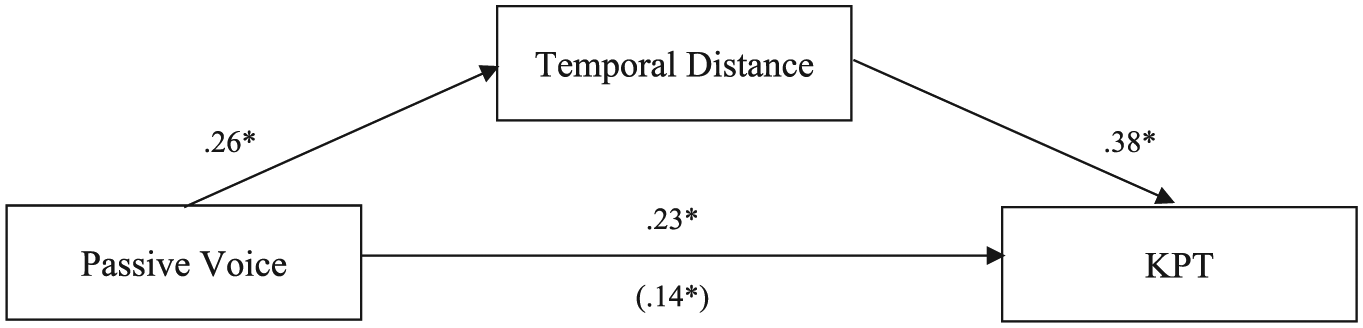
Study 1: Mediation model results.
Discussion
Study 1 provides the first indication that reading the passive voice invokes greater abstract thinking than the active voice because the passive voice fosters greater psychological distance—temporal distance in this specific case. Of particular interest is the KPT, which measures construal in the form of visual processing. Thus, a written passage can shape visual cognition, providing evidence that the passive voice could influence information processing in unrelated domains.
Study 2: Australians and Hypothetical Distance
We sought to replicate our effect with four primary changes. First, we recruited Australians who tend to follow British spelling and grammatical rules primarily, but follow American rules in some aspects. For example, Australians spell colour with a “u” following British spelling, but they write “The class is happy” following American grammar (Macmillan Publishers, 2017). We wanted to test our proposed effects with Australian English in this study. We will later, in Study 3, recruit Britons directly. Second, participants read a different passage on a different topic (i.e., scientific in nature) to generalize the effect beyond trips to France. Third, we assessed a different psychological distance (hypotheticality or likelihood) to show robustness across different measures of distance. Fourth, we assessed construal level by employing a different, established instrument, again in the interest of robustness. We predicted that participants reading a scientific passage in the passive voice would feel that the activity (i.e., the scientific study described) would be less likely to occur (i.e., the scientific effect would be less certain), which would then lead them to score higher on abstraction.
Procedure
Consistent with Study 1, we recruited about 10% more than the 200 required to test an estimated effect size of .20 at the level of α = .05 and power = .80. We likewise recruited 230 participants; 11 had missing responses, resulting in a data set with 219 responses. The mean age in our sample was 19.33 years old (SD = 1.77 years old); there were 105 men and 114 women. Participants were undergraduates from a research-intensive university in Australia. They received course credit for their time.
Participants read a passage we adapted from published literature. The passage was the abstract to the “Macbeth Effect” by Zhong and Liljenquist (2006). We chose this because we felt that it would interest the students. We further felt the finding might seem far-fetched to those unfamiliar with the literature on embodied cognition, allowing us to assess as a dependent measure how likely students believed the effect to be, indeed, “real.” We merely changed the abstract to either the active or passive voice (see Appendix A in Supplementary Material). Participants read their respective abstract (in the active or passive voice) under the cover story that we were interested in understanding “how readers perceive scientific writing.” In line with the cover story, after reading the passage, participants indicated how “interesting” and “concise” the passage was in a manner similar to Study 1. We note that the passage used more vague terms such as “a threat to one’s moral purity can induce the need to cleanse oneself” (emphasis added) rather than “a threat to one’s moral purity induces . . . ,” which suggests some degree of certainty about the Macbeth effect. This was done to also ensure that the results presented did not appear absolutely certain, allowing for some degree of subjective (un)certainty in students’ assessments regarding their credence in the findings.
Then, participants completed the 25-item Behavioral Identification Form (BIF; Vallacher & Wegner, 1987), an established measure of abstraction. Last, as measures of hypothetical distance, all participants indicated how certain they were that “the Macbeth effect was real—that a threat to one’s moral purity can induce the need to cleanse oneself” (in the active voice version) or “that the need to cleanse oneself can be induced by a threat to one’s moral purity” (in the passive voice version). We matched the active or the passive voice in the question to the original condition. All participants responded on a 9-point scale (1 = very uncertain, 9 = very certain).
Results
Interest
On Interest, there was no difference between participants reading the passive voice (M = 6.77, SD = 1.71) and the active voice (M = 6.62, SD = 1.65), F(1, 217) = 0.43, p = .51, d = .09 (95% CI = [–.18, .36]).
Concision
On Concision, there was no difference between participants reading the passive voice (M = 6.99, SD = 1.46) and the active voice (M = 6.65, SD = 1.51), F(1, 217) = 2.82, p = .10, d = .23 (95% CI = [–.04, .49]).
Abstraction
Totaling the number of superordinate, abstract choices made by each participant on the BIF (out of 25), indicating greater Abstraction, those reading the passive voice scored higher (M = 16.26, SD = 3.58) than those reading the active voice (M = 14.27, SD = 4.41), F(1, 217) = 13.50, p < .001, d = .50 (95% CI = [.23, .77]).
Hypothetical distance
Participants reading the passive voice felt that the Macbeth effect was less certain (thus higher on Hypothetical Distance; M = 5.01, SD = 1.52) than those reading the active voice (M = 5.74, SD = 1.61), F(1, 217) = 11.96, p < .001, d = .47 (95% CI = [.20, .74]).
Mediation analysis
A mediation analysis using Model 4 (Preacher & Hayes, 2008) indicated that the indirect effect of the passive voice on Abstraction through Hypothetical Distance was estimated to lie between .03 and .18 (95% CI; 5,000 bootstrapped samples). Please see Figure 2.
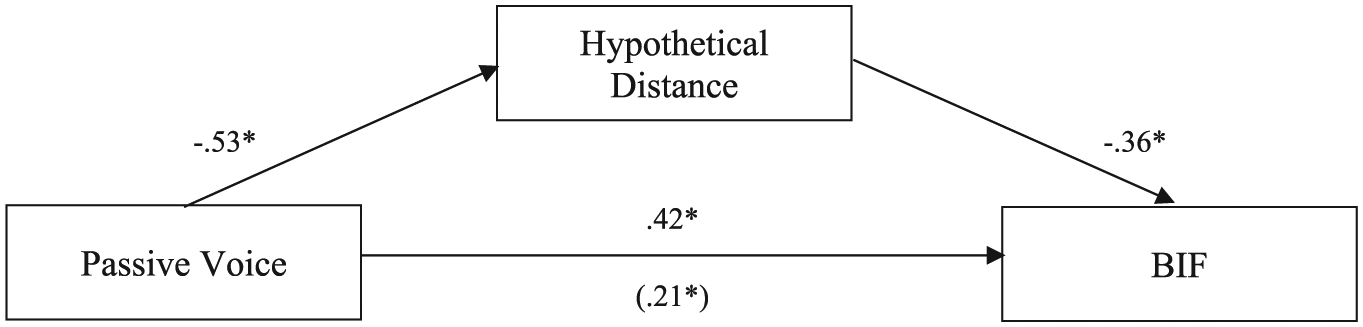
Study 2: Mediation model results.
Discussion
These results conceptually replicate Study 1 with a different sample, a different passage, a different psychological distance, and a different measure of construal. Thus, the passive voice increased hypothetical distance (i.e., reduced certainty of the effect) to then increase the level of mental construal.
Study 3: Britons and Spatial Distance
We sought to replicate our findings once more with another different sample, different passage of text, and a different psychological distance measure. We recruited Britons from the United Kingdom. We sought to see if reading a passage in the passive voice would lead Britons to feel that the activity described in the text would be farther away than reading a passage in the active voice in terms of spatial distance to then affect mental construal levels. We suspected that reading a passage about an event taking place in North Carolina in the passive voice would lead British readers to feel that North Carolina in the United States was farther away than reading a passage in the active voice, resulting in greater abstraction.
Procedure
We recruited 230 Britons from Prolific, following a priori sample size determinations from Studies 1 and 2. In the end, we excluded four participants (as they failed an attention check), which thus left us with a data set with 226 data points. The mean age was 35.88 years old (SD = 12.11 years old), and there were 150 men and 76 women. We conducted Study 3 in October 2018, 1 month after Hurricane Florence ravaged the United States’s Eastern Coast in September 2018. Participants received a small monetary compensation in return for their time.
Participants read a passage about Hurricane Florence; ostensibly the author and his or her family were living in North Carolina at the time of the natural disaster. In line with the pretense that we were interested in studying how “natural disasters affect people,” after reading the short passage (see Appendix A in Supplementary Material), participants indicated how “interesting” and “concise” the passage was in a manner similar to Studies 1 and 2. Participants then completed the BIF in a manner similar to Study 2. Then, they indicated how far away North Carolina felt (1 = very close by, 9 = very far away).
Results
Interest
On Interest, there was no difference between participants reading the passive voice (M = 5.56, SD = 2.09) and the active voice (M = 5.78, SD = 1.93), F(1, 224) = 0.73, p = .40, d = .11 (95% CI = [–.15, .38]).
Concision
On Concision, there was no difference between participants reading the passive voice (M = 6.12, SD = 1.78) and the active voice (M = 5.87, SD = 1.63), F(1, 224) = 1.31, p = .25, d = .15 (95% CI = [–.11, .41]).
Abstraction
Totaling the number of superordinate, abstract choices made by each participant on the BIF, indicating greater Abstraction, those reading the passive voice scored higher (M = 18.12, SD = 4.13) than those reading the active voice (M = 14.98, SD = 5.67), F(1, 224) = 24.18, p < .001, d = .66 (95% CI = [.39, .93]).
Spatial distance
Participants reading the passive voice felt that North Carolina was farther away (thus higher on Spatial Distance; M = 7.23, SD = 1.34) than those reading the active voice (M = 6.45, SD = 1.44), F(1, 217) = 19.07, p < .001, d = .58 (95% CI = [.32, .85]).
Mediation analysis
A mediation analysis using Model 4 (Preacher & Hayes, 2008) indicated that the indirect effect of the passive voice on Abstraction through Spatial Distance was estimated to lie between .04 and .13 (95% CI; 5,000 bootstrapped samples). Please see Figure 3.
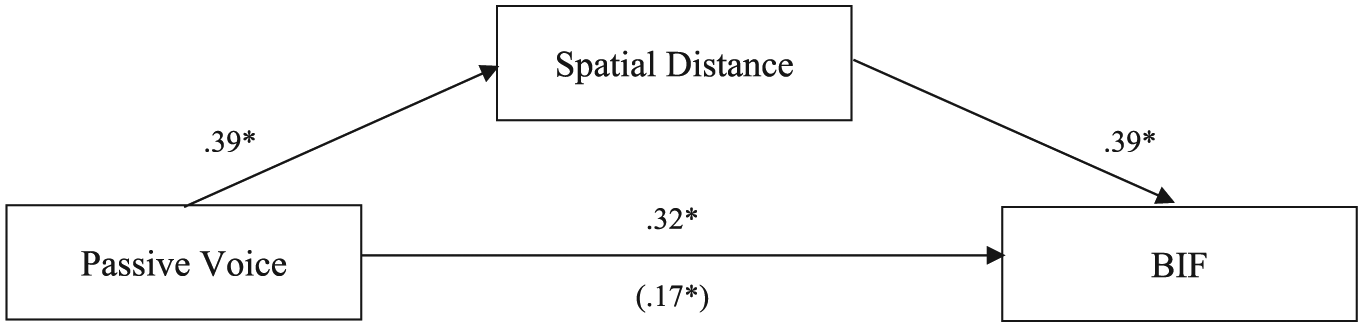
Study 3: Mediation model results.
Discussion
These results once again replicate our effect, this time with a British sample and using spatial distance as our measurement of psychological distance. The passive voice increased the felt psychological distance between the (British) reader and the (American) location described in the text (North Carolina), thus invoking a higher and more abstract level of mental construal. Thus, we have now provided converging support for our hypothesis from three countries (the United States, Australia, and the United Kingdom) using two construal measures (KPT, BIF) and three measures of psychological distance (temporal, hypothetical, and spatial).
Study 4: Americans and Different Paragraphs
Our next two studies had the primary purpose of demonstrating the robustness of our effect in different ways. In Study 4, we constructed five different paragraphs that were in either the active or the passive voice. In Studies 1 to 3, we used one paragraph (in either the active or the passive voice) in each study. Collectively, the results display evidence that the passive voice in general and not just in relation to a particular passage or event increases distance and abstraction. We wanted to provide further evidence for this in a single study with a single sample. Here, we posited that, regardless of the paragraph participants were reading, reading the passive voice can increase abstraction. We did not assess psychological distance here because the paragraphs speak toward different topics, such that one form of psychological distance might be relevant to one paragraph but not the other. But if the paragraphs all increase (different forms of) psychological distance, they should all converge on greater abstraction, which we measured once again using the BIF.
Furthermore, as Studies 1 to 3 provided evidence that concision did not account for the effect, we omitted measurement of this variable in this study; we retained interestingness, as the different paragraphs might reasonably vary in how interesting participants find them that could still influence construal. We also added a new item—ease of understanding—because we wanted to rule out this possible confound in explaining our effect (as fluency has been brought to bear on distance and construal; Alter & Oppenheimer, 2008).
Procedure
Using G*Power to determine our sample size, 259 participants were needed to test an effect size of f = .25 at the α = .05 and power = .80 levels, with df = 9 and 10 groups because this was a 5 (different paragraphs) × 2 (active, passive) between-participants design. Given the ease of collecting data on MTurk, we increased the sample size by about 50 more to 312 Americans from MTurk. In the end, we excluded five participants (as they failed an attention check), which left us with a data set with 307 data points. The mean age was 37.05 years old (SD = 12.64 years old) with 123 men and 183 women. They received a small monetary compensation in exchange for their time.
We presented participants with one of five different paragraphs (see Appendix B in Supplementary Material), in either the active or passive voice. Upon reading it, they indicated how “interesting” and “easy to understand” the passage was, both on 9-point scales. Then, they completed the 10-item short form of the BIF, which Labroo and Patrick (2009) developed to be affect-neutral, allowing us to rule out possible biasing effects of mood indirectly.
Results
Interest
We analyzed the data to see if there were differences in how interesting participants found their respective paragraphs. A 5 × 2 analysis of variance (ANOVA) revealed a significant difference in Interest across the five paragraphs, F(4, 297) = 7.70, p < .001, d = .32 (95% CI = [.09, .54]), which was not surprising given that the different events depicted would result in different levels of interest. In a departure from Studies 1 to 3, participants reading the active voice found the paragraphs more interesting (M = 5.74, SD = 2.39) than those reading the passive voice (M = 5.29, SD = 2.44), F(1, 297) = 5.81, p = .02, d = .27 (95% CI = [.05, .51]). There was no interaction crossing the two factors, F(4, 297) = 2.13, p = .08, d = .16 (95% CI = [–.05, .39]).
Easy to understand
We analyzed the data to see if there were differences in how easy it was for participants to understand their respective paragraphs. A 5 × 2 ANOVA revealed a significant difference in Easiness across the five paragraphs, F(4, 297) = 39.63, p < .001, d = .72 (95% CI = [.49, .96]), which is not surprising given that the different events depicted would result in different perceptions of ease of understanding. Furthermore, participants reading the active voice found the paragraphs easier to understand (M = 6.81, SD = 2.51) than those reading the passive voice (M = 6.24, SD = 2.39), F(1, 297) = 8.42, p = .004, d = .33 (95% CI = [.10, .56]), in line with findings from the literature on evaluation of active versus passive voice (Platow & Brodie, 1999). There was no interaction crossing the two factors, F(4, 297) = 1.14, p = .33, d = .12 (95% CI = [–.10, .35]).
Abstraction
A 5 × 2 ANOVA on the BIF scores (maximum score of 10) revealed that participants reading the passive voice scored higher (M = 5.16, SD = 1.46) than those reading the active voice (M = 4.73, SD = 1.31), F(1, 297) = 5.75, p = .02, d = .27 (95% CI = [.04, .50]). The different passages did not produce a main effect on Abstraction, F(4, 297) = 0.42, p = .79, d = .07 (95% CI = [–.15, .30]), and there was no interaction crossing the two factors, F(4, 297) = 2.00, p = .10, d = .16 (95% CI = [–.06, .39]). Please see Figure 4.
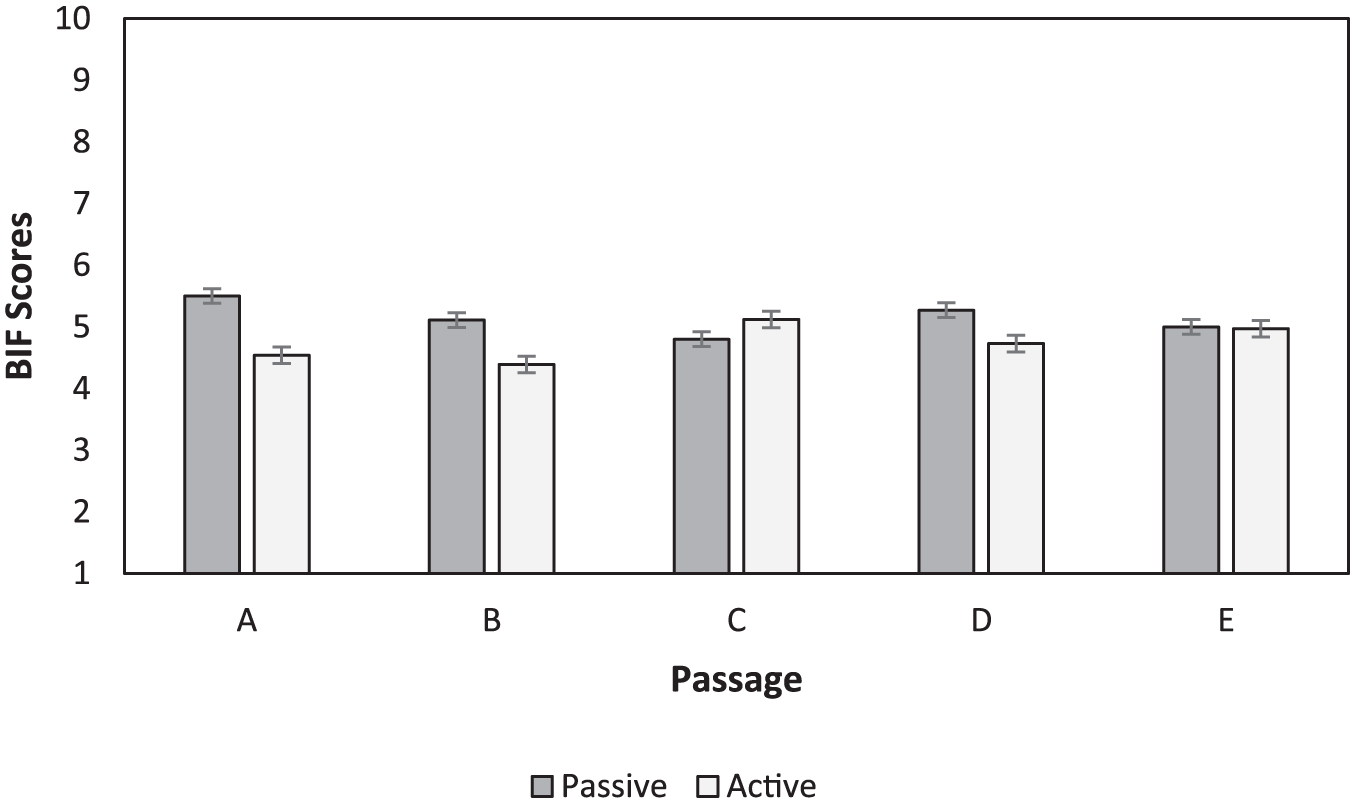
Study 4: Results on the abridged BIF.
Given that we found main effects of the active and passive voices on both Interest and Ease of Understanding, we included the two variables as controls in a 5 × 2 analysis of covariance (ANCOVA). The main effect of voice remained significant, F(1, 295) = 5.87, p = .02, d = .27 (95% CI = [.05, .51]). The main effect of Interest was not significant, F(1, 295) = 0.21, p = .64, d = .05 (95% CI = [–.17, .28]), nor was the main effect of Ease of Understanding, F(1, 295) < 0.001, p = .99, d = .003 (95% CI = [–.22, .23]). There was still no main effect of passage, F(4, 295) = 0.42, p = .79, d = .07 (95% CI = [–.15, .30]), and the interaction was also still not significant, F(4, 295) = 1.91, p = .11, d = .15 (95% CI = [–.06, .38]). This confirms the robustness of our key results.
Discussion
Conceptually replicating the aggregate findings from Studies 1 to 3, Study 4 demonstrates that reading different passages in the passive voice can lead to greater abstraction. Studies 1 to 3 each used a different paragraph, but Study 4 tested this possibility in a single study while also providing evidence against alternative accounts based on interestingness and ease of understanding. Thus, Study 4 provides evidence for the robustness of our proposed effects. The next study aims to test for robustness in a different manner.
Study 5: Canadians and Paragraphs Versus Sentences
In Studies 1 to 4, we presented participants with passages, albeit short and not full-length essays. This leads to the question as to the minimum criteria for our posited effect to arise, perhaps—but as yet untested—with even just one single sentence. If reading a single sentence can have a similar effect on readers’ levels of mental construal, then this would offer strong evidence that the passive voice, however brief, might change readers’ way of thinking. Thus, we focused on abstraction here, not on psychological distance, again because the paragraphs and sentences we offered to participants in Study 5 differed and thus did not all lend themselves to estimates of one particular form of psychological distance. We also tested for abstraction using another measurement, namely, the Navon (1977) task, adding to our repertoire that has thus far used the KPT and the BIF. Finally, as Studies 1 to 4 provided evidence that interestingness and ease of understanding did not account for the effect on abstraction, we omitted measurement of these variables in Study 5.
Procedure
We recruited 107 undergraduates from a research-intensive Canadian university for this study. In the end, seven students did not complete the study in full; thus, we removed their data from analysis. This left us with a data set of 100 participants. The mean age was 19.60 years old (SD = 1.78 years old), and there were 40 men and 60 women. Our sample size was limited given the administrative setup of the university’s subject pool. A sensitivity analysis at the α = .05 and power = .80 levels with df = 3 and four groups, in a 2 (paragraph, sentence) × 2 (active, passive) between-participants design, indicated that the sample size could detect an effect size of f = .33. Students received course credit.
We presented half of the participants with a sentence that was in either the active or the passive voice, and the other half received a paragraph that was in either the active or the passive voice (see Appendix C in Supplementary Material).
Afterward, all participants completed the Navon (1977) task, which has been confirmed to be a reliable indicator of level of mental construal (Liberman & Förster, 2009; Trope & Liberman, 2010). In this task, participants see a large letter made of smaller ones (e.g., a large H can be made of smaller Es). In the original task, participants indicated whether a certain target letter was presented, with those thinking abstractly responding faster to indicate “yes” if the large letter was the target letter presented. Here, we simply asked all our students to indicate which letter (just one) they saw, either the larger one or the smaller one. In total, participants provided ratings of 11 such images. We summed up the number of large letters that participants indicated that they saw, with a higher score indicating greater abstraction.
Results
A 2 × 2 ANOVA on the Navon task scores (maximum score of 11) revealed that participants reading the passive voice scored higher on abstraction (M = 7.72, SD = 3.17) than those reading the active voice (M = 6.44, SD = 2.55), F(1, 96) = 4.79, p = .03, d = .43 (95% CI = [.04, .83]). There was no main effect of whether the passage was a paragraph or sentence (Mparagraph = 7.19, SD = 2.71 vs. Msentence = 6.98, SD = 3.14), F(1, 96) = 0.19, p = .65, d = .08 (95% CI = [–.31, .48]), and there was no interaction crossing the two factors, F(1, 96) = 1.16, p = .28, d = .21 (95% CI = [–.18, .62]). Figure 5 illustrates the results.
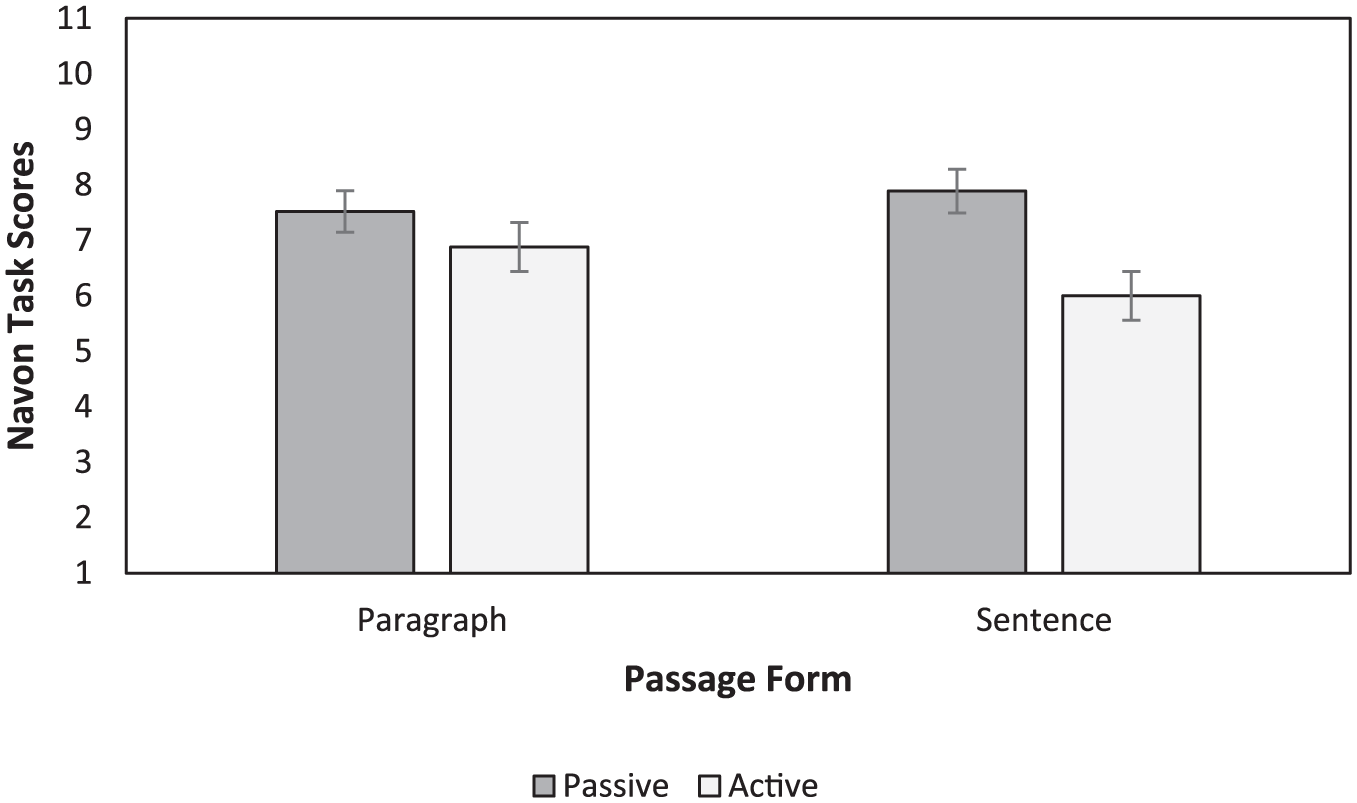
Study 5: Results on the Navon task.
Discussion
These results provide deeper evidence for our hypothesized relationship between the passive voice and construal level. Here, we show that the effect can arise even with just one sentence. Reading a single sentence in the passive voice could increase abstraction, as suggested by the higher scores on the Navon task, which complements our previous results documented using the KPT and the BIF.
General Discussion
Across five studies, we document a connection between the passive voice and greater felt psychological distance as well as a higher, more abstract level of mental construal. Specifically, reading a passage in the passive voice leads the reader to think in more global, superordinate, and abstract terms relative to reading a passage with identical content but in the active voice. This effect likely generalizes across different passages, operates independently of targeted alternative accounts, and emerges after reading both paragraphs and sentences. As evidence for bidirectionality in our hypothesized relationship, we report one further study in our Supplementary Material in which we find that authors thinking abstractly also tend to use more passive voice constructions in their writing compared with those thinking more concretely. To provide greater evidence on the factors that do (and do not) appear to account for our hypothesized relationship, we report a second study in our Supplementary Material that provides evidence that the passive voice is perceived as more objective relative to the active voice but that voice does not differ in perceived oddness, precision, or vagueness (the latter two items chosen as ostensible markers of abstractness of the text itself). All these findings are consistent with the passive voice, likely due to its greater objectivity, demarcating greater psychological distance, not only among elements of prose (i.e., between the semantic subject and the activity described) but separating the author and, also, the reader from the activity described.
While our measures of psychological distance (Studies 1-3) pertained to the content of the passages used to operationalize active versus passive voice, our measures of construal—in those studies as well as those that did not measure distance—were ostensibly unrelated to the tasks participants had performed previously. Thus, prose presented in different voices—active or passive—can influence how readers think about other stimuli beyond what is stated in the written text. This diversifies the existing findings in Construal Level Theory that primarily manipulate distance as related to the construal-dependent judgment or activate a concrete or an abstract construal by buttressing the nascent idea that activation of a sense of distance spills over onto unrelated judgments (Liberman & Förster, 2009; P. K. Smith & Trope, 2006). While the present findings join earlier investigations in documenting carryover effects of construal as assessed both conceptually and perceptually, they remain admittedly upstream relative to the established power of frames of mind to color downstream judgments (Xu & Wyer, 2008). Instead, it is quite likely that reading a passage in the passive (vs. the active) voice might affect broader decisions, choices, and actions. For instance, abstraction-via-passive voice could lead to a decision to buy a product with positive central rather than secondary attributes (Trope & Liberman, 2000, 2010) consistent with other findings on construal evoked via linguistic cues (Maglio et al., 2014).
If so, then our findings may have important consequences in any context filled with language—which is to say, almost every context. Consider our Study 2, in which Australians reading the passive voice version of the abstract of the “Macbeth effect” article were more uncertain about the effect. Although authors may adopt the passive voice in the interest of communicating scientific information in an unbiased manner, using the passive voice may have the unintended consequence of reducing belief in the veracity of a scientific finding, problematic to reviewers and lay audiences alike. This could be especially concerning for warnings issued by governments for public health. Consider the phrase “You should put on sunscreen because by doing so, your chances of skin cancer will be reduced by 62%.” This framing in the passive voice may lead the public to question the veracity of this statistic, making one less likely to heed to the warning, compared with the same statement conveyed in the active voice.
Although our hypothesis development, in the interest of focusing on a relatively downstream effect on construal, conceptualized the different psychological distances as equally indicative of greater objectivity and reduced emotional intensity, this does not preclude the possibility that the passive voice first impacts one dimension of distance before spreading to others (Bar-Anan, Liberman, Trope, & Algom, 2007). As an example, the “Introduction” section noted that the passive voice can obfuscate the relationship between the semantic subject and the action, and can even go so far as to leave fully ambiguous who the acting agent is (“Mistakes were made”). Should such uncertainty as to the relations or to the actor create a sense of hypothetical distance or feeling removed from the actor or whether the events occurred in the first place (Wakslak, Trope, Liberman, & Alony, 2006), this initial sense of distance in hypotheticality could become responsible, at least in part, for the effects documented on other forms of psychological distance. Because the mind so closely links the different psychological distances, it is a challenge to differentiate whether they operate in parallel or in sequence. Rather than conflicting with Construal Level Theory, which posits only an interrelation among the distances, a path model like this would complement recent research on politeness. Stephan et al. (2010) developed the conceptual model that politeness first creates social distance before subsequently impacting other forms and then impacting greater abstraction. Whether the passive voice might warrant a similar sequence of distancing (see also Chan & Maglio, 2019) awaits future consideration.
Construal Level Theory also posits not just an interrelationship between the various psychological distances but also the bidirectionality between distance and construal. Although distance influences construal, an abundance of research has shown that mental construal levels can also influence felt distance. This leads to the question of whether the passive voice might, at first, influence abstraction in a manner that then influences psychological distance. We adopted a data-driven approach to answer this question, rerunning the bootstrapped mediation analyses from Studies 1 to 3 but with construal as the potential mediator and distance as the dependent variable. The results of these analyses told a less consistent story (see Supplementary Material)—with some of the mediation analyses being significant, others not. While this pattern of results is consistent with the hypothesis development articulated in the “Introduction” section (in which the passive voice first evokes distance, which in turn increases abstraction), we note that any such mediation test remains limited in the conclusions that can be drawn from it (Fiedler, Harris, & Schott, 2018), meaning that other mechanisms—especially in Studies 4 and 5, in which distance was not assessed—might play a role. Given the brevity of our passages and of our studies generally, it is possible there are other mediators and moderators for our basic effect, which we cannot uncover currently with our existing stimuli and data.
By way of other limits on generality, in all passages in the passive voice, we indicated the semantic subject (which is the grammatical object in the passage construction) to make it comparable with the active voice where the semantic subject is always indicated (e.g., “Mistakes were made by X” compared with “X made the mistakes”). It could be that truncated passives, which do not indicate the semantic subject (“Mistakes were made”), would first lead to an abstract thinking because the obscurity of the actor introduces vagueness vis-à-vis abstraction, to then generate effects on different forms of psychological distance. To lend greater nuance, even in the passive voice, passages can be in the simple past, past progressive, present perfect, or any number of tenses that could all serve to moderate the effects that we have found.
Moreover, we have only focused on English. While the passive voice is possible in many other languages, it is not in others. For example, in Chinese, the passive voice is impossible, with the closest approximation introducing “allowance” (e.g., “I was hit in the face by you” in English can only be translated to Chinese, literally, as “I allowed you to hit me in the face”). We do not contend, as might the strong form of the Sapir-Whorf hypothesis, that speakers of languages lacking the passive voice are precluded from estimating the content of text to lie at a great psychological distance or from thinking abstractly. Indeed, other aspects of languages or even cultures without the passive voice could potentially influence mental construal levels (Au, 1983; Im Shin & Kim, 2017; Maglio et al., 2014; Rabaglia et al., 2016; Stephan et al., 2010). Indeed, language is only one aspect of a society that can shape thinking. For example, viewing the self interdependently—a noted characteristic of Eastern (e.g., Chinese) culture—situates targets of consideration closer in psychological space, resulting in more concrete ways of thought (Spassova & Lee, 2013). Accordingly, further work is needed to better understand how different linguistic forms and devices and also different languages may influence how people think and process information.
Although both the active and passive voices are common, an understanding of their psychological consequences has remained largely absent. Our work advances knowledge in this area. Some research has examined the concreteness of linguistic devices on construals (Hansen & Wänke, 2010), but we are the first to link the active and passive voices to psychological distance and, in turn, to level of construal. We provide a starting basis from which to understand how the way we write could influence how individuals think beyond what is stated by the written word. There are many questions that our results produce and many questions still to ask, so we hope that there will be more work to explore the influence of writing and language on information processing.
Supplemental Material
Chan_OnlineAppendix – Supplemental material for The Voice of Cognition: Active and Passive Voice Influence Distance and Construal
Supplemental material, Chan_OnlineAppendix for The Voice of Cognition: Active and Passive Voice Influence Distance and Construal by Eugene Y. Chan and Sam J. Maglio in Personality and Social Psychology Bulletin
Footnotes
Declaration of Conflicting Interests
The author(s) declared no potential conflicts of interest with respect to the research, authorship, and/or publication of this article.
Funding
The author(s) received no financial support for the research, authorship, and/or publication of this article.

Supplemental Material
Supplemental material is available online with this article.
References
Supplementary Material
Please find the following supplemental material available below.
For Open Access articles published under a Creative Commons License, all supplemental material carries the same license as the article it is associated with.
For non-Open Access articles published, all supplemental material carries a non-exclusive license, and permission requests for re-use of supplemental material or any part of supplemental material shall be sent directly to the copyright owner as specified in the copyright notice associated with the article.
