




Abstract
The question of how we decide that someone else has done something wrong is at the heart of moral psychology. Little work has been done to investigate whether people believe that others’ moral judgment differs from their own in moral dilemmas. We conducted four experiments using various measures and diverse samples to demonstrate the self–other discrepancy in moral judgment. We found that (a) people were more deontological when they made moral judgments themselves than when they judged a stranger (Studies 1-4) and (b) a protected values (PVs) account outperformed an emotion account and a construal-level theory account in explaining this self–other discrepancy (Studies 3 and 4). We argued that the self–other discrepancy in moral judgment may serve as a protective mechanism co-evolving alongside the social exchange mechanism and may contribute to better understanding the obstacles preventing people from cooperation.
Introduction
In “The Adventure of the Abbey Grange,” Sherlock Holmes says to Captain Croker, the murderer: I am not sure that in defense of your own life your action will not be pronounced legitimate. However, that is for a British jury to decide. Meanwhile I have so much sympathy for you that if you choose to disappear in the next twenty-four hours I will promise you that no one will hinder you. (Doyle, 1905, p. 20)
In this story, Captain Croker commits a murder. Holmes, however, is willing to admit that Captain Croker “acted under the most extreme provocation to which any man could be subjected.” Meanwhile, Holmes thinks other people (e.g., juries) might make a different judgment (i.e., the juries’ judgment would be based solely on the consequence of Captain Croker’s action). Therefore, Holmes withholds his clues from Inspector Stanley Hopkins. This story gives us a hint that there may be a self–other discrepancy in moral judgment.
There is a long history of self–other discrepancies in social psychology. Self–other discrepancies are quite general, appearing not only in beliefs about abstract traits and abilities but also in predictions of specific behavior (Epley & Dunning, 2000). For example, previous studies have consistently reported the better-than-average effect, wherein people see themselves as more ethical, more competent, and more intelligent than others (Alicke, Klotz, Breitenbecher, Yurak, & Vredenburg, 1995; Epley & Dunning, 2000; Klein & Epley, 2016), and the bias blind spot, where people tend to see bias in others while being blind to it in themselves (Pronin & Kugler, 2007). A widely accepted account of these self–other discrepancies is that people tend to perceive themselves via introspective information and others via observable information (Pronin, 2008). Often, these differences produce disagreement and conflict (Pronin, 2008). The conflict induced by self–other discrepancy might be stronger in the domain of moral psychology, given that the question of how we decide that someone else has done something wrong is at the heart of moral psychology (Greene & Haidt, 2002). As noted by Pronin (2008), people tend to evaluate their own decision via “introspection” (looking inwards to thoughts, feelings, and intentions) and others’ decision via “extrospection” (looking outwards to observable behavior). In this sense, people may favor moral reasoning based on reasons for the decision (feelings and intentions) when making moral judgment themselves, whereas favor moral reasoning based on decision consequences when surmising others’ moral judgment.
Existing empirical studies examining self–other discrepancies in moral judgment are mostly related to evaluating moral or immoral behaviors (Allison, Messick, & Goethals, 1989; Epley & Dunning, 2000; Klein & Epley, 2016; Tasimi & Johnson, 2015). For example, Epley and Dunning (2000) found that people believe they are more likely to engage in selfless, kind, and generous behaviors than their peers. Klein and Epley (2016) found that when considering relatively immoral actions participants consistently believed they would behave more ethically than others.
In contrast to moral or immoral behavior being positive or negative itself, people must weigh negative actions against positive consequences to make judgments in moral dilemmas (Guglielmo, 2015). In this sense, examining the self–other discrepancy in moral dilemmas is particularly interesting, as the use of moral dilemmas has much to contribute to our understanding of moral decision-making (Bartels, Bauman, Cushman, Pizarro, & McGraw, 2015). Despite quite a few experiments documenting the self–other discrepancy in moral judgment with respect to moral and immoral behaviors, remarkably few studies have investigated the self–other discrepancy when considering moral dilemmas. Moral dilemmas are widely used in the study of moral judgment to explore the moral trade-offs between individual rights and the greater good (Aguilar, Brussino, & Fernández-Dols, 2013; Amit & Greene, 2012; Baron & Ritov, 2009; Bartels, 2008; Bartels & Medin, 2007; Conway & Gawronski, 2013; Greene et al., 2009; Greene, Sommerville, Nystrom, Darley, & Cohen, 2001; Kahane, Everett, Earp, Farias, & Savulescu, 2015; Ritov & Baron, 1999). When faced with moral dilemmas, we can, on one hand, reject an action that violates moral rules, despite the goodness of the outcome (Baron & Ritov, 2009; Bartels et al., 2015; Greene, 2007a). On the other hand, we can opt for the best outcome, the one that maximizes the total amount of well-being, regardless of other features of the action or the context in which it is undertaken (Baron & Ritov, 2009; Bartels et al., 2015; Greene, 2007a). The former view that the qualities of an action outweigh the outcome is called deontology, and the latter view that the moral status of an action (or inaction) should be determined solely based on the outcome it produces is called utilitarianism 1 (Amit & Greene, 2012; Baron & Ritov, 2009; Bartels et al., 2015; Greene, 2007b; Greene et al., 2001). In the Sherlock Holmes story mentioned above, Holmes’s default assumption is that juries would probably make a utilitarian judgment, that is, Captain Croker’s action would not be pronounced legitimate by juries, given the outcome that someone was murdered by Captain Croker. In contrast, Holmes himself made a deontological judgment, which did not solely take outcomes into consideration.
In the present study, we employed moral dilemmas to test our hypothesis. Specifically, we hypothesized that people tend to make more deontological moral judgments themselves than they surmise a stranger would make. The hypothesis had three rationales. The first follows from the construal-level theory (Liberman & Trope, 2014; Trope & Liberman, 2010). According to this theory, a low-level construal focuses on means (i.e., qualities of actions) and a high-level construal focuses on ends (i.e., consequences of actions) (Liberman & Trope, 2014; Trope & Liberman, 2010). In this sense, a low-level construal facilitates deontological judgments, whereas a high-level construal facilitates utilitarian judgments. Previous studies have shown that it is easier to associate self with low-level construal and others with high-level construal than to associate self with high-level construal and others with low-level construal (Bar-Anan, Liberman, & Trope, 2006) and that a third-person visual perspective elicits a higher level construal than a first-person visual perspective (Agerström, Björklund, & Carlsson, 2013; Libby, Shaeffer, & Eibach, 2009). Therefore, when responding to moral dilemmas themselves, people may represent the dilemmas as lower level construal and make more deontological judgments than when surmising a stranger’s response to the dilemmas.
The second rationale of our hypothesis follows from the dual-process theory of moral judgment (Greene, 2007b; Greene, Morelli, Lowenberg, Nystrom, & Cohen, 2008; Greene, Nystrom, Engell, Darley, & Cohen, 2004; Greene et al., 2001). This theory proposes that deontological judgments are driven by automatic emotional responses, whereas utilitarian judgments are driven by controlled cognitive processes (Greene, 2007b; Greene et al., 2008; Greene et al., 2001; McDonald, Defever, & Navarrete, 2017). Findings in decision making suggest that when people decide for themselves, their judgment is influenced by the emotions that have been aroused in the situation (Hsee & Weber, 1997; Loewenstein, Weber, Hsee, & Welch, 2001; Weber & Johnson, 2009). When they decide for another person, they may base their suggestions partially on their own feelings. However, people may have difficulty fully considering that the other person has feelings that are as strong as their own (Faro & Rottenstreich, 2006; Hsee & Weber, 1997; Van Boven, Dunning, & Loewenstein, 2000; Van Boven & Loewenstein, 2003; Weber & Johnson, 2009). Therefore, when they make moral judgments themselves, people may experience more emotional engagement, resulting in more deontological judgments, than when they are surmising what a stranger’s moral judgments would be.
The third rationale follows from the theory of protected values (PVs; Baron, 2017; Baron & Spranca, 1997). In some theories of rational decision making, values, including moral values, can be traded off (Baron, 2017; Baron & Spranca, 1997). However, previous studies suggest that people hold some values (i.e., PVs) that resist being traded off with other values, regardless of the consequences (Baron, 2003, 2017; Baron & Leshner, 2000; Baron & Ritov, 2009; Baron & Spranca, 1997; Ritov & Baron, 1999). PVs were thought of as a crucial constituent in a simple process-based approach to understanding morally motivated judgment and decision making (Bartels, 2007; Tanner, Medin, & Ilive, 2008). PVs derive from deontological rules (Baron, 2017; Baron & Spranca, 1997) and were taken as motivators of deontology (Bartels, 2007; Tanner et al., 2008). Thus, PVs facilitate deontological judgments. PVs scores were consistently found to be highly correlated with deontological orientation (but fairly independent of consequentialist orientation; Baron & Spranca, 1997; Bartels, 2008; Tanner et al., 2008). Five properties—quantity insensitivity, agent relativity, moral obligation, denial of trade-offs by wishful thinking, and anger—are the basic characteristics of PVs (Baron & Spranca, 1997). Among these properties, agent relativity is of interest because it emphasizes the participation of the decision maker (Baron & Spranca, 1997). Specifically, agent relativity means that PVs are rules for the person holding the values that apply to her own choices but not to her obligations with respect to others’ choices (Baron, 2003; Baron & Ritov, 2009; Baron & Spranca, 1997). Compared with the absence of a sense of participation, a sense of participation will lead to a greater concern with action, and PVs will arise, resulting in a more deontological moral judgment (Baron & Spranca, 1997; Ritov & Baron, 1999). Therefore, we speculated that when making moral judgments themselves, people would have a greater sense of participation and believe that they have more PVs, leading to more deontological judgments than when they were surmising a stranger’s judgments.
The theoretical origins of these three rationales are not exclusive. Therefore, the second aim of our study was to distinguish between these three rationales.
We conducted four studies to test our hypothesis. Studies 1 and 2 examined the self–other discrepancy in moral judgment using different measures. Studies 3 and 4 replicated the findings of the self–other discrepancy in moral judgment and examined which of the aforementioned rationales could account for the effect of self–other condition on moral judgment.
Study 1
For our first test of the hypothesis, we used a direct method: We asked participants to make a moral judgment themselves and to surmise a stranger’s judgment at the same time. Following Ritov and Baron (1999) and Conway and Gawronski (2013; see also Gawronski, Armstrong, Conway, Friesdorf, & Hütter, 2017), moral judgments were measured by whether or not a described action was chosen to be performed. We hypothesized that people would make more utilitarian judgments when they surmised a stranger’s judgments than when they made judgments themselves.
Method
Participants
Using G*Power 3.1 (Faul, Erdfelder, Buchner, & Lang, 2009), we calculated a sample size of 90 for a small-to-medium effect size of Cohen’s d = 0.3, a significance level of α = .05, and a power of 0.8 (within-subject design, two-tailed). However, we sought to recruit as large a sample as we could to maximize the statistical power.
One hundred twenty-two participants (75 female and 47 male) were recruited through the university psychological research pool and completed the study online. One hundred six participants were graduate and undergraduate students, while 16 participants were nonstudents. The mean age of the participants was 23.92 ± 4.23. Informed consent was obtained from each participant online. The study was approved by the Institutional Review Board of the Institute of Psychology, the Chinese Academy of Sciences.
Materials
Eight moral dilemmas adopted from Gawronski et al. (2017) and Ritov and Baron (1999) were used: the Immune Deficiency dilemma, the Variant of Immune Deficiency dilemma, the Starvation dilemma, the Medical Assistance dilemma, the Accidents dilemma, the Orphan Asylum dilemma, the Government Support dilemma, and the Civil Rights dilemma (see the supplemental material for details). These dilemmas are considered to have better external validity than sacrificial dilemmas (e.g., the Trolley dilemma), given that they are presented in ways that are more consistent with the way people might face those trade-offs in the real world (Bauman, Mcgraw, Bartels, & Warren, 2014). In most dilemmas, the utilitarian response is the affirmative (“Yes”) response, while in one dilemma (the Variant of Immune Deficiency dilemma), the utilitarian response is the negative response (“No”).
In each item, the participants were presented with a dilemma and then asked to respond to two questions. For example:
Immune deficiency
A foreign student who is volunteering in a developing country got infected with a rare virus. The virus is highly contagious and deadly to seniors and children. The only medication that can effectively stop the virus from spreading has severe side-effects. Although the virus will not kill her, the student suffers from a chronic immune deficiency that will make her die from these side-effects.
Would you give the student the medication?
Do you believe that a stranger 2 would give the student the medication?
Procedure
The experimental design was within-subject. In each item, participants were asked to make a moral judgment themselves (the self condition) and surmise a stranger’s moral judgment (the other condition) at the same time. The order of the eight items and the order of the two questions were random.
Results
Moral judgments were analyzed with mixed-effects binary logistic regression models using the lme4 and lmerTest packages in the R statistical environment (Bates, Mächler, Bolker, & Walker, 2015; Kuznetsova, Brockhoff, & Christensen, 2017). The deontological judgment was coded as 0, and the utilitarian judgment was coded as 1. In our model, the judgment was predicted from the self–other condition (self = 0 vs. other = 1), a fixed factor, with dilemma and participant as random factors. By treating dilemma and participant as random factors, we can generalize our findings beyond the specific dilemmas and participants in the present study (Baayen, Davidson, & Bates, 2008; Judd, Westfall, & Kenny, 2012). Because in our experimental design all the participants and dilemmas were crossed with condition, the model included random intercepts and random slopes for both the dilemmas and the participants.
The results revealed a significant effect of condition, b = 0.43, SE = 0.10, 95% confidence interval (CI) = [0.22, 0.64]; Z = 4.12; p < .001; and the odds ratio was 1.42 (95% CI [1.19, 1.70]). In line with our hypothesis, this result suggested that people believe that a stranger would be more utilitarian than themselves (see Figure 1).

The percentages of utilitarian response in each dilemma in Study 1.
Study 2
In Study 2, we made two major changes. First, we measured the moral judgment by providing a range of trade-off values rather than a single yes/no question to the participants, so that the level of deontology–utilitarianism could be measured more thoroughly. This paradigm was derived from Bartels and Medin (2007) and Connolly and Jochen (2003) and is described in detail below. Second, we investigated participants whose occupations were related to judging other people’s morality-related behaviors (e.g., police officers and lawyers). For one thing, people whose occupations were related to law were typical individuals who play an important role in judging other people’s moral-related behaviors. For another, the dilemmas might be closely related to those people’s daily life. Investigating people whose occupations were related to law can reduce concerns about generalizability and the practical implications of the findings in that the effect might be manifested only in the laboratory but not in the real world.
We hypothesized that people would be more deontological when they made moral judgments themselves than when they surmised what a stranger might do.
Method
Participants
Using G*Power 3.1 (Faul et al., 2009), we calculated a sample size of 102 for a medium effect size of Cohen’s d = 0.5, a significance level of α = .05, and a power of 0.8 (one-tailed, between-subject design). We sought to recruit as large a sample as we could to maximize the statistical power. However, due to the difficulty of recruiting participants whose occupations were related to law, the final sample consisted of 80 participants. These participants were recruited from three different organizations: a local procuratorate, a police force, and a legal aid organization. The mean age was 38.96 ± 8.42, with an average work experience of 16.54 ± 8.97 years. Because these occupations tend to be male-dominated, the majority of the participants were male (14 female, 65 male, and one missing). Each participant was randomly assigned to one condition, resulting in 42 participants in the self condition and 38 participants in the other condition.
Materials
Six dilemmas selected from Study 1 were used. These dilemmas were the Starvation dilemma, the Medical Assistance dilemma, the Accidents dilemma, the Orphan Asylum dilemma, the Government Support dilemma, and the Civil Rights dilemma.
In each item, the participants were presented with a dilemma and then asked to respond to five hypothetical questions with increasingly harmful consequences. For example:
Starvation
A convoy of food trucks is on its way to a refugee camp during a famine in Africa. (Airplanes cannot be used.) You find that a second camp has even more refugees. If you tell the convoy to go to the second camp instead of the first, you will save 1,000 people from death, but some people in the first camp will die as a result.
Would you tell the convoy to go to the second camp if 100 people in the first camp will die as a result? Yes/No. Would you tell the convoy to go to the second camp if 300 people in the first camp will die as a result? Yes/No. Would you tell the convoy to go to the second camp if 500 people in the first camp will die as a result? Yes/No. Would you tell the convoy to go to the second camp if 700 people in the first camp will die as a result? Yes/No. Would you tell the convoy to go to the second camp if 900 people in the first camp will die as a result? Yes/No.
Procedure
The experimental design was between-subject. Each participant was asked either to respond personally to the dilemmas (the self condition) or to surmise how a stranger would respond to the dilemmas (the other condition).
Results
We calculated the ratio between the highest level of harm caused by the action that each participant approved for each dilemma and the outcome without any intervention as a utilitarian index. If a participant did not choose any “Yes” answers, the index equaled 0; if a participant chose all “Yes” answers, the index was .90. A higher value of this index indicates a more utilitarian moral judgment.
We used a mixed model to analyze the data (Judd et al., 2012; Judd, Westfall, & Kenny, 2017) using the lme4 and lmerTest packages in the R statistical environment (Bates et al., 2015; Kuznetsova et al., 2017). In this model, the utilitarian index was predicted from the self–other condition (self = 0 vs. other = 1), a fixed factor, with dilemma and participant as random factors. Due to the experimental design, in which dilemmas were crossed with condition and participants were nested under condition, the model included random intercepts for the participants and both random intercepts and random slopes for the dilemmas.
The results revealed a significant effect of condition, b = 0.14, SE = 0.05, 95% CI [0.04, 0.24]; t = 2.70; p = .008; and Cohen’s d = 0.44, 3 suggesting that the utilitarian index in the other condition was higher than that in the self condition, after controlling for random variances from participants and dilemmas (see Figure 2).

Mean utilitarian indexes in each condition in Studies 2 to 4.
Study 3
Studies 1 and 2 consistently showed that people were more deontological when they made moral judgments themselves than when they surmised what a stranger would do. In Study 3, we attempted to explore the psychological mechanism underlying the self–other discrepancy in moral judgment.
We considered three possible accounts for this effect. First, based on the construal-level theory, people focus more on means than ends in the self condition than in the other condition, leading to more deontological moral judgments (Aguilar et al., 2013; Bar-Anan et al., 2006; Libby et al., 2009). Second, people tend to have more salient emotional responses to the dilemmas in the self condition than in the other condition, leading to more deontological moral judgments (Greene et al., 2001; Loewenstein et al., 2001; Van Boven et al., 2000). Finally, people believe that they have more PVs than other people, leading to a more deontological judgment (Baron & Spranca, 1997). To examine which account could explain the self–other discrepancy in moral judgment, we conducted Study 3 by testing the mediating roles of the three candidate accounts in the relationship between the self–other condition and the moral judgment.
Method
Participants
Fritz and Mackinnon (2007) provided a method for determining the sample size required for adequate power to detect a mediation effect. According to Fritz and Mackinnon’s estimates, for a percentile bootstrap test with a medium effect size, at least 78 participants are necessary to achieve a statistical power of .80. A total of 124 (73 female and 51 male) participants were recruited online from Beijing Normal University in China. The mean age of the participants was 21.72 ± 2.73. Written informed consent was obtained from each participant.
Materials
We employed the same materials for manipulating the self–other condition and measuring moral judgment as in Study 2. In addition, we added measures for PVs, emotion, and construal level.
The measurement of PVs was modified from Ritov and Baron (1999). PVs were measured by asking the participants what they thought about the acceptability of trade-offs for the values associated with the dilemmas presented earlier in the self condition or by asking the participants to surmise what a stranger would think about the trade-off in the other condition. The participants chose one response from among three options: option A, “do not object to this”; option B, “this is acceptable if it leads to some sort of benefits that are great enough”; and option C, “this is not acceptable no matter how great the benefits.” If the participant chose option C (not acceptable), the participant was counted as having a PV for the value at issue.
Six emotions (i.e., disgust, anger, contempt, guilt, shame, and empathy) that have been viewed as playing a fundamental role in morality (Eisenberg, 2000; Moll & Schulkin, 2009; Russell, Piazza, & Giner-Sorolla, 2013) were measured for each item. The participants were asked to indicate to what extent they felt that way at that moment on a 5-point scale (1 = very slightly or not at all, 5 = extremely). The instructions were the same in the self and other conditions.
The construal level was measured using the Behavioral Identification Form (BIF; also called the Personal Agency Questionnaire) (Libby et al., 2009; Liberman & Trope, 1998; Liviatan, Trope, & Liberman, 2008; Vallacher & Wegner, 1989) after the participants responded to all six moral judgment items. The BIF is a questionnaire presenting 25 activities (e.g., “reading”), each followed by two restatements, one describing the activity in terms of its means (low-level, for example, “following lines of print”) and one describing it in terms of its ends (high-level, for example, “gaining knowledge”). The participants were asked to choose the restatement that best described the activity according to their own preference in the self condition or to choose the restatement that best described the activity according to their surmise about a stranger’s preference in the other condition. For all 25 activities in the BIF, the high-level identifications were coded as 1 and the low-level identifications were coded as 0.
Procedure
The experimental design was within-subject. The participants were asked to complete the questionnaires in both the self and other conditions, with an interval of about 1 week between the questionnaires. The order of the conditions was counterbalanced across the participants. Half of the participants made moral judgments in the self condition first and the other half did so in the other condition first.
Results
Self–other discrepancy analysis
To determine whether we had replicated the results of Study 2, we computed the utilitarian index as in Study 2 and used a mixed model to analyze the data (Judd et al., 2012, 2017). The utilitarian index was predicted from the self–other condition (self = 0 vs. other = 1), a fixed factor, with dilemma and participant as random factors. According to the experimental design, the model included random intercepts and random slopes for both the dilemmas and the participants.
The results revealed a significant effect of condition, b = 0.05, SE = 0.02, 95% CI [0.01, 0.09]; t = 2.57; p = .013; and Cohen’s d = 0.15. 4 This result suggested that the utilitarian index in the other condition was higher than that in the self condition after controlling for random variances from the participants and dilemmas (see Figure 2).
Mediation analysis
We averaged the utilitarian indexes, PVs scores, and emotion scores across the dilemmas in each condition to conduct the mediation analysis. BIF scores were summed in each condition for each participant, resulting in a possible range of 0 to 25 for the construal-level scores. Table 1 presents descriptive statistics of the variables.
Descriptive Statistics of Variables in Study 3.

Note. BIF = Behavioral Identification Form.
Using the MEMORE macro for SPSS (Montoya & Hayes, 2017), we estimated the indirect effect of the self–other condition on moral judgment. MEMORE was specifically developed for within-subject mediation analysis (Montoya & Hayes, 2017). Ninety-five percent CIs for the indirect effects (reported in brackets for each result below) were obtained using the percentile bootstrap method with 5,000 bootstrap samples. We conducted a single multiple mediation model in lieu of separate simple mediation models and conducted pairwise comparisons between specific indirect effects (Preacher & Hayes, 2008). We used the parallel multiple mediator model in MEMORE (Montoya & Hayes, 2017). The parallel mediation model allows (a) correlations between the mediators, (b) estimating the indirect effect of each mediator controlling for the effect of the other candidate mediators, and (c) comparing the indirect effects to each other (Montoya & Hayes, 2017).
Figure 3 shows the results of the parallel mediation analysis. The interpretation of these results was that, taken as a set, PVs, emotion, and construal level did mediate the effect of the self–other condition on moral judgment. The total and direct effects of the self–other condition on moral judgment were −.052, p = .009, and −.012, p = .583, respectively. The total indirect effect through the three mediators was −.040 [−.070, −.013].

Results of the parallel mediation analysis of PVs, the emotion, and the construal level in Study 3.
An examination of the specific indirect effects showed that the indirect effects of the self–other condition on moral judgment were a1b1 = −.028 [−.050, −.007] (through PVs), a2b2 = −.013 [−.034, .003] (through emotion), and a3b3 = .000 [−.005, .006] (through construal level). These results indicated that only PVs was a mediator, as its 95% CI did not contain zero. Neither emotion nor construal level contributed to the indirect effect above and beyond PVs. We can conclude that PVs is likely an important mediator.
An examination of the pairwise contrasts of the indirect effect showed that the specific indirect effect through PVs was larger than the specific indirect effect through construal level, with a 95% CI of −.053 to −.007. The specific indirect effects through PVs and emotion were not distinguished in terms of magnitude, with a 95% CI of −.042 to .014, despite the fact that the indirect effect through PVs was significantly different from zero and the indirect effect through emotion was not.
These results suggested that the self condition led to more deontological moral judgments than the other condition and that this effect was primarily mediated by having PVs that connected with the dilemmas.
Study 4
Study 3 showed that PVs provided a better account of the self−other discrepancy in moral judgment than the other explanations. That is, the self condition led to more PVs than the other condition, and the differences in the PVs caused different moral judgments.
Study 3 may have three limitations. First, the presentation order of the three mediators was not counterbalanced—PVs always came first, followed by emotion and, finally, the construal level. Second, the construal level might not have been measured properly. The construal level was measured after all six moral judgment items had been completed, whereas the application of PVs to the dilemmas and the emotions felt at the moment of judgment were measured for each item individually. In addition, asking participants to choose a restatement based on what a stranger might decide (in the implement of the BIF) in the other condition does not measure construal mind-set properly. Third, some researchers might argue that distancing oneself from the judgment would lead to lower levels of self-reported emotion, regardless of whether or not this emotion reflected anything about the judgment itself. To overcome these limitations, Study 4 improved on Study 3 in three respects. First, we counterbalanced the presentation order of the three mediators. Second, the construal level was measured for each item. In addition, we asked participants to complete the BIF by choosing the restatement that best described the activity according to their own preference in both the self and the other conditions. Third, we asked participants to surmise what a stranger making the judgment in the other condition was feeling at the time rather than what they personally were feeling at the time.
Method
Participants
As in Study 3, for a percentile bootstrap test with a medium effect size, a sample size of 78 was necessary to achieve a statistical power of .80 (Fritz & Mackinnon, 2007). We recruited 117 (53 male and 64 female) participants from Nankai University in China for this study. Twenty-four participants failed to pass an instructional attention check (see the following section for details). Data from these participants were excluded from the statistical analyses, leaving us with a final sample of 93 university students (42 male and 51 female; mean age = 21.17 ± 2.40). Written informed consent was obtained from each participant.
Materials and procedure
We used the same materials and procedure as in Study 3, except for the following modifications.
For measuring the construal level, we used two different measures. The first measure entailed asking participants to assess to what extent the action, relative to the dilemma they were encountering, could be described as how the action was done (means focus) and as why the action was done (ends focus). They responded on a 6-point scale (1 = not at all, 6 = completely). The second measure involved dividing the 25 activities in the BIF into six groups (five groups containing four activities and one group containing five activities). Each group of the BIF was assigned to one of the six items randomly. Participants were asked to choose the restatement that best described the activity according to their own preference in both the self and the other conditions.
For measuring emotion, participants were asked to surmise the stranger’s feelings in the other condition and to report their own feelings in the self condition.
The presentation order of the three mediators was counterbalanced, and the items were presented in a random order.
Upon completion of the measures of moral judgment and mediators, participants were presented with a one-item instructional attention check to ensure that they had thoroughly read the behavioral descriptions (Gawronski et al., 2017). The attention check included the following instructions: Most modern theories of decision making recognize the fact that decisions do not take place in a vacuum. Individual preferences and knowledge, along with situational variables, can greatly impact the decision process. To facilitate our research on decision making, we are interested in knowing certain factors about you, the decision maker. Specifically, we are interested in whether you actually take the time to read the directions; if not, then some of our questionnaires that require you to understand the instructions will be filled out inaccurately. So, to demonstrate you have read the instructions, please answer “very bad” on the mood item below. Thank you very much.
Below the instructions, participants were presented with the question What is your current mood? and the response options: (a) very bad, (b) bad, (c) poor, (d) neither good nor bad, (e) fair, (f) good, and (g) very good. By default, all participants who did not follow the instruction to respond very bad on this item were excluded.
Results
Self–other discrepancy analysis
Similar to Study 3, a mixed model analysis revealed a significant effect of condition, b = 0.07, SE = 0.02, 95% CI [0.03, 0.11]; t = 3.12; p = .003; and Cohen’s d = 0.15 (see Figure 2).
Mediation analysis
We computed PVs scores, emotion scores, and BIF scores as in Study 3. The means-focus scores and ends-focus scores were averaged across the dilemmas separately for each condition. Table 2 presents descriptive statistics of the variables. We used the MEMORE macro for SPSS (Montoya & Hayes, 2017) to conduct the parallel mediation model.
Descriptive Statistics of Variables in Study 4.
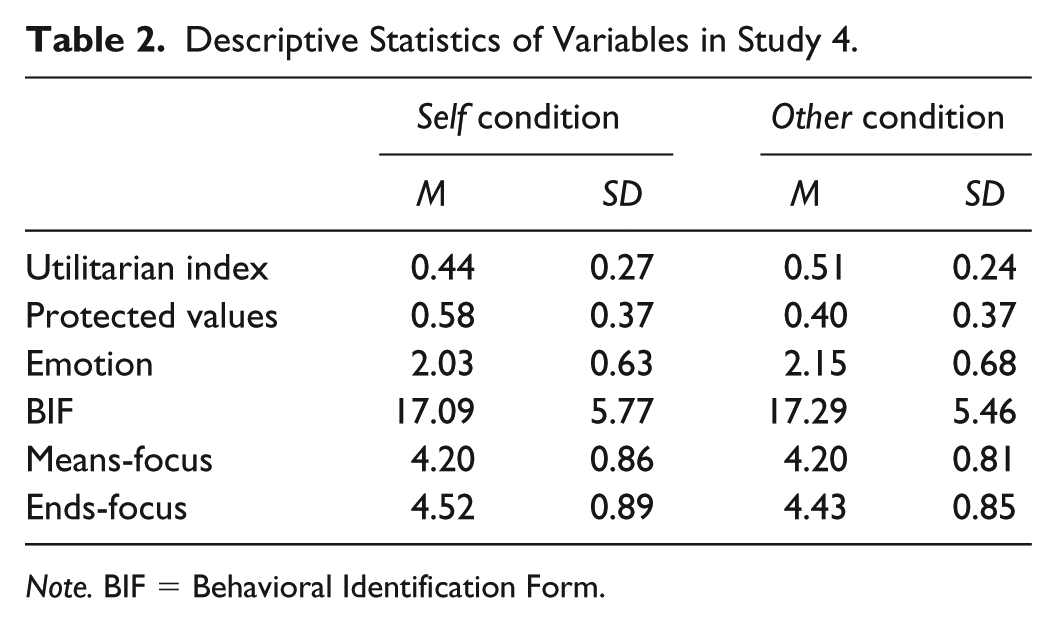
Note. BIF = Behavioral Identification Form.
Figure 4 shows the results of the parallel mediation analysis. Taken as a set, PVs, emotion, BIF, means-focus, and ends-focus did mediate the effect of the self–other condition on moral judgment. The total and direct effects of the self–other condition on moral judgment were −.068, p = .003, and −.023, p = .387, respectively. The total indirect effect through the three mediators was −.045 [−.092, −.010].

Results of the parallel mediation analysis of PVs, the emotion, the BIF, means-focus, and ends-focus in Study 4.
An examination of the specific indirect effects showed that the indirect effects of the self–other condition on moral judgment were a1b1 = −.042 [−.080, −.013] (through PVs), a2b2 = −.008 [−.030, .004] (through emotion), a3b3 = .001 [−.005, .007] (through BIF), a4b4 = −.000 [−.006, .005] (through means-focus), and a5b5 = .005 [−.004, .018] (through ends-focus). These results indicate that only PVs was a mediator, as its 95% CI did not contain zero. Neither emotion nor construal level contributed to the indirect effect above and beyond PVs.
An examination of the pairwise contrasts of the indirect effect showed that the specific indirect effect through PVs was larger than the specific indirect effects through emotion (95% CI [−.074, −.001]), BIF (95% CI [−.082, −.013]), means-focus (95% CI [−.081, −.012]), and ends-focus (95% CI [−.088, −.015]).
The results of Study 4 revealed that the effect of the self–other condition on moral judgment could only be explained by a PVs account.
General Discussion
The present research suggests that there is a self–other discrepancy in moral judgment. First, we demonstrated in two experiments (Studies 1 and 2) that people were more deontological when they made moral judgment themselves than when they surmised what a stranger would do. Second, this effect was observed in both people whose jobs were related to law (Study 2) and university students (Studies 1, 3, and 4). Third, we explored the psychological mechanism through mediation. We found that the PVs account outperformed the emotion account and the construal-level theory account in explaining the self–other discrepancy in moral judgment (Studies 3 and 4).
To provide convergent evidence for our arguments, we conducted four experiments, using within- and between-subject designs with diverse samples. In addition, we tested the possible explanations by measuring a few proposed mediators. We sought to maximize the statistical power in several ways. First, we sought to recruit as large a sample as we could. Second, we demonstrated the self–other discrepancy in moral judgment by utilizing both student samples and nonstudent samples—the effect was observed in students as well as participants with occupations related to law, indicating the robustness of our findings. Third, the present study employed different moral judgment measures, including the choice of whether or not to perform a described action (Study 1) and the responses to five hypothetical questions varying in trade-off values (Study 2). Fourth, we used a mixed model to analyze the data. By treating the participants and dilemmas as random factors simultaneously, the mixed model is more rigorous than the traditional analysis of variance (Baayen et al., 2008; Judd et al., 2012, 2017).
To explain the self–other discrepancy in moral judgment, we proposed three possible accounts: a PVs account, an emotion account, and a construal-level theory account. For the construal-level theory account, the indirect effect through the construal level was not significant and smaller than the indirect effect through the PVs in either Study 3 or Study 4. One might argue that the mediation analysis of the construal level could be problematic in Study 3—given that the construal level was only measured once at the end of the questionnaire, whereas the PVs and emotions were measured for each item—and that the implement of the BIF was inappropriate. However, the indirect effect through the construal level was still nonsignificant after its measures were improved in Study 4. Therefore, consistent evidence showed that the self–other discrepancy could not be explained by the construal-level theory.
For the emotion account, we found that the indirect effect through emotion was smaller than the indirect effect through PVs in Study 4 but was not distinguishable from the indirect effect through PVs in Study 3. The essential difference between Study 4 and Study 3 was that participants surmised the stranger’s feelings instead of indicating their own feelings in the other condition. Interestingly, we found that in Study 4, people believed that the stranger’s emotional responses were greater than their own when making moral judgments. This finding seems to contradict previous research on financial decision making, suggesting that people underestimate the intensity of emotional reactions held by others (Faro & Rottenstreich, 2006; Hsee & Weber, 1997; Kurt & Inman, 2013; Van Boven et al., 2000). However, to our knowledge, previous research on financial decision making did not ask participants to directly surmise the intensity of emotional reactions held by others. Considering that we did find that people reported less intense personal emotional reactions in the other condition than in the self condition in Study 3, our findings suggest that there may be a significant difference between surmising others’ emotional reactions and rating personal emotional reactions in the other condition. Future research should take this difference into consideration. Previous evidence showed that emotional responses play a central role in determining moral judgments in moral dilemmas (Greene & Haidt, 2002; Greene et al., 2001; Teper, Zhong, & Inzlicht, 2015). Our study clarified that it is the emotional responses of those who are responding to the moral dilemmas that can affect the moral judgments, even when they are surmising a stranger’s judgment.
For the PVs account, the indirect effects through PVs were consistently significant in Studies 3 and 4. Although the indirect effects through PVs and emotion were not distinguished in terms of magnitude in Study 3, the PVs account was better supported by the data than the emotion account, because (a) the parallel mediation analyses showed that the indirect effects through emotion were not significant when controlling for PVs in either Study 3 or Study 4 and (b) the pairwise contrasts of the indirect effect showed that the indirect effect through PVs was significantly larger than the indirect effect through emotion in Study 4. It is worth noting that emotion, particularly anger, is a property of PVs (Baron & Spranca, 1997). Evidence has revealed that people with absolute PVs show greater feelings of anger and bother than those without PVs (Baron & Spranca, 1997). The inclusion of emotion in PVs probably explains why the indirect effects through PVs and emotion were not distinguished in Study 3. However, researchers have demonstrated that PVs are not necessarily influenced by emotion, as emotion can be manipulated without any effect on PVs (Baron & Ritov, 2009). Therefore, in our study, the mediating effects through emotion were nonsignificant in the parallel mediation analyses that took the mediating effects through PVs into account.
Altogether, these results suggest that people make more deontological judgments in the self condition than in the other condition because they believe that they have more PVs than other people.
The self–other discrepancy in moral judgment may have a selective or survival advantage. Morality plays a critical role in enforcing and sustaining large-scale cooperation (Krebs, 2008; Lahti & Weinstein, 2005; Stanford, 2018; Van Vugt & Van Lange, 2006). Previous studies on moral judgment revealed that people who made deontological judgments were perceived as more moral and trustworthy (Everett, Pizarro, & Crockett, 2016; Sacco, Brown, Lustgraaf, & Hugenberg, 2017), whereas people who made utilitarian judgments were seen as deficient in empathy and moral character, although utilitarian decisions were viewed as the preferred actions (Kreps & Monin, 2014; Uhlmann, Zhu, & Tannenbaum, 2013). In addition, some researchers have found an association between utilitarian judgments and psychopathy, Machiavellianism, and life meaninglessness (Bartels & Pizarro, 2011). Consequently, people who express deontological judgments are more valued as partners, and people who express utilitarian judgments are less desirable in cooperative market and social exchanges (Everett et al., 2016). Through the evolution of social exchange, the human psychological system has been equipped with mechanisms to protect individuals from exploitation by their partners (Van Vugt & Van Lange, 2006). One of these mechanisms is that humans show a bias toward negative rather than positive personality information about the morality of an exchange partner (Brycz & Wojciszke, 1992; Van Vugt & Van Lange, 2006). In the same vein, surmising that a stranger is more utilitarian than oneself, which is analogous to the negativity effect, might be beneficial for protecting individuals from exploitation. Therefore, the self–other discrepancy in moral judgment may serve as a protective mechanism that has co-evolved alongside the social exchange mechanism, as evidenced by its prevalence across different cultures.
Our findings have practical implications. First, understanding the discrepancy between self and other in moral judgment may contribute to better understanding the obstacles preventing people from cooperation. From an evolutionary perspective of human moral psychology, people establish and maintain a connection between the extent to which they are themselves motivated by a given moral norm and the extent to which they use conformity to that same norm as a criterion in evaluating candidate partners (Stanford, 2018). That is, if a person conforms to a particular moral norm, those who conform to the same moral norms as she or he does will be regarded as desirable potential partners, and those who do not will be judged to be less desirable (Stanford, 2018). Our findings on the discrepancy between self and other in moral judgment suggest that people are inclined to regard others as having a lower deontological level and as less likely to have PVs than themselves. This inclination may be an obstacle to establishing and developing cooperation. Therefore, an awareness of the discrepancy between self and other in moral judgment could be useful in promoting cooperation.
Second, the discrepancy between self and other in moral judgment may contribute to a better understanding of the factors that induce people to violate rules or laws. The self–other discrepancy indicates that people overestimate others’ utilitarian tendencies and overestimate the influence of desired outcomes on others’ decisions. In daily life, people may often be confronted with situations that involve a conflict between moral rules and personal benefits, such as whether to keep money found in a lost wallet, whether to have an illegal lunch with a judge to win a case, whether to provide confidential information in exchange for money, and so on (Greene et al., 2001).
Our findings about the self–other discrepancy in moral judgment suggest that people tend to think that other people will violate moral rules in pursuit of personal interest. This tendency could, in turn, increase their own motivation to break rules, leading to severe negative consequences for the public interest. Therefore, our findings could be beneficial by helping to prevent people from biasing their judgments about others’ self-interested motivation and thus limiting their own motivation to break rules.
Supplemental Material
Rao_Online_Appendix – Supplemental material for Do People Believe That They Are More Deontological Than Others?
Supplemental material, Rao_Online_Appendix for Do People Believe That They Are More Deontological Than Others? by Ming-Hui Li and Li-Lin Rao in Personality and Social Psychology Bulletin
Footnotes
Acknowledgements
The authors are grateful to Jonathan Baron for helpful comments, to Zi-Han Wei for her assistance with data collection, and to Drs. Rhoda E. Perozzi and Edmund F. Perozzi for English and content editing assistance.
Declaration of Conflicting Interests
The author(s) declared no potential conflicts of interest with respect to the research, authorship, and/or publication of this article.
Funding
The author(s) disclosed receipt of the following financial support for the research, authorship, and/or publication of this article: This work was partially supported by the National Natural Science Foundation of China (No. 31671166), the Young Elite Scientists Sponsorship Program by CAST (No. YESS20160143), and the Youth Innovation Promotion Association CAS (No. 2015067). The funders had no role in the study design, data collection and analysis, decision to publish, or preparation of the manuscript.

Notes
Supplemental Material
Supplemental material for this article is available online.
References
Supplementary Material
Please find the following supplemental material available below.
For Open Access articles published under a Creative Commons License, all supplemental material carries the same license as the article it is associated with.
For non-Open Access articles published, all supplemental material carries a non-exclusive license, and permission requests for re-use of supplemental material or any part of supplemental material shall be sent directly to the copyright owner as specified in the copyright notice associated with the article.
