



Abstract
Many real-world dilemmas involve disagreement about whether decisions should follow moral norms in an unconditional manner (deontology) or be based on the consequences for the greater good (utilitarianism). To examine how political ideology may account for some of these disagreements, the current research used a formal modeling approach to investigate the associations between political ideology and (a) sensitivity to consequences, (b) sensitivity to moral norms, and (c) general preference for inaction versus action in responses to moral dilemmas. Across three studies (N = 996) with samples from the United States (Studies 1 and 3) and the United Kingdom (Study 2), conservatives were less influenced by overall consequences for the greater good in comparison with liberals. Political ideology was not significantly associated with sensitivity to moral norms and general action tendencies. The findings provide more nuanced insights into how political ideology may contribute to disagreements on real-world moral dilemmas.
Imagine that a passenger plane is hijacked by an extremist group who intends to crash it into a densely populated metropolitan area, potentially killing thousands of people. Would it be morally acceptable to shoot down the hijacked passenger plane? Some people might argue for shooting down the plane, because it will ultimately save more lives by preventing the death of thousands on the ground. Yet, others might argue against shooting down the plane, because one should not kill innocent people. Whereas the former position has been described as utilitarian in the sense that the moral status of a given action is judged on the basis of its consequences for the greater good, the latter position has been described as deontological in the sense that the moral status of a given action is judged on the basis of its consistency with moral norms (Conway et al., 2018).
Consistent with the debate surrounding this issue (“Law to Shoot Down Airliners Overturned,” 2006), research in moral psychology has evidenced considerable disagreement on the right course of action in dilemmas that involve a conflict between the consequences of a given action for the greater good and the consistency of that action with moral norms (e.g., Gleichgerrcht & Young, 2013; Moore et al., 2011; Patil, 2015; Szekely et al., 2015; Van den Bos et al., 2011). Although there are many factors that may contribute to this disagreement, one potential source is political ideology, which has been associated with many aspects of moral judgment in past research (Graham et al., 2009; Inbar & Pizarro, 2016; Janoff-Bulman & Carnes, 2016). The main goal of the current research was to investigate this possibility by examining whether political ideology is associated with judgments about the right course of action in moral dilemmas that pit consequences against moral norms (see Greene et al., 2001). Using a formal modeling approach to quantify distinct determinants of moral dilemma judgments (Gawronski et al., 2017), we further tested whether the associations between political ideology and moral dilemma judgments are driven by differences in (a) sensitivity to consequences, (b) sensitivity to moral norms, or (c) general preference for inaction versus action (or some combination of the three).
Political Ideology and Moral Dilemma Judgments
Although there are many factors that may contribute to disagreements about the right course of action in moral dilemmas (see Körner et al., 2020), one promising candidate is political ideology. Political ideology has been associated with many aspects of moral judgment, including differences in moral values such as loyalty, authority, purity, and social justice (Graham et al., 2009; Janoff-Bulman & Carnes, 2016) as well as morally relevant emotions like disgust (Inbar & Pizarro, 2016). Given its contribution to moral disagreements in these areas, political ideology may play a similar role in disagreements about the correct resolution of moral dilemmas. In line with this possibility, several studies found that conservatives are less inclined to break a moral norm for the greater good than liberals (Chan, 2019; Hannikainen et al., 2017; Piazza & Landy, 2013; Piazza & Sousa, 2014; Young et al., 2013; but see Lane & Sulikowski, 2017; Uhlmann et al., 2009). Collectively, these studies suggest that conservatives may show a weaker preference for utilitarian over deontological judgments than liberals.
Although these findings provide initial insight into the association between political ideology and moral dilemma judgments, there are two notable limitations. First, many of the dilemmas used in prior research have been criticized for including unrealistic, even humorous, scenarios that seem highly implausible (Bauman et al., 2014; Körner et al., 2019). Second, dilemma responses in past research are conceptually ambiguous. One ambiguity arises from the fact that the traditional dilemma paradigm treats utilitarian and deontological judgments as bipolar opposites, although their underlying processes are claimed to be independent (Conway & Gawronski, 2013). A second ambiguity arises from the fact that utilitarian judgments have been conflated with action (e.g., shooting down the plane) and deontological judgments with inaction (e.g., not shooting down the plane) (Crone & Laham, 2017). Thus, even if the concern about unrealistic scenarios is addressed by using realistic scenarios of real-world relevance, the finding that conservatives show a weaker preference for utilitarian over deontological judgments than liberals could reflect (a) a stronger sensitivity to consequences among liberals (see Piazza & Sousa, 2014), (b) a stronger sensitivity to moral norms among conservatives (see Young et al., 2013), or (c) a greater aversion to actions interfering with current states of affairs among conservatives (i.e., status quo bias; see Samuelson & Zeckhauser, 1988).
CNI Model
A valuable tool to disentangle these three factors underlying moral dilemma judgments is the CNI model of moral decision-making (Gawronski et al., 2017). The CNI model is a multinomial model (Batchelder & Riefer, 1999; Hütter & Klauer, 2016) that quantifies (a) sensitivity to consequences, (b) sensitivity to moral norms, and (c) general preference for inaction versus action in responses to moral dilemmas. Each of these factors is captured by a separate parameter, which is estimated based on participants’ responses to four kinds of dilemmas with different cost–benefit ratios (i.e., benefits of action greater vs. smaller than costs) and different salient norms (i.e., proscriptive vs. prescriptive). The model’s C parameter captures the extent to which participants’ responses are sensitive to consequences, implying that actions are judged as acceptable (i.e., action) when their benefits outweigh their costs and judged as unacceptable (i.e., inaction) when their costs outweigh their benefits (see first row in Figure 1). The model’s N parameter captures the extent to which participants’ responses are sensitive to moral norms, implying that actions are judged as acceptable (i.e., action) when they are prescribed by a moral norm and judged as unacceptable (i.e., inaction) when they are prohibited by a moral norm (see second row in Figure 1). Finally, the model’s I parameter captures the extent to which participants’ responses reflect a general preference for inaction versus action, implying that actions are judged as generally unacceptable (i.e., inaction, see third row in Figure 1) as opposed to generally acceptable (i.e., action, see fourth row in Figure 1). By disentangling these three distinct factors, research using the CNI model has provided valuable insights into the underpinnings of a wide range of findings, including effects of cognitive resources (Gawronski et al., 2017), incidental emotions (Gawronski et al., 2018), and psychopathy (Gawronski et al., 2017; Körner et al., 2020; Luke & Gawronski, in press).
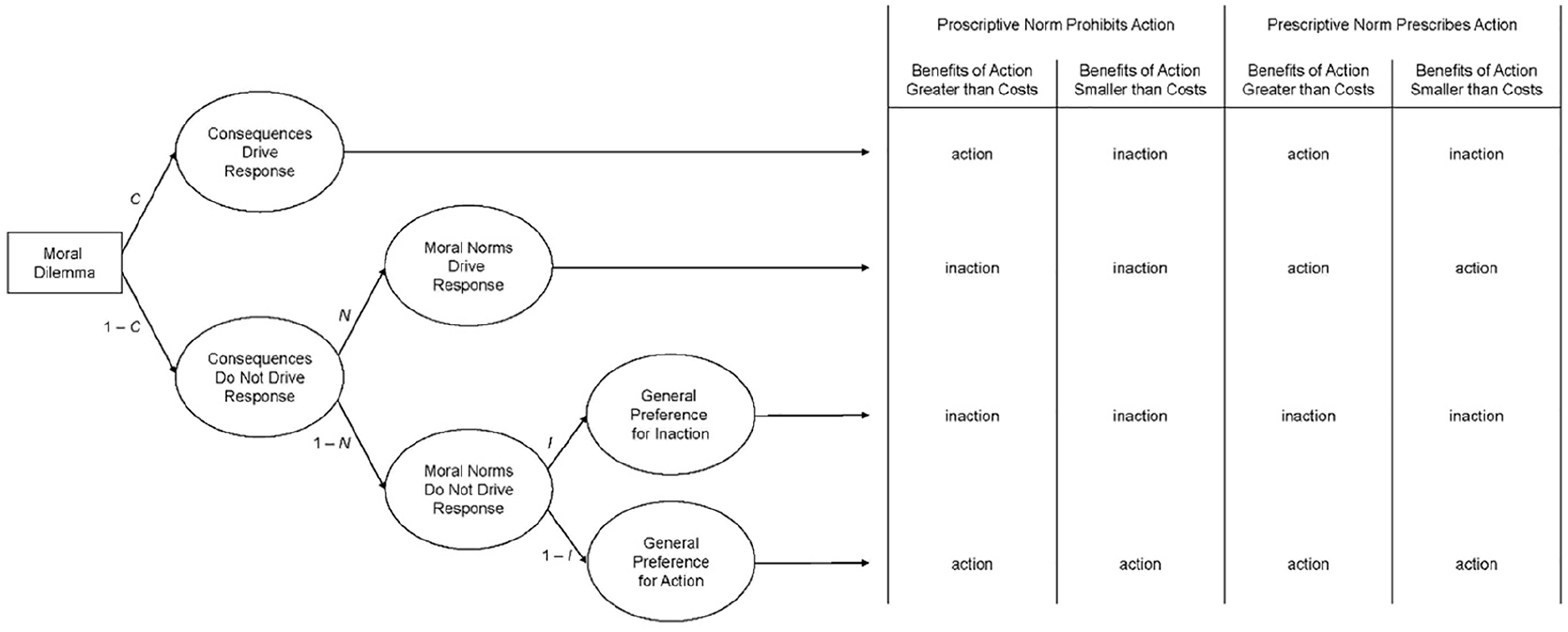
CNI model of moral decision-making predicting action versus inaction responses in moral dilemmas with proscriptive and prescriptive norms and consequences involving benefits of action that are either greater or smaller than costs of action.
The Current Research
In the current research, we used the CNI model to investigate the associations between political ideology and moral dilemma judgments. Toward this end, participants first completed a measure of political ideology, followed by a battery of moral dilemmas for research using the CNI model (Körner et al., 2020). To address concerns that many of the dilemmas used in prior research include unrealistic, sometimes humorous, scenarios that seem highly implausible (Bauman et al., 2014; Körner et al., 2019), the dilemmas of the employed battery have been designed to capture a wide range of real-world cases that ignited moral debates about the most appropriate courses of action (Gawronski et al., 2017; Körner et al., 2020).
To permit a comparison of our findings with previous research (e.g., Chan, 2019; Hannikainen et al., 2017; Lane & Sulikowski, 2017; Piazza & Landy, 2013; Piazza & Sousa, 2014; Young et al., 2013), we first analyzed correlations between political ideology and preference for action over inaction on dilemmas involving a proscriptive norm that prohibits action in cases where the benefits of action outweigh its costs to well-being (similar to the trolley problem; see Foot, 1967). Greater preference for action over inaction on this type of dilemma is typically interpreted as reflecting a stronger preference for utilitarian over deontological responses (see Greene et al., 2001). Although the dilemmas in the current study were quite different from the ones in previous research, we expected to replicate earlier findings suggesting that conservatives show a weaker preference for utilitarian over deontological judgments than liberals. In a second step, we used the CNI model to further examine whether this association is driven by differences in (a) sensitivity to consequences, (b) sensitivity to moral norms, or (c) general action tendencies.
To investigate the replicability and generality of the obtained results, we conducted three studies: two with a sample from the United States (Studies 1 and 3) and one with a sample from the United Kingdom (Study 2). Given the methodological similarity between studies, we report the methods and results of all studies together. Studies 1 and 2 were exploratory in nature. Study 3 was a preregistered replication of Studies 1 and 2, which further examined the robustness of the obtained associations after controlling for basic demographic variables. For Studies 1 and 2, we aimed to recruit 300 participants, which provides a statistical power of .80 in detecting a correlation of r = .16 (two-tailed). Based on the effect sizes obtained in Studies 1 and 2, we aimed to recruit 516 participants in Study 3, which provides a statistical power of .80 in detecting a correlation of r = .12 (two-tailed). By default, we excluded participants who failed to pass an instructional attention check (see Oppenheimer et al., 2009). The data for each study were collected in one shot without intermittent statistical analyses. We report all measures, all conditions, and all data exclusions. The data, analysis codes, and materials for the three studies are available at https://osf.io/4yx9b. The preregistration for Study 3 can be found at https://osf.io/hxf3s.
Method
Participants
Participants in Studies 1 and 2 were recruited between February 2019 and March 2019 using Prolific, a crowdsourcing platform for online research (Peer et al., 2017). Participants in Study 3 were Amazon Mechanical Turk (MTurk) workers recruited in December 2019 through Turk Prime (Litman et al., 2016). All data collection was completed before the outbreak of the COVID-19 pandemic. Eligibility for participation in Studies 1 and 2 were restricted to Prolific workers from the United States (Study 1) or the United Kingdom (Study 2) who were at least 18 years of age, successfully completed one prior assignment, and had an approval rating of at least 95% across assignments. Eligibility for participation in Study 3 was identical except that MTurk workers were required to have successfully completed 100 prior assignments and could not have participated in a prior study from the authors’ lab using the moral dilemmas involved in the current research.
For each study, we created three separate assignments to obtain a diverse sample spanning the political spectrum. Toward this end, Studies 1 and 2 used Prolific’s demographic screening tool to restrict completion of each assignment to Prolific workers who self-identified as either liberal, moderate, or conservative. 1 In Study 3, we used Turk Prime’s panel options (based on prior demographic surveying) to restrict completion of each assignment to MTurk workers who self-identified as (a) “very liberal” or “liberal,” (b) “moderate,” or (c) “very conservative” or “conservative.” For each study, the procedure and materials for participants recruited through different assignments were identical. Completion of each study took approximately 30 min, and participants were compensated US$4.00 for their time. Sample characteristics for each study can be seen in Table 1.
Sample Characteristics (Sample Size, Demographic Statistics) of Studies 1 to 3.
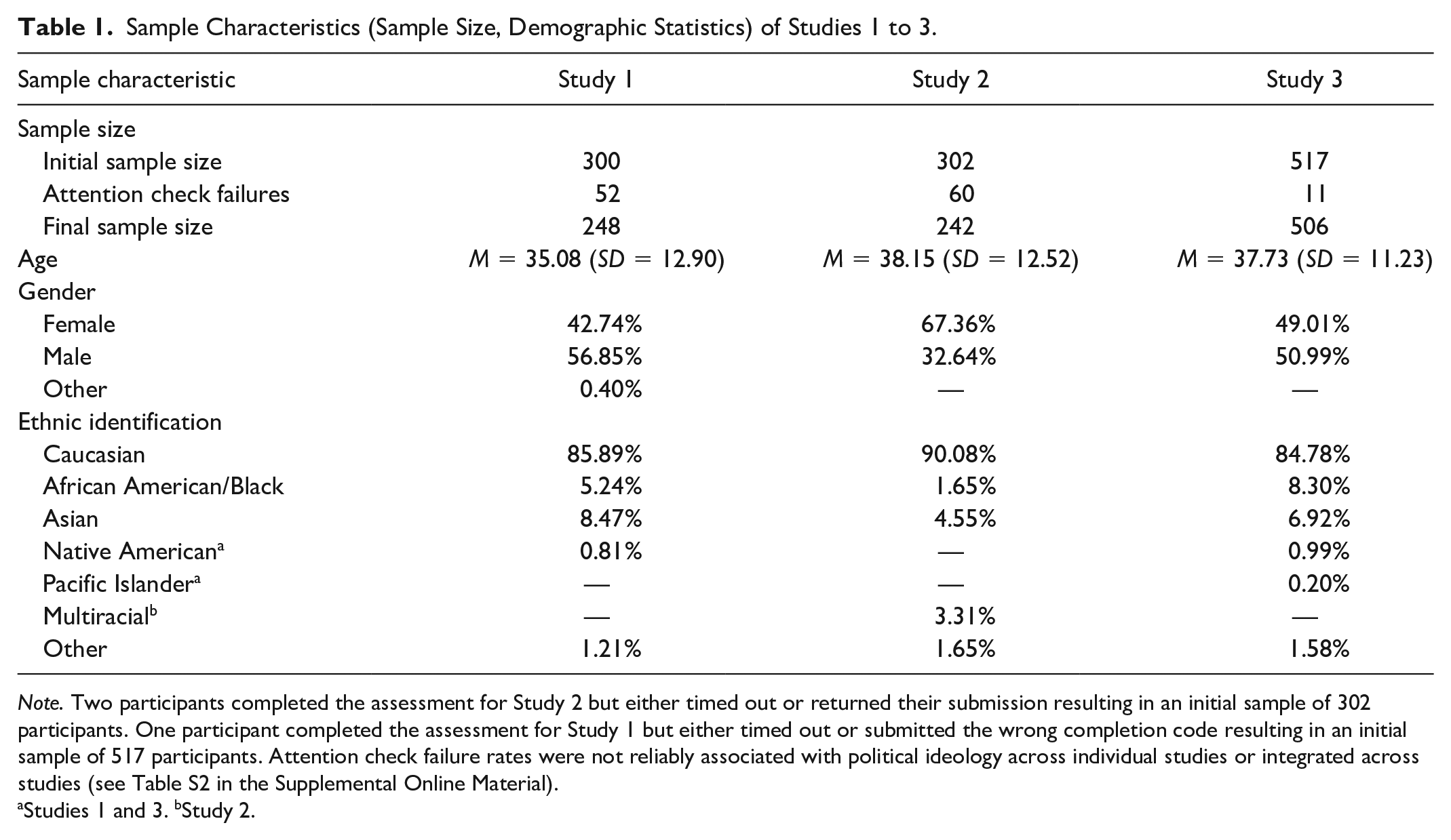
Note. Two participants completed the assessment for Study 2 but either timed out or returned their submission resulting in an initial sample of 302 participants. One participant completed the assessment for Study 1 but either timed out or submitted the wrong completion code resulting in an initial sample of 517 participants. Attention check failure rates were not reliably associated with political ideology across individual studies or integrated across studies (see Table S2 in the Supplemental Online Material).
Studies 1 and 3. bStudy 2.
Procedure and Materials
The procedure and materials were largely the same across studies. After providing informed consent, participants were asked to indicate their political ideology on three items: (a) How do you consider yourself politically in general? (b) How do you consider yourself politically in terms of social issues? and (c) How do you consider yourself politically in terms of economic issues? (Study 1: α = .92; Study 2: α = .92; Study 3: α = .93). Political ideology was measured with a 7-point rating scale, ranging from 1 (very liberal) to 7 (very conservative). Participants were then asked to complete a battery of 48 moral dilemmas adapted from Körner et al. (2020). The battery included 12 basic scenarios in four variants, reflecting the manipulations of cost–benefit ratios (i.e., benefits of action greater vs. smaller than costs) and salient norms (i.e., proscriptive vs. prescriptive) required for analyses using the CNI model (Gawronski et al., 2017). Each dilemma asked participants to indicate whether the described action was acceptable (yes vs. no). All dilemmas were presented in a random order that was fixed for all participants (for a sample dilemma, see Table 2). After responding to the dilemmas, participants completed a set of demographic questions and an instructional attention check (see Oppenheimer et al., 2009), after which they were thanked for their participation and given a completion code to request compensation.
Example of a Moral Dilemma Involving Either a Proscriptive or a Prescriptive Norm Where the Benefits of Action Are Either Greater or Smaller Than the Costs of Action.
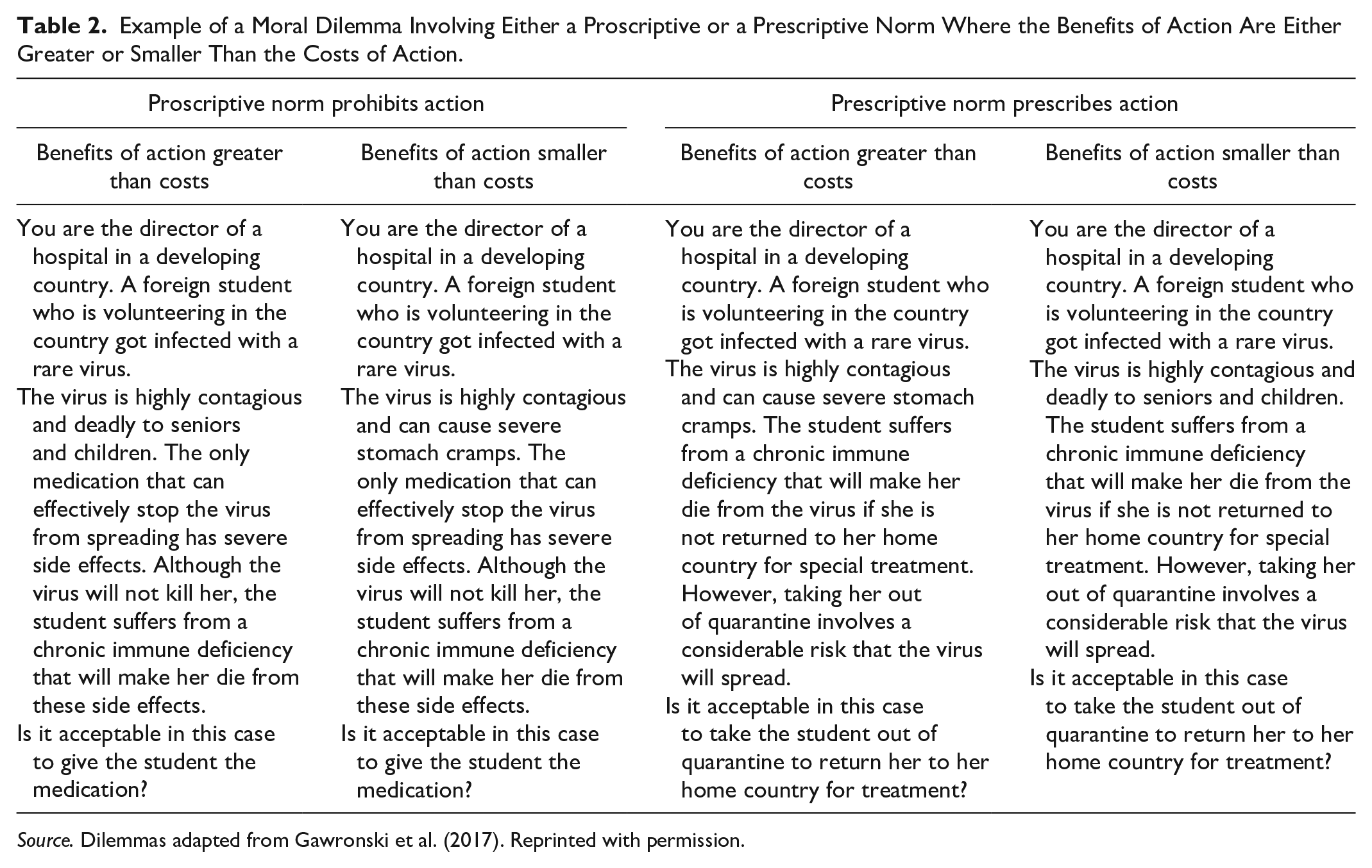
Source. Dilemmas adapted from Gawronski et al. (2017). Reprinted with permission.
This procedure was followed in all three studies with a few notable deviations. In Study 2, participants were asked to complete an additional three-item measure of self-identification in terms of the right–left dimension for exploratory purposes (see Note 1). In Study 3, a basic arithmetic question was added to the beginning of the assessment to prevent bots from participating, 2 and measures of income and religion were added to the set of demographic questions at the end of the assessment. Income was measured by asking participants What is your total household income in dollars per year? which was answered using 12 response options beginning with Less than US$10,000 and incrementally increasing to More than US$150,000. Religiosity was measured using a 10-item religiosity scale adapted from Koenig and colleagues (2005). Responses to each item were measured using a dichotomous yes versus no answer choice.
Data Analyses
Across all studies, we examined the associations between political ideology and moral dilemma judgments in two steps. To permit a comparison of our findings with previous research, we first analyzed correlations between political ideology and preference for action over inaction on dilemmas involving a proscriptive norm that prohibits action in cases where the benefits of action outweigh its costs to well-being. Greater preference for action over inaction on this type of dilemma is typically interpreted as reflecting a stronger preference for utilitarian over deontological responses (see Greene et al., 2001). For the sake of simplicity, we use the term traditional dilemma score for this relative preference measure.
In a second step, we analyzed the associations between political ideology and moral dilemma judgments using the CNI model. Individual parameter scores of sensitivity to consequences (C), sensitivity to moral norms (N), and general preference for inaction versus action (I) were estimated with the freeware multiTree (Moshagen, 2010) by fitting the CNI model to the aggregated moral judgment data of each participant (see Körner et al., 2020). Because the statistical details of the CNI model have been described elsewhere (Gawronski et al., 2017), we describe only the main steps of the analyses. Based on the processing tree depicted in Figure 1, the CNI model provides a unique equation for each of the four kinds of dilemmas (see the appendix). 3 The four equations include the three model parameters as unknowns and the probability of action versus inaction responses on a given type of dilemma as known numerical values. Using maximum likelihood statistics, numerical values are estimated for each parameter such that the difference between the predicted probabilities of action versus inaction responses and the empirically observed probabilities of action versus inaction responses across the four kinds of dilemmas is minimized. Estimates for each parameter can range from 0 to 1. Higher scores on the C parameter indicate a greater effect of consequences on moral judgments. Higher scores on the N parameter indicate a greater effect of moral norms on moral judgments. Scores above .50 on the I parameter indicate a stronger general preference for inaction, while scores below .50 indicate a stronger general preference for action. Following the procedures recommended by Gawronski et al. (2017), the modeling analyses used a fixed estimation algorithm with random start values, two replications, and a maximum of 90,000 iterations.
As specified in the preregistration, we conducted additional analyses in Study 3 to examine whether the associations between political ideology and CNI parameters are robust after controlling for demographic variables. To this end, each of the three moral judgment parameters (C parameter, N parameter, I parameter) was simultaneously regressed onto political ideology and gender, age, education, income, and religiosity. 4
Results
Means and 95% confidence intervals (CIs) of the aggregated moral judgment data for each study are presented in Table 3. Means and 95% CIs of political ideology scores and CNI model parameters for each study are presented in Table 4.
Means and 95% CIs of Action (vs. Inaction) Responses on Moral Dilemmas With Proscriptive and Prescriptive Norms and Consequences Involving Benefits of Action That Are Either Greater or Smaller Than Costs of Action.

Note. Scores can range from 0 to 12. The neutral reference value of equal numbers of action and inaction responses is 6. CIs = confidence intervals.
Means and 95% CIs of Political Ideology Scores and CNI Model Parameters.
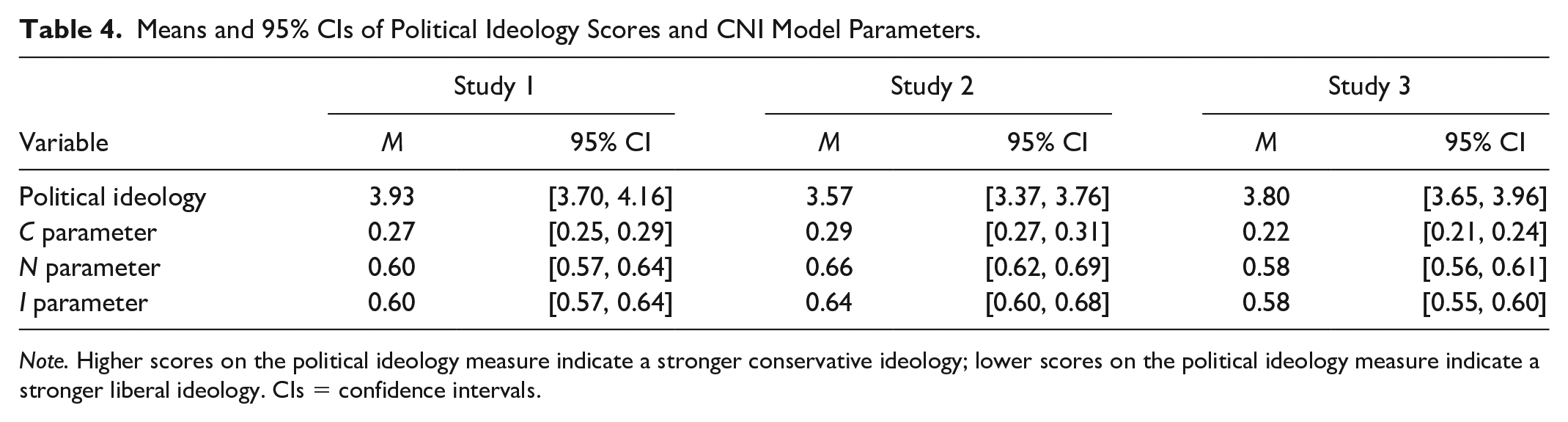
Note. Higher scores on the political ideology measure indicate a stronger conservative ideology; lower scores on the political ideology measure indicate a stronger liberal ideology. CIs = confidence intervals.
Traditional Analyses
Replicating previous findings, political ideology was significantly associated with traditional dilemma scores in Study 1, r(246) = −.17, p = .008, 95% CI = [–.29, –.05], and Study 3, r(504) = −.13, p = .003, 95% CI = [–.22, –.05], indicating that conservatives showed a weaker preference for utilitarian over deontological judgments than liberals. Political ideology was not significantly associated with traditional dilemma scores in Study 2, r(240) = −.08, p = .212, 95% CI = [–.20, .05]. Thus, prior findings regarding associations between political ideology and preference for utilitarian over deontological judgment were only partially supported by the current research, a point to which we will return in the “Discussion” section.
CNI Analyses
Correlations between political ideology and the three CNI model parameters are presented in Table 5. Political ideology showed a significant association with the C parameter in Study 1, r(246) = −.13, p = .035, 95% CI = [–.25, –.01]; Study 2, r(240) = −.13, p = .046, 95% CI = [–.25, –.002]; and Study 3, r(504) = −.12, p = .007, 95% CI = [–.21, –.03], indicating that sensitivity to consequences was negatively related to conservative (vs. liberal) political ideology. Political ideology showed no significant associations with the N parameter in Study 1, r(246) = .03, p = .625, 95% CI = [–.09, .16]; Study 2, r(240) = −.08, p = .206, 95% CI = [–.21, .04]; or Study 3, r(504) = .06, p = .182, 95% CI = [–.03, .15]. Similarly, political ideology showed no significant associations with the I parameter in Study 1, r(246) = .10, p = .131, 95% CI = [–.03, .22]; Study 2, r(240) = −.04, p = .575, 95% CI = [–.16, .09]; or Study 3, r(504) = .09, p = .056, 95% CI = [–.002, .17], although the association in Study 3 was marginal. Taken together, these findings suggest that sensitivity to consequences decreases as a function of conservative (vs. liberal) political ideology. Political ideology does not seem to be associated with sensitivity to moral norms or general action tendencies.
Correlations Between Political Ideology and Moral Judgment Variables.
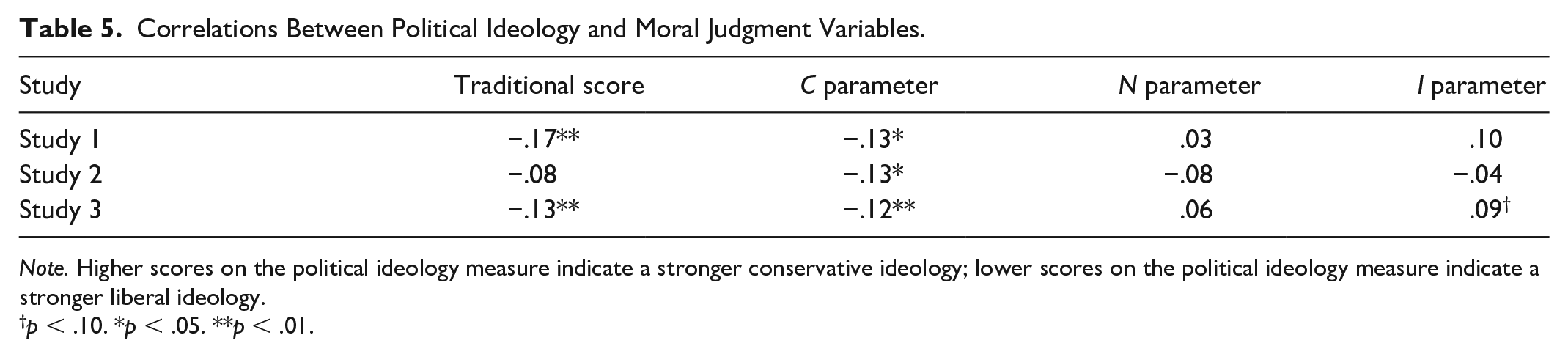
Note. Higher scores on the political ideology measure indicate a stronger conservative ideology; lower scores on the political ideology measure indicate a stronger liberal ideology.
p < .10. *p < .05. **p < .01.
Control Analyses
In accordance with the preregistration for Study 3, we conducted additional analyses examining whether the association between political ideology and the C parameter would hold after controlling for basic demographic variables. To this end, the C parameter was regressed onto political ideology as well as gender, age, income, education, and religiosity (see Table 6). Consistent with the hypothesis of a direct association between political ideology and moral judgments, political ideology continued to show a significant association with the C parameter, β = −.12, t(499) = −2.42, p = .016, 95% CI = [–.22, –.02], indicating that sensitivity to consequences decreased as a function of conservative (vs. liberal) political ideology even after controlling for basic demographic variables. In addition to political ideology, the C parameter showed a significant positive association with age, β = .19, t(499) = 4.17, p < .001, 95% CI = [.10, .28]; a significant negative association with religiosity, β = −.13, t(499) = −2.67, p = .008, 95% CI = [–.22, –.03]; and a marginal negative association with education, β = −.08, t(499) = −1.67, p = .095, 95% CI = [–.17, .01]. Consistent with the results of the correlation analyses, neither the N nor the I parameter was significantly related to political orientation after controlling for basic demographic variables (see Table 6).
Association Between Political Ideology and Moral Judgment Variables Controlling for Basic Demographic Variables, Study 3.
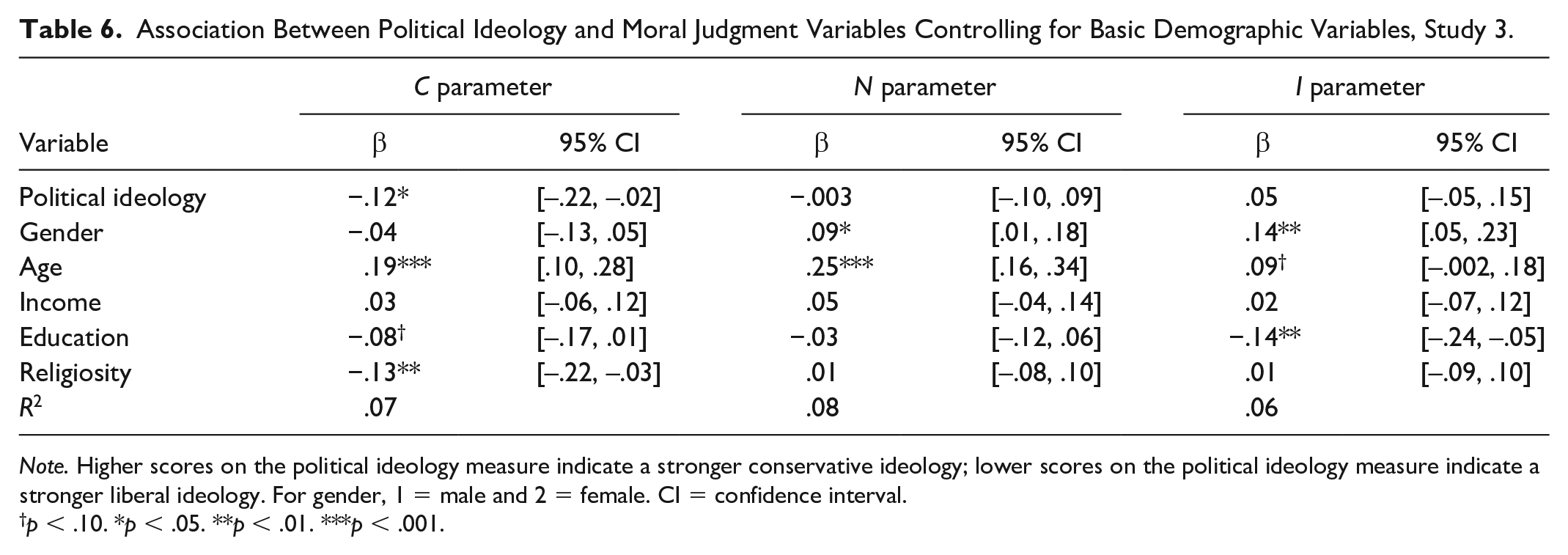
Note. Higher scores on the political ideology measure indicate a stronger conservative ideology; lower scores on the political ideology measure indicate a stronger liberal ideology. For gender, 1 = male and 2 = female. CI = confidence interval.
p < .10. *p < .05. **p < .01. ***p < .001.
Discussion
The main goal of the current research was to provide deeper insights into the role of political ideology in disagreements about the right course of action in moral dilemmas. Using a battery of moral dilemmas inspired by real-world cases (Körner et al., 2020) and the CNI model to quantify sensitivity to consequences (C), sensitivity to moral norms (N), and general preference for inaction versus action (I) in responses to moral dilemmas (Gawronski et al., 2017), we found that sensitivity to consequences decreased as a function of conservative (vs. liberal) political ideology. Political ideology was not significantly associated with sensitivity to moral norms and general action tendencies. These findings replicated in two exploratory studies (Studies 1 and 2) and one preregistered study (Study 3) with participants from the United States (Studies 1 and 3) and the United Kingdom (Study 2) and remained robust after controlling for basic demographic variables (Study 3). The results also replicated in an integrative data analysis (Curran & Hussong, 2009) combining the data from all three studies (see Table S9 in the Supplemental Online Material). Scatterplots of the associations between political ideology and the three CNI parameters in the integrative data analysis can be seen in Figure 2.
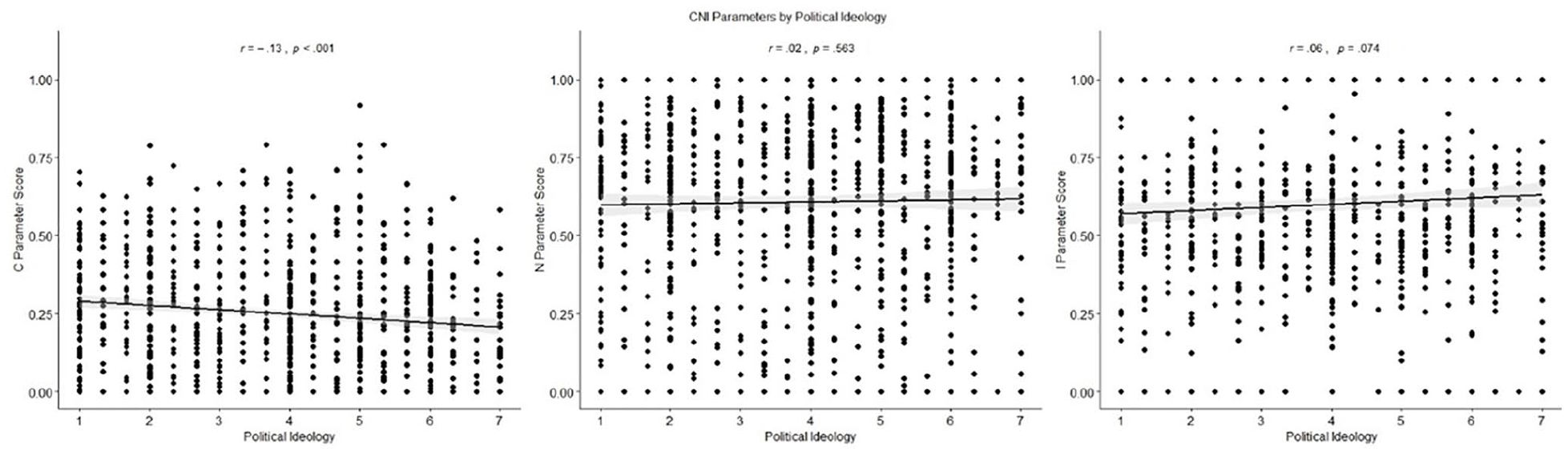
Scatterplots of associations between political ideology and sensitivity to consequences (C parameter), sensitivity to moral norms (N parameter), and general preference for inaction versus action regardless of consequences and norms (I Parameter) in integrative data analysis combining the data from Studies 1 to 3 (N = 996).
The current findings offer more nuanced insights into why conservatives and liberals may disagree about the most appropriate course of action in real-world dilemmas. Past research suggests that conservatives are less likely than liberals to endorse actions that violate moral norms for the sake of the greater good (e.g., Hannikainen et al., 2017; Piazza & Sousa, 2014). One potential interpretation of this difference is that conservatives are more concerned about violations of moral norms than liberals (see Young et al., 2013), suggesting a significant positive correlation between conservative (vs. liberal) political ideology and sensitivity to moral norms. Another interpretation is that conservatives are more concerned about actions that interfere with current states of affairs (i.e., status quo bias; see Samuelson & Zeckhauser, 1988), suggesting a significant positive correlation between conservative (vs. liberal) political ideology and general preference for inaction over action. Neither of these predictions received empirical support in the current studies. Instead, we found a significant negative correlation between conservative (vs. liberal) political ideology and sensitivity to consequences, suggesting that conservatives are less willing to accept consequentialist arguments about the greater good than liberals (see Piazza & Sousa, 2014). In other words, liberals and conservatives seem to agree that certain actions would be morally wrong because they violate consensually accepted moral norms. Yet, they seem to differ in the extent to which they are willing to accept trade-offs when a norm violation would be beneficial for the greater good.
An interesting question regarding this finding is whether political differences in sensitivity to consequences are driven by political conservatism, political liberalism, or both. Because participants were recruited in groups based on their political ideology (i.e., conservative, moderate, liberal), follow-up analyses using a categorical classification can provide valuable insights for this question (see Table S5 in the Supplemental Online Material). While we did not find consistent differences between groups in the three individual studies, an integrative data analysis (Curran & Hussong, 2009) combining the data from all three studies revealed that sensitivity to consequences was significantly weaker in the conservative group than in the liberal group. 5 Yet, neither the conservative nor the liberal group differed from the moderate group. Together, these results suggest that sensitivity to consequences varies continuously across the political spectrum and is not driven exclusively by either conservatism or liberalism.
Another interesting question is whether sensitivity to consequences is more strongly associated with social or economic political ideology. Follow-up analyses with the data from the three individual studies did not find consistent evidence for different associations between sensitivity to consequences and social versus economic political ideology. However, when the data from all three studies were combined, an integrative data analysis revealed that sensitivity to consequences showed a significantly stronger association with social compared with economic political ideology (see Tables S6–S9 in the Supplemental Online Material). This difference is consistent with earlier findings by Chan (2019), who found that preference for utilitarian over deontological judgments is more strongly associated with social compared with economic political ideology. The current results expand on these findings, suggesting that associations between moral dilemma judgments and social political ideology are rooted in differences in sensitivity to consequences.
Why the Difference?
While the current findings suggest that disagreement about the correct course of action in moral dilemmas is rooted in political differences in sensitivity to consequences, it is still unclear why liberals and conservatives differ in the observed manner. One potential explanation could be derived from Greene et al.’s (2001) dual-process theory of moral dilemma judgment, which suggests that deontological judgments are rooted in automatic emotional reactions to the idea of causing harm, whereas utilitarian judgments result from deliberate cognitive analyses of costs and benefits. Thus, to the extent that conservatives are less inclined to engage in deliberate thinking compared with liberals (see Jost et al., 2003), conservatives may show a weaker sensitivity to consequences, as observed in the current studies. However, counter to this interpretation, research using the CNI model suggests that deliberate thinking influences moral dilemma judgments via general action tendencies rather than sensitivity to consequences. Specifically, Gawronski et al. (2017, Experiments 2a and 2b) found that, although cognitive load led to a weaker preference for utilitarian over deontological judgments, this effect was driven by greater general preference for inaction versus action under cognitive load, not by weaker sensitivity to consequences. These results question not only a core assumption of Greene et al.’s (2001) dual-process theory, they also pose a challenge to the idea that the obtained association between political ideology and sensitivity to consequences is driven by differences in deliberate thinking.
An alternative possibility is that political differences in sensitivity to consequences are rooted in proto-utilitarian inclinations. Kahane and colleagues (2018) have proposed a two-dimensional model of utilitarian psychology, consisting of acceptance of instrumental harm for the sake of the greater good (instrumental harm) and impartial concern for the welfare of others (impartial beneficence). To the extent that instrumental harm is positively associated with political conservatism and impartial beneficence is negatively associated with political conservatism—as proposed by Everett and Kahane (2020)—the current findings may be driven by weaker impartial concern for the welfare of others among conservatives. 6 However, previous findings with the CNI model render this possibility unlikely. Körner et al. (2020) examined associations between the three CNI model parameters and the two dimensions of utilitarianism as captured by the Oxford Utilitarianism Scale (OUS; Kahane et al., 2018). Across four studies, neither instrumental harm nor impartial beneficence showed reliable associations with sensitivity to consequences. Instead, both dimensions showed significant negative associations with sensitivity to moral norms, suggesting that self-reported endorsement of utilitarian ideas (as captured by the two dimensions of the OUS) merely serves to justify a rejection of moral norms without increasing people’s actual sensitivity to consequences. Thus, given that political ideology was significantly associated with sensitivity to consequences and unrelated to sensitivity to moral norms, political differences in proto-utilitarian inclinations seem rather unlikely to account for the current findings.
A potential answer to the question of why liberals and conservatives differ in their sensitivity to consequences is suggested by the finding that sensitivity to consequences was more strongly associated with social than economic political ideology (see Table S9 in the Supplemental Online Material). Whereas social political ideology has been found to be more strongly linked to resistance to social change, economic political ideology has been found to be more strongly linked to acceptance of inequality (Duckitt & Sibley, 2010; Jost et al., 2009). Together with the current findings, these results suggest that political differences in sensitivity to consequences may be rooted in differences in resistance to social change. Consistent with this conclusion, Hannikainen et al. (2018) found evidence for a societal shift toward utilitarian judgments in the resolution of moral dilemmas. To the degree that conservatives (relative to liberals) are more resistant to such societal shifts, the negative association between political conservatism and sensitivity to consequences may reflect resistance to an increased sensitivity to consequences at the societal level. Future research might evaluate this hypothesis more directly by examining whether the three parameters of the CNI model are less affected by societal changes among conservatives compared with liberals.
Some Caveats
Although we obtained consistent evidence for an association between political ideology and sensitivity to consequences, it is worth noting that there was only partial support for an association between political ideology and traditional dilemma scores. Consistent with past research (e.g., Hannikainen et al., 2017; Piazza & Sousa, 2014), conservatives showed a weaker preference for utilitarian over deontological judgment than liberals in Studies 1 and 3. However, there were no political differences in preference for utilitarian over deontological judgment in Study 2. A potential reason for these mixed findings is that traditional dilemma scores confound the influence of multiple distinct determinants of moral dilemma judgments (Conway & Gawronski, 2013; Crone & Laham, 2017), which creates noise in the measurement of each confounded factor. Disentangling the confounded factors provides cleaner measures of each factor, which can increase the statistical power to detect associations between a given factor and other variables. Consistent with this interpretation, our findings were consistent with past research when analyses were conducted using the combined data from all three studies (see Table S9 in the Supplemental Online Material), suggesting that conservatives show a weaker preference for utilitarian over deontological judgment than liberals.
While the association between political ideology and sensitivity to consequences was consistent across studies, it is worth noting that the obtained correlations were relatively small overall. Across studies, conservative (vs. liberal) political ideology showed a correlation with sensitivity to consequences of around r = −.13, and the strength of this association was attenuated when controlling for demographic variables, falling to marginal significance in Studies 1 and 2 (see Note 4). The strength of this association may seem somewhat surprising given the strong associations between political ideology and other aspects of moral judgment (e.g., Graham et al., 2009). Thus, although political ideology may contribute to disagreement about the right course of action in real-world dilemmas, it is possible that other person-related variables contribute to such debates over and above political ideology (e.g., Körner et al., 2020; Kroneisen & Heck, 2020; Luke & Gawronski, in press). In support of this possibility, gender was consistently associated with sensitivity to moral norms across studies, and age showed relatively strong associations with sensitivity to consequences and sensitivity to moral norms in Study 3. Future research examining associations between moral dilemma judgments and other person-related characteristics might help to better understand the sources of conflicting views in moral debates about real-world issues.
Related to this point, another important consideration is that the size of associations between political ideology and moral dilemma judgment may be sensitive to content-related aspects of specific dilemmas. Although associations between political ideology and preference for utilitarian over deontological judgments have been replicated with various dilemmas that are different from the ones used in the current studies (e.g., Chan, 2019; Hannikainen et al., 2017; Piazza & Landy, 2013; Piazza & Sousa, 2014; Young et al., 2013), we aimed to address this concern in an integrative data analysis (Curran & Hussong, 2009) that examined the contribution of individual dilemmas to the obtained results by separately excluding each dilemma before the calculation of the three parameter scores (see Table S10 in the Supplemental Online Material). Confirming the generality of the obtained results, the association between political ideology and sensitivity to consequences was robust across exclusions, with conservatives being significantly less sensitive to consequences than liberals in every single case (–.15 < rs < –.11).
Finally, while the CNI modeling approach taken in the current research offers nuanced insights into the association between political ideology and moral dilemma judgment, all of the analyses are correlational and therefore not indicative of causation. Based on the preceding discussion, it seems possible that political conservatism (vs. liberalism) decreases sensitivity to consequences via resistance to societal shifts toward utilitarian judgments. Future research may test this causal hypothesis by employing longitudinal designs to examine how political ideology predicts changes in sensitivity to consequences over time or experimental designs to examine how sensitivity to consequences is influenced by manipulations of perceived societal standards surrounding moral dilemma judgment.
Conclusion
Returning to our introductory example, the current findings suggest that, on average, conservatives are less inclined to accept harmful actions for the greater good than liberals. However, the conflicting views do not seem to be driven by differences in the concern about norm violations. Both liberals and conservatives seem to be highly sensitive to moral norms pertaining to care and harm. The conflicting views also seem to be independent of potential differences in concerns about actions interfering with the status quo. Instead, our findings suggest that liberals are more sensitive to the consequences of a given action for the greater good than conservatives.
Supplemental Material
sj-docx-1-psp-10.1177_0146167220987990 – Supplemental material for Political Ideology and Moral Dilemma Judgments: An Analysis Using the CNI Model
Supplemental material, sj-docx-1-psp-10.1177_0146167220987990 for Political Ideology and Moral Dilemma Judgments: An Analysis Using the CNI Model by Dillon M. Luke and Bertram Gawronski in Personality and Social Psychology Bulletin
Supplemental Material
sj-docx-2-psp-10.1177_0146167220987990 – Supplemental material for Political Ideology and Moral Dilemma Judgments: An Analysis Using the CNI Model
Supplemental material, sj-docx-2-psp-10.1177_0146167220987990 for Political Ideology and Moral Dilemma Judgments: An Analysis Using the CNI Model by Dillon M. Luke and Bertram Gawronski in Personality and Social Psychology Bulletin
Footnotes
Appendix
Authors’ Note
The funders had no role in study design, data collection and analysis, decision to publish, or preparation of the manuscript. Any opinions, findings, and conclusions or recommendations expressed in this material are those of the authors and do not necessarily reflect the views of the National Science Foundation.
Declaration of Conflicting Interests
The author(s) declared no potential conflicts of interest with respect to the research, authorship, and/or publication of this article.
Funding
The author(s) disclosed receipt of the following financial support for the research, authorship, and/or publication of this article: This research was supported by the National Science Foundation (NSF), Grant Number 1449620.
Open Practices
Studies 1 and 2 were exploratory and not formally preregistered; Study 3 was preregistered as a confirmatory study. The data, analysis codes, and materials for all studies are available at https://osf.io/4yx9b. The preregistration for Study 3 can be viewed at  .
.
Supplemental Material
Supplemental material is available online with this article.
Notes
References
Supplementary Material
Please find the following supplemental material available below.
For Open Access articles published under a Creative Commons License, all supplemental material carries the same license as the article it is associated with.
For non-Open Access articles published, all supplemental material carries a non-exclusive license, and permission requests for re-use of supplemental material or any part of supplemental material shall be sent directly to the copyright owner as specified in the copyright notice associated with the article.
