




Abstract
Although moral dilemma judgments are influenced by a variety of situational factors, there is evidence for considerable disagreement between individuals. Using the CNI model to disentangle (a) sensitivity to consequences, (b) sensitivity to moral norms, and (c) general preference for inaction versus action in responses to moral dilemmas, the current research examined the temporal stability of individual differences along the three dimensions. Across two time points 1 month apart, sensitivity to consequences (r = .81) and sensitivity to norms (r = .84) showed high levels of stability that were comparable to the Big Five personality traits; general preference for inaction versus action showed lower stability (r = .41). Exploratory analyses revealed reliable associations between the three dimensions of moral dilemma judgments and three of the Big Five (extraversion, agreeableness, openness). Together, these findings provide evidence for stable individual differences in moral dilemma judgments that are related to basic personality traits.
Considerable research in moral psychology has examined judgments regarding the appropriate resolution of moral dilemmas pitting moral norms and duties against the greater good (e.g., is it acceptable to sacrifice the lives of a small number of people when it would save the lives of a larger number?). This body of research has consistently shown disagreements about the right course of action (e.g., Greene et al., 2001), which have in turn been associated with individual differences in a range of important psychological traits (Baron et al., 2018; Bostyn et al., 2016; Choe & Min, 2011). In the current work, we investigated the extent to which such disagreements are rooted in temporally stable moral traits. Using a formal modeling approach to disentangle (a) sensitivity to consequences, (b) sensitivity to moral norms, and (c) general preference for inaction versus action in responses to moral dilemmas (Gawronski et al., 2017), we were particularly interested in (a) whether the three dimensions of moral dilemma judgments differ in terms of their temporal stability, (b) how their stability compares to the stability of the Big Five personality traits, and (c) whether individual differences along the three dimensions are systematically related to the Big Five personality traits.
Temporal Stability of Moral Dilemma Judgments
A large body of research in moral psychology has examined how people resolve dilemmas in which moral norms conflict with overall consequences for the greater good. The most prominent example is the trolley dilemma, in which a runaway trolley is moving down a set of tracks and, if uninterrupted, will run into and kill five workers. In one variant of the dilemma, participants are told that it would be possible to pull a lever to redirect the trolley to another track, where it would kill only one person instead of five (Foot, 1967). In another variant, participants are told that it would be possible to stop the trolley by pushing a large man from a bridge overlooking the tracks, which would kill the large man instead of the five workers (Thomson, 1976). Judgments in opposition of these actions have been described as deontological in the sense that they conform to salient moral norms (i.e., prohibitions against killing another person) while judgments in favor of these actions have been described as utilitarian in the sense that they maximize overall consequences for the greater good (i.e., save the most lives possible; see Conway et al., 2018).
One line of research using this approach has examined how situation-related factors influence moral dilemma judgments, including manipulations of incidental emotions (e.g., Gawronski et al., 2018; Valdesolo & DeSteno, 2006), processing resources (e.g., Greene et al., 2008; Suter & Hertwig, 2011), and social expectations (e.g., Bostyn & Roets, 2017a; Rom & Conway, 2018). Another line of research has investigated the role of person-related factors, exploring correlations between moral dilemma judgments and individual differences in emotion (e.g., Baron et al., 2018; Choe & Min, 2011), cognition (e.g., Baron et al., 2015; Patil et al., 2021), and attitudes (e.g., Bostyn et al., 2016; Piazza & Sousa, 2014). The latter line of work resonates with the idea that disagreements about the right course of action in moral dilemmas are at least partly rooted in moral traits.
Although associations between moral judgments and individual-difference measures are consistent with the idea of moral traits, it is possible that cross-sectional correlations are driven by individual differences in transient states rather than temporally stable traits. Thus, in addition to cross-sectional correlations between moral dilemma judgments and individual-difference measures, another important criterion for the presumed role of moral traits is the temporal stability of individual differences in moral dilemma judgments (Helzer et al., 2017). Although there has been relatively less research on the latter question, some studies suggest that individual differences in moral dilemma judgments can be quite stable over time. For example, in a two-wave longitudinal study, Hannikainen et al. (2018) found that individual differences in moral dilemma judgments were highly stable over a period of 8 years (r = .67). A similar level of stability (r = .66) was obtained by Helzer et al. (2017), although the temporal interval in their study is unknown due to a recording error. Finally, although weaker in magnitude, Yang et al. (2019) found evidence of stability across a span of 6 months, with correlations depending on the type of moral dilemma considered (.35 < r < .41). Collectively, these results provide preliminary, if somewhat mixed, support for the moral trait hypothesis, which implies that individual differences in moral dilemma judgments should be highly stable over time.
Ambiguities in the Traditional Dilemma Paradigm
While past research has provided initial insights into the temporal stability of moral dilemma judgments, a nuanced understanding of these findings is hindered by two ambiguities in the traditional dilemma paradigm (Gawronski et al., 2020). One ambiguity lies in the fact that consequence-maximizing judgments and norm-adhering judgments are pit against one another, such that endorsing one implies rejecting the other. As a result, any given finding could be driven by differences in the maximization of consequences, differences in the adherence to moral norms, or differences in both (Conway & Gawronski, 2013). Another ambiguity is rooted in the fact that consequence-maximizing judgments are often conflated with action (e.g., pulling the lever, pushing the man) while norm-adhering judgments are often conflated with inaction (e.g., not pulling the lever, not pushing the man; for a notable exception, see Helzer et al., 2017). As a result, any given finding may reflect differences in general action preferences rather than differences in outcome maximization and norm adherence (Crone & Laham, 2017). Together, these considerations suggest that moral dilemma judgments in the traditional paradigm conflate at least three conceptually distinct dimensions: (a) sensitivity to consequences, (b) sensitivity to moral norms, and (c) general preference for inaction versus action (Gawronski et al., 2017).
These ambiguities suggest that the temporal stability of moral dilemma judgments may be more complex than previously acknowledged. One problem is that estimates of temporal stability in the traditional dilemma paradigm may conceal differences in the stability of the three underlying dimensions. For example, it is possible that individual differences along some dimensions are more stable over time than others. In line with this argument, research suggests that those who make judgments according to situation-specific outcomes are perceived as erratic and unpredictable (Sacco et al., 2017; Turpin et al., 2020), while those who make judgments in accordance with unconditional moral norms are perceived as reliable and predictable (Everett et al., 2016; Turpin et al., 2020). To the extent that these perceptions are rooted in actual differences between people, individual differences in sensitivity to consequences might be less stable than individual differences in sensitivity to moral norms. Alternatively, it seems possible that individual differences along both of these dimensions are rooted in temporally stable belief systems (e.g., utilitarian beliefs, deontological beliefs), while general action tendencies might be shaped by incidental aspects of the situation. In this case, sensitivity to consequences and sensitivity to moral norms may both be highly stable over time and more stable compared with general preference for inaction versus action. Any such differences would be obscured in the traditional dilemma paradigm. Moreover, if individual differences along some dimensions are less stable than individual differences along others, findings obtained with the traditional paradigm would underestimate the stability of the stable dimensions and overestimate the stability of the unstable dimensions, because estimates obtained with the traditional paradigm reflect the combined stability of all three dimensions.
The CNI Model
To gain more nuanced insights into the temporal stability of moral dilemma judgments, the current research employed the CNI model to quantify (a) sensitivity to consequences, (b) sensitivity to moral norms, and (c) general preferences for inaction versus action in responses to moral dilemmas (Gawronski et al., 2017). The CNI model is a multinomial model (see Hütter & Klauer, 2016) that disentangles these dimensions using response patterns across four types of dilemmas that vary in terms of their consequences (i.e., the benefits of the described action are either greater or smaller than the costs) and salient moral norms (i.e., the described action is either prohibited or prescribed by a moral norm). As depicted in Figure 1, each dimension is captured by a parameter in the model and is reflective of a unique pattern of responding across the four types of dilemmas. Sensitivity to consequences is captured by the model’s C parameter, which reflects the extent to which action is favored when the benefits of action are greater than their costs and inaction is favored when the costs of action outweigh their benefits (see the first row in Figure 1). Sensitivity to moral norms is captured by the N parameter, which reflects the extent to which action is favored when action is prescribed by a moral norm and inaction is favored when action is prohibited by a moral norm (see the second row in Figure 1). Finally, general preference for inaction versus action is captured by the I parameter, which reflects the extent to which either inaction or action is favored regardless of consequences and moral norms (see the third and fourth row in Figure 1). Past research using the CNI model has offered nuanced insights into cross-sectional associations between moral dilemma judgments and various individual-difference measures (Körner et al., 2020; Kroneisen & Heck, 2020; Luke & Gawronski, 2021). The current work expands on these findings by investigating the temporal stability of the three dimensions of moral dilemma judgments.
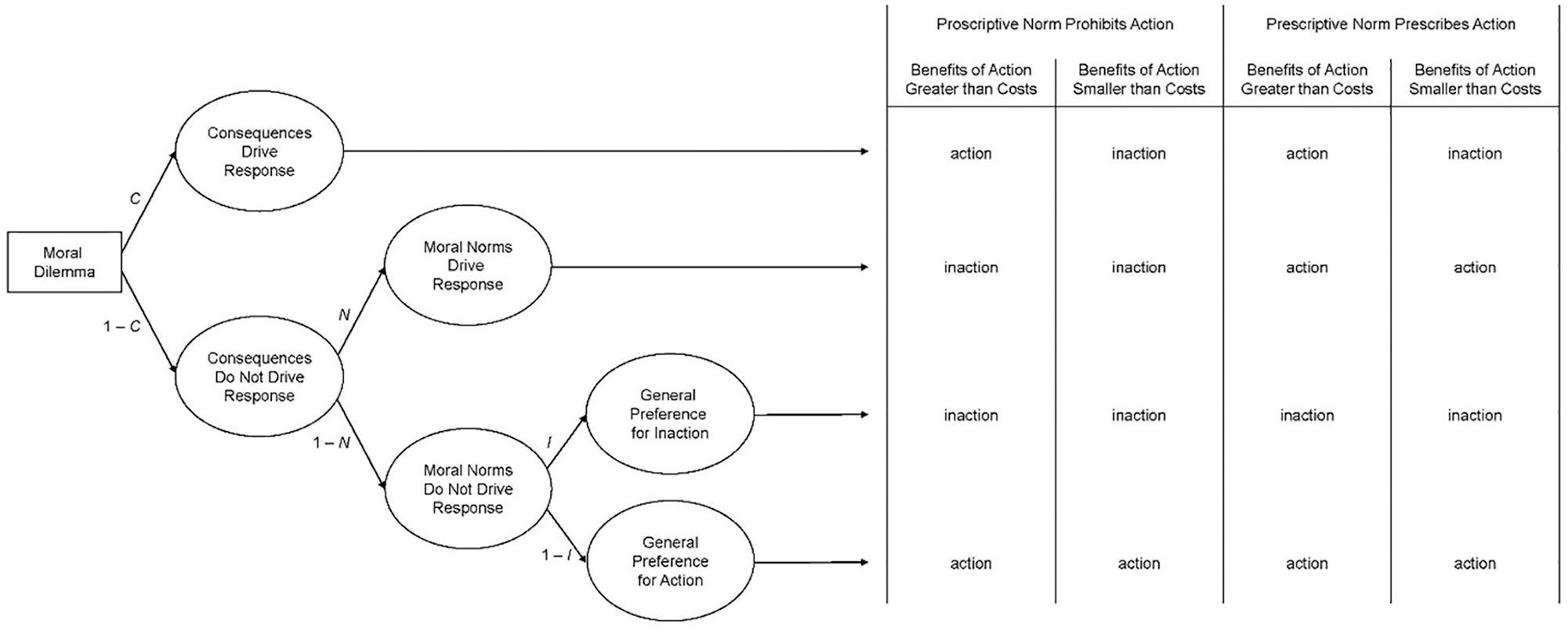
CNI model of moral decision-making predicting action versus inaction responses in moral dilemmas with proscriptive and prescriptive norms and consequences involving benefits of action that are either greater or smaller than costs of action.
The Current Research
Using a two-wave longitudinal design and a validated battery of 48 moral dilemmas for research using the CNI model (Körner et al., 2020), the current study aimed to address three questions. First, we investigated whether the three dimensions of moral dilemma judgments differ in terms of their temporal stability. Because estimates of temporal stability in the traditional dilemma paradigm may conceal differences in the stability of the three underlying dimensions, an analysis using the CNI model provides more nuanced insights into the contribution of temporally stable traits to moral dilemma judgments. To this end, we assessed moral dilemma judgments at two time points 1 month apart and analyzed test–retest correlations for each parameter of the CNI model. Second, we compared the stability of the three CNI parameters to the stability of the Big Five personality traits. The Big Five personality traits have been shown to have high stability across the lifespan (Costa et al., 2019) and should therefore serve as a high standard by which to compare the temporal stability of moral dilemma judgments. To this end, we included a measure of the Big Five at both time points and examined how the stability of the three CNI parameters compared to the stability of the Big Five. Third, we conducted exploratory analyses to examine whether individual differences along the three moral judgment dimensions are related to basic personality traits. To our knowledge, no prior research has comprehensively examined whether the Big Five personality traits are associated with the three dimensions of moral dilemma judgments captured by the CNI model. Evidence for cross-sectional associations between a given dimension and the Big Five personality traits would provide further support for the idea that individual differences along this dimension are rooted in basic personality traits. To investigate this possibility, we (a) analyzed zero-order correlations between the three CNI parameters and the Big Five and (b) regressed each CNI parameter onto all of the Big Five at each time point. We report all measures, all conditions, and all data exclusions. All data, analysis codes, and materials are available at https://osf.io/5kemc/.
Method
Participants
Participants were recruited in the Spring 2019 via Amazon’s Mechanical Turk (MTurk) to complete assessments at two time points, 1 month apart. Eligibility for participation was restricted to MTurk workers from the United States who were at least 18 years of age, had completed at least one previous assignment, had an approval rating of at least 95% on past assignments, and had not participated in a prior moral dilemma study from our lab. The intended sample size was 200 participants with valid data at both time points, which provides a power of 80% in detecting a correlation of r = .20 (two-tailed). Based on prior online longitudinal studies in our lab, we anticipated that approximately 10% of the participants at Time 1 would not be invited for the assessment at Time 2 because of failing an attention check (see below) and that an additional 33% of the participants at Time 1 would not accept our invitation to complete the assessment at Time 2. To compensate for the anticipated loss of participants, we aimed to recruit 330 participants for the assessment at Time 1. Participants who passed an attention check at Time 1 were invited to participate at Time 2 on a first-come, first-serve basis until 200 participants completed the assessment. Of the 337 completed submissions 1 at Time 1, 32 cases were excluded because they involved duplicate submissions under the same participant ID (two submissions) or participants failed the attention check (30 submissions). After these exclusions, the Time 1 sample comprised a total of 305 participants who were invited for the assessment at Time 2 (45.90% female, 52.79% male, 0.33% other; 0.98% prefer not to answer; Mage = 34.18; SDage = 10.72). Of the 202 participants who completed submissions 2 at Time 2, seven cases were excluded because they involved duplicate submissions under the same participant ID (two submissions) or participants failed the attention check at Time 2 (five submissions). After these exclusions, the final sample comprised a total of 195 participants with valid data from both assessments (49.23% female, 49.74% male, 1.03% prefer not to answer; Mage = 34.42; SDage = 10.91). Of these participants, 76.92% identified as Caucasian, 8.21% as African American or Black, 14.36% as Asian, 3.08% as Native American, 0.51% as Native Hawaiian or Pacific Islander, and 1.03% as other ethnicities. Participants were compensated $4.00 for completing the assessment at each time point.
Procedure and Materials
The procedure and materials were identical at Time 1 and Time 2. Consenting participants who successfully completed a basic arithmetic equation (e.g., “6 + 7”), were first asked to complete the Big Five Inventory 2–Short Form (BFI-2-S; Soto & John, 2017). The BFS-2-S is a 30-item inventory assessing extraversion, agreeableness, conscientiousness, neuroticism, and openness. Each trait was measured using a six-item subscale, which has been shown to strike a good balance between brevity and validity (Soto & John, 2019). Responses were measured using 5-point rating scales ranging from 1 (disagree strongly) to 5 (agree strongly). After the BFI-2-S, participants completed a battery of 48 moral dilemmas for research using the CNI model (Körner et al., 2020). The battery included 12 basic scenarios in four variants (presented in a fixed random order), reflecting the manipulations of cost–benefit ratios (i.e., benefits of action greater vs. smaller than costs) and salient moral norms (i.e., proscriptive vs. prescriptive). Each dilemma asked participants to indicate whether the described action was acceptable (yes vs. no). After responding to the dilemmas, participants completed a set of demographic questions and a reading-intensive attention check (Oppenheimer et al., 2009), after which they were given a completion code to request compensation.
Data Analyses
Moral dilemma judgments were analyzed in two ways. First, to permit comparisons with previous research, moral dilemma judgments were analyzed using the traditional approach. To this end, we calculated the sum of action (i.e., yes) responses on the 12 dilemmas in which the described action is prohibited by a moral norm and the benefits of the action for the greater good outweigh its costs. Consistent with the structure of the trolley problem, greater preference for action versus inaction on this type of dilemma reflects a stronger preference for breaking proscriptive norms to maximize overall consequences. For the sake of simplicity, we use the term traditional dilemma score for this measure.
Second, to overcome limitations of the traditional approach, moral dilemma judgments were analyzed using the CNI model. Because the statistical details of the CNI model have been explained in detail elsewhere (Gawronski et al., 2017), we will only summarize the main steps of the modeling analysis. Within the CNI model, sensitivity to consequences (C parameter), sensitivity to moral norms (N parameter), and general preference for inaction versus action (I parameter) are each captured by a distinct model parameter. These parameters can be illustrated via distinct processing paths in a multinomial processing tree (see Figure 1), each dictating a unique pattern of responding across the four different types of moral dilemmas varying in terms of their consequences and moral norms. For each type of moral dilemma, the probability of an action being judged as acceptable (i.e., action response) versus unacceptable (i.e., inaction response) is determined by the processing paths, which can be mathematically represented in terms of the CNI model parameters. For example, in dilemmas in which the described action is prohibited by a moral norm and the benefits of the action for the greater good outweigh its costs, action responses should occur when either (a) consequences drive the response, C (first processing path in Figure 1) or (b) neither consequences, moral norms, nor general preference for inaction drive the response, [(1 – C) × (1 – N) × (1 – I)] (fourth processing path in Figure 1). Therefore, the probability of an action response in this case, p(action | proscriptive norm, benefits > costs), is equivalent to the sum of these processing paths represented in terms of CNI model parameters, C + [(1 – C) × (1 – N) × (1 – I)]. Following this procedure, it is possible to derive four non-redundant equations, each containing the observed probability of action versus inaction responses to a given dilemma type as a known value and the three model parameters as unknown values (see the appendix). 3 Numerical scores for the three model parameters are estimated using maximum likelihood statistics such that the discrepancy between the predicted probabilities of action versus inaction responses on the four types of moral dilemmas and the observed probabilities of action versus inaction responses on the four types of moral dilemmas are minimized.
Using this procedure, unique scores for the C parameter, N parameter, and I parameter can be estimated for each participant by fitting their aggregated action versus inaction responses on the four types of moral dilemmas to the CNI model (see Körner et al., 2020). Resulting parameter estimates can range from 0 to 1. Higher scores on the C parameter reflect a stronger sensitivity to consequences in moral dilemma responses, implying a pattern of responding in which actions are judged as acceptable when their benefits are greater than their costs and judged as unacceptable when their benefits are smaller than their costs (see first row in the table on the right-hand side of Figure 1). Higher scores on the N parameter reflect a stronger sensitivity to moral norms in moral dilemma responses, implying a pattern of responding in which actions are judged as acceptable when they are prescribed by a moral norm and judged as unacceptable when they are prohibited by a moral norm (see second row in the table on the right-hand side of Figure 1). Scores above .50 on the I parameter reflect a general preference for inaction (see third row in the table on the right-hand side of Figure 1) while scores below .50 reflect a general preference for action (see fourth row in the table on the right-hand side of Figure 1), each implying a pattern of generalized responding in which actions are judged as either unacceptable or acceptable regardless of consequences and moral norms.
CNI parameters were estimated with the freeware multiTree (Moshagen, 2010) and the template files for individual-difference analyses with the CNI model provided by Körner et al. (2020). Following the procedures recommended by Gawronski et al. (2017), the modeling analyses used a fixed estimation algorithm with random start values, two replications, and a maximum of 90,000 iterations.
Results
Means and 95% confidence intervals of the aggregated moral judgment data are presented in Table 1. Means, 95% confidence intervals, and estimates of internal consistency of the Big Five measures and the CNI parameters are presented in Table 2. 4 Correlations between moral judgment indices are presented in Table 3.
Means and 95% Confidence Intervals of Action (vs. Inaction) Responses on Moral Dilemmas With Proscriptive and Prescriptive Norms and Consequences Involving Benefits of Action That Are Either Greater or Smaller Than Costs of Action (N = 195).
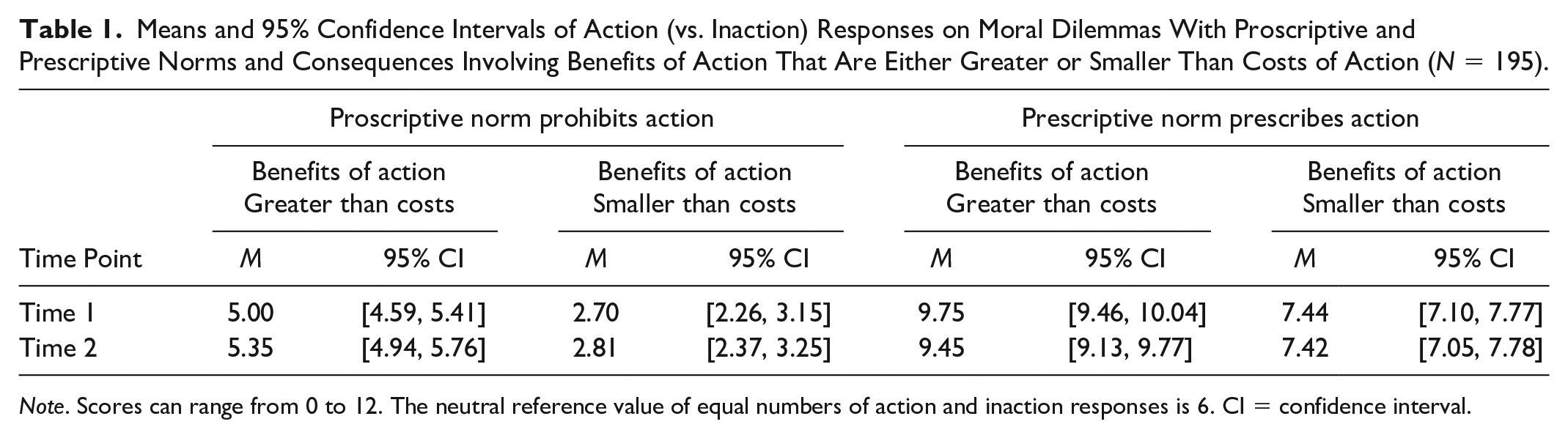
Note. Scores can range from 0 to 12. The neutral reference value of equal numbers of action and inaction responses is 6. CI = confidence interval.
Means, 95% Confidence Intervals, and Estimates of Internal Consistency of CNI Model Parameters and Personality Trait Scores (N = 195).
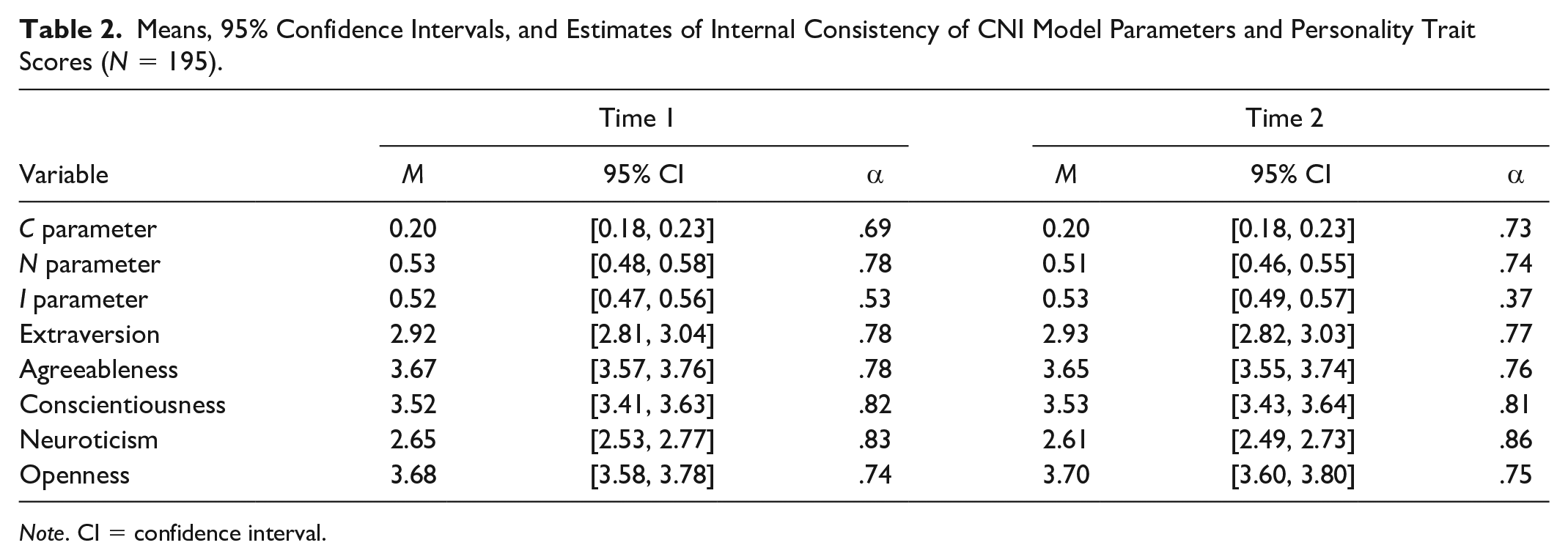
Note. CI = confidence interval.
Cross-Sectional Correlations Between Moral Judgment Indices at Time 1 and Time 2 (N = 195).
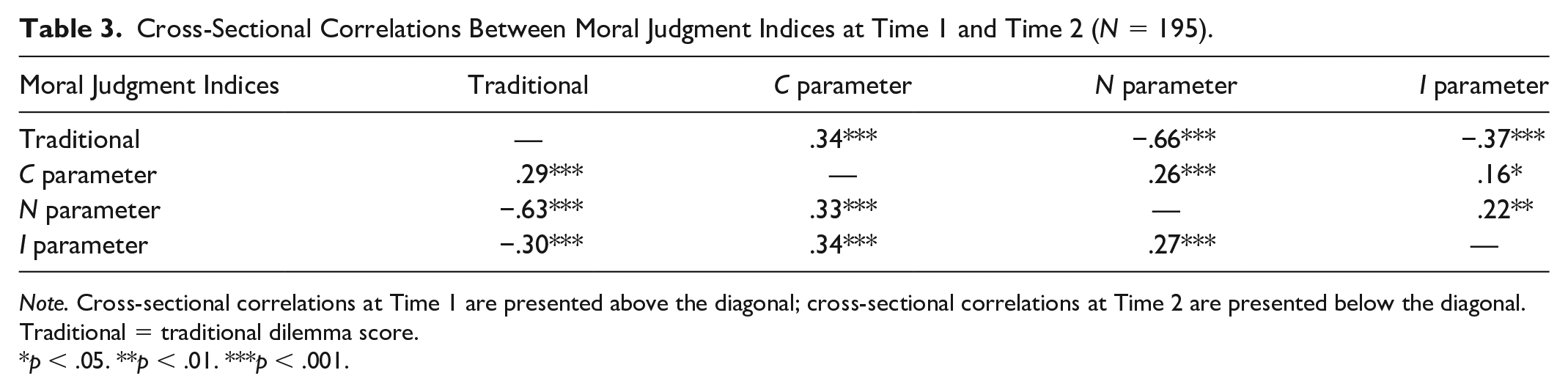
Note. Cross-sectional correlations at Time 1 are presented above the diagonal; cross-sectional correlations at Time 2 are presented below the diagonal. Traditional = traditional dilemma score.
p < .05. **p < .01. ***p < .001.
Attrition Analysis
Attrition analyses were conducted to examine whether participants who completed the assessments at both time points differed from participants who completed only the Time 1 assessment. The two groups did not significantly differ in terms of extraversion, agreeableness, conscientiousness, neuroticism, or openness (all ps > .111). However, the two groups did significantly differ in their traditional dilemma scores, t(303) = 2.75, p = .006, d = .33, such that participants who completed both assessments (M = 5.10, SD = 2.98) showed a weaker preference for breaking proscriptive norms to maximize overall consequences than participants who completed only the Time 1 assessment (M = 6.10, SD = 3.07). Further analyses revealed that this difference was driven by differences in sensitivity to norms, t(303) = −2.57, p = .011, d = −.31, such that participants who completed both assessments (M = .52, SD = .35) were more sensitive to moral norms than participants who completed only the Time 1 assessment (M = .41, SD = .36). The two groups did not differ in terms of their sensitivity to consequences, t(303) = .01, p = .995, d = .00, or general preference for inaction versus action, t(303) = −.96, p = .339, d = −.12.
To examine whether differences in sensitivity to moral norms might have affected temporal stability, moral judgment indices and Big Five measures at Time 2 were separately regressed onto the corresponding variable at Time 1, the N parameter at Time 1, and the interaction between the two. 5 Findings across these analyses suggested that the temporal stability of agreeableness, β = .58, t(191) = 2.18, p = .030, and neuroticism, β = .40, t(191) = 3.25, p = .001, depended on differences in sensitivity to moral norms such that their temporal stability increased as sensitivity to moral norms increased. Thus, in conjunction with the finding that participants who completed both assessments were more sensitive to moral norms than those who did not, the temporal stability of agreeableness and neuroticism may be overestimated in the current sample. Because the temporal stability of the Big Five measures were used as a standard by which to compare the temporal stability of moral dilemma judgment, overestimation of the temporal stability of agreeableness and neuroticism provides a more conservative test of the moral trait hypothesis. Sensitivity to moral norms did not significantly moderate the temporal stability of any other variables (all ps > .111).
Temporal Stability of Moral Dilemma Judgments
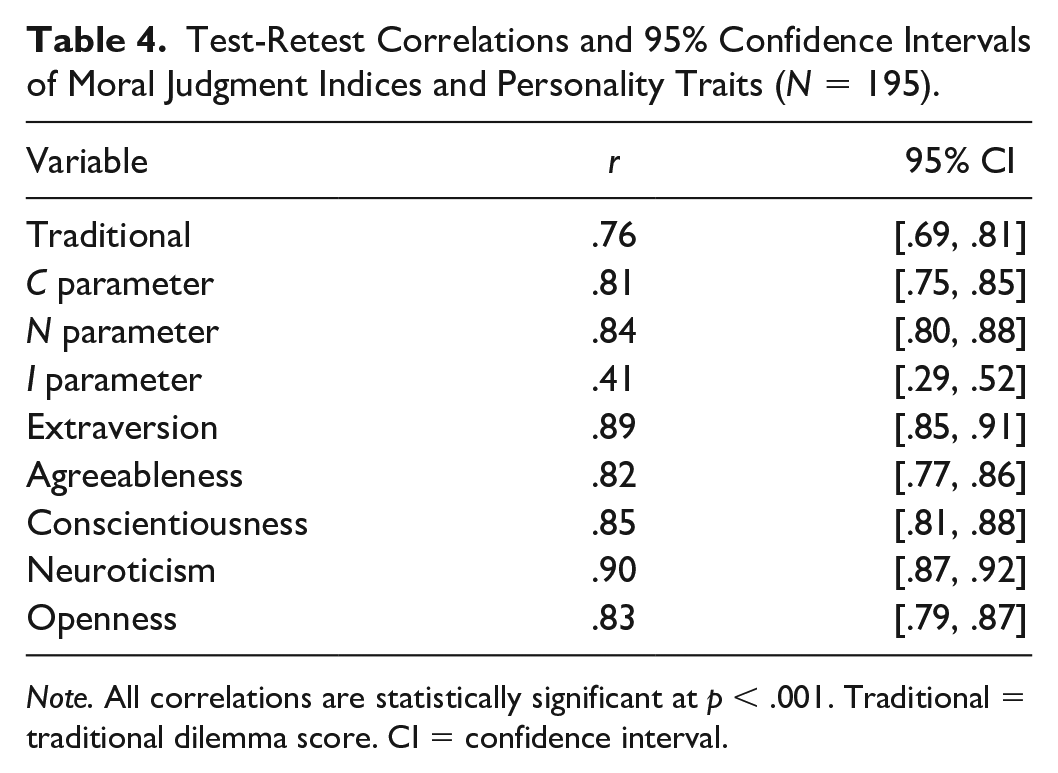
Test–retest correlations of moral judgment indices are presented in Table 4. Traditional dilemma scores showed a test–retest correlation of r = .76, indicating high temporal stability of preferences for breaking proscriptive norms to maximize overall consequences. Further analyses using the CNI model revealed test–retest correlations of r = .81 for the C parameter and r = .84 for the N parameter, indicating high temporal stability in sensitivity to consequences and sensitivity to norms. The I parameter showed a lower test–retest correlation with r = .41, which was significantly lower than the test–retest correlations observed for the C parameter, Z = 6.84, p < .001, and the N parameter, Z = 8.00, p < .001. Test–retest correlations of the C parameter and the N parameter were not significantly different, Z = −1.14, p = .254. The test–retest correlation for traditional dilemma scores was significantly lower compared with the N parameter, Z = −2.83, p = .006, and significantly higher compared to the I parameter, Z = 5.72, p < .001, but it did not significantly differ from the test–retest correlation of the C parameter, Z = −1.34, p = .180.
Test-Retest Correlations and 95% Confidence Intervals of Moral Judgment Indices and Personality Traits (N = 195).
Note. All correlations are statistically significant at p < .001. Traditional = traditional dilemma score. CI = confidence interval.
Test–retest correlations of the Big Five measures are presented in Table 4. Consistent with past research (Costa et al., 2019), all of the Big Five measures showed high test–retest correlations (all rs > .82, all ps < .001), indicating high temporal stability. The temporal stabilities of sensitivity to consequences and sensitivity to moral norms were comparable to those of the Big Five measures. In contrast, the temporal stability of general preference for inaction versus action was much lower compared with the Big Five measures. 6
Associations Between Moral Judgments and the Big Five
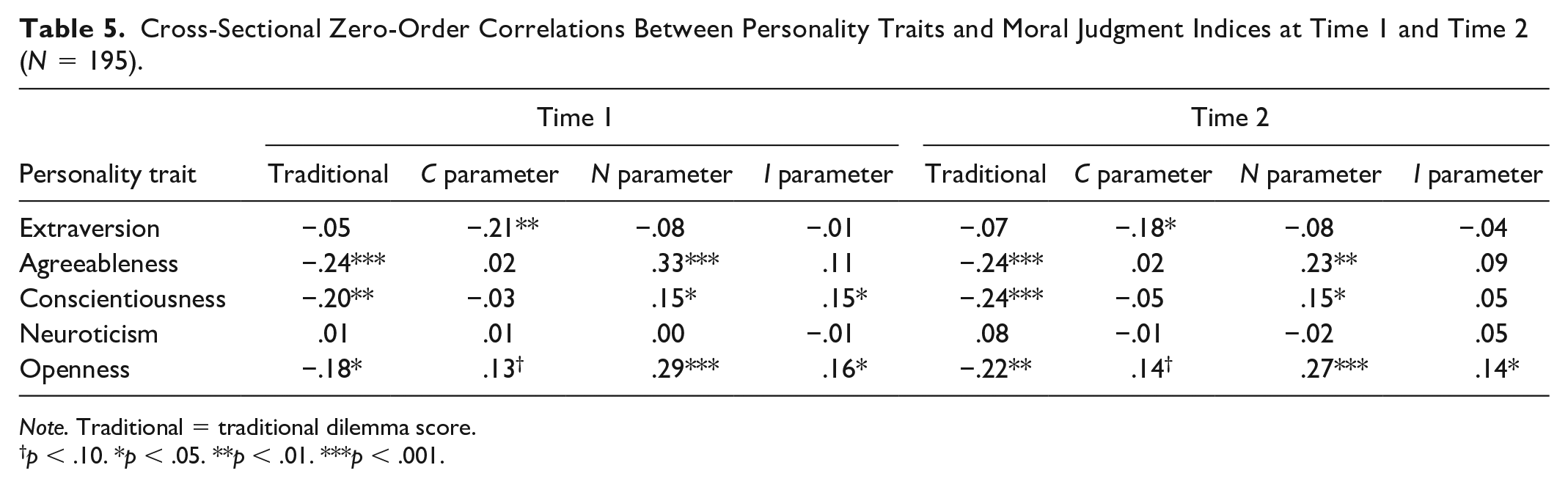
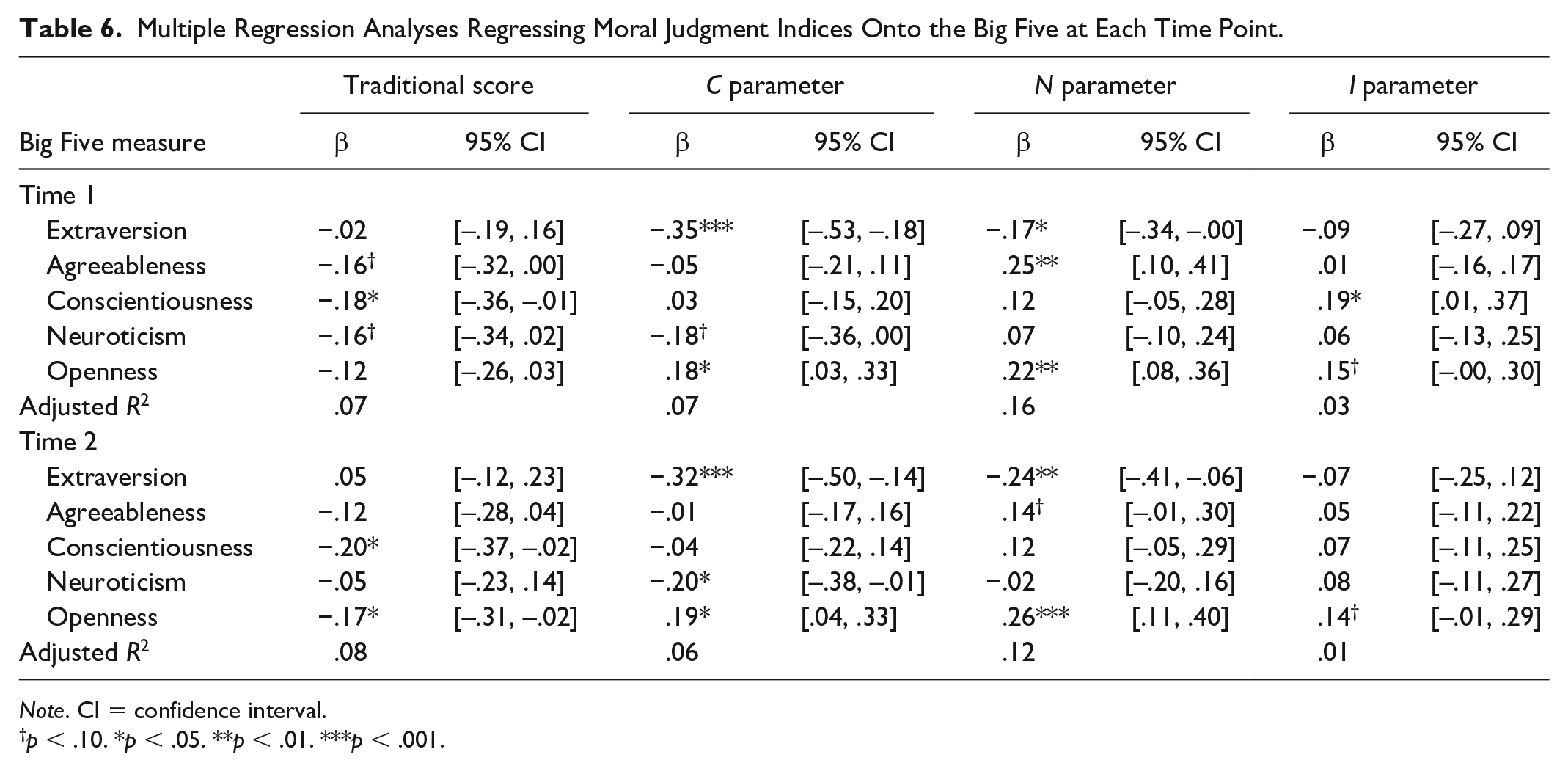
Zero-order correlations between moral judgment indices and the Big Five measures at each time point are presented in Table 5. Results of multiple regression analyses regressing each moral judgment index onto all of the Big Five measures at each time point are presented in Table 6.
Cross-Sectional Zero-Order Correlations Between Personality Traits and Moral Judgment Indices at Time 1 and Time 2 (N = 195).
Note. Traditional = traditional dilemma score.
p < .10. * p < .05. **p < .01. ***p < .001.
Multiple Regression Analyses Regressing Moral Judgment Indices Onto the Big Five at Each Time Point.
Note. CI = confidence interval.
p < .10. *p < .05. **p < .01. ***p < .001.
Traditional dilemma scores
Traditional dilemma scores showed significant negative correlations with agreeableness at Time 1, r(193) = −.24, p < .001, 95% CI [–.36, –.10], and Time 2, r(193) = −.24, p < .001, 95% CI [–.36, –.10], conscientiousness at Time 1, r(193) = −.20, p = .005, 95% CI [–.33, –.06], and Time 2, r(193) = −.24, p < .001, 95% CI [–.37, –.10], and openness at Time 1, r(193) = −.18, p = .010, 95% CI [–.32, –.05], and Time 2, r(193) = −.22, p = .002, 95% CI [–.35, –.08]. Traditional dilemma scores were not significantly correlated with extraversion or neuroticism at either time point (all ps > .253). When simultaneously regressed onto all of the Big Five, traditional dilemma scores continued to show a significant negative association with conscientiousness at Time 1, β = −.18, t(189) = −2.09, p = .038, and Time 2, β = −.20, t(189) = −2.22, p = .028. In contrast to the correlational analyses, however, traditional dilemmas scores were not significantly associated with agreeableness at either Time 1, β = −.16, t(189) = −1.97, p = .051, or Time 2, β = −.12, t(189) = −1.43, p = .155, although the association at Time 1 was marginal. Similarly, while traditional dilemma scores continued to show a significant negative association with openness at Time 2, β = −.17, t(189) = −2.30, p = .022, this association was not significant at Time 1, β = −.12, t(189) = −1.57, p = .118. Thus, when considering only those associations that replicate across analyses and time points, the current findings suggest that higher levels of conscientiousness are associated with a weaker preference for breaking proscriptive norms to maximize overall consequences.
C parameter
The C parameter showed a significant negative correlation with extraversion at Time 1, r(193) = −.21, p = .003, 95% CI [–.34, –.07], and Time 2, r(193) = −.18, p = .012, 95% CI [–.31, –.04], and a marginally positive correlation with openness at Time 1, r(193) = .13, p = .074, 95% CI [–.01, .26], and Time 2, r(193) = .14, p = .056, 95% CI [–.00, .27]. The C parameter was not significantly correlated with any of the other Big Five measures at either time point (all ps > .492). When simultaneously regressed onto all of the Big Five, the C parameter continued to show a significant negative association with extraversion at Time 1, β = −.35, t(189) = −3.96, p < .001, and Time 2, β = −.32, t(189) = −3.57, p < .001. In addition, associations between the C parameter and openness rose to significance at both Time 1, β = .18, t(189) = 2.43, p = .016, and Time 2, β = .19, t(189) = 2.53, p = .012. The analysis further revealed a significant negative association between the C parameter and neuroticism at Time 2, β = −.20, t(189) = −2.11, p = .037, and a marginal negative association at Time 1, β = −.18, t(189) = −1.92, p = .056. Thus, when considering only those associations that replicate across analyses and time points, the current findings suggest that (a) higher levels of extraversion are associated with a weaker sensitivity to consequences and (b) higher levels of openness are associated with a stronger sensitivity to consequences.
N parameter
The N parameter showed significant positive correlations with agreeableness at Time 1, r(193) = .33, p < .001, 95% CI [.20, .45], and Time 2, r(193) = .23, p = .001, 95% CI [.09, .36], conscientiousness at Time 1, r(193) = .15, p = .032, 95% CI [.01, .29], and Time 2, r(193) = .15, p = .042, 95% CI [.01, .28], and openness at Time 1, r(193) = .29, p < .001, 95% CI [.16, .41], and Time 2, r(193) = .27, p < .001, 95% CI [.14, .40]. The N parameter was not significantly correlated with extraversion or neuroticism at either time point (all ps > .259). When simultaneously regressed onto the Big Five, the N parameter continued to show a positive association with agreeableness at Time 1, β = .25, t(189) = 3.23, p = .001, and Time 2, β = .14, t(189) = 1.80, p = .073, and with openness at Time 1, β = .22, t(189) = 3.17, p = .002, and Time 2, β = .26, t(189) = 3.58, p < .001, although the association with agreeableness at Time 2 was marginal. Different from the results of the correlational analyses, the N parameter was not significantly associated with conscientiousness at either Time 1, β = .12, t(189) = 1.41, p = .159, or Time 2, β = .12, t(189) = 1.39, p = .167. Instead, the analysis revealed a significant negative association between the N parameter and extraversion at Time 1, β = −.17, t(189) = −2.00, p = .047, and Time 2, β = −.24, t(189) = −2.71, p = .007, suggesting a potential suppressor effect. Thus, when considering only those associations that replicate across analyses and time points, the current findings suggest that higher levels of agreeableness and higher level of openness are both associated with a stronger sensitivity to moral norms.
I parameter
The I parameter showed a significant positive correlation with openness at Time 1, r(193) = .16, p = .027, 95% CI [.02, .29], and Time 2, r(193) = .14, p = .049, 95% CI [.00, .28]. The I parameter also showed a significant positive correlation with conscientiousness at Time 1, r(193) = .15, p = .039, 95% CI [.01, .28], but this association did not replicate at Time 2, r(193) = .05, p = .447, 95% CI [–.09, .19]. The I parameter was not significantly correlated with any of the other Big Five at either time point (all ps > .131). When simultaneously regressed onto all of the Big Five, the association between the I parameter and openness fell to a marginal level at both Time 1, β = 15, t(189) = 1.94, p =.054, and Time 2, β = .14, t(189) = 1.84, p = .068. As in the correlational analyses, the I parameter showed a significant positive association with conscientiousness at Time 1, β = .19, t(189) = 2.10, p = .037, but this association was not significant at Time 2, β = .07, t(189) = .79, p = .429. Thus, when considering only those associations that replicate across analyses and time points, the current findings suggest that higher levels of openness are associated with a greater preference for inaction versus action.
Discussion
Expanding on the idea that disagreements about the right course of action in moral dilemmas are at least partly driven by moral traits, the current research investigated the extent to which individual differences in moral dilemma judgments are stable over time. Using the CNI model to resolve ambiguities in the traditional dilemma paradigm, we found high test–retest correlations for sensitivity to consequences (r = .81) and sensitivity to moral norms (r = .84) that were comparable to the Big Five (rs > .82). These findings are consistent with the idea of temporally stable moral traits, as suggested by descriptions of individuals as utilitarians or deontologists. However, different from the notion that people are sensitive to either consequences or moral norms, the two factors underlying moral dilemma judgments were largely independent (see Table 3). Thus, it is possible for a person to be (a) sensitive to consequences but not moral norms, (b) sensitive to moral norms but not consequences, (c) sensitive to both consequences and moral norms, or (d) not sensitive to either. If anything, the observed positive correlation between sensitivity to consequences and sensitivity to moral norms suggests that a considerable number of people are concerned about both the greater good and moral norms.
Consistent with the concern that the three dimensions of moral dilemma judgments may differ in terms of their temporal stability, general preference for inaction versus action showed a test–retest correlation (r = .41) that was substantially smaller than the ones obtained for sensitivity to consequences and sensitivity to moral norms. It was also substantially smaller compared with the stabilities obtained for the Big Five. One potential interpretation of this finding is that general action preferences are more susceptible to incidental situational influences that fluctuate over time (e.g., mental resources, mood states). Consistent with this interpretation, previous research suggests that manipulations of cognitive resources and personal involvement influence moral dilemma judgments via general action tendencies rather than via sensitivity to consequences and moral norms (Gawronski et al., 2017). An alternative (although not mutually exclusive) possibility is that the lower test–retest correlation for the I parameter is the product of unreliable measurement (Costa et al., 2019). To the extent that the proportion of measurement error is greater for estimations of I compared with C and N, the lower test–retest correlation obtained for the I parameter may reflect the methodological truism that measurement error reduces correlations with any variable that is systematically related to the construct of interest. Consistent with this possibility, estimates of internal consistency for the I parameter were substantially lower compared with the C and the N parameter (see Table 2). Based on the available evidence, we suspect that both greater fluctuations in general action tendencies and greater measurement error contribute to lower test–retest correlations for the I parameter. Future research tackling the role of measurement error in the assessment of general action tendencies may help to provide deeper insights into this question.
Another interesting finding is that all three dimensions of moral dilemma judgments showed significant associations with basic personality traits. Across analyses, sensitivity to consequences was negatively associated with extraversion, such that individuals high in extraversion were less sensitive to consequences than those low in extraversion. Given that a central component of extraversion is reward sensitivity and sensitivity to social rewards in particular (Smillie et al., 2019), a possible explanation for this finding may lie in the potential of different types of moral judgment in garnering praise or admiration from others. A growing body of research suggests that people who prefer norm-adhering over consequence-maximizing judgments are perceived as more trustworthy and as having a stronger moral character (e.g., Bostyn & Roets, 2017b; Everett et al., 2016). It is therefore possible that norm-adhering judgments are perceived to elicit more praise and admiration from others compared with consequence-maximizing judgments. On this basis, one might expect that those higher in extraversion should be more likely to adhere to salient moral norms and less likely to maximize consequences for the greater good. Although there was no evidence for a positive association between extraversion and sensitivity to moral norms, the current findings are at least partly consistent with these ideas, in that extraversion was negatively associated with sensitivity to consequences.
Across analyses, there was also evidence for an association between sensitivity to moral norms and agreeableness, such that individuals high in agreeableness were more sensitive to moral norms than those low in agreeableness. Given that (a) sensitivity to moral norms has been found to be associated with empathic concern (Körner et al., 2020) and (b) empathic concern has been found to be associated with agreeableness (Ozer & Benet-Martinez, 2006 ), it is possible that those who are more agreeable show greater concern for others, which in turn promotes greater reliance on moral norms surrounding care and harm. Future research might investigate this possibility by examining whether empathic concern mediates the link between agreeableness and sensitivity to moral norms.
Finally, all three moral judgment parameters showed positive relations with openness such that individuals high in openness showed a stronger sensitivity to consequences, a stronger sensitivity to moral norms, and a stronger general preference for inaction versus action compared with those low in openness. Given that openness is related to complex cognitive functioning (DeYoung, 2014), those who are higher in openness may be more likely to consider and think about moral issues in general, thereby enhancing their sensitivity to both consequences and moral norms. Moreover, because general action aversion can result from perceptions that harm caused via action is more severe than harm caused via inaction (i.e., omission bias; see Cushman et al., 2006), the positive association between openness and general preference for inaction versus action may be driven by the same underlying mechanism. Future research might test these hypotheses by examining whether individual differences related to moral reflection (e.g., moral attentiveness; Reynolds, 2008) mediate associations between openness and moral dilemma judgments.
Another noteworthy aspect of the current findings is that the magnitude of many of the obtained associations is comparable to those obtained for individual-difference constructs that have been claimed to be more proximally related to moral dilemma judgments. For example, several associations obtained in the current study are similar in size or even stronger than associations found with empathic concern and need for cognition (Körner et al., 2020). Given the theoretical relevance of these constructs to prominent theories of moral judgment (Greene, 2007), the fact that moral dilemma judgments showed comparable relations with many of the Big Five personality factors is suggestive of a more powerful role of basic personality traits in moral judgment than has been previously considered.
While relations between personality and moral dilemma judgment were stronger than expected, it is worth noting that these associations are cross-sectional in nature, limiting conclusions about causality. One way of providing more evidence for causality is by conducting longitudinal analyses examining differences in personality traits and moral dilemma judgments over time. To this end, we conducted supplemental analyses examining (a) whether the Big Five at Time 1 predicted change in moral judgment indices across time points (or vice versa) and (b) whether change in moral judgment indices over time and change in the Big Five over time were correlated (see Tables S2–S4 in the Supplemental Online Materials and CNI Temporal Stability Materials). Across analyses, results were largely null, with the exception of a significant positive correlation between change in sensitivity to moral norms and change in conscientiousness. Although the null results may be interpreted as evidence against causal relations between moral dilemma judgments and personality traits, we urge caution in drawing strong conclusions on the basis of these analyses. Given the relatively short interval between time points and the high levels of temporal stability obtained in the current research, changes in individual differences in moral dilemma judgments and personality were very small. As a consequence, the current research may have been underpowered to detect relations between changes in moral dilemma judgments and personality traits over time, rendering the results of our supplemental analyses inconclusive. Future research imposing a longer time delay between measurements might be better suited to examine relations between changes in moral judgment and personality over time.
Taken together, our findings regarding associations between moral dilemma judgment and personality traits make important contributions to moral and personality psychology and expand on recent work by Kroneisen and Heck (2020) who investigated associations between the CNI model parameters and a selected subset of the HEXACO personality traits (Ashton & Lee, 2007). The authors found a significant positive association between sensitivity to consequences and emotionality, a significant positive association between sensitivity to norms and honesty-humility, and a significant positive association between general preference for inaction versus action and emotionality. Our exploratory findings complement these earlier results in at least three ways. First, whereas Kroneisen and Heck investigated relations with personality traits of the HEXACO model, the current research investigated relations with the Big Five. Second, whereas Kroneisen and Heck focused specifically on six out of the 18 possible relations between the three CNI parameters and the six HEXACO traits, the current analysis included all 15 possible relations between the CNI parameters and the Big Five. Third, whereas Kroneisen and Heck used a small set of three basic dilemmas in four variants, the current work used a substantially larger set of 48 dilemmas to avoid artifacts resulting from incidental stimulus features and false negatives from unreliable parameter estimations at the individual level (for a discussion, see Körner et al., 2020). Nevertheless, we would like to reiterate the exploratory nature of our analyses regarding associations between the three CNI parameters and the Big Five personality traits. Thus, before drawing strong conclusions from the current findings, we deem it important that they are replicated in an independent sample.
Although the current work provides valuable insights into the stability of moral dilemma judgments and their underlying dimensions, a few caveats seem appropriate. First, estimates of temporal stability partially depend on the length of time between measurement occasions, in that stability tends to decrease as time increases (Costa et al., 2019). Thus, it is possible that stability estimates would be lower for longer intervals. Second, it is worth noting that evidence for high temporal stability of individual differences in moral dilemma judgments does not conflict with evidence for situationally induced mean-level changes in moral dilemma judgments (Funder, 2006). After all, it possible for situational factors to induce shifts in overall mean-levels without affecting the rank-order of individual differences. For example, although everyone may become less sensitive to moral norms under conditions of incidental happiness (see Gawronski et al., 2018), individuals who are the most (least) sensitive to moral norms may still be the most (least) sensitive to moral norms under conditions of incidental happiness. Third, from a radical situationist perspective, high temporal stability of individual differences may not necessarily be the product of a stable underlying trait. After all, high temporal stability of individual differences may also reflect a high stability of situational influences that differ across individuals (e.g., peer groups, social relationships). Future research may help to disentangle the contribution of stable traits and stable environments to the stability of moral judgments. Fourth, although the Big Five model is a prominent model of personality, a notable alternative is the HEXACO model (Ashton & Lee, 2007), which includes honesty/humility as an additional trait dimension. Given its strong relation to morality (Ashton et al., 2014), the honesty/humility dimension may show even stronger relations to moral dilemma judgments compared with the associations identified in the current study (see Kroneisen & Heck, 2020). Finally, it is worth noting that recruitment in the current research was restricted to individuals from the United States, whose moral judgments may differ from the moral judgments of individuals from other societies (Henrich et al., 2010). For purposes of generalizability, future research should examine the temporal stability of moral dilemma judgments in other societies.
Conclusion
While a major line of research indicates that moral dilemma judgments are influenced by a broad range of situation-related factors, a separate line of research suggests that moral dilemma judgments also depend on person-related factors. Using a formal modeling approach to disentangle different dimensions of moral dilemma judgments, the current study obtained high levels of temporal stability for sensitivity to consequences and sensitivity to moral norms that are comparable to the Big Five personality traits. General action preferences showed a substantially lower stability over time. Moreover, all dimensions of moral dilemma judgments showed significant associations with basic personality traits. Together, these findings provide evidence for stable individual differences in moral dilemma judgments that are related to basic personality traits, supporting the idea that moral disagreements are at least partly driven by temporally stable moral traits.
Supplemental Material
sj-docx-1-psp-10.1177_01461672211035024 – Supplemental material for Temporal Stability of Moral Dilemma Judgments: A Longitudinal Analysis Using the CNI Model
Supplemental material, sj-docx-1-psp-10.1177_01461672211035024 for Temporal Stability of Moral Dilemma Judgments: A Longitudinal Analysis Using the CNI Model by Dillon M. Luke and Bertram Gawronski in Personality and Social Psychology Bulletin
Supplemental Material
sj-docx-2-psp-10.1177_01461672211035024 – Supplemental material for Temporal Stability of Moral Dilemma Judgments: A Longitudinal Analysis Using the CNI Model
Supplemental material, sj-docx-2-psp-10.1177_01461672211035024 for Temporal Stability of Moral Dilemma Judgments: A Longitudinal Analysis Using the CNI Model by Dillon M. Luke and Bertram Gawronski in Personality and Social Psychology Bulletin
Footnotes
Appendix
Declaration of Conflicting Interests
The author(s) declared no potential conflicts of interest with respect to the research, authorship, and/or publication of this article.
Funding
The author(s) disclosed receipt of the following financial support for the research, authorship, and/or publication of this article: This research was supported by National Science Foundation (NSF) Grant 1449620. The funders had no role in study design, data collection and analysis, decision to publish or preparation of the manuscript. Any opinions, findings, and conclusions or recommendations expressed in this material are those of the authors and do not necessarily reflect the views of the National Science Foundation.

Supplemental Material
Supplemental material is available online with this article.
Notes
References
Supplementary Material
Please find the following supplemental material available below.
For Open Access articles published under a Creative Commons License, all supplemental material carries the same license as the article it is associated with.
For non-Open Access articles published, all supplemental material carries a non-exclusive license, and permission requests for re-use of supplemental material or any part of supplemental material shall be sent directly to the copyright owner as specified in the copyright notice associated with the article.
